Dubai is a gorgeous, clean, modern city in the Emirates state of Abu Dhabi. As such it is Abu Dhabi’ as it were, Abu Dhabi’s gateway into being a modern Islamic Republic. All religions are respected in the city of Dubai, though not elsewhere in the Emirates. Alcohol and nightclubs are permitted, even encouraged, along with western books, movies, and music. There’s fast Internet, low taxes, free newspapers, and great plane connections via Emirates Air, along with premiere hotels, Ferraris, lots of them, and villas on peninsulas shaped like palm trees. Dubai is promoted with the phrase, “It’s better in Dubai,” Other promotions included having the Sex in the City movie filmed there and hosting the 2022 FIFA World Cup. And then Iran attacked with 5000 drones and missiles, hitting hotels, below and oil shipping. Three Emirates oil ships struck in the last week alone, leaving one crew member dead, 20 injured. Some rich people are fleeing, while others are staying. The airport is still open, as are the eyes of some rich folks in the US and Europe. It’s not so great in Dubai, but not that bad either. I don’t think Dubai is going away, and expect it to grow, slowly.
Photos from Dubai after an attack last week.
A similar pattern is playing out in Qatar’s western-style area of Doha. This is a section of the capital city that allows alcohol, and has fast internet, air-conditioning, western religion, movies, and books. I’d written, with wonder about Qatar, with its rich citizens and indentured, workers. I would have thought Doha would be safe from Iranian missiles since Qatar is Shia Mulsim, like Iran. It too is being hit, and not only in the western areas. Iran also destroyed Qatar’s largest natural gas and oil facilities, and their helium plant. The problem for Iran is that Qatar isn’t Shia Islamic enough to make them happy. Alternately, Qatar is rich, and Iran is jealous. Destruction is the answer, but the city endures, and I expect it will grow.
Saudi Arabia was in the process of building the beginnings of its own, modern gateway city, NEOM. It’s more conservative religiously than Dubai, but more technically advanced, envisioned with robots, solar energy, and zero cars. It’s in the early stages, but already attacked by Iran. The motivation, I expect, is to insure that the king doesn’t sign the Abraham accords with Israel and Abu Dhabi. The king has slowed construction, but not stopped, or stopped working with the US.
While these attacks are clearly a setback for these western-enclaves, I don’t expect Saudi Arabia, Qatar, and Abu Dhabi will shut them down. Dubai, Doha, and Neom are attractive, and seen as a necessary part of a post oil future. I suspect the attacks only bring resentment of Iran and its mullahs, plus a desire for increased spending on defense. The attacked countries may ally with each other, something unlikely before the attacks perhaps through expended Abraham accords, or via some other defense cooperation. I also imagine that the gateway cities will grow, allowing conservative Muslims to become more comfortable with Western ideas and behaviors.
I don’t expect Iran to change, nor copy these cities, nor do I expect their influence to weaken much. They have oil and a powerful ally, China, who depends on Iranian oil. China benefits by Iran fighting China’s western rivals, or it did before sanctions. I expect Iran to make more trouble for us and their neighbors, especially when Democrats win congress in a few months. I’m not totally sure why Democrats are sanguine about a nuclear Iran as negotiated by Obama, or seem OK with Iran bombing their neighbors for no good reason. Then again, I don’t quite understand “Queers for Palestine.” Most liberals are unhappy, and my guess is that the Iran leadership is too. Both are happy seeing Dubai and Doha bombed. Even with the bombs falling, I see these cities as a gate to a more peaceful, more tolerant Middle East.
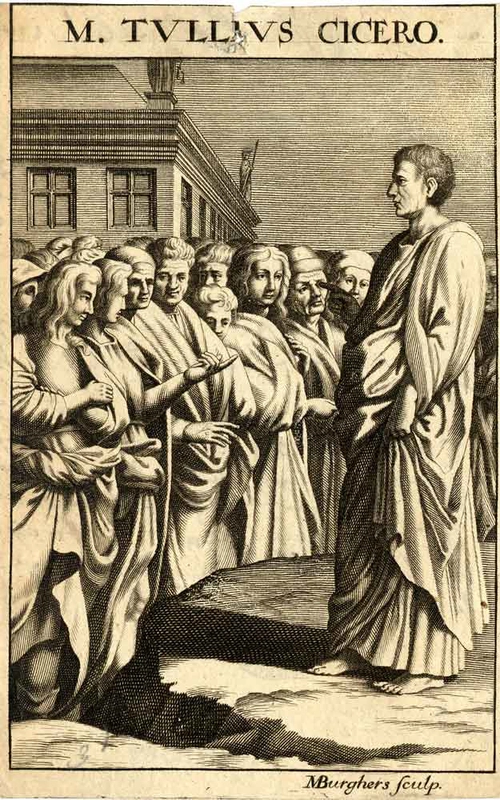
A proven way to remove a leader is to accuse him of trying to become a king. The Democrats keep trying this, but they lack a great orator to make the case in a way that gets the guy out. The classic speaker for this, someone most everyone in college read, was Marcus Tullius Cicero. Take, for example, his speech against Catiline, his fellow senator, that got Catiline removed, and then murdered. I’ve copied a bit below, in translation from Latin.
WHEN, O Catiline, do you mean to cease abusing our patience? How long is that madness of yours still to mock us? When is there to be an end of that unbridled audacity of yours, swaggering about as it does now? Do not the nightly guards placed on the Palatine Hill—do not the watches posted throughout the city—does not the alarm of the people, and the union of all good men—does not the precaution taken of assembling the senate in this most defensible place—do not the looks and countenances of this venerable body here present, have any effect upon you? Do you not feel that your plans are detected? Do you not see that your conspiracy is already arrested and rendered powerless by the knowledge which every one here possesses of it? What is there that you did last night, what the night before—where is it that you were—who was there that you summoned to meet you—what design was there which was adopted by you, with which you think that any one of us is unacquainted? Shame on the age and on its principles! The senate is aware of these things; the consul sees them; and yet this man lives. Lives! aye, he comes even into the senate. He takes a part in the public deliberations; he is watching and marking down and checking off for slaughter every individual among us. And we, gallant men that we are, think that we are doing our duty to the republic if we keep out of the way of his frenzied attacks. You ought, O Catiline, long ago to have been led to execution by command of the consul. That destruction which you have been long plotting against us ought to have already fallen on your own head…… ……. speech, source.
It’s strong stuff, far better than the democrats have yet presented, with lines of innuendo and attack that have been reused many times since. Cicero claims to understand the thoughts of Catiline as he sits in the senate. He accuses Catiline, not only of wanting to be king, but of wanting their deaths: “He is watching and marking down and checking off for slaughter every individual among us.” Catiline was exiled, and then, with Cicero’s encouragement executed without trial. Julius Caesar argued for Catiline, claiming he should be imprisoned, but no more. So Caesar was exiled to fight the Britains and Gauls.
In time, Cicero and his friends came to believe that Caesar too dreams of kingship too, He had become too successful and uncontrollable. He needed to be re-educated, according to Cicero (below).
“Men who become uncontrollable and overconfident as a result of success need to be put through a round of training in reason until they recognize the fragility of human affairs and the uncertainty of fortune.”
Marcus Cato’s assessment was even stronger, in the senate he, argued that Caesar’s fight with the Gauls was illegal and immoral, and that he should be stripped of power. Democrats argue this today regarding the war in Venezuela and Iran. I think they are wrong, but the argument is the same, that we/I are the rightful power, and I/we know the evil plans in Caesar’s mind. The senate agreed to strip Caesar of power, but use deception getting it. Caesar, knowing how this would likely turn out, returned to Rome, fought Cicero’s and Cato’s friends, and pardoned Cicero 45 BCE. Cato committed suicide. About 1 year later, though, on the 15th of March, a group of Caesars so-called friends stabbed him to death in the senate, as recounted here. Cicero was killed in the bloody civil war that followed. What goes around comes around. And a dictatorship ensued.
I’m not convinced that Cicero’s attacks were legitimate, nor the Democrats’ attacks. In both cases, the speakers claim to know the evil thoughts in the mind of the leader. In both cases, the proposed solution was leadership by group consensus — leadership by a group who could not agree on anything beyond their own unhappiness.
Legitimate or not, attacks by a good orator worked. They caused the death of Catiline and Caesar, and many others over the years. Generally, they don’t benefit the great speaker, long term, nor result in freedom. I’m reminded of Trotsky, here. The lesson for those pushing to depose Trump is you need a really good speaker, and you could get a leader who’s worse. Your speaker needs to convince the audiences that he knows what his enemy is thinking. So far, no Democrat has managed to convince an audience of this, or even vaguely that he knows what Trump will do next.
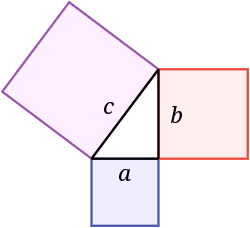
One of the coolest old bits of math is the Pythagorean theorem. For any right triangle, the sum of the squares of the length of the legs equals the square of the length of the hypotenuse. That is a2 + b2 = c2.
The formula wasn’t invented by Pythagorus, but was known as early as 1800 BCE, in Babylon. What Pythagorus adds is the focus on whole number solutions, like 3, 4, 5. These are called Pythagorean triples, something important to Pythagorus because he believed that the essence of the world was whole numbers. It’s an approach that also is found with Democritus and Epicurus. Democracy, for example being, the idea that the whole of the national sprit is based on the will of unit individuals rather than the will of a single mystic who alone sees the political soul.
There is a formula for finding Pythagorean triples that was discovered, or first presented, by Euclid. Pick any two positive whole numbers, m and n where m>n. For any value of m and n he showed that there is a pythagorean triple where the hypotenuse equals m2+n2 and where one side equals m2-n2 and the other side is 2mn. For example, if you pick m=3 and n=2, you’ll find there is a triple with hypotenuse 13, and with legs 5 and 12. It’s a very cool formula, I think. Like pythagorus, I find a certain magic in Pythagorean triples.
The proof of this method is to note that (m2-n2)2 = m4 + n4 – 2m22n2. Now note that this is very similar to the formula for (m2+n2)2 = m4 + n4 + 2m2n2. We see that (m2+n2)2 = (m2-n2)2 + 4m2n2. These are all whole numbers since m and n are whole numbers, and they have the form for a pythagorus triple. This formula gives you all the “fundamental “primitive” triples, plus some others. Once you have these, you can find the remaining ripples by multiplying these by 2, 3, 4, etc.
There is another nice formula for whole-number triangles in 3 space, useful for boat building and the like — if you go to the shop and ask for someone to cut wood, they generally want to cut to whole numbers, usually whole inches, 5″ by 12″. With pythagorean triples, there is a better chance that your pieces will fit together. (I was designing and building boats a few posts back) Maybe I’ll go into it in another post.
There are 16 primitive Pythagorean triples of numbers up to 100.
One of my favorite presidents is James K. Polk. While running for president he claimed we would do four major things –and do them as a one-term president. He then did them, and left office — and died 103 days later at the age of 53. Mr Polk’s four stated objectives were: a reduction in the tariff, an independent treasury, settlement of the Oregon boundary dispute, and acquisition of California. Acquisition of California required admission of Texas, plus a war with Mexico and a cash payment, but he was ready. Settling the Oregon border required a compromise and a cash payment. But he did it and more. Modern professors are not happy with Polk, ranking him far below Obama, Kennedy, or Adams, but his aims were good, and he got hem done. Few presidents do that, and even fewer left office if they had the power to stay. No professor I know has ever willingly left if he had the power to stay, and didn’t have a better job to go to.
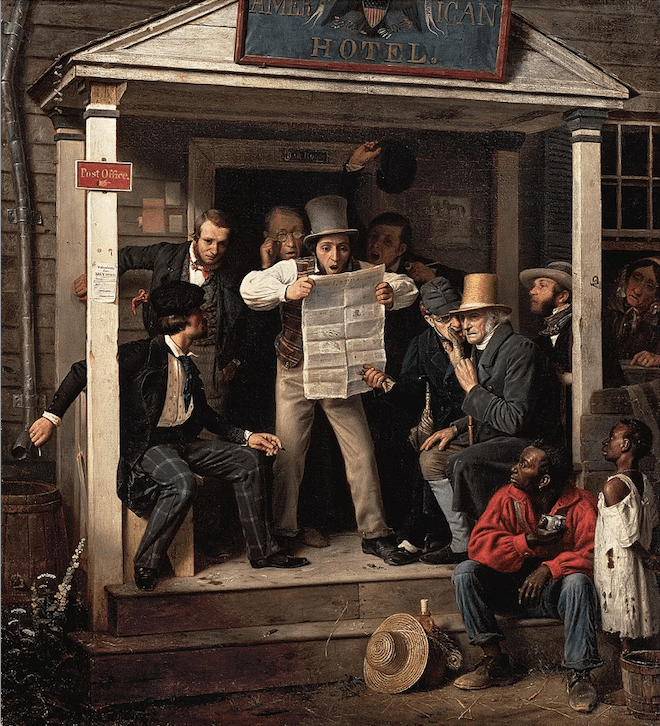
News from Mexico, oil on canvas painting by Richard Caton Woodville Sr., Düsseldorf, 1848. Polk was a god-send for newspaper sales.
I believe that the clarity of Polk’s four objectives was the reason he was a candidate at all, and the reason he won the election, and also the reason he achieved the objectives. There is a magic in clear objectives, repeated often, I find. It’s a formula that got Trump elected that few seem to understand: “Make America Great Again.” “Build the Wall”, “Drill baby Drill” “Deport illegals” “Tariffs. ” Like these ideas or not, you know Trump’s aims. Also, you know that, if. you oppose them, you oppose him. Trump’s pastor, Norman Vincent Peale promoted this approach, one I’ve thought of trying myself. I suspect that Polk died so shortly after leaving office because he had no further goal beyond relaxing; bad water hurt him too.. I suspect that Trump will die shortly after leaving office too- from lack of purpose.
Polk wasn’t expected to be a candidate, but was a “dark horse”, ex-governor of Tennessee, who had lost his past two elections. Martin Van Burin was expected to be the Democrats’ candidate, but he opposed slavery, and most Democrats were for it. What’s more, he was opposing annexation of Texas, at least south of the Nueces River, and many Democrats were for, as were some Whigs.
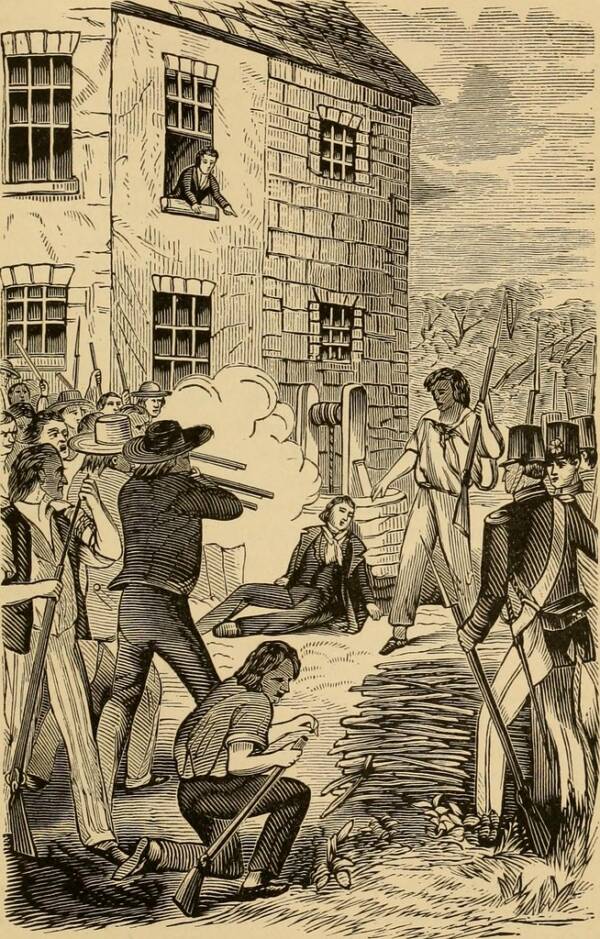
Joseph Smith was shot multiple times while campaigning for president.
Polk was pro-slavery, as was the Whig candidate, Henry Clay. But Polk said repeatedly that he would annex Texas — all the way to the Rio Grande, “no matter what any Mexican said.” He also said he’d fight for California and all of Oregon too: “Fifty four forty or fight”. You might not agree with this, Grant did not, but you knew where he stood. And Polk said he’d serve only one term. Thus, if you didn’t like him, he’d be gone in four years. After a few ballots, Polk became the Democratic Party candidate, with George Dallas as his VP. Like Polk, Dallas was pro Texas – they eventually named a city after him. Clay was Polk’s main opposition, anti Texas, and more vague about everything else.
At first John Tyler, the incumbent, also ran against Polk, but when he saw he was losing, he dropped out to help Polk. Also running for president, 1844 was Joseph Smith, the Mormon founder-profit. he ran as an independent because God told him to. He was shot multiple times, and died while campaigning. Finally there was James G. Birney, the Liberty party candidate. He gained few votes running on an abolitionist ticket. It’s been speculated that Polk won because Birney split the Whig vote. My take is that’s unlikely: Clay was pro-slavery. Polk’s win, I think, was in the power of his clarity.
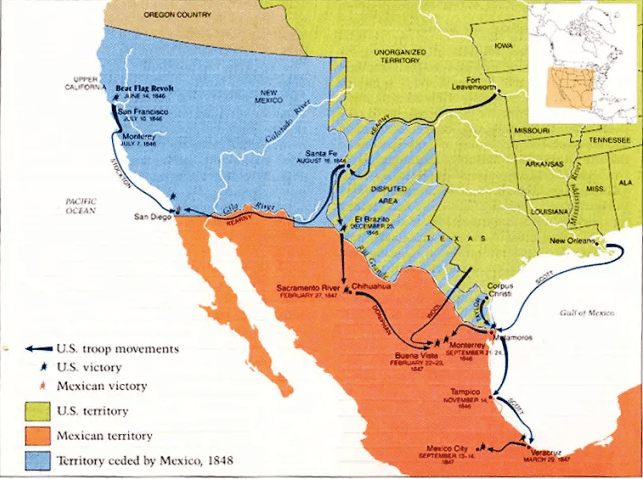
Map of the territory and war.
Once elected, Polk first moved to annex Texas, something he achieved with the help of expresident John Tyler. Tyler sent his Secretary of State, Abel Upsher to negotiat an annexation treaty with Sam Houston, but the Whig-controlled congress rejected it. After the election, Tyler resubmitted the treaty to the new, Democrat-controlled congress, and got two versions passed. The house passed a pro-slavery version, while the senate, pushed by Thomas Hart Benton (a favorite of mine) produced an annexation treaty that divided Texas in half, with a pro-slave and an anti-slave half. Polk liked the pro-slave, House version, returning it to Texas in his first week in office. He instructed the Texas legislature to accept it unconditionally, with no change so he could submit it directly to the Senate. The Texans did so, and congress approved this version later that year. Texas entered the union as one, large, slaveholder state.
With annexation not yet ratified by congress, Polk sent a diplomatic mission to buy California from Mexico along with all of the disputed Texas territory and everything in between for $25 million. Mexico refused, so Polk invited war. He sent 4000 soldiers into disputed Texas territory south of the Nueces River, under command of General Zachary Taylor. Mexican forces attacked them in April 1846, and Polk declared war. The war lasted to 1848, winning all the desired lands including California, and achieving a release of any rights Mexico might have on Oregon.
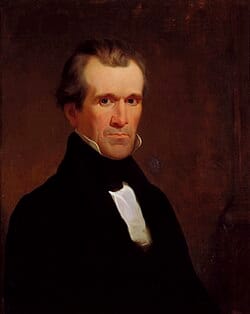
Polk, as governor of Tennessee
The next Polk goal was resolution of the Oregon dispute, ideally with us getting all of it: land that included the current states of Washington, Oregon, and Idaho, plus the Canadian Provence of British Columbia. Britain and Russia also claimed this land, so Polk’s first step was to buy off Russia. The British said they’d fight, noting that they had a larger army and navy and that the US was already at war with Mexico. Polk’s response was to back settlers going to Oregon. Americans had started migrating to Oregon in 1843. In his inaugural address, 1845, Polk said he would defend them “against the British and Indians.” By 1846 Britain recognized the difficulty of fighting US settlers so far from home. On June 15, they agreed to a deal that split the territory along the 49th parallel, giving the US the lower half, except for Vancouver Island, thus allowing Britain an opening to the sea. This deal had been proposed by Edward Everett, Tyler’s minister in London. Polk gave up nothing, beyond an informal agreement to lower tariffs on British goods, something he aimed to do anyway. It’s generally thought that Polk’s willingness for war allowed him to achieve so much without fighting. Polk said, in his inaugural, March 1845: “The world has nothing to fear from military ambition in our government,” a statement that clearly means the opposite of what it claims to say.
Polk’s third goal was lowering the “Black Tariffs”. High and uneven, they were 32% on average, with cut-outs to help specific, northern businesses. Polk’s secretary of the treasury, Robert Walker negotiated a flat advalorum tariff of 25%, with luxury goods, tobacco and alcohol tariffed higher. The “Walker tariff” bill was passed July, 1846, one month after the Oregon agreement. The British, reduced their “corn tariffs” against US grain, benefitting both countries. Our tariffs average 17%, currently, with many cut-outs. I think our tariffs should be more like the Walker tariff, perhaps 20% and simpler.
Polk’s 4th campaign promise was establishing an independent treasury. This was done to weaken “pet” banks, and stabilize the economy. The treasury would now hold all US assets; they would issue most currency, and would pay people directly, either in specie (gold or silver) or notes of debt. Independent banks could still issue notes, but only in amounts over $20. Polk passed this bill August 6, 1846, one week after the Walker Tariff bill. With this, Polk had already achieved all of his goals except California by the mid-term elections, 1846.
Having achieved so much, Polk set out to buy Cuba, but Spain said no. Some other accomplishments: opening the U.S. Naval Academy and the Smithsonian Institution, overseeing the groundbreaking for the Washington Monument, and the issuance of the first United States postage stamp. By the summer of 1848 Polk confirmed that he was satisfied and would not run for re-election. In his address to congress, December 1848, he said, “Peace, plenty, and contentment reign throughout our borders, and our beloved country presents a sublime moral spectacle to the world.” …. “I am heartily rejoiced that my term is so near its close. I will soon cease to be a servant and will become a sovereign.” I trust that was met with applause.
Innovation is the special sauce that propels growth and allows a country to lead and prosper. The current Nobel prize believe that innovation powered the Industrial Revolution, causing England to become rich and powerful, while other nations remained poor, weak, and stagnant. Similarly, Innovation, they believe is why 19th century Japan rose to defeat China, and propelled China’s 21st century rise. But why did they succeed when others did not. What could the leader of a country do to bring power and wealth through innovation. Improved education seems to help; all of the innovation countries have it, but it is not the whole. Some educated countries (Germany, Russia) stagnate. An open economy is nice, but it isn’t sufficient or that necessary: (look at China). That was the topic of this year’s, 2025 Nobel prize in economics to Mokyr, Howitt, and Aghion, with half going to Joel Mokyr for his insights, historical and forward looking, the other half going for economic modeling. I give below my understanding of their insights, more technical than most, but not so mathematical as to be obtuse the normal reader..
The winners hold that innovation, as during the industrial revolution, is a non-continuous contribultion caused by a particular combination of education and market opportunity, of theoretical knowledge, and practical, and that a key aspect is depreciation (destruction) of other suppliers. Let’s start by creating a simple, continuous function model for economic growth where growth = capital growth, that is dK/dt. K, Capital, is understood to be the sum of money, equipment, and labor knowledge, and t is time with dK/dt, the change in K with time modeled as equal to the savings rate, s, times economic activity, Y minus a depreciation factor, δ, times capital, K.
growth = dK/dt = sY − δ K.
Innovation, in the Howett model, is discontinuous and accumulative. It builds on itself.
For the authors, Y = GDP + x, where x is the cost of outside goods used. They then claim that Y is a non-linear function of K, where K is now considered a product of capital goods and labor K = xL and,
dY/dK = AKα + γ where 0< α <1, and where γ is the contribution of innovation and/or depreciation. The power function, as I understand it, is a mathematical way of saying there are economies of scale. The authors assume a set of interacting enterprises (countries0 so that the innovation factor, γ for one country is the depreciation factor for the other. That is, growth and destruction are connected, with growth being a function of monopoly power — control of your innovation.
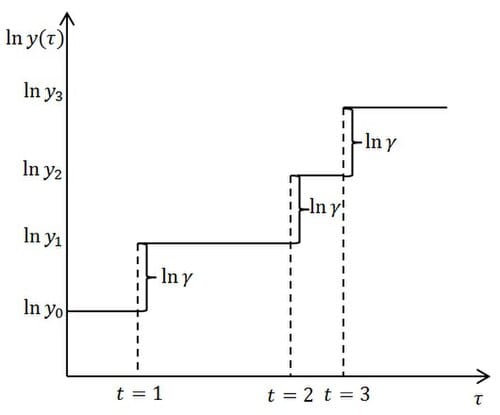
According to the Nobel winners, γ is built n previous γ as shown in the digram at right. It can not be predicted as such, but requires education and monopolistic power. The inventor-manufacturer of the typewriter has a monopolistic advantage over the makers of fountain pens. Innovation thus causes depreciation, δ K as one new innovation depreciates many old processes and products. If you add enough math, you can derive formulas for GDP and GDP growth, all based on factors like A and α, that are hard to measure.
GDP = α(2α/1−α) (1-α2)A L,
Thus, GDP is proportional to Labor, L and per-capita GDP is mostly an independent function related to economies of scale and the ability to use capital and labor which is related to general country-wide culture.
The above analysis, as I understand it, is in contrast to Kensyan models, where growth is unrelated to innovation, and where destruction is bad. In these Kenysean models, growth can be created by government spending, especial spending to maintain large industries with economies of scale and by spending to promote higher education. The culture preferred here, as I understand is one that rewards risk-taking, monopoly economics, and creative destruction. Howitt, and Aghion, importantly codify all this with formulas, as presented above that (to me) provide little specific. No great guidance to the head of a country. Nor does the math make the models more true, but it makes the statements somewhat clearer. Or perhaps the only real value of the math is to make things sound more scientific see the Tom Lehrer song, Sociology.
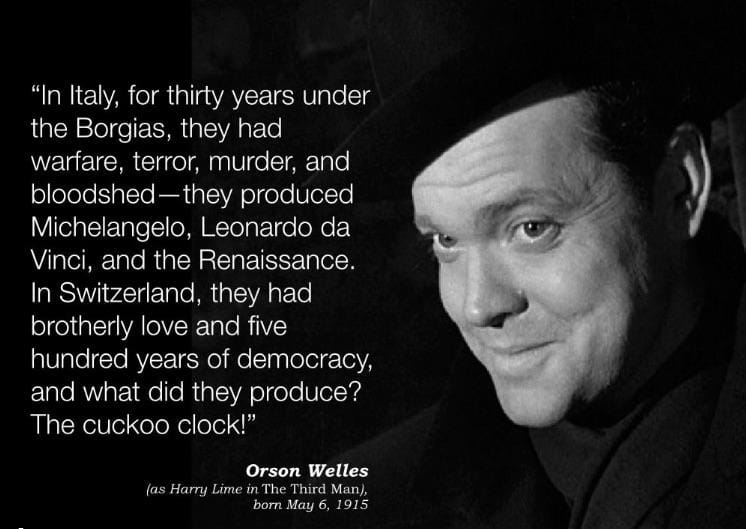
This insight from movie script by Grham Green suggests to me that progress may not be the greatest of advantages, perhaps not even worth it.
This work seems more realistic, to me, than the Keynesian models Both models are mathematically consistent, but if Keynes’s were true, Britain might still be on top, and Zambia would be a close competitor among the richest countries on earth. Besides these new fellows seem to agree with the views of Peter Cooper, my hero. See more here.
Writing all this reminds me that the fundamental assumption that progress is good, in not necessarily true. I quote above a line that Orson Wells, as Harry Lime, ad-libbed for the movie, “The Third Man.” Lime points out that innovation goes with suffering, and claims that Switzerland had little innovation because of its stability. Perhaps then, what you really want is the stability and peace of Switzerland, along with the lack of domination and innovation. On the same note, I’ve noticed that engineering innovators often ruin themselves dining in ruin, while the peaceable, stable civil engineers live long pleasant lives of honor.
Robert Buxbaum, November 16, 2025. A note about Switzerland is that was peaceful and stable because of a strong military. As Publius Vegetius wrote, Si vis pachim para bellum (if you wish of peace, prepare for war).
So, as is little known, Jesus drove a car, a large Honda, but didn’t publicize the fact: “I did not speak of my own accord.” (John 12:49) You can tell it was a large Honda, likely a wagon, as it says “the apostles were in one accord” (Acts 1:14). It is appropriate that He drive a modest car. I would have expected him to drive an F150, as he was a carpenter, single, 30 years old. That’s the perfect demographic for an F150.
David also drove a small vehicle, “In a Triumph, I will divide Shechem, and measure out the valley of Succoth.” Similarly, Isiah, (13:3), but he was proud of it: “I have called my warriors who exult in my Triumph.”
As for God, it’s clear he drove muscle cars, “He terrifies them in his Fury. (Ps. 2:5) “Behold, I will gather them out of all countries where I have driven them .. in My fury… ” (Jeremiah 32:37). He also had a Tempest: “You snatch me up and make me ride in the Tempest.” (Job 20:32), “Pursue your enemies with your Tempest.” (Ps. 83:15).
Moses, like God drove a large vehicle, a Ram with a loud horn, “… when the Ram’s horn sounds a long blast, they can approach the mountain. (Ex 19:13). Even so, he gave a Mazda to Eliezer, “Moses gave the Tribute to Eleazar the Priest. (Numbers 31:41).
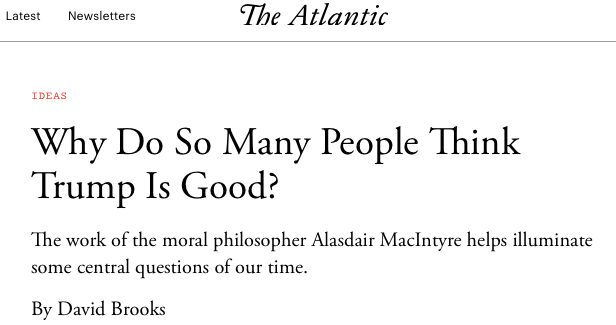
This post was inspired by articles like the one below asking how it was that some Americans, MAGAs think Trump is good when everyone of value sees him as a fat, bigoted, criminal clown. The Atlantic’s answer is they’re detached from classic ideals of good or moral, and are now fueled by “narcissism, fanaticism, and authoritarianism”. I thought a more helpful explanation was that we’re going through a paradigm shift, perhaps progressing in our thought of what it means to be good.
Consider Thomas Kuhn’s analysis of scientific progress. Tomas Kuhn was a major American Philosopher of the 1960s-70s who claimed that science progress was not uniform but included long periods of “normal science” punctuated by change. A “crisis” leading a “Revolution” resulting in big changes in language, outlook and thinking, a “paradigm shift”. In the midst of these scientific revolutions, the experts of the old system fight bitterly against the new while being confounded by the fact that it seems to work.
Consider the resistance to relativity and quantum mechanics. Before 1905 the experts were doing fine: Professors taught and students learned — formulas, tools and techniques were handed over. Educated had respect and money, and could communicate. There were some few contradictions, as in why the sun burned hot, or why the sky was blue, but one could ignore these. You knew who the experts were, and they didn’t include Einstein, Bohr, Pauli, Plank.
Democrats sell red hats and buttons with Fascist or Felon because Trump’s red MAGA (Make America Great Again) hats work for him.
But then came a few more problems, (inconsistencies in Kuhn-speak: radioactivity, photoelectrons, the speed of light… Einstein published on them in 1905, thoughts that few took seriously: imaginary time was a fourth dimension at right angles to the others, etc. The explantations seemed mad and for 14 years after he published, Einstein could not get a university job — anywhere. By 1919 detailed experiments suggested he might be right on a lot of things. It lead to the rise of a new group of experts plus a loss of esteem for the old, and a bunch of crank explainers who were neither but flourished in the confusion.
Hate abounded; new weapons and cures WWI removed aristocrats and beards. A popular book a lecture series of the time was “100 scientists against Einstein.” There followed a lost generation with no clear foundation. It took 50 years to resolve confusion, but there developed new thought leaders, a new language, new standard formulas and books were sold, and we were returned slowly to “normal science” in a new thought paradigm.
I see the conflict of opinion surrounding Mr Trump as a crisis in political thought similar to the crisis in science thought 100 years ago. Polite discourse if gone, replaced by stunts and insults. The government is currently shut, with 40% federal workers, those whose jobs are non-critical, on unpaid leave. It’s a collapse, not of morals, but of language. Trump hopes to use the shutdown, I think, to show that most of these 40%, are not needed. If they are not needed, it reflects a big lack in government — actually a big bloat in government. You can see why the opponents of cuts see Trump as a fascist who uses “dog whistles” to motivate “his base”, there is a lack of communication and a fear Trump may be right too, I think. The experiment in smaller government is being run as I write, and Trump seems confident that some 400,000 federal workers are not needed. Are they? Instead of debating, we’ve got to violence: two attempts on Trump’s life so far, the main college debater, Charlie Kirk, shot dead. Appropriate, I think, is Bob Dylan’s, “Times are a-changing” and “something is happening here, but you don’t know what it is, do you, Mr Jones.”
Other questions are being worked out as we speak -sending chills through the old order: Are China and Europe “ripping us off,” by free trade and stolen technology? Are tariffs an answer. Canadian and European leaders deride these thoughts openly, but I notice that both Canada and the EU have put heavy tariffs on Chinese goods.
Another issue is respect for experts. The Atlantic bemoaned that Trump supporters don’t respect experts on health, climate, and education, but perhaps they are lying. The seas have not risen as expected. Some warming may be good, or better than the remedies. Even if RFK Jr.’s ideas are wrong it seems that science has become unreliable (irreproducible), and that elite colleges aren’t fair in their assessment, nor do they provide great value.
Eventually things will settle down; we will some day have polite discourse. In 40-50 years, I suspect we’ll agree that some tariffs are good and that Trump’s tariffs are either to high or low, We’ll think that the climate push to no nuclear power, was a mistake, as was the giant, Ivanpah solar farm). And we’ll be able to discuss it civilly. I hope the change in thought takes less than 50 years.
Robert Buxbaum, October 3, 2025 – we are now entering another physics crisis too, I think.
There is no truly good way to give representative voices to a population. The founders of the country decided that there would be a set number of congresional representatives, divided it by states, and left it to the individual states to subdivide, with a few provisos. They mandated that congressional districts have to be contiguous, entirely within a state, and contain approximately the same number of citizens in each. A later law specified that the districts should not directly disadvantage a racial minority. Within these parameters, legislators in most states have divided congressional districts to advantage those in power to a greater or lesser extent. The most egregious of these are Gerrymanders, odd shaped districts that protect sitting congressmen and parties, as bad as the worst of these are, they are better than some, truly awful, “fair” divisions, in my opinion.
This was Michigan’s district map (Detroit area) until redrawn by independent commission, 2022. My district was the dark blue one that looked like a man in a chair.
Consider my state: Michigan, a swing state that voted for both Biden, and Trump. Currently the state house is 52% R and 48% D, but Democrats were in majority as recently as 2024. Our congressional district map used to be a disaster, shown at left. In 2022 it was replaced by a map created by an independent committee that aimed for roughly square districts that aimed to keep towns and communities together. The result is that most districts are either safe D or safe R. This, we’re told, is bad in that it leads to factionalism, with congressmen pandering to political extremes, with little incentive to compromise.
A fairer alternative (?) would divide the congressional districts so that all or most district are swing, like the state. Supposedly such districts would elect moderates who compromise. This version, though no-less fair than the above, is not good, in my opinion. I expect it creates chaos and turnover. I’m also not convinced that compromise is always best.
Pennsylvania’s congressional map before redistricting by independent committee. Ugly, but fair in its way.
The variant of this that preceded our current is for congressmen and others in power to create districts that are fairly safe for themselves and their party, leaving those of the other party in a few, super-concentrated districts. This division is less fair, but far more stable and workable. It lead to ugly gerrymander districts in Michigan (left) and Pennsylvania (below). This is not bad in itself. What was bad about these gerrymanders is that the congress folk, secure in their jobs, formed a political aristocracy. Seats passed from generation to generation, and ruled fairly disconnected from the wishes of those they represented. A good part of the aristocracy is that they worked well with each other, across party lines. They were friends, alumni of the same schools, members of the same churches and country clubs. They were good-‘ol-boys, who didn’t pander nor embrace ideological extremes. Writers romanticize this, but I’ prefer our current’m glad it’s going in MI.
California and Texas politicians are pushing for more gerrymandering. California’s congressional districts were drawn by independent committee. Their governor called the Trump White House fascists as recently as today. There’s a vote to get five more D-districts. The claim is it’s to balance Texas’s push for three more R-districts. I nothing illegal or immoral here, just old style politics, power grabs left and right, with incendiary language. The districts look bad, but I’ve seen worse. No need to call ‘fascist’ unless your next step is to impeach president Trump again, or your hope is another shooting.
The worst option, in my opinion is term limits. It’s promoted from both sides, and I consider it insane, except for party bosses. It actively prevents people from re-electing the politicians they like based on the objection that these people have been on the job long enough to feel at home and get things done. I consider term limits completely non-republican, non-democratic, a disease, “fair” only in that it hurts every citizen equally, benefitting only party bosses.
The Turks and Armenians have been at war for centuries. Perhaps the major event in the war was in the years leading to WWI. The Turks invaded the Armenian region of their empire, killing about 1 million. More recently, Armenia invaded Turkish Azerbaijan, taking territory including the Negorno Karabakh region, while killing and exiling 50,000. Armenia had allied in its fight with Iran and Russia while Azerbaijan had allied with Turkey and Israel. Fighting had continuing until last week when Trump signed a peace deal that involved the US private industry (Trump) building a corridor, modestly named the Trump Road for International Peace and Prosperity (TRIPP). No normal diplomat or investor would indulge in such a deal, and no normal person would commit to it. It seems certain to fail, but then again, it might bring peace to the region and money for Trump.
From the economist
The logic of the deal, and why it might work, is that the wars may have not been so much wars of religion, but wars of geography. The Armenian, Christian communities are dispersed within the Muslim Turkish and Azerbaijani communities. Without their help the Armenians can not communicate with each other nor sell or receive goods. Turkish and Azerbaijani communities are dispersed within Armenia and Iran. Azerbaijan is divided in half, while Negorno Karabakh is entirely within Azerbaijan. The proposed Trump Road would allow transit and trade. Trump and colleagues would to build and defend this road, allowing trade, in particular allowing the flow of oil and gas from eastern Azerbaijan to western, and perhaps even to Turkey, implied is also free trade with Negorno Karabakh. It seems good, and the leaders of Armenia and Azerbaijan have signed their agreement. As presented, the road would be Armenian territory, but would allow free transit, though not likely of weapons from Iran.
Official photo of the signing; Donald Trump (C), Azerbaijani President Ilham Aliyev (L), and Armenian Prime Minister Nikol Pashinyan (R), August 8, 2025.
Could it work? Trump is a magician, and sometimes he does what seems impossible. Still there is a lot that could go wrong. Even if this conflict isn’t religious, there are long simmering hatreds, and deep distrust. This is, at best couples therapy, and the one who typically loses is the peace maker. The Armenian Daily Journal has already complained that Armenia gets too little economic benefit, “just crumbs.” There is no way to please both sides, 100%.
There is also a trouble maker, Iran. Iran is in the middle of a 1000 year long religious war for control of the region. Iran sells oil and gas to Turkey and Syria, while funding revolutionaries, Hezboalh. They are not willing to see their trade displaced by Azerbaijan and the US. Iran’s leaders have threatened war to maintain their control. Iran was more threatening two months previously, but Trump punctured Iran’s nuclear program, and joined with Turkey and Israel in the removal of Hezbollah from Syria. Iran still has one card more, but it’s weaker than it was. As a member of BRICS, they have called on their BRICS allies, China, India, and Russia to help them keep the US out. So far, nothing. In a region like this, no normal person would get involved, but Trump is no normal person, and peace is good, if only for a few years (or weeks).
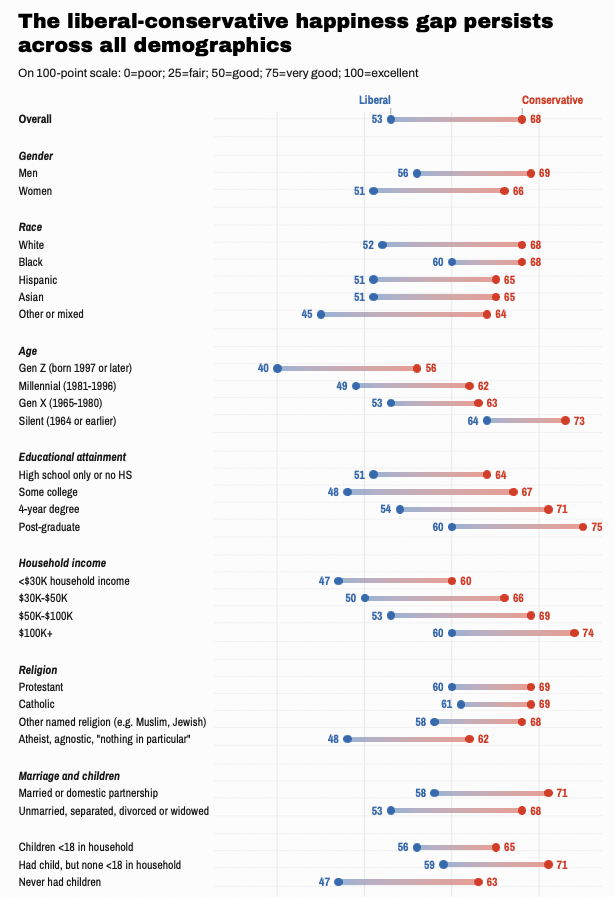
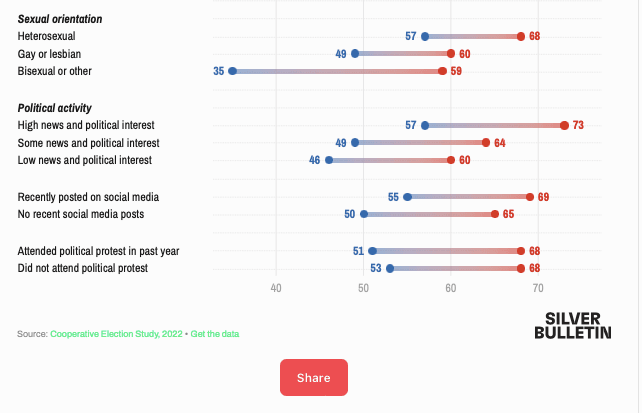
Liberals are less happy than conservatives, a finding that has been found consistently in every study since the first in 1972. It persists for Americans whether Democrats or Republicans are in control in Washington, and holds true for both sexes, and all sexualities, all ages, all races and incomes, all education levels. An example is the 2022 Cooperative Election Study from Tufts University. According to the survey, organized by Nate Silver for his silver bulletin, here, liberals of every demographic are significant less happy than conservatives in that demographic, with an average difference of 15 points on a 0 to 100 scale.
Graphic from Nate Silver’s “Silver bulletin,” based on data from the 2022 cooperative election survey.
I note that 2020-2022 was the height of the Biden administration, with Democrats in control of the entire government.
Some of this can be explained perhaps by self-selection: A liberal may considered a person who don’t like the current situation, and wants it changed, while a conservative, in some sense is someone happy with the status quo. Of course this isn’t the full story, since conservatives too generally want to see change — smaller government, less regulation and taxes, and the like. The real gap in happiness, then seems to come from a difference in perception of how important the change is, or how bad things are now. Liberals, on TV at least, claim that America is awful, among the worst countries ever: racist, sexist, colonialist, violent, stupid, fascist. They blame the US for warm temperatures and suffering Iranian women, finding half of their fellow Americans – those who don’t agree– “a basket of deplorables,” to quote Hillary Clinton, where half of these conservatives needed re-education, in her view, and the other half were beyond re-education. Conservatives are just not as unhappy. They still think that they can “Make America Great Again”, perhaps by capturing something of the good old days (1945, say).
Devyn Brandt (They/Them) orientation advisor for Washington University. My guess is liberal, and not very happy.
The happiness gap has increased with time and extends into mental health. In the 2022 Cooperative Election Study found that, 16% of all Americans who voted for Joe Biden had depression in 2020. Going further, 45% of self-described liberals said their mental health was poor. By contrast 51% of conservatives said their mental health was excellent, and only 19% said it was poor. This might be self-delusion, still it is consistent year to year. A year later this 2023 depression study from Columbia University found only 20% of liberals who believed they had excellent mental health while 51% of conservatives believed their mental health was excellent. Presenting this another way, among voters who said their mental health was poor, 45% identified as liberal, and 19% as conservative. The remaining 36% were either independent, or decided not to answer the question.
Some things make liberals happy, though, and one of them is money. The highest income liberals (>$100k per household) are happier than poorer liberals, but only as happy as the lowest income conservatives (<$30k/ household), 60% in both cases. Education helps too, but not as much, and religion. Political activism only makes things worse, both for liberals and conservatives. My advice for the summer: try ice cream. It always works for me. And this song from the musical Iolanthe, where the guard outside the parliament confides that political stance is inborn, with particular opinions handed down by others, including a band of mischievous fairies.