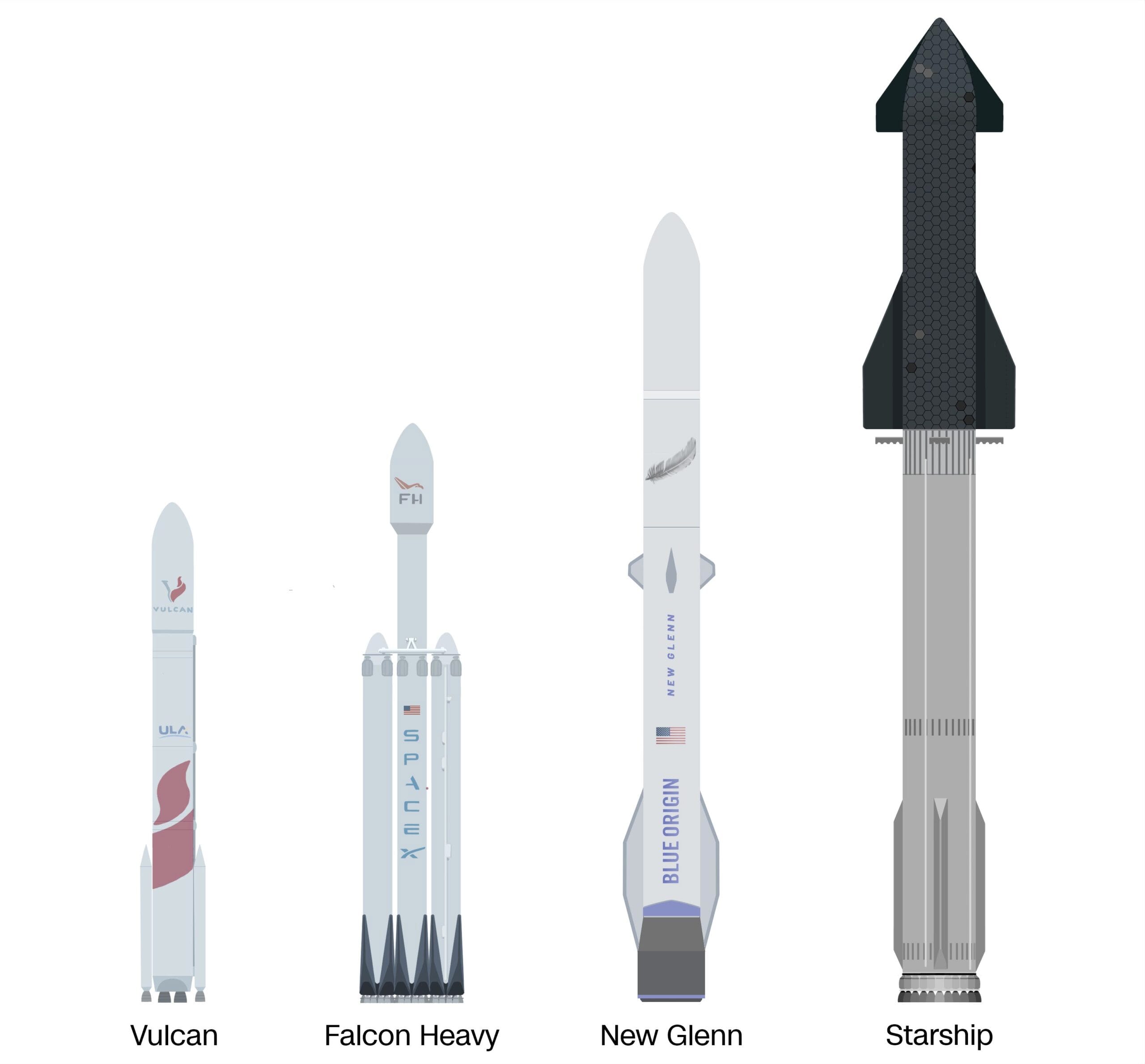
Blue Origin had its third New Glenn flight last week, and though it wasn’t quite successful, in that the satellite failed to reach proper orbit, it was successful in that it launched, reached space, and returned to a barge. It had a larger faring than even Falcon Heavy, and in terms of payload and price per ton, it beat SpaceX’s main vehicle, the Falcon 9. A SpaceX Falcon 9 flight will cost you $72 million with a weight limit to LEO of 17,400 kg. By contrast, New Glenn flights are priced at $80 million with more than double the weight limit to LEO, 45,000 kg. The price per Kg is less than half, and the faring is bigger. What’s not to like?
For now SpaceX products still retain an edge. The Falcon Heavy will lift more weight to LEO than the New Glenn (one launched today), at an even lower price per kg. Besides, SpaceX’s products are reliable, they’ve launched 240 commercial flights in the last 16 months alone, and all were successful. Blue Origin is still viable in that they’re relatively cheap and fill an important gap in SpaceX’s size portfolio, but they’re not a SpaceX killer. On the other hand they seem like a killer of Boeing’s two space projects, the CST Starliner, and the Boeing SLS that launched Artemis earlier this month.
CST Starliner is Boeing’s space capsule. It was vastly over budget and behind schedule. And when the first semi-successful version reached the Space Station with Astronauts in 2024, it showed multiple malfunctions and was condemned to return to earth unmanned. The astronauts were rescued in a SpaceX Dragon. NASA will want an alternative to Dragon, but now Blue Origin provides one. It’s the same story with Boeing’s SLS. Like the capsule, it was vastly delayed and over budget. While it provided the lift for Artemis II, that was after a near four year delay since Artemis I, November, 2022. The price per kg to launch on SLA is $37,000/kg, about twenty times that of a launch on Falcon Heavy or New Glenn. The only justification for SLS, as I see it, is that it was the main alternative to SpaceX. Now it isn’t. For more on the comparison, see here.
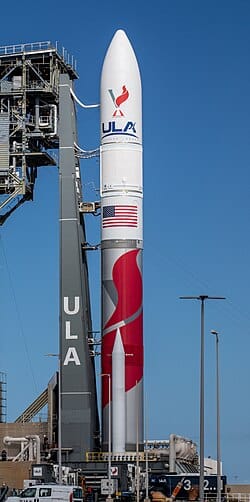
Both SpaceX and Blue Origin have newer versions for reusable heavy lifting due to debut within the year. SpaceX hopes to launch their Starship V3 next month. If it works as predicted, the throw weight will be triple that of New Glenn at a fraction of the cost per kg. Blue Origin has a larger version of New Glenn in the works, the 9×4 also reusable. Blue Origin has also started supplying high efficiency methane-burning engines for the Vulcan Centaur rockets made by ULA (United Launch Alliance). ULA continues to make the Atlas V rocket, but these are powered by Russian RD180 engines aided by Teledyne solid boosters. The Russian contract ended after Russia’s invasion of Ukraine, and ULA’s supply is almost exhausted. Since 2025 ULA has flown two missions successfully using Blue Origin’s, BE-4 engines instead, aided as before, by Teledyne boosters. The price per kg on these Vulcan Centaur rockets is well below that of the old Atlas V, because with BE-4 they can reuse the lift stage. For all of these, the price is far below a flight on Boeing SLS.
The French too have improved their Ariene line. They’re now reusable, and while they’re somewhat expensive, and can’t lift as much as the New Glenn, Falcon Heavy, or Vulcan, they’re cheaper than Atlas V, and are an alternative for deep space projects. With these alternatives I see little value in continuing with Boeing’s SLS. When I look for a path to the moon and beyond, I look to Starship and perhaps New Glenn.
Robert Buxbaum, April 27, 2026