Category Archives: theater

Korean movies and music; my thoughts on why they do so well

A Korean animated movie, K-Pop Demon Hunters, KPDH, just broke all-time record for most watched movie in the History of Netflix. It’s only 92 days old, and not a big-budget film with massive marketing, but it’s had over 314 million views so far, appearing on the most-watched list in 32 countries. Some Chinese movies have had more views, but these tend to be specific to China, with limited appeal elsewhere. KPDH has three songs in the Billboard 100 too, including golden at no.1, see official music video, 352M views for the music video. The last movie to have three songs in the Billboard top 100 was Saturday Night Fever, some 45 years ago. Other top Korean groups include Stray Kids, BTS, and Black Pink, they’ve had multiple #1 songs world wide of the last five years, and fill 50,000 seat stadiums regularly with seats going for $150. Here are Black Pink, filling a 50,000 seat stadium in Paris. If you read the US press, you’d hardly know these groups exist. BTS had a big hit during Covid called, “Permission to Dance,” a positive song during that grim period, danced e.g at the UN. Listeners noticed, the press did not. I think the press finds Koreans “anodyne”, that is, insipid.
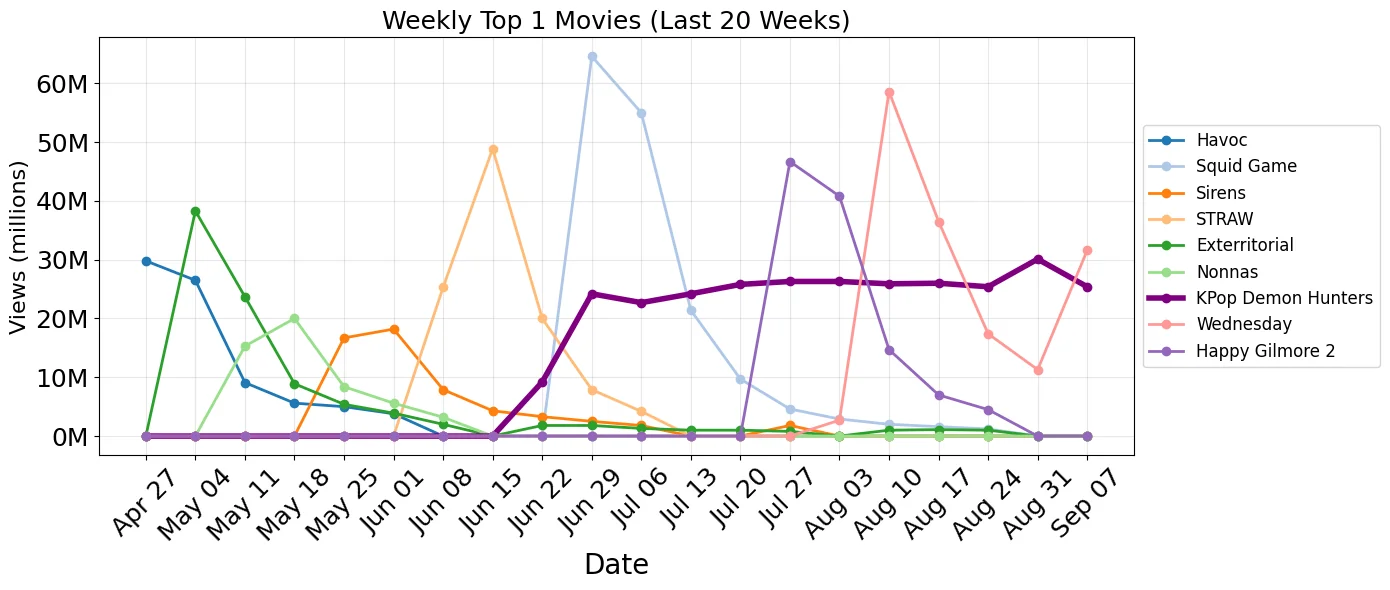
Top movies of the last 20 weeks include two Korean offerings, Squid Game and K-Pop Demon Hunters

One thing that turns off the US press, is that Korean songsters and movies are less sexual, and less politically moralizing. The top Oscar awards go to political movies. At the Emmies, this year, we were told, “F*ck ICE, Free Palestine.” Similarly, Green Day, Eminem, and other western bands lead chants of F*ck Trump. The press takes this moralizing as intellectual, but I find it cheap and suspect it turns off many potential fans.
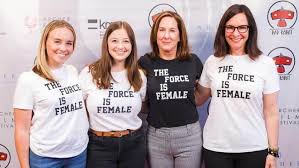
Director of Star Wars, Kennedy, promoting diversity.

A favorite moralizing of US movies is to show women who don’t need or want men. Frozen was like that, as was Encanto, Last Dragon, Moana… Star Wars was a top franchise that Disney made more feminist, writing basically every man as bad. Women were good, powerful, and inherently talented. Rey a main new character, grabs a light saber with no background or training, and uses it like an expert. It turns off men, then women stayed away too.
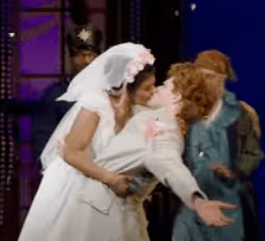
End kiss of Pirates of Penzance, the pirate prince and the major general’s daughter

We like to show black actors in white rolls too, though not white actors in black rolls. Hamilton was successful, and had black actors playing in every positive roll, white actors playing evil idiots. It was done again with 1776, less successfully. All the founding fathers are cast as women; Jefferson is black, bisexual, and pregnant. There’s a message somewhere. The upcoming movie about King Gustaf of Sweden has a dark-skinned actor playing the king. Why? We had a dark- skinned daughter of the major general, who bends the pirate over to kiss him, a dark skinned Snow White with most of the Dwarves normal height, a female She-Hulk, stronger than the original, who lectures the original (and us) about anger. Apparently, the idea is to highlight the difficulties powerful women face. Korean shows have casts that make sense to the plot, and no gratuitous reversals or sex. Did Oppenheimer need the many sex scenes? Did the suicidal love interest have to be written stronger than the main character?

Then there are the sequels: the Marvel universe includes 37 interconnected movies, Star Wars, 19, Batman 13. To get the full story, you have to see them all. So far, in 2025, only two of the major funded movies were original (one was Korean, Mikey 17). The others are all reboots or sequels with recycled plots and ever-bigger explosions. It all works until it doesn’t, then they make a reboot. Law and Order, 26 years old with 500 episodes.

Scene from Crash Landing on You. These two are in serious trouble.

Korean entertainment has series too, but much shorter and with fewer explosions. A TV series will have only 16-24 episodes and I’ve yet to see one with a mass-murderer. The Squid game, has had 13 episodes over 3 seasons. Some deaths, but not wholesale. A longer series, “Crash Landing on You,” 24. In it, a successful South Korean executive (female) is blown across the border to North Korea into the arms of a handsome, North Korean. No deaths. They could have gone on for years, but didn’t. People rewatch the original.

Other countries movies moralize too, like ours do, but they tend to be patriotic moralization, and anti gratuitous violence, not violent, anti-patriotic as in the US. Chinese TV shows present Chinese politicians as honest, they have praise for the Chinese schools and infrastructure, and regular invocations to respect the police. India moralization is similar, but more towards family order. Korean messages are in-between, with some crooked politicians, some violence, people with mental or emotional problems who evolve.

Robert Buxbaum, September 17, 2025. The industry has pushed back against criticism of their wokeness, claiming that the only folks turned off are the toxic fans: white, MAGA men, mostly, who hate diversity. They claim to be happy when such fans stay home and watch KPDH, or go buy $150 tickets to see Koreans sing in Korean.
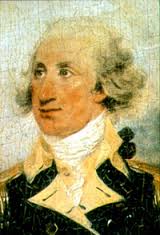
Hamilton and his slave-trading father in law.

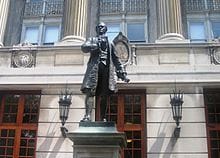
Philip Schuyler as a Major General in the Revolution. His statue was removed.

What most folks know about Alexander Hamilton’s father in law, Philip Schuyler, is that he was “loaded”, that he had three daughters, and that he quickly took to young Alexander. But an important fact varnished over is that Schuyler made his money in the slave trade, a trade that Hamilton was likely in when he met the young Schuyler daughters. Schuyler was also a slave owner, owning 13 slaves, by his record, and perhaps another 17 indentured servants working at two mansions. So far, only the Philip Schyler statue has been taken down. It seems possible that many monuments to Hamilton may follow.

Statue of Alexander Hamilton, proudly stands in front of Columbia University. The ten dollar founding father.

The play “Hamilton” proclaims Hamilton’s genius and exceptional work ethic, mentioning that, at the young age of 14 (more likely 16) he was left in charge of a trading company. This was for 5 months in 1771, while the owner was over seas doing business. Hamilton knew the business well; he’d been hired as a clerk at 11 at Beekman and Cruger, a similar import-export trading firm. What items did these firms trade — cotton, sugar, rum, and most profitable slaves. This likely was the business that kept the owner overseas for 5 months while Alexander ran the shop. There are at least two notifications of slave ships entering the harbor with human good for sale. Among Hamilton’s likely jobs would have been fattening and oiling the goods for sale. Hamilton himself seems to have owned a slave-boy named Ajax who he inherited (briefly) from his mother, Rachel. His mother is listed on the tax records as white. She owned five saves at one time, suggesting she was not entirely impoverished. Hamilton’s father, though a failed businessman, was a Scottish Laird (a Lord). As for the court-mandated transfer of Ajax from Alexander, it was to his half-brother James because James was “Legitimate.”

I base Hamilton’s age on the Nevis-St Kitts record of his birth, January 11, 1755.”[1] The play takes as a fact Hamilton’s claim to have been born two years later, January 11, 1757. I trust the written records here, and imagine Hamilton wanted to present himself as a young genius, rather than as a bright, but older fellow. In 1772, at at age 17, Hamilton wrote a “fire and brimstone” description of a deadly hurricane, describing it as “divine rebuke to human vanity and pomposity.”[2] Between this, and his skill at trading, the community leaders collected money to send him to New York, but unlike the play’s description, it was not only for further education. The deal was that he continue trading for the firm,[3] and this is likely how he met his future father in law. “[4] 

Hercules Mulligan, a revolutionary tailor: He was a spy. According to the CIA, much of the work was through his black slave, Cato.

In New York, Hamilton met Schuyler and his daughters. It seems likely that he met the father first, likely as possible customer for the slave trade from the Caribbean, or perhaps as a customer for rum and sugar. A 1772 letter in Hamilton’s handwriting [4] asks for the purchase of “two or three poor boys” for plantation work, “bound in the most reasonable manner you can.” As in the play, Hamilton was friends with John Laurens, an abolitionist, and among his first lodgings was with Hercules Mulligan, a tailor’s apprentice. Hercules is presented as black in the play, but he was quite white (see picture) with a black slave, Cato. Cato ran most of the messages. According to the play, “I’m joining the rebellion cuz I know it’s my chance
To socially advance, Instead of sewin’ some pants, I’m taking my shot. No, Hercules was socially advanced ,married into the British Admiralty, even. He was a true believer in freedom and a slave-holder. His older brother, Hugh Mulligan, was one of the traders that Hamilton was supposed to work with.[5] As for Laurens and his anti-slavery organization, most of those in the organization owned slaves, and though they opposed slavery, they could never decide on when or how to end it. There is no evidence that Cato was ever set free.

The appointment to Washingtons staff was not likely a coincidence. The elder Schuyler was one of the four top generals appointed in 1775 to serve directly under Washington. Phillip oversaw, at a distance, the disastrous attack on Quebec and the victory at Saratoga– both, Burr served admirably. Phillip’s main role was as a quartermaster/supplier, and this is not a small role. Phillip Schuyler had been a quarter-master in the French and Indian war. It’s likely that it was Schuyler who got Hamilton his appointment to Washington’s staff.

Once on Washington’s staff, Hamilton served admirably. Originally serving as a secretary, Hamilton wrote many of Washington’s dispatches. Then, according to tradition, as a cannon commander, he took particular pleasure in the attack on Princeton University. He then served well as secretary of the Treasury, and as head of the Bank of The United States, the only major US bank until Burr opened the Bank of the Manhattan company. Despite his aversion to slavery, Hamilton also continued to deal in slaves. A 1796 cash book entry records Hamilton’s payment of $250 to his father-in-law for “2 Negro servants purchased by him for me.” This is only 3 years before 1799, when New York began to end slavery in the state with the Act for the Gradual Abolition of Slavery. Children of slaves born after July 4, 1799, were to be legally free, but required indentured servitude: to age 28 for males and 25 for females. Those born before July 4, 1799 became free in 1817. There is no evidence that Hamilton was a leader in any of this, but Burr, another slave-owning abolitionist, was a leader in the NY legislature at the time.

I’m with Burr.He was flawed, a slave-owning abolitionist, but vehimently against the Alien and Sedition Acts, a Hamiltonian horror.

It seems that Robert Morris introduced Hamilton to the importance of tariffs, and to the idea of using debt service as a backing to currency. It’s brilliant idea, but Hamilton understood it and took to it. Hamilton also understood the need for a coast guard to enforce the tariffs. As for Hamilton’s character, or Burr’s. Both, in my understanding, were imperfect people who did great deeds. I’ve already written that Hamilton was likely setting up Burr for murder, perhaps because of Burr’s vehement opposition to the Alien and Sedition Acts — That’s why Hamilton wore his glasses and fiddled with the gun so much. Burr was also gaining power through his Manhattan corporation and Tammany organization. both of which got his support among the immigrants.

My intent here is not to knock the image of Hamilton, Schuyler, Laurens and Mulligan, nor to raise that of Burr, but to correct some current fictions in the play “Hamilton”, and to fight a disease of our age, the cancel culture. The cancel culture elevates their heroes (Hamilton, Mulligan) to god-status. They will lie to cover the flaws of their heroes, and will lie also to claim a drop of black blood in them; neither Hamilton nor Mulligan were black and both owned slaves, as did Burr. The other side of the cancel culture is to cancel — to eliminate the validity — of the reactionaries, the non-revolutionary. In the play, these include Samuel Seebury and Aaron Burr. Great building is almost always the work of contradictory people. They need some talent, and a willingness to act, and because building requires a group, they have to work in a group, tolerating flaws of the others in the group. It is just these flawed, contradictory builders that are being cancelled, and I don’t think that’s right or healthy.

Robert Buxbaum, August 4, 2020.

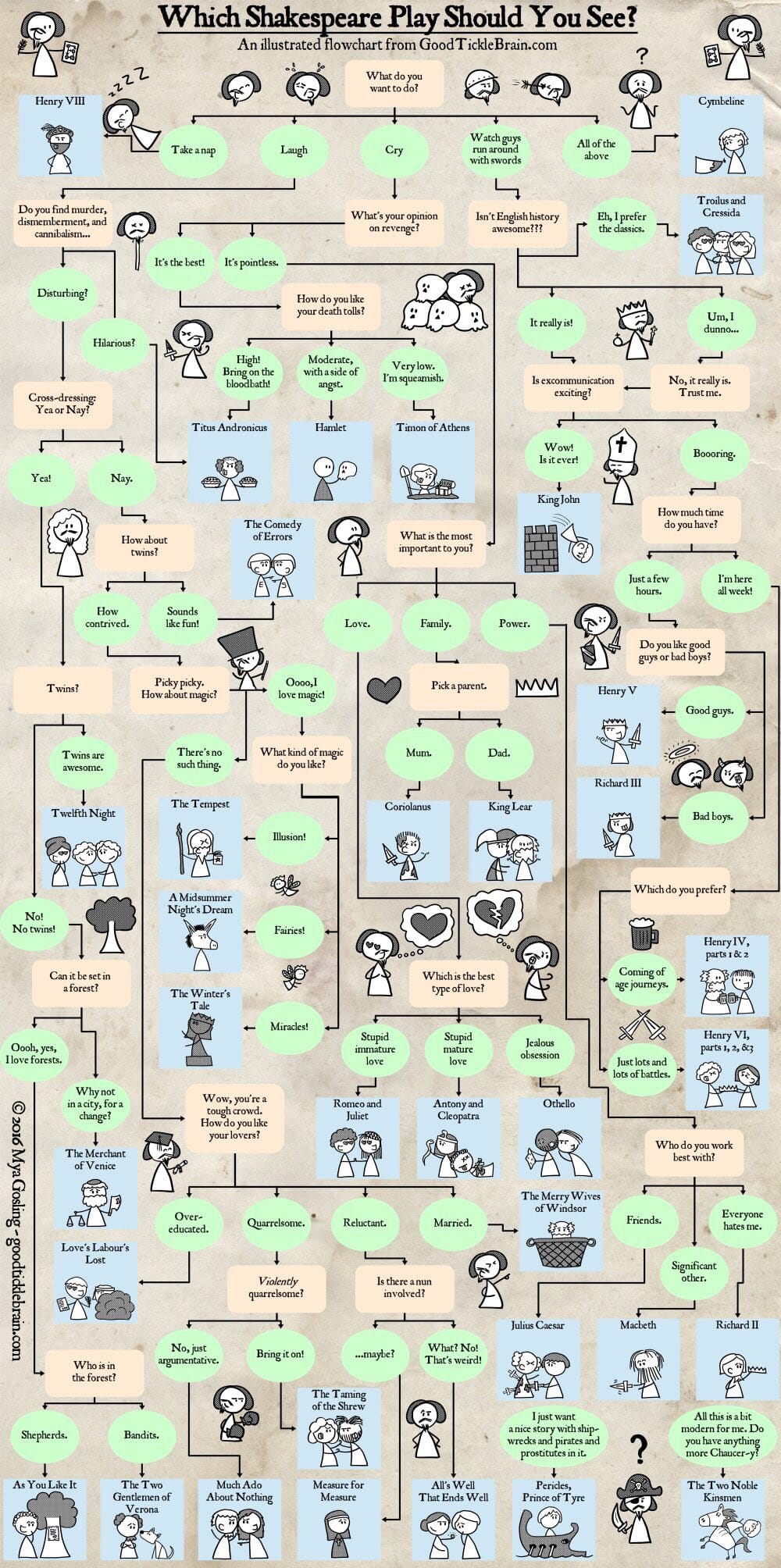
Shakespeare’s plays, organized.

One remarkable thing about Shakespeare’s plays is how varied they are. There are comedies and tragedies; histories of England, and of Rome, musings on religion, and on drink, and lots of cross-dressing. He wrote at least thirty seven plays between 1590 and 1613, alone or as a major collaborator, and the chart below gives a sense of the scope. I have seen less than half of these plays, so I find the chart below both useful and humorous. The humor of the chart is partly that it presents the common man (us) access to the godly (Shakespeare). That access is the root of the best comedy, in my opinion. Shakespeare also has a comic dog, some total idiots, comic violence to women, and a few other cringeworthy laugh-getters, but we’ll not mention those; it’s low comedy. You’ll notice that Merchant of Venice is listed here as a comedy; I think it was seen that way by Shakespeare. The hero of the play in my opinion, is a woman, Portia, who outsmarts all others by her legal genius at the end. Tragedy is when the great individual can not access great things. At least that’s how I see it. As for History; it’s been said, that it starts as tragedy, and ends as comedy. Shakespeare’s histories include some of each. And as for our, US history, Lincoln was tragedy, like LBJ; Truman was comedy, and Andrew Jackson too. And, as for Trump, who knows?

By Myra Gosling, www.goodticklebrain.com
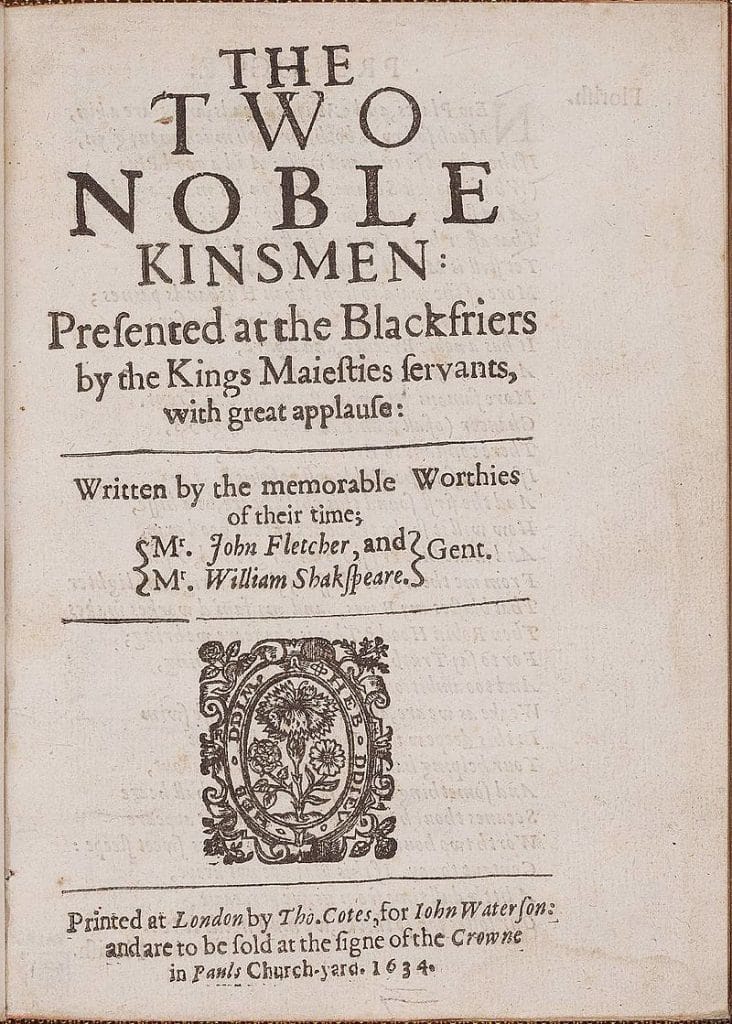
A Shakespeare collaboration. The collaborator, Fletcher, is cited by name.

Ms Gosling’s graphic, wonderful as it is, lists some but not all of Shakespeare’s collaborations. Two listed ones, “Henry VIII,” and “The Two Noble Kinsmen” were with John Fletcher. The cover shown at right, shows Fletcher named as first author. Since Fletcher outlived Shakespeare and took over the company after his death, I’ll assume these are later plays.

“Henry IV, part 1” is thought to be from Shakespeare’s early career, and seems to have been a mass collaboration: something written by a team the way situation comedies are written today. And “Pericles, Prince of Tyre,” listed near the bottom right, seems to have been a mid-career collaboration with George Wilkins. At least four of Shakespeare’s collaborations don’t appear at all in the graphic. “Edward III” and “The Spanish Tragedy”, appear to have been written with Thomas Kyd, likely early in Shakespeare’s career. Perhaps Gosling felt they don’t represent the real Shakespeare, or perhaps she left them off because they are not performed often. Another collaboration, “Sir Thomas More” (an intentional misspelling of Moore?), is well regarded today, and still put on. An existing manuscript includes 300+ lines written in Shakespeare’s hand. Still, Shakespeare’s main contribution seems to have been editing the play to get it past the censors. Finally, “Cardenio,” is a lost play, likely another collaboration with Fletcher. It got good reviews.

The cool thing about Shakespeare’s play writing, in my opinion, is his willingness to let the characters speak for themselves. Even characters who Shakespeare doesn’t like have their say. They speak with passion and clarity; without interruption or mockery. Writing this way is difficult, and most writers can’t avoid putting themselves and their opinions in the forefront. I applaud Ms Gosling for making Shakespeare accessible. Here’s this month’s issue of her blog, GoodTickleBrain.

Robert Buxbaum, June 26, 2019. As a side note, Shakespeare appears to have been born and died on the same date, April 23; in 1564 and 1616, respectively.