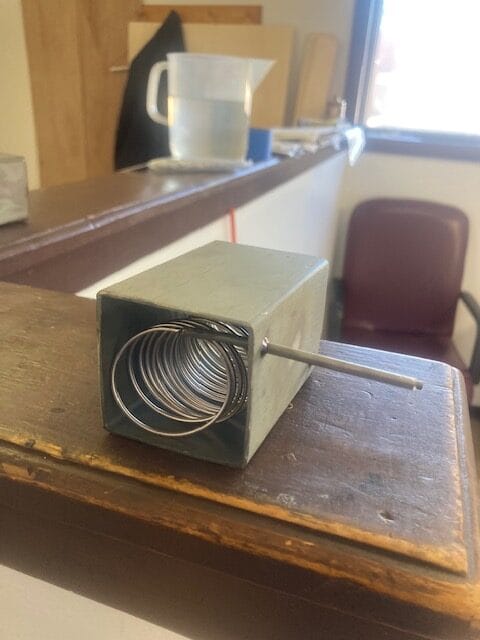
We occasionally make hydrogen stripper systems where the goal is to strip the hydrogen, and sometimes other gases from a mixed gas leaving everything else in place. We use metal membranes, coiled as shown below, if the gas to be removed is hydrogen. For other gases H2S, siloxanes, we use polymeric membranes. In either case, it’s not a product we advertise, but it’s worthy of a blog post.
A typical customer was a Cambridge researcher using gas chromatography with hydrogen as the carrier gas to separate a series of compounds. He now wanted to recover the separated compounds without the hydrogen.
A hydrogen extractor during manufacture.
To minimize the amount of membrane needed, I like to create a plug flow. If the flow is low, or there isn’t much hydrogen, we use a single coiled membrane. If the flow is high or there is a lot of hydrogen, we use several straight membranes in parallel, typically with baffles; we even have a patient for this. Some customers want to recover the hydrogen. If so, we extract it with a vacuum pump. Other customers just want the hydrogen gone. For these oxidation works well. The reaction H2 + 1/2 O2 –> H2O is essentially irreversible, and quite fast on a palladium surface.
A basic analysis is to assume that flux is proportional to hydrogen pressure in the gas, and calculate the hydrogen pressure as total pressure, P, times the fraction of hydrogen in the mixed gas, H/(H + inerts) .
Then, for any small amount of membrane area, dA, the small amount of hydrogen removed per second, dH equals the area, dA, times the permeance of the membrane, P, times P, times H/(H + inerts): dH = -PP (H/(H+Inerts)) dA.
We now rearrange the above: dH(H+Inerts)/H = -PP dA, and integrate:
∫ dH ( H+Inerts)/H = ∫(1 + inerts/H) dH = ∫ -PP dA. It’s found that
Hi – Hf , + inerts • ln (Hi)/(Hf) = PPA. Thus,
A = (Hi – Hf )/PP + (Inerts/PP) ln (Hi)/(Hf).
where A is the total area of membrane needed, inerts = the inert gas flow per second, and and Hi and Hf ate the hydrogen flow rates in the mix at the beginning and end of the extraction. Hi – Hf equals the total amount of hydrogen removed per second.
Note that the first term dominates in the beginning of the extraction process, or where there is a lot of hydrogen content, ln 1 =0), and the pressure of hydrogen is essentially P. The logarithmic term dominates in latter (final) stages, where the inert content is the majority and hydrogen content changes fast. In these later stages, very little hydrogen removal decreases the partial pressure by half, but a significant area of membrane is needed to remove every successive 50% since the hydrogen pressure is continuously decreasing by 50%.
You can derive similar equations for normal distillation, as used to make liquor or refine gasoline. You can also modify the above expression because permeation isn’t always proportional to pressure but to the difference of Pressure to some power, the 1/2 power, or so. I should also mention that, in membrane distillation and liquor it is important to continuously remove components that can build up in the still. For membrane- based hydrogen stripping, we do this using a back-pressure controller, or a flow controller. Thus, if you know you have a feed of 95% hydrogen, 5% desirable inerts, you want a to maintain a suitable back-pressure and you want a flow controller that lets mostly inerts out of the process with minimal H2.
She was only the moonshiner’s daughter, but he lover her still.
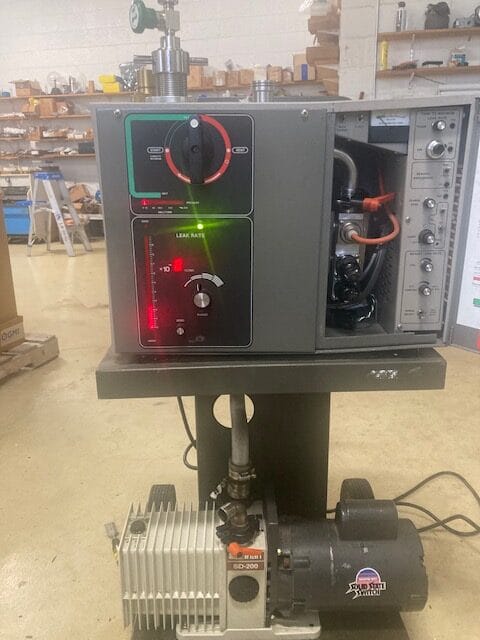
Our helium leak detector being calibrated with a standardized He leak
We just got a new helium leak detector, a Varian 938, about 15 years old, shown at right. Our old detector, a Veeco, had not worked well for years, and then we could no longer get it fixed. For a while we outsourced our leak checking, and on rush jobs it didn’t always get done. Now we can check everything in-house at much better sensitivity than before.
It used to be that helium leak checking services were common locally, in Detroit, but we lost a lot of manufacturing and our quality checkers left too, for Ohio, then abroad. Companies that used to do He leak checking switched to fluorescent die checking, which isn’t as good, and then stopped checking altogether. But small cracks at welds are not uncommon, particularly with laser welding of stainless steel. They form as the metal cools, and are too small to see. They show up in helium leakage through the micro-cracks, and if not detected and corrected, these cracks will grow and destroy a pipe or system over time. For my products, hydrogen purifiers, the micro cracks affect hydrogen purity. Any crack that helium can get through will allow impurities to diffuse into our output hydrogen. Because of the problems of micro-leaks and durability, it used to be obligatory in the nuclear navy to helium leak check every part.
The picture above was taken while calibrating our new helium leak detector. I’d bought some calibrated sources, in this case, one certified to bleed at 3.6×10⁻⁸ cc/sec, which is equivalent to 2.1 x 10⁻⁹ slpm. If a leak of that rate would appear in one of my 1 slpm purifiers, that would imply a delivered hydrogen purity of 99.999998%, and that’s generally the purity limit I certify. This is also a common leak standard in the industry, but my new detector is better than that standard. We can test down to 0.5×10⁻⁹cc/s . A 1 slpm purifier with that leak rate will deliver hydrogen at 99.9999999+ purity, more than nine-nines, as they say. On the calibration day, above, I tested three new purifiers, and found they were all perfect to the higher standard, ≤ 0.5×10⁻⁹cc/s. I’m so happy with this, I thinking of going into free-lance, helium leak checking. There’s no one local who does it.
In case you want to know, I bought this detector on eBay but found it didn’t work. I tried cleaning key parts, replaced the pump oil, nothing helped. Then bought another leak detector, with a spare filament, but without a pump or a mass-spec unit. It included the standard leaks that I now use to calibrate. That one didn’t work in the same way that the original one didn’t; we never reached pressure, and the filament never came on. Eventually, I came to believe that the vacuum pump was a fault. I sent it to a great pump repair shop in Greentown, PA, and discovered they also repair helium leak detectors. I hope to visit them. They replaced the pump and spiffed up my detector at a decent prices ($1500 as I recall). Now, it works like a charm.
What makes something elite? For elite colleges and academic journals, a large part is selectivity, the lower fraction of people who can go to your college or publish in your journal, or earn your credential, the more selective, thus the most elite. Harvard, boasts that “the best” apply, and of these, only 3% get in. Thus Harvard selects for the top 1%, or so they claim. These are not selected as the brightest, or most moral or motivated, but by a combination: they are the most Harvardian.
The top 20 most selective US colleges, 2022-23 according to Nathan Yau, FlowingData.com
Selectivity is viewed as good. That this 1% can get into Harvard makes the students elite and makes Harvard desirable. Some lower-class Ivy colleges (Columbia, for example) have been found to cheat to pretend higher selectivity; they’ve exaggerated the number of people who apply so they can inflate their rejection rate, and justify a high tuition, and presumably a high salary for their graduates. And it’s self-sustaining. Generally speaking, college professors and high-powered executives are drawn from elite institutions. Elite grads pick other elite grads as their way to get the best material, with the best education.
By this measure, selectivity, The Journal of Universal Rejection is the most elite and best. It’s the journal you should definitely get. The reject every article submitted on every subject. They are thus more elite than Harvard or Cal Tech, and more select than the quorum of US presidents, or Olympic gold winners, or living Chess champions, and they got there by just saying no. Many people send their articles, by the way, all rejected.
My lesson from this, is that selectivity is a poor metric for quality. Just because an institution or journal that is select in some one aspect does not mean that it will be select in another. Top swimmers and footballers rarely go to Harvard, so they have to pick from a lower tear of applicants for their swimming and football teams. It’s the same with the top in math or science, they apply to Cal Tech, with the rejects going to Stanford or Princeton. As for top chess players or US Navy Seals, a Harvard degree does nothing for them; few seals go to Harvard, and few Harvard students could be Seals. Each elite exists in its own bubble, and each bubble has its own rules. Thus, if you want to be hired as a professor, you have to go to the appropriate institution, though not necessarily from the top most selective.
From Nature, 2024. 20% of all academics come from just 8 schools, 40% come from the top 21.
As for journals to read or write in, an elevated reader like you should publish where you can be read, and understood, and perhaps to change things for the better, I think. Some money would be nice too, but few scientific journals offer that. Based on this, I have a hard time recommending scientific journals, or conferences. More and more, they charge the writer to publish or present, and offer minimal exposure of your ideas. They charge the readers and attendees such high fees that very few will see your work; university libraries subscribe, but often on condition that not everyone can read for free. Journal often change your writing too, sometimes for the better, but often to match the journal outlook or style, or just to suggest (demand) that you cite some connected editor. JofUR is better in a way, no charge to the author, and no editorial changes.
Typically, journals limit your ability to read or share your work, assuming they accept it, then they expect you to review for them, for free. So why do academics write for these journals? They’re considered the only legitimate way to get your findings out; worse, that’s how universities evaluate your work. University administrators are chosen with no idea of your research quality, and a requirement of number-based evaluation, so they evaluate professors by counting publications, particularly in elite (selective) journals, and based on the elite (selective) school you come from. It’s an insane metric that results in awful research and writing, and bad professors too. I’ve come to think that anyone, outside of academia, who writes in a scientific journal is a blockhead. If you have something worthwhile to say, write a blog, or maybe a book, or find a free, open access journal. In my field, hydrogen, the only free, open access journals are published in Russia and Iran.
And just for laughs, if you don’t mind the futility of universal rejection, there’s JoUR. Mail your article, with a self addressed return, or email it to j.universal.rejection@gmail.com. You’ll get a rejection notice and you’ll join an un-elite group: rejected, self effacing academics with time on their hands.
ROBERT BUXBAUM, January 16, 2025. If, for some reason, you want to get your progeny into an elite college, my niece, a Harvard grad., has a company that does just that, International College Counselors, they help with essays, testing, and references, and nudge your progeny to submit on time.
The Mythbusters dimpled Taurus, and a diagram meant to show how drag is reduced. On a golf ball, at low NRE, vortex separation is moved back to 110°, the mechanism on a car is different, I suspect.
The dimples on a golf ball reduce air-drag resistance, so why don’t we put dimples on planes or cars? Perhaps because it’s ugly, or that cars are much bigger and than golf-balls, so we expect the effect of skin effects to be smaller. Finally, a Reynolds number analysis suggests that dimples on cars should increase drag, not reduce it.
In 2009, the Mythbusters decided to test the conjecture. Hosts Jamie Hyneman and Adam Savage ran careful gas usage tests on a Ford Taurus that was first covered with smooth clay. They drove the car repeatedly (5X) on a track at 65 mph (about 100 km/h), and measured “slightly over 26 mpg,” 9.047 l/100km, a respectable value. They then carved dimples into the clay to simulate the surface of a golf ball. See picture at right, and put the removed clay into the trunk so there would be no decrease in weight.
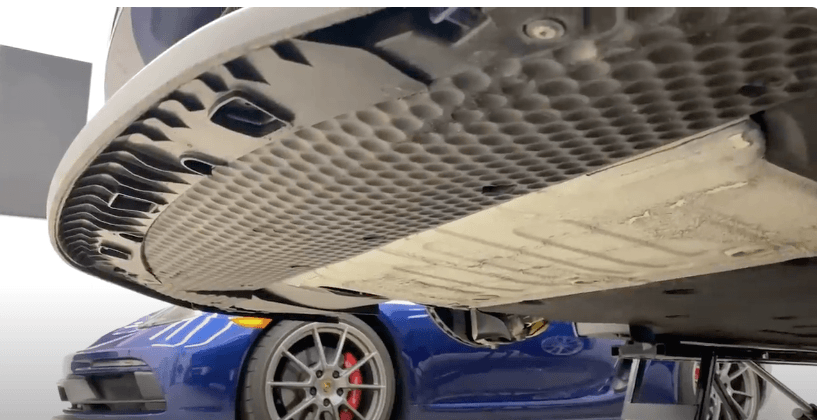
Underneath a Porche GT4, smallish dimples.
They then drove the dimpled car over the same course, five times as before at exactly 65 mph, and found the car got 14% more mpg, 29.6 mpg, or 7.946 l/100 km. See video excerpt here. They considered it their most surprising Mythbuster episode.
As it happens, dimples had been put on some production cars, even before the episode. They are just located underneath where most people don’t see them. The VW “Golf” had dimples even before the episode, and the Porsche Cayman GT4 does today, see picture above left, but most experiments find little or nothing. Car dimples are typically smaller than those used on Mythbusters, so that may be an explanation. Dimples have been found to help on soccer balls (the stitching acts as the dimples), and bicycle wheels (less advantage).
PHYSICS OF FLUIDS 18, 041702 (2006) Mechanism of drag reduction by dimples on a sphere, Jin Choi, Woo-Pyung Jeon, and Haecheon Choia.
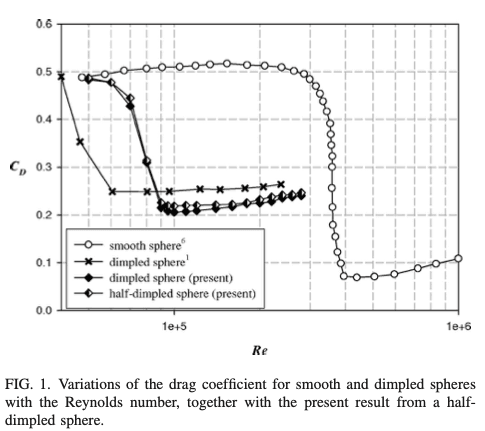
The graph at right shows the source of confusion for cars and the great advantage for golf balls. It’s a plot of the drag coefficient for smooth and dimpled golf balls, as a function of the Reynolds Number, where NRE = Vdρ/µ. In this formula, V is velocity, d is the diameter of the car, ball or whatever, ρ is the density of the fluid, and µ is viscosity. NRE can be thought of as the ratio of the inertial to viscous forces acting on the object. It’s a way of describing the combined effects of speed and size for different objects in motion.
We see, above, that dimples reduce golf-ball drag by more than 50%, but only at speeds/ Reynolds numbers that are much lower than for normal cars, NRE between about 4×10⁴ and 3.5×10⁵, as are typical of golf balls during play. A typical car at 65mph will have a NRE.CAR = 3×10⁶, suggesting that there should be no advantage for dimples, or possibility a disadvantage, that dimples should increase drag. A side note one sees, above, is that it is only the dimples on the front of the golf-ball that reduce drag: other dimples do nothing. If one were to add dimples to high-speed trains and airplanes I’d suggest them only on the front, so far I have not seen them.
I think that the Mythbusters did a good job with their experiments, and find their 14% improvement significant. So why do so few other cars see and advantage. One thought I had was to note that the Ford Taurus is a remarkably round car, providing ample space for front dimples to help, most cars today are more angular. I also note that the production cars have smaller dimples, as on the Porsche, above. Then again, the Mythbusters folks may have made some non-obvious experimental error.
Robert Buxbaum, January 4, 2024. An important side issue in this is that Google’s AI was awful, a handicap in researching this article. It lies continuously and convincingly, and did so here. I’d asked it for the year of the episode, and the AI lied, and said 2012. I asked for the type of car, the AI said an SUV, and it gave a misdescription of the tests. Lying AIs appear as villains in science fiction, e.g. HAL of 2001 A Space Odyssey, now in real life.
Original hardware brass screws from my door and locks, plus one of the stainless screw that I used as a replacement.
I just replaced the door knob assembly on my home and found that it was held in place by a faceplate that was attached by two, 5/8″, brass screws. These screws, shown at right with their replacement, would not have been able to withstand a criminal, I think. Our door is metal, foam filled, and reasonably strong. I figure it would have withstood a beating, but the brass screws would not, especially since only 1/4″ of the screw is designed to catch foam. Look closely at the screws, and you will see there are two sizes of pitch, each 1/4 long. Only the last 1/4″ looks like it was ever engaged. The top 1/4″ may have been designed to catch metal, but the holes in the door were not tapped to match. The bottom 1/4″ held everything. Even without a criminal attack, the screw at right was bent and beginning to go.
Instead of reusing these awful screws or buying similar ones, I replaced them with stainless screws, 1 3/4″ long, like the one shown in the picture above. But then I had a thought — what were the other locks on my door attached with? I checked and found my deadbolt lock was held in by two of the same type of sorry, 5/8″ brass screws. So I replaced these too, using two more, 1.75″ stainless steel. Then, in my disgust, I thought to write this post. Perhaps the screws holding your door hardware is as lousy as was holding mine. Take a look.
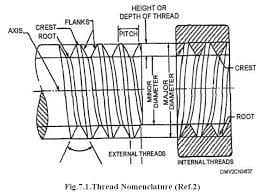
The glory of American screws and bolts is their low cost ubiquity, especially in our coarse thread (UNC = United National Coarse) sizes. Between 1/4 inch and 5/8″, they are sized in 1/16″ steps, and after that in 1/8″ steps. Below 3/16″, they are sized by wire gauges, and generally they have unique pitch sizes. All US screws and bolts are measured by their diameter and threads per inch. Thus, the 3/8-16 (UNC) has an outer diameter (major diameter) of 3/8″ with 16 threads per inch (tpi). 16 tpi is an ideal thread number for overall hold strength. No other bolt has 16 threads per inch so it is impossible to use the wrong bolt in a hole tapped for 3/8-16. The same is true for basically every course thread with a very few exceptions, mainly found between 3/16″ and 1/4″ where the wire gauges transition to fractional sizes. Because of this, if you stick to UTC you are unlikely to screw up, as it were. You are also less-likely to cross-thread.
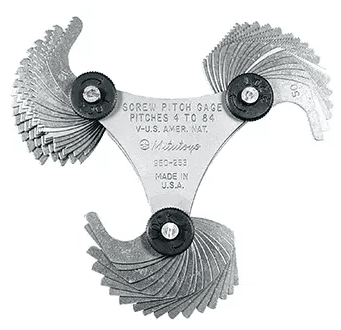
I own one of these. It’s a tread pitch gauge.
US fine threads come in a variety of standards, most notably UNF = United National Fine. No version of fine thread is as strong as coarse because while there are more threads per inch, each root is considerably weaker. The advantage of fine treads is for use with very thin material, or where vibration is a serious concern. The problem is that screwups are far more likely and this diminishes the strength even further. Consider the 7/16″ – 24 (UNF). This bolt will fit into a nut or flange tapped for 1/2″- 24. The fit will be a little loose, but you might not notice. You will be able to wrench it down so everything looks solid, but only the ends of the threads are holding. This is a accident waiting to happen. To prevent such mistakes you can try to never allow a 7/6″-24 bolt into your shop, but this is uncomfortably difficult. If you ever let a 7/6″-24 bolt in, some day someone will grab it and use it, in all likelihood with a 1/2″ -24 nut or flange, since these are super-common. Under stress, the connection will fail in the worst possible moment.
Other UNF bolts and nuts present the same screwup risk. For example, between the 3/8″-24 and 5/16″-24 (UNF), or the #10-32 (UNF) and also with the 3/16″- 32, and the latter with the #8-32 (UNC). There is also a French metric with 0.9mm — this turns out to be identical to -32 pitch. The problem appears with any bolt pair where with identical pitch and the major diameter of the smaller bolt has a larger outer diameter (major diameter) than the inner diameter (minor diameter) of the larger bolt. If these are matched, the bolts will seem to hold when tightened, but they will fail in use. You well sometimes have to use these sizes because they match with some purchased flange. If you have to use them, be careful to use the largest bolt diameter that will fit into the threaded hole.
Where I have the option, my preference is to stick to UNC as much as possible, even where vibration is an issue. In vibration situations, I prefer to add a lock nut or sometimes, an anti-vibration glue, locktite, available in different release temperatures. Locktite is also helpful to prevent gas leaks. In our hydrogen purifiers, I use lock washers on the ground connection from the power cord, for example.
I try to avoid metric, by the way. They less readily available in the US, and more expensive. The other problem with metric is that there are two varieties (Standard and French — God love the French engineering) and there are so many sizes and pitches that screwups are common. Metric bolts come in every mm diameter, and often fractional mm too. There is a 2mm, a 2.3mm, a 2.5mm, and a 2.6mm, often with overlapping pitches. The pitch of metric screws and bolts is measured by their spacing, by the way, so a 1mm metric pitch means there is 1mm between threads, the the equivalent of a 24.5 pitch in the US, and a 0.9mm pitch = US-32. Thread confusion possibilities are endless. A M6x1 (6mm OD x 1mm pitch) is easily confused with a M5x1 or a M7x1, and the latter with the M7.5×1. A M8x1.25 is easily confused with a M9x1.25, and a M14x2 with an M16x2. And then there is confusion with US bolts: a 2.5mm metric pitch is nearly identical to a US 10tpi pitch. I can not rid myself of US threads, so I avoid metric where I can. As above, problems arise if you use a smaller diameter bolt in a larger diameter nut.
For those who have to use metric, I suggest you always use the largest bolt that will fit (assuming you can find it). I try to avoid bringing odd-size bolts into their shop, that is, stick to M6, M8, M10. It’s not always possible, but it’s a suggestion. I get equipment with odd-size metric bolts too. My preference is to stick to UNC and to avoid odd numbers.
Robert Buxbaum, January 23, 2024. Note: I’ve only really discussed bolt sizes between about #4 and 1″, and I didn’t consider UNRC or UNJF or other, odd options. You can figure these issues out yourself from the above, I think.
Leading up to the Cybertruck launch 4 weeks ago, the expert opinion was that it was a failure. Morgan Stanley, here dubbed it as one, as did Rolling Stone here. Without having driven the vehicle, the experts at Motor trend, here, declared it was worse than you thought, “a novelty” car. I’d like to differ. The experts point out that the design is fundamentally different from what we’ve made for years. They claim it’s ugly, undesirable, and hard to build. Ford’s F-150 trucks are the standard, the top selling vehicle in the US, and Cybertruck looks nothing like an F-150. I suspect that, because of the differences, the Cybertruck can hardly fail to be a success in both profit and market share.
Cybertruck pulls a flat-bed trailer at Starbase.
Start with profit. Profit is the main measure of company success. High profit is achieved by selling significant numbers at a significant profit margin. Any decent profit is a success. This vehicle could trail the F-150 sales forever and Musk could be the stupidest human on the planet, so long as Tesla sells at a profit, and does so legally, the company will succeed. Tesla already has some 2 million pre-orders, and so far they show no immediate sign of leaving despite the current price of about $80,000. Unless you think they are all lying or that Musk has horribly mispriced the product, he should make a very decent profit. My guess is he’s priced to make over $10,000 per vehicle, or $20B on 2 million vehicles. Meanwhile, no other eV company seems to be making a profit.
The largest competing electric pickup company is Rivian. They sold 16,000 electric trucks in Q3 2023, but the profit margin is -100%. This is to say, they lose $1 for every $1 worth of sales –and that’s unsustainable. Despite claims to the contrary, a money-losing business is a failure. The other main competitors are losing too. Ford is reported to lose about $50,00 per eV. According to Automotive News, here, last week, Ford decided to cut production of its electric F-150, the Lightning, by 50%. This makes sense, but provides Cybertruck a market fairly clear of US e-competition.
2024 BYD, Chinese pickup truck
Perhaps the most serious competitor is BYD, a Chinese company backed by the communist government, and Warren Buffet. They are entering the US market this month with a new pickup. It might be profitable, but BYD is relatively immune to profitability. The Chinese want dominance of the eV market and are willing to lose money for years until they get it. Fortunately for Tesla, the BYD truck looks like Rivian’s. Tesla’s trucks should exceed them in range, towing, and safety. BYD, it seems, is aiming for a lower price point and a different market, Rivian’s.
A video, here, shows the skin of a Cybertruck is bulletproof to 9mm, shotgun, and 45 caliber machine gun fire. Experts scoff at the significance of bulletproof skin — good for folks working among Mexican drug lords, or politicians, or Israelis. Tesla is aiming currently for a more upscale customer, someone who might buy a Hummer or an F-250. This is more usable and cheaper.
Don’t try this with other trucks.
Another way Cybertruck could fail is through criminal activity. Musk could be caught paying off politicians or cheating on taxes or if the trucks fail their safety tests. So far, Cybertruck seems to meet Federal Motor Vehicle Safety Standards by a good margin. In a video comparison, here, it appears to take front end collisions as well as an F-150, and appears better in side collisions.
This leaves production difficulty. This could prevent the cybertruck from being a big success, and the experts have all harped on this. The vehicle body is a proprietary stainless steel, 0.07″ thick. Admittedly it’s is hard to form, but Tesla seems to manage it. VIN number records indicate that Tesla had delivered 448 cybertrucks as Friday last week, many of them to showrooms, but some to customers. Drone surveys of the Gigafactory lot show that about 19 are made per day. That’s a lot more than you’d see if assembly was by hand. Assuming a typical learning curve, it’s reasonable to expect some 600 will be delivered by December 31, and that production should reach 6000 per month in mid 2024. At that rate, they’ll be making and selling at the same rate as Rivian or Ford, and making real money doing it. The stainless body might even be a plus, deterring copycat competition. Other pluses are the add-ons, like the base-camp tent option, a battery extension, a ramp, and (it’s claimed) some degree of sea worthiness. Add-ons add profit and deter direct copying (for a time).
Basecamp, tent option.
So why do I think the experts are so wrong? My sense is that these people are experts because of long experience at other companies — the competitors. They know what was tried, and that innovation failed. They know that their companies chose not to make anything like a Cybertruck, and not to provide the add-ons. They know that the big boys avoid “novelty cars” and add-ons. There is an affinity among experts for consensus and sure success, the success that comes from Chinese companies, government support and international banking. If the Cybertruck success is an insult to them and their expertise. Nonetheless, if Cybertruck succeeds, they will push their companies towards a more angular design plus add-ons. And they will claim cybertruck is no way novel, but that government support is needed to copy it.
Elite colleges strive to be selective, and they are, just not for the hard-working scholars they claim to select for. They claim to be color-blind, income-blind, and race-blind, aiming for the best: the most intelligent, most ethical, and hardest working scholar-candidates. Then, to their surprise and satisfaction, all the ivies find that the vast majority of the chosen come from the same rich families and prep-schools as 100 years ago. That happens because the selection is crooked with measures tilted to the rich, Protestant, and preppy.
Through most of the 1900s, most of the ivies had a Jewish quota, enforced formally or informally. They also did their best to discourage middle class, black, and Catholic students in the interest of maintaining the proper student mix. Under Woodrow Wilson, Princeton went further and admitted not one black student. When quotas became illegal, schools began to rely on athletics and tests, with blatant cheating as revealed by the “Varsity Blues” sting operation. In that sting, a dozen or more athletic coaches and high-school administrators were caught taking SAT tests for their richer, connected students, and/or making up phony athletic achievements. The Ivies claimed shock after the cheating was revealed, but it is beyond belief that no one had noticed that these top brains and athletes were neither.
Many top athletes are diagnosed as asthmatic. Some actually are. With the right doctor, you can get an advantage
Another version of this is that richer kids can get extra time to do SAT and ACT tests. The extra time doesn’t show up on the SAT or ACT score, you need a doctor to certify that you are dyslectic or have severe ADHD. Most boys are diagnosed with ADHD these days, itself something of a scam, but most boys don’t get extra test time. You need the right doctor and the right documentation, plus enough money and connections to get the test given by certified test-giver in your own private room. It used to be that the SAT and ACT would report the extra time, but this changed in 2004. Now the extra time, and the disease is not documented, just the higher score. There have been complaints, but the scam goes on. Similar to this, top Olympic athletes can be diagnosed with asthma, and allowed to use performance enhancing, anti-asthma steroids. Again complaints, but no change.
Ivy League schools also tilt to the right families by requiring signs of the right sort of leadership as evaluated by an interview and an essay (see my post on John Kennedy’s essay). You score high on leadership if you helped your relative run for governor. By contrast, if you organized a ping-pong or basketball tournament at your Catholic or Jewish school, you’re the wrong sort of leader. Eagle Scout is sort-of the right sort, and speaking against climate change on TV is. Greta Thernberg and Chelsea Clinton are climate leaders; you, probably are not.
The Ivys explicitly state that they choose for athleticism, but not all sports are equal. All the Ivies claim to need a good women’s lacrosse team, a good crew team, and some good high-divers. Are these sports unavailable at your high-school? What a shame, you’re not a real athlete. You can still try to get in based on extreme leadership and academics.
The Princeton alumni of 1993-1994 were primarily white, rich and preppy. Favoring their children helps insure that the class of 2024 is that way too.
There is no real reason that Harvard needs a top crew team, or needs to excel at women’s lacrosse or high-diving. Sport was not an admission criteria in the 1800s. It was added in the 1900s to avoid admitting Catholics, Jews, and Asians who tended to score well but could not compete on the selected sports. The president of Harvard, Abbot Lowell wrote, “Somehow or other the enrollment of the Jewish students must be limited”. The method he chose, and that all the Ivies came to use, included these tests of leadership and sport, plus a preference for legacies. The children and grand-children of alumni are given significant preferential selection at all the ivies. At Harvard, the acceptance rate for legacy students is about 33%, compared with an overall acceptance rate of under 6%. Since legacies are mostly white, rich, protestant, and preppy, the next generation is guaranteed to be the same.
The Ivies’ methods have been challenged many times over the years. Quotas were found to be illegal as early as 1964. Since then there have been claims of effective quotas, a cause that was pushed under the rug until Donal Trump took it up. Most recently, Harvard, Princeton, and UNC were sued by Asians. One of these, from a poor background scored at the top of his class with a 4.4 GPA and had near-perfect SAT scores, but was rejected for no obvious reason beyond race. The Supreme Court is expected to hear the case in 2023. Ahead of this decision, all eight Ivies have decided to dispense with testing for at least for now. The ivies claim that, by making tests optional, they will avoid locking out students who are great (though somewhat illiterate and innumerate). The real purpose seems to be to lock out pushy Asians who might sue them or be so bright they make the legacies feel dumb.
None of the above would matter if the Ivies were not so wonderful, at least the better ones are. I went to Princeton grad school, see photos. It was great despite its waspy leanings. If you can go there, or to Harvard, Yale, Cornell or Penn, go. My feeling for Brown and Columbia are rather the opposite: they’ve gone to the extreme and voted for BDS, see the text here for Brown’s version. Not only did they vote to boycott Israelis and Israeli produce, the “B” of BDS, the’ve also committed to suppress Zionists everywhere. That’s Jews who support Israel. Several, non ivy schools, have committed to the same. In their view, for open debate to flourish anywhere, proud Jews must be excluded. These are no longer colleges, but Klavens.
It is a particular skill of management to hog the glory and cast the blame; if a project succeeds, executives will make it understood that the groups’ success was based on their leadership (and their ability to get everyone to work hard for low pay). If the project fails, a executive will cast blame typically on those who spotted the problem some months early. These are the people most likely to blame the executive, so the executive discredits them first.
This being the dynamic of executive oversight, it becomes difficult to look over the work of a group and tell who is doing good and who is coasting. If someone’s got to be fired in the middle of a project, or after, who do you fire? My first thought is that, following a failure, you fire the manager and the guy at the top who drew the top salary. That’s what winning sports teams do. It seems to promote “rebuilding” it’s a warning to those who follow. After the top people are gone, you might get an honest appraisal of what went wrong and what to do next.
A related problem, if you’re looking to hire is who to pick or promote from within. In the revolutionary army, they allowed the conscripts to pick some of their commanders, and promoted others based on success. This may not be entirely fair, as there are many causes to success and failure, but it seemed to work better than the British system, where you picked by birth or education. Here’s a lovely song about the value of university education in a modern major general.
A form of this feedback about who knows what he’d doing and who does not, is to look at who is listened to by colleagues. When someone speaks, do people who know listen. It’s a method I’ve used to try to guess who knew things in a field outside my own. Bull-shitters tend to be ignored when they speak. The major general above is never listened to.
In basketball or hockey, the equivalent method is to see who the other players pass to the most, and who steals the most from the other side. It does not take much watching to get a general sense, but statistics help. With statistics, one can set up a hierarchical system based on who listens to whom, or who passes to whom with a logistic equation as used for chess and dating sites. A lower-paid person at the center-top is a gem who you might consider promoting.
In terms of overall group management, it was the opinion of W Edwards Deming, the name-sake of the Deming prize for quality, that overall group success was typically caused by luck or by some non-human cause. Thus that any manager would be as good as any other. Deming had a lovely experiment to show why this is likely the case– see it here. If one company or team did better year after year, it was common that they were in the right territory, or at the right time. As an example, the person who succeeded selling big computers in New York in the 1960s was not necessarily a good salesman or manager. Anyone could have managed that success. To the extent that this is true, you should not fire people readily, but neither worry that your highest paid manager or salesman is irreplaceable.
The rifle Oswald used was a Modello 91/38, Carcano (1938 model of a design originally used in 1891) with an extra-long, 20.9″ barrel, bought for only $19.95 including a 4x sight. That’s $12.50 for the gun, the equivalent of $100 in 2020). The gun may have been cheep, but it was a fine Italian weapon: it was small, fast, pretty, manual, and unreliable. The small size allowed Oswald to get the gun into the book depository without arousing suspicion. He claimed his package held curtain rods, and the small, narrow shape of the gun made the claim believable.
The first question, the fast shooting, is answered in part by the fact that loading the 91/38 Carcano rifle takes practice. Three American marksmen who tried to duplicate the shots for the Warren commission didn’t succeed, but they didn’t have the practice with this type of gun that Oswald had. The Carcano rifle used a bolt and clip loading system that had gone out of style in the US before WWI. To put in a new shell, you manually unlock and pull back the bolt. The old casing then flies out, and the spring–clip loads a new shell. You then have to slam the bolt forward and lock it before you can fire again. For someone practiced, loading this way is faster than with a semi-automatic. To someone without practice it is impossibly slow, like driving a stick shift car for the first time. Even with practice, Americans avoid stick shift cars, but Italians prefer them. Some time after the Warren report came out, Howard Donahue, an American with experience on this type of rifle, was able to hit three moving targets at the distance in 4.8 seconds. That’s less than the shortest estimate of the time it took Oswald to hit twice. Penn of Penn and Teller recreates this on TV, and shows here that Kennedy’s head would indeed have moved backward.
Oswald’s magic bullet, shot two.
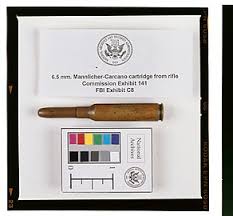
That Oswald was so accurate is explained, to great extent by the way the sight was mounted and by the unusual bullets. The model 38 Carcano that Oswald bought fired light, hollow, 6.5×52mm cartridges. This is a 6.5 mm diameter bullet, with a 52 mm long casing. The cartridge was adopted by the Italians in 1940, and dropped by 1941. These bullets are uncommonly bullet is unusually long and narrow (6.5 mm = .26 caliber), round-nosed and hollow from the back to nearly the front. In theory a cartridge like this gives for greater alignment with the barrel., and provides a degree of rocket power acceleration after it leaves the muzzle. Bullets like this were developed in the US, then dropped by the late 1800s. The Italians dropped this bullet for a 7.5 mm diameter version in 1941. The 6.5 mm version can go through two or three people without too much damage, and they can behave erratically. The small diameter and fast speed likely explains how Oswald’s second shot went through Kennedy and Connolly twice without dong much. An American bullet would have done a lot more damage.
Because of the light weight and the extra powder, the 6.5 mm hollow bullet travels uncommonly fast, about 700 m/s at the muzzle with some acceleration afterwards, ideally. Extra powder packs into the hollow part by the force of firing, providing, in theory, low recoil, rocket power. Unfortunately these bullets are structurally weak. They can break apart or bend and going off-direction. By comparison the main US rifle of WWII, the M1, was semi-automatic, with bullets that are shorter, heavier, and slower, going about 585 m/s. Some of our bullets had steel cores too to provide a better combination of penetration and “stopping power”. Only Oswald second shot stayed pristine. It could be that his third shot — the one that made Kennedy’s head explode — flattened or bent in flight.
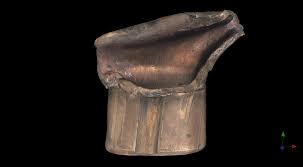
Oswald fragment of third bullet. It’s hollow and seems to have come apart in a way a US bullet would not.
The extra speed of Oswald’s bullets and the alignment of his gun would have given Oswald a great advantage in accuracy. At 100 yards (91 m), test shots with the rifle landed 2 1⁄2 to 5 inches high, within a 3-to-5-inch circle. Good accuracy with a sight that was set to high for close shot accuracy. The funky sight, in my opinion , explains how Oswald managed to miss Walker, but explains how he hit Kennedy accurately especially on the last, longest shot, 81 m to Kennedy’s head
Given the unusually speed of the bullets (I will assume 750 m/s) Oswald’s third shot would have taken 0.108 s to reach the target. If the sight were aligned string and if Kennedy were not moving, the bullet would have been expected to fall 2.24″ low at this range, but given the sight alignment we’d expect him to shoot 3-6″ high on a stationary target, and dead on, on the president in his moving vehicle. Kennedy was moving at 5 m/sand Oswald had a 17° downward shot. The result was a dead on hit to the moving president assuming Oswald didn’t “lead the shot”. The peculiarities of the gun and bullets made Oswald more accurate here than he’d been in the army, while causing him to miss Walker completely at close range.
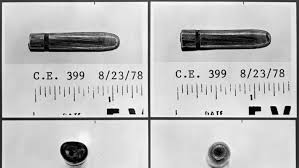
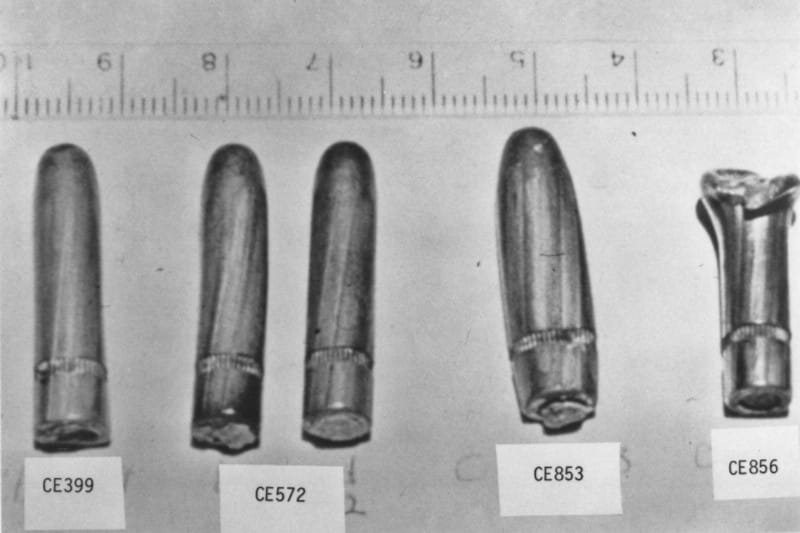
comparison of the actual, second shot, “magic bullet,” left, with four test-shot bullets. Note that one of the test bullets collapsed, two bent, and one exploded. This is not a reliable bullet design.
We now get to the missed, first shot: How did he miss the car completely firing at the closest range. The answer, might have to do with deformation of the bullets. A hollow base bullet can explode, or got dented and fly off to the side. More prosaically, it could be that he hit a tree branch or a light pole. The Warren commission blamed a tree that was in the way, and there was also a light pole that was never examined. For all we know the bullet is in a branch today, or deflected. US bullets would have a greater chance to barrel on through to at least hit the car. This is an aspect of Italian engineering — when things are light, fast, and flexible, unusual things happen that do not expect to happen with slow, ugly, US products. It’s a price of excellence, Italian style.
Another question appears: Why wasn’t Oswald stopped when the FBI knew he’d threatened Kennedy, and was suspected of shooting at Walker. The simple answer, I think, is that the FBI was slow, and plodding. Beyond this, neither the FBI nor the CIA seem to have worried much about Kennedy’s safety. Even if Kennedy had used the bubble top, Oswald would likely have killed him. Kennedy didn’t care much for the FBI and didn’t trust Texas. Kennedy had a long-running spat with the FBI involving his involvement with organized crime, and perhaps running back to the days when Kennedy’s father was a bootlegger. His relation with the CIA was similar.
The Mateba, Italian semi-automatic revolver, $3000, available only in 357 Magnum and 44 magnum.
I should mention that the engineering styles and attitudes of a country far outlast the particular engineer. We still make big, fat, slow, ugly cars — that are durable and reasonably priced. Germans still overbuild, and Italian cars and guns are as they ever were: beautiful, fast, expensive, and unreliable. The fastest production car is Italian, a Bugatti with a top speed of 245 mph; the fastest rollercoaster is at Ferrari gardens, 149 mph, and in terms of guns, let me suggest you look at the Mateba, left, a $3000 beautiful super fast semi-automatic revolver (really), produced in Italy, and available in 357 magnum and .44 magnum only . It’s a magnificent piece of Italian engineering beautiful, accurate, powerful, and my guess is it’s unreliable as all get out. Our, US pistols typically cost 1/5 to 1/10 as much. A country’s cars, planes, and guns represent the country’s aesthetics. The aesthetics of a county changes only slowly, and I think the world is better off because of it
Robert Buxbaum, February 14, 2020. One of my favorite courses in engineering school, Cooper Union, was in Engineering Aesthetics and design.