Monthly Archives: January 2026

Tariffs raise $30 billion per month, but haven’t affected inflation

Economic experts claimed the tariffs would raise no signifiant money, would bring in no jobs, and would be so inflationary that the damage would far exceed any benefit. President Trump instituted them anyway, claiming they would benefit workers, raising wages, returning manufacturing to the US, and serving as a tool of diplomacy. Based on data so far, it appears the experts were completely wrong, and that Trump was right on all counts.

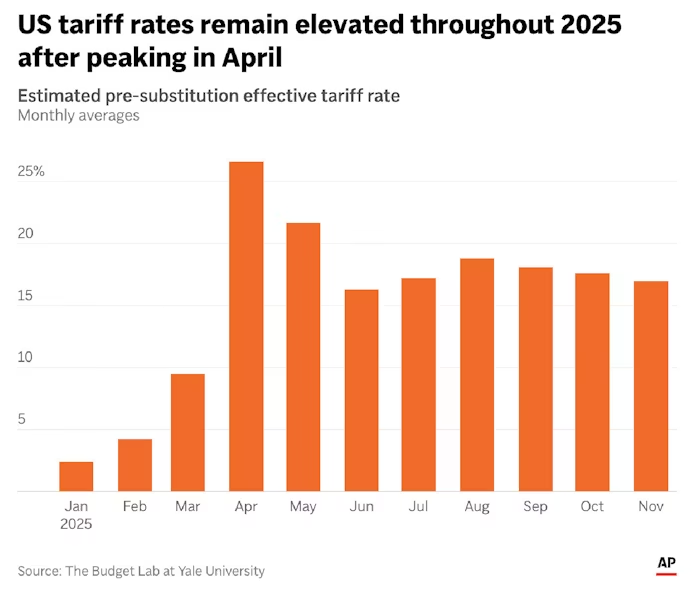
As an average, for the last nine months, our tariff rate has been about 17%, as shown in the chart above, bringing in about $30 billion per month. That tariff rate is as high as it’s been since the 1940s, but far lower than it was in the early 20th century. Chinese products are taxed more, at 47.5% on average, while goods from Mexico and Canada are taxed less, about 5%. High or low the tariffs generate complaints all around. Strangely, those complaining, in the US and out, see nothing amiss with the tariffs that our trading partners have placed on US products. The money from these tariffs came in handy, for example during the recent government shutdown, when we could not borrow money. This tariff money allowed us to pay the military and has helped reduce the annual deficit.

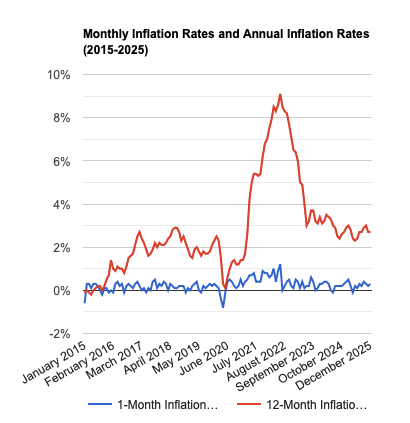
Despite the dire inflation prediction, there has been no noticeable uptick. Inflation has held constant for the last year, at about 2.7%. This is the same as during the last months under Biden, see chart, and is far lower than the 4-8% we saw for most of the Biden term. Basic commodities, in particular, remain cheap, with the price of gasoline and beer lower than in 2024, and luxury imports somewhat more expensive. Lower and middle income Americans don’t seem to mind since most of us don’t buy these goods. This year of inflation data supports Milton Friedman’s claim that taxes are inflation neutral, and that the cause of inflation is government overspending, as he says here. Liberal experts disagree, but the data says otherwise. I suspect the experts are blinded by overly simple theory, of Keynes, that they refuse to abandon. Alternately, they may be willfully lying to promote the agenda of university heads and all others who fund them. I noticed this pattern with global warming experts too. They don’t change their models and dire predictions though it’s way past 2014, and the arctic isn’t ice free.

There has been some job growth, but less than hoped for. There was a decrease in the tech sector and in government employment, but an uptick in services and healthcare. Unemployment has changed little, remaining at 4.4%. Several foreign businesses have moved manufacturing to the US. These include BASF, Volkswagen, LG, and Hanwha to name a few. Hanwha just completed its purchase of the Philadelphia shipyard, and committed $5B to its modernization. I consider this very important. It provides jobs, but beyond this, improved shipbuilding will help us commercially and militarily.

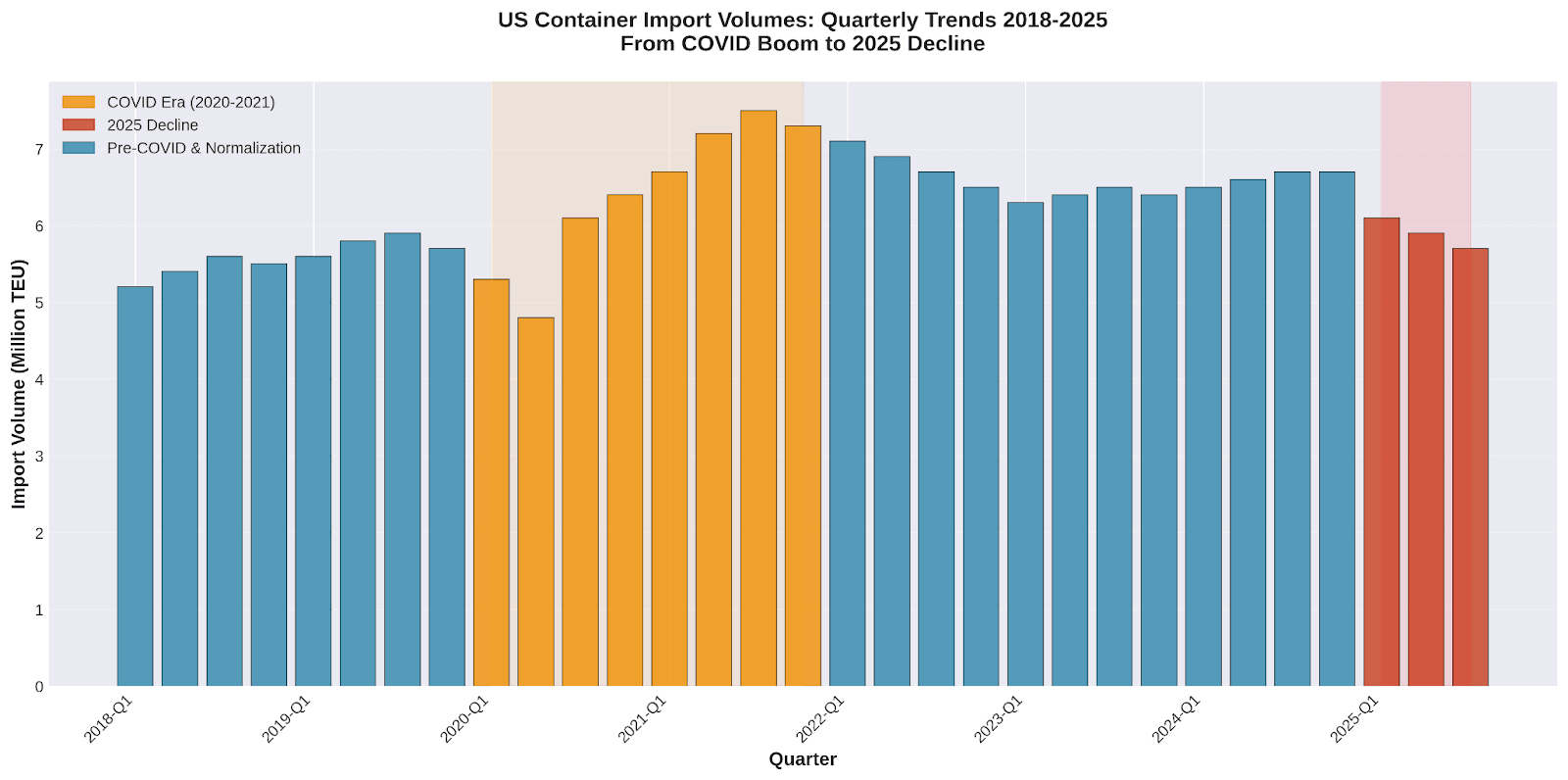
The reason that employment has not gone up as much as hoped seems to be that we’re still buying the same amount from abroad as before, containerized are the same as in the pre-COVID years, see chart below. There’s been some switching of sources, with more coming from Mexico, Taiwan, and Vietnam, and less from Canada and India. Import volumes from China have hardly changed though, since last year, nor have the prices that Americans pay risen. This suggests that China is “eating the tariffs”. I suspect they’ve undervalued their currency to make this happen. We’re selling a little more too, causing the trade imbalance to narrow, but the sales increase are largely precious metals (gold) to China, about 1000 tons in 2025. I’m not sure what China achieves by this; they’ve raised the price of gold to $4,675/oz currently, about double in 1.5 years, and kept the price of Chinese currency low. Perhaps that’s the intent — to keep their currency devalued relative to the dollar. Maybe they have some other idea, like to switch to a gold-backed currency? Who knows? Their purchases increase the value of our gold in Ft. Knox.

Trump’s other justification for the tariffs was as a tool of diplomacy. Trump is using tariffs somewhat this way, as a non-military stick to encourage friendly nations to do what he wants. He got Mexico to stop immigrants and drugs, encouraged the same from Canada and Columbia. He got the EU to spend more in their defense, and got them deal a little less with Russia. They’re still the biggest buyer of Russian natural gas. He also used tariffs to nudge for peace in the Middle East, and between Cambodia and Thailand. Recently, he’s using them to support the Iranian rebels by threatening countries that buy from Iran, or that help the mullahs launder their money and oil. All in all, the tariffs seem to be working for us. The experts are not impressed.

Robert Buxbaum, January 19, 2026

EDDS chelation for electroless coating, solar cells and soil remediation

Among the products our company sells is a non-toxic chelating agent, EDDS (ethylenediamine-disuccinic acid), typically sold as a purified salt in ammonia solution, see here. The main use of EDDS is to stabilize heavy metal ions in solution. We use it, for example, as an aide in electroless Palladium coating, to stabilize palladium ions, helping us produce a smaller grain, more continuous coat. The structure, shown below, is similar to that of EDTA (ethylenediaminetetraacetic acid), and the behavior is similar too. EDDS is more stabilizing in the presence of the other ions and we like that it is non-toxic.

Structure of EDDS, it binds metals by way of four OH groups. While each binding is weak, the total is strong.

The popular literature use for chelating agents like this is as a treatment for heavy metal poisoning by lead, arsenic, cadmium, nickel or copper. The TV series “House” featured patients with all these metal-poisoning problems, problems. Chelation treatment was important in Flint Michigan, 2015 when thousands got low-level lead poisoning and legionaries disease after the water department put insufficient phosphate and hypochlorite into the water and lead leached from pipes. Typically, EDTA is used for humans here, while EDDS is used by farmers and ranchers to treat animals. EDDS is less toxic, and removes fewer essential light minerals: magnesium, calcium, and zinc, so I’d think it would be better for humans too.

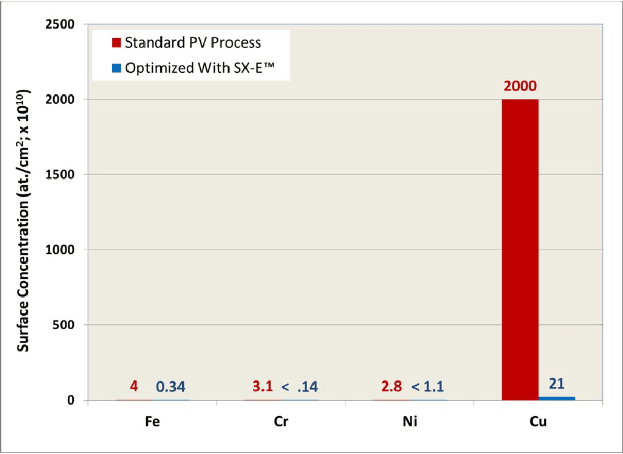
Effect of 300ppm SX-E in DI water, compared to standard DI water and acid wash. The biggest difference is with copper.

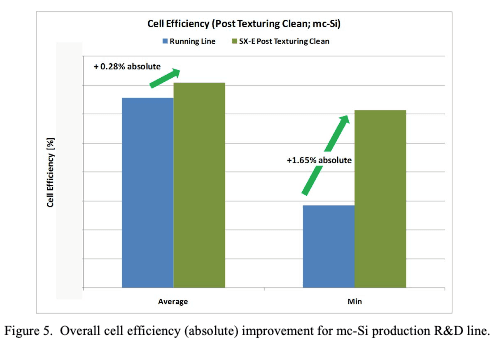
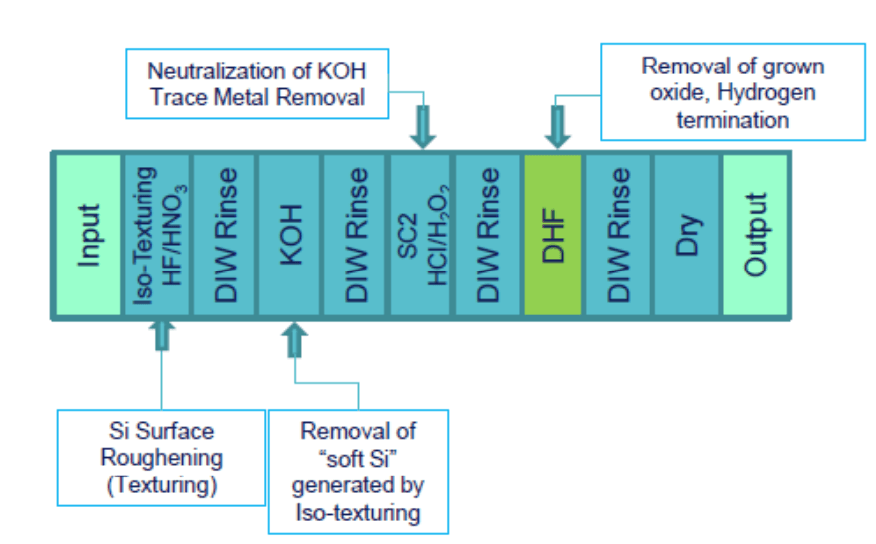
Our EDDS has been used to make cleaning solutions for silicon wafers, Sunsonix SXE, for example. Sunsonix SXE behaves as a soap, removing Fe, Cr, Ni, and Cu from solar cells, see reproduced figures at right. These metals will diffuse into surface of a silicon wafer, forming defects that absorb light and decrease solar cell performance by an average of 0.28%, see below.

Solar cell efficiency improvement with EDDS washing from a baseline of 16%. Occasionally 1.65% improvement was seen, but 0.28% on average

This is, based on a baseline efficiency of 16%. For more details see “Surface Contamination Removal from Si PV Substrates Using a Biodegradable Chelating Agent and Detection of Cleaning Endpoints Using UV/VIS Spectroscopy” ECS Transactions, 41 (5) 295-302 (2011). See also this article in Wikipedia.

This is the normal treatment regime for solar cells

At a different pH, EDDS and EDTH are used in remediation of metal-contaminated soils, see here. This can be done ex-situ, with the soil taken out to an external site and then washed. Alternately, for less contaminated soils, remediation can be done in-situ with the chelating wash applied to the soil. Plants, like vetiver grass (Chrysopogon zizanioides) then extract the heavy metals, concentrating them in their leaves. EDDS is more suitable for this as it is biodegradable and shows a high extraction efficiency in mineral rich soils, see here for comparison to EDTA.

Moving to another area of extraction. It seems that EDDS or EDTA solutions can be used to profitably extract rare earth metals, perhaps sending them to plants before final concentration. A standard methods of rare earth extraction uses chlorine and high temperatures. Alternate methods use ion-exchange extraction of liquid-liquid extraction. I suspect that chelation treatment might turn out to be more effective and cheaper. The price of rare earths has risen in recent years as China restricts sales so that the need for a new source has become a national priority.

Robert Buxbaum, January 13, 2026

Trump’s battleships, right size, perhaps too late

Donald Trump has announced his intent to build at least two battleships, the first built for our navy since the USS Missouri, 1944. The press has been largely negative on this, claiming that these ships are obsolete already, and will be more-so when they are completed — assuming they are completed. My sense is these are useful, overdue really, and I’d like to explain why.

The George Washington Carrier with nine surface support ships.

The centerpiece of America’s military power lies in our aircraft carrier groups, currently. We have 11 carriers in service: two modern, Ford class, and nine older, Nimitz class. Each of these weighs 100,000 tons, is 1100 feet long, and carries some 6000 men and women, 3200 navy crew, another 2500 in the air wing, and perhaps 300 support staff of doctors, nurses, and marines. Because they are vulnerable, each carrier travels in a group with six to ten other ships carrying an additional 3000 people, see photo. Without the support ships a carrier is deemed to be too vulnerable for use. Even with the support ships, Swedish and French submarines successfully “sank” U.S. carriers during exercises in 2005 and 2015. 

The support ships are typically slower than the carrier and difficult to maintain. Many are old with relatively short range. Our carriers can go around the world, 30000 miles, traveling at 30+ knots, but the main support ships, Arleigh Burke destroyers, 9000 tons, 350 crew, have a range of only 4,400 nmi  at a slower, 20 knots. They require regular refuelings for any major mission, like patrolling the Caribbean. Still, they’re “cheap,” about $2.5B each, capable, and work relatively well. We have some 75 in service, built since 1991, with more on order.

We also have nuclear missile submarines, but these are blunt instruments of policy, not suited to most navy missions, like keeping open shipping lanes in the Red Sea or stopping ISIS, or for blockading Venezuela. The mostly hold weapons of last resort.

The navy has recognized the need for a larger support ship for better carrier protection and more flexible roles, a cruiser likely, with good range and weapons, and with enough speed to keep up with a carrier crossing the Pacific. We’ve built many cruisers over the years, but these are old. Our latest are the Ticonderoga class  guided-missile cruisers built from 1980 onward. They have good speed, 32.5kn, and good range, 6000nm, but are well past their retirement date, and break down a lot. Only 7 are still in service.

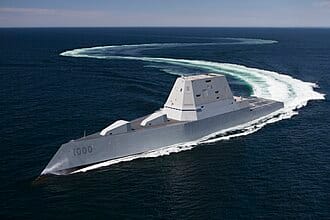
The USS Zumwalt at sea. Trump said it was “Ugly as F.”

The supposed replacement, was a cruiser-size, stealth ship, the Zumwalt destroyer, 17,000 tons and 600 feet long. It is reasonably fast, 33.5kn, and carries a small crew, <100. We’ve managed to build three of these since 2008, but have cancelled the project due to operational problems and costs that rose to $8B per ship. Zumwalts have inward-sloped sides that deflect radar, but they become unstable in turns. Its main weapons are expensive, too: Aegis missiles and CPS hypersonics costing $28-$50 million each. That’s uneconomical compared to French Aster missiles, Mach 3, 80 mile range, $1.1 million. Originally, Zumwalt destroyers carried a rail gun, but it required so much power that you could not move the ship and fire at the same time. The rail guns were eventually replaced by conventional 5″ cannon with a 24 mile range. The three Zumwalts we have are hardly used today, and no more are on order. Something cheaper was needed at least for support, and that was supposed to be the Constellation Frigate, approved by Trump in 2017.

A frigate is smaller than a cruiser, in this case about half the weight. The Constellation was a proven Italian design, 492 feet long and only 7,291 tons. It had good speed, 26 kn, good range, 6000 nm at 16kn, and cost only $950 million, at least when built in Europe. The contract was awarded to Fincantieri Marinette Marine (FMM) of Marinette Wisconsin, the US division of the Italian company. What could go wrong? The problem was that the navy kept adding capabilities and weight. As of November 2025, eight years on, the weight had increased by 700 tons, the cost to $9 B for two, and no design has been finalized. The first Constellation frigate is only 12% built! Trump has not quite cancelled the program, but has reduced the order to two from the original eight.

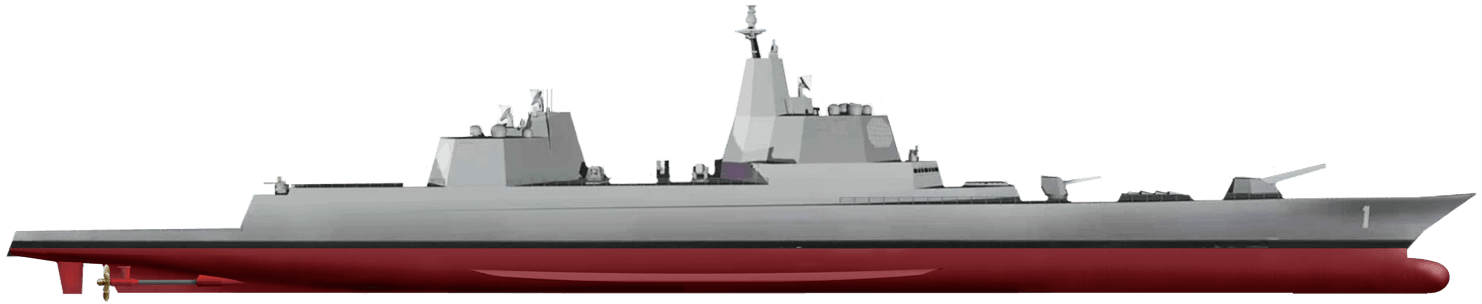
Trump-class battleship, as envisioned, with a rail-gun, lasers and two, conventional 5″ cannon.

And that brings us to the current, Trump class battleship, shown above. It’s long, 840-880 feet, and heavy, 39,000 tons, or 2.5 times the weight of the cruiser-sized, Zumwalt. As was intended for the Zumwalt, the offensive weapons are missiles and a rail gun, 32 MJ, but now there is enough power run the ship and fire the weapon. Japanese versions of the rail gun have launched cheap shells at hypersonic speeds, ~5000 mph (hypersonic) at a distance of over 100 miles and a fire-rate of ~one per second. The shells cost only $85,000 each, a bargain compared to hypersonic missiles.

For defense, these battleships are to carry two, 300kW, Helios lasers, similar to Israel’s “Iron beam,” but 3 times as powerful. They are augmented by smaller lasers, by four, 30 mm chain guns (Gatling guns), and two, 5″ conventional navy guns of 24 mile range. Engines are estimated to be two gas turbines, perhaps 50MW each of for acceleration and to power the weapons, plus ~100 MW in diesel power for cruising at good speed and mpg. I thus estimate a total of ~200 MW, about as much as on a carrier. There is plentiful space for missiles and fuel, so it should provide some resupply of support ships. The crew size is bigger than on the Ticonderoga, 600 to 800, but far less than on a carrier, and the look is impressive. A Trump goal is that it should be an attractive, command ship. Still, there are objections.

A main complaint is vulnerability as discussed here, the claim is these ships are “bomb magnets,” not stealthy, nor as heavily armored as the Iowas. Detractors claim that lasers and chain guns are insufficient for defense from drone swarm attacks. They note that the Bismarck, Yamamoto, and Arizona have been sunk, typically by air attack. What the detractors don’t mention is that it took a lot of bombs and torpedos to sink these battleships nor that these battleships will travel with support ships, while the Bismarck travelled alone.

Detractors also question the rail gun. Can it shoot down an airplane? can it sink a ship? The tests I’ve seen suggest that the rail gun can take out an airplane, but that it can not sink a ship, at least not with one shot. That still needs a missile, but the battleship does have missiles. The gun seems appropriate for shore bombardment too, even against hardened targets, and for dissuading actions by a Chinese navy that is already bigger than ours. As for the defense against drones, the battleship is to have high-powered lasers that have been shown to stop drones and cruise missiles at a cost of only ~$10 per shot. That’s nothing compared to a harpoon missile ($1.4 million each) or Aegis ($28 million). These are great weapons, and I don’t see a smaller ship being able to power them. Also it’s nice to have extra room for expansion — like adding a nuclear reactor.

The time-line is what worries me most. These will take ten years at least. Until then, we will have to rely on our short-range Arleigh Burkes that did not have the firepower to bombard the Houthis effectively on land, nor effectively defend US shipping in the Red Sea. Those ships had to use million-dollar missiles to shoot down $20,000 drones. I expect us to really need the battleships, even if it takes us ten years to get one.

Robert Buxbaum, January 5, 2026. As a totally side issue: some claim this isn’t a battleship. It carries only one gun, admittedly a powerful gun. I half agree, you need at least two big guns to be a battleship, IMHO.