Category Archives: space

Blue Origin isn’t a SpaceX killer but a Boeing SLS killer

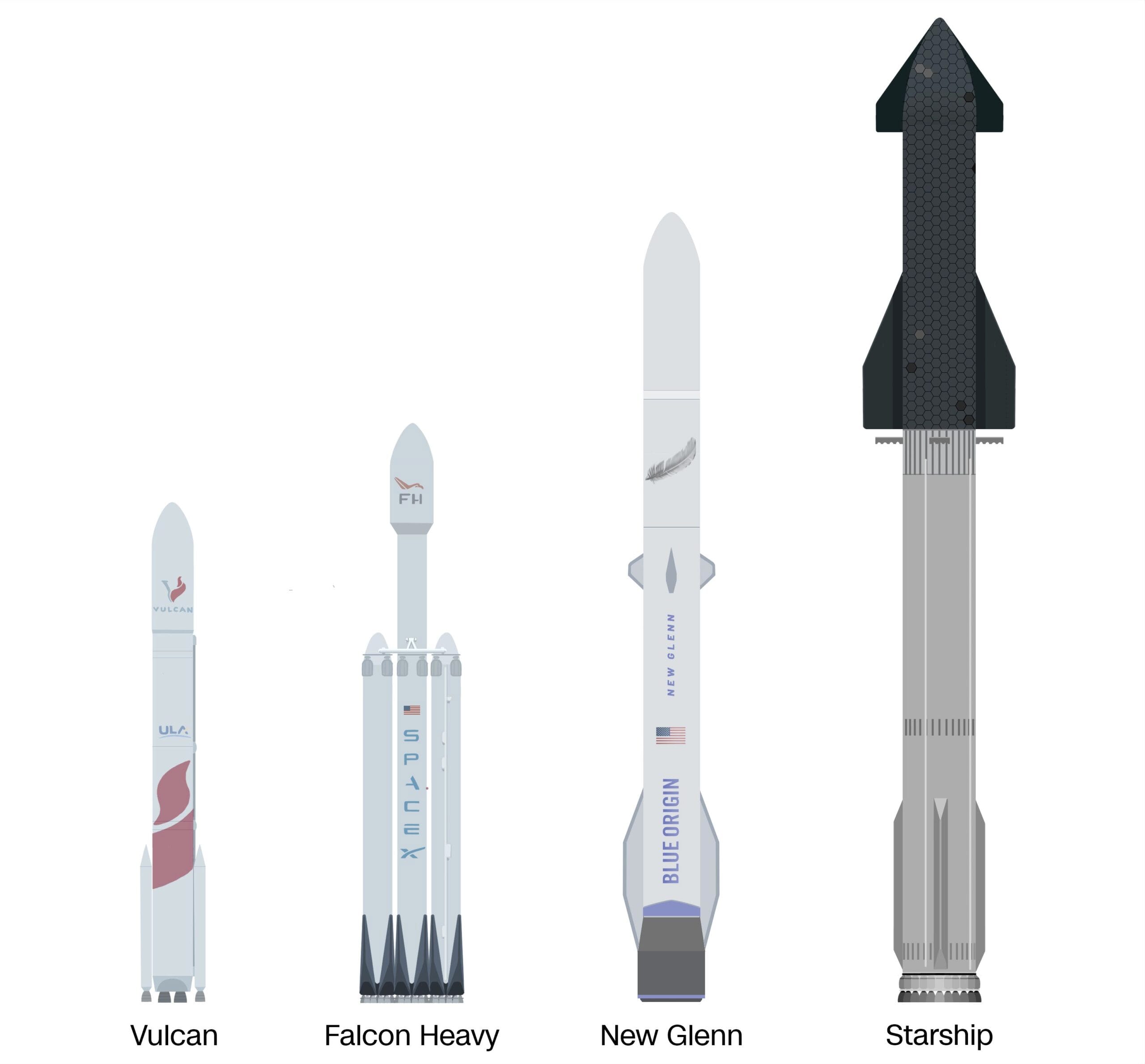
CNN comparison of heavy lift, US rockets. Boeing’s SLS is not shown.

Blue Origin had its third New Glenn flight last week, and though it wasn’t quite successful, in that the satellite failed to reach proper orbit, it was successful in that it launched, reached space, and returned to a barge. It had a larger faring than even Falcon Heavy, and in terms of payload and price per ton, it beat SpaceX’s main vehicle, the Falcon 9. A SpaceX Falcon 9 flight will cost you $72 million with a weight limit to LEO of 17,400 kg. By contrast, New Glenn flights are priced at $80 million with more than double the weight limit to LEO, 45,000 kg. The price per Kg is less than half, and the faring is bigger. What’s not to like?

For now SpaceX products still retain an edge. The Falcon Heavy will lift more weight to LEO than the New Glenn (one launched today), at an even lower price per kg. Besides, SpaceX’s products are reliable, they’ve launched 240 commercial flights in the last 16 months alone, and all were successful. Blue Origin is still viable in that they’re relatively cheap and fill an important gap in SpaceX’s size portfolio, but they’re not a SpaceX killer. On the other hand they seem like a killer of Boeing’s two space projects, the CST Starliner, and the Boeing SLS that launched Artemis earlier this month.
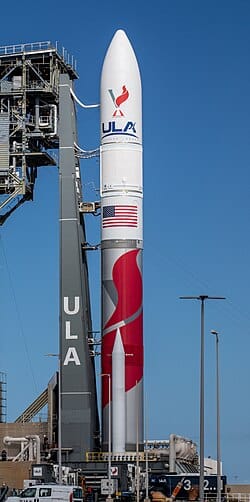
United Launch Alliance’s Vulcan rocket pairs two Blue Origin engines in the lower stage with as many as six solid booster engines from Teledyne.

CST Starliner is Boeing’s space capsule. It was vastly over budget and behind schedule. And when the first semi-successful version reached the Space Station with Astronauts in 2024, it showed multiple malfunctions and was condemned to return to earth unmanned. The astronauts were rescued in a SpaceX Dragon. NASA will want an alternative to Dragon, but now Blue Origin provides one. It’s the same story with Boeing’s SLS. Like the capsule, it was vastly delayed and over budget. While it provided the lift for Artemis II, that was after a near four year delay since Artemis I, November, 2022. The price per kg to launch on SLA is $37,000/kg, about twenty times that of a launch on Falcon Heavy or New Glenn. The only justification for SLS, as I see it, is that it was the main alternative to SpaceX. Now it isn’t. For more on the comparison, see here.

Both SpaceX and Blue Origin have newer versions for reusable heavy lifting due to debut within the year. SpaceX hopes to launch their Starship V3 next month. If it works as predicted, the throw weight will be triple that of New Glenn at a fraction of the cost per kg. Blue Origin has a larger version of New Glenn in the works, the 9×4 also reusable. Blue Origin has also started supplying high efficiency methane-burning engines for the Vulcan Centaur rockets made by ULA (United Launch Alliance). ULA continues to make the Atlas V rocket, but these are powered by Russian RD180 engines aided by Teledyne solid boosters. The Russian contract ended after Russia’s invasion of Ukraine, and ULA’s supply is almost exhausted. Since 2025 ULA has flown two missions successfully using Blue Origin’s, BE-4 engines instead, aided as before, by Teledyne boosters. The price per kg on these Vulcan Centaur rockets is well below that of the old Atlas V, because with BE-4 they can reuse the lift stage. For all of these, the price is far below a flight on Boeing SLS.

The French too have improved their Ariene line. They’re now reusable, and while they’re somewhat expensive, and can’t lift as much as the New Glenn, Falcon Heavy, or Vulcan, they’re cheaper than Atlas V, and are an alternative for deep space projects. With these alternatives I see little value in continuing with Boeing’s SLS. When I look for a path to the moon and beyond, I look to Starship and perhaps New Glenn.

Robert Buxbaum, April 27, 2026
Does solar powered AI on the moon and in space make sense?

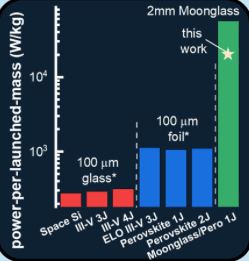
Jeff Bezos’s “Blue Alchemist” program recently got $25M from NASA to develop moon-based solar cell manufacturing on earth. See article here. The idea sort of makes sense to me: instead of transporting solar cells to the moon from earth, why not make them on the moon in bulk. Even light solar cells would weigh about 1kg/kW, making cells on the moon would reduce the effective weight per kW by a factor of 100 it is predicted, see figure. Given a need for megawatts of power, and the high cost to transport things to the moon, $1M/kg currently, this may make sense for the not super-distant future. Moon-made solar cells could reduce the cost per kW on the moon from $1million currently, to a mere $10,000/kW, cheap by moon prices, though super expensive by earth standards.

Elon Musk, perhaps out of envy or long-range vision, wants to go far further. He” recently’s posted’s proposed, at length a plan to launch moon-made solar cells into space along wit moon-made AI chips, with all this done to power AI centers in space, orbiting the earth or moon, see him discuss it here. He notes that “It’s always sunny in space”, so this electricity should be cheap. I don’t consider even moon-solar at $10,000/kW cheap, and power from these moon-launched cells will be pricer yet.

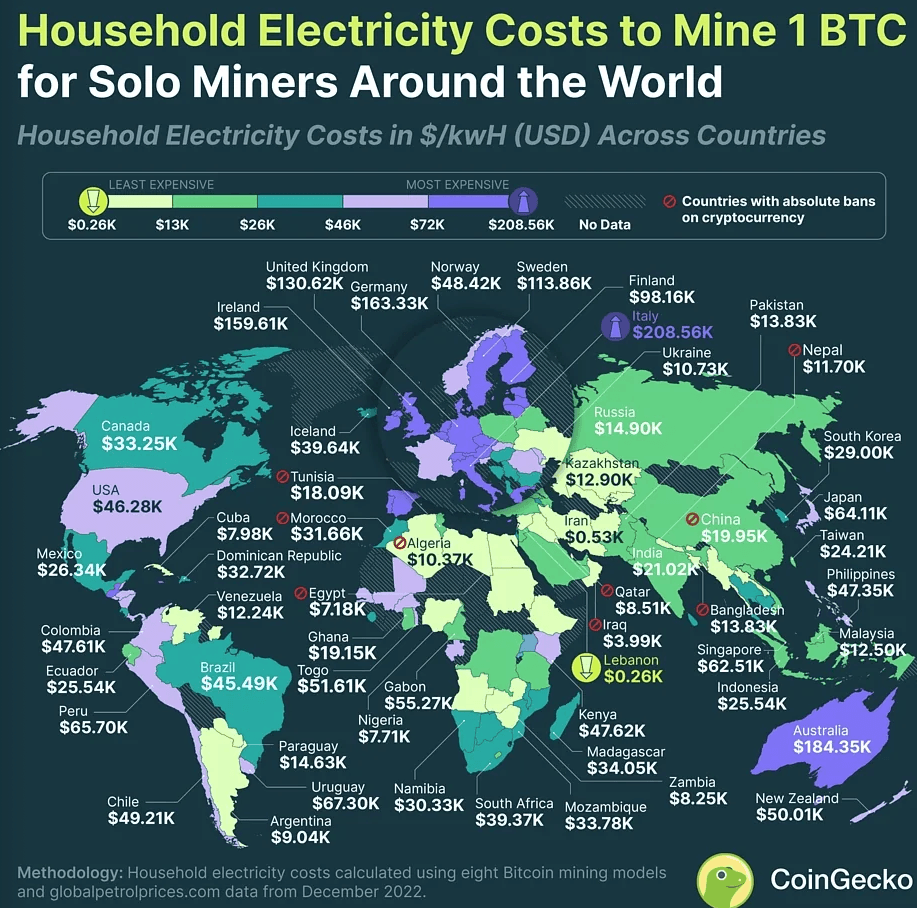
The reason all this makes sense to Musk is that he avoids the disruptions of solar power that come at night-time, and he avoids regulatory boards. He argues that there is no real alternative! given that power on earth is too hard and expensive, and complains that regulators oppose new power plants. I suspect there are some over-regulations, but some regulations are necessary, and I doubt he’ll avoid by going to space. As for the high cost of power, it’s really cheap in China, Lebanon, Iraq, Iran…Just look att he figure below showing the electric cost of bitcoin harvesting around the world. China runs on nuclear power or coal, delivering large-scale electricity at ~ 2¢/kWh. You can make power at a similar cost if you build your own plant, many of the bit-coin folks operate that way. It’s not exactly cheap, but a known technology, and cheaper than space solar amortized to less than 50 years.

AI chip-making is hard to do, even on earth, requiring water, chemicals, equipment and technical attention. Most companies can’t do it; China has barely cracked the technology. Doing it on the moon adds unnecessary difficulties: water and chemicals scarce, skilled servicing labor is hard to find. At some point, the moon and Mars community will want to make AI in space, but before that, they’ll want to make simpler things, like rice cookers. Until we have a fairly large community on the moon, why now make AI chips on earth. If he’s looking for practice, Musk could manufacture in a place that’s inhospitable, but more accessible than the moon: Greenland or Antarctica or the top of Everest. These locations are wam compared to the moon, and they have air and water, and I suspect electricity on Everest is cheaper than on the moon.

Operating AI centers in space is not particularly attractive, by the way. Chips have a tendency to flake-out in space because of cosmic radiation and stronger electromagnetic fields (EM). For this to work at all, chips have to be built specially robust, with correction software that must be particularly active, and you must shield everything from EM to a much greater extent than on earth.

I suspect the reason Musk wants to manufacture AI in space, and to operate there, is to over-shadow Bezos’s solar cell factory, and show off his own (Tesla) technology. Also to have a use for his Starships lifting heavy complicated things. It’s not a plan I would back.

Robert Buxbaum, March 1, 2026