A proven way to remove a leader is to accuse him of trying to become a king. The Democrats keep trying this, but they lack a great orator to make the case in a way that gets the guy out. The classic speaker for this, someone most everyone in college read, was Marcus Tullius Cicero. Take, for example, his speech against Catiline, his fellow senator, that got Catiline removed, and then murdered. I’ve copied a bit below, in translation from Latin.
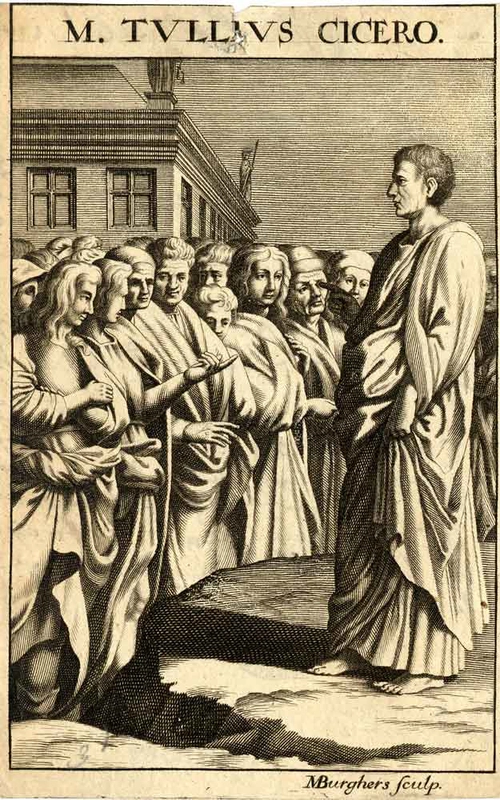
WHEN, O Catiline, do you mean to cease abusing our patience? How long is that madness of yours still to mock us? When is there to be an end of that unbridled audacity of yours, swaggering about as it does now? Do not the nightly guards placed on the Palatine Hill—do not the watches posted throughout the city—does not the alarm of the people, and the union of all good men—does not the precaution taken of assembling the senate in this most defensible place—do not the looks and countenances of this venerable body here present, have any effect upon you?
Do you not feel that your plans are detected? Do you not see that your conspiracy is already arrested and rendered powerless by the knowledge which every one here possesses of it? What is there that you did last night, what the night before—where is it that you were—who was there that you summoned to meet you—what design was there which was adopted by you, with which you think that any one of us is unacquainted?
Shame on the age and on its principles! The senate is aware of these things; the consul sees them; and yet this man lives. Lives! aye, he comes even into the senate. He takes a part in the public deliberations; he is watching and marking down and checking off for slaughter every individual among us. And we, gallant men that we are, think that we are doing our duty to the republic if we keep out of the way of his frenzied attacks.
You ought, O Catiline, long ago to have been led to execution by command of the consul. That destruction which you have been long plotting against us ought to have already fallen on your own head……
……. speech, source.
It’s strong stuff, far better than the democrats have yet presented, with lines of innuendo and attack that have been reused many times since. Cicero claims to understand the thoughts of Catiline as he sits in the senate. He accuses Catiline, not only of wanting to be king, but of wanting their deaths: “He is watching and marking down and checking off for slaughter every individual among us.” Catiline was exiled, and then, with Cicero’s encouragement executed without trial. Julius Caesar argued for Catiline, claiming he should be imprisoned, but no more. So Caesar was exiled to fight the Britains and Gauls.
In time, Cicero and his friends came to believe that Caesar too dreams of kingship too, He had become too successful and uncontrollable. He needed to be re-educated, according to Cicero (below).
“Men who become uncontrollable and overconfident as a result of success need to be put through a round of training in reason until they recognize the fragility of human affairs and the uncertainty of fortune.”
Marcus Cato’s assessment was even stronger, in the senate he, argued that Caesar’s fight with the Gauls was illegal and immoral, and that he should be stripped of power. Democrats argue this today regarding the war in Venezuela and Iran. I think they are wrong, but the argument is the same, that we/I are the rightful power, and I/we know the evil plans in Caesar’s mind. The senate agreed to strip Caesar of power, but use deception getting it. Caesar, knowing how this would likely turn out, returned to Rome, fought Cicero’s and Cato’s friends, and pardoned Cicero 45 BCE. Cato committed suicide. About 1 year later, though, on the 15th of March, a group of Caesars so-called friends stabbed him to death in the senate, as recounted here. Cicero was killed in the bloody civil war that followed. What goes around comes around. And a dictatorship ensued.
I’m not convinced that Cicero’s attacks were legitimate, nor the Democrats’ attacks. In both cases, the speakers claim to know the evil thoughts in the mind of the leader. In both cases, the proposed solution was leadership by group consensus — leadership by a group who could not agree on anything beyond their own unhappiness.
Legitimate or not, attacks by a good orator worked. They caused the death of Catiline and Caesar, and many others over the years. Generally, they don’t benefit the great speaker, long term, nor result in freedom. I’m reminded of Trotsky, here. The lesson for those pushing to depose Trump is you need a really good speaker, and you could get a leader who’s worse. Your speaker needs to convince the audiences that he knows what his enemy is thinking. So far, no Democrat has managed to convince an audience of this, or even vaguely that he knows what Trump will do next.
Robert Buxbaum, June 24, 2026