Monthly Archives: April 2024

7% of new US vehicles were EVs in 2023. Expect slow growth in 2024.

About 7% of new US car and truck sales in 2023 were electric, 1.2 million vehicles. Of these, about 55% were Teslas. These numbers make sense based on US manufacturing and driving habits, so I don’t expect fast sales growth in 2024.

Currently home owners are the only major group of private drivers that save on fuel cost from owning an EVs. Home owners pay relatively little for electricity, about 11¢ per kWh, and they can generally charge their EVs conveniently, at home, overnight. Charging is more expensive and inconvenient for apartment dwellers. As a result, in 2023, some 95% of US EV sales went to home owners. Over 2 to 3 years they could hope to recover in gasoline savings the $7000 more that their EVs cost compared to petrol-powered vehicles, but they still have to drive a fair amount. A full charge of 80kWh EV at home will cost about $8.80 at current rates. This will power about 250 miles at a cost of 3.5¢/mile = $8.80/250.

Home, level 2 Chargers will cost about $1500 including the electrician cost.

The cost of gasoline is about 16.5¢/mile = $3.80/gal/ 23mi/gal) suggesting that you save 13¢ per mile by owning an EV. In order to recover the extra $7000 cost of the car in two years, you’d have to drive 27,000 miles per year, or 74 miles per day. To recover the difference in three years, you must drive 50 miles per day or 18,000 miles per year. This is more than most people drive.

EVs also offer reduced maintenance, but customers can balance this against the inconvenience of long charge times and spotty availability of chargers. My sense is that the fraction of Americans who benefit and drive 50-75 miles per day is about 7%. This fraction will increase as EVs get cheaper, but families that can benefit already own an EV.

The average Tesla costs today about $3000 more than the equivalent petrol car, but that still makes it relatively expensive, and it seems that the price differential was intentionally set to match sales to Tesla’s production capacity. Tesla could make EVs cheaper than petrol cars and still make a profit on each, but if they did this, they would have too much demand. Other US auto makers are mostly lose money on EVs and are unmotivated to lower prices. Based on this, my sense is that it is unlikely that sales will be much higher in 2024 than the 1.2 million sold in 2023.

The Chinese have plenty of new EVs, and they are eager to export. Their car market is currently about 50% EV, with companies like BYD selling EVs for as little as $12,000. The Chinese government subsidizes production and powers their EVs with cheap electricity by burning coal. These cars do not seem very good, compared to Tesla, but at this price they would flood the market if allowed to compete. The US government has kept them out with tariffs and with complaints about slave labor. Trump has promised a yet higher tariff, 100% on Chinese cars, if elected. The intent is to preserve US jobs and manufacturing. This is one of those situations where tariffs are good, IMHO.

Toyota Prius, the most popular hybrid.

Hybrids are a third option, cheaper than EVs, high mpg than normal engines. Though they are sometimes touted as a transition to EVs, to me they’ seem to suit a completely different demographic: those who don’t own their own home and drive a lot. Toyota makes the most popular hybrids in the US. They cost about $4000 more than the equivalent petrol car, $30,000 for a Prius vs $26,000 for a Corolla. When using a Prius in the city, you’ll get about 50 mpg, spending 7.5¢ per mile ($3.80/gal / 50 mpg = 7.5¢). This implies a gas savings of about 9¢ per mile vs an ordinary Corolla. Based on this, you have to drive about 27,000 miles per year in the city to recover the cost difference in two years. That’s a lot, and your performance is typically worse with a hybrid: you have a heavier car with a small engine. Maintenance cost is also higher with a hybrid than with an EV: you still need oil changes, fluid changes, belts, etc. and the mpg advantage vanishes on the highway. A hard driving home owner is better off with an EV, IMHO, an apartment dweller with a hybrid. Hybrids also should make sense for taxis and local-haul trucks. I can imagine hybrid sales rising in 2024, perhaps as high as 15% of vehicle sales. What we’re all waiting for is more near-shore manufacturing (or mandates), and this is not likely in 2024.

Robert Buxbaum April 28, 2024
Why did the UK reject Trump’s trade deals?

When the UK left the EU, they gained economic freedom, but lost easy access to their largest trade partner. Trump offered to replace them. No need to follow the EU’s weird green policies, no need to take low cost workers from Poland, Bulgaria, etc. At the beginning of his term, Trump proposed a trade deal during a visit by British PM, Theresa May, the first of four attempts. It, and all others were rejected in a most-forceful and insulting way. Why. Perhaps, at first, May and the British elite worried about a predicted BREXIT crash that never came. May pushed to get back into the EU. If she succeeded, no trade deal would be needed.

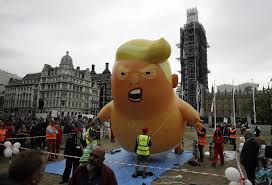
Trump applied for a personal trade visit in July of 2017. Protests ensued with the mayor of London floating a blimp of Trump as a big baby. The British Parliament were divided on allowing the visit at all, with PM May making no strong case either way. The Queen was not sure she had time for tea (she had time for Obama). Trump cancelled the visit in June and tried to negotiate trade from DC, to no success. Britain made trade deals with Norway, Iceland, Israel, and Palestine, but not the US.

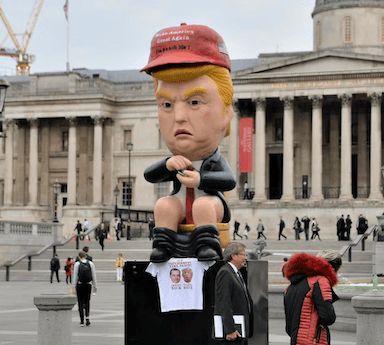
Over the next two years Trump made trade deals with Mexico, Canada, Japan, and Korea. He visited the UK in July, 2019. This time Theresa May was more welcoming as the economy was stalling and she was facing an election. Still, the mayor’s blimp was brought out, towed around England following Trumps travels. There was also an official statue of Trump on the toilet, tweeting, and making fart sounds while saying “witch hunt,” “no collusion*”, etc. The statue was placed in front of Trump’s hotel, and followed him like the balloon, preventable insults not done to any other world leader. No deal was signed. These items now sit on display in a UK museum, as art.

I suspect Trump’s trade offers to the UK were similar to those with other partners, like with Japan, and Japan seemed very happy with the deal. Biden offered to renegotiate, and Japan’s Abe said no, and proposed Trump for the Nobel Prize. So why the British antagonism? Even if they would say no, as India did in 2020, they could have said no politely, as India did to Trump and to the UKs trade deal too.

Perhaps PM May was swayed by the anti-Trump German press (see magazine covers). To UK conservatives, Germany was the leader of Europe (this status has diminished), but May was voted out, replaced by Boris Johnson who was pro-Trump. Johnson’s government also rejected Trump’s deal, acting as if they could recreate the British empire of Queen Victoria — a silly thought. He tried for deals with India, Turkey, and Saudi Arabia. All said no. Then COVID came and the UK economy stalled. Johnson was removed, replaced by Rishi Sunak. Still no deal. Then Biden replaced Trump, and Rishi Sunak, got no deal with Biden. Clearly personality clashes are not the problem.

The UK needs a substantial trade partner or two, it seems to me, soon. Partners with bigger economies than Norway. Britain is suited to be a hub of commerce, information, and banking, currently without any good spokes. The US is the obvious partner. If personality clashes were the problem, there would have been a deal, perhaps between Rishi Sunak and Joe Biden. I suspect that a lot of it is national ego now, even though, since leaving the EU, the UK is doing better than Germany, UK leaders don’t like feeling second best to Brazil and India, recalling better times, perhaps before 1776.

Maybe it’s Biden’s fault that there’s been no deal, but I doubt it. Last week, British Foreign secretary, David Cameron, came to visit Trump at Mar a Lago for a good feelings chat and to start on a trade deal should Trump become president. It’s not clear that Trump will become president, and while it’s nice that there are hopes for a deal, and a need for a deal, I have to think they are not quite ready. If they were, we would not have to wait for a Trump presidency.

Robert Buxbaum, April 18, 2024 *”Russian collusion” was a big deal at the time. A dossier was supposed show that Trump was a Russian agent. It turned out the dossier was created by Democrats and the FBI director. They were trying to save America, they say.