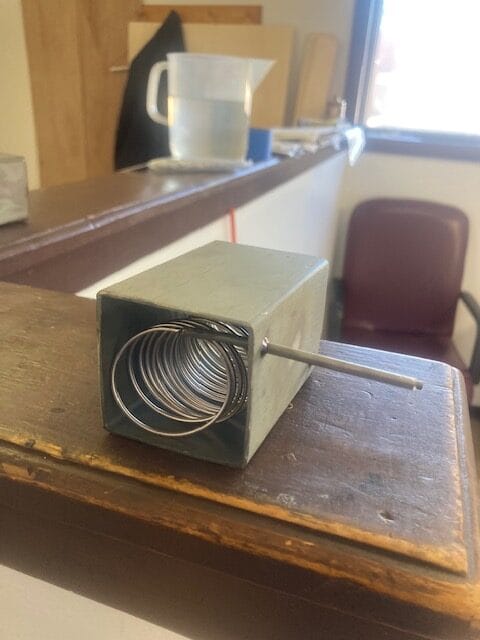
We occasionally make hydrogen stripper systems where the goal is to strip the hydrogen, and sometimes other gases from a mixed gas leaving everything else in place. We use metal membranes, coiled as shown below, if the gas to be removed is hydrogen. For other gases H2S, siloxanes, we use polymeric membranes. In either case, it’s not a product we advertise, but it’s worthy of a blog post.
A typical customer was a Cambridge researcher using gas chromatography with hydrogen as the carrier gas to separate a series of compounds. He now wanted to recover the separated compounds without the hydrogen.
A hydrogen extractor during manufacture.
To minimize the amount of membrane needed, I like to create a plug flow. If the flow is low, or there isn’t much hydrogen, we use a single coiled membrane. If the flow is high or there is a lot of hydrogen, we use several straight membranes in parallel, typically with baffles; we even have a patient for this. Some customers want to recover the hydrogen. If so, we extract it with a vacuum pump. Other customers just want the hydrogen gone. For these oxidation works well. The reaction H2 + 1/2 O2 –> H2O is essentially irreversible, and quite fast on a palladium surface.
A basic analysis is to assume that flux is proportional to hydrogen pressure in the gas, and calculate the hydrogen pressure as total pressure, P, times the fraction of hydrogen in the mixed gas, H/(H + inerts) .
Then, for any small amount of membrane area, dA, the small amount of hydrogen removed per second, dH equals the area, dA, times the permeance of the membrane, P, times P, times H/(H + inerts): dH = -PP (H/(H+Inerts)) dA.
We now rearrange the above: dH(H+Inerts)/H = -PP dA, and integrate:
∫ dH ( H+Inerts)/H = ∫(1 + inerts/H) dH = ∫ -PP dA. It’s found that
Hi – Hf , + inerts • ln (Hi)/(Hf) = PPA. Thus,
A = (Hi – Hf )/PP + (Inerts/PP) ln (Hi)/(Hf).
where A is the total area of membrane needed, inerts = the inert gas flow per second, and and Hi and Hf ate the hydrogen flow rates in the mix at the beginning and end of the extraction. Hi – Hf equals the total amount of hydrogen removed per second.
Note that the first term dominates in the beginning of the extraction process, or where there is a lot of hydrogen content, ln 1 =0), and the pressure of hydrogen is essentially P. The logarithmic term dominates in latter (final) stages, where the inert content is the majority and hydrogen content changes fast. In these later stages, very little hydrogen removal decreases the partial pressure by half, but a significant area of membrane is needed to remove every successive 50% since the hydrogen pressure is continuously decreasing by 50%.
You can derive similar equations for normal distillation, as used to make liquor or refine gasoline. You can also modify the above expression because permeation isn’t always proportional to pressure but to the difference of Pressure to some power, the 1/2 power, or so. I should also mention that, in membrane distillation and liquor it is important to continuously remove components that can build up in the still. For membrane- based hydrogen stripping, we do this using a back-pressure controller, or a flow controller. Thus, if you know you have a feed of 95% hydrogen, 5% desirable inerts, you want a to maintain a suitable back-pressure and you want a flow controller that lets mostly inerts out of the process with minimal H2.
She was only the moonshiner’s daughter, but he lover her still.
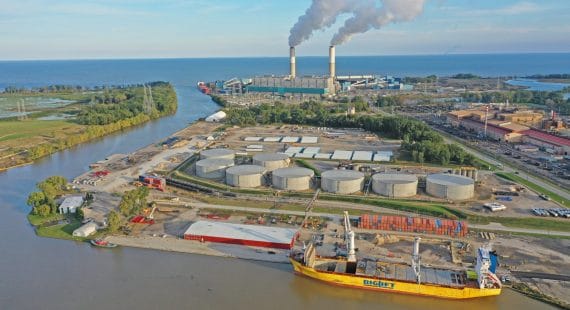
Michigan has only one container-capable port, the port of Monroe, shown below. It’s small, connected to Lake Erie via a channel that’s 500 ft wide but only 21 feet deep. This is OK for handling Great Lakes, wide-bottom rafts and some shallow draft barges, but it is too shallow to handle ocean going vessels, or even larger Great Lakes ships. The only way Port Monroe takes containers is by pushing them onto rafts that are then drawn by tug, typically to Canada. The port has been neglected due to a belief, popular with Michigan Democrats, that fast rail traffic is the future success, while ports are the past. This is a popular belief in Europe, Japan, and China, but planes, cars, and ships make more sense in the US I think, in part because of regulations that prevent rail-carried mail. A nice thing about planes and ships is we don’t buy land, nor maintain tracks.
In term of price per pound mile, ships are vastly cheaper than any other system, especially big ships. But big ships need deep water ports, ideally ports with good road (or rail) connections, and good connections to the sea. Monroe has good road and rail connections, and Detroit does too. Detroit is an obvious city for a hub, centrally located on the narrows between the US and Canada, but Detroit has no port infrastructure currently, and shows no interest in adding any. That leaves Monroe, pretty bad, but better than nothing.
The port of Monroe, MI, is a bulker port, mostly and handles no ferries or cruise ships. Some few containers leave by barge. The shallow channel is part of the problem. Picture from the Detroit News.
I would like to see the Port Monroe improved, with cranes and more storage area, and with the channel deepened to handle seaway – max vessels of 27 feet draft so we could handle ocean- cargo business, and cruise ships — a ferry would be nice too. With an improved Michigan port, our exports would not have to be trucked to New York for shipment, and we would be able to import machinery and steel without it having to stop in New York, or Montreal. The lack of a decent port is why Detroit is the most expensive major US city in terms of the cost of international trade.
Monroe has the space for improvement, and they got a recent USDoT grant of $15 million to improve. It’s covered the building of a new dock, and is expect to provide for some berths for Coast Guard ships and tugs (needed). With the new dock, there’s rumors that Monroe could be a decent way to export windmills components and other items that are too large for bridges and unsuitable to major ships. We’ll see how things develop.
I’ve come to discover that we have a major helium shortage. Helium is used in semiconductor manufacture, in MRIs, chemical chromatography, and low temperature refrigeration. I need it for leak checking, something we just started doing, a quality assurance test for our products and now a service. I’m not hit hard by the shortage, but some other industries are.
For gas chromatography, helium can be replaced by hydrogen, as discussed here. I was recently invited to a seminar on it. Hydrogen gives sharper peaks than helium, and slightly quicker residence times, but it has to be very pure. As it happens, We make hydrogen purifiers at REB Research, it’s our main product. These purifiers allow you to do chromatography, or brazing with low-cost, bottled hydrogen, and even with electrolysis hydrogen. The purifier is a one-time purchase, and then you can use low cost hydrogen. You will want to vent the output of the chromatograph; you use very little for chromatography, or brazing, ~50 cc/min typically, but without some venting, it can build up eventually.
Helium monument Amarillo
Some testers have begun using natural gas for leak checking, I notice. It’s not a sensitive, and you have to make sure you’re vented so there isn’t a flame. A safer alternative is forming gas: 5% hydrogen in nitrogen. The leak sensitivity is low, well below that with helium, but above smoke, or smelly compounds.
A major cause of the helium draught is Biden’s sale, with congressional approval, June 24, 2024 of the Federal Helium Reserve. This was a massive underground stockpile of helium, 32 billion cubic feet, that filled a set of caverns that span three states. We’d managed the stockpile for years, with a monument too, see right, but Biden sold the entire reserve including 425 miles of piping, purifiers, and caverns to Messer LLC, a German company owned in China. See an NBC article about the sale, here. The price was $460 million, less than 1¢ per cubic foot of He, with the pipes, storage area, and purification facility thrown in for free. Messer LLC quickly sold off the helium to recoup their purchase, and now it’s gone.
The sale of the reserve would not have been so bad, but in March, the Iranian Revolutionary guard bombed Qatar’s Ras Laffan natural gas and helium plant, the world’s largest helium plant, doubling the spot price of helium, see. AP article here. Why does Iran, a Shia-Islamic republic, bomb plants in Qatar, another Shia Islamic republic? it’s a form of economic war. Russia is another major gas and helium producer, and I expect Ukraine will bomb Russia’s plants too. If you use helium for chromatography, you might want to switch to hydrogen, and invest in a purifier from REB Research.
Pearl of the Seas, one of several Great Lakes cruise companies.
The Great Lakes system presents a growing summer cruise opportunity, relatively untraveled, but so far relatively expensive. There’s great scenery, including Niagara Falls, Mackinac, Painted Rocks, Chicago, and the Soo Locks: interesting sites, and the options are growing. As a cheaper alternative, as interesting, IMHO, is the lower Saint Lawrence seaway, including Quebec City, Montreal, Portland and Prince Edward Island, leaving from Boston, NYC, or Philadelphia.
The 2026 Great Lakes season includes seven cruise lanes and 10 largish ships and 7 cruise lines, up from six lines and eight ships in 2025. Major lines include Viking, Pearl Seas, Ponant, and American Cruise Lines who provide over 800 port visits in 2026, up from 700 in 2025. The largest of the Great Lakes ships are smaller than those for Alaska and the Caribbean cruises, but more luxurious. On the St Lawrence, the ships are bigger, the prices lower, and you get more or less what you’d expect on an Alaska cruise, with an open bar, typically.
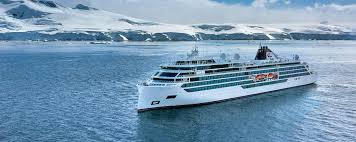
Viking Oceanis
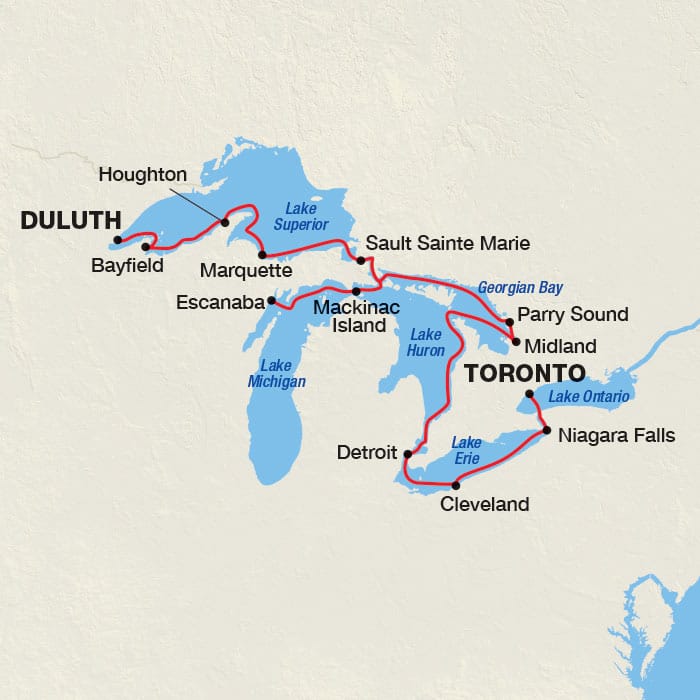
The cost differences are more than I would expect, but coming down, I expect. Currently, a nine-day Great Lakes cruise from a Viking Oceanis cruise from Cleveland costs a minimum of $8,675 per person. The 14-day version in the map above costs $14,270+. Details: https://l.cleveland.com/g2f86w. By comparison, a Boston to Quebec City cruise costs about $1200 per person, similar to a one week European or Alaska tour, on average.
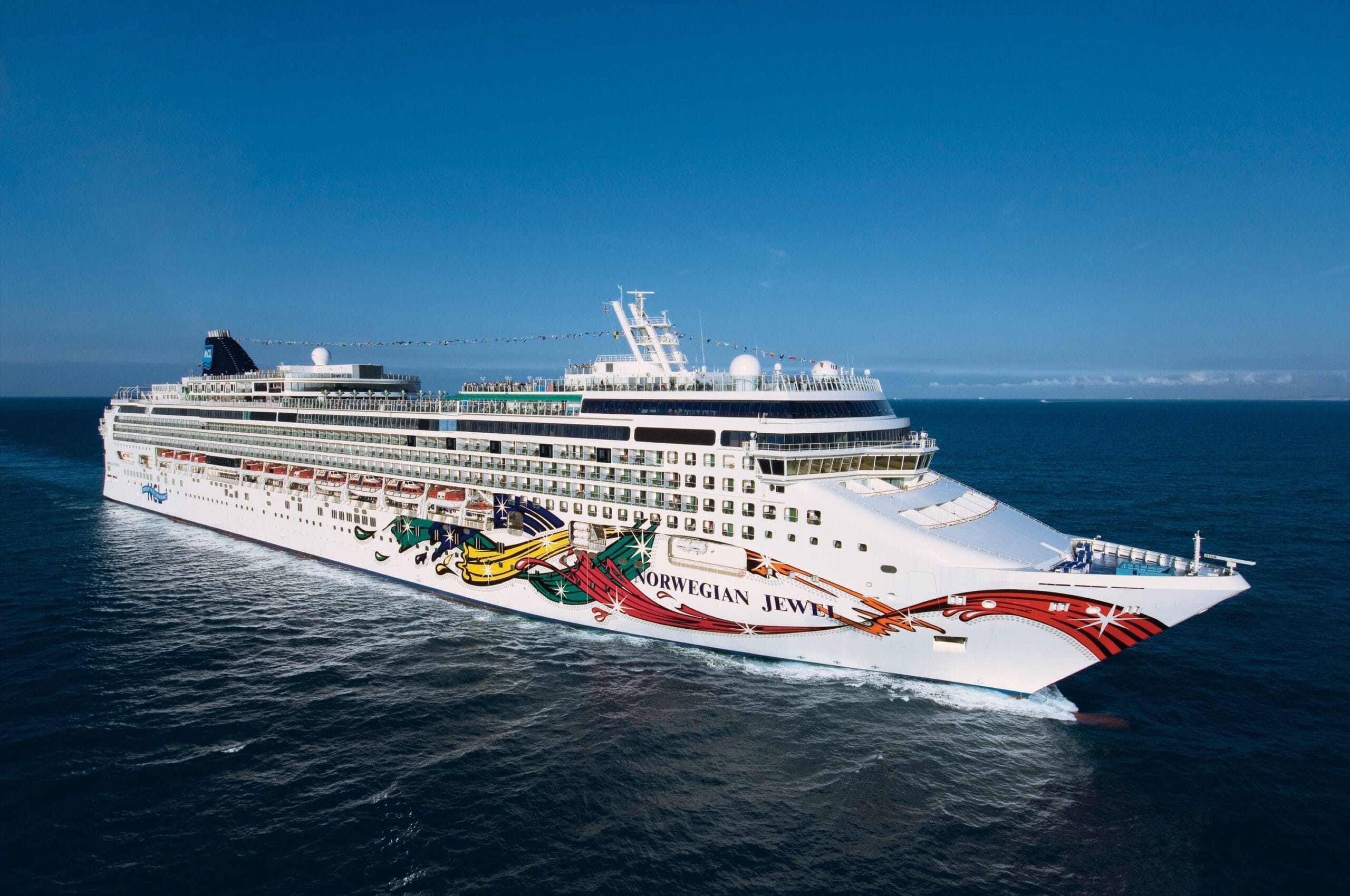
I put the blame for the high cost of Great Lakes cruising on the size limits of the locks on the St Lawrence canal and on the Niagara Falls, Welland Canal: 740 feet (225.5 m) in length, 78 feet (23.8 m) in width (beam), and 26.5 feet (8.08 m) of depth (draft). The largest cruise ship now operating on the Great Lakes, the Viking Oceanis, show above measures 665 feet (205 meters) length, by 77 feet (23.5 meters) width, by 19 feet, 8″ draft, barely smaller than the canal. It boasts a capacity for 378 guests and 256 crew members. By contrast, the Norwegian Jewel, a popular ship for the New York and Boston to Quebec City route holds 2,870 passenger and a crew of about 1,069. This explains some of the price difference but not all. The rest, perhaps is competition. A standard European cruise ship can be rerouted to the St. Lawrence, but not to the Great Lakes.
Aerial Norwegian Jewel
Norwegian Jewel – Norwegian Cruise Line
If one wanted to run a large cruise ship on the Great Lakes, it would have to be built there. It could be done, but isn’t currently. We make very large ore carriers that operate entirely on the Great Lakes, so the capacity exists. The other alternative would be to expand one of the canals. IF this were done, there would be a lot more competition and ships, and we could be served by much larger container ships as well. An unfortunate aspect of the small lock size of the Welland and upper St. Lawrence is that currently, only very small container ships can enter or leave the Great Lakes. The result is that cargo prices are much higher than for any of the US coastal ports or the Mississippi. Both the US and Canada would benefit from a larger connection to the sea.
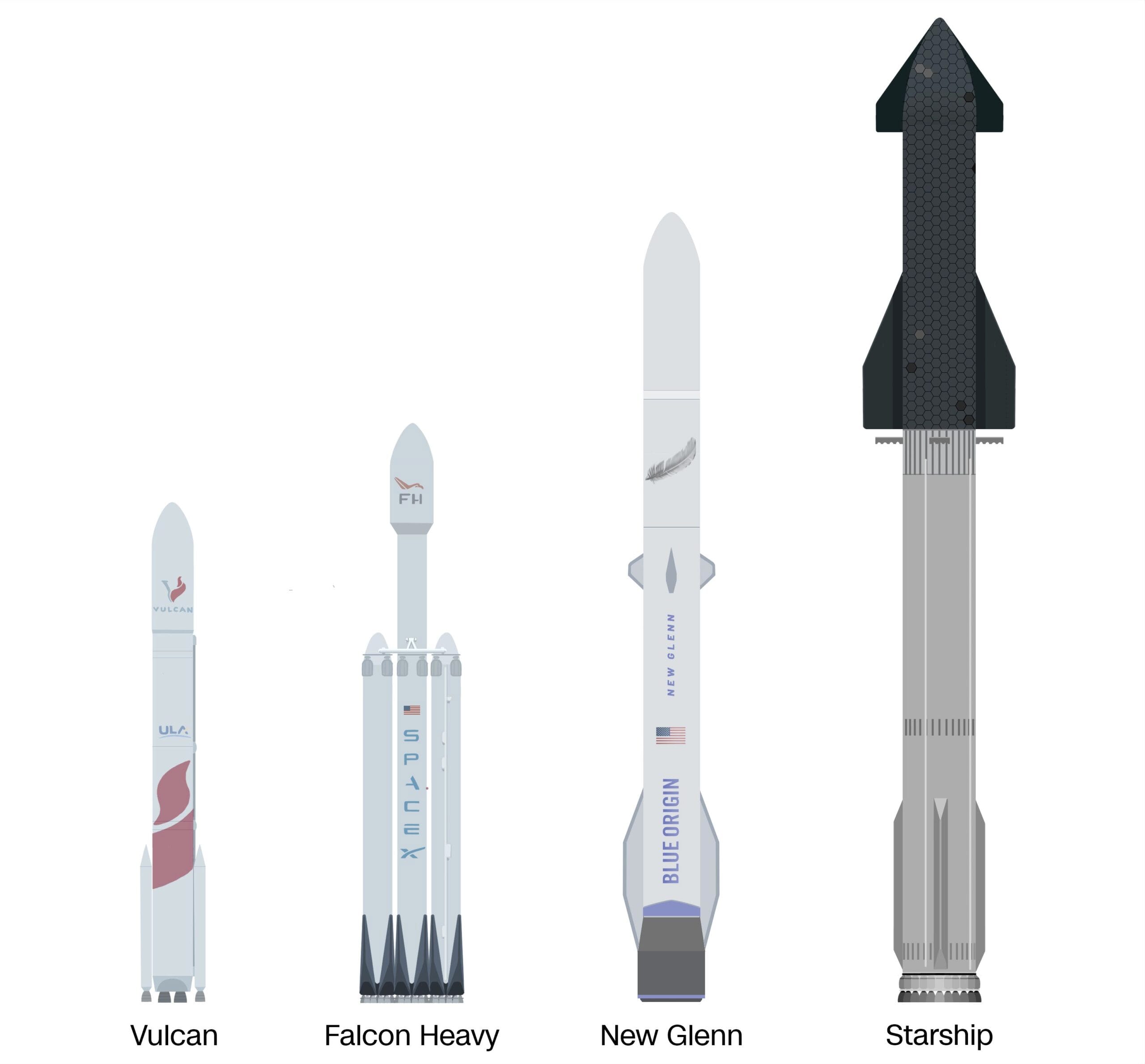
CNN comparison of heavy lift, US rockets. Boeing’s SLS is not shown.
Blue Origin had its third New Glenn flight last week, and though it wasn’t quite successful, in that the satellite failed to reach proper orbit, it was successful in that it launched, reached space, and returned to a barge. It had a larger faring than even Falcon Heavy, and in terms of payload and price per ton, it beat SpaceX’s main vehicle, the Falcon 9. A SpaceX Falcon 9 flight will cost you $72 million with a weight limit to LEO of 17,400 kg. By contrast, New Glenn flights are priced at $80 million with more than double the weight limit to LEO, 45,000 kg. The price per Kg is less than half, and the faring is bigger. What’s not to like?
For now SpaceX products still retain an edge. The Falcon Heavy will lift more weight to LEO than the New Glenn (one launched today), at an even lower price per kg. Besides, SpaceX’s products are reliable, they’ve launched 240 commercial flights in the last 16 months alone, and all were successful. Blue Origin is still viable in that they’re relatively cheap and fill an important gap in SpaceX’s size portfolio, but they’re not a SpaceX killer. On the other hand they seem like a killer of Boeing’s two space projects, the CST Starliner, and the Boeing SLS that launched Artemis earlier this month.
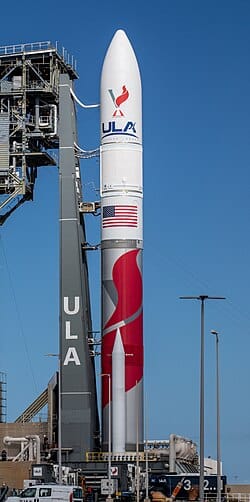
United Launch Alliance’s Vulcan rocket pairs two Blue Origin engines in the lower stage with as many as six solid booster engines from Teledyne.
CST Starliner is Boeing’s space capsule. It was vastly over budget and behind schedule. And when the first semi-successful version reached the Space Station with Astronauts in 2024, it showed multiple malfunctions and was condemned to return to earth unmanned. The astronauts were rescued in a SpaceX Dragon. NASA will want an alternative to Dragon, but now Blue Origin provides one. It’s the same story with Boeing’s SLS. Like the capsule, it was vastly delayed and over budget. While it provided the lift for Artemis II, that was after a near four year delay since Artemis I, November, 2022. The price per kg to launch on SLA is $37,000/kg, about twenty times that of a launch on Falcon Heavy or New Glenn. The only justification for SLS, as I see it, is that it was the main alternative to SpaceX. Now it isn’t. For more on the comparison, see here.
Both SpaceX and Blue Origin have newer versions for reusable heavy lifting due to debut within the year. SpaceX hopes to launch their Starship V3 next month. If it works as predicted, the throw weight will be triple that of New Glenn at a fraction of the cost per kg. Blue Origin has a larger version of New Glenn in the works, the 9×4 also reusable. Blue Origin has also started supplying high efficiency methane-burning engines for the Vulcan Centaur rockets made by ULA (United Launch Alliance). ULA continues to make the Atlas V rocket, but these are powered by Russian RD180 engines aided by Teledyne solid boosters. The Russian contract ended after Russia’s invasion of Ukraine, and ULA’s supply is almost exhausted. Since 2025 ULA has flown two missions successfully using Blue Origin’s, BE-4 engines instead, aided as before, by Teledyne boosters. The price per kg on these Vulcan Centaur rockets is well below that of the old Atlas V, because with BE-4 they can reuse the lift stage. For all of these, the price is far below a flight on Boeing SLS.
The French too have improved their Ariene line. They’re now reusable, and while they’re somewhat expensive, and can’t lift as much as the New Glenn, Falcon Heavy, or Vulcan, they’re cheaper than Atlas V, and are an alternative for deep space projects. With these alternatives I see little value in continuing with Boeing’s SLS. When I look for a path to the moon and beyond, I look to Starship and perhaps New Glenn.
This is a short post, but useful. We had a moaning toilet. This was “our two-mode commode” described previously, but the same thing happens with one-mode commodes too. I cured it. At issue, the toilet moaned or wailed after it was flushed. Either the toilet was possessed by a tormented soul, as sometimes happens, or the moan was caused by a vibration in the fill diaphragm. That was the case here.
It’s usually toilets in social science university buildings that get inhabited by tormented souls, as these are typically social scientists who are forced to come back this way as punishment for passing themselves off as real scientists. Sometimes they show up making the heating pipes rattle and clang. You can cure this by bringing in a plumber or heating professional to encourage the soul to repent. The heating professional then adjusts some things and the soul moves on. In our case, a toilet in a private home, it required no exorcism, just an adjustment of the flow.
In our case, it became clear that the fill valve had become partially blocked resulting in a high flow against the diaphragm. This diaphragm, shown below, is in the valve that gets closed when the float in the toilet tank rises. At high flows the diaphragm begins to vibrate and moan, sounding just like a possessed toilet.
toilet diaphragm
For most toilets, replacing this diaphragm is an easy repair: buy a new diaphragm for about $4, (and typically, also a new flapper — it’s a good idea to change the flapper every 4-6 years), remove the old diaphragm. It’s behind a thumb-nut, typically, and do the necessary exchange. Remember, thumbnuts are better than others. Sorry to say, our toilet has a new-fangled float mechanism where the diaphragm is hidden inside, not easily replaced. A normal thing to do is to replace the float mechanism, but those cost $30 or more, and take a fair amount of work. Instead, I choose to reduce the flow speed of the water by partially closing the inlet valve sending fill water to the commode. It now fills slightly slower than before, but since there is less flow, there is no longer any audible vibration. A quick fix at zero cost.
If that hadn’t worked, I’d have called in the exorcist, an expensive proposition. You have to pay your the exorcist. If you don’t, you get repossessed.
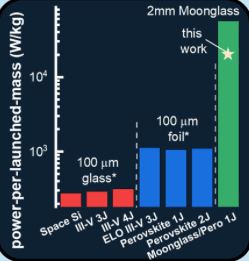
Jeff Bezos’s “Blue Alchemist” program recently got $25M from NASA to develop moon-based solar cell manufacturing on earth. See article here. The idea sort of makes sense to me: instead of transporting solar cells to the moon from earth, why not make them on the moon in bulk. Even light solar cells would weigh about 1kg/kW, making cells on the moon would reduce the effective weight per kW by a factor of 100 it is predicted, see figure. Given a need for megawatts of power, and the high cost to transport things to the moon, $1M/kg currently, this may make sense for the not super-distant future. Moon-made solar cells could reduce the cost per kW on the moon from $1million currently, to a mere $10,000/kW, cheap by moon prices, though super expensive by earth standards.
Elon Musk, perhaps out of envy or long-range vision, wants to go far further. He” recently’s posted’s proposed, at length a plan to launch moon-made solar cells into space along wit moon-made AI chips, with all this done to power AI centers in space, orbiting the earth or moon, see him discuss it here. He notes that “It’s always sunny in space”, so this electricity should be cheap. I don’t consider even moon-solar at $10,000/kW cheap, and power from these moon-launched cells will be pricer yet.
The reason all this makes sense to Musk is that he avoids the disruptions of solar power that come at night-time, and he avoids regulatory boards. He argues that there is no real alternative! given that power on earth is too hard and expensive, and complains that regulators oppose new power plants. I suspect there are some over-regulations, but some regulations are necessary, and I doubt he’ll avoid by going to space. As for the high cost of power, it’s really cheap in China, Lebanon, Iraq, Iran…Just look att he figure below showing the electric cost of bitcoin harvesting around the world. China runs on nuclear power or coal, delivering large-scale electricity at ~ 2¢/kWh. You can make power at a similar cost if you build your own plant, many of the bit-coin folks operate that way. It’s not exactly cheap, but a known technology, and cheaper than space solar amortized to less than 50 years.
AI chip-making is hard to do, even on earth, requiring water, chemicals, equipment and technical attention. Most companies can’t do it; China has barely cracked the technology. Doing it on the moon adds unnecessary difficulties: water and chemicals scarce, skilled servicing labor is hard to find. At some point, the moon and Mars community will want to make AI in space, but before that, they’ll want to make simpler things, like rice cookers. Until we have a fairly large community on the moon, why now make AI chips on earth. If he’s looking for practice, Musk could manufacture in a place that’s inhospitable, but more accessible than the moon: Greenland or Antarctica or the top of Everest. These locations are wam compared to the moon, and they have air and water, and I suspect electricity on Everest is cheaper than on the moon.
Operating AI centers in space is not particularly attractive, by the way. Chips have a tendency to flake-out in space because of cosmic radiation and stronger electromagnetic fields (EM). For this to work at all, chips have to be built specially robust, with correction software that must be particularly active, and you must shield everything from EM to a much greater extent than on earth.
I suspect the reason Musk wants to manufacture AI in space, and to operate there, is to over-shadow Bezos’s solar cell factory, and show off his own (Tesla) technology. Also to have a use for his Starships lifting heavy complicated things. It’s not a plan I would back.
I’ve written a fair amount about sewage over the years, including the benefits of small dams, and problems of combined sewers, but I thought I’d write here about something really fundamental: sewage has two components, poop and rain, and they should be kept separate. The poop and related liquids are known as sanitary sewage. Ideally it is the treated, saved and used as fertilizer. Rain, known as storm sewage, needs to go to the rivers at a controlled speed, unmixed with sanitary sewage. Sorry to say, in many counties, mine included, the two are mixed following every rain, costing us unnecessary money, and making swimming unsafe, and boating (sometimes) unpleasant.
Our system is not quite mixed, but is semi-separate. It only mixes in a “big” rain, more than 1/2″, something that happens once per month, on average. The Pipes are semi-connected as shown below.
Combined sewer system, like in our county, Oakland MI. We use little dams in the pipe system to semi-separate the flows. Here, showing a rain-induced overflow of combined sewage, a CSO.
The pipes of a sanitary sewage system can be relatively small in diameter as this flow is continuous, but never that large. The cost of treatment is high, per gallon though. Some of this cost can be recovered in fertilizer value.
Stormwater flow, by contrast, requires big pipes because the flow, while episodic and be 10,000 more than the sanitary flow. A city can go for weeks without storm flow as there’re is no rain. A storm will then drop more water in an hour than all the sanitary sewage of the last few weeks. You need large diameter stormwater pipes, and you typically want retention basins so that even these pipes are not overwhelmed, and to provide a little settling. The pipes should direct storm water to the nearest river. In our county we mixed the two for historical reasons. This adds tremendously to the cost of sewage treatment, and we find we regularly overwhelm the treatment facility. When this happens, as shown above, sanitary sewage is flushed into the riveras I described ten years ago in a post focussed on pollution from combined sewers. If the rains are really heavy, they back up “sanitary” sewage into basements as well. More commonly, once or twice a month where I live, we just pollute the river. Several cities with combined sewers have separated them recently. Paris, for example, ahead of the 2024 Summer Olympics.
To get an idea of the relative size of the flows in our county, note that Oakland county is a square 30 miles by 30 miles. That’s 900 square miles, or 25.1 billion square feet. In th4e event of a, not uncommon, 2″ rain on this area, we must deal with 4.2 billion cubic feet of water or 33 billion gallons. Some of this absorbs into the ground, but much of it runs goes to pipes heading to the rivers. Ideally we retain some of it above ground for an hour or more because the pipes can’t handle this flow. Even with retention, our rivers rise some 10 feet typically and begin to flow at many miles per hour after a storm. They can be seen carrying trees along, and massively eroding the soil, even in areas that were prepared appropriately.
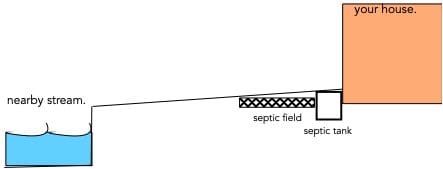
A home based approach to sewage. Many homes near me have this setup — with internal plumbing and a septic field for sewage treatment. Often, these homes are near a stream that flows at least temporarily.
Sanitary sewage flows are far less voluminous. Our county has roughly 1 million people who flush about 100 million gallons per day, generally sending this to our sanitary sewage treatment plants. That averages a mere 4 million gallons per hour, or 500,000 cubic feet. That’s roughly 8000 times less flow than the storm flow. If any significant fraction of the rainwater goes into our sanitary system, it will quickly overwhelm it and back up into our basements.
Many people try to get out of paying the high price for municipal sewage treatment by making their own small system with a septic tank an a septic field. I think this is a great idea, a benefit for them and the county. I will be happy to direct them to appropriate educational materials so that home waste flows to the septic tank where anaerobic bacteria break things down, it should then flow to a septic field that filters the nutrients and allows aerobic bacteria to break things down further. Nutrients in the sewage helps whatever you plant and, as we say, “the grass is always greenest over the septic tank.” As for the county on the whole, I wish we got real value from the fertilizer, as Milwaukee does, and wish we’d separate the sewers.
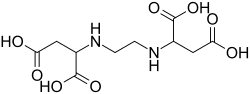
Among the products our company sells is a non-toxic chelating agent, EDDS (ethylenediamine-disuccinic acid), typically sold as a purified salt in ammonia solution, see here. The main use of EDDS is to stabilize heavy metal ions in solution. We use it, for example, as an aide in electroless Palladium coating, to stabilize palladium ions, helping us produce a smaller grain, more continuous coat. The structure, shown below, is similar to that of EDTA (ethylenediaminetetraacetic acid), and the behavior is similar too. EDDS is more stabilizing in the presence of the other ions and we like that it is non-toxic.
Structure of EDDS, it binds metals by way of four OH groups. While each binding is weak, the total is strong.
The popular literature use for chelating agents like this is as a treatment for heavy metal poisoning by lead, arsenic, cadmium, nickel or copper. The TV series “House” featured patients with all these metal-poisoning problems, problems. Chelation treatment was important in Flint Michigan, 2015 when thousands got low-level lead poisoning and legionaries disease after the water department put insufficient phosphate and hypochlorite into the water and lead leached from pipes. Typically, EDTA is used for humans here, while EDDS is used by farmers and ranchers to treat animals. EDDS is less toxic, and removes fewer essential light minerals: magnesium, calcium, and zinc, so I’d think it would be better for humans too.
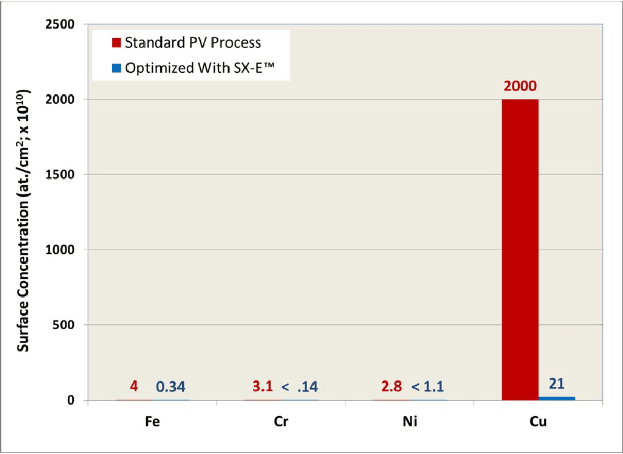
Effect of 300ppm SX-E in DI water, compared to standard DI water and acid wash. The biggest difference is with copper.
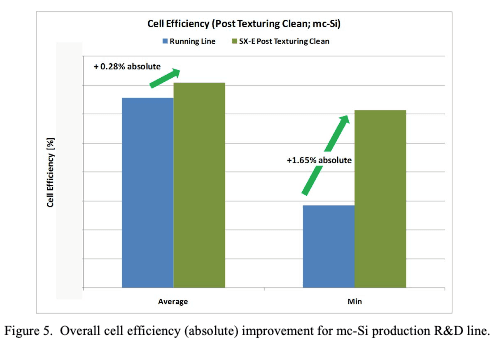
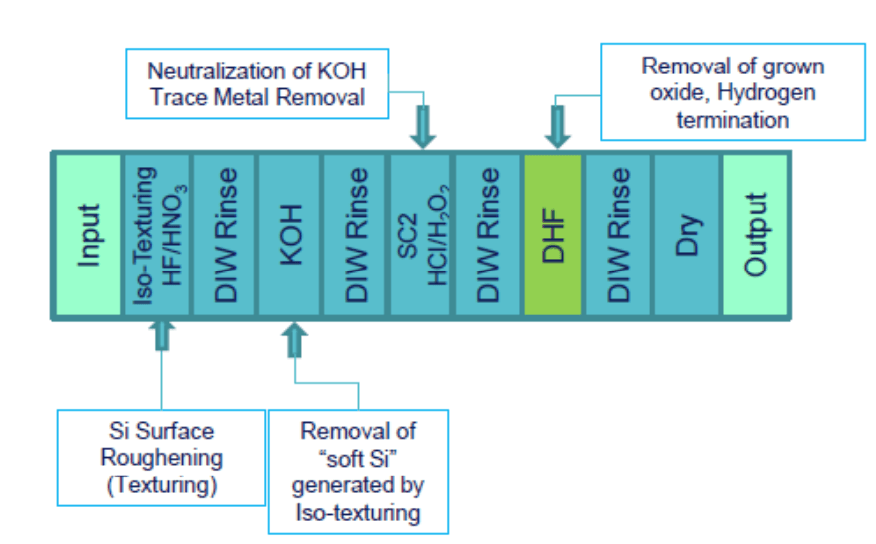
Our EDDS has been used to make cleaning solutions for silicon wafers, Sunsonix SXE, for example. Sunsonix SXE behaves as a soap, removing Fe, Cr, Ni, and Cu from solar cells, see reproduced figures at right. These metals will diffuse into surface of a silicon wafer, forming defects that absorb light and decrease solar cell performance by an average of 0.28%, see below.
Solar cell efficiency improvement with EDDS washing from a baseline of 16%. Occasionally 1.65% improvement was seen, but 0.28% on average
This is, based on a baseline efficiency of 16%. For more details see “Surface Contamination Removal from Si PV Substrates Using a Biodegradable Chelating Agent and Detection of Cleaning Endpoints Using UV/VIS Spectroscopy” ECS Transactions, 41 (5) 295-302 (2011). See also this article in Wikipedia.
This is the normal treatment regime for solar cells
At a different pH, EDDS and EDTH are used in remediation of metal-contaminated soils, see here. This can be done ex-situ, with the soil taken out to an external site and then washed. Alternately, for less contaminated soils, remediation can be done in-situ with the chelating wash applied to the soil. Plants, like vetiver grass (Chrysopogon zizanioides) then extract the heavy metals, concentrating them in their leaves. EDDS is more suitable for this as it is biodegradable and shows a high extraction efficiency in mineral rich soils, see here for comparison to EDTA.
Moving to another area of extraction. It seems that EDDS or EDTA solutions can be used to profitably extract rare earth metals, perhaps sending them to plants before final concentration. A standard methods of rare earth extraction uses chlorine and high temperatures. Alternate methods use ion-exchange extraction of liquid-liquid extraction. I suspect that chelation treatment might turn out to be more effective and cheaper. The price of rare earths has risen in recent years as China restricts sales so that the need for a new source has become a national priority.
Donald Trump has announced his intent to build at least two battleships, the first built for our navy since the USS Missouri, 1944. The press has been largely negative on this, claiming that these ships are obsolete already, and will be more-so when they are completed — assuming they are completed. My sense is these are useful, overdue really, and I’d like to explain why.
The George Washington Carrier with nine surface support ships.
The centerpiece of America’s military power lies in our aircraft carrier groups, currently. We have 11 carriers in service: two modern, Ford class, and nine older, Nimitz class. Each of these weighs 100,000 tons, is 1100 feet long, and carries some 6000 men and women, 3200 navy crew, another 2500 in the air wing, and perhaps 300 support staff of doctors, nurses, and marines. Because they are vulnerable, each carrier travels in a group with six to ten other ships carrying an additional 3000 people, see photo. Without the support ships a carrier is deemed to be too vulnerable for use. Even with the support ships, Swedish and French submarines successfully “sank” U.S. carriers during exercises in 2005 and 2015.
The support ships are typically slower than the carrier and difficult to maintain. Many are old with relatively short range. Our carriers can go around the world, 30000 miles, traveling at 30+ knots, but the main support ships, Arleigh Burke destroyers, 9000 tons, 350 crew, have a range of only 4,400 nmi at a slower, 20 knots. They require regular refuelings for any major mission, like patrolling the Caribbean. Still, they’re “cheap,” about $2.5B each, capable, and work relatively well. We have some 75 in service, built since 1991, with more on order.
We also have nuclear missile submarines, but these are blunt instruments of policy, not suited to most navy missions, like keeping open shipping lanes in the Red Sea or stopping ISIS, or for blockading Venezuela. The mostly hold weapons of last resort.
The navy has recognized the need for a larger support ship for better carrier protection and more flexible roles, a cruiser likely, with good range and weapons, and with enough speed to keep up with a carrier crossing the Pacific. We’ve built many cruisers over the years, but these are old. Our latest are the Ticonderoga class guided-missile cruisers built from 1980 onward. They have good speed, 32.5kn, and good range, 6000nm, but are well past their retirement date, and break down a lot. Only 7 are still in service.
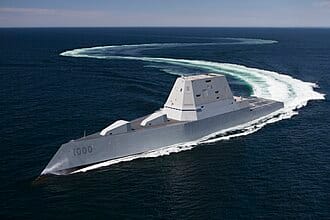
The USS Zumwalt at sea. Trump said it was “Ugly as F.”
The supposed replacement, was a cruiser-size, stealth ship, the Zumwalt destroyer, 17,000 tons and 600 feet long. It is reasonably fast, 33.5kn, and carries a small crew, <100. We’ve managed to build three of these since 2008, but have cancelled the project due to operational problems and costs that rose to $8B per ship. Zumwalts have inward-sloped sides that deflect radar, but they become unstable in turns. Its main weapons are expensive, too: Aegis missiles and CPS hypersonics costing $28-$50 million each. That’s uneconomical compared to French Aster missiles, Mach 3, 80 mile range, $1.1 million. Originally, Zumwalt destroyers carried a rail gun, but it required so much power that you could not move the ship and fire at the same time. The rail guns were eventually replaced by conventional 5″ cannon with a 24 mile range. The three Zumwalts we have are hardly used today, and no more are on order. Something cheaper was needed at least for support, and that was supposed to be the Constellation Frigate, approved by Trump in 2017.
A frigate is smaller than a cruiser, in this case about half the weight. The Constellation was a proven Italian design, 492 feet long and only 7,291 tons. It had good speed, 26 kn, good range, 6000 nm at 16kn, and cost only $950 million, at least when built in Europe. The contract was awarded to Fincantieri Marinette Marine (FMM) of Marinette Wisconsin, the US division of the Italian company. What could go wrong? The problem was that the navy kept adding capabilities and weight. As of November 2025, eight years on, the weight had increased by 700 tons, the cost to $9 B for two, and no design has been finalized. The first Constellation frigate is only 12% built! Trump has not quite cancelled the program, but has reduced the order to two from the original eight.
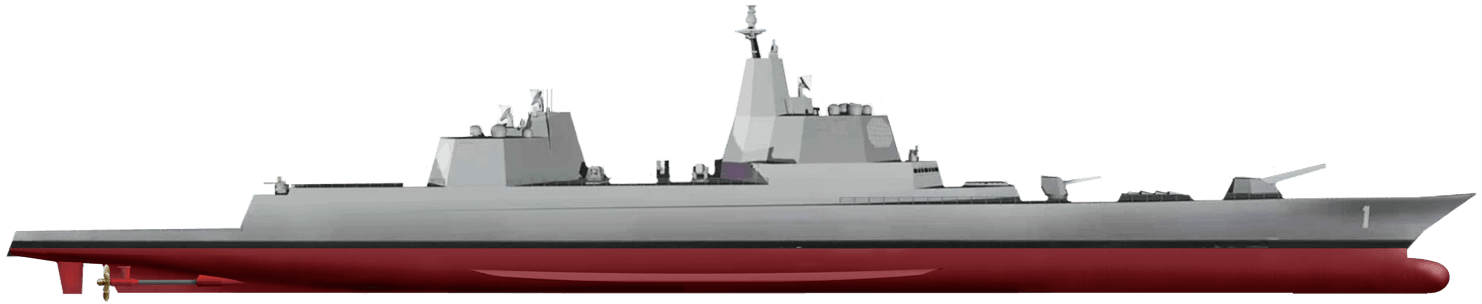
Trump-class battleship, as envisioned, with a rail-gun, lasers and two, conventional 5″ cannon.
And that brings us to the current, Trump class battleship, shown above. It’s long, 840-880 feet, and heavy, 39,000 tons, or 2.5 times the weight of the cruiser-sized, Zumwalt. As was intended for the Zumwalt, the offensive weapons are missiles and a rail gun, 32 MJ, but now there is enough power run the ship and fire the weapon. Japanese versions of the rail gun have launched cheap shells at hypersonic speeds, ~5000 mph (hypersonic) at a distance of over 100 miles and a fire-rate of ~one per second. The shells cost only $85,000 each, a bargain compared to hypersonic missiles.
For defense, these battleships are to carry two, 300kW, Helios lasers, similar to Israel’s “Iron beam,” but 3 times as powerful. They are augmented by smaller lasers, by four, 30 mm chain guns (Gatling guns), and two, 5″ conventional navy guns of 24 mile range. Engines are estimated to be two gas turbines, perhaps 50MW each of for acceleration and to power the weapons, plus ~100 MW in diesel power for cruising at good speed and mpg. I thus estimate a total of ~200 MW, about as much as on a carrier. There is plentiful space for missiles and fuel, so it should provide some resupply of support ships. The crew size is bigger than on the Ticonderoga, 600 to 800, but far less than on a carrier, and the look is impressive. A Trump goal is that it should be an attractive, command ship. Still, there are objections.
A main complaint is vulnerability as discussed here, the claim is these ships are “bomb magnets,” not stealthy, nor as heavily armored as the Iowas. Detractors claim that lasers and chain guns are insufficient for defense from drone swarm attacks. They note that the Bismarck, Yamamoto, and Arizona have been sunk, typically by air attack. What the detractors don’t mention is that it took a lot of bombs and torpedos to sink these battleships nor that these battleships will travel with support ships, while the Bismarck travelled alone.
Detractors also question the rail gun. Can it shoot down an airplane? can it sink a ship? The tests I’ve seen suggest that the rail gun can take out an airplane, but that it can not sink a ship, at least not with one shot. That still needs a missile, but the battleship does have missiles. The gun seems appropriate for shore bombardment too, even against hardened targets, and for dissuading actions by a Chinese navy that is already bigger than ours. As for the defense against drones, the battleship is to have high-powered lasers that have been shown to stop drones and cruise missiles at a cost of only ~$10 per shot. That’s nothing compared to a harpoon missile ($1.4 million each) or Aegis ($28 million). These are great weapons, and I don’t see a smaller ship being able to power them. Also it’s nice to have extra room for expansion — like adding a nuclear reactor.
The time-line is what worries me most. These will take ten years at least. Until then, we will have to rely on our short-range Arleigh Burkes that did not have the firepower to bombard the Houthis effectively on land, nor effectively defend US shipping in the Red Sea. Those ships had to use million-dollar missiles to shoot down $20,000 drones. I expect us to really need the battleships, even if it takes us ten years to get one.
Robert Buxbaum, January 5, 2026. As a totally side issue: some claim this isn’t a battleship. It carries only one gun, admittedly a powerful gun. I half agree, you need at least two big guns to be a battleship, IMHO.