Tag Archives: SpaceX

Blue Origin isn’t a SpaceX killer but a Boeing SLS killer

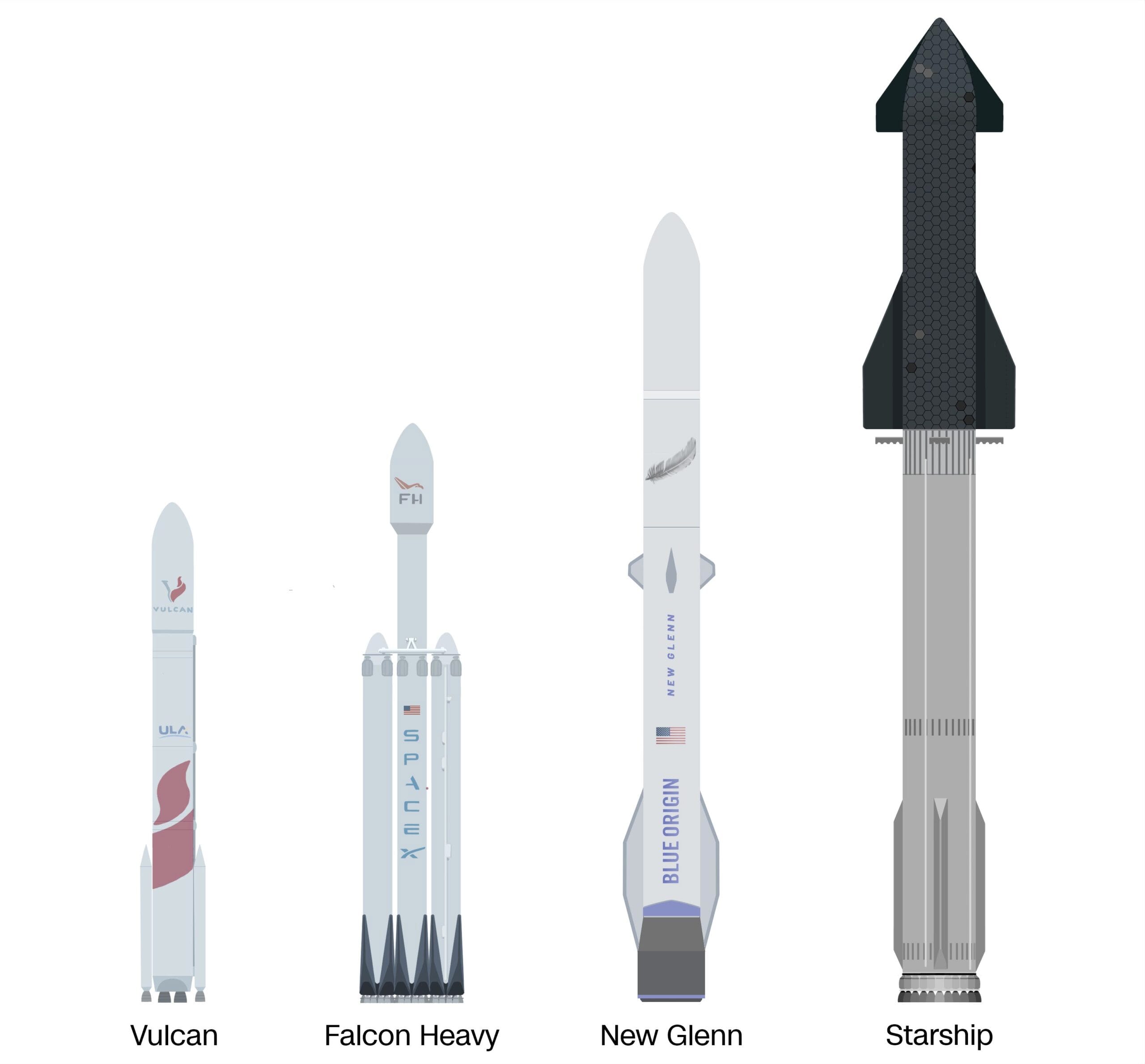
CNN comparison of heavy lift, US rockets. Boeing’s SLS is not shown.

Blue Origin had its third New Glenn flight last week, and though it wasn’t quite successful, in that the satellite failed to reach proper orbit, it was successful in that it launched, reached space, and returned to a barge. It had a larger faring than even Falcon Heavy, and in terms of payload and price per ton, it beat SpaceX’s main vehicle, the Falcon 9. A SpaceX Falcon 9 flight will cost you $72 million with a weight limit to LEO of 17,400 kg. By contrast, New Glenn flights are priced at $80 million with more than double the weight limit to LEO, 45,000 kg. The price per Kg is less than half, and the faring is bigger. What’s not to like?

For now SpaceX products still retain an edge. The Falcon Heavy will lift more weight to LEO than the New Glenn (one launched today), at an even lower price per kg. Besides, SpaceX’s products are reliable, they’ve launched 240 commercial flights in the last 16 months alone, and all were successful. Blue Origin is still viable in that they’re relatively cheap and fill an important gap in SpaceX’s size portfolio, but they’re not a SpaceX killer. On the other hand they seem like a killer of Boeing’s two space projects, the CST Starliner, and the Boeing SLS that launched Artemis earlier this month.
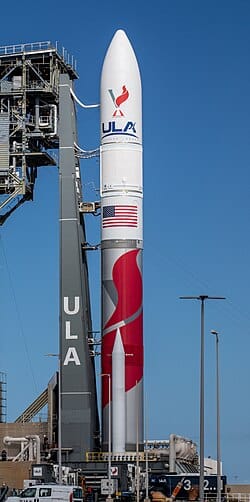
United Launch Alliance’s Vulcan rocket pairs two Blue Origin engines in the lower stage with as many as six solid booster engines from Teledyne.

CST Starliner is Boeing’s space capsule. It was vastly over budget and behind schedule. And when the first semi-successful version reached the Space Station with Astronauts in 2024, it showed multiple malfunctions and was condemned to return to earth unmanned. The astronauts were rescued in a SpaceX Dragon. NASA will want an alternative to Dragon, but now Blue Origin provides one. It’s the same story with Boeing’s SLS. Like the capsule, it was vastly delayed and over budget. While it provided the lift for Artemis II, that was after a near four year delay since Artemis I, November, 2022. The price per kg to launch on SLA is $37,000/kg, about twenty times that of a launch on Falcon Heavy or New Glenn. The only justification for SLS, as I see it, is that it was the main alternative to SpaceX. Now it isn’t. For more on the comparison, see here.

Both SpaceX and Blue Origin have newer versions for reusable heavy lifting due to debut within the year. SpaceX hopes to launch their Starship V3 next month. If it works as predicted, the throw weight will be triple that of New Glenn at a fraction of the cost per kg. Blue Origin has a larger version of New Glenn in the works, the 9×4 also reusable. Blue Origin has also started supplying high efficiency methane-burning engines for the Vulcan Centaur rockets made by ULA (United Launch Alliance). ULA continues to make the Atlas V rocket, but these are powered by Russian RD180 engines aided by Teledyne solid boosters. The Russian contract ended after Russia’s invasion of Ukraine, and ULA’s supply is almost exhausted. Since 2025 ULA has flown two missions successfully using Blue Origin’s, BE-4 engines instead, aided as before, by Teledyne boosters. The price per kg on these Vulcan Centaur rockets is well below that of the old Atlas V, because with BE-4 they can reuse the lift stage. For all of these, the price is far below a flight on Boeing SLS.

The French too have improved their Ariene line. They’re now reusable, and while they’re somewhat expensive, and can’t lift as much as the New Glenn, Falcon Heavy, or Vulcan, they’re cheaper than Atlas V, and are an alternative for deep space projects. With these alternatives I see little value in continuing with Boeing’s SLS. When I look for a path to the moon and beyond, I look to Starship and perhaps New Glenn.

Robert Buxbaum, April 27, 2026

Comparing Artemis SLS to Saturn V and Falcon heavy

This week, the Artemis I, Orion capsule splashed down to general applause after circling the moon with mannequins. The launch cost $4.1 Billion, and the project, $50 Billion so far, of $93 Billion expected. Artemis II will carry people around the moon, and Artemis III is expected to land the first woman and person of color. The goal isn’t one I find inspiring, and I feel even less inspired by the technology. I see few advances in Artemis compared to the Saturn V of 50 years ago. And in several ways, it looks like a step backwards.

The graphic below compares the Artemis I SLS (Space Launch System) to the Saturn V. The SLS is 10% lighter, but the payload is lighter, too. It can carry 27 tons to the moon, while the Saturn V sent 50 tons to the moon. I’d expect more weight by now. We have carbon fiber and aramids, and they did not. Add to this that the cost per flight is higher, $4.1 B, versus $1.49 B in 2022 dollars for a Saturn V ($185 million in 1969 dollars). What’s more there was no new engine development or production, so the flight numbers are limited: Each SLS launch throws away five, space shuttle engines. When they are all gone, the project ends. We have no plans or ability to make more engines.

Comparison of Apollo Saturn V and Artemis SLS. The SLS has less lift weight and costs more per launch.

As it happens, there was a better alternative available, the Falcon heavy from SpaceX. The Falcon heavy has been flying for 5 years now, and costs only $141 million per launch, about 1/30 as much as an Artemus launch. The rocket is largely reusable, with 3D printed engines, and boosters that land on their tails. Each SLS is expensive because it’s essentially a new airplane built specially for each flight. Every part but the capsule is thrown away. Adding to the cost of SLS launches is the fuel; hydrogen, the same fuel as the space shuttle. Per energy it’s very expensive. The energy cost for the SLS boosters is high too, and the efficiency is low; each SLS booster costs $290M, more than the cost of two Falcon heavy launches. Falcon launches are cheap, in part because the engines burn kerosine, as did the Saturn V at low altitude. Beyond cost hydrogen has low thrust per flow (low momentum), and is hard to handle; hydrogen leaks caused two Artemis scrubs, and numerous Shuttle delays. I discussed the physics of rocket engines in a post seven years ago.

This graph of $/kg to low earth orbit is mostly from futureblind.com. I added the data for Artemis SLS. Saturn V and Falcon use cheaper fuel and a leaner management team.

It might be argued that Artemis SLS is an inspirational advance because it can lift an entire moon project in one shot, but the Saturn V lifted that and more, all of Skylab. Besides, there is no need to lift everything on one launch. Elon Musk has proposed lifting in two stages, sending the moon rocket and moon lander to low earth orbit with one launch, then lifting fuel and the astronauts on a second launch. Given the low cost of a Falcon heavy launch, Musk’s approach is sure to save money. It also helps develop space refueling, an important technology.

Musk’s Falcon may still reach the moon because NASA still needs a moon lander. NASA has awarded the lander contract to three companies for now, Jeff Bezos’s Blue Origin, Dynetics-Aerodyne makers of the Saturn V, and Musk’s SpaceX. If the SpaceX version wins, a modified Falcon will be sent to the moon on a Falcon heavy along with a space station. Artemis III will rendezvous with them, astronauts will descend to the moon on the lander, and will use the lander to ascend. They’ll then transfer to an Orion capsule for the return journey. NASA has also contracted with Bezos’s Blue origin for planetary, Earth observation, and exploration plans. I suspect that Musk’s lander will win, if only because of reliability. There have been 59 Falcon launches this year, all of them with safe landings. By contrast, no Blue Origin or Dynetics rocket has landed, and Blue Origin does not expect to achieve orbital velocity till 2025.

As best I can tell, the reason we’re using the Artemis SLS with its old engines is inspiration. The Artemis program director, Charlie Blackwell-Thompson is female, and an expert in space shuttle engines. Previous directors were male. Previous astronauts too were mostly male. Musk is not only male, but his products suffer from him being considered a horrible person, a toxic male, in the Tony Stark (Iron Man) mold. Even Jeff Bezos and Richard Branson are considered better, though their technology is worse. See my comparison of SpaceX, Virgin Blue, and Blue Origin.

To me, the biggest blocks to NASA’s inspirational aims, in my opinion, are the program directors who gave us the moon landing. These were two Nazi SS commanders (SS Sturmbannführers), Arthur Rudolph and Wernher Von Braun. Not only were they male and white, they were barely Americanized Nazis, elevated to their role at NASA after killing off virtually all of their 20,000, mostly Jewish, slave workers making rockets for Hitler. Here’s a song about Von Braun, by Tom Lehrer. Among those killed was Von Braun’s professor. In his autobiography, Von Braun showed no sign of regret for any of this, nor does he take blame. The slave labor camp they ran, Dora-Mittelbau, had the highest death rate of all slave labor camps, and when some workers suggested that they could work better if they were fed, the directors, Rudolph and Von Braun had 80 machine gunned to death. Still, Von Braun got us to the moon, and his inspirational comments line the walls at NASA, Kennedy. Blackwell-Thompson and Bezos are surely more inspirational, but their designs seem like dead ends. We may still have to use Musk’s SpaceX if we want a lander or a moon program after the space shuttle’s engines are used up. As Von Braun liked to point out, “Sacrifices have to be made.”

Robert Buxbaum, December 21, 2022. Here’s a bit more about Rudolph, von Braun, the Peenemünda rocket facility, and the Dora-Mittelbau slave labor camp. I may post photos of Von Braun with Hitler and Himmler in SS regalia, but feel uncomfortable doing so at the moment. I feel similarly about posting links to Von Braun’s inspirational interviews.