Tag Archives: Boeing

Blue Origin isn’t a SpaceX killer but a Boeing SLS killer

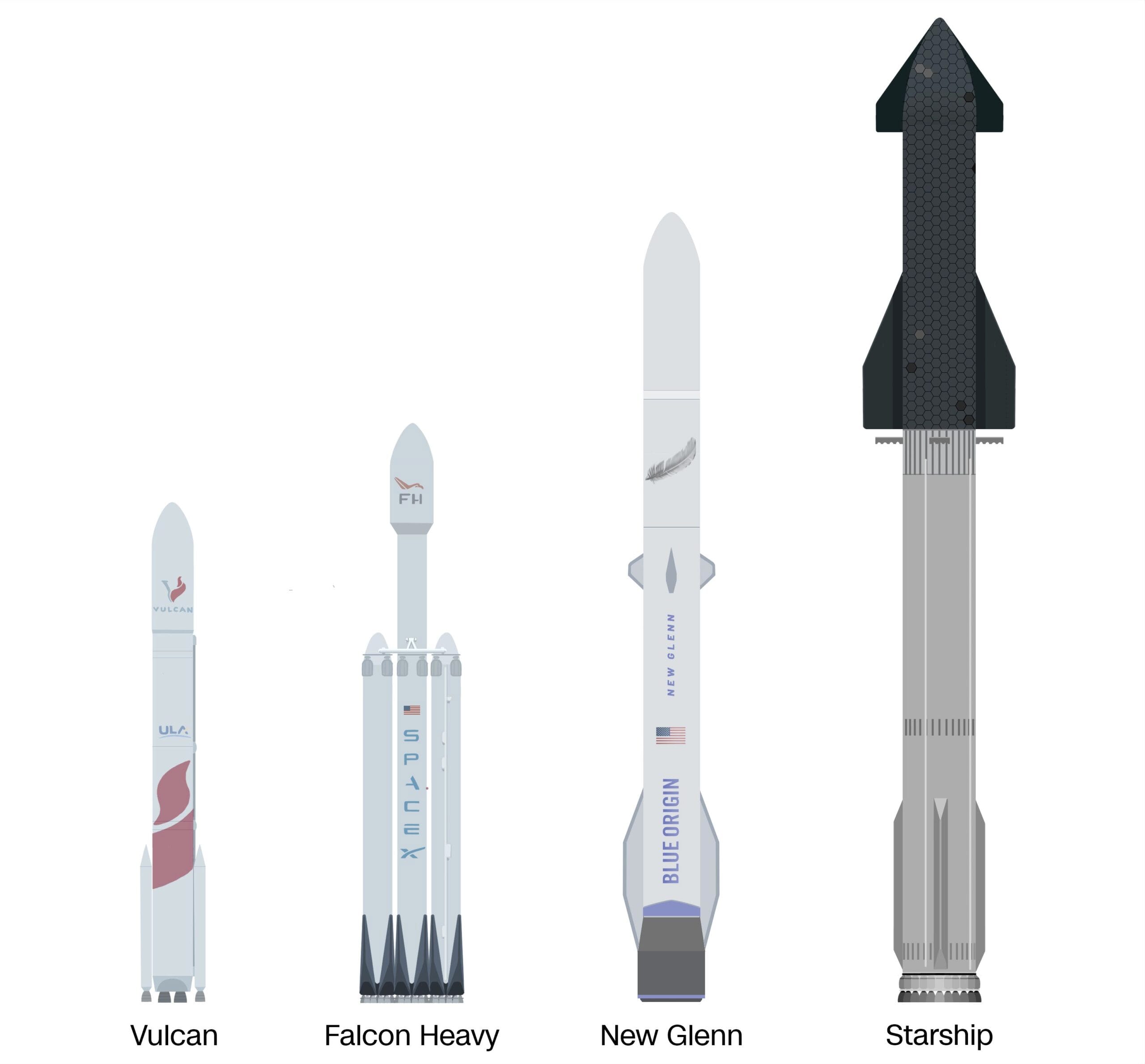
CNN comparison of heavy lift, US rockets. Boeing’s SLS is not shown.

Blue Origin had its third New Glenn flight last week, and though it wasn’t quite successful, in that the satellite failed to reach proper orbit, it was successful in that it launched, reached space, and returned to a barge. It had a larger faring than even Falcon Heavy, and in terms of payload and price per ton, it beat SpaceX’s main vehicle, the Falcon 9. A SpaceX Falcon 9 flight will cost you $72 million with a weight limit to LEO of 17,400 kg. By contrast, New Glenn flights are priced at $80 million with more than double the weight limit to LEO, 45,000 kg. The price per Kg is less than half, and the faring is bigger. What’s not to like?

For now SpaceX products still retain an edge. The Falcon Heavy will lift more weight to LEO than the New Glenn (one launched today), at an even lower price per kg. Besides, SpaceX’s products are reliable, they’ve launched 240 commercial flights in the last 16 months alone, and all were successful. Blue Origin is still viable in that they’re relatively cheap and fill an important gap in SpaceX’s size portfolio, but they’re not a SpaceX killer. On the other hand they seem like a killer of Boeing’s two space projects, the CST Starliner, and the Boeing SLS that launched Artemis earlier this month.
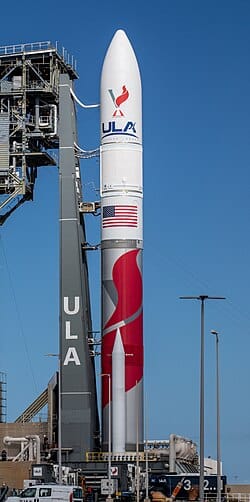
United Launch Alliance’s Vulcan rocket pairs two Blue Origin engines in the lower stage with as many as six solid booster engines from Teledyne.

CST Starliner is Boeing’s space capsule. It was vastly over budget and behind schedule. And when the first semi-successful version reached the Space Station with Astronauts in 2024, it showed multiple malfunctions and was condemned to return to earth unmanned. The astronauts were rescued in a SpaceX Dragon. NASA will want an alternative to Dragon, but now Blue Origin provides one. It’s the same story with Boeing’s SLS. Like the capsule, it was vastly delayed and over budget. While it provided the lift for Artemis II, that was after a near four year delay since Artemis I, November, 2022. The price per kg to launch on SLA is $37,000/kg, about twenty times that of a launch on Falcon Heavy or New Glenn. The only justification for SLS, as I see it, is that it was the main alternative to SpaceX. Now it isn’t. For more on the comparison, see here.

Both SpaceX and Blue Origin have newer versions for reusable heavy lifting due to debut within the year. SpaceX hopes to launch their Starship V3 next month. If it works as predicted, the throw weight will be triple that of New Glenn at a fraction of the cost per kg. Blue Origin has a larger version of New Glenn in the works, the 9×4 also reusable. Blue Origin has also started supplying high efficiency methane-burning engines for the Vulcan Centaur rockets made by ULA (United Launch Alliance). ULA continues to make the Atlas V rocket, but these are powered by Russian RD180 engines aided by Teledyne solid boosters. The Russian contract ended after Russia’s invasion of Ukraine, and ULA’s supply is almost exhausted. Since 2025 ULA has flown two missions successfully using Blue Origin’s, BE-4 engines instead, aided as before, by Teledyne boosters. The price per kg on these Vulcan Centaur rockets is well below that of the old Atlas V, because with BE-4 they can reuse the lift stage. For all of these, the price is far below a flight on Boeing SLS.

The French too have improved their Ariene line. They’re now reusable, and while they’re somewhat expensive, and can’t lift as much as the New Glenn, Falcon Heavy, or Vulcan, they’re cheaper than Atlas V, and are an alternative for deep space projects. With these alternatives I see little value in continuing with Boeing’s SLS. When I look for a path to the moon and beyond, I look to Starship and perhaps New Glenn.

Robert Buxbaum, April 27, 2026
Why the Boeing Dreamliner’s batteries burst into flames

Boeing’s Dreamliner is currently grounded due to two of their Li-Ion batteries having burst into flames, one in flight, and another on the ground. Two accidents of the same type in a small fleet is no little matter as an airplane fire can be deadly on the ground or at 50,000 feet.

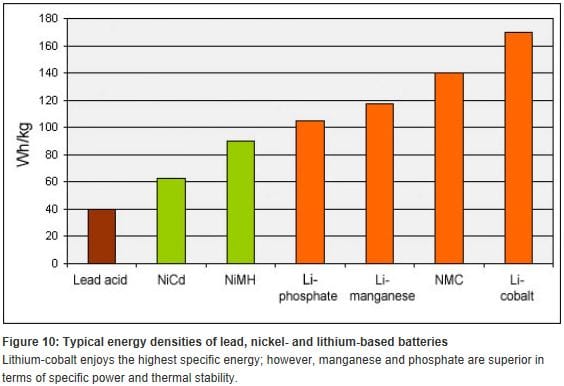
The fires are particularly bad on the Dreamliner because these lithium batteries control virtually everything that goes on aboard the plane. Even without a fire, when they go out so does virtually every control and sensor. So why did they burn and what has Boeing done to take care of it? The simple reason for the fires is that management chose to use Li-Cobalt oxide batteries, the same Li-battery design that every laptop computer maker had already rejected ten years earlier when laptops using them started busting into flames. This is the battery design that caused Dell and HP to recall every computer with it. Boeing decided that they should use a massive version to control everything on their flagship airplane because it has the highest energy density see graphic below. They figured that operational management would insure safety even without the need to install any cooling or sufficient shielding.

All lithium batteries have a negative electrode (anode) that is mostly lithium. The usual chemistry is lithium metal in a graphite matrix. Lithium metal is light and readily gives off electrons; the graphite makes is somewhat less reactive. The positive electrode (cathode) is typically an oxide of some sort, and here there are options. Most current cell-phone and laptop batteries use some version of manganese nickel oxide as the anode. Lithium atoms in the anode give off electrons, become lithium ions and then travel across to the oxide making a mixed ion oxide that absorbs the electron. The process provides about 4 volts of energy differential per electron transferred. With cobalt oxide, the cathode reaction is more or less CoO2 + Li+ e– —> LiCoO2. Sorry to say this chemistry is very unstable; the oxide itself is unstable, more unstable than MnNi or iron oxide, especially when it is fully charged, and especially when it is warm (40 degrees or warmer) 2CoO2 –> Co2O+1/2O2. Boeing’s safety idea was to control the charge rate in a way that overheating was not supposed to occur.

Despite the controls, it didn’t work for the two Boeing batteries that burst into flames. Perhaps it would have helped to add cooling to reduce the temperature — that’s what’s done in lap-tops and plug-in automobiles — but even with cooling the batteries might have self-destructed due to local heating effects. These batteries were massive, and there is plenty of room for one spot to get hotter than the rest; this seems to have happened in both fires, either as a cause or result. Once the cobalt oxide gets hot and oxygen is released a lithium-oxygen fire can spread to the whole battery, even if the majority is held at a low temperature. If local heating were the cause, no amount of external cooling would have helped.

battery-materials-energy-densities-battery-university

Something that would have helped was a polymer interlayer separator to keep the unstable cobalt oxide from fueling the fire; there was none. Another option is to use a more-stable cathode like iron phosphate or lithium manganese nickel. As shown in the graphic above, these stable oxides do not have the high power density of Li-cobalt oxide. When the unstable cobalt oxide decomposed there was oxygen, lithium, and heat in one space and none of the fire extinguishers on the planes could put out the fires.

The solution that Boeing has proposed and that Washington is reviewing is to leave the batteries unchanged, but to shield them in a massive titanium shield with the vapors formed on burning vented outside the airplane. The claim is that this shield will protect the passengers from the fire, if not from the loss of electricity. This does not appear to be the best solution. Airbus had planned to use the same batteries on their newest planes, but has now gone retro and plans to use Ni-Cad batteries. I don’t think that’s the best solution either. Better options, I think, are nickel metal hydride or the very stable Lithium Iron Phosphate batteries that Segway uses. Better yet would be to use fuel cells, an option that appears to be better than even the best batteries. Fuel cells are what the navy uses on submarines and what NASA uses in space. They are both more energy dense and safer than batteries. As a disclaimer, REB Research makes hydrogen generators and purifiers that are used with fuel-cell power.

More on the chemistry of Boeing’s batteries and their problems can be found on Wikipedia. You can also read an interview with the head of Tesla motors regarding his suggestions and offer of help.