Category Archives: Hydrogen

Hydrogenation, how we’ve already entered the hydrogen economy

The hydrogen economy is generally thought to come in some distant future, where your car (and perhaps your home) runs on hydrogen, and the hydrogen, presumably, is made by clean nuclear or renewable solar or wind power. This is understood to be better than the current state of things where your car runs on dirty gasoline, and your home runs on coal or gas, except when the sun is shining bright and the wind is blowing hard. Our homes and cars can not run on solar or wind alone, although solar cells have become quite cheap, because solar power is only available in the daytime, basically for 6 hours, from about 9AM to 3PM. Hydrogen has been proposed as a good way to store solar and wind energy that you can’t use, but it’s not easy to store hydrogen — or is it? I’d like to suggest that, to a decent extent, we already store green hydrogen and use it to run our trucks. We store this hydrogen in the form of Diesel fuel, so you don’t realize it’s hydrogen.

Much of the oil in the United States these days comes from tar sands and shale. It doesn’t flow well at room temperature, and is too heavy and gooey for normal use. We could distill this crude oil and use only the light parts, but that would involve throwing away a huge majority of the oil. Instead we steam reform it to gasoline, ethylene and other products. The reaction is something like this, presuming an input feed of naphtha, C10H8:

C10H8 + 2 H2O –> C7H8 + C2H4 + CO2.

The C2H4 component is ethylene. We use it to make plastics. The C7H8 is called toluene. It is a component of high octane gasoline (octane rating about 114). The inventor of the process, Eugene Jules Houdry claimed to have won WWII for the allies because his secret process (Houdryflow catalytic cracking) allowed high production of lots of gasoline of very high octane, giving US and British planes and trucks higher mpg than the Germans or Japanese had. It was a great money maker, but companies can make even more by adding hydrogen.

Schematic of the hydrocracking process, from the US energy information agency

Over the last 2-3 decades, refineries have been adding catalytic hydrogenation processes. These convert high octane aromatic products, like toluene to low -octane diesel and jet fuel. These products sell for more. Aromatic toluene is exposed to hydrogen at about 500°C and 300 psi (20 bar) to produce heptane, an excellent diesel fuel with about 7% more energy content than toluene per gallon.

C7H8 + 4H2 –> C7H16.

Diesel fuel sell for about 20% more than gasoline per gallon, in part because of the higher energy content, and because Diesel engines are more efficient than gas engines. What’s more, toluene expands as it’s converted to heptane. One gallon of toluene converts to 1.16 gallons of heptane. As a result hydrogenation adds about 40% to the sales price per molecule. Refineries have found that they can make significant money this way if they can buy cheap hydrogen. Over the last few years, several refineries in Norway and Texas (high sun and wind areas) have added hydrogenators along with electrolysis units to produce the cheap hydrogen when no one needs the unwanted electricity generated when supply exceeds demand. Here is an analysis of the thermodynamics of this type of hydrogen generation.

Robert Buxbaum, May 11, 2023

Rotating sail ships and why your curve ball doesn’t curve.

The Flettner-sail ship, Barbara, 1926.

Sailing ships are wonderfully economic and non-polluting. They have unlimited range because they use virtually no fuel, but they tend to be slow, about 5-12 knots, about half as fast as Diesel-powered ships, and they can be stranded for weeks if the wind dies. Classic sailing ships also require a lot of manpower: many skilled sailors to adjust the sails. What’s wanted is an easily manned, economical, hybrid ship: one that’s powered by Diesel when the wind is light, and by a simple sail system when the wind blows. Anton Flettner invented an easily manned sail and built two ships with it. The Barbara above used a 530 hp Diesel and got additional thrust, about an additional 500 hp worth, from three, rotating, cylindrical sails. The rotating sales produced thrust via the same, Magnus force that makes a curve ball curve. Barbara went at 9 knots without the wind, or about 12.5 knots when the wind blew. Einstein thought it one of the most brilliant ideas he’d seen.

Force diagram of Flettner rotor (Lele & Rao, 2017)

The source of the force can be understood with help of the figure at left and the graph below. When a simple cylinder sits in the wind, with no spin, α=0, the wind force is only drag, calculated as 1/2 the wind speed squared, times the cross-sectional area of the cylinder, Dh, times the density of air, times. a drag coefficient, CD. Here, CD is about 1 for a non-spinning cylinder, increasing to about 2 for a fast spinning cylinder. In any case, FD= CDDhρv2/2.

A spinning cylinder has lift force too. FL= CLDhρv2/2.

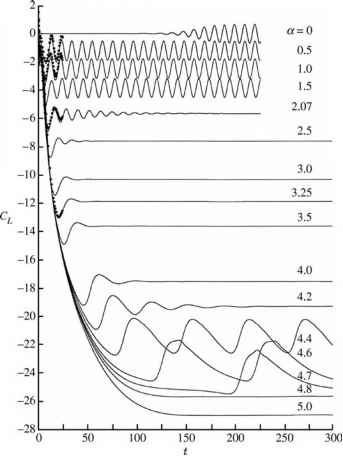
Numerical lift coefficients versus time, seconds for different ratios of surface speed to wind speed, a. (Mittal & Kumar 2003), Journal of Fluid Mechanics.

The lift on the ship, the force you want is calculated the same way, FL= CLDhρv2/2, where the coefficient of lift, CL is graphed in the figure at right. When there is no spin, it is effectively zero with sustained vibrations; that’s at, α=0. Vibrations are useless for propulsion, and can be damaging to the sail, though they are helpful in baseball pitching, producing the erratic flight of knuckle balls. If you spin the cylindrical mast at α>2.1 there are no vibrations, and you get significant lift, CL> 6. At α = 2.1 the fast side of the cylinder moves in the direction of the wind at 2.1 times the wind speed. The other side of the rotor moves opposite: 1.1 times as fast as the wind, but backwards. Even at this, relatively low rotation speed, the coefficient of lift, CL= 6, is more than twice that found with a typical, triangular, non-rotating sail. Drag is higher too, but not as much. The lift is about 4 times the drag, far better than in a typical sail. Another plus is that the ship can be propelled forward or backward -just reverse the spin direction. This is very good for close-in sailing.

The sail lift, and lift to drag ratio, increases with rotation speed reaching very values of 10 to 18 at α values of 3 to 4. Flettner considered α=3.5. optimal. At this α -value you get far more thrust than with a normal sail, and you can go faster than the wind, and far closer to the wind than with any normal sail. You don’t want α values above 4.2 because you start seeing vibrations again. Also more rotation power is needed (rotation power goes as ω2); unless the wind is strong, you might as well use a normal propeller.

The driving force is always at right angles to the perceived wind, called the “fair wind”, and the fair wind moves towards the front as the ship speed increases. Controlling the rotation speed is somewhat difficult but important. Flettner sails were no longer used by the 1930s because fuel became cheaper and control was difficult. Normal sails weren’t being used either for the same reasons.

In the early 1980s, there was a return to the romantic. Famous underwater explorer, Jacques Cousteau, revived a version of the Flettner sail for his exploratory ship, the Alcyone. He used aluminum sails, and an electric motor for rotation. He claimed that the ship drew more than half of its power from the wind, and claimed that, because of computer control, it could sail with no crew. This claim was likely bragging, but he bragged a lot. Even with today’s computer systems, people are needed to steer and manage things in case something goes wrong. The energy savings were impressive, though, enough so that some have begun to put Flettner sails on cargo ships, as a right. This is an ideal use since cargo ships go about as fast as a typical wind, 10- 20 knots. It’s reported that, Flettner- powered cargo ships get about 20% of their propulsion from wind power, not an insignificant amount.

And this gets us to the reason your curve ball does not curve: it’s likely you’re not spinning it fast enough. To get a good curve, you want the ball to spin at α =3, or about 1.5 times the rate you’d get by rolling the ball off your fingers. You have to snap your wrist hard to get it to spin this fast. As another approach, you can aim for α=0, a knuckle ball, achieved with zero rotation. At α=0, the ball will oscillate. It’s hard to do, but your pitch will be nearly impossible to hit or catch. Good luck.

Robert Buxbaum, March 22, 2023. There are also Flettner airplane designs where horizontal, cylindrical “wings” rotate to provide high lift with short wings and a relatively low power draw. So-far, these planes are less efficient and slower than a normal helicopter. The idea could bear more development work, IMHO. Einstein had an eye for good ideas.

Hydrogen transport in metallic membranes

The main products of my company, REB Research, involve metallic membranes, often palladium-based, that provide 100% selective hydrogen filtering or long term hydrogen storage. One way to understand why these metallic membrane provide 100% selectivity has to do with the fact that metallic atoms are much bigger than hydrogen ions, with absolutely regular, small spaces between them that fit hydrogen and nothing else.

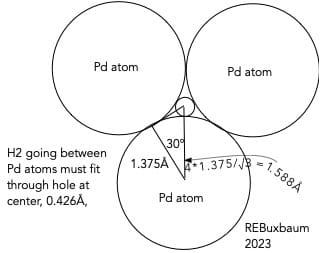
Palladium atoms are essentially spheres. In the metallic form, the atoms pack in an FCC structure (face-centered cubic) with a radius of, 1.375 Å. There is a cloud of free electrons that provide conductivity and heat transfer, but as far as the structure of the metal, there is only a tiny space of 0.426 Å between the atoms, see below. This hole is too small of any molecule, or any inert gas. In the gas phase hydrogen molecules are about 1.06 Å in diameter, and other molecules are bigger. Hydrogen atoms shrink when inside a metal, though, to 0.3 to 0.4 Å, just small enough to fit through the holes.

The reason that hydrogen shrinks has to do with its electron leaving to join palladium’s condition cloud. Hydrogen is usually put on the upper left of the periodic table because, in most cases, it behaves as a metal. Like a metal, it reacts with oxygen, and chlorine, forming stoichiometric compounds like H2O and HCl. It also behaves like a metal in that it alloys, non-stoichiometrically, with other metals. Not with all metals, but with many, Pd and the transition metals in particular. Metal atoms are a lot bigger than hydrogen so there is little metallic expansion on alloying. The hydrogen fits in the tiny spaces between atoms. I’ve previously written about hydrogen transport through transition metals (we provide membranes for this too).

No other atom or molecule fits in the tiny space between palladium atoms. Other atoms and molecules are bigger, 1.5Å or more in size. This is far too big to fit in a hole 0.426Å in diameter. The result is that palladium is basically 100% selective to hydrogen. Other metals are too, but palladium is particularly good in that it does not readily oxidize. We sometime sell transition metal membranes and sorbers, but typically coat the underlying metal with palladium.

We don’t typically sell products of pure palladium, by the way. Instead most of our products use, Pd-25%Ag or Pd-Cu. These alloys are slightly cheaper than pure Pd and more stable. Pd-25% silver is also slightly more permeable to hydrogen than pure Pd is — a win-win-win for the alloy.

Robert Buxbaum, January 22, 2023

Comparing Artemis SLS to Saturn V and Falcon heavy

This week, the Artemis I, Orion capsule splashed down to general applause after circling the moon with mannequins. The launch cost $4.1 Billion, and the project, $50 Billion so far, of $93 Billion expected. Artemis II will carry people around the moon, and Artemis III is expected to land the first woman and person of color. The goal isn’t one I find inspiring, and I feel even less inspired by the technology. I see few advances in Artemis compared to the Saturn V of 50 years ago. And in several ways, it looks like a step backwards.

The graphic below compares the Artemis I SLS (Space Launch System) to the Saturn V. The SLS is 10% lighter, but the payload is lighter, too. It can carry 27 tons to the moon, while the Saturn V sent 50 tons to the moon. I’d expect more weight by now. We have carbon fiber and aramids, and they did not. Add to this that the cost per flight is higher, $4.1 B, versus $1.49 B in 2022 dollars for a Saturn V ($185 million in 1969 dollars). What’s more there was no new engine development or production, so the flight numbers are limited: Each SLS launch throws away five, space shuttle engines. When they are all gone, the project ends. We have no plans or ability to make more engines.

Comparison of Apollo Saturn V and Artemis SLS. The SLS has less lift weight and costs more per launch.

As it happens, there was a better alternative available, the Falcon heavy from SpaceX. The Falcon heavy has been flying for 5 years now, and costs only $141 million per launch, about 1/30 as much as an Artemus launch. The rocket is largely reusable, with 3D printed engines, and boosters that land on their tails. Each SLS is expensive because it’s essentially a new airplane built specially for each flight. Every part but the capsule is thrown away. Adding to the cost of SLS launches is the fuel; hydrogen, the same fuel as the space shuttle. Per energy it’s very expensive. The energy cost for the SLS boosters is high too, and the efficiency is low; each SLS booster costs $290M, more than the cost of two Falcon heavy launches. Falcon launches are cheap, in part because the engines burn kerosine, as did the Saturn V at low altitude. Beyond cost hydrogen has low thrust per flow (low momentum), and is hard to handle; hydrogen leaks caused two Artemis scrubs, and numerous Shuttle delays. I discussed the physics of rocket engines in a post seven years ago.

This graph of $/kg to low earth orbit is mostly from futureblind.com. I added the data for Artemis SLS. Saturn V and Falcon use cheaper fuel and a leaner management team.

It might be argued that Artemis SLS is an inspirational advance because it can lift an entire moon project in one shot, but the Saturn V lifted that and more, all of Skylab. Besides, there is no need to lift everything on one launch. Elon Musk has proposed lifting in two stages, sending the moon rocket and moon lander to low earth orbit with one launch, then lifting fuel and the astronauts on a second launch. Given the low cost of a Falcon heavy launch, Musk’s approach is sure to save money. It also helps develop space refueling, an important technology.

Musk’s Falcon may still reach the moon because NASA still needs a moon lander. NASA has awarded the lander contract to three companies for now, Jeff Bezos’s Blue Origin, Dynetics-Aerodyne makers of the Saturn V, and Musk’s SpaceX. If the SpaceX version wins, a modified Falcon will be sent to the moon on a Falcon heavy along with a space station. Artemis III will rendezvous with them, astronauts will descend to the moon on the lander, and will use the lander to ascend. They’ll then transfer to an Orion capsule for the return journey. NASA has also contracted with Bezos’s Blue origin for planetary, Earth observation, and exploration plans. I suspect that Musk’s lander will win, if only because of reliability. There have been 59 Falcon launches this year, all of them with safe landings. By contrast, no Blue Origin or Dynetics rocket has landed, and Blue Origin does not expect to achieve orbital velocity till 2025.

As best I can tell, the reason we’re using the Artemis SLS with its old engines is inspiration. The Artemis program director, Charlie Blackwell-Thompson is female, and an expert in space shuttle engines. Previous directors were male. Previous astronauts too were mostly male. Musk is not only male, but his products suffer from him being considered a horrible person, a toxic male, in the Tony Stark (Iron Man) mold. Even Jeff Bezos and Richard Branson are considered better, though their technology is worse. See my comparison of SpaceX, Virgin Blue, and Blue Origin.

To me, the biggest blocks to NASA’s inspirational aims, in my opinion, are the program directors who gave us the moon landing. These were two Nazi SS commanders (SS Sturmbannführers), Arthur Rudolph and Wernher Von Braun. Not only were they male and white, they were barely Americanized Nazis, elevated to their role at NASA after killing off virtually all of their 20,000, mostly Jewish, slave workers making rockets for Hitler. Here’s a song about Von Braun, by Tom Lehrer. Among those killed was Von Braun’s professor. In his autobiography, Von Braun showed no sign of regret for any of this, nor does he take blame. The slave labor camp they ran, Dora-Mittelbau, had the highest death rate of all slave labor camps, and when some workers suggested that they could work better if they were fed, the directors, Rudolph and Von Braun had 80 machine gunned to death. Still, Von Braun got us to the moon, and his inspirational comments line the walls at NASA, Kennedy. Blackwell-Thompson and Bezos are surely more inspirational, but their designs seem like dead ends. We may still have to use Musk’s SpaceX if we want a lander or a moon program after the space shuttle’s engines are used up. As Von Braun liked to point out, “Sacrifices have to be made.”

Robert Buxbaum, December 21, 2022. Here’s a bit more about Rudolph, von Braun, the Peenemünda rocket facility, and the Dora-Mittelbau slave labor camp. I may post photos of Von Braun with Hitler and Himmler in SS regalia, but feel uncomfortable doing so at the moment. I feel similarly about posting links to Von Braun’s inspirational interviews.

A simpler way to recycle the waste fuel of a SOFC.

My favorite fuel cells burn hydrogen-rich hydrocarbon fuels, like methane (natural gas) instead of pure hydrogen. Methane is far more energy dense, and costs far less than hydrogen per energy content. The US has plenty of methane and has pipelines that distribute it to every city and town. It’s a low CO2 fuel, and we can lower the CO2 impact further by mixing in hydrogen to get hythane. Elon Musk has called hydrogen- powered fuel cells “fool cells”, methane-powered fuel cells look a lot less foolish. They easily compete with his batteries and with gasoline. Besides, Musk has chosen methane as the fuel for his proposed starship to Mars.

Solid oxide fuel cells, SOFCs, can use methane directly without any pre-reformer. They operate at 800°C or so. At these temperatures, methane reacts with water (steam) within the fuel cell to form hydrogen by the reaction, CH4 + H2O –> 3H2 + CO. The hydrogen, and to a lesser extent the CO is oxidized in the fuel cell to create electricity,, but the methane is not 100% consumed, generally. Unused methane, CO, and some hydrogen exits a solid oxide fuel cell along with the products of combustion, CO2 and water.

Several researchers have looked for ways to recycle this waste fuel to capture the energy value. Six years ago, I patented a membrane method to extract the waste fuel and recycle it, see a description here. I now see this method as too complex, and have applied for a patent on a simpler version, shown below as Figure 1. As before the main work is done by a membrane but here I dispense with the water gas shift reactor, and many of the heat exchangers of the previous approach.

Simple way to improve fuel use in a high temperature fuel cell, using just a membrane.

The fuel cell system of Fig. 1 operates at somewhat elevated pressure, 2 atm or more. It is expected that the majority of the exhaust going to the membrane will be CO2 and water. Most of this will pass through the membrane and will exhaust to the air. The rest is mixed with fresh methane and recycles to the fuel cell. Despite the pressure of the fuel cell, very a little energy is needed for recirculation since the methane does not go through the membrane. The result is a light, simple, and energy efficient process. If you are interested, please contact me at REB Research. Or you can purchase the silicone membrane module here. Alternately, see here for flux information and other applications.

Robert Buxbaum, December 8, 2022.

Of covalent bonds and muon catalyzed cold fusion.

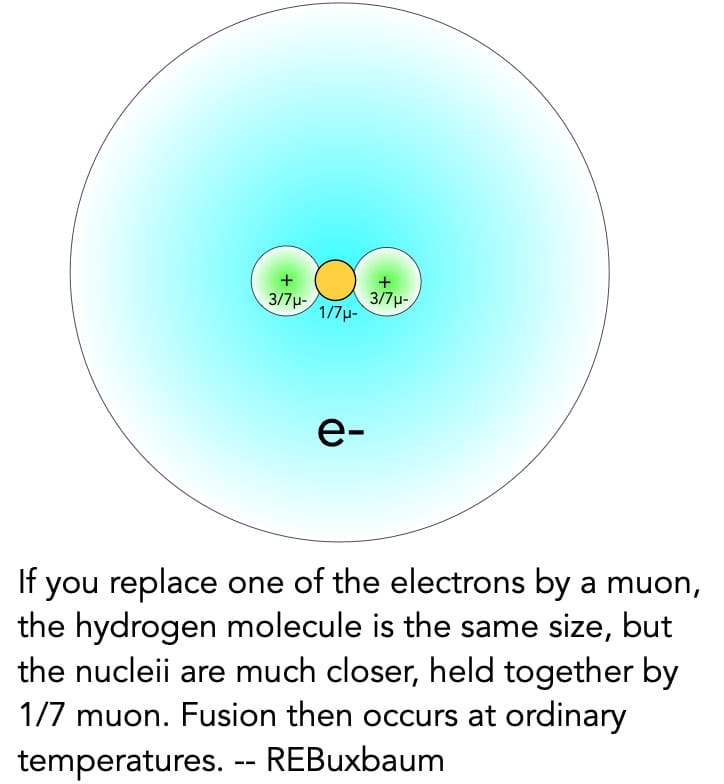
A hydrogen molecule consists of two protons held together by a covalent bond. One way to think of such bonds is to imagine that there is only one electron is directly involved as shown below. The bonding electron only spends 1/7 of its time between the protons, making the bond, the other 6/7 of the time the electron shields the two protons by 3/7 e each, reducing the effective charge of each proton to 4/7e+.

We see that the two shielded protons will repel each other with the force of FR = Ke (16/49 e2 /r2) where e is the charge of an electron or proton, r is the distance between the protons (r = 0.74Å = 0.74×10⁻¹⁰m), and Ke is Coulomb’s electrical constant, Ke ≈ 8.988×10⁹ N⋅m2⋅C−2. The attractive force is calculated similarly, as each proton attracts the central electron by FA = – Ke (4/49) e2/ (r/2)2. The forces are seen to be in balance, the net force is zero.

It is because of quantum mechanics, that the bond is the length that it is. If the atoms were to move closer than r = 0.74Å, the central electron would be confined to less space and would get more energy, causing it to spend less time between the two protons. With less of an electron between them, FR would be greater than FA and the protons would repel. If the atoms moved further apart than 0.74Å, a greater fraction of the electron would move to the center, FA would increase, and the atoms would attract. This is a fairly pleasant way to understand why the hydrogen side of all hydrogen covalent bonds are the same length. It’s also a nice introduction to muon-catalyzed cold fusion.

Most fusion takes place only at high temperatures, at 100 million °C in a TOKAMAK Fusion reactor, or at about 15 million °C in the high pressure interior of the sun. Muon catalyzed fusion creates the equivalent of a much higher pressure, so that fusion occurs at room temperature. The trick to muon catalyzed fusion is to replace one of the electrons with a muon, an unstable, heavy electron particle discovered in 1936. The muon, designated µ-, behaves just like an electron but it has about 207 times the mass. As a result when it replaces an electron in hydrogen, it forms form a covalent bond that is about 1/207th the length of a normal bond. This is the equivalent of extreme pressure. At this closer distance, hydrogen nuclei fuse even at room temperature.

In normal hydrogen, the nuclei are just protons. When they fuse, one of them becomes a neutron. You get a deuteron (a proton-neutron pair), plus an anti electron and 1.44 MeV of energy after the anti-electron has annihilated (for more on antimatter see here). The muon is released most of the time, and can catalyze many more fusion reactions. See figure at right.

While 1.44MeV per reaction is a lot by ordinary standards — roughly one million times more energy than is released per atom when hydrogen is burnt — it’s very little compared to the energy it takes to make a muon. Making a muon takes a minimum of 1000 MeV, and more typically 4000 MeV using current technology. You need to get a lot more energy per muon if this process is to be useful.

You get quite a lot more energy when a muon catalyzes deuterium fusion or deuterium- fusion. With these reactions, you get 3.3 to 4 MeV worth of energy per fusion, and the muon will be ejected with enough force to support about eight D-D fusions before it decays or sticks to a helium atom. That’s better than before, but still not enough to justify the cost of making the muon.

The next reactions to consider are D-T fusion and Li-D fusion. Tritium is an even heavier isotope of hydrogen. It undergoes muon catalyzed fusion with deuterium via the reaction, D+T –> 4He +n +17.6 MeV. Because of the higher energy of the reaction, the muons are even less likely to stick to a helium atom, and you get about 100 fusions per muon. 100 x 17.6 MeV = 1.76 GeV, barely break-even for the high energy cost to make the muon, but there is no reason to stop there. You can use the high energy fusion neutrons to catalyze LiD fusion. For example, 2LiD +n –> 34He + T + D +n producing 19.9 MeV and a tritium atom.

With this additional 19.9 MeV per DT fusion, the system can start to produce usable energy for sale. It is also important that tritium is made in the process. You need tritium for the fusion reactions, and there are not many other supplies. The spare neutron is interesting too. It can be used to make additional tritium or for other purposes. It’s a direction I’d like to explore further. I worked on making tritium for my PhD, and in my opinion, this sort of hybrid operation is the most attractive route to clean nuclear fusion power.

Robert Buxbaum, September 8, 2022. For my appraisal of hot fusion, see here.

A clever range extender for EVs

Electric vehicles work well for short trips between places where you can charge with cheap electricity. Typically that’s trips from home to a nearby place of work, and to local shopping malls and theaters with low-cost charge spots. If you drive this way, you’ll pay about 3.2¢/mile for home electricity, instead of about 17¢/mile for gasoline transport (e.g. 24 mpg with $4/gallon gas). Using an EV also saves on oil changes, transmission, air filters, belts, etc., and a lot of general complexity. Battery prices are still high, but much lower than they were even a few years ago.

The 10 kW Aquarius Engine is remarkably small and light, about 10kg (22 lb).

EVs are less attractive for long trips, especially in the cold. Your battery must provide the heat, as there is no waste heat from the engine. Expect to have to recharge every 200 -250 miles, or perhaps twice in the middle of a long trip. Each charge will take a half-hour or more, and fast charging on the road isn’t low cost. Expect to pay about 15¢/mile, nearly as much as for gasoline. See my full comparison of the economics here.

One obvious solution is to have two cars: a short commuter and an EV. Another solution is a hybrid. The Toyota’s Prius and the Chevy Volt were cutting edge in their day, but people don’t seem to want them. These older hybrids provided quick fill-ups, essentially infinite range, and about double the gas milage of a standard automobile, 30-45 mpg. The problem is you have even more complexity and maintenance than with even a gas automobile.

Aquarius liner engine as a range extender

I recently saw a small, simple, super-efficient (they say) gas engine called Aquarius. It provides 9.5 kW electric output and weighs only 22 lbs (10 kg), see picture above. A Tesla S uses about 16 kW during highway driving, implying that this engine will more than double the highway range of a Tesla S at minimal extra weight and complexity. It also removes the fear of being stranded on the highway, far from the nearest charge-station.

The energy efficiency is 34%, far higher than that for normal automobile engines, but fairly typical of floating piston linear engines. The high efficiency of these engines is partly due to the lack of tapper valves, risers, crank-shaft, and partially due to the fact that the engine always runs at its maximum power. This is very close to the maximum efficiency point. Most car engines are over sized (200 hp or so) and thus must run at a small fraction of their maximum power. This hurts the efficiency, as I discuss here. The Aquarius Engine makes electricity by the back-forth motion of its aligner rods moving past magnetic stator coils. Slots in the piston rod and in the side of the cylinder operate as sliding valves, like in a steam engine. First versions of the Aquarius Engine ran on hydrogen, but the inventors claim it can also run on gasoline, and presumably hythane, my favorite fuel, a mix of hydrogen and natural gas.

At the moment shown, slit valves in the piston rod are open to both cylinder chambers. The explosion at left will vent to the exhaust at left and out the manifold at top. The sliding valve is currently sending fresh air into the cylinder at right, but will soon send it into both cylinders to help scavenge exhaust and provide for the next cycle; engine speed and impression are determined by the mass of the piston.

A video is available to show the basic operation (see it here). The drawing at right is from that video, modified by me. Air is drawn into the engine through a sliding valve at the middle of the cylinder. The valve opens and closes depending on where the piston is. At the instant shown in the picture, the valve is open to the right. Air enters that chambered is likely exiting through slits in the hollow piston rod. It leaves through the manifold t the top, pushing exhaust along with it. When the piston will have moved enough, both the slits and the intake will close. The continued piston motion (inertially driven) will compress the air for firing. After firing, the piston will move left, generating electricity, and eventually opening the slit-valve in the piston to allow the exhaust to leave. When it moves a little further the intake will open.

The use of side-opening exhaust valves is a novelty of the “Skinner UniFlow” double-acting, piston steam engines, seen on the Badger steamship on Lake Michigan. It’s one of my favorite steam engine designs. Normally you want a piston that is much thicker than the one in the drawing. This option is mentioned in the patent, but not shown in the drawing.

Aquarius is not the only company with a free-piston range extender. Toyota built a free-piston extender of similar power and weight; it was more complex but got higher efficiency. It has variable compression though, and looks like a polluter. (the same problems might affect the Aquarius) They dropped the project in 2014. Deutsch Aerospace has a two headed version that’s more powerful, but long and heavier: 56kg and 35kW. Lotus has a crank-piston engine, also 56kg, 35kW; it’s more complex and may have service life issues, but it’s compact and relatively light, and it probably won’t pollute. Finally, Mazda is thinking of bringing back its Wankel rotary engine as a range extender. Any of these might win in the marketplace, but I like the Aquarius engine for its combination of light weight, compact size, and simplicity.

This is not to say that Aquarius motors is a good investment. Aquarius automotive went public on the Toronto exchange in December, 2021, AQUA.TA. The company has no profits to date, and the only chance of them making a profit resides in them getting a good licensing deal from an established company. The major car companies have shown no interest so far, though they clearly need something like this. Their plug in hybrids currently use standard-size, 4 stroke engines: 110-150 kW, 100-150 kg, complex, and low efficiency. Consumers have not been impressed. Tesla autos could benefit from this engine, but Musk shows no interest either.

Robert Buxbaum May 5, 2022. I have no stock in Aquarius motors, nor have I received any benefits from them, or any auto company.

A more accurate permeation tester

There are two ASTM-approved methods for measuring the gas permeability of a material. The equipment is very similar, and REB Research makes equipment for either. In one of these methods (described in detail here) you measure the rate of pressure rise in a small volume.This method is ideal for high permeation rate materials. It’s fast, reliable, and as a bonus, allows you to infer diffusivity and solubility as well, based on the permeation and breakthrough time.

Exploded view of the permeation cell.

For slower permeation materials, I’ve found you are better off with the other method: using a flow of sampling gas (helium typically, though argon can be used as well) and a gas-sampling gas chromatograph. We sell the cells for this, though not the gas chromatograph. For my own work, I use helium as the carrier gas and sampling gas, along with a GC with a 1 cc sampling loop (a coil of stainless steel tube), and an automatic, gas-operated valve, called a sampling valve. I use a VECO ionization detector since it provides the greatest sensitivity differentiating hydrogen from helium.

When doing an experiment, the permeate gas is put into the upper chamber. That’s typically hydrogen for my experiments. The sampling gas (helium in my setup) is made to flow past the lower chamber at a fixed, flow rate, 20 sccm or less. The sampling gas then flows to the sampling loop of the GC, and from there up the hood. Every 20 minutes or so, the sampling valve switches, sending the sampling gas directly out the hood. When the valve switches, the carrier gas (helium) now passes through the sampling loop on its way to the column. This sends the 1 cc of sample directly to the GC column as a single “injection”. The GC column separates the various gases in the sample and determines the components and the concentration of each. From the helium flow rate, and the argon concentration in it, I determine the permeation rate and, from that, the permeability of the material.

As an example, let’s assume that the sample gas flow is 20 sccm, as in the diagram above, and that the GC determines the H2 concentration to be 1 ppm. The permeation rate is thus 20 x 10-6 std cc/minute, or 3.33 x 10⁻⁷ std cc/s. The permeability is now calculated from the permeation area (12.56 cm2 for the cells I make), from the material thickness, and from the upstream pressure. Typically, one measures the thickness in cm, and the pressure in cm of Hg so that 1 atm is 76cm Hg. The result is that permeability is determined in a unit called barrer. Continuing the example above, if the upstream hydrogen is 15 psig, that’s 2 atmospheres absolute or or 152 cm Hg. Lets say that the material is a polymer of thickness is 0.3 cm; we thus conclude that the permeability is 0.524 x 10⁻¹⁰ scc/cm/s/cm2/cmHg = 0.524 barrer.

This method is capable of measuring permeabilities lower than the previous method, easily lower than 1 barrer, because the results are not fogged by small air leaks or degassing from the membrane material. Leaks of oxygen, and nitrogen show up on the GC output as peaks that are distinct from the permeate peak, hydrogen or whatever you’re studying as a permeate gas. Another plus of this method is that you can measure the permeability of multiple gas species simultaneously, a useful feature when evaluating gas separation polymers. If this type of approach seems attractive, you can build a cell like this yourself, or buy one from us. Send us an email to reb@rebresearch.com/blog/, or give us a call at 248-545-0155.

Robert Buxbaum, April 27, 2022.

Low temperature hydrogen removal

Platinum catalysts can be very effective at removing hydrogen from air. Platinum promotes the irreversible reaction of hydrogen with oxygen to make water: H2 + 1/2 O2 –> H2O, a reaction that can take off, at great rates, even at temperatures well below freezing. In the 1800s, when platinum was cheap, platinum powder was used to light town-gas, gas street lamps. In those days, street lamps were not fueled by methane, ‘natural gas’, but by ‘town gas’, a mix of hydrogen and carbon monoxide and many impurities like H2S. It was made by reacting coal and steam in a gas plant, and it is a testament to the catalytic power of Pt that it could light this town gas. These impurities are catalytic poisons. When exposed to any catalyst, including platinum, the catalyst looses it’s power to. This is especially true at low temperatures where product water condenses, and this too poisons the catalytic surface.

Nowadays, platinum is expensive and platinum catalysts are no longer made of Pt powder, but rather by coating a thin layer of Pt metal on a high surface area substrate like alumina, ceria, or activated carbon. At higher temperatures, this distribution of Pt improves the reaction rate per gram Pt. Unfortunately, at low temperatures, the substrate seems to be part of the poisoning problem. I think I’ve found a partial way around it though.

My company, REB Research, sells Pt catalysts for hydrogen removal use down to about 0°C, 32°F. For those needing lower temperature hydrogen removal, we offer a palladium-hydrocarbon getter that continues to work down to -30°C and works both in air and in the absence of air. It’s pretty good, but poisons more readily than Pt does when exposed to H2S. For years, I had wanted to develop a version of the platinum catalyst that works well down to -30°C or so, and ideally that worked both in air and without air. I got to do some of this development work during the COVID downtime year.

My current approach is to add a small amount of teflon and other hydrophobic materials. My theory is that normal Pt catalysts form water so readily that the water coats the catalytic surface and substrate pores, choking the catalyst from contact with oxygen or hydrogen. My thought of why our Pd-organic works better than Pt is that it’s part because Pd is a slower water former, and in part because the organic compounds prevent water condensation. If so, teflon + Pt should be more active than uncoated Pt catalyst. And it is so.

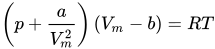
Think of this in terms of the  Van der Waals equation of state:{\displaystyle \left(p+{\frac {a}{V_{m}^{2}}}\right)\left(V_{m}-b\right)=RT}

where V_{m} is molar volume. The substance-specific constants a and b can be understood as an attraction force between molecules and a molecular volume respectively. Alternately, they can be calculated from the critical temperature and pressure as
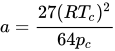
{\displaystyle a={\frac {27(RT_{c})^{2}}{64p_{c}}}}{\displaystyle b={\frac {RT_{c}}{8p_{c}}}.}

Now, I’m going to assume that the effect of a hydrophobic surface near the Pt is to reduce the effective value of a. This is to say that water molecules still attract as before, but there are fewer water molecules around. I’ll assume that b remains the same. Thus the ratio of Tc and Pc remains the same but the values drop by a factor of related to the decrease in water density. If we imagine the use of enough teflon to decrease he number of water molecules by 60%, that would be enough to reduce the critical temperature by 60%. That is, from 647 K (374 °C) to 359 K, or -14°C. This might be enough to allow Pt catalysts to be used for H2 removal from the gas within a nuclear wast casket. I’m into nuclear, both because of its clean power density and its space density. As for nuclear waste, you need these caskets.

I’ve begun to test of my theory by making hydrogen removal catalyst that use both platinum and palladium along with unsaturated hydrocarbons. I find it works far better than the palladium-hydrocarbon getter, at least at room temperature. I find it works well even when the catalyst is completely soaked in water, but the real experiments are yet to come — how does this work in the cold. Originally I planned to use a freezer for these tests, but I now have a better method: wait for winter and use God’s giant freezer.

Robert E. Buxbaum October 20, 2021. I did a fuller treatment of the thermo above, a few weeks back.

Automobile power 2021: Batteries vs gasoline and hydrogen

It’s been a while since I did an assessment of hydrogen and batteries for automobile propulsion, and while some basics have not changed, the price and durability of batteries has improved, the price of gasoline has doubled, and the first commercial fuel cell cars have appeared in the USA. The net result (see details below) is that I find the cost of ownership for a gasoline and a battery car is now about the same, depending on usage and location, and that hydrogen, while still more pricey, is close to being a practical option.

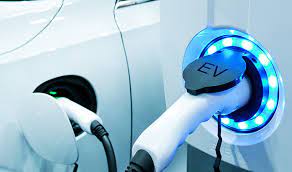
EV Chargers. They look so much cooler than gasoline hoses, and the price per mile is about the same.

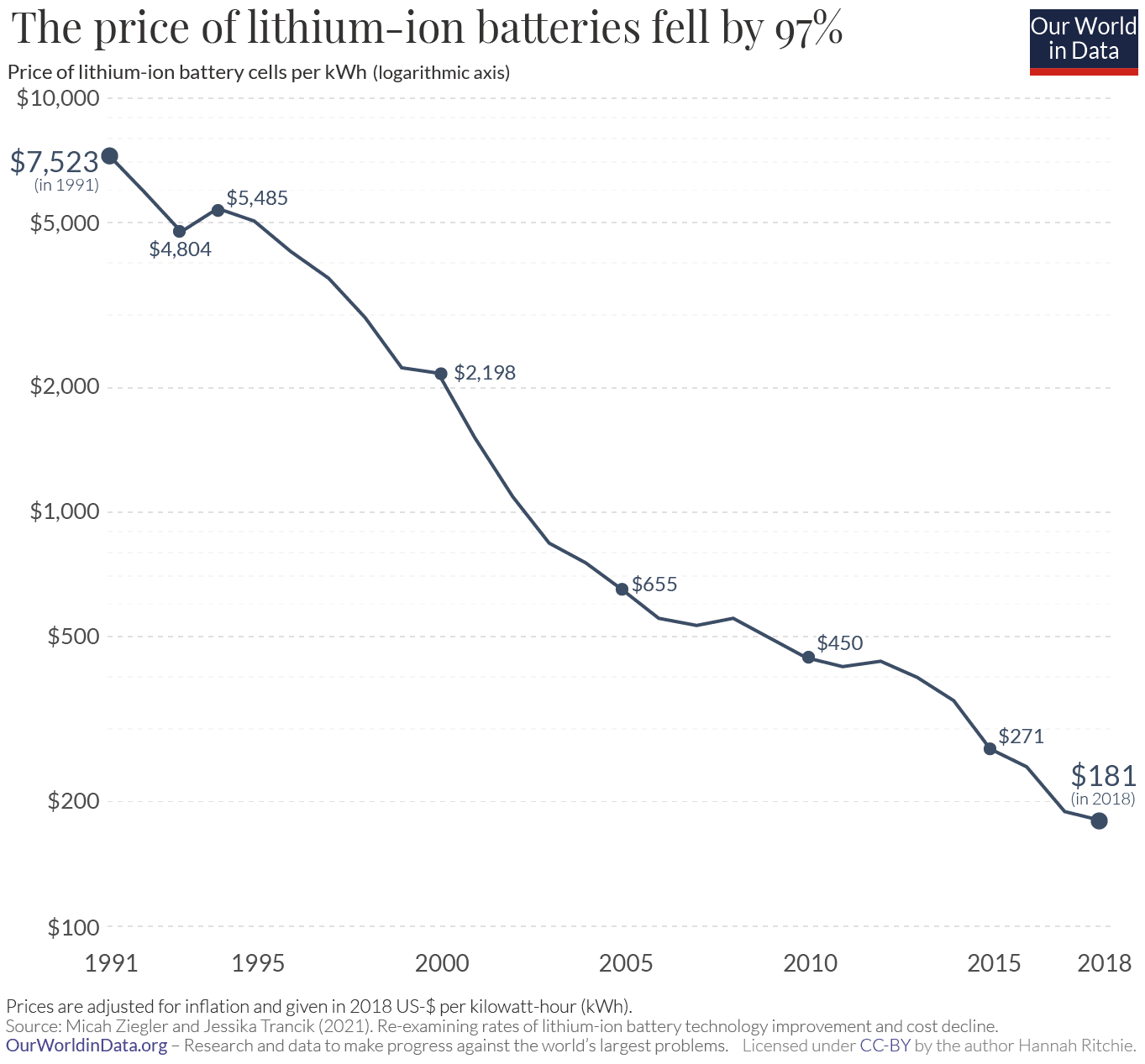
Lithium battery costs are now about $150/kwh. That’s $10,000 for a 70 kWh battery. That’s about 1/5 the price of a Tesla Model 3. The reliability that Tesla claims is 200,000 miles or more, but that’s with slow charging. For mostly fast charging, Car and Driver’s expectation is 120,000 miles. That’s just about the average life-span of a car these days.

The cost of the battery and possible replacement adds to the cost of the vehicle, but electricity is far cheaper than gasoline, per mile. The price of gasoline has doubled to, currently, $3.50 per gallon. A typical car will get about 24 mpg, and that means a current operation cost of 14.6¢/mile. That’s about $1,460/year for someone who drives 10,000 miles per year. I’ll add about $150 for oil and filter changes, and figure that operating a gas-powered car engine costs about $1,610 per year.

If you charge at home, your electricity costs, on average, 14¢/kWh. This is a bargain compared to gasoline since electricity is made from coal and nuclear, mostly, and is subsidized while gasoline is taxed. At level 2 charging stations, where most people charge, electricity costs about 50¢/kWh. This is three times the cost of home electricity, but it still translates to only about $32 for a fill-up that take 3 hours. According to “Inside EVs”, in moderate temperatures, a Tesla Model 3 uses 14.59 kWh/100 km with range-efficient driving. This translates to 11.7¢ per mile, or $1170/year, assuming 10,000 miles of moderate temperature driving. If you live in moderate climates: Californian, Texas or Florida, an electric car is cheaper to operate than a gasoline car. In cold weather gasoline power still makes sense since a battery-electric car uses battery power for heat, while a gasoline powered car uses waste heat from the engine.

Battery cars are still somewhat of more expensive than the equivalent gasoline car, but not that much. In a sense you can add $400/year for the extra cost of the Tesla above, but that just raises the effective operating cost to about $1,570/year, about the same as for the gasoline car. On the other hand, many folks drive less than 50 miles per day and can charge at home each night. This saves most of the electric cost. In sum, I find that EVs have hit a tipping point, and Tesla lead the way.

Now to consider hydrogen. When most people think hydrogen, they think H2 fuel, and a PEM fuel cell car. The problem here is that hydrogen is expensive, and PEM FCs aren’t particularly efficient. Hydrogen costs about $10/kg at a typical fueling station and, with PEM, that 1 kg of hydrogen takes you only about 25 miles. The net result is that the combination hydrogen + PEM results in a driving cost of about 40¢/mile, or about three times the price of gasoline. But Toyota has proposed two better options. The fist is a PEM hybrid, the hydrogen Prius. It’s for the commuter who drives less than about 40 miles per day. It has a 10kWh battery, far cheaper than the Tesla above, but enough for the daily commute. He or she would use charge at home at night, and use hydrogen fuel only when going on longer trips. If there are few long trips, you come out way ahead.

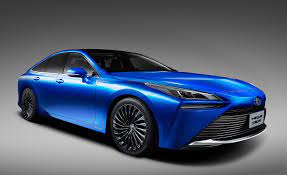
Toyota 2021 Mirai, hydrogen powered vehicle

Toyota also claims to have a hydrogen powered Corolla or debut in 2023. This car will have a standard engine, and I would expect (hope) will drive also — preferably — on hythane, a mix of hydrogen and methane. Hythane is much cheaper per volume, and more energy dense, see my analysis. While Toyota has not said that their Corolla would run on hythane, it is supposed to have an internal combustion engine, and that suggests that hythane will work in it.

A more advanced option for Toyota or any other car/truck manufacturer would be to design to use solid oxide fuel cells, SOFCs, either with hydrogen or hythane. SOFCs are significantly more efficient than PEM, and they are capable of burning hythane, and to some extent natural gas too. Hythane is not particularly available, but it could be. Any station that currently sells natural gas could sell hythane. As for delivery to the station, natural gas lines already exist underground, and the station would just blend in hydrogen, produced at the station by electrolysis, or delivered. Hythane can also be made locally from sewer gas methane, and wind-power hydrogen. Yet another SOFC option is to start with natural gas and convert some of the natural gas to hydrogen on-board using left-over heat from the SOFC. I’ve a patent for this process.

Speaking of supply network, I should mention the brown outs we’ve been having in Detroit. Electric cars are part of the stress to the electric grid, but I believe that, with intelligent charging (and discharging) the concern is more than manageable. The driver who goes 10,000 miles per year only adds about 2,350 kWh/year of extra electric demand. This is a small fraction of the demand of a typical home, 12,154 kWh/year.It’s manageable. Then again, hythane adds no demand to the electric grid and the charge time is quicker — virtually instantaneous.

Robert Buxbaum, September 3, 2021

A useful chart, added September 20, 2021. Battery prices are likely to keep falling.