Category Archives: Engineering

Activated sludge sewage treatment bioreactors

I ran for water commissioner of Oakland county in 2016, a county with 1.3 million people and eight sewage treatment plants. One of these plants uses the rotating disk contractor, described previously, but the others process sewage by bubbling air through it in a large tank — the so-called, activated sludge process. A description is found here in Wikipedia, but with no math, and thus, far less satisfying than it could be. I thought I might describe this process relevant mathematics, for my understanding and those interested: what happens to your stuff after you flush the toilet or turn on the garbage disposal.

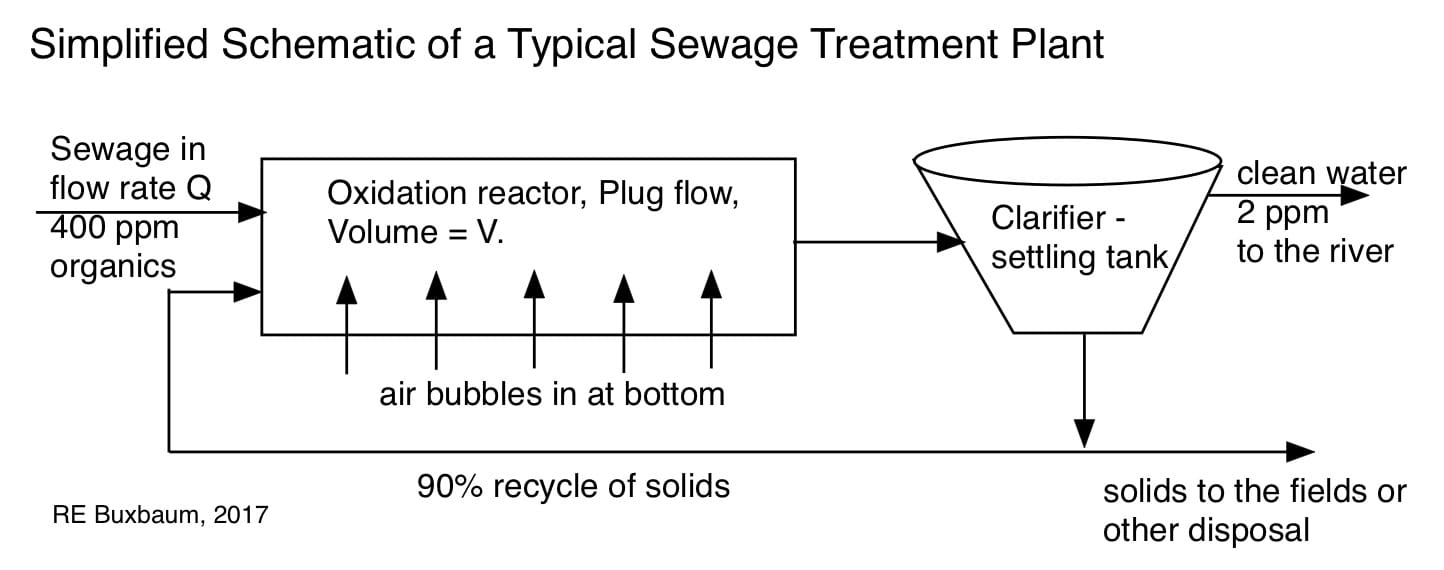
Simplified sewage plant: a plug-flow reactor with a 90+% solids recycle used to maintain a high concentration of bio-catalyst material.

Simplified sewage plant: a bubbling, plug-flow bio-reactor with 90% solids recycle and a settler used to extract floc solids and bio-catalyst material.

In most of the USA, sanitary sewage, the stuff from your toilet, sink, etc. flows separately from storm water to a treatment plant. At the plant, the sewage is first screened (rough filtered) and given a quick settle to remove grit etc. then sent to a bubbling flow, plug-flow bioreactor like the one shown at right. Not all cities use this type of sludge processes, but virtually every plant I’ve seen does, and I’ve come to believe this is the main technology in use today.

The sewage flows by gravity, typically, a choice that provides reliability and saves on operating costs, but necessitates that the sewage plant is located at the lowest point in the town, typically on a river. The liquid effluent of the sewage, after bio-treatment is typically dumped in the river, a flow that is so great more than, during dry season, more than half the flow of several rivers is this liquid effluent of our plants – an interesting factoid. For pollution reasons, it is mandated that the liquid effluent leaves the plant with less than 2 ppm organics; that is, it leaves the plant purer than normal river water. After settling and screening, the incoming flow to the bio-reactor typically contains about 400 ppm of biomaterial (0.04%), half of it soluble, and half as suspended colloidal stuff (turd bits, vegetable matter, toilet paper, etc). Between the activated sludge bio-reactor and the settler following it manage to reduce this concentration to 2 ppm or less. Soluble organics, about 200 ppm, are removed by this cellular oxidation (metabolism), while the colloidal material, the other 200 ppm, is removed by adsorption on the sticky flocular material in the tank (the plug-flow tank is called an oxidation ditch, BTW). The sticky floc is a product of the cells. The rate of oxidation and of absorption processes are proportional to floc concentration, F and to organic concentration, C. Mathematically we can say that

dC/dt = -kFC

where C and F are the concentration of organic material and floc respectively; t is time, and k is a reaction constant. It’s not totally a constant, since it is proportional to oxygen concentration and somewhat temperature dependent, but I’ll consider it constant for now.

As shown in the figure above, the process relies on a high recycle of floc (solids) to increase the concentration of cells, and speed the process. Because of this high recycle, we can consider the floc concentration F to be a constant, independent of position along the reactor length.

The volume of the reactor-ditch, V, is fixed -it’s a concrete ditch — but the flow rate into the ditch, Q, is not fixed. Q is high in the morning when folks take showers, and low at night. It’s also higher — typically about twice as high — during rain storms, the result of leakage and illegal connections. For any flow rate, Q, there is a residence time for a bit of sewage flowing through a tank, τ = V/Q. We can now solve the above equation for the value of τ for an incoming concentration C° = 400 ppm, an outgoing concentration Co of 2 ppm. We integrate the equation above and find that:

ln (C°/Co) = kFτ

Where τ equals the residence time, τ = V/Q. Thus,

ln (C°/Co) = kFV/Q.

The required volume of reactor, V, is related to the flow rate, Q, as follows for typical feed and exit concentrations:

V = Q/kF ln( 400/2) = 5.3 Q/kF.

The volume is seen to be dependent on F. In Oakland county, tank volume V is chosen to be one or two times the maximum expected value of Q. To keep the output organic content to less than 2 ppm, F is maintained so that kF≥ 5.3 per day. Thus, in Oakland county, a 2 million gallon per day sewage plant is built with a 2-4 million gallon oxidation ditch. The extra space allows for growth of the populations and for heavy rains, and insures that most of the time, the effluent contains less than 2 ppm organics.

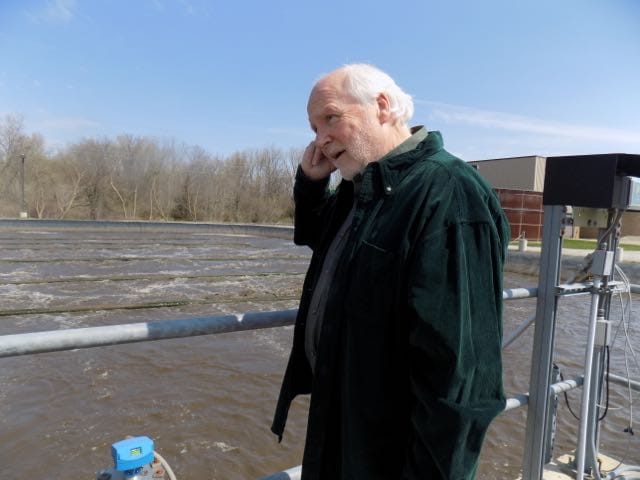
Bob Martin by the South Lyon, MI, Activated Sludge reactor

Bob Martin chief engineer the South Lyon, MI, Activated Sludge plant, 2016. His innovation was to control the air bubblers according to measurements of the oxygen content. The O2 sensor is at bottom; the controller is at right. When I was there, some bubblers were acting up.

As you may guess, the activated sludge process requires a lot of operator control, far more than the rotating disk contractor we described. There is a need for constant monitoring and tweaking. The operator deals with some of the variations in Q by adjusting the recycle amount, with other problems by adjusting the air flow, or through the use of retention tanks upstream or downstream of the reactor, or by adding components — sticky polymer, FeCl3, etc. Finally, in have rains, the settler-bottom fraction itself is adjusted (increased). Because of all the complexity. sewer treatment engineer is a high-pay, in demand, skilled trade. If you are interested, contact me or the county. You’ll do yourself and the county a service.

I’d mentioned that the effluent water goes to the rivers in Oakland county. In some counties it goes to the fields, a good idea, I think. As for the solids, in Oakland county, the solid floc is concentrated to a goo containing about 5% solids. (The goo is called unconsolidated sludge) It is shipped free to farmer fields, or sometimes concentrated to more than 5% (consolidated sludge), and provided with additional treatment, anaerobic digestion to improve the quality and extract some energy. If you’d like to start a company to do more with our solids, that would be very welcome. In Detroit the solids are burned, a very wasteful, energy-consuming process, IMHO. In Wisconsin, the consolidated sludge is dried, pelletized, and sold as a popular fertilizer, Milorganite.

Dr. Robert Buxbaum, August 1, 2017. A colleague of mine owned (owns?) a company that consulted on sewage-treatment and manufactured a popular belt-filter. The name of his company: Consolidated Sludge. Here are some sewer jokes and my campaign song.

A rotating disk bio-reactor for sewage treatment

One of the most effective designs for sewage treatment is the rotating disk bio-reactor, shown below. It is typically used in small-throughput sewage plants, but it performs quite well in larger plants too. I’d like to present an analysis of the reactor, and an explanation of why it works so well.

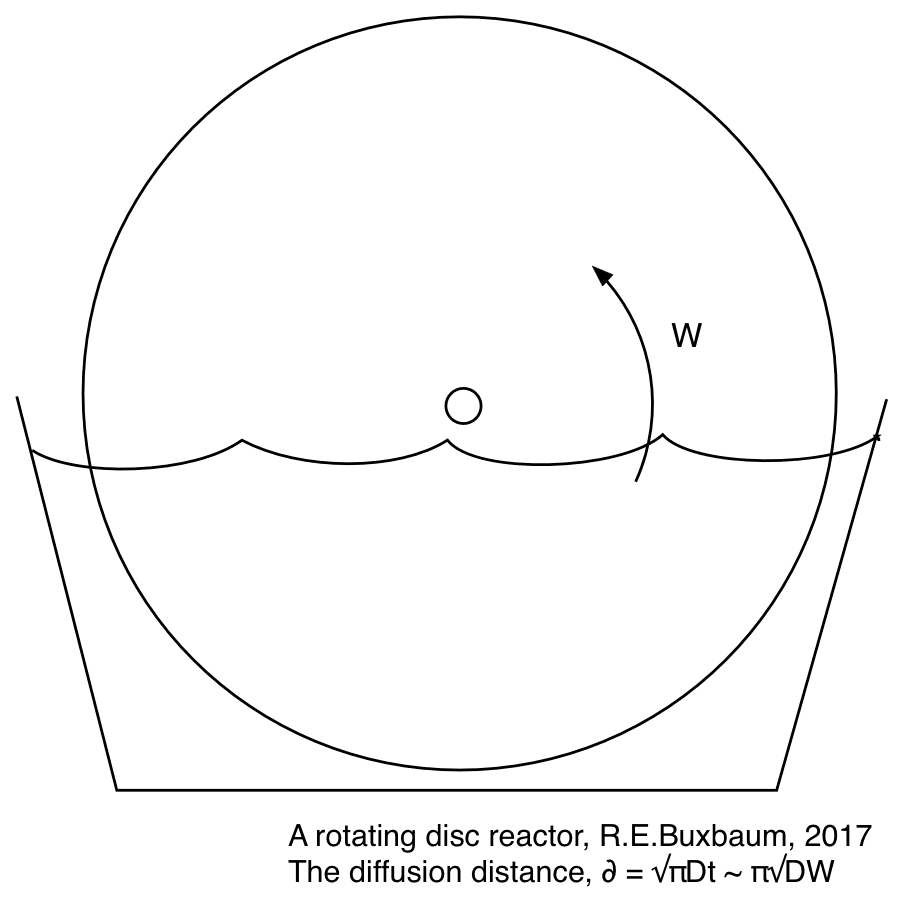
A rotating disc sewage reactor.

A rotating disk sewage reactor; ∂ is the thickness of the biofilm. It’s related to W the rotation rate in radians per sec, and to D the limiting diffusivity.

As shown, the reactor is fairly simple-looking, nothing more than a train of troughs filled with sewage-water, typically 3-6 feet deep, with a stack of discs rotating within. The discs are typically 7 to 14 feet in diameter (2-4 meters) and 1 cm apart. The shaft is typically close to the water level, but slightly above, and the rotation speed is adjustable. The device works because appropriate bio-organisms attach themselves to the disk, and the rotation insures that they are fully (or reasonably) oxygenated.

How do we know the cells on the disc will be oxygenated? The key is the solubility of oxygen in water, and the fact that these discs are only used on the low biological oxygen demand part of the sewage treatment process, only where the sewage contains 40 ppm of soluble organics or less. The main reaction on the rotating disc is bio oxidation of soluble carbohydrate (sugar) in a layer of wet slime attached to the disc.

H-O-C-H + O2 –> CO2 + H2O.

As it happens, the solubility of pure oxygen in water is about 40 ppm at 1 atm. As air contains 21% oxygen, we expect an 8 ppm concentration of oxygen on the slime surface: 21% of 40 ppm = 8 ppm. Given the reaction above and the fact that oxygen will diffuse five times more readily than sugar at least, we expect that one disc rotation will easily provide enough oxygen to remove 40 ppm sugar in the slime at every speed of rotation so long as the wheel is in the air at least half of the time, as shown above.

Let’s now pick a rotation speed of 1/3 rpm (3 minutes per rotation) and see where that gets us in terms of speed of organic removal. Since the disc is always in an area of low organic concentration, it becomes covered mostly with “rotifers”, a fungus that does well in low nutrient (low BOD) sewage. Let’s now assume that mass transfer (diffusion) of sugar in the rotifer slime determines the thickness of the rotifera layer, and thus the rate of organic removal. We can calculate the diffusion depth of sugar, ∂ via the following equation, derived in my PhD thesis.

∂ = √πDt

Here, D is the diffusivity (cm2/s) for sugar in the rotifera slime attached to the disk, π = 3.1415.. and t is the contact time, 90 seconds in the above assumption. My expectation is that D in the rotifer slime will be similar to the diffusivity sugar in water, about 3 x 10⁻⁶ cm2/s. Based on the above, we find the rotifer thickness will be ∂ = √.00085 cm2 = .03 cm, and the oxygen depth will be about 2.5 times that, 0.07 cm. If the discs are 1 cm apart, we find that, about 14% of the fluid volume of the reactor will be filled with slime, with 2/5 of this rotifer-filled. This is as much as 1000 times more rotifers than you would get in an ordinary constantly stirred tank reactor, a CSTR to use a common acronym. We might now imagine that the volume of this sewage-treatment reactor can be as small as 1000 gallons, 1/1000 the size of a CSTR. Unfortunately it is not so; we’ll have to consider another limiting effect, diffusion of nutrients.

Consider the diffusive mass transfer of sugar from a 1,000,000 gal/day flow (43 liters/sec). Assume that at some point in the extraction you have a concentration C(g/cc) of sugar in the liquid where C is between 40 ppm and 1 ppm. Let’s pick a volume of the reactor that is 1/20 the normal size for this flow (not 1/1000 the size, you’ll see why). That is to say a trough whose volume is 50,000 gallons (200,000 liters, 200 m3). If the discs are 1 cm apart, this trough (or section of a trough) will have about  4×10^8 cm2 of submerged surface, and about 9×10^8 total surface including wetted disc in the air. The mass of organic that enters this section of trough is 44,000 C g/second, but this mass of sugar can only reach the rotifers by diffusion through a water-like diffusion layer of about .06 cm thickness, twice the thickness calculated above. The thickness is twice that calculated above because it includes the supernatant liquid beyond the slime layer. We now calculate the rate of mass diffusing into the disc: AxDxc/z = 8×10^8 x 3×10-6 x C/.06 cm = 40,000 C g/sec, and find that, for this tank size and rotation speed, the transfer rate of organic to the discs is 2/3 as much as needed to absorb the incoming sugar. This is to say that a 50,000 gallon section is too small to reduce the concentration to ln (1) at this speed of disc rotation.

Based on the above calculation, I’m inclined to increase the speed of rotation to .75 rpm. At this speed, the rotifer-slime layer will be 2/3 as thin 0.2 mm, and we expect an equally thinner diffusion barrier in the supernatant. At this faster speed, there is now 3/2 as much diffusion transfer per area because the thinner diffusion barrier, and we can expect a 50,000 liter reactor section to reduce the initial concentration by a fraction of 1/2.718 or C/e. Note that the mass transfer rate to the discs is always proportional to C. If we find that 50,000 gallons of tank reduces the concentration to 1/e, we find that we need 150,000 gallons of reactor to reduce the concentration of sugar from 40 ppm to 2 ppm, the legal target, ln (40/2) = 3. This 150,000 gallons is a remarkably small volume to reduce the sBOD concentration from 40 ppm to 2 ppm (sBOD = soluble biological oxygen demand), and the energy use is small too if the disc bearings are good.

The Holly sewage treatment plant is the only one in Oakland county, MI using the rotating disc contacted technology. It has a flow of 1,000,000 gallons per day, and has a contactor trough that is 215,000 gallons, about what we’d expect though their speed is somewhat higher, over 1 rpm and their input concentration is likely lower than 40 ppm. For the first stage of sewage treatment, the Holly plant use a vertical-draft, trickle-bed reactor. That is they drizzle the sewage-liquids over a slime-coated packing to reduce the sBOD concentration from 200 ppm to before feeding the flow to the rotating discs. My sense of the reason they don’t do the entire extraction with a trickle bed is that the discs use far less energy.

I should also add that the back-part of the disc isn’t totally useless oxygen storage, as it seems from my analysis. Some non-sugar reactions take place in the relatively anoxic environment there and in the liquid at the bottom of the trough. In these regions, iron reacts with phosphate, and nitrate removal takes place. These are other important requirements of sewage treatment.

Robert E. Buxbaum, July 18, 2017. As an exercise, find the volume necessary for a plug flow reactor or a stirred tank reactor (CSTR) to reduce the concentration of sugar from 40 ppm to 2 ppm. Assume 1,000,000 gal per day, an excess of oxygen in these reactors, and a first order reaction with a rate constant of dC/dt = -(0.4/hr)C. At some point in the future I plan to analyze these options, and the trickle bed reactor, too.

If the wall with Mexico were covered in solar cells

As a good estimate, it will take about 130,000 acres of solar cells to deliver the power of a typical nuclear facility, 26 TWhr/year. Since Donald Trump has proposed covering his wall with Mexico with solar cells, I came to wonder how much power these cells would produce, and how much this wall might cost. Here goes.

Lets assume that Trump’s building a double wall on a strip of land one chain (66 feet) wide, with a 2 lane road between. Many US roads are designed in chain widths, and a typical, 2 lane road is 1/2 chain wide, 33 feet, including its shoulders. I imagine that each wall is slanted 50° as is typical with solar cells, and that each is 15 to 18 feet high for a good mix of power and security. Since there are 10 square chains to an acre, and 80 chains to a mile we find that it would take 16,250 miles of this to produce 26 TWhr/year. The proposed wall is only about 1/10 this long, 1,600 miles or so, so the output will be only about 1/10 as much, 2.6 TWhr/year, or 600 MW per average daylight hour. That’s not insignificant power — similar to a good-size coal plant. If we aim for an attractive wall, we might come to use Elon Musk’s silica-coated solar cells. These cost $5/Watt or $3 Billion total. Other cells are cheaper, but don’t look as nice or seem as durable. Obama’s, Ivanpah solar farm, a project with durability problems, covers half this area, is rated at 370 MW, and cost $2.2 Billion. It’s thus rated to produce slightly over half the power of the wall, at a somewhat higher price, $5.95/Watt.

Elon Musk with his silica solar panels.

Elon Musk with his, silica-coated, solar wall panels. They don’t look half bad and should be durable.

It’s possible that the space devoted to the wall will be wider than 66 feet, or that the length will be less than 1600 miles, or that we will use different cells that cost more or less, but the above provides a good estimate of design, price, and electric output. I see nothing here to object to, politically or scientifically. And, if we sell Mexico the electricity at 11¢/kWhr, we’ll be repaid $286 M/year, and after 12 years or so, Republicans will be able to say that Mexico paid for the wall. And the wall is likely to look better than the Ivanpah site, or a 20-year-old wind farm.

As a few more design thoughts, I imagine an 8 foot, chain-link fence on the Mexican side of the wall, and imagine that many of the lower solar shingles will be replaced by glass so drivers will be able to see the scenery. I’ve posited that secure borders make a country. Without them, you’re a tribal hoard. I’ve also argued that there is a pollution advantage to controlling imports, and an economic advantage as well, at least for some. For comparison, recent measurement of the Great Wall of China shows it to be 13,170 miles long, 8 times the length of Trump’s wall with China.

Dr. Robert E. Buxbaum, June 14, 2017.

Sewage jokes, limericks, and a song.

I ran for water commissioner (sewer commissioner) of Oakland county, Michigan last year, lost, but enjoyed my run. It’s a post that has a certain amount of humor built-in. If you can’t joke about yourself, you’ve got no place in the sewer. So here are some sewage jokes, and poems, beginning with an old favorite; one I used often in my campaign:3b37b9cab2d27693de2aa7004a3d90ef

Why was Piglet staring into the toilet?
He was looking for Poo.

Last week someone broke into the police station and stole all the toilets. The cops are still searching. So far, they have nothing to go on.paperwork

On administration: In life as on the toilet, the job isn’t done until the paperwork is finished.

Speaking of toilet paper: do you know why Star Trek is like toilet paper? They both go past Uranus and capture Klingons. I wrote an essay on Toilet paper — really. 

Here’s my campaign song and video. It’s sung by Art Carney (I’ve no rights, but figure they’ve expired). The pictures are of me, my daughter, and various people we met visiting sewage treatment plants around the county. Great men and a few great women who don’t mind getting their hands dirty. 

septic12

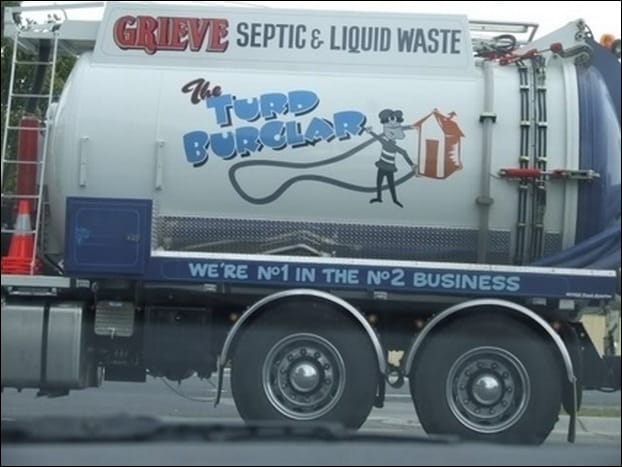
The Turd Burglar, We’re No.1 in the No. 2 business. What a motto!

And now for sewage Limericks:

There once was a man named McBride.
Who fell in the sewer and died.
The same day his brother
Fell in another,
And they were interred side by side.

There is a double intent in that Limerick, in case you missed it

By the sewer she lived, by the sewer she died. Some said t’was disease, but I say, Suicide

sewage treatment

sewage treatment plant in Pontiac, MI — the county’s largest.

How do you describe a jocular sewage joker? pun gent.

Life is like a sewer, what you get out of it is what you put into it (Tom Lehrer). And sometimes it stinks.

Robert E. Buxbaum, June 4, 2017. There is just one more sewage joke I know, but I thought I’d leave it out. It concerns the sewage backup at the prom. Unfortunately, the punchline stinks.

A clever, sorption-based, hydrogen compressor

Hydrogen-powered fuel cells provide weight and cost advantages over batteries, important e.g. for drones and extended range vehicles, but they require highly compressed hydrogen and it’s often a challenge compressing the hydrogen. A large-scale solution I like is pneumatic compression, e.g. this compressor. One would combine it with a membrane reactor hydrogen generator, to fill tanks for fuel cells. The problem is that this pump is somewhat complex, and would likely add air impurities to the hydrogen. I’d now like to describe a different, very clever hydrogen pump, one that suited to smaller outputs, but adds no impurities and and provides very high pressure. It operates by metallic hydride sorption at low temperature, followed by desorption at high temperature.

Hydride sorption -desorption pressures vs temperature.

Hydride sorption -desorption pressures vs temperature, from Dhinesh et al.

The metal hydriding reaction is M + nH2 <–> MH2n. Where M is a metal or metallic alloy and MH2n is the hydride. While most metals will undergo this reaction at some appropriate temperature and pressure, the materials of practical interest are exothermic hydrides that is hydrides that give off heat on hydriding. They also must undergo a nearly stoichiometric absorption or desorption reaction at reasonable temperatures and pressures. The plot at right presents the plateau pressure for hydrogen absorption/ desorption in several, exothermic metal hydrides. The most attractive of these are shown in the red box near the center. These sorb or desorb between 1 and 10 atmospheres and 25 and 100 °C.

In this plot, the slope of the sorption line is proportional to the heat of sorption. The most attractive materials for this pump are the ones in the box (or near) with a high slope to the line implying a high heat of sorption. A high heat of sorption means you can get very high compression without too much of a temperature swing.

To me, NaAlH4 appears to be the best of the materials. Though I have not built a pump yet with this material, I’d like to. It certainly serves as a good example for how the pump might work. The basic reaction is:

NaAl + 2H2 <–> NaAlH4

suggesting that each mol of NaAl material (50g) will absorb 2 mols of hydrogen (44.8 std liters). The sorption line for this reaction crosses the 1 atm horizontal line at about 30°C. This suggests that sorption will occur at 1 am and normal room temperature: 20-25°C. Assume the pump contains 100 g of NaAl (2.0 mols). Under ideal conditions, these 100g will 4 mols of hydrogen gas, about 90 liters. If this material in now heated to 226°C, it will desorb the hydrogen (more like 80%, 72 liters) at a pressure in excess of 100 atm, or 1500 psi. The pressure line extends beyond the graph, but the sense is that one could pressure in the neighborhood of 5000 psi or more: enough to use filling the high pressure tank of a hydrogen-based, fuel cell car.

The problem with this pump for larger volume H2 users is time. It will take 2-3 hours to cycle the sober, that is, to absorb hydrogen at low pressure, to heat the material to 226°C, to desorb the H2 and cycle back to low temperature. At a pump rate of 72 liters in 2-3 hours, this will not be an effective pump for a fuel-cell car. The output, 72 liters is only enough to generate 0.12kWh, perhaps enough for the tank of a fuel cell drone, or for augmenting the mpg of gasoline automobiles. If one is interested in these materials, my company, REB Research will be happy to manufacture some in research quantities (the prices blow are for materials cost, only I will charge significantly more for the manufactured product, and more yet if you want a heater/cooler system).

Properties of Metal Hydride materials; Dhanesh Chandra,* Wen-Ming Chien and Anjali Talekar, Material Matters, Volume 6 Article 2

Properties of Metal Hydride materials; Dhanesh Chandra,* Wen-Ming Chien and Anjali Talekar, Material Matters, Volume 6 Article 2

One could increase the output of a pump by using more sorbent, perhaps 10 kg distributed over 100 cells. With this much sorbent, you’ll pump 100 times faster, enough to take the output of a fairly large hydrogen generator, like this one from REB. I’m not sure you get economies of scale, though. With a mechanical pump, or the pneumatical pump,  you get an economy of scale: typically it costs 3 times as much for each 10 times increase in output. For the hydride pump, a ten times increase might cost 7-8 times as much. For this reason, the sorption pump lends itself to low volume applications. At high volume, you’re going to want a mechanical pump, perhaps with a getter to remove small amounts of air impurities.

Materials with sorption lines near the middle of the graph above are suited for long-term hydrogen storage. Uranium hydride is popular in the nuclear industry, though I have also provided Pd-coated niobium for this purpose. Materials whose graph appear at the far, lower left, titanium TiH2, can be used for permanent hydrogen removal (gettering). I have sold Pd-niobium screws for this application, and will be happy to provide other shapes and other materials, e.g. for reversible vacuum pumping from a fusion reactor.

Robert Buxbaum, May 26, 2017 (updated Apr. 4, 2022). 

Future airplane catapults may not be electric

President Trump got into Hot Water with the Navy this week for his suggestion that they should go “back to god-damn steam” for their airplane catapults as a cure for cost over-runs and delays with the Navy’s aircraft carriers. The Navy had chosen to go to a more modern catapult called EMALS (electromagnetic, aircraft launch system) based on a traveling coil and electromagnetic pulses. This EMAL system has cost $5 Billion in cost over-runs, has added 3 years to the program, and still doesn’t work well. In response to the president’s suggestion (explosion), the Navy did what the rest of Washington has done: blame Trump’s ignorance, e.g. here, in the Navy Times. Still, for what it’s worth, I think Trump’s idea has merit, especially if I can modify it a bit to suggest high pressure air (pneumatics) instead of high pressure steam.


Tests of the navy EMALS, notice that some launches go further than others; the problem is electronics, supposedly.

If you want to launch a 50,000 lb jet fighter at 5 g acceleration, you need to apply 250,000 lbs of force uniformly throughout the launch. For pneumatics, all that takes is 250 psi steam or air, and a 1000 square inch piston, about 3 feet in diameter. This is a very modest pressure and a quite modest size piston. A 50,000 lb object accelerated this way, will reach launch speed (130 mph) in 1.2 seconds. It’s very hard to get such fast or uniform acceleration with an electromagnetic coil since the motion of the coil always produces a back voltage. The electromagnetic pulses can be adjusted to counter this, but it’s not all that easy, as the Navy tests show. You have to know the speed and position of the airplane precisely to get it right, and have to adjust the firing of the pushing coils accordingly. There is no guarantee of smooth acceleration like you get with a piston, and the EMALS control circuit will always be vulnerable to electromagnetic and cyber attack. As things stand, the control system is thought to be the problem.

A piston is invulnerable to EM and cyber attack since, if worse comes to worse, the valves can be operated manually, as was done with steam-catapults throughout WWII. And pistons are very robust — far more robust than solenoid coils — because they are far less complex. As much force as you put on the plane, has to be put on the coil or piston. Thus, for 5 g acceleration, the coil or piston has to experience 250,000 lbs of horizontal force. That’s 3 million Newtons for those who like SI units (here’s a joke about SI units). A solid piston will have no problem withstanding 250,000 lbs for years. Piston steamships from the 50s are still in operation. Coils are far more delicate, and the life-span is likely to be short, at least for current designs. 

The reason I suggest compressed air, pneumatics, instead of steam is that air is not as hot and corrosive as steam. Also an air compressor can be located close to the flight deck, connected to the power center by electric wires. Steam requires long runs of steam pipes, a more difficult proposition. As a possible design, one could use a multi-stage, inter-cooled air compressor connected to a ballast tank, perhaps 5 feet in diameter x 100 feet long to guarantee uniform pressure. The ballast tank would provide the uniform pressure while allowing the use of a relatively small compressor, drawing less power than the EMALS. Those who’ve had freshman physics will be able to show that 5 g acceleration will get the plane to 130 mph in only 125 feet of runway. This is far less runway than the EMALS requires. For lighter planes or greater efficiency, one could shut off the input air before 120 feet and allow the remainder of the air to expand for 200 feet of the piston.

The same pistons could be used for capturing an airplane. It could start at 250 psi, dead-ended to the cylinder top. The captured airplane would push air back into the ballast tank, or the valve could be closed allowing pressure to build. Operated that way, the cylinder could stop the plane in 60 feet. You can’t do that with an EMAL. I should also mention that the efficiency of the piston catapult can be near 100%, but the efficiency of the EMALS will be near zero at the beginning of acceleration. Low efficiency at low speed is a problem found in all electromagnetic actuators: lots of electromagnetic power is needed to get things moving, but the output work,  ∫F dx, is near zero at low velocity. With EM, efficiency is high at only at one speed determined by the size of the moving coil; with pistons it’s high at all speeds. I suggest the Navy keep their EMALS, but only as a secondary system, perhaps used to launch drones until they get sea experience and demonstrate a real advantage over pneumatics.

Robert Buxbaum, May 19, 2017. The USS Princeton was the fanciest ship in the US fleet, with super high-tech cannons. When they mis-fired, it killed most of the cabinet of President Tyler. Slow and steady wins the arms race.

Nestle pays 1/4,000 what you pay for water

When you turn on your tap or water your lawn, you are billed about 1.5¢ for every gallon of water you use. In south-east Michigan, this is water that comes from the Detroit river, chlorinated to remove bacteria, e.g. from sewage, and delivered to you by pipe. When Nestle’s Absopure division buys water, it pays about 1/4000 as much — $200/ year for 218 gallons per minute, and they get their water from a purer source, a pure glacial aquifer that has no sewage and needs no chlorine. They get a far better deal than you do, in part because they provide the pipes, but it’s mostly because they have the financial clout to negotiate the deal. They sell the Michigan water at an average price around $1/gallon, netting roughly $100,000,000 per year (gross). This allows them to buy politicians — something you and I can not afford.

Absopure advertises that I t will match case-for-case water donations to Flint. Isn't that white of them.

Absopure advertises that I t will match case-for-case water donations to Flint. That’s awfully white of them.

We in Michigan are among the better customers for the Absopure water. We like the flavor, and that it’s local. Several charities purchase it for the folks of nearby Flint because their water is near undrinkable, and because the Absopure folks have been matching the charitable purchases bottle-for bottle. It’s a good deal for Nestle, even at 50¢/gallon, but not so-much for us, and I think we should renegotiate to do better. Nestle has asked to double their pumping rate, so this might be a good time to ask to increase our payback per gallon. So far, our state legislators have neither said yes or no to the proposal to pump more, but are “researching the matter.” I take this to mean they’re asking Nestle for campaign donations — the time-honored Tammany method. Here’s a Detroit Free Press article.

I strongly suspect we should use this opportunity to raise the price by a factor of 400 to 4000, to 0.15¢ to 1.5¢ per gallon, and I would like to require Absopure to supply a free 1 million gallons per year. We’d raise $300,000 to $3,000,000 per year and the folks of Flint would have clean water (some other cities need too). And Nestle’s Absopure would still make $200,000,000 off of Michigan’s, clean, glacial water.

Robert Buxbaum, May 15, 2017. I ran for water commissioner, 2016, and have occasionally blogged about water, E.g. fluoridationhidden rivers, and how you would drain a swamp, literally.

May 1, St. Tammany day

May 1 is St. Tammany day, a day to rejoice in the achievements of Tammany Hall, and of St Tammany, the guardian of crooked politicians everywhere. The Sons of St. Tammany started in 1773 as a charitable club of notable revolutionary-era individuals including Benjamin Franklin, John Hancock, and John Dickenson, but evolved into perhaps the most corrupt, and American, of political organizations. The picture of a US politician – the cartoon version at least — is the Tammany Democrat: a loud, drunken, womanizer, willing to do or promise whatever the people seem to want at the moment. Tammany and its bosses helped form this image. They helped new immigrants, but did so by creating needless government jobs, by filling them often with incompetent loyalists, and by overcharging on government contracts. Today, these Tammany ways rule in every major American city; the other clubs of the day are gone or influence-less.

John Hancock leads a meeting of the St. Tammany (Columbian) society. Note the "Appeal to Heaven flag and the Indian, real or imagined. Indians participated in several, early St. Tammany meetings.

John Hancock leads a meeting of the St. Tammany society. Note the “Appeal to Heaven” flag. While Indians participated in some, early meetings, the one here is, I suspect, a ghost: St. Tammany.

In revolutionary-era America, the Sons of St. Tammany was just one of many social-charitable clubs (Americans like to form clubs), in many ways it was similar to the Masons and the Cincinnati, but those clubs were international and elitist. The sons of Tammany was purely American, and anti-elitist. It was open to anyone born on this side of the Atlantic, and had Indian customs. The Cincinnati society, for comparison, started with members who were as notable (Alexander Hamilton, George Washington, Marie, Marquis de Lafayette, Henry Knox, etc.) but was originally open only to high officers of the regular army, including foreigners like Lafayette, but not ordinary soldiers, minutemen (militia), or the general public. The symbols of the Tammanies were American: the liberty-cap and the “Appeal to Heaven” flag, now a popular symbol of the Tea Party; the leader was called by an Indian name: Sachem. By contrast, the Cincinnati society symbol was the Imperial Eagle (Washington’s was gold with diamonds), and the leader was called “general”. The Tammany society began admitting immigrants in 1810 or so, while the Cincinnati society remains closed to this day, except to descendants of Revolutionary officers — an aristocratic affectation in the eyes of some.

It was Aaron Burr who first saw the opportunity to use the Tammany organization as a for-profit, political machine. In the years 1795-9, New York was suffering from yellow fever and a variety of other diseases that were taken to be caused by a lack of clean water. Burr proposed, with Tammany support, the creation of a corporation to build a new water system to bring fresh, clean water from the Bronx River to lower Manhattan via iron pipes. The Manhattan company was duly chartered, with directors who were primarily Tammany men, Republican-Democrats, and not Federalists. Federalists (Hamilton, primarily) controlled the only NY banks at the time and controlled the directorate of every chartered company in the city. The Manhattan company requested a $2,000,000 perpetual charter, twice as big as the charter of Hamilton’s Bank of New York, and a monopoly on water distribution. These were reasonable requests given the task, but unusual in the lack of Federalist or governmental oversight. But the Manhattan company was a water company, and water was needed. But Burr’s intent, all along, it seems was to build a bank, not a water company. After the charter was approved, but before signing, he amended it to allow any excess funds to be used for any legal purpose. 

In this cartoon by Dr. Seuss, The Tammany Tiger says, "Today is the Big Day Folks. Vote Early and Often."

In this cartoon by Dr. Seuss, The Tammany Tiger says, “Today is the Big Day Folks. Vote Early and Often.”

Money was raised, but only $100,000 used for the water system. The remaining 95% of the charter funds, $1,900,000, went to found “The Bank of The Manhattan company” — later to be known as “The Chase Manhattan Bank” or “The Manhattan Bank of Cholera.” Instead of building the reservoir in upper Manhattan and filling it with clean water as originally proposed, Burr’s Tammany trustees voted to dig wells in lower Manhattan, and placed its reservoir in lower Manhattan too, near Chamber’s St,  next to a cemetery where Cholera victims were buried. New York suffered with Cholera, Typhoid, and leaky, wooden pipes until 1842 when Peter Cooper brought clean water to lower Manhattan from the Groton River via iron pipes. To this day, crooked water contracts are a staple of Tammany politics

The Bank of the Manhattan company opened at 40 Wall St on September 1, 1799, a mere four months after the water company’s incorporation. Hamilton was furious. The company continues today as The JP Morgan, Chase Manhattan Bank, one of the largest banking institutions in the world. Burr used the money and power of his company to reward supporters and to run for vice president with Thomas Jefferson’s tacit support. Except for his Tammany candidacy, John Adams would have won New York and a second term as president. Burr’s career pretty-well died after the Hamilton duel, but Tammany did well without him. By 1812, the Society built its first Tammany Hall, officially called the Wigwam, a $55,000, five-story building with a meeting hall for 2000. New York Democratic politics would center on Tammany Hall for the next century at least.

Following disappointment with John Quincy Adams, “the bitter branch of the bitter tree,” Tammy leaders went national. They recruited Andrew Jackson, a war hero and early recruit of Burr’s. They’d support Jackson if he’d hand over spoils, control of government jobs. He agreed and, as president, fired perfectly good, long-standing government employees He replaced them with Democratic loyalists. When Jackson stepped down in 1833, Tammany elected an equally corrupt New Yorker, Martin van Buren. Though there were periodic Whig and Republican reforms, Tammany learned they could wait those out. They always re-emerged like mushrooms after a rain.

Boss Tweed and other Tammany leaders: who stole the money?

Boss Tweed and other Tammany leaders in a cartoon by Nast, Tammany Ring. “Who stole the money? He did.”  

A key vote-getter in the Tammany system is to provide Thanksgiving dinners and other charitable giveaways for the poor, as well as promises of jobs. By the late 1800s, William J. Brian added promises of soft money and wealth redistribution, cornerstones of the Democratic platform to this day. Tammany also tends to be for low tariffs as opposed to the high tariff ideas of Hamilton and many Whigs and 19th century Republicans. A case can be made for either view.

Tammany helped New York immigrants, particularly the Irish to get citizenship and avoid legal troubles in return for votes and occasional muscle. In other cities, Democratic clubs were less open to Catholics, reflecting the views of the common voter in each state. In the North they were pro-union, in the South anti, electing Klu Kluxers like George Wallace, Sam Ervin, and Robert Byrd. This lead to a famous split in the Democratic party about the 1968 convention. Famous Tammany leaders include William M. “Boss” Tweed, “Big” Tim Sullivan, and “Gentleman” Jimmy Walker. Sullivan famously authored the first anti-gun law, the Sullivan act; it was designed to protect his thugs against private citizens shooting them. It didn’t always work.

Edwin Edwards, Democratic Governor of Louisiana. 1972-1996. Who would not trust this man?

Hon. (?) Edwin Edwards, Governor of Louisiana. 1972-1996. Tammany lives

If you want to see Tammany politics in action, visit almost any large US city, or read its newspaper. In Chicago, the dead vote, and 4 of the last 6 governors have gone to jail. Mayor Daily famously told Kennedy that 90 percent of the registered voters of Cook County would vote for him. They did (sort of); because of this, JFK won Illinois and the presidency. In New York, voters discovered only in the 1960s that Tammany’s leader, Carmine DeSapio had been working for 30 years with known gangland murderer, Charles “Lucky” Luciano. In Detroit, where I live and corruption in the water department is legendary. Race-based job handouts, unemployment is high along with high minimum (living) wages. We’re now in the process of a $70,000,000 project to replace 100 feet of sewer pipe, and we’re building a $140 million, 3.3 mile trolley. Tammany loves all public works.

Then there is Louisiana, home to St Tammany parish. Louisiana Democrats like Huey Long and Edwin Edwards (shown at left) are unusual in that they’re proud to say that their corrupt methods are corrupt. Edwards has had two long runs as governor despite several convictions for doing illegal things he admits to doing. When Edwards was asked why he did favors for his friends. He responded: “Who should I do them for? My enemies?” Or, to quote one of Edwin Edwards campaign ads. Vote Edwin EdwardsPeople seem to love it, or did until the levy broke. There is a particularly American grandeur to all this. As Will Rodgers said, “America has the best politicians money can buy.” Today is the day to be proud of that uniquely American tradition. You too can grow up to buy a president.

Robert Buxbaum, April 28, 2017. I ran for water commissioner, and have written about sewage treatment, flood avoidance, and fluoride, as well as the plusses and minuses of trade unionization, and the difference between Republicans and Conservatives.

pee in the shower and other water savers

Do you want to save the planet and save money at the same time? Here are some simple tips:

The first money and planet saver, is to pee in the shower. For those who don’t have a lawn, or who don’t water, your single biggest water cost is likely the toilet. Each person in your household will use it several times per day, at roughly 1.6 gallons per flush. In Oak Park, Michigan the cost of water is 1.5¢/gallon, so each flush costs you, roughly 2.5¢. If you pee in the shower every morning, you’ll save yourself about one flush per day, or 2.5¢. Over the course of a year you’ll have used about 500 gallons less, and will have saved yourself somewhere between $5 and $10. Feel good about yourself every morning; the effort involved is truly minimal.

Related to peeing in the shower, I should mention that many toilets leak. A significant part of your water bill can often be cut by replacing the “flapper valve on the inside of your toilet tank, and/or by cleaning the needle fill valve. To see if you need this sort of help, put a few drops of food dye in the toilet when you leave in the morning. If the color is largely gone by the time you get back, the toilet is leaking the equivalent of a few volumes per day, that is at least as much water as is flushed. If the color goes faster, or you hear the tank refill when no one used it, you’re leaking more. Check the flapper and replace it if it’s worn — it’ll cost about $3 — and check the needle-fill valve. They don’t work forever. Cleanliness is near godliness.

Mulch is good, this is too much concentrated by the tree trunk. Use only 2 inches and spread it out to save water and weeding.

Mulch is good, this is too much concentrated by the tree trunk. Use only 2-3 inches and spread it out from the trunk to save water and weeding without attracting bugs.

If your valve is leaking and you decide to replace it, you may want to replace with a variable flush valve. Typically, there are two options: a big vale for big flush (1.6 gal) and a small valve for small flush (1 gal or less). These are widely used in Europe. You can make up for this cost rather quickly at 1.5¢/gallon.

The next big issue is lawn-care. If you water your lawn and flowers daily, you’ve likely noticed that you pay about $300/month for water in the summer: a lot more than in the winter, or than your lazes-faire neighbor in the summer. Every $150 of summer-excess, water bill you pay represents about 10,000 gallons applied to your lawn. That’s a cubic foot, or 1¢ to 2¢ of water applied per ft2 per month for typical watering. While many sites advise that you can save by adding a rain barrel, I disagree. Rain barrels are costly, ugly, and are a lot of work ago plumb in. And each barrel only holds 55 gallons of water, 82¢ worth when full. You do a lot better, IMHO by putting down an inch or two of mulch around your flowers and vegetables. This mulch requires no work and will keep you from needing to water these areas for the 3-4 days after every rainfall. A layer of 1″ to 2″ will help your soil hold 0.5 to 1 gallon of water per square foot. At typical prices of mulch and water, this will pay for itself in 1-2 years and will help you avoid weeding. Mulch is a far better return than the rain-barrels that are often touted, and there’s far less effort involved. Buy the mulch, not the barrel, but don’t put down too more than 2″ on flowers and vegetable. Trees can take 3 -4″; don’t use more. Avoid a mulch mountain right next to a tree, it causes the roots to grow weird, and provides a home for bugs and undesirable anaerobic molds.

A little more work than the above is to add a complete rain garden or bioswale. Build it at the bottom of any large incline on your property, where the water runs off (It’s likely a soggy swamp already). Dig the area deeper and put, at the bottom of the hole, a several-inch layer of mulch and gravel. Top it off with the soil you just removed, ideally raising the top high enough that, if the rain garden should fill, the water will run off to the street. Plant in the soil at the top long-rooted grasses, or flowers, vegetables, or water-tolerant trees. You may want to direct the water from your home’s sump pump here too (It can help to put a porous pipe at the bottom to distribute this water). If you do this right, you’ll get vegetables or trees and you won’t have to water the garden, ever. Also, you’ll add value to your property by removing the swampy eyesore. You’ll protect your home too, since a major part of home flooding comes from the water surge of sump water to the sanitary sewer.

Robert E. Buxbaum, April 14, 2017. I ran for water commissioner, Oakland County, MI, Nov. 2016. Among my other thoughts: increased retention to avoid flooding, daylighting rivers, and separating the sanitary from the storm sewers. As things stand, the best way to save money on water– get the same deal the state gave to Nestle/ Absopure: they pay only $200/year to pump 200 gal/minute. That is, they pay only 1/3000 of what you and I pay. It helps to have friends in government.

The hydrogen jerrycan

Here’s a simple invention, one I’ve worked on off-and-on for years, but never quite built. I plan to work on it more this summer, and may finally build a prototype: it’s a hydrogen Jerry can. The need to me is terrifically obvious, but the product does not exist yet.

To get a view of the need, imagine that it’s 5-10 years in the future and you own a hydrogen, fuel cell car. You’ve run out of gas on a road somewhere, per haps a mile or two from the nearest filling station, perhaps more. You make a call to the AAA road-side service and they show up with enough hydrogen to get you to the next filling station. Tell me, how much hydrogen did they bring? 1 kg, 2 kg, 5 kg? What did the container look like? Is there one like it in your garage?

The original, German "Jerry" can. It was designed at the beginning of WWII to help the Germans to overrun Europe.

The original, German “Jerry” can. It was designed at the beginning of WWII to help the Germans to overrun Europe. I imagine the hydrogen version will be red and roughly these dimensions, though not quite this shape.

I figure that, in 5-10 years these hydrogen containers will be so common that everyone with a fuel cell car will have one, somewhere. I’m pretty confident too that hydrogen cars are coming soon. Hydrogen is not a total replacement for gasoline, but hydrogen energy provides big advantages in combination with batteries. It really adds to automotive range at minimal cost. Perhaps, of course this is wishful thinking as my company makes hydrogen generators. Still it seems worthwhile to design this important component of the hydrogen economy.

I have a mental picture of what the hydrogen delivery container might look like based on the “Jerry can” that the Germans (Jerrys) developed to hold gasoline –part of their planning for WWII. The story of our reverse engineering of it is worth reading. While the original can was green for camouflage, modern versions are red to indicate flammable, and I imagine the hydrogen Jerry will be red too. It must be reasonably cheap, but not too cheap, as safety will be a key issue. A can that costs $100 or so does not seem excessive. I imagine the hydrogen Jerry can will be roughly rectangular like the original so it doesn’t roll about in the trunk of a car, and so you can stack a few in your garage, or carry them conveniently. Some folks will want to carry an extra supply if they go on a long camping trip. As high-pressure tanks are cylindrical, I imagine the hydrogen-jerry to be composed of two cylinders, 6 1/2″ in diameter about. To make the rectangular shape, I imagine the cylinders attached like the double pack of a scuba diver. To match the dimensions of the original, the cylinders will be 14″ to 20″ tall.

I imagine that the hydrogen Jerry can will have at least two spouts. One spout so it can be filled from a standard hydrogen dispenser, and one so it can be used to fill your car. I suspect there may be an over-pressure relief port as well, for safety. The can can’t be too heavy, no more than 33 lbs, 15 kg when full so one person can handle it. To keep the cost and weight down, I imagine the product will be made of marangeing steel wrapped in kevlar or carbon fiber. A 20 kg container made of these materials will hold 1.5 to 2 kg of hydrogen, the equivalent of 2 gallons of gasoline.

I imagine that the can will have at least one handle, likely two. The original can had three handles, but this seems excessive to me. The connection tube between two short cylinders could be designed to serve as one of the handles. For safety, the Jerrycan should have a secure over-seal on both of the fill-ports, ideally with a safety pin latch minimize trouble in a crash. All the parts, including the over- seal and pin, should be attached to the can so that they are not easily lost. Do you agree? What else, if anything, do you imagine?

Robert Buxbaum, February 26, 2017. My company, REB Research, makes hydrogen generators and purifiers.