Tag Archives: hydrogen

Simple electroplating of noble metals

Electro-coating gold onto a Pd tube by dissolving an iron wire.

Electro-coating gold onto at Pd-coated tube by dissolving an iron wire at REB Research.

Here’s a simple trick for electroplating noble metals: gold, silver, copper, platinum. I learned this trick at Brooklyn Technical High School some years ago, and I still use it at REB Research as part of our process to make hydrogen permeation barriers, and sulfur tolerant permeation membranes.  It’s best used to coat reasonably inactive, small objects,  e.g. to coat copper on a nickel or silver on a penny for a science fair.

As a first step, you make a dilute acidic solution of the desired noble metal. Dissolve a gram or so of copper sulphate, silver nitrate, or gold chloride per 250 ml of water. Make sure the solution is acidic using pH paper, add acid if needed aiming for a pH of 3 to 4. Place some solution into a test tube or beaker of a size that will hold the object you want to coat. As a next step, attach an iron or steel wire to the object, I typically use bailing wire from the hardware store wrapped several times about the top of the object, and run the length of the object; see figure. Place the object into your solution and wait for 5 to 30 minutes. Coating works without the need for any other electric source or any current control.

The iron wire creates the electricity used in electroplating the noble metal. Iron has a higher electro-motive potential than hydrogen and hydrogen has a higher potential than the noble metals. In acid solution, the iron wire dissolves but (it’s hoped) the substrate does not. Each iron atom gives up two electrons, becoming Fe++. Some of these electrons go on to reduce hydrogen ions making H2 (2H+ 2e –> H2), but most should go to reduce the noble metal ions in the solution to form a coat of metallic gold, silver, or copper on both the wire and the object. See an example of how I do calculations regarding voltage, electron number, and Gibbs free energy.

Transferring electrons requires you have good electrical contact between the wire and the object. Most of the noble metal coats the object, not the wire since the object is bigger, typically. Thanks to my teachers at Brooklyn Technical High School for teaching me. For a uniform coat, it helps to run the wire down parallel to the entire length of tube; I think this is a capacitance, field effect. For a larger object, you may want several wires if you are plating a larger object. For a thicker coat, I found you are best off making many thin coats and heating them. This reduces tension forces in the coat, I think.

The picture shows a step in the process we use making our sulfur-resistant hydrogen permeation membranes (buy them here), used, e.g. to concentrate impurities in a hydrogen stream for improved gas chromatography. The next step is to dissolve the gold or copper into the palladium.

Go here for a great periodic table cup from REB Research, or for the rest of our REB Research products. I occasionally make silver-coated pennies for schoolchildren, but otherwise use this technology only for in-house production.

R.E. Buxbaum, July 20, 2013.

yet another quantum joke

Why do you get more energy from a steak than from the same amount of hamburger?


Hamburger is steak in the ground state.


Is funny because….. it’s a pun on the word ground. Hamburger is ground-up meat, of course, but the reference to a ground state also relates to a basic discovery of quantum mechanics (QM): that all things exist in quantized energy states. The lowest of these is called the ground state, and you get less energy out of a process if you start with things at this ground state. Lasers, as an example, get their energy by electrons being made to drop to their ground state at the same time; you can’t get any energy from a laser if the electrons start in the ground state.

The total energy of a thing can be thought of as having a kinetic and a potential energy part. The potential energy is usually higher the more an item moves from its ideal (lowest potential point). The kinetic energies of though tends to get lower when more space is available because, from Heisenberg uncertainty, ∆l•∆v=h. That is, the more space there is, the less uncertainty of speed, and thus the less kinetic energy other things being equal. The ground energy state is the lowest sum of potential and kinetic energy, and thus all things occupy a cloud of some size, even at the ground state. Without this size, the world would cease to exist. Atoms would radiate energy, and shrink until they vanished.

In grad school, I got into understanding thermodynamics, transport phenomena, and quantum mechanics, particularly involving hydrogen. This lead to my hydrogen production and purification inventions, what my company sells.

Click here for a quantum cartoon on waves and particles, an old Heisenberg joke, or a joke about how many quantum mechanicians it takes to change a lightbulb.

R. E. Buxbaum, July 16, 2013. I once claimed that the unseen process that maintains existence could be called God; this did not go well with the religious.


Thermodynamics of hydrogen generation

Perhaps the simplest way to make hydrogen is by electrolysis: you run some current through water with a little sulfuric acid or KOH added, and for every two electrons transferred, you get a molecule of hydrogen from one electrode and half a molecule of oxygen from the other.

2 OH- –> 2e- + 1/2 O2 +H2O

2H2O + 2e- –>  H2 + 2OH-

The ratio between amps, seconds and mols of electrons (or hydrogen) is called the Faraday constant, F = 96500; 96500 amp-seconds transfers a mol of electrons. For hydrogen production, you need 2 mols of electrons for each mol of hydrogen, n= 2, so

it = 2F where and i is the current in amps, and t is the time in seconds and n is the number electrons per molecule of desired product. For hydrogen, t = 96500*2/i; in general, t = Fn/i.

96500 is a large number, and it takes a fair amount of time to make any substantial amount of hydrogen by electrolysis. At 1 amp, it takes 96500*2 = 193000 seconds, 2 days, to generate one mol of hydrogen (that’s 2 grams Hor 22.4 liters, enough to fill a garment bag). We can reduce the time by using a higher current, but there are limits. At 25 amps, the maximum current of you can carry with house wiring it takes 2.14 hours to generate 2 grams. (You’ll have to rectify your electricity to DC or you’ll get a nasty H2 /O2 mix called Brown’s gas, While normal H2 isn’t that dangerous, Browns gas is a mix of H2 and O2 and is quite explosive. Here’s an essay I wrote on separating Browns gas).

Electrolysis takes a fair amount of electric energy too; the minimum energy needed to make hydrogen at a given temperature and pressure is called the reversible energy, or the Gibbs free energy ∆G of the reaction. ∆G = ∆H -T∆S, that is, ∆G equals the heat of hydrogen production ∆H – minus an entropy effect, T∆S. Since energy is the product of voltage current and time, Vit = ∆G, where ∆G is the Gibbs free energy measured in Joules and V,i, and t are measured Volts, Amps, and seconds respectively.

Since it = nF, we can rewrite the relationship as: V =∆G/nF for a process that has no energy losses, a reversible process. This is the form found in most thermodynamics textbooks; the value of V calculated this way is the minimum voltage to generate hydrogen, and the maximum voltage you could get in a fuel cell putting water back together.

To calculate this voltage, and the power requirements to make hydrogen, we use the Gibbs free energy for water formation found in Wikipedia, copied below (in my day, we used the CRC Handbook of Chemistry and Physics or a table in out P-chem book). You’ll notice that there are two different values for ∆G depending on whether the water is a gas or a liquid, and you’ll notice a small zero at the upper right (∆G°). This shows that the values are for an imaginary standard state: 20°C and 1 atm pressure. You can’t get 1 atm steam at 20°C, it’s an extrapolation; behavior at typical temperatures, 40°C and above is similar but not identical. I’ll leave it to a reader to send this voltage as a comment.

Liquid H2O formation∆G° =-237.14
Gaseous H2O formation∆G° =-228.61

The reversible voltage for creating liquid water in a reversible fuel cell is found to be -237,140/(2 x 96,500) = -1.23V. We find that 1.23 Volts is about the minimum voltage you need to do electrolysis at 0°C because you need liquid water to carry the current; -1.18 V is about the maximum voltage you can get in a fuel cell because they operate at higher temperature with oxygen pressures significantly below 1 atm. (typically). The minus sign is kept for accounting; it differentiates the power out case (fuel cells) from power in (electrolysis). It is typical to find that fuel cells operate at lower voltages, between about .5V and 1.0V depending on the fuel cell and the power load.

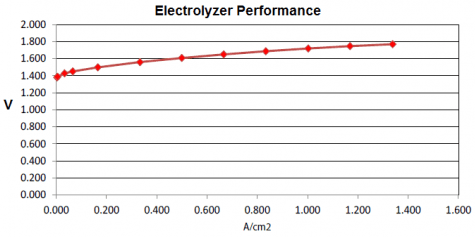
Most electrolysis is done at voltages above about 1.48 V. Just as fuel cells always give off heat (they are exothermic), electrolysis will absorb heat if run reversibly. That is, electrolysis can act as a refrigerator if run reversibly. but electrolysis is not a very good refrigerator (the refrigerator ability is tied up in the entropy term mentioned above). To do electrolysis at reasonably fast rates, people give up on refrigeration (sucking heat from the environment) and provide all the entropy needed for electrolysis in the electricity they supply. This is to say, they operate at V’ were nFV’ ≥ ∆H, the enthalpy of water formation. Since ∆H is greater than ∆G, V’ the voltage for electrolysis is higher than V. Based on the enthalpy of liquid water formation,  −285.8 kJ/mol we find V’ = 1.48 V at zero degrees. The figure below shows that, for any reasonably fast rate of hydrogen production, operation must be at 1.48V or above.

Electrolyzer performance; C-Pt catalyst on a thin, nafion membrane

Electrolyzer performance; C-Pt catalyst on a thin, nafion membrane

If you figure out the energy that this voltage and amperage represents (shown below) you’re likely to come to a conclusion I came to several years ago: that it’s far better to generate large amounts of hydrogen chemically, ideally using a membrane reactor like my company makes.

The electric power to make each 2 grams of hydrogen at 1.5 volts is 1.5 V x 193000 Amp-s = 289,500 J = .080 kWh’s, or 0.9¢ at current rates, but filling a car takes 20 kg, or 10,000 times as much. That’s 800 kW-hr, or $90 at current rates. The electricity is twice as expensive as current gasoline and the infrastructure cost is staggering too: a station that fuels ten cars per hour would require 8 MW, far more power than any normal distributor could provide.

By contrast, methanol costs about 2/3 as much as gasoline, and it’s easy to deliver many giga-joules of methanol energy to a gas station by truck. Our company’s membrane reactor hydrogen generators would convert methanol-water to hydrogen efficiently by the reaction CH3OH + H2O –> 3H2 + CO2. This is not to say that electrolysis isn’t worthwhile for lower demand applications: see, e.g.: gas chromatography, and electric generator cooling. Here’s how membrane reactors work.

R. E. Buxbaum July 1, 2013; Those who want to show off, should post the temperature and pressure corrections to my calculations for the reversible voltage of typical fuel cells and electrolysis.

Another Quantum Joke, and Schrödinger’s waves derived

Quantum mechanics joke. from xkcd.

Quantum mechanics joke. from xkcd.

Is funny because … it’s is a double entente on the words grain (as in grainy) and waves, as in Schrödinger waves or “amber waves of grain” in the song America (Oh Beautiful). In Schrödinger’s view of the quantum world everything seems to exist or move as a wave until you observe it, and then it always becomes a particle. The math to solve for the energy of things is simple, and thus the equation is useful, but it’s hard to understand why,  e.g. when you solve for the behavior of a particle (atom) in a double slit experiment you have to imagine that the particle behaves as an insubstantial wave traveling though both slits until it’s observed. And only then behaves as a completely solid particle.

Math equations can always be rewritten, though, and science works in the language of math. The different forms appear to have different meaning but they don’t since they have the same practical predictions. Because of this freedom of meaning (and some other things) science is the opposite of religion. Other mathematical formalisms for quantum mechanics may be more comforting, or less, but most avoid the wave-particle duality.

The first formalism was Heisenberg’s uncertainty. At the end of this post, I show that it is identical mathematically to Schrödinger’s wave view. Heisenberg’s version showed up in two quantum jokes that I explained (beat into the ground), one about a lightbulb  and one about Heisenberg in a car (also explains why water is wet or why hydrogen diffuses through metals so quickly).

Yet another quantum formalism involves Feynman’s little diagrams. One assumes that matter follows every possible path (the multiple universe view) and that time should go backwards. As a result, we expect that antimatter apples should fall up. Experiments are underway at CERN to test if they do fall up, and by next year we should finally know if they do. Even if anti-apples don’t fall up, that won’t mean this formalism is wrong, BTW: all identical math forms are identical, and we don’t understand gravity well in any of them.

Yet another identical formalism (my favorite) involves imagining that matter has a real and an imaginary part. In this formalism, the components move independently by diffusion, and as a result look like waves: exp (-it) = cost t + i sin t. You can’t observe the two parts independently though, only the following product of the real and imaginary part: (the real + imaginary part) x (the real – imaginary part). Slightly different math, same results, different ways of thinking of things.

Because of quantum mechanics, hydrogen diffuses very quickly in metals: in some metals quicker than most anything in water. This is the basis of REB Research metal membrane hydrogen purifiers and also causes hydrogen embrittlement (explained, perhaps in some later post). All other elements go through metals much slower than hydrogen allowing us to make hydrogen purifiers that are effectively 100% selective. Our membranes also separate different hydrogen isotopes from each other by quantum effects (big things tunnel slower). Among the uses for our hydrogen filters is for gas chromatography, dynamo cooling, and to reduce the likelihood of nuclear accidents.

Dr. Robert E. Buxbaum, June 18, 2013.

To see Schrödinger’s wave equation derived from Heisenberg for non-changing (time independent) items, go here and note that, for a standing wave there is a vibration in time, though no net change. Start with a version of Heisenberg uncertainty: h =  λp where the uncertainty in length = wavelength = λ and the uncertainty in momentum = momentum = p. The kinetic energy, KE = 1/2 p2/m, and KE+U(x) =E where E is the total energy of the particle or atom, and U(x) is the potential energy, some function of position only. Thus, p = √2m(E-PE). Assume that the particle can be described by a standing wave with a physical description, ψ, and an imaginary vibration you can’t ever see, exp(-iωt). And assume this time and space are completely separable — an OK assumption if you ignore gravity and if your potential fields move slowly relative to the speed of light. Now read the section, follow the derivation, and go through the worked problems. Most useful applications of QM can be derived using this time-independent version of Schrödinger’s wave equation.

Link

Some 2-3 years ago I did an interview where I stood inside one of our hydrogen generator shacks (with the generator running) and poked a balloon filled with hydrogen with a lit cigar — twice. No fire, no explosion, either time. It’s not a super hit, but it’s gotten over 5000 views so far. Here it is

New hydrogen generator from REB Research

Here’s the new, latest version of our Me150 hydrogen generator with our wonder-secretary, Libby, shown for scale. It’s smaller and prettier than the previous version shown at left (previous version of Me150, not of secretary). Hydrogen output is 99.9999% pure, 9.5 kg/day, 75 slpm, 150 scfh H2; it generates hydrogen from methanol reforming in a membrane reactor. Pricing is $150,000. Uses about 7 gal of methanol-water ($6 worth) per kg of H2 (380 ft3). Can be used to fill weather balloons, cool electric dynamos, or provide hydrogen fuel for 2-10 fuel cell cars.

New REB Research hydrogen generator 150 scfh of 99.9999% H2 from methanol reforming

New REB Research hydrogen generator 150 scfh of 99.9999% pure H2 from methanol-water reforming against metal membranes.

Dr. Robert E. Buxbaum

Hydrogen versus Battery Power

There are two major green energy choices that people are considering to power small-to-medium size, mobile applications like cars and next generation, drone airplanes: rechargeable, lithium-ion batteries and hydrogen /fuel cells. Neither choice is an energy source as such, but rather a clean energy carrier. That is, batteries and fuel cells are ways to store and concentrate energy from other sources, like solar or nuclear plants for use on the mobile platform.

Of these two, rechargeable batteries are the more familiar: they are used in computers, cell phones, automobiles, and the ill-fated, Boeing Dreamliner. Fuel cells are less familiar but not totally new: they are used to power most submarines and spy-planes, and find public use in the occasional, ‘educational’ toy. Fuel cells provided electricity for the last 30 years of space missions, and continue to power the international space station when the station is in the dark of night (about half the time). Batteries have low energy density (energy per mass or volume) but charging them is cheap and easy. Home electricity costs about 12¢/kWhr and is available in every home and shop. A cheap transformer and rectifier is all you needed to turn the alternating current electricity into DC to recharge a battery virtually anywhere. If not for the cost and weight of the batteries, the time to charge the battery (usually and hour or two), batteries would be the obvious option.

Two obvious problems with batteries are the low speed of charge and the annoyance of having to change the battery every 500 charges or so. If one runs an EV battery 3/4 of the way down and charges it every week, the battery will last 8 years. Further, battery charging takes 1-2 hours. These numbers are acceptable if you use the car only occasionally, but they get more annoying the more you use the car. By contrast, the tanks used to hold gasoline or hydrogen fill in a matter of minutes and last for decades or many thousands of fill-cycles.

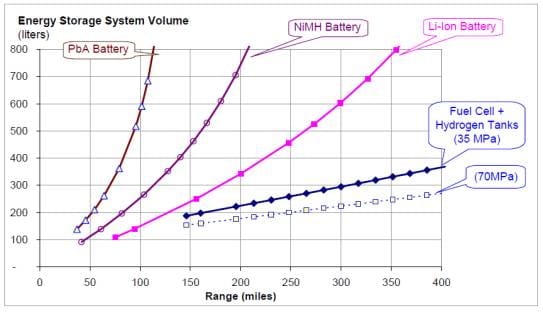
Another problem with batteries is range. The weight-energy density of batteries is about 1/20 that of gasoline and about 1/10 that of hydrogen, and this affects range. While gasoline stores about 2.5 kWhr/kg including the weight of the gas tank, current Li-Ion batteries store far less than this, about 0.15 kWhr/kg. The energy density of hydrogen gas is nearly that of gasoline when the efficiency effect is included. A 100 kg of hydrogen tank at 10,000 psi will hold 8 kg of hydrogen, or enough to travel about 350 miles in a fuel-cell car. This is about as far as a gasoline car goes carrying 60 kg of tank + gasoline. This seems acceptable for long range and short-range travel, while the travel range with eVs is more limited, and will likely remain that way, see below.

The volumetric energy density of compressed hydrogen/ fuel cell systems is higher than for any battery scenario. And hydrogen tanks are far cheaper than batteries. From Battery University. http://batteryuniversity.com/learn/article/will_the_fuel_cell_have_a_second_life

The volumetric energy density of compressed hydrogen/ fuel cell systems is higher than for any battery scenario. And hydrogen tanks are far cheaper than batteries. From Battery University. http://batteryuniversity.com/learn/article/will_the_fuel_cell_have_a_second_life

Cost is perhaps the least understood problem with batteries. While electricity is cheap (cheaper than gasoline) battery power is expensive because of the high cost and limited life of batteries. Lithium-Ion batteries cost about $2000/kWhr, and give an effective 500 charge/discharge cycles; their physical life can be extended by not fully charging them, but it’s the same 500 cycles. The effective cost of the battery is thus $4/kWhr (The battery university site calculates $24/kWhr, but that seems overly pessimistic). Combined with the cost of electricity, and the losses in charging, the net cost of Li-Ion battery power is about $4.18/kWhr, several times the price of gasoline, even including the low efficiency of gasoline engines.

Hydrogen prices are much lower than battery prices, and nearly as low as gasoline, when you add in the effect of the high efficiency fuel cell engine. Hydrogen can be made on-site and compressed to 10,000 psi for less cost than gasoline, and certainly less cost than battery power. If one makes hydrogen by electrolysis of water, the cost is approximately 24¢/kWhr including the cost of the electrolysis unit.While the hydrogen tank is more expensive than a gasoline tank, it is much cheaper than a battery because the technology is simpler. Fuel cells are expensive though, and only about 50% efficient. As a result, the as-used cost of electrolysis hydrogen in a fuel cell car is about 48¢/kWhr. That’s far cheaper than battery power, but still not cheap enough to encourage the sale of FC vehicles with the current technology.

My company, REB Research provides another option for hydrogen generation: The use of a membrane reactor to make it from cheap, easy to transport liquids like methanol. Our technology can be used to make hydrogen either at the station or on-board the car. The cost of hydrogen made this way is far cheaper than from electrolysis because most of the energy comes from the methanol, and this energy is cheaper than electricity.

In our membrane reactors methanol-water (65-75% Methanol), is compressed to 350 psi, heated to 350°C, and reacted to produce hydrogen that is purified as it is made. CH3OH + H2O –> 3H2 + CO2, with the hydrogen extracted through a membrane within the reactor.

The hydrogen can be compressed to 10,000 psi and stored in a tank on board an automobile or airplane, or one can choose to run this process on-board the vehicle and generate it from liquid fuel as-needed. On-board generation provides a saving of weight, cost, and safety since you can carry methanol-water easily in a cheap tank at low pressure. The energy density of methanol-water is about 1/2 that of gasoline, but the fuel cell is about twice as efficient as a gasoline engine making the overall volumetric energy density about the same. Not including the fuel cell, the cost of energy made this way is somewhat lower than the cost of gasoline, about 25¢/kWhr; since methanol is cheaper than gasoline on a per-energy basis. Methanol is made from natural gas, coal, or trees — non-imported, low cost sources. And, best yet, trees are renewable.

Why the Boeing Dreamliner’s batteries burst into flames

Boeing’s Dreamliner is currently grounded due to two of their Li-Ion batteries having burst into flames, one in flight, and another on the ground. Two accidents of the same type in a small fleet is no little matter as an airplane fire can be deadly on the ground or at 50,000 feet.

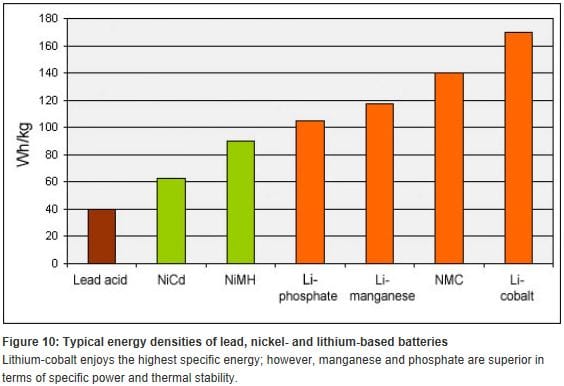
The fires are particularly bad on the Dreamliner because these lithium batteries control virtually everything that goes on aboard the plane. Even without a fire, when they go out so does virtually every control and sensor. So why did they burn and what has Boeing done to take care of it? The simple reason for the fires is that management chose to use Li-Cobalt oxide batteries, the same Li-battery design that every laptop computer maker had already rejected ten years earlier when laptops using them started busting into flames. This is the battery design that caused Dell and HP to recall every computer with it. Boeing decided that they should use a massive version to control everything on their flagship airplane because it has the highest energy density see graphic below. They figured that operational management would insure safety even without the need to install any cooling or sufficient shielding.

All lithium batteries have a negative electrode (anode) that is mostly lithium. The usual chemistry is lithium metal in a graphite matrix. Lithium metal is light and readily gives off electrons; the graphite makes is somewhat less reactive. The positive electrode (cathode) is typically an oxide of some sort, and here there are options. Most current cell-phone and laptop batteries use some version of manganese nickel oxide as the anode. Lithium atoms in the anode give off electrons, become lithium ions and then travel across to the oxide making a mixed ion oxide that absorbs the electron. The process provides about 4 volts of energy differential per electron transferred. With cobalt oxide, the cathode reaction is more or less CoO2 + Li+ e– —> LiCoO2. Sorry to say this chemistry is very unstable; the oxide itself is unstable, more unstable than MnNi or iron oxide, especially when it is fully charged, and especially when it is warm (40 degrees or warmer) 2CoO2 –> Co2O+1/2O2. Boeing’s safety idea was to control the charge rate in a way that overheating was not supposed to occur.

Despite the controls, it didn’t work for the two Boeing batteries that burst into flames. Perhaps it would have helped to add cooling to reduce the temperature — that’s what’s done in lap-tops and plug-in automobiles — but even with cooling the batteries might have self-destructed due to local heating effects. These batteries were massive, and there is plenty of room for one spot to get hotter than the rest; this seems to have happened in both fires, either as a cause or result. Once the cobalt oxide gets hot and oxygen is released a lithium-oxygen fire can spread to the whole battery, even if the majority is held at a low temperature. If local heating were the cause, no amount of external cooling would have helped.

battery-materials-energy-densities-battery-university

Something that would have helped was a polymer interlayer separator to keep the unstable cobalt oxide from fueling the fire; there was none. Another option is to use a more-stable cathode like iron phosphate or lithium manganese nickel. As shown in the graphic above, these stable oxides do not have the high power density of Li-cobalt oxide. When the unstable cobalt oxide decomposed there was oxygen, lithium, and heat in one space and none of the fire extinguishers on the planes could put out the fires.

The solution that Boeing has proposed and that Washington is reviewing is to leave the batteries unchanged, but to shield them in a massive titanium shield with the vapors formed on burning vented outside the airplane. The claim is that this shield will protect the passengers from the fire, if not from the loss of electricity. This does not appear to be the best solution. Airbus had planned to use the same batteries on their newest planes, but has now gone retro and plans to use Ni-Cad batteries. I don’t think that’s the best solution either. Better options, I think, are nickel metal hydride or the very stable Lithium Iron Phosphate batteries that Segway uses. Better yet would be to use fuel cells, an option that appears to be better than even the best batteries. Fuel cells are what the navy uses on submarines and what NASA uses in space. They are both more energy dense and safer than batteries. As a disclaimer, REB Research makes hydrogen generators and purifiers that are used with fuel-cell power.

More on the chemistry of Boeing’s batteries and their problems can be found on Wikipedia. You can also read an interview with the head of Tesla motors regarding his suggestions and offer of help.

Heisenberg joke and why water is wet

I love hydrogen in large part because it is a quantum fluid. To explain what that means and how that leads to water being wet, let me begin with an old quantum physics joke.

Werner Heisenberg is speeding down a highway in his car when he’s stopped by a police officer. “Do you know how fast you were going?” asks the officer. “No idea” answers Heisenberg, “but I know exactly where I am.”

The joke relates to a phenomenon of quantum physics that states that the more precisely you can know the location of something, the less precisely you can infer the speed. Thus, the fact that Heisenberg knew precisely where he was implied that he could have no idea of the car’s speed. Of course, this uncertainty is mostly seen with small things like light and electrons –and a bit with hydrogen, but hardly at all with a car or with Dr. Heisenberg himself (and that’s why it’s funny).

This funky property is related to something you may have wondered about: why is water wet? That is, why does water cling to your hands or clothes while liquid teflon repels. Even further, you may have wondered why water is a liquid at normal conditions when H2S is a gas; H2S is a heavier analog, so if one of the two were a liquid, you’d think it was H2S.

Both phenomena are understood through hydrogen behaving as the quantum car above. Oxygen atoms are pretty small, and hydrogen atoms are light enough to start behaving in a quantum way. When a hydrogen atom attaches to an oxygen atom to form part of a water molecule, its location becomes fixed rather precisely. As a result, the hydrogen atom gains velocity (the hydrogen isn’t going anywhere with this velocity, and it’s sometimes called zero-point energy), but because of this velocity or energy, its bond to the oxygen becomes looser than it would be if you had heavier hydrogen. When the oxygen of another water molecule or of a cotton cellulose molecule comes close, the hydrogen starts to hop back and forth between the two oxygen atoms. This reduces the velocity of the hydrogen atom, and stabilizes the assemblage. There is now less kinetic energy (or zero-point energy) in the system, and this stability is seen as a bond that is caused not by electron sharing but by hydrogen sharing. We call the reasonably stable bond between molecules that share a hydrogen atom this way a “hydrogen bond.” (now you know).

The hydrogen bond is why water is a liquid and is the reason water is wet. The hydrogen atom jumping between water molecules stabilizes the liquid water more than it would stabilize liquid H2S. Since sulfur atoms are bigger than oxygen atoms, the advantage of hydrogen jumping is smaller. As a result, the heat of vaporization of water is higher than that of H2S, and water is a liquid at normal conditions while H2S is a gas.

Water sticks to cotton or your skin the same way, hydrogen atoms skip between the oxygen of water molecules and of these surfaces creating a bond. It is said to whet these surfaces, and the result is that water is found to be wet. Liquid teflon does not have hydrogen atoms that can jump so there is no band that could be made from that direction (there are some hydrogen atoms on the cotton that can jump to the teflon, but there is no advantage to bonding of this sort as there are only a few hydrogen atoms, and these already jump to other oxygens in the cotton. Thus, to jump to the teflon would mean breaking a bond with other oxygen atoms in the cotton — there would be no energy advantage. This then is just one of the reasons I love hydrogen: it’s a quantum-y material.

A visit to the Buxbaum laboratory from Metromedia

It’s a slow news day in Detroit, so the folks from Metromedia came to visit my laboratory at REB Research. You can visit too. We’re doing cool stuff most of the time, we’re working on a hydrogen-fueled plane that stays aloft for weeks (not that cool, actually, the Hindenberg did it in the 30s). On this particular day I’ve got a cool hat on, and a beige suit. I’m putting hydrogen in my car. Hydrogen increases the speed of combustion, and so it adds to milage — or it has when we’ve added it from electrolysis sources.buxbaum-003

The fun thing about science is that there are always surprises.

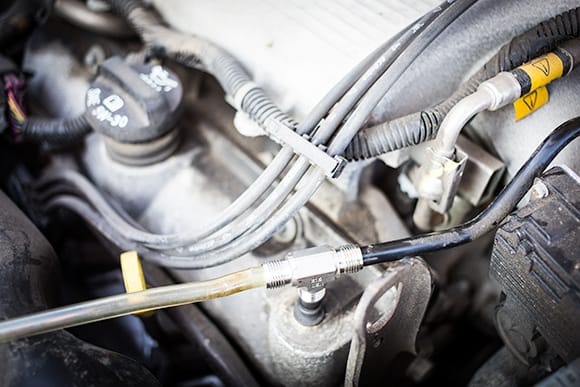
Adding hydrogen to a Malibu at REB Research

Adding hydrogen to a Malibu at REB Research