The following is Elizabeth Warren’s law registration for the state of Texas, 1986 claiming she is an American Indian. There was very little evidence for it and an genetic test showed she was somewhere between 1/256 and 1/1000 Indian. My son was determined to have 1/1000 Indian blood in a similar test, and we have no Indian ancestors at all, as best as I can tell. Still, as an Indian Ms. Warren is entitled to affirmative action; she’s to get preferential hiring financial, and educational treatment over someone more qualified, but without Indian blood. Affirmative action was institute as a way to redress the suffering of Indians and other minorities, but it is not clear that is serves this purpose when someone with so little, or no blood can take the advantage. There is no requirement of proof that you are at all Indian by blood, and even if you are 1/1000 Indian, what about the other 999/1000? Why don’t they count to give yo lower standing than someone who is 1/10 Indian, say. How indian should you have to be to get benefits.
Related to the question of how much Indian blood you should have to have to get benefits is the question of making other folks suffer to provide this benefit. Many of the people who suffer because of affirmative action are dependents of immigrant minorities, Jews, Italians, and Chinese, and these folks have not had it that well. The Italians were discriminated against in hiring, as mandated by the city council, see announcement below, and Chinese immigrants had very limited migration and work rights, as specified under The Chinese Exclusion Act of 1882. This act was not repealed until 1943 as part of our war against Japan.
In the late 1800s anti Italian discrimination was common. In part this was the Tammany Hall Irish doing their best to keep out an upstart immigrant group. Should Italians have affirmative action preferences?
At maximum Ms. Warren is less than 1% indians and thus over 99% Texan. This is to suggest that the majority of her bloodline is descent is from those who displaced the Indians, but her preferential hiring was likely in preference to other minorities who suffered too, and who likely have a purer bloodline to that suffering and exclusion than Ms Warren has. Is this what we want from affirmative action? The form we’ve got benefits, for the most part, only the most crooked, connected members of society. People like Ms Warren. I think this has to change.
One way to look at dating and other life choices is to consider them as decision-time problems. Imagine, for example that have a number of candidates for a job, and all can be expected to say yes. You want a recipe that maximizes your chance to pick the best. This might apply to a fabulously wealthy individual picking a secretary or a husband (Mr Right) in a situation where there are 50 male choices. We’ll assume that you have the ability to recognize who is better than whom, but that your pool has enough ego that you can’t go back to anyone once you’ve rejected the person.
Under the above restrictions, I mentioned in this previous post that you maximize your chance of finding Mr Right by dating without intent to marry 36.8% of the fellows. After that, you marry the first fellow who is better than any of the previous. My previous post had a link to a solution using Riemann integrals, but I will now show how to do it with more prosaic math — a series. One reason for doing this by series is that it allows you to modify your strategy for a situation where you can not be guaranteed a yes, or where you’re OK with number 2, but you don’t like the high odds of the other method, 36.8%, that you’ll marry no one.
I present this, not only for the math interest, but because the above recipe is sometimes presented as good advice for real-life dating, e.g. in a recent Washington Post article. With the series solution, you’re in a position to modify the method for more realistic dating, and for another related situation, options cashing. Let’s assume you have stock options in a volatile stock company, if the options are good for 10 years, how do you pick when to cash in. This problem is similar to the fussy suitor, but the penalty for second best is small.
The solution to all of these problems is to pick a stopping point between the research phase and the decision phase. We will assume you can’t un-cash in an option, or continue dating after marriage. We will optimize for this fractional stopping point between phases, a point we will call x. This is the fraction of guys dated without intent of marriage, or the fraction of years you develop your formula before you look to cash in.
Let’s consider various ways you might find Mr Right given some fractional value X. One way this might work, perhaps the most likely way you’ll find Mr. Right, is if the #2 person is in the first, rejected group, and Mr. Right is in the group after the cut off, x. We’ll call chance of of finding Mr Right through this arrangement C1, where
C1 = x (1-x) = x – x2.
We could used derivatives to solve for the optimum value of x, but there are other ways of finding Mr Right. What if Guy #3 is in the first group and both Guys 1 and 2 are in the second group, and Guy #1 is earlier in the second line-up. You’d still marry Mr Right. We’ll call the chance of finding Mr Right this way C2. The odds of this are
C2 = x (1-x)2/2
= x/2 – x2 + x3/2
There is also a C3 and a C4 etc. Your C3 chance of Mr Right occurs when guy number 4 is in the first group, while #1, 2, and 3 are in the latter group, but guy number one is the first.
C3 = x (1-x)3/4 = x/4 – 3x2/4 + 3x3/4 – x4/4.
I could try to sum the series, but lets say I decide to truncate here. I’ll ignore C4, C5 etc, and I’ll further throw out any term bigger than x^2. Adding all smaller terms together, I get ∑C = C, where
C ~ 1.75 x – 2.75 x2.
To find the optimal x, take the derivative and set it to zero:
dC/dx = 0 ~ 1.75 -5.5 x
x ~ 1.75/5.5 = 31.8%.
That’s not an optimal answer, but it’s close. Based on this, C1 = 21.4%, C2 = 14.8%, C3 =10.2%, and C4= 7.0% C5= 4.8%Your chance of finding Mr Right using this stopping point is at least 33.4%. This may not be ideal, but you’re clearly going to very close to it.
The nice thing about this solution is that it makes it easy to modify your model. Let’s say you decide to add a negative value to not ever getting married. That’s easily done using the series method. Let’s say you choose to optimize your chance for either Mr 1 or 2 on the chance that both will be pretty similar and one of them may say no. You can modify your model for that too. You can also use series methods for the possibility that the house you seek is not at the last exit in Brooklyn. For the dating cases, you will find that it makes sense to stop your test-dating earlier, for the parking problem, you’l find that it’s Ok to wait til you’re less than 1 mile away before you settle on a spot. I’ll talk more about this latter, but wanted to note that the popular press seems overly impressed by math that they don’t understand, and that they have a willingness to accept assumptions that bear only the flimsiest relationship to relaity.
Some days, I spend hours at a time on facebook, and when I’m done, I often feel it was a complete waste of time. I do not make friends this way, and I have little evidence that I’ve convinced anyone. Still, for some reason, I can’t seem to stay off for long, so I figure I might as well look for the attraction.
One positive thing I do (did) with FB was to run for office. I lost, but I was able to speak to more people using FB in a day than I could have otherwise. Another thing I do is to spread articles — those I find interesting, and my own writing, blog posts, mostly. I write these posts for free, and while I imagine my blog posts do some good. I sometimes get nice comments suggesting people read the blogs and think about what I say. Still, it does not make money, and takes a fair amount of effort.
I can imagine I help mankind in some subtle, long range way, or perhaps gain some long-range fame. But who cares about long-range fame? And, as for helping people, it is also possible I will hurt them too. Computers sit analyzing my words, and everyone’s, tracking their views and using the data for what. I’m just feeding the computer, and that makes me think my writing may harm more than help. What I write on FB is owned by FB. It’s free content for the owners of FB to re-use to sell: my personality, capsulated, my friends likes and dislikes, for sale at a price. My posts turn me and my friends into commodities — and there isn’t even remuneration.
It is claimed that, in the 2016 election, Trump was able to win, at low cost, through a Russian-managed facebook campaign. The educated elites of politics were not able to come with the wiley Russians, for all their brain-power, and despite help from the FBI, or so the theory goes. If so, it’s a warning that all the information I provide to facebook is available to Trump and the Russians to use against me. The management of facebook was committed to Ms Clinton in 2016, and is completely committed to Trump’s removal as best I can tell. If they are not able to beat the Russians, maybe I should not try. Then again, maybe they’re not as elite as they think.
Sometimes I imagine that the alternative of not-posting is worse; it is to have no voice at all, and to have no information of the common discussion. The newspapers seem no less biassed than those on my FB. I write then in a bizarre chasm between hope for posterity, and a better world, and out of desperation that to be an unheard, quiet one, is to be dead. I suspect I’m not unique here.
Free will is generally considered a good thing — perhaps a unique gift from the creator to man-kind. Legal philosophers contend that it is free will that makes us liable to legal punishment for our crimes. while piranhas and machines are not. We would never think of jailing a gun or a piranha even it harmed a child.
It’s not totally clear that we have free will, though, nor is it totally clear what free will is. The common test is that no one can tell what I will do. If this is the only requirement, though, it seems a random number generator should be found to have free will. One might want to add some degree of artificial intelligence so that the random numbers are used to make decisions that are rational in some sense, say choosing between tea and coffee, for example, and not tea and covfefe, but this should not be difficult. With that modification, we should find that the random device would make free decisions as boldly or conservatively as any person.
The numbers should be truly random, but even if they are not quite, this should not be a barrier. We generally take statistical things to be random, the speed of the wind tomorrow at 3:00 PM for example even though there is a likely average, and 500 mph is exceedingly unlikely. And, if that isn’t quite random enough, one could use quantum mechanics. One could devise a system that measures the time between the next two radioactive decays to an accuracy many times greater than the likely time between. If the sample has a decay every 100 seconds or so, the second and third digit of this time after the decimal is random to an extent that most would accept, and that one can predict it at all — or so we understand it. (God might be an exception here, but since He is outside of time, prediction becomes an oxymoron). Using these quantum mechanic random numbers, one should be able to make decisions showing as much free will as any person shows, and likely more . Most folks are fairly predictable.
Since God is considered to be outside of time, any mention of his fore-knowledge or pre-determination is an oxymoron. There is no pre or fore if you’re outside of time, as I’d understand things
I notice that few people would say that a radioactive atom has free will, though, and that many doubt that people have free will. Still no one seems interested in handing major issues to a computer, or holding the machine liable if things turn out poorly. And if one wants to argue that people have no free will, it seems to me that the argument for punishment would get rather weak. Without free will, shy would it be more wrong to kill a person than a piranha, or a plant.
A typical plant in Oakland county treats 2,000,000 gallons per day of this stuff, with the bio-reactor receiving liquid waste containing about 200 ppm of soluble and colloidal biomass. That’s 400 dry gallons for those interested, or about 3200 dry lbs./day. About half of this will be oxidized to CO2 and water. The rest (cell bodies) are removed with insoluble components, and applied to farmers fields or buried, or burnt in an incinerator.
There is another type of reactor used in Oakland County. It’s mostly used for secondary treatment, converting consolidated sludge to higher-quality sludge that can be sold or used on farms with less restriction, but it is a type of reactor used at the South Lyon treatment plant, for primary treatment. It is a Continually stirred tank reactor, or CSTR, a design that is shown in schematic below.
As of some years ago, the South Lyon system involved a single largish pond lined with plastic with a volume about 2,000,000 gallons total. About 700,000 gallons per day of sewage liquids went into the lagoon, at 200 ppm soluble organics. Air was bubbled through the liquid providing a necessary reactant, and causing near-perfect mixing of the contents. The aim of the plant managers is to keep the soluble output to the, then-acceptable level of 10 ppm; it’s something they only barely managed, and things got worse as the flow increased. Assume as before, a value V and a flow Q.
We will call the concentration of soluble organics C, and call the initial concentration, the concentration that enters, Ci. It’s about 200 ppm. We’ll call the output concentration Co, and for this type of reactors, Co = C. The reaction is first order, approximately, so that, if there were no flow into or out of the reactor, the concentration of organics would decrease at the rate of
dC/dt = -kC.
Here k is a reaction constant, dependent on temperature oxygen and cell content. It’s typically about 0.5/hour. For a given volume of tank the rate of organic removal is VkC. We can now do a mass balance on soluble organics. Since the rate of organic entry is QCi and the rate leaving by flow is QC. The difference must be the amount that is reacted away:
QCi – QC = VkC.
We now use algebra, to find that
Co = Ci/(1 + kV/Q).
V/Q is sometimes called a residence time; for the system. At normal flow, the residence time of the South Lyon system is about 2.8 days or 68.6 hours. Plugging these numbers in, we find that the effluent from the reactor leaves at 1/35 of the input concentration, or 5.7 ppm, on average. This would be fine except that sometimes the temperature drops, or the flow increases, and we start violating the standard. A yet bigger problem was that the population increased by 50% while the EPA standard got more stringent to 2 ppm. This was solved by adding another, smaller reactor, volume = V2. Using the same algebraic analysis, as above you can show that, with two reactors,
Co = Ci/ [(1 + kV/Q)(1+kV2/Q)].
It’s a touchy system, but it meets government targets, just barely, most of the time. I think it is time to switch to a plug-flow reactor system, as used in much of Oakland county. In these, the fluid enters a channel and is reacted as it flows along. Each gallon of fluid, in a sense moves by itself as if it were its own reactor. In each gallon, we can say that dC/dt = -kC. We can thus solve for Co in terms of the total residence time, where t again is V/Q. We can rearrange this equation and integrate: ∫dC/C = – ∫kdt. We then find that,
ln(Ci/Co) = kt = kV/Q
To convert 200 ppm sewage to 2 ppm we note that Ci/Co = 100 and that V = Q ln(100)/k = Q (4.605/.5) hours. An inflow of 1000,000 gallons per day = 41,667 gal/ hour, and we find the volume of tank is 41,667 x 9.21 = 383,750 gallons. This is quite a lot smaller than the CSTR tanks at South Lyon. If we converted the South Lyon tanks to a plug-flow, race-track design, it would allow it to serve a massively increased population, discharging far cleaner sewage.
Some months ago, I demonstrated that the maximum height of a concrete skyscraper was 45.8 miles, but there were many unrealistic assumptions. The size of the base was 100 mi2, about that of Sacramento, California; the shape was similar to that of the Eiffel tower, and there was no wind. This height is semi-reasonable; it’s about that of the mountains on Mars where there is a yellow sky and no wind, but it is 100 times taller than the tallest skyscraper on earth. the Burj Khalifa in Dubai, 2,426 ft., shown below. Now I’d like to include wind, and limit the skyscraper to a straight tower of a more normal size, a city-block square of manhattan, New York real-estate. That’s 198 feet on a side; this is three times the length of Gunther’s surveying chain, the standard for surveying in 1800.
As in our previous calculation, we can find the maximum height in the absence of windby balancing the skyscrapers likely strength agains its likely density. We’ll assume the structure is made from T1 steel, a low carbon, vanadium steel used in bridges, further assume that the structure occupies 1/10 of the floor area. Because the structure is only 1/10 of the area, the average yield strengthener the floor area is 1/10 that of T1 steel. This is 1/10 x 100,000 psi (pounds per square inch) = 10,000 psi. The density of T1 steel is 0.2833 pounds per cubic inch, but we’ll assume that the density of the skyscraper is about 1/4 this; (a skyscraper is mostly empty space). We find the average is 0.07 pounds per cubic inch. The height, is the strength divided by the density, thus
This is 4 1/4 times higher than the Burj Khalifa. The weight of this structure found from the volume of the structure times its average density, or 0.07 pounds per cubic inch x 123 x 1982x 11,905 = 56.45 billion pounds, or, in SI units, a weight of 251 GNt.
Lets compare this to the force of a steady wind. A steady wind can either either tip over the building by removing stress on the upwind side, or add so much extra stress to the down-wind side that the wall fails. The force of the wind is proportionals to the wind’s energy dissipation rate. I’ll assume a maximum wind speed of 120 mph, or 53.5 m/s. The force of the wind equals the area of the building, times a form factor, ƒ, times the rate of kinetic energy dissipation, 1/2ρv2. Thus,
F= (Area)*ƒ* 1/2ρv2, where ρ is the density of air, 1.29kg/m3.
The form factor, ƒ, is found to be 1.15 for a flat plane. I’ll presume that’s also the form factor for a skyscraper. I’ll take the wind area as
Area = W x H,
where W is the width of the tower, 60.35 m in SI, and the height, H, is what we wish to determine. It will be somewhat less than H’max-tower, =3629 m, the non-wind height. As an estimate for how much less, assume H = H’max-tower, =3629 m. For this height tower, the force of the wind is found to be:
F = 3629 * 60.35* 2123 = 465 MNt.
This is 1/500 the weight of the building, but we still have to include the lever effect. The building is about 60.1 times taller than it is wide, and as a result the 465 MNt sideways force produces an additional 28.0 GNt force on the down-wind side, plus and a reduction of the same amount upwind. This is significant, but still only 1/9 the weight of the building. The effect of the wind therefore is to reduce the maximum height of this New York building by about 9 %, to a maximum height of 2.05 miles or 3300 m.
The tallest building of Europe is the Shard; it’s a cone. The Eiffel tower, built in the 1800s, is taller.
A cone is a better shape for a very tall tower, and it is the shape chosen for “the shard”, the second tallest building in Europe, but it’s not the ideal shape. The ideal, as before, is something like the Eiffel tower. You can show, though I will not, that even with wind, the maximum height of a conical building is three times as high as that of a straight building of the same base-area and construction. That is to say that the maximal height of a conical building is about 6 miles.
In the old days, one could say that a 2 or 6 mile building was inconceivable because of wind vibration, but we’ve found ways to deal with vibration, e.g. by using active damping. A somewhat bigger problem is elevators. A very tall building needs to have elevators in stages, perhaps 1/2 mile stages with exchanges (and shopping) in-between. Yet another problem is fire. To some extent you eliminate these problems by use of pre-mixed concrete, as was used in the Trump tower in New York, and later in the Burj Khalifa in Dubai.
The compressive strength of high-silica, low aggregate, UHPC-3 concrete is 135 MPa (about 19,500 psi), and the density is 2400 kg/m3 or about 0.0866 lb/in3. I will assume that 60% of the volume is empty and that 20% of the weight is support structure (For the steel building, above, I’d assumed 3/4 and 10%). In the absence of wind,
H’max-cylinder-concrete = .2 x 19,500 psi/(0.4 x.0866 lb/in3) = 112,587″ = 9,382 ft = 1.77 miles. This building is 79% the height of the previous, steel building, but less than half the weight, about 22,000,000,000 pounds. The effect of the wind will be to reduce the above height by about 14%, to 1.52 miles. I’m not sure that’s a fire-safe height, but it is an ego-boost height.
One big danger of political humor is that some folks just don’t get the joke. You say something outrageous and they don’t get that you were exaggerating, but think you were lying, or ignorant, or worse yet they take you at your word, and think you were telling the truth.
Daniel Boone liked to claim things that were not true; he claimed he jumped the Mississippi and that he lassoed a tornado and that he killed a bear (with his bear hands) when he was three. The joke was on anyone who took him seriously, and I’m sure there were those who did: “Why that’s not true!” “You’re a liar!” or worse yet “Wow, how did you do that!” It’s a sort of brag-joke that, today is called “trolling.”
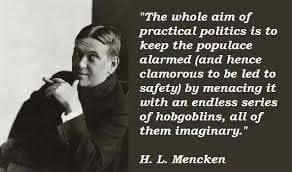
H.L. Menken on the fake news of the early – mid 20th century.
But there is a bigger danger with political jokes, and that happens when you’re not quite making a joke and folks realize you are telling the truth, or at least that there is a dagger of threat thats being passed off within a joke, or as part of an exaggeration. Basically, they realize that this joke was no joke at all.
A recent case in point, two weeks ago Trump was speaking to Jewish businessmen, and told them about his troubles building the US embassy in Jerusalem (read the whole speech here), but within the funny story is a hook:
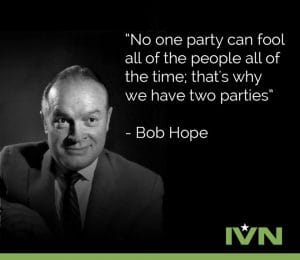
Bob Hope told the truth but hid it in a funny delivery.
“And I called David Friedman. I said, “David, I need some help. I just approved an embassy, and they want to spend $2 billion to build the embassy. And I know what that means: You’re never going to get it built. It’ll take years and years.” I said, “You know what’s going on here? …. So we’re going to spend 2 billion, and one of them was going to buy a lousy location. A lot of you are in the real estate business because I know you very well. You’re brutal killers. (Laughter.) Not nice people at all. But you have to vote for me; you have no choice. You’re not going to vote for Pocahontas, I can tell you that. (Laughter and applause.) You’re not going to vote for the wealth tax. “Yeah, let’s take 100 percent of your wealth away.” No, no. Even if you don’t like me; some of you don’t. Some of you I don’t like at all, actually. (Laughter.) And you’re going to be my biggest supporters because you’ll be out of business in about 15 minutes, if they get it. So I don’t have to spend a lot of time on that. But David calls me back and he goes, “Sir” — he always used to call me “Donald.”
The press claimed the above was vile and anti-semitic. It almost sounds otherwise when quoted in context, but they are not totally off. There is truth inside that jest. Such truths lose the humor, but they do get the message across. A lot has to do with the delivery. Ideally the folks that you want to get the point will, and the rest will think you mean nothing by it. It’s a hard act.
A lot of folks want to marry their special soulmate, and there are many books to help get you there, but I thought I might discuss a mathematical approach that optimizes your chance of marrying the very best under some quite-odd assumptions. The set of assumptions is sometimes called “the fussy suitor problem” or the secretary problem. It’s sometimes presented as a practical dating guide, e.g. in a recent Washington Post article. My take, is that it’s not a great strategy for dealing with the real world, but neither is it total nonsense.
The basic problem was presented by Martin Gardner in Scientific American in 1960 or so. Assume you’re certain you can get whoever you like (who’s single); assume further that you have a good idea of the number of potential mates you will meet, and that you can quickly identify who is better than whom; you have a desire to marry none but the very best, but you don’t know who’s out there until you date, and you’ve an the inability to go back to someone you’ve rejected. This might be he case if you are a female engineering student studying in a program with 50 male engineers, all of whom have easily bruised egos. Assuming the above, it is possible to show, using Riemann Integrals (see solution here), that you maximize your chance of finding Mr/Ms Right by dating without intent to marry 36.8 % of the fellows (1/e), and then marrying the first fellow who’s better than any of the previous you’ve dated. I have a simpler, more flexible approach to getting the right answer, that involves infinite serieses; I’ll hope to show off some version of this at a later date.
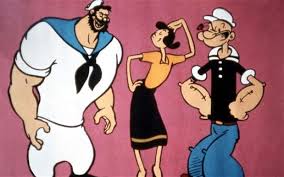
Bluto, Popeye, or wait for someone better? In the cartoon as I recall, she rejects the first few people she meets, then meets Bluto and Popeye. What to do?
With this strategy, one can show that there is a 63.2% chance you will marry someone, and a 36.8% you’ll wed the best of the bunch. There is a decent chance you’ll end up with number 2. You end up with no-one if the best guy appears among the early rejects. That’s a 36.8% chance. If you are fussy enough, this is an OK outcome: it’s either the best or no-one. I don’t consider this a totally likely assumption, but it’s not that bad, and I find you can recalculate fairly easily for someone OK with number 2 or 3. The optimal strategy then, I think, is to date without intent at the start, as before, but to take a 2nd or 3rd choice if you find you’re unmarried after some secondary cut off. It’s solvable by series methods, or dynamic computing.
It’s unlikely that you have a fixed passel of passive suitors, of course, or that you know nothing of guys at the start. It also seems unlikely that you’re able to get anyone to say yes or that you are so fast evaluating fellows that there is no errors involved and no time-cost to the dating process. The Washington Post does not seem bothered by any of this, perhaps because the result is “mathematical” and reasonable looking. I’m bothered, though, in part because I don’t like the idea of dating under false pretense, it’s cruel. I also think it’s not a winning strategy in the real world, as I’ll explain below.
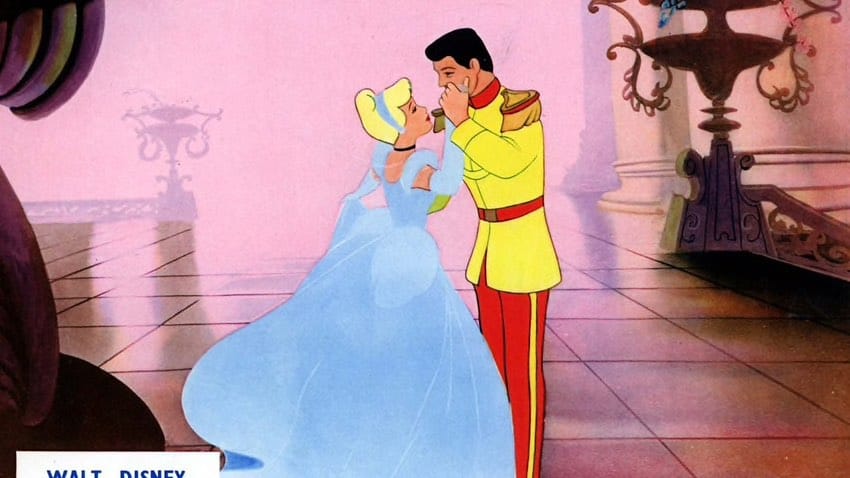
One true/useful lesson from the mathematical solution is that it’s important to learn from each date. Even a bad date, one with an unsuitable fellow, is not a waste of time so long as you leave with a better sense of what’s out there, and of what you like. A corollary of this, not in the mathematical analysis but from life, is that it’s important to choose your circle of daters. If your circle of friends are all geeky engineers, don’t expect to find Prince Charming among them. If you want Prince Charming, you’ll have to go to balls at the palace, and you’ll have to pass on the departmental wine and cheese.
If you want Prince Charming, you may have to associate with a different crowd from the one you grew up with. Whether that’s a good idea for a happy marriage is another matter. By the way, perfect people are rarely perfect; it’s usually better to find one you relate to. I suspect that Cinderella here will be bored in the palace, like Princess Diana was.
The assumptions here that you know how many fellows there are is not a bad one, to my mind. Thus, if you start dating at 16 and hope to be married by 32, that’s 16 years of dating. You can use this time-frame as a stand in for total numbers. Thus if you decide to date-for-real after 37%, that’s about age 22, not an unreasonable age. It’s younger than most people marry, but you’re not likely to marry the fort person you meet after age 22. Besides, it’s not great dating into your thirties — trust me, I’ve done it.
The biggest problem with the original version of this model, to my mind, comes from the cost of non-marriage just because the mate isn’t the very best, or might not be. This cost gets worse when you realize that, even if you meet prince charming, he might say no; perhaps he’s gay, or would like someone royal, or richer. Then again, perhaps the Kennedy boy is just a cad who will drop you at some time (preferably not while crossing a bridge). I would therefor suggest, though I can’t show it’s optimal that you start out by collecting information on guys (or girls) by observing the people around you who you know: watch your parents, your brothers and sisters, your friends, uncles, aunts, and cousins. Listen to their conversation and you can get a pretty good idea of what’s available even before your first date. If you don’t like any of them, and find you’d like a completely different circle, it’s good to know early. Try to get a service job within ‘the better circle’. Working with people you think you might like to be with, long term, is a good idea even if you don’t decide to marry into the group in the end.
Once you’ve observed and interacted with the folks you think you might like, you can start dating for real from the start. If you’re super-organized, you can create a chart of the characteristics and ‘tells’ of characteristics you really want. Also, what is nice but not a deal-breaker. For these first dates, you can figure out the average and standard deviation, and aim for someone in the top 5%. A 5% target is someone whose two standard deviations above the average. This is simple Analysis of variation math (ANOVA), math that I discussed elsewhere. In general you’ll get to someone in the top 5% by dating ten people chosen with help from friends. Starting this way, you’ll avoid being unreasonably cruel to date #1, nor will you loose out on a great mate early on.
Some effort should be taken to look at the fellow’s family and his/her relationship with them. If their relationship is poor, or their behavior is, your kids may turn out similar.
After a while, you can say, I’ll marry the best I see, or the best that seems like he/she will say yes (a smaller sub-set). You should learn from each date, though, and don’t assume you can instantly size someone up. It’s also a good idea to meet the family since many things you would not expect seem to be inheritable. Meeting some friends too is a good idea. Even professionals can be fooled by a phony, and a phony will try to hide his/her family and friends. In the real world, dating should take time, and even if you discover that he/ she is not for you, you’ll learn something about what is out there: what the true average and standard deviation is. It’s not even clear that people fall on a normal distribution, by the way.
Don’t be too upset if you reject someone, and find you wish you had not. In the real world you can go back to one of the earlier fellows, to one of the rejects, if one does not wait too long. If you date with honesty from the start you can call up and say, ‘when I dated you I didn’t realize what a catch you were’ or words to that effect. That’s a lot better than saying ‘I rejected you based on a mathematical strategy that involved lying to all the first 36.8%.’
Robert Buxbaum, December 9, 2019. This started out as an essay on the mathematics of the fussy suitor problem. I see it morphed into a father’s dating advice to his marriage-age daughters. Here’s the advice I’d given to one of them at 16. I hope to do more with the math in a later post.
A common opinion of Samuel Johnson was that “No man but a blockhead ever wrote except for money”. It’s recorded by Boswell on April 5, 1776 well into the revolution, and applied equally to the American revolutionaries and all other unpaid enthusiasts. Johnson wrote for money. He wrote sermons for priests, he wrote political speeches for Troys, he wrote serialized travel logs, and at one point a tearful apology for a priest about to be hanged for forgery. That he was paid was proof that he was good at writing, though not 100% convincing. The priest was forgiven and acquitted in the public eye, but he was hanged for the forgery none-the-less.
Some Samuel Johnson Quotes about America
Johnson was unequivocal in his opinion of American independence. His pamphlet ,”Taxation no Tyranny” 1775 (read it here) makes a semi-convincing Tory argument that taxation without representation is in no way tyranny, and is appropriate for America. America, it’s argued, exists for the good of the many, and that’s mainly for the good of England. He notes that, for the most part, Americans came to the land willingly, and thus gave up their rights: “By his own choice he has left a country, where he had a vote and little property, for another, where he has great property, but no vote.” Others left other lands or were sent as criminals. They “deserved no more rights than The Cornish people,” according to Johnson. Non-landed people, in general had no vote, and he considered that appropriate. Apparently, if they had any mental value, they’d be able to afford an estate. His views of Irish Catholics were somewhat similar , “we conquered them.” By we, Johnson meant Cromwell over a century earlier, followed by William of Orange. Having beat the Irish Catholics at the battle of the Boyne meant that that the Protestants deserved to rule despite the Catholics retaining a substantial right to land. I am grateful that Johnson does not hide his claim to rulership in the will of God, or in some claim to benefit the Irish or Americans, by the way. It is rule of superior over inferior, pure and simple. Basically, ‘I’m better than you, so I get to rule.’
One must assume that Johnson realized that the US founders wrote well, as he admitted that some Whigs (Burke) wrote well. Though he was paid for writing “Taxation no Tyranny”, Johnson justifies the rejection of US founding fathers’ claims by noting they are motivated by private gain. He calls American leaders rascals, robbers, and pirates, but is certain that they can be beat into submission. The British army , he says, is strong enough that they can easily “burn and destroy them,” and advises they should so before America gets any stronger. He tells Boswell, “Sir, they are a race of convicts, and ought to be thankful for anything we allow them short of hanging.” Even after a treaty was signed, he confides, “I am willing to love all mankind, except an American.”
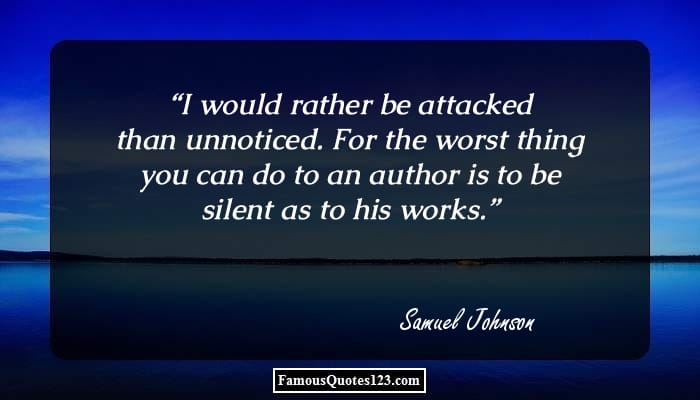
I’ve come to love Johnson’s elitism, his justification for rule and exploitation based purely on his own superiority and that of his fellow British. It allows him to present his prejudices uncommonly clearly, mixing in enough flattery to be convincing to those who accept his elitist perspective. That makes his words eminently quotable. It doesn’t make them right, nor does it mean that his was a useful way to deal with people or problems. Adam Smith was willing to admit that the Americans had a gripe, and suggests the simple remedy of giving Americans a voice in Parliament. His solution might have kept the empire whole. Edward Gibbon, an expert on Rome who opposed rights for Americans, at least admitted that we might win the war. Realistic views like this are more productive, but far less marketable. If you are to sell your words, it helps to be a pig-headed bigot and a flatterer of those who agree with you. This advantage of offending your opponents was not lost on Johnson as the quote below shows.
Johnson writing about notoriety, a very American attitude.
I’m left to wonder about the source of Johnson’s hatred for Americans though — and for the Irish, Cornish, and Scots. In large part, I think it stems from a view of the world as a zero-sum game. Any gain for the English servant is a loss to the English gentleman. The Americans, like the Irish and Cornish, were subject peoples looking for private benefit. Anything like low taxes was a hurt to the income of him and his fellows. The zero sum is also the view of Scrooge in a Christmas Carol; it is a destructive view.
As for those acted in any way without expectation of pay, those who would write for posterity, or would fight the Quixotic fight, such people were blockheads in his view. He was willing to accept that there were things wrong in England, but could not see how an intelligent person would favor change that did not help him. This extended to his beliefs concerning education of children: “I would not have set their future friendship to hazard for the sake of thrusting into their heads knowledge of things for which they might not perhaps have either taste or necessity. You teach your daughters the diameters of the planets, and wonder when you have done that they do not delight in your company. No science can be communicated by mortal creatures without attention from the scholar; no attention can be obtained from children without the affliction of pain, and pain is never remembered without resentment.” This is more of Johnson’s self-interest: don’t teach anything that will bring resentment and no return benefit. Teach the sons of the greats that they are great and that they are to lead. Anything more is a waste or an active harm to the elite.
But what happens when America succeeds? Johnson was still alive and writing in 1783. If the Americans could build an army and maintain prosperous independence, they would have to be respected as an equal or near-equal. Then what of the rest of the empire? How do you admit that this one servant is your equal and not admit that your other servants may be too? This is the main source of his hatred, I think, and also of the hatred the Scrooge has for mankind. It’s the hatred of the small soul for the large, of the sell-out for the enthusiast. If the other fellow’s sacrifice produces a great outcome, that suggests a new order in the stars — it suggests that everything you’ve done was wrong, or soon will be. The phrase “novus ordo seclorum” on our dollars alludes to just that idea, ‘there is a new order in the heavens.’. He must have realized the possibility, and trembled. Could there be something to the rabble, something beyond cash, safety and rule by the elite? I suspect the very thought of it insulted and angered poor Samuel. At his death, he could be comforted that, at least the Irish, Indians, and Canadians remained subservient.
Robert Buxbaum, December 2, 2019. This essay started out as a discussion of paid writing. But I’ve spent many years of my life dealing with elitists who believed that being paid proved they were right. I too hope that my writing will convince people, and maybe I’ll be paid as an expert (Water commissioner?) To hope for personal success, while trying to keep humble is the essential glorious folly of man.
While several towns have had problems with lead in their water, the main route for lead entering the bloodstream seems to be from the soil. The lead content in the water can be controlled by chemical means that I reviewed recently. Lead in the soil can not be controlled. The average concentration of lead in US water is less than 1 ppb, with 15 ppb as the legal limit. According to the US geological survey, of lead in the soil, 2014., the average concentration of lead in US soil is about 20 ppm. That’s more than 1000 times the legal limit for drinking water, and more than 20,000 times the typical water concentration. Lead is associated with a variety of health problems, including development problems in children, and 20 ppm is certainly a dangerous level. Here are the symtoms of lead poisoning.
Several areas have deadly concentrations of lead and other heavy metals. Central Colorado, Kansas, Washington, and Nevada is particularly indicated. These areas are associated with mining towns with names like Leadville, Telluride, Silverton, Radium, or Galena. If you live in an areas of high lead, you should probably not grow a vegetable garden, nor by produce at the local farmer’s market. Even outside of these towns, it’s a good idea to wash your vegetables to avoid eating the dirt attached. There are hardly any areas of the US where the dust contains less than 1000 times the lead level allowed for water.
Lead content of US soils, from the US geological survey of soils, 2014. Michigan doesn’t look half bad.
Breathing the dust near high-lead towns is a problem too. The soil near Telluride Colorado contains 1010 mg/kg lead, or 0.1%. On a dust-blown day in the area, you could breath several grams of the dust, each containing 1 mg of lead. That’s far more lead than you’d get from 1000 kg of water (1000 liters). Tests of blood lead levels, show they rise significantly in the summer, and drop in the winter. The likely cause is dust: There is more dust in the summer.
Recalled brand of curry powder associated with recent poisoning.
Produce is another route for lead entering the bloodstream. Michigan produce is relatively safe, as the soil contains only about 15 ppm, and levels in produce are generally far smaller than in the soil. Ohio soils contains about three times as much lead, and I’d expect the produce to similarly contain 3 times more lead. That should still be safe if you wash your food before eating. When buying from high-lead states, like Colorado and Washington, you might want to avoid produce that concentrates heavy metals. According Michigan State University’s outreach program, those are leafy and root vegetables including mustard, carrots, radishes, potatoes, lettuce, spices, and collard. Fruits do not concentrate metals, and you should be able to buy them anywhere. (I’d still avoid Leadville, Telluride, Radium, etc.). Spices tend to be particularly bad routes for heavy metal poisoning. Spices imported from India and Soviet Georgia have been observed to have as much as 1-2% lead and heavy metal content; saffron, curry and fenugreek among the worst. A recent outbreak of lead poisoning in Oakland county, MI in 2018 was associated with the brand of curry powder shown at left. It was imported from India.
Marijuana tends to be grown in metal polluted soil because it tolerates soil that is too polluted fro most other produce. The marijuana plant concentrates the lead into the leaves and buds, and smoking sends it to the lungs. While tobacco smoking is bad, tobacco leaves are washed and the tobacco products are regulated and tested for lead and other heavy metals. If you choose to smoke cigarettes, I’d suggest you chose brands that are low in lead. Here is an article comparing the lead levels of various brands. . Better yet, I’s suggest that you vape. There are several advantages of vaping relative to smoking the leaf directly. One of them is that the lead is removed in the process of making concentrate.
Some states test the lead content of marijuana; Michigans and Colorado do not, and even in products that are tested, there have been scandals that the labs under-report metal levels to help keep tainted products on the shelves. There is also a sense that the high cost encourages importers to add lead dust deliberately to increase the apparent density. I would encourage the customer to buy vape or tested products, only.