Tag Archives: immigration

Poor Canada and its China lifeline

Canada has long-standing economic problems relative to the US, and they have been growing since 2015 as the figure shows (figure from a conservative, Canadian politician, Ryan Williams). These problems infect most of Europe, and will soon extend to the US. They are largely due to a declining birthrate, bad management, and an aging population. The result is a declining Canadian dollar (CAD), rising housing prices, rising national health costs and rising government debt. In both countries, life feels less affordable than in previous years, but the effects hit harder in Canada. Consider, for example, that the average salary in Toronto, Canada’s largest city, is $62,050 CAD. that’s pretty low by US standards, the equivalent of $45,000 US, well below the average salary in Chicago or Houston, two comparable US cities. In those cities the average is ~$63,000 US. Meanwhile rent prices in Toronto are about the same as in Chicago in US dollars, and far above rent prices in Houston. If you wish to buy a home, the price in Chicago is about half that in Toronto. Even with healthcare, life is generally more affordable in the US, and home ownership, though difficult, is not out of reach, especially in Houston.
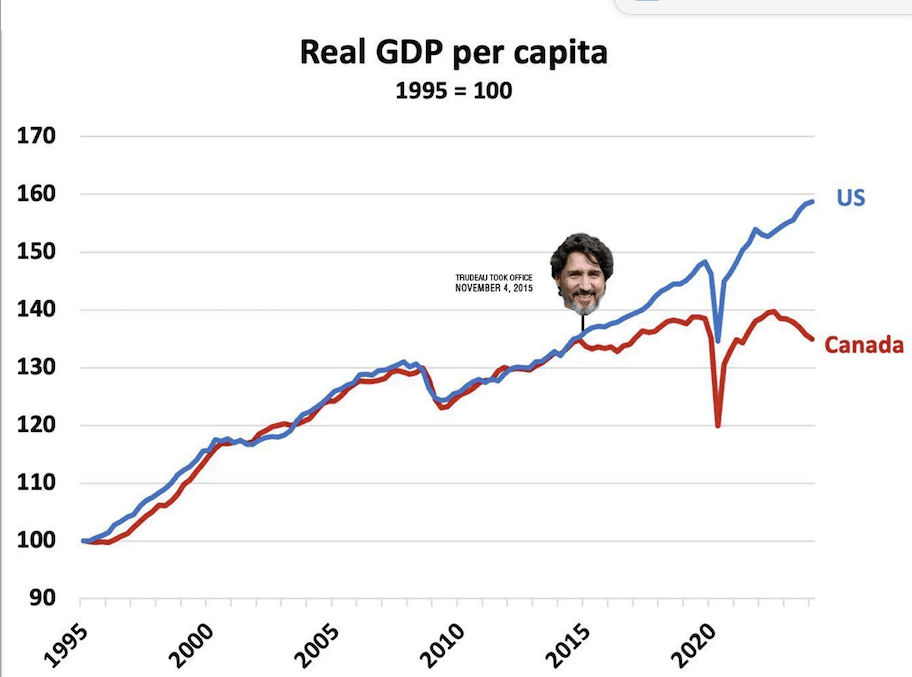
Image generated by (for) Ryan Williams, a Conservative Canadian politician. It overstates the problems caused by Trudeau. Canada first began falling behind in the 1980s, though problems increased in 2015.

A main reason that Canadian housing is so expensive is permitting is difficult. Canada has plenty of space for housing, but it’s hard to get a permit to build, and it’s hard to sell the home, too. To be a real-estate agent in Canada, for example, you have to take a year-long course, and pass several stages of permitting tests costing $6000 -$10,000 CAD. In the US, it’s cheaper, about $1000 US and generally it requires only a month-long course. These same regulations also cause salaries to be low, by decreasing productivity. It is hard to start a company in Canada, and hard to retain good workers, since low-productivity workers have rights to equal pay for equal work, with no regard to productivity.

Canadian salaries also suffer from high immigration, particularly of low skill labor. Canada accepts about 500,000 immigrants per year, offering free healthcare and social services. During the Biden years, we accepted 6x more, about 3 million per year, mostly illegally, but Canada has 1/8 the population of the US and more generous benefits. As a result the decrease in affordability has been far greater. In the US and Canada, immigrants have been low skill or unemployed, presenting tough competition for native-born, low-skill workers, and burdening the government welfare system. There has been a push-back in Canada, as in the US, and Canada has begun removing illegal immigrants, as have we in the US. It’s less unpopular in Canada because Canadians see themselves as good no matter what they do. The Canadian population shrank by 0.15% last year, while ours continued to grow. In both countries, lower immigration of unemployed individuals, should lower housing prices, and should protect the welfare system. Of course some businesses benefit from low wage immigrant, and from the unemployed, the social services industry for one, Janitorial services for another. Rich folks are alway s complaining for more immigration because they find it’s hard to get cleaning help, and because they rarely pay taxes at any meaningful rate.
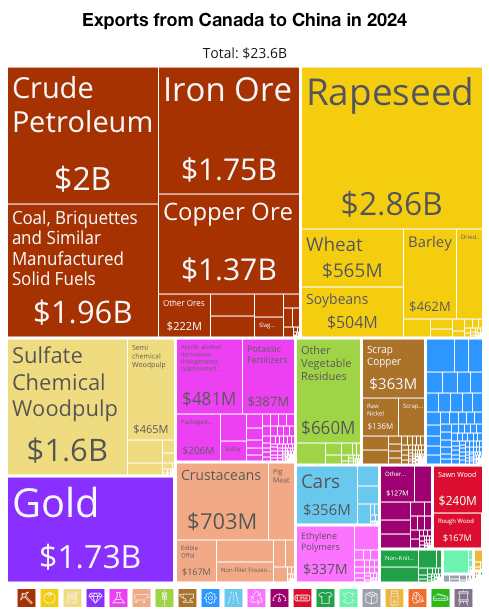
As a band-aide to these economic problems, both in Canada and the US, we have caught to raise government income through a new tax, tariffs. We’ve each put 25% tariffs on automobiles produced in the neighboring country. But Canada has a twist, it can benefit bringing bringing in high-tariff and prohibited imports from China and Cuba hoping the imports cross the border to the US. For example, they import Cuban cigars, and sell them near the border at inflated prices to Americans (largely) who smuggle them to the US. It worked too during prohibition for whiskey. In the last month, Canadian PM Carney reduced the tariff on 50,000 China-made EVs to 6.1%. If large numbers find their way to the US as new or used vehicles, the hope is that Chinese companies will buy manufactured goods from Canada, or evenest up manufacturing. It might work, though Cuba never set up cigar manufacturing in Canada. Typically Chinese companies send abroad nearly finished items, allowing the host country to add finishing touches that involve no technology but that can be claimed to raise the value significantly to avoid taxes. As the chart above, China imports from Canada are virtual all raw goods: food, petroleum, iron ore, gold… Technological expertise stays at home. Canada will need a home grown engine to get out of its funk.

At this point, the most likely home-grown engine is likely to be oil. Canada has oil, and the world needs it, especially China. Currently the Straight of Hormuz is effectively closed because of the war. Many countries are being hurt by this, but particularly China because of troubles in three of its major, sanctioned suppliers, Iran, Venezuela, and Russia. China will need a new source of oil, and will likely pay Canadian prices if the Canadian government can see through to provide infrastructure for export. Selling to China could also avoid a war.

Another thought, both to benefit Canada and the US, I’m pro-immigration, but suggest we target hard working, honest immigrants with usable skills: plumbers, cooks, programmers, cement workers … people who are unlikely to start out on welfare, and likely to provide a decent middle class lifestyle. The children from these immigrants integrate well in the US, and likely will into Canada. They integrate far better than the children of unskilled violent refugees. I also favor tariffs, especially on manufactured and luxury goods, like cars and wine. It provides government income, and promotes technical skill at home.

Robert Buxbaum, March 10, 2026.

The Brexit, Trump, Johnson anti-crash

Before Brexit, I opined, against all respectable economists, that a vote for Bexit would not sink the British economy. Switzerland, I argued, was outside the EU, and their economy was doing fine. Similarly, Norway, Iceland, and Israel — all were outside the EU and showed no obvious signs of riots, food shortages, or any of the other disasters predicted for an exited Britain. Pollsters were sure that Britain would vote “No” but, as it happened, they voted yes. The experts despaired, but the London stock market surged. It’s up 250% since the Brexit vote.

Lodon stock market prices from January 2016 through the Brexit vote, August 2016, to the Boris Johnson election, August 2019. The price has risen by more than 250%.

A very similar thing happened with the election of Trump and of Boris Johnson. In 2016 virtually every news paper supported Ms Clinton, and every respectable economic expert predicted financial disaster if he should, somehow win. As with Brexit, the experts were calmed by polls showing that Trump would, almost certainly lose. He won, and as with Brexit, the stock market took off. Today, after a correction that I over-worried about, the S+P index remains up 35% from when Trump was elected. As of today, it’s 2872, not far from the historic high of 3049. Better yet, unemployment is down to record levels, especially for black and hispanic workers, and employment is way up, We’ve added about 1% of adult workers to the US workforce, since 2017, see Federal Reserve chart below.

Returning to Britain, the economic establishment have been predicting food shortages, job losses and a strong stock market correction unless Brexit was re-voted and rejected. Instead, the ruling Conservative party elected Boris Johnson to prime-minister, “no deal” Brexiter. The stock market responded with a tremendous single day leap. See above

Ratio of Civilian Employment to US Population. Since Trump’s election, we’ve added about 1% of the working age US population to the ranks of the employed.

You’d think the experts would show embarrassment for their string of errors. Perhaps they would save some face by saying they were blinded by prejudice, or that their models had a minor flaw that they’ve now corrected, but they have not said anything of the sort. Paul Krugman of the New York Times, for example, had predicted a recession that would last as long as Trump did, and has kept up his predictions. He’s claimed a bone rattling stock crash continuously for nearly three years now, predicting historic unemployment. He has been rewarded with being wrong every week, but he’s also increased the readership of the New York Times. So perhaps he’s doing his job.

I credit our low un-employment rate to Trump’s tariffs and to immigration control. When you make imports expensive, folks tend to make more at home. Similarly, with immigration, when you keep out illegal workers, folks hire more legal ones. I suspect the same forces are working in Britain. Immigration is a good thing, but I think you want to bring in hard-working, skilled, honest folks to the extent possible. I’m happy to have fruit pickers, but would like to avoid drug runners and revolutionaries, even if they have problems at home.

I still see no immediate stock collapse, by the way. One reason is P/E analysis, in particular Schiller’s P/E analysis (he won a Nobel prize for this). Normal P/E analysis compares the profitability of companies to their price and to the bond rate. The inverse of the P/E is called the earnings yield. As of today, it’s 4.7%. This is to say, every dollar worth of the average S+P 500 stock generates 4.7¢ in profits. Not great, but it’s a lot better than the 10-year bond return, today about 1.5%.

The Schiller P/E is an improved version of this classic analysis. It compares stock prices to each company’s historic profitability, inflation adjusted for 10 years. Schiller showed that this historic data is a better measure of profitability than this year’s profitability. As of today, the Schiller P/E is 29.5, suggesting an average corporate profitability of 3.5%. This is still higher than the ten-year bond rate. The difference between them is 2%, and that is about the historic norm. Meanwhile, in the EU, interest rates are negative. The ten year in Germany is -0.7%. This suggests to me that folks are desperate to avoid German bank vaults, and German stocks. From my perspective, Trump, Johnson, and the Fed seem to be doing much better jobs than the EU bankers and pendents.

Robert E. Buxbaum, August 16, 2019.

My solution to the world’s problems: better people

Most of the problems of the world are caused by people. Look at war, it’s caused by people; look at pollution, people; look at overeating, or welfare, or gun violence. You name it, the problem is people. My simple solution, then: better people. Immigration is a simple solution for a county that can do it selectively (take in the best, leave the rest); it’s worked for the US and it doesn’t have to beggar the third world. Education is another way to help, but we’re not quite sure what sort of education makes people better. “An uneducated man may steel from a boxcar, an educated one may steal the whole railroad.” Theodore Roosevelt is supposed to have quipped.

Those who claim they are uncommonly moral and good at teaching have barely any proof that they are. American schools produce financially successful people, but not particularly moral ones; Europe’s approach is different, but there’s no indication they’ve done better at moral education. We look to the 18th century, or the Greeks, but they were no more moral than us, as best I can tell. The Taliban, the communists, or similar fundamentalists claim moral superiority over the west, but from my perspective, they look even worse. 

I notice that people learn morality from one another — that is each person acts like his neighbor. I also note that people tend to act better when they are involved, and feel part of whatever country, city or group they are in. Targeted immigration might bring in better people–honest, hard working, non-violent — and these people might help improve and motivate the locals. And even if we don’t improve by interaction, perhaps lazy Americans will ride on the backs of the hard-working immigrants. But it strikes me that the disconnect between world problems of high unemployment, world hunger, and lots of open, US jobs is a moral problem that could be solved by targeted love. Allowing some increased mobility from country to country and job to job (plus better preaching?). If you can move you are more-likely to find a job or place where you feel fulfilled, and you are likely to do better and more there. Even the countries and jobs that are left might benefit by being rid of their malcontents. And we don’t have to take everyone.

From "Hispanic-hope."

From “Hispanic-hope.”, an interesting combination of Bible-study and immigration morality.

Living in America is desirable for most people from most countries. Far more people want to live here than we can accept. As a result, we are in a position to target the bright, honest, hard-working Peoples from virtually any country. These folks are helpful to industry and to the US tax base as these immigrants tend to work out — or get deported. In the short-term they might displace Americans or depress salaries, but even that is not certain. There is no fixed slate of US jobs nor a fixed amount of work need. Yesterday’s job taker is tomorrow’s job creator. Our country is built on immigrants, and has not suffered from it. We should not take those who hate the US, or those who hate freedom, or have no skills, criminals and the sick. Nor should we give citizenship immediately. But that still leaves plenty who we’d want, and who want to be here. Th. Roosevelt said, “you can not take in too many of the right people, and even one of the wrong type is too many.” I suspect this is true.

I suspect we’d have 90+% odds picking good people from a crowd. The Immigration system does a good job now, and the great colleges have done better for years. The past is usually a great indicator. If someone is well, and has worked for years, or has been here in school; if they’ve managed to stay productive and out of trouble, he/she is a good candidate. A first step would be a work permit, and in a few years they can apply for permanent residence or citizenship. Many of the most successful people in America are either immigrants or descendents of immigrants. The founders of Google and Facebook; the builders and the shakers. These people have the ‘get-up and go.’ You can tell because they’ve gotten up and gone.

Dr. Robert Buxbaum, June 16, 2014. I’m a child of an immigrant, went to public school, got a PhD at Princeton, have built my own company, and have (so far) avoided arrest, imprisonment or serious scandal. With the help of my Canadian-immigrant wife, I’ve produced three Buxbaum clones, my biggest contribution to improving the US and the world.