Tag Archives: Chicago

Poor Canada and its China lifeline

Canada has long-standing economic problems relative to the US, and they have been growing since 2015 as the figure shows (figure from a conservative, Canadian politician, Ryan Williams). These problems infect most of Europe, and will soon extend to the US. They are largely due to a declining birthrate, bad management, and an aging population. The result is a declining Canadian dollar (CAD), rising housing prices, rising national health costs and rising government debt. In both countries, life feels less affordable than in previous years, but the effects hit harder in Canada. Consider, for example, that the average salary in Toronto, Canada’s largest city, is $62,050 CAD. that’s pretty low by US standards, the equivalent of $45,000 US, well below the average salary in Chicago or Houston, two comparable US cities. In those cities the average is ~$63,000 US. Meanwhile rent prices in Toronto are about the same as in Chicago in US dollars, and far above rent prices in Houston. If you wish to buy a home, the price in Chicago is about half that in Toronto. Even with healthcare, life is generally more affordable in the US, and home ownership, though difficult, is not out of reach, especially in Houston.
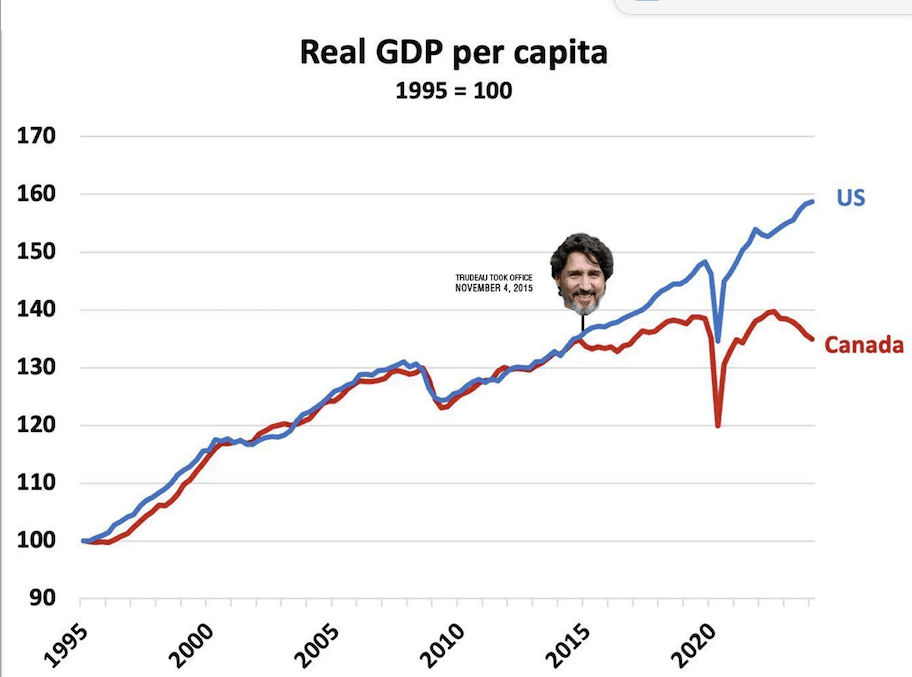
Image generated by (for) Ryan Williams, a Conservative Canadian politician. It overstates the problems caused by Trudeau. Canada first began falling behind in the 1980s, though problems increased in 2015.

A main reason that Canadian housing is so expensive is permitting is difficult. Canada has plenty of space for housing, but it’s hard to get a permit to build, and it’s hard to sell the home, too. To be a real-estate agent in Canada, for example, you have to take a year-long course, and pass several stages of permitting tests costing $6000 -$10,000 CAD. In the US, it’s cheaper, about $1000 US and generally it requires only a month-long course. These same regulations also cause salaries to be low, by decreasing productivity. It is hard to start a company in Canada, and hard to retain good workers, since low-productivity workers have rights to equal pay for equal work, with no regard to productivity.

Canadian salaries also suffer from high immigration, particularly of low skill labor. Canada accepts about 500,000 immigrants per year, offering free healthcare and social services. During the Biden years, we accepted 6x more, about 3 million per year, mostly illegally, but Canada has 1/8 the population of the US and more generous benefits. As a result the decrease in affordability has been far greater. In the US and Canada, immigrants have been low skill or unemployed, presenting tough competition for native-born, low-skill workers, and burdening the government welfare system. There has been a push-back in Canada, as in the US, and Canada has begun removing illegal immigrants, as have we in the US. It’s less unpopular in Canada because Canadians see themselves as good no matter what they do. The Canadian population shrank by 0.15% last year, while ours continued to grow. In both countries, lower immigration of unemployed individuals, should lower housing prices, and should protect the welfare system. Of course some businesses benefit from low wage immigrant, and from the unemployed, the social services industry for one, Janitorial services for another. Rich folks are alway s complaining for more immigration because they find it’s hard to get cleaning help, and because they rarely pay taxes at any meaningful rate.

As a band-aide to these economic problems, both in Canada and the US, we have caught to raise government income through a new tax, tariffs. We’ve each put 25% tariffs on automobiles produced in the neighboring country. But Canada has a twist, it can benefit bringing bringing in high-tariff and prohibited imports from China and Cuba hoping the imports cross the border to the US. For example, they import Cuban cigars, and sell them near the border at inflated prices to Americans (largely) who smuggle them to the US. It worked too during prohibition for whiskey. In the last month, Canadian PM Carney reduced the tariff on 50,000 China-made EVs to 6.1%. If large numbers find their way to the US as new or used vehicles, the hope is that Chinese companies will buy manufactured goods from Canada, or evenest up manufacturing. It might work, though Cuba never set up cigar manufacturing in Canada. Typically Chinese companies send abroad nearly finished items, allowing the host country to add finishing touches that involve no technology but that can be claimed to raise the value significantly to avoid taxes. As the chart above, China imports from Canada are virtual all raw goods: food, petroleum, iron ore, gold… Technological expertise stays at home. Canada will need a home grown engine to get out of its funk.

At this point, the most likely home-grown engine is likely to be oil. Canada has oil, and the world needs it, especially China. Currently the Straight of Hormuz is effectively closed because of the war. Many countries are being hurt by this, but particularly China because of troubles in three of its major, sanctioned suppliers, Iran, Venezuela, and Russia. China will need a new source of oil, and will likely pay Canadian prices if the Canadian government can see through to provide infrastructure for export. Selling to China could also avoid a war.

Another thought, both to benefit Canada and the US, I’m pro-immigration, but suggest we target hard working, honest immigrants with usable skills: plumbers, cooks, programmers, cement workers … people who are unlikely to start out on welfare, and likely to provide a decent middle class lifestyle. The children from these immigrants integrate well in the US, and likely will into Canada. They integrate far better than the children of unskilled violent refugees. I also favor tariffs, especially on manufactured and luxury goods, like cars and wine. It provides government income, and promotes technical skill at home.

Robert Buxbaum, March 10, 2026.

Ferries make more sense than fast new trains.

Per pound mile of material, the transport cost by ship is 1/4 as much as by train, and about 1/8 as much as by truck. Ships are slower, it is true, but they can go where trucks and trains can not. They cross rivers and lakes at ease and can haul weighty freight with ease. I think America could use many more ferries, particularly drive-on, fast ferries. I don’t think we need new fast rail lines, because air travel will always be faster and cheaper. The Biden administration thinks otherwise, and spends accordingly.

Amtrak gets $30 Billion for train infrastructure this year, basically nothing for ferries.

The Biden administration’s infrastructure bill, $1.2 Trillion dollars total, provides $30 Billion this year for new train lines, but includes less than 1% as much for ferries, $220 million, plus $1B for air travel. I think it’s a scandal. The new, fast train lines are shown on the map, above. Among them is a speed upgrade to the “Empire Builder” train running between Chicago and Seattle by way of Milwaukee. I don’t think this will pay off — the few people who take this train, takes it for the scenery, I think, and for the experience, not to get somewhere fast.

There is money for a new line between Cleveland and Detroit, and for completion of the long-delayed, and cost-over-run prone line between LA and San Francisco. Assuming these are built, I expect even lower ridership since the scenery isn’t that great. Even assuming no delays (and there are always delays), 110 mph is vastly slower than flying, and typically more expensive and inconvenient. Driving is yet slower, but when you drive, you arrive with your car. With a train or plane, you need car rental, typically.

New Acela train, 150 mph max. 1/4 as fast as flying at the same price.

Drive-on ferries provide a unique advantage in that you get there with your car, often much faster than you would with by driving or by train. Consider Muskegon to Milwaukee (across the lake), or Muskegon to Chicago to Milwaukee, (along the lake). Cleveland to Canada, or Detroit to Cleveland. No land would have to be purchased and no new track would have to be laid and maintained. You’d arrive, rested and fed (they typically sell food on a ferry), with your car.

There’s a wonderful song, “City of New Orleans”, sung here by Arlo Guthrie describing a ride on the historic train of that name on a trip from Chicago to New Orleans, 934 miles in about one day. Including stops but not including delays, the average speed is 48 mph, and there are always delays. On board are, according to the song, “15 restless riders, 3 conductors, and 25 sacks of mail.” The ticket price currently is $200, one way, or about as much as a plane ticket. The line loses money. I’ve argued, here, for more mail use to hep make this profitable, but the trip isn’t that attractive as a way to get somewhere, it’s more of a land-cruise. The line is scheduled for an upgrade this year, but even if upgraded to 100 mph (14 hours to New Orleans including stops?) it’s still going to be far slower than air travel, and likely more expensive, and you still have to park your car before you get on, and then rent another when you get off. And will riders like it more? I doubt it, and doubt the speed upgrade will be to 100 mph.

Lake Express, 30 mph across Lake Michigan

Ferry travel tends to cost less than train or plane travel because water traffic is high volume per trip with few conductors per passenger. At present, there are only two ferryboats traveling across Lake Michigan, between Michigan and Wisconsin, Milwaulkee to Muskegon. They are privately owned, and presumably make money. The faster is the Lake Express, 30 mph. It crosses the lake in 2.5 hours. Passenger tickets cost $52 one way, or $118 for passenger and car. That’s less than the price of an Amtrak ticket or a flight. I think a third boat would make sense and that more lines would be welcome too. Perhaps Grand Haven to Racine or Chicago.

Route of the Lake Express. I’d like to see more like this; St. Joseph to Milwaukee say, and along Lake Erie.

Currently, there are no ferries across Lake Erie. Nor are there any along Lake Erie, or even across Lake St. Clair, or along the Detroit River, Detroit to Toledo or Toledo to Cleveland. These lines would need dock facilities, but they would have ridership, I think. New York’s Staten Island ferry has good ridership, 35,000 riders on a typical day, plus cars and trucks. In charge are roughly 120 engineers, captains and mates, one employee for every 300 passengers or so. By comparison, Amtrak runs 300 trains that carry a total of 87,000 passengers on an average day, mostly on the east coast. These 300 trains are run by 17,100 employees as of fiscal year 2021, one employee for every 4 passengers. Even at the slow speeds of our trains the cost is far higher per passenger and per passenger mile.

The Staten Island ferry is slow, 18.5 mph, but folks don’t seem to mind. The trip takes 20 minutes, about half as long as most people’s trips on Amtrak. There are also private ferry lines in NY, many of these on longer trips. People would take ferries for day-long trips along our rivers, I think. Fast ferries would be nice, 40 mph or more, but I think even slow ferries would have ridership and would make money. A sea cruise is better than a land cruise, especially if you can have a cabin. On the coal-steam powered, Badger, you can rent a state-room to spend the night in comfort. Truckers seem to like that they cover ground during their mandatory rest hours. The advantage is maximized, I think, for ferry trips that take 12 hours or so, 250 to 350 miles. That’s Pittsburgh to Cincinnatti or Chicago to Memphis.

New York’s Staten Island ferry leaves every 15 minutes during rush hour. Three different sizes of boat are used. The largest carry over 5000 passengers and 100 cars and trucks at a crossing.

A low risk way to promote ferry traffic between the US and Canada would be to negotiate bilateral exemption to The Jones Act and its Canadian equivalent. Currently, we allow only US ships with US crews for US travel within the US.* Cabotage it’s called, and it applies to planes as well, with exemptions. Canada has similar laws and exemptions. A sensible agreement would allow in-country and cross-country travel on both Canadian and US ships, with Canadian and/or US crew. In one stoke, ridership would double, and many lines would be profitable.

Politicians of a certain stripe support trains because they look futuristic and allow money to go to friends. Europeans brag of their fast trains, but they all lose money, and Europe had to ban many short hop flights to help their trains compete. Without this, Europeans would fly. There is room to help a friend with a new ferry, but not as much as when you buy land and lay track. We could try to lead in fancy ferries going 40 mph or faster, providing good docks, and some insurance. Investors would take little risk since a ferry route can be moved**. Don’t try that with a train.

In Detroit we have a close up of train mismanagement involving the “People Mover.” It has no ridership to speak of. Our politicians then added “The Q line” to connect to it. People avoid both lines. I think people would use a ferry along the Detroit river, though, St. Claire to Wyandotte, Detroit, Toledo — and to Cleveland or Buffalo. Our lakes and rivers are near-empty superhighways. Let’s use them.

Robert Buxbaum, January 2, 2024. *The US air cabotage act (49 U.S.C. 41703) prohibits the transportation of persons, property, or mail for compensation or hire between points of the U.S. in a foreign civil aircraft. We’ve managed exemptions, though, e.g. for US air traffic with Airbus and Embraer planes. We can do the same with ferries.

** I notice that it was New York’s ferries, and their captains, that rescued the people on Sullenberger’s plane when it went down in the Hudson River — added Jan. 6.

Making the train, City of New Orleans profitable

The City of New Orleans is the name of the only passenger train between Chicago and New Orleans. It’s also the name of a wonderful song by Steve Goodman, 1971. Hear it, sung by Arlo Guthrie with scenes from a modern ride.

“Riding on the City of New Orleans
Illinois Central Monday morning rail
Fifteen cars and fifteen restless riders
Three conductors and twenty-five sacks of mail
All along the southbound odyssey
The train pulls out at Kankakee
Rolls along past houses, farms and fields
Passin’ trains that have no names
Freight yards full of old black men
And the graveyards of the rusted automobiles…”

Every weekday, this train leaves Chicago at 9:00 PM and gets into New Orleans twenty hours later, at 5:00 PM. It’s a 925 mile trip at a 45 mph average: slow and money-losing, propped up by US taxes. Like much of US passenger rail, it “has the disappearing railroad blues.” It’s a train service that would embarrass the Bulgarians: One train a day?! 45 mph average speed!? It’s little wonder is that there are few riders, and that they are rail-enthusiasts: “the sons of Pullman porters, and the sons of engineers, Ride[ing] their father’s magic carpets made of steel.” The wonder, to me was that there was ever fifteen cars for these, “15 restless riders”.

A sack of mail being picked up on the fly.

I would be happy to see more trips and a faster speed, at an average speed of at least 60 mph. This would require 85 mph or higher between stops, but it would save on salaries, and it would bring in some new customers. But even if these higher speeds cost nothing extra, in net, you’d still need something more to make the trip profitable; a lot more if the goal is to add another train. Air-traffic will always be faster, and the automobile, more convenient. I find a clue to profitability in the fifteen cars of the song and in the sacks of mail.

Unless I’m mistaken, mail traffic was at least as profitable as passenger traffic, and those “twenty-five sacks of mail” were either very large, or just the number on-loaded at Kankakee. Passenger trains like ‘the city of New Orleans’ were the main mail carriers till the late 1970s, a situation that ended when union disputes made it unprofitable. Still, I suspect that mail might be profitable again if we used passenger trains only for fast mail — priority and first class — and if we had real fast mail again. We currently use trucks and freight trans for virtually all US mail, we do not have a direct distribution system. The result is that US mail is vastly slower than it had been. First class mail used to arrive in a day or two, like UPS now. But these days the post office claims 2 to 4 business days for “priority mail,” and ebay guarantees priority delivery time “within eight business days”. That’s two weeks in normal language. Surely there is room for a faster version. It costs $7.35 for a priority envelope and $12.80 for a priority package (medium box, fixed price). That’s hardly less than UPS charges.

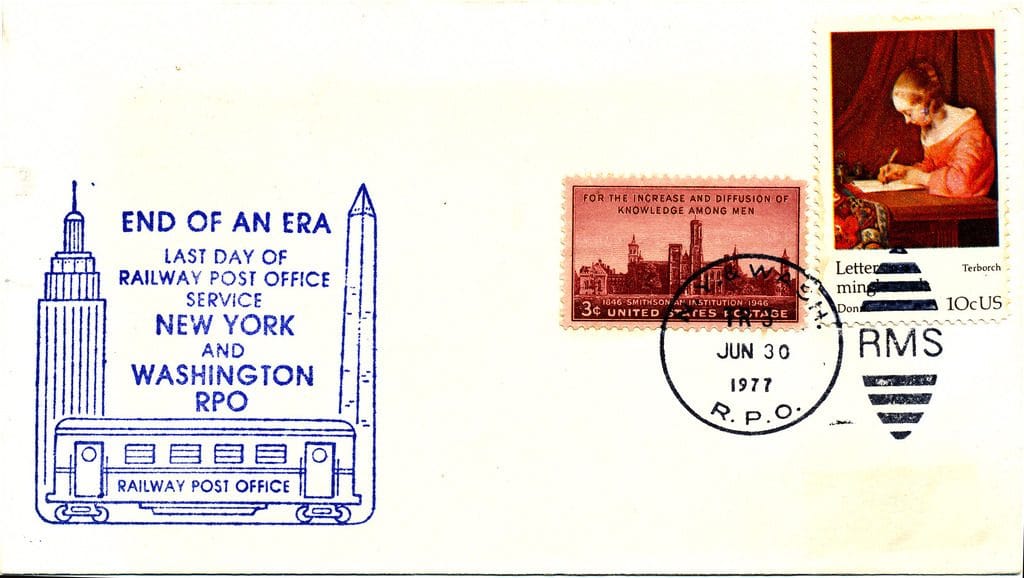
Last day of rail post service New York to Washington, DC. .June 30, 1977.

Passenger trains could speed our slow mail a lot, even with our slow speed trains. The City of New Orleans makes its trip in less than a day, with connections to major cities across the US. If priority mail went north-south in under one day, people would use it more, and that could make the whole operation profitable. Trains are far cheaper than trucks when you are dealing with large volumes; there are fewer drivers per weight, and less energy use per weight. Still there are logistical issues to making this work, and you want to move away from having many post men handling individual sacks, I think. There are logistical advantages to on-loading and off-loading much larger packages and to the use of a system of standard sizes on a moving conveyor.

How would a revised mail service work? I’d suggest using a version of intermodal logistics. Currently this route consists of 20 stops including the first and last, Chicago and New Orleans. This suggests an average distance between stops of 49 Miles. Until the mid 70s, , mail would be dropped off and picked up at every stop, with hand sorting onboard and some additional on-off done on-the-fly using sacks and hooks, see picture above. For a modern version, I would suggest the same number of passenger stops, but fewer mail pick ups and drop offs, perhaps only 1/3 as many. These would be larger weight, a ton or more, with no hand sorting. I’d suggest mail drop offs and pick ups every 155 miles or so, and only of intermodal containers or pods: ten to 40 foot lengths. These containers plus their contents would weigh between 2,500 and 25,000 pounds each. They would travel on flatcars at the rear of the passenger cars, and contain first class and priority mail only. Otherwise, what are you getting for the extra cost?

The city of New Orleans would still leave Chicago with six passenger cars, but now these would be followed by eight to ten flatcars holding six or more containers. They’d drop off one of the containers at a stop around the 150 mile mark, likely Champaign Urbana, and pick up five or so more (they’d now have ten). Champaign Urbana is a major east-west intermodal stop, by the way. I’d suggest the use of six or more heavy forklifts to speed the process. At the next mail-stop, Centralia, two containers might come off and four or more might come on. Centralia is near St. Louis, itself a major rail hub for trains going west. See map below. The next mail stop might be Memphis. Though it’s not shown as such, Memphis is a major east-west rail hub; it’s a hub for freight. A stripped down mail-stop version of passenger train mail like this seems quite do-able — to me at least. It could be quite profitable, too.

Amtrak Passenger rail map. The city of New Orleans is the dark blue line going north-south in the middle of the map.

Intermodal, flat-bed trucks would take the mail to sorting locations, and from there to distribution points. To speed things, the containers might hold pre-sorted sacks of mail. Intermodal trucks might also carry some full containers east and west e.g. from Centralia to St. Louis, and some full flatcars could be switched on and off too. Full cars could be switched at the end, in New Orleans for travel east and west, or in the middle. There is a line about “Changing cars in Memphis Tennessee.” I imagine this relates to full carloads of mail joining or leaving the train in Memphis. Some of these full intermodal containers could take priority mail east and west. One day mail to Atlanta, and Houston would be nice. California in two days. That could be a money maker.

At this point, I would like to mention “super-fast” rail. The top speeds of these TGV’s “Transports of Grande Vitess” are in the range of 160 mph (265 km/hr) but the average speeds are lower because of curves and the need to stop. The average speeds are roughly 125 mph on the major routes in Europe, but they require special rails and rail beds. My sense is that this sort of special-use improvement is not worth the cost for US rail traffic. While 60 -90 mph can be handled on the same rails that carry freight, the need for dedicated track comes with a doubling of land and maintenance costs. And what do you have when you have it? The bullet rail is still less than half as fast as air travel. At an average speed of 125 mph, the trip between Chicago and New Orleans would take seven hours. For business travelers, this is not an attractive alternative to a two hour flight, and it is not well suited for intermodal mail. The fuel costs are unlikely to be lower than air travel, and there is no easy way to put mail on or off a TGV. Mail en-route would slow the 125 mph speed further, and the use of intermodal containers would dramatically increase the drag and fuel cost. Air travel has less drag because air density is lower at high altitude.

Meanwhile, at 60 mph average speeds, train travel can be quite profitable. Energy use is 1/4 as high at 60 mph average as at 120 mph. An increase of average speed to 60 mph would barely raise the energy use compared to TGV, but it would shorten the trip by five hours. The new, 15 hour version of “The City of New Orleans” would not be competitive for business travel, but it would be attractive for tourists, and certainly for mail. Having fewer hours of conductor/ engineer time would save personnel costs, and the extra ridership should allow the price to stay as it is, $135 one-way. A tourist might easily spend $135 for this overnight trip: leaving Chicago after dinner and arriving at noon the next day. This is far nicer than arriving at 5:00 PM, “when the day is done.”

Robert Buxbaum, June 21, 2019. One summer during graduate school, I worked in the mail room of a bank, stamping envelopes and sorting them by zip code into rubber-band tied bundles. The system I propose here is a larger-scale version of that, with pre-sorted mail bags replacing the rubber bands, and intermodal containers replacing the sacks we put them in.