Category Archives: politics

Biden stops fracking and gas prices go up 300% — Surprise!

Natural gas prices for June 2022 as of May 6, 2022.

Natural gas prices have quadrupled in the last 17 months. It’s gone from $2.07 per million BTU in mid January 2021 when Joe Biden took office, to nearly $9 today. It’s a huge increase in the cost to heat your home, and adds to the cost of any manufactured product you buy. Gasoline prices have risen too, going from $2/gallon when Biden took office to about $4.40 today. Biden blames the war with Russia, but the rise began almost as soon as he took office, and it far outstrips the rise in the price of wheat shown below (wheat is grown in Ukraine — it’s their major export). The likely cause is Biden’s moratorium on fracking, including his decision to stop permitting oil exploration and drilling on federal land. In recent weeks Biden has walked back some of this, to the consternation of the environmentalists. On April 15, 2022, the Interior Department announced this significant change including its first onshore lease sale since the moratorium.

Biden also cancelled the Keystone XL oil pipeline that would have brought tar-sands oil from Canada and North Dakota to Texas for refining. Blocking the pipeline helped increase gas prices here and helped cause a recession in Alberta and North Dakota. The protesters who claimed to speak for the natives are not affected.

Another issue fueling price increases is that Biden is printing money. Bidenflation is running at 8%/year. It’s not hyperinflation, but it’s getting close. It’s money taken from your pocket and from your savings. Much of the money is given to friends: to groups that Biden thinks will use it virtuously, but inflation is money taken from us, from our pockets and savings. Another beneficiary are those who are rich enough to take no salary, but live by borrowing against their real estate and corporate equity. The richest people in the US do this, earning $1 per year or less, (here’s a list compiled by Bloomberg, it’s basically every rich person). They pay no taxes, as they have no income. The only way to tax them is by tariffs, taxing what they import, but the government is against tariffs.

What you can do, personally about energy-cost inflation is not much. I would recommend insulating your home. I plan to repaint the roof white, and put in a layer of roof insulation. I also have fruit trees: an apple tree and a peach tree, grapes and a juneberry. They provide summer shade, and you get a lot of fruit with minimal work. Curtains are a good investment. Another thought is to buy solar cells. A vegetable garden is fun too, but it’s unlikely to pay you back.

Winter wheat prices are up by about 40%, likely due to the loss of supply from Ukraine and Russia

Speaking of wheat prices, they are up. They increased 40% when Russian troops invaded Ukraine, and have held steady at that level since. This is far less increase than for natural gas. Corn and rice prices are up too, but nowhere near as much. Fertilizer prices are up 300%, though, and Biden has indicated he’d like to push for a sustainable alternative; is that poop? There is a baby formula shortage too. We can handle it, I think, unless Biden get involved, or starts a hot war with Russia.

Robert Buxbaum May 10, 2022. As a fun sidelight, here is Biden answering questions about Pakistan when someone in a Bunny costume grabs him and walks him away from the reporters. Who is that masked handler? What’s going on in Pakistan?

Ukraine looks like Vietnam or the beginnings of WWI

The press and our Russian experts claim we’re helping in Ukraine, protecting it from a Russian invasion. I suspect they are wrong, and that our help and protection will prove to be as deadly to all as in the Vietnam war. I’m also uncomfortable with their presentation their framing of Putin as an out of touch autocrat. Putin has popular support, and acts with a strong sense of history, as I see it, just not our version of history. In the Russian version, it was Russia that stopped the Nazis — of Germany and Ukraine. We are not the heroes of WWII in their telling; I doubt we’ll be the heroes of this conflict either.

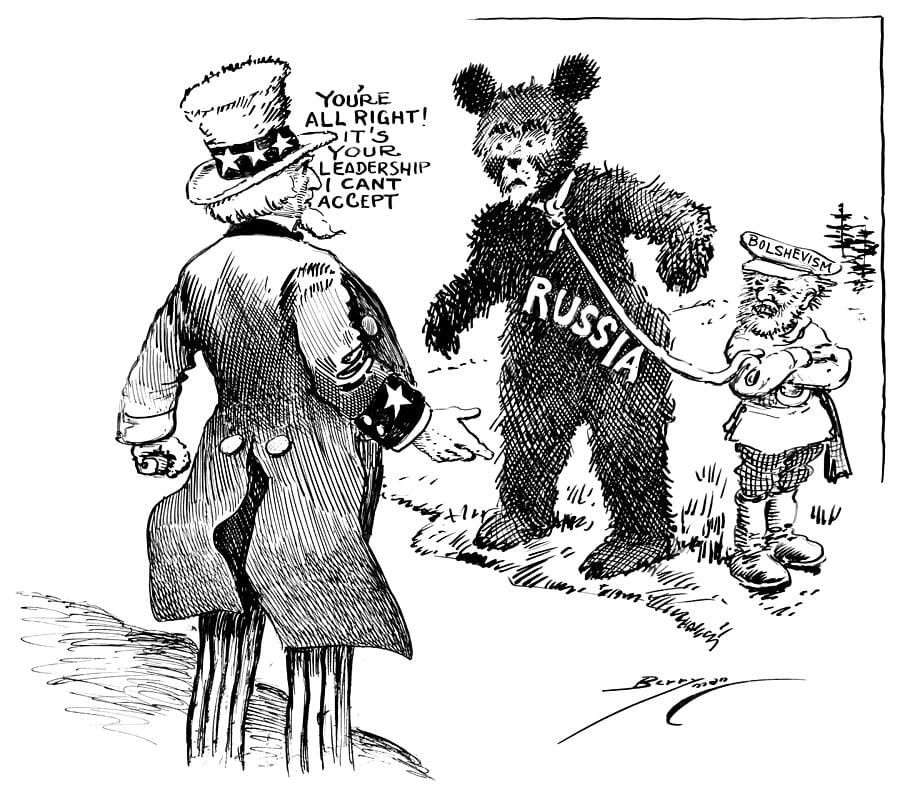
We have a habit of seeing ourselves as saving heroes as we enter other people’s conflicts. It is how we got into Vietnam, to save the South from the North. It’s also how Europe got into WWI: Russia was saving Serbia, Germany was saving Austria, etc (see cartoon below). We meddle our way, and leave much later than we planned. The result, as in Vietnam and Afghanistan is far more death and destruction than if we’d minded our own business. And US war-dead too. In Vietnam 58,000 US deaths. In Afghanistan 2,400 US dead. and no obvious accomplishment. As Henry Kissinger famously commented: “It’s dangerous to be America’s enemy, but deadly to be America’s friend.”

European aggression in WWII started with the good intention of preventing aggression. It got out of hand, as I fear our good intentions will in Ukraine.

The US troops we’ve sent to Ukraine are not called soldiers. They are “fighting advisors” sent to help the Ukrainians use our weapons. In WWI and Vietnam, fighting advisors are called invaders; it’s how we got drawn into Vietnam. The Russians claimed to send advisors when they entered the Crimea and later the Dundas. We called it an invasion. We can’t be that blind to our own words. Sooner or later, the advisors will start killing each other– something we’ll call an unprovoked attack. Our high tech aid including anti-tank missiles are reported to have killed some 10,000 Russians so far. We don’t seem to think the Russians will mind, or that they’ll give up as the body count mounts. In Vietnam, the more we killed with our high-tech weapons, the more the Vietnamese on both sides called us the villains, and the more Vietnamese joined the fight against us. That’s the future I fear for Ukraine, or worse. The conflict in WWI spiraled quickly beyond the borders of Serbia to include the whole world, and continued through WWII.

Our approach to diplomacy is counterproductive too, in my opinion, and similar to Vietnam too. We call Putin a terrorist, a madman and a narcissist, and then we begin talks with him to end the war. Biden has asked to have Putin removed by assassination.Does he think this will help, or if Putin is removed his successor will be a friend of the US? We demonized Ho Chi Minh, and propped up our favored, corrupt leaders. Minh was popular, as is Putin, and both have valid reasons for opposing us. Putin worries about the expansion of NATO. It’s not an illegitimate worry given Russian history of repeated invasions from the west.

Our desire to remove Russian leadership is a long-standing mistake. It does not lead to peace, or good negotiation, nor even peaceful co-existence.

Russia has been invaded many times. US schools mention Napoleon’s invasion in 1812 and the German’s in 1941, but there are more. They were invaded by the Germans in WWI too, and by the Ukrainian Cossacks in the days of Khmelnytsky, 1646-57. Before that the Polish Lithuanians, 1609-1618, the Swedes, 1701-1709, and in the early days, it was Tartars, Mongols, who invaded and ruled Russia from about 1225 til they joined with the Russian Tzars about 1650. Add to that, our help in the war of the Whites vs the Reds (1917-23) that produced Ukrainian independence — I talk about the relevance here. With a history like that, Russia has every reason to worry about NATO expansion. We should be cognizant of this and stop calling Putin a madman. Let’s accept the Russian version of history, and the sitting ruler of Russia.

Some cite the Budapest memorandum that lead to the removal of “Ukrainian” nuclear weapons, read it here. It’s short, only 1 page, and deliberately vague. it was signed by Putin’s predecessor, Boris Yeltsin, for the Russian Federation, along with representatives for Ukraine, The US, and The UK. The missiles were not Ukrainian, they were Soviet, and pointed at us. As a result of that agreement, they were dismantled and moved into Russia. There is no sense that this is an invitation for us to protect Ukraine against Russia. The co-signers sort-of agree to protect Ukraine from outsiders (Germany, Turkey,..?), but that’s not clear. We commit ourselves to peace in the region, and can claim that Russia violated the peace first, but there’s no invitation for us to violate it second. Until recently, the UK provided no military aid. China and most of the EU still trades with Russia; if they see a villainy, it’s not enough to stop trade.

Robert McNamara was Secretary of Defense under Kennedy and Johnson, and a key “Whiz Kid” pushing for war in Vietnam. Years later, he decided Vietnam was a mistake. A sad cartoon: the veterans are walking past the grave monument for the 58,000 US dead. I worry we’ll have a similar cartoon after this war.

In my opinion, our best course is to reduce our military aid to providing only basics: bullets, blankets, food… We should reopen discussions with Putin, not demonize him, or try to remove him. Ukraine will likely fight on even without our high-tech weapons. Perhaps they’ll buy from Europe, or from independent dealers. The death rate on both sides will be lower and peace will come quicker without us. Crimea might remain Ukrainian or Russian, but that will not be our decision. We’ve done enough damage for now. It took many years after the end of the Vietnam war for the instigators admit is was a mistake.

Robert Buxbaum April 3, 2022. Much of my thinking about Vietnam comes from Francis Fitzgerald’s wonderful book “Fire in the Lake”. I see it all happening again here. Also worth reading is this 2014 letter by Henry Kissinger about how to negotiate a peace: “Damning Putin is not a foreign policy; it’s an alibi for the lack of one.” It’s a nice insight. He seems to understand diplomacy about as well as anyone.

A Nuclear-blast resistant paint: Starlite and co.

About 20 years ago, an itinerate inventor named Maurice Ward demonstrated a super insulating paint that he claimed would protect most anything from intense heat. He called it Starlite, and at first no one believed the claims. Then he demonstrated it on TV, see below, by painting a paper-thin layer on a raw egg. He then blasting the egg with a blow torch for a minute till the outside glowed yellow-red. He then lifted the egg with his hand; it was barely warm! And then, on TV, he broke the shell to show that the insides were totally raw, not only uncooked but completely unchanged, a completely raw egg. The documentary below shows the demonstration and describes what happened next (as of 10 years ago) including an even more impressive series of tests.

Intrigued, but skeptical, researchers at the US White Sands National Laboratory, our nuclear bomb test lab, asked for samples. Ward provided pieces of wood painted as before with a “paper thin” layer of Starlite. They subjected these to burning with an oxyacetylene torch, and to a simulated nuclear bomb blast. The nuclear fireball radiation was simulated by an intense laser at the site. Amazing as it sounds, the paint and the wood beneath emerging barely scorched. The painted wood was not damaged by the laser, nor by an oxyacetylene torch that could burn through 8 inches of steel in seconds.

The famous egg, blow torch experiment.

The inventor wouldn’t say what the paint was made of, or what mechanism allowed it to do this, but clearly it had military and civilian uses. It seems it would have prevented the twin towers from collapsing, or would have greatly extended the time they stayed standing. Similarly, it would protect almost anything from a flame-thrower.

As for the ingredients, Ward said it was non-toxic, and that it contained mostly organic materials, plus borax and some silica or ceramic. According to his daughter, it was “edible”; they’d fed it to dogs and horses without adverse effects.

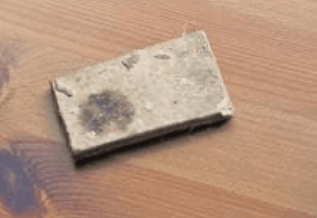
Starlite coasted wood. The simulated nuclear blast made the char mark at left.

The White sands engineers speculate that the paint worked by combination of ablation and intumescence, controlled swelling. The surface, they surmised, formed a foam of char, pure carbon, that swelled to make tiny chambers. If these chambers are small enough, ≤10 nm or so, the mean free path of gas molecules will be severely reduced, reducing the potential for heat transfer. Even more insulting would be if the foam chambers were about 1 nm. Such chambers will be, essentially air free, and thus very insulating. For a more technical view of how molecule motion affects heat transfer rates, see my essay, here.

Sorry to say we don’t know how big the char chambers are, or if this is how the material works. Ward retained the samples and the formula, and didn’t allow close examination. Clearly, if it works by a char, the char layer is very thin, a few microns at most.

Because Maurice Ward never sold the formula or any of the paint in his lifetime, he made no money on the product. He kept closed muted about it, as he knew that, as soon as he patented, or sold, or let anyone know what was in the paint, there would be copycats, and patent violations, and leaks of any secret formula. Even in the US, many people and companies ignore patent rights, daring you to challenge them in court. And it’s worse in foreign countries where the government actively encourages violation. There are also legal ways around a patent: A copycat inventor looks for ways to get the same behavior from materials that are not covered in the patent. Ward could not get around these issues, so he never patented the formula or sold the rights. He revealed the formula only to some close family members, but that was it till May, 2020, when a US company, Thermashield, LLC, bought Ward’s lab equipment and notes. They now claim to make the original Starlite. Maybe they do. The product doesn’t seem quite as good. I’ve yet to see an item scorched as little as the sample above.

Many companies today are now selling versions of Starlite. The formulas are widely different, but all the paints are intumescent, and all the formulas are based on materials Ward would have had on hand, and on the recollections of the TV people and those at White Sands. I’ve bought one of these copycat products, not Thermashield, and tested it. It’s not half bad: thicker in consistency than the original, or as resistive.

There are home-made products too, with formulas on the internet and on YouTube. They are applied more like a spackle or a clay. Still, these products insulate remarkably well: a lot better than any normal insulator I’d seen.

If you’d like to try this as a science fair project, among the formulas you can try; a mix of glue, baking soda, borax, and sugar, with some water. Some versions use sodium silicate too. The Thermoshield folks say that this isn’t the formula, that there is no PVA glue or baking soda in their product. Still it works.

Robert Buxbaum, March 13, 2022. Despite my complaints about the US patent system, it’s far better than in any other country I’ve explored. In most countries, patents are granted only as an income stream for the government, and inventors are considered villains: folks who withhold the fruits of their brains for unearned money. Horrible.

The claim that Ukrainians are Nazis is also Ukraine’s claim to statehood.

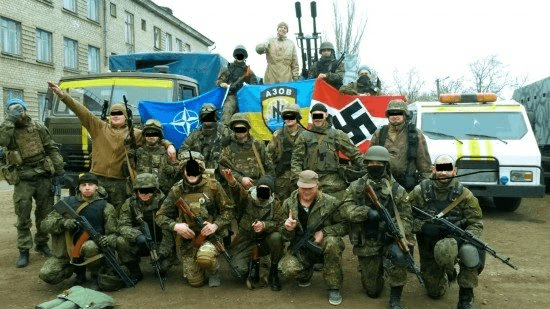
Recently Putin claimed he was going into Ukraine to fight Nazis. Twitter makes fun of this, but also shows many pictures of these Nazis. Under the hashtag #AzovBattalion, you’ll see many pictures of white boys with swastikas and Ukraine flags (see below). Perhaps these pictures are just Russian propaganda: According to our media there are no Nazis to speak of, and besides, the president of Ukraine is a Jew. Still, the pictures look real, and based on Ukraine history, there is quite a bit reason to think they are not an aberration. Still, to the extent that they represent Ukraine, these individuals are a major basis of Ukraine’s claim for independence. They are also a good reason to leave Ukraine out of NATO, IMHO.

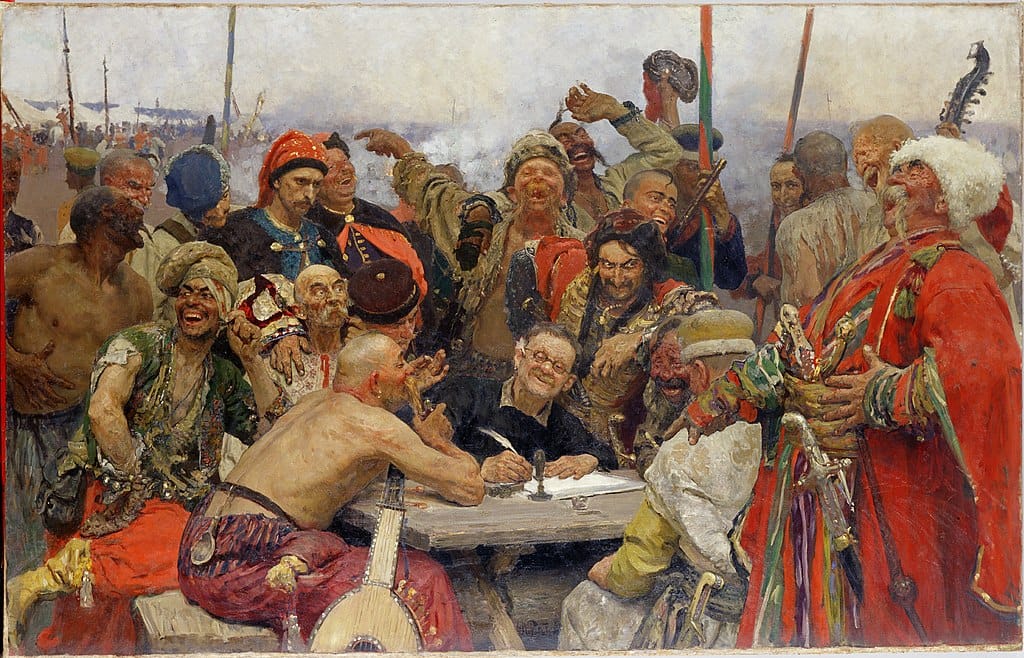
Let’s go back to the late days of the Tartars and the early days of the Cossacks, about 1600. There is a painting, below depicting Cossacks of those days writing a letter to The Sultan (original in the Kharkov museum). They do not seem the most savory of people, but they do seem independent and egalitarian. The letter is not written by a noble, but by a committee of pirates, and not everyone is happy about it.

Zaporozhian Cossacks write a letter to the sultan. These are the people who Putin claims should be loyal to Russia, but they have a long history of behaving otherwise. I like the scribe. A couple of people at left seem unhappy.

From 1250 to the mid 1700s, Southern Ukraine was ruled, to a greater or lesser extent, by the Crimean Tartars, a group of horse-riding Mongols who nominally served the great Khan. Moscow paid dues to them, and in 1571 the Tartar ruler,  Devlet I Giray burnt Moscow to collect his dues. The early Cossacks were Black-sea pirates, and enemies of the Tartars. Around 1600, the Cossacks and Tartars realized they had a lot in common (alcoholism, pederasty…) and formed an alliance. Mainly this was against the Poles and Jews. A famous result of this alliance was the Khmelnytsky Uprising (about 1650). Khmelnytsky was the “Hetman” (Head man?), the elected, temporary ruler for the uprising. He has become a symbol of Ukrainian independence, but he was also a brutal murderer of virtually all the Jews and Catholics. Today, he graces Ukraine’s $5 bill, and sits atop a statue in Kyiv’s central square. This elevation of Khmelnytsky is no small insult to Jews, Catholics, and civilization.

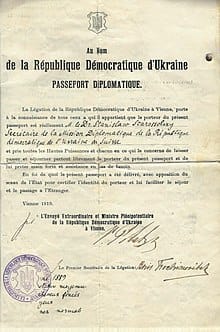
Ukrainian Republic passport, 1919.

 In 1654, via the Pereyaslav Agreement, Khmelnytsky’s Tartar-Cossacks formed an allegiance with the Tsar while retaining autonomy in Ukraine. This autonomy eroded over the years, and ended with Bolshevik rule in the early 20th century. After WWI, Ukrainians briefly tried for independence, forming the Ukraine Peoples Republic and the Ukraine Democratic republic, from 1917 to 1921. The head of the Republic was called hetman, an elected leader but also a throwback to a mass-murderer.

Stalin punished the Cossack remnant before WWIi, and when the Germans invaded in 1939, many of the remaining Ukrainians supported the Nazi invasion, and provided some of the most brutal murders of Jews; the murderers of Baba Year, for example. Putin recalls this collaboration when he calls the Ukrainians Nazis, and I suspect that he’s more right than our press will admit. These #azovbattalion pictures don’t look faked. On the other hand, the autonomy of the Ukrainians and Cossacks, and their attempts at independence provide historical backing for Ukraine’s claim to independence. Putting this another way, the more you accept that Ukraine is full of Nazi sympathizers, the more you should accept them as a distinct society from Russia.

Ukrainians of the Azov Battalion with a statue of Khmelnytsky, or some other murderer.

As an idea of how the war might go, I should mention another group of Tartar-Cossacks. These were Moslems who operated between the Don and Volga Rivers in what is known as Chechnya. Chechnya fought Russia in a long, bloody, unsuccessful struggle, that is only recently ended. Russia may win in Ukraine, but it is not likely to win easily or cheaply if Chechnya is any model.

Robert Buxbaum, Mar. 2, 2022

Who watches the watchmen; who protects from the protectors?

One of the founding ideas of a limited government, as I think our founders intended, is that the power of the state to protect carries with it several dangers. The first of these is cost, all good services and all good protections come at a cost. Generally that is achieved by taxation or by inflation, or by imposing regulations that do more harm than good. Once a tax for a service is accepted the service is really removed, and there is a tendency to over tax or over inflate to maintain it and to mis-distribute the service as well. The people do not become wealthier, or better served, but the people distributing the services win out. There are those who would say we are living through this today.

Another problem with a big, protective government is that the protectors can turn on the people they are supposed to protect. This can be small issues, like firing people who refuse to vaccinate, or large matters like imprisoning enemies. The history of the world is littered with examples of governments taken over by their own police or army. Generally the excuse is that the police is protecting the people from some bigger danger: rioters, disease, subversives. But once the police take over, they are hard to remove. They tend to see anyone who wants to limit their power as another subversive, and they tend to treat treat such people ruthlessly.

In the French Revolution, the group who ran the guillotine was the “committee for public safety”. First they killed to protect the folk from dangerous monarchists, then the clergy, and capitalists, and eventually anyone they considered a threat: That is anyone who considered them a threat. A similar outcome occurred in Russia, the removal of the Tzar lead to a rein of terror by Stalin. Harry Truman wrote saying that the CIA was another Stalinist police force, and wrote that congress was afraid of them. (see his Op-ed here). It seems that FBI director James Comey used made-up evidence of Russian collaboration to try to remove Trump (see NY Post story here).

A final problem with a powerful group of protectors is that it can be bought by outside agents. Rudolf Hess was Truman’s agent for dealing with the UN to promote world peace. It also turns out that he was also a Soviet agent. In Britain in the 50s to 70s, the assistant head of spying, the second in command of MI6, was Kim Philby a Soviet agent. The Soviets helped Philby’s rise by destroying the reputation of anyone who might do the job well. To this day, we regularly find Chinese and Russian agents in our FBI, NSA, and CIA. There is no better place to gather information and spread lies than with the organization that is supposed to protect us.

The title of my essay comes from a satrical poem/ essay written by Juvinal, in first century Rome (read it here). The more famous line is Quis custodiet ipsos custodes? Juvenal points out that not only is group of watchmen/protectors a danger in itself so that, if you hire a watchman to keep your wife chaste, she is likely to stray with the watchman, but he also points out that the watchmen are expensive, and that they are easily bought. Juvenal also points out that cruelty and vanities are common outcomes of a large retinue; if the wife or one of her high eunuchs feels disregarded, everyone lower will be beaten mercilessly. It’s a problem that is best solved, in the home and in politics in general by having a small staff — just what’s really needed. This, I think, was the intent of the founders of our country who limited the number of services provided.

Robert E. Buxbaum, November 27, 2021. As a more-fun way to present watchmen getting excessive, here is a parity song, “Party in the CIA,” by Weird Al. …Better put your hands up and get in the van, Or else you’ll get blown away, Stagin’ a coup like yeah… Party in the CIA.

COVID is 1/50 as deadly in China, Hong Kong, Taiwan, Korea…

I may be paranoid, but that doesn’t mean I’m crazy. COVID-19 shows a remarkably low death rate in Asia, particularly Eastern Asia, compared to the US or Europe or South America. As of this month, there have been 734,600 US deaths from COVID-19, representing 0.22% of all Americans. Another way of stating this is 2.2 deaths per thousand population. In one year, COVID has lowered the life expectancy of US men by 2.1 years; with the decline worst among hispanic men. The COVID death rate is very similar in Europe, and higher in South America (in Peru 0.62%), but hardly any deaths in East Asia. In China only 4,636 people, 0.003% of the population. That’s 1/700th the rate in the US, and almost all of these deaths are in western China. They no longer bother with social distancing.

The low death rate in East Asia. was noted by the BBC over a year ago. Based on today’s data from Worldometer, here, the low death rates continue throughout East Asia, as graphed at right. In Hong-Kong the death rate is 0.03 per thousand, or 1/70th the US rate. In Taiwan, 0.04 per thousand; in Singapore, 0.01 per thousand; in S. Korea 0.04 per thousand; Cambodia and Japan, 0.1 per thousand. The highest of these countries shows 1/20 the death rate of the US. This disease kills far fewer East Asians than Westerners. This difference shows up, for example in a drop in the lifespan of male Americans by 2.16 years. The lifespan of male Hispanics dropped more, by 4.58 years. In China, Japan, and Korea the lifespans have continued to increase.

Life expectancy for US males has dropped by 2.16 years. It’s dropped more for Hispanic and Black Americans. Data for women is similar but not as dramatic.

My suspicion is that this was a racially targeted bio-weapon. But perhaps the targeting of westerners reflects a cultural lifestyle difference. Mask use has been suggested, but I don’t think so. In many high mask countries the death rate is high, while in low mask Taiwan and Korea it’s low, only 0.04 COVID deaths per thousand. Even Sweden, with no masks reports only 1.4 per thousand deaths; that’s 2/3 the death rate of the US. Masks do not seem to explain the difference.

Another lifestyle difference is obesity; Americans are fat. Then again, Peru was hit far worse than we were, and Peruvians are thin. Meanwhile, in Hong Kong, folks are fat, but the death rate is small. Another cultural difference is medicine, but I don’t believe Sweden, Germany, and France have worse healthcare than Taiwan or Cambodia. Cambodia saw 1/20 the US COVID death rate.

My suspicion is that this disease targets by race because it was designed that way. If it isn’t a bio weapon, it certainly behaves like one. I may be paranoid here, but that’s the way it seems.

As a side issue, perhaps related, I note that China keeps pushing for the to close its manufacturing in the interest of CO2 abatement, while they keep building coal burning power plants to fill the manufacturing need that we abandon. I also notice that they hit us with tariffs while protesting our tariffs, that they steal our intellectual property, and that they are building islands in the sea between China and Japan. There is war-tension between our countries, and Western-targetting virus appears right outside of China’s top-security virus lab — their only level 4 lab — I’m guessing it’s not a total coincidence.

Robert Buxbaum, October 12, 2021

Of cigars and marriage, Kipling, Freud and Shaw.

My last post included a rather gruesome bit of poetry by Rudyard Kipling where he describes the Afghani women coming to kill the wounded British soldiers in the first Afghan war. It’s sexist, or anti-sexist, if you like. Since it reverses a stereotype of the non-violent, female home-body. Then again the Afghanis had wiped out an entire British army, killing virtually everyone including civilians.

What follows is The Betrothed, one of Kipling’s first published poems, appearing in “the civil and military gazette”, Lahor, India (near Afghanistan), November, 1888. Kipling was an assistant editor). It has a more traditional view of women, or of British women who do not go out murdering, but who do wish to control/ stop a British man’s cigar smoking. In a sense, such stoppage is murder. The inspiration was a breach of ‘Promise of Marriage’ case in Glasgow, August 1888, where a young woman, Maggie Watson, sued her fiancee because he continued to smoke cigars after she insisted he stop. Kipling explores the psychology of the choice between smoking and marriage. I think Freud would approve.

The Betrothed.

OPEN the old cigar-box, get me a Cuba stout, For things are running crossways, and Maggie and I are out. 

We quarrelled about Havanas—we fought o’er a good cheroot, And I knew she is exacting, and she says I am a brute. 

Open the old cigar-box—let me consider a space; In the soft blue veil of the vapour musing on Maggie’s face. 

Maggie is pretty to look at—Maggie’s a loving lass, But the prettiest cheeks must wrinkle, the truest of loves must pass. 

There’s peace in a Larranaga, there’s calm in a Henry Clay; But the best cigar in an hour is finished and thrown away— 

Thrown away for another as perfect and ripe and brown— But I could not throw away Maggie for fear o’ the talk o’ the town! 

Maggie, my wife at fifty—grey and dour and old— With never another Maggie to purchase for love or gold! 

And the light of Days that have Been. The dark of the Days that Are,
And Love’s torch stinking and stale, like the butt of a dead cigar— 

The butt of a dead cigar you are bound to keep in your pocket— With never a new one to light tho’ it’s charred and black to the socket! 

Open the old cigar-box—let me consider a while. Here is a mild Manila—there is a wifely smile. 

Which is the better portion—bondage bought with a ring, Or a harem of dusky beauties, fifty tied in a string? 

Counsellors cunning and silent—comforters true and tried, And never a one of the fifty to sneer at a rival bride? 

Thought in the early morning, solace in time of woes, Peace in the hush of the twilight, balm ere my eyelids close, 

This will the fifty give me, asking nought in return, With only a Suttee’s passion—to do their duty and burn. 

This will the fifty give me. When they are spent and dead, Five times other fifties shall be my servants instead. 

The furrows of far-off Java, the isles of the Spanish Main, When they hear my harem is empty will send me my brides again. 

I will take no heed to their raiment, nor food for their mouths withal, So long as the gulls are nesting, so long as the showers fall. 

I will scent ’em with best vanilla, with tea will I temper their hides, And the Moor and the Mormon shall envy who read of the tale of my brides. 

For Maggie has written a letter to give me my choice between. The wee little whimpering Love and the great god Nick o’ Teen. 

And I have been servant of Love for barely a twelvemonth clear, But I have been Priest of Cabanas a matter of seven year; 

And the gloom of my bachelor days is flecked with the cheery light Of stumps that I burned to Friendship and Pleasure and Work and Fight. 

And I turn my eyes to the future that Maggie and I must prove, But the only light on the marshes is the Will-o’-the-Wisp of Love. 

Will it see me safe through my journey or leave me bogged in the mire? Since a puff of tobacco can cloud it, shall I follow the fitful fire? 

Open the old cigar-box—let me consider anew— Old friends, and who is Maggie that I should abandon you? 

A million surplus Maggies are willing to bear the yoke; And a woman is only a woman, but a good Cigar is a Smoke. 

Light me another Cuba—I hold to my first-sworn vows. If Maggie will have no rival, I’ll have no Maggie for Spouse! 

Sigmund Freud with his cigar. The attraction of cigars, is a strange one, as Freud knew better than most. Part Thanatos, Cigars are deadly, but casual, often with a good flavor, and they provide sucking comfort. The death-risk of one is small and distant. Cigars thus represent risky fun they are thus life-affirming, in a temporary, risky way. Marriage is permanence and safe, and binding. The binding permanence of marriage is thus a sort of death, but children are good, and that’s life. Freud’s choice was to smoke himself to death. Kipling got married and eventually gave up smoking. C’est la vie.

Robert E. Buxbaum, September 17, 2021. Kipling has a great sense of words, and an attractive sense of the subjects, great and small. For years he was the voice of his generation in Britain, but by the end of his life, his views were unacceptable. sexist. On the other hand, he remained staunchly anti-Nazi, anti eugenics, and anti Soviet. By comparison, George Bernard Shaw was a vocal fan of Stalin, of Hitler, and of the eugenic removal of Jews and other undesirables. Shaw’s words remain fashionable, while Kipling’s do not. Such is the nature of fame.

The British Exit from Afghanistan, and ours

As bad as our exit from Afghanistan has been, the slow British exit in the 1840s to 1920 was worse. While we lost a lot of stuff and left hundreds of Americans and contractors behind, the British, in their first try at leaving, lost a whole army including thousands of civilians. Then they returned and left repeatedly for 80 years, having to fight against their own weapons and people that they had trained. We did many of the same things the Brits did, like trusting our security to folks we’d been trying to kill, but we have not lost anywhere near as many people (yet) and we have not returned (yet). What follows is a look at the British exit, based mostly on Wikipedia articles: “The First Afghan War“, and the retreat from Kabul, 1842, and the biographies of Shah Shujah and Akbar Khan, pictures below.

Akbar Khan. The British tried to kill him, then negotiated with him. Sketch by Vincent Eyre
Britain’s Puppet King, Shah Shujah, Sketch by Vincent Eyre.

The British went into Afghanistan, as we did, to create a more stable and western-friendly government. Their first act was to remove the king, Mohammed Khan, and install a more pliant leader, Sultan Shujah. Mohammed was part of the Khanate, that is the Moguls (Mongols), a deadly violent group who the British were fighting in India. We did the same when we entered Afghanistan. We removed the elected president, Burhanuddin Rabbani, a “radical Moslem” associated with the Taliban leader, Mohammed Omar, an even more radical moslem. Omar was associated Osama bin Laden who’d attacked the US on 9-11. We replaced these, long-bearded Moslems with Hamid Karzai, a moderate Moslem: short beard, reasonably popular, US-friendly, elected in Bonn, Germany. The problem with Shah Shujah and Hamid Karzai is neither one had legitimacy in the eyes of the people, nor respect from the army, either. In part that’s because we put them in power and kept them there, in part that’s because we never let them lead in war or diplomacy. Our follow-on leader, Ashraf Ghani, had no beard, and even less legitimacy and respect. The Afghan army left Ghani as soon as we started leaving; they’d done the same to Shah Shujah when the British left in 1842.

William Macnaughten, the British Envoy, prison sketch by Vincent Eyre, the same fellow who sketched Akbar and Shujah above.

Shah Shujah had a habit of mutilating those who worked for him whenever he got upset. All of Shujah’s servants were missing ears or noses or testicles. Strangely, this seems to have given him more legitimacy than Ghani had. Perhaps if we allowed our leaders to lead, or at least mutilate, the army would have stayed loyal. Then again, maybe nothing would have prevented the puppet from collapsing when the puppet-master left. Both we and the Brits relied on our own troops to keep the peace, along with payoffs and occasional assassinations (we call those airstrikes). It worked for a time, but did not build loyalty or love.

Among those the British paid off and occasionally tried to kill was Akbar Khan, the son of imprisoned Mohammed Khan. Eventually, the British felt they needed Akbar’s help to protect their exit, as he controlled the hills around Kabul including the old Silk Road that the British hoped to travel. Similarly, in the end, we found we needed Taliban help to clear the road to the airport. We didn’t quite get the help, nor did the Brits.

On December 23, 1841, the British envoy, William Macnaughten, visited Akbar Khan and proposed that he would hand over Shah Shujah and make him king in return for safe passage for 16,500 people under General Keith Elphinstone on a journey from Kabul to fort Jalalabad: 93 miles due east. Akbar agreed, but had Macnoughton arrested and later killed. His body was hung in the bazaar. Akbar seems to have figured that anyone willing to betray his old friend would be likely to betray him as well.

Kipling was stationed in India, near the Afghan border. His view of the locals is rather gruesome.

General Elphinstone left Kabulon January 5, 1842 with 4,500 armed soldiers, several cannon, and 12,000+ unarmed civilians. The going was slow and supplies didn’t arrive. Five days later, January 10, allies of Akbar attacked in the hills and killed or captured most of the group. Akbar invited Elphinstone to tea the next day and announced that the group was now his prisoner. He offered safe passage for the women and children, but demanded payment. The alternative was that they freeze in the hills. Elphinstone, at first refused, then ransomed himself and others, in all nine people. The rest of the group were shot, stabbed, taken by the Afghanis to be wives, or stripped of clothing and left to freeze. Younger children were raised as Afghanis, only identified as British sixty or more years later– the British liked to pretend they had not left them. Of the rest, only two survived. One soldier, William Brydon made it to Jalalabad, January 13, 1842. Elphinstone died in captivity in Kabul, April, 1842. According to Kipling’s poem, the Afghanis mutilated British bodies. More likely it was animals.

Hamid Karzai, American supported President, now under house arrest.

The British re-invaded Kabul several times after that, each time hoping to free captives and show who’s boss. There followed a second Anglo Afghan war (1878-80) and third (1919-20), and arguably a fourth (2001-21). Our exit isn’t as bad, at least not yet. We’ve left behind 200-300 Americans plus hundreds of helicopters, trucks, and high-tech weapons. The Taliban are now in charge, folks we’d tried to kill, all of them were associated with Omar, and several with Osama bin Laden, too. Our security forces have been shot, the embassy translator is scheduled to be beheaded, the new government includes several senior members who had been detained at Guantánamo Bay, released to Qatar in a prisoner swap for Bowe Bergdahl in 2014. Hamid Karzai is in captivity, and we’ve taken 100,000 Afghanis who may not integrate well into US society. But at lest there is no sign we’re going back, not for Karzai, or the Americans, or for anyone else. It’s very bad, but it could be worse. Biden calls it a success. Compared to the British exit, it is so far.

Robert Buxbaum, Sept. 5, 2021. IMHO beards are associated with commitment.

What I learned by running for office.

I’m an enemy of unity and a harborer of prejudice. During the election, I was told that all Republicans are, and I’ve come to accept it as true. I’d run for county water commissioner (drain commissioner) as a Republican, see web-site, and the charge is fair. I wasn’t happy to that George Will write to not for any Republicans because, in his opinion, we’re all prejudiced, and thus a Democrat is better for all jobs. When George, or anyone else, talks about getting rid of the prejudiced, it sounds to me like he wants to get rid of me and those who think like me. We’re to be replaced by those who think like him, or (since he has few solid ideas) whose ideas are gleaned as an average of those running the respectable media (It turns out there are only a fairly few people running the respectable media).

Biden seems to have fallen into the presidency. He didn’t campaign, but the press and a lot of people didn’t like Trump, and could not settle on anyone with opinions.

I didn’t like how the Water department was run, or how the costs were distributed, and some of this has to do with prejudice — engineering aesthetics, I call it. After living with these prejudices or aesthetics, I’ve come to think of them as part of me. I worked to form my opinions — opinions of what was fair, and who was likely to do good work, and what was good engineering. My prejudices and opinions were developed over many years. They’re not perfect, but I like them. I don’t want to have to exchange my opinions and prejudices for the government’s. If I felt otherwise, I would not have run for office. I also resent sensitivity training — the person running them rarely shows any sensitivity, IMHO.

One of the things that anti-racists hate, and I support is zionism. It’s a founding principle of Black Lives Matter that black people in the US can’t be free so long as the zionist state (Israel) exists. Why is this? There is an assumption that all black peoples are one, and that zionists are oppressors. Not that you could tell a Palestinian from a zionist by skin color, but it’s a truth that the faculty of Princeton endorses.

Not long ago the faculty of Princeton University voted unanimously for BDS including a ban on any zionist speaker from speaking on campus. The faculty also picked George Will as the graduation speaker in 2020. Most of the professors chose to not vote, but of those who did (1/7 of the total including many Jews) the pro-BDS vote was unanimous. As a result, if Einstein were to rise from the grave, with the unified field equations finally worked out, he’d have to speak off-campus because he was a zionist, and the university is committed to BLM and anti prejudice. (Tell me again, how does anti-zionism help black lives to matter?; how does BLM help you get clean water or good sewage treatment?)

In terms of sewage treatment or bringing clean water, I’ve found that the sort of person willing to do the work is usually someone with an opinion, and that usually it’s a rough opinion. My sense is to let people have their opinions and to say, if you treat the sewage right, I treat you right. Good work isn’t cheap, and people who do it can’t be culled from those with the right views and political opinions.

While campaigning I told leaders of the pipe-fitters union that I could tell that the Pontiac sewage plant was badly run just by smelling the air around the plant — you shouldn’t be able to smell a sewage plant from miles away. They said that was a racist statement. I then told them that the boilers were rusty, and that at the roof of the digester cad caved in, at least a year ago. They said they’d already endorsed the Democrat, and only spoke to me as a courtesy.

Robert Buxbaum June 25, 2021