It’s not uncommon for scientists to get inspiration from popular music. I’d already written about how the song ‘City of New Orleans’ inspires my view of the economics of trains, I’d now like to talk about dealing with nuclear waste, and how the song Alice’s Restaurant affects my outlook.
The best way to get rid of nuclear waste would be (as I’ve blogged) to use a fast nuclear reactor to turn the worst components into more energy and less-dangerous elements. Unfortunately doing this requires reprocessing, and reprocessing was banned by Jimmy Carter, one of my least favorite presidents. The alternative is to store the nuclear waste indefinitely, waiting for someone to come up with a solution, like allowing it to be buried in Yucca Mountain, the US burial site that was approved, but that Obama decided should not be used. What then? We have nuclear waste scattered around the country, waiting. I was brought in as part of a think-tank, to decide what to do with it, and came to agree with several others, and with Arlo Guthrie, that one big pile [of waste] Is better than two little piles. Even if we can’t bury it, it would be better to put the waste in fewer places (other countries bury their waste, BTW).
That was many years ago, but even the shipping of waste has been held up as being political. Part of the problem is that nuclear waste gives off hydrogen — the radiation knocks hydrogen atoms off of water, paper, etc. and you need to keep the hydrogen levels low to be able to transport the waste safely. As it turns out we are one a few companies that makes hydrogen removal pellets and catalysts. Our products have found customers running tourist submarines (lead batteries also give off hydrogen) and customers making sealed electronics, and we are waiting for the nuclear shipping industry to open up. In recent months, I’ve been working on improving our products so they work better at low temperature. Perhaps I’ll write about that later, but here’s where you’d go to buy our current products.
Robert Buxbaum, July 4, 2021. I’ve done a few hydrogen-related posts in a row now. In part that’s because I’d noticed that I went a year or two talking history and politics, and barely talking about H2. I know a lot about hydrogen — that’s my business– as for history or politics, who knows.
In the last presidential election, the largest billionaires in the US were vocal Democrats, and two billionaires, Yang and Bloomberg were candidates. Bloomberg had been an anticrime Republican when he ran for mayor but in 2020 he spent $!B of his own money on anti Republican ads, and paid the debts of thousands of Florida felons who he thought would vote his way. It’s a strange new world.
Other vocal Democrats include: Jeff Bezios, majority owner of Amazon and The Washington Post, Mark Zuckerberg, Facebook, Bill Gates, founder and largest owner of Microsoft (just today blasting the Republicans over global warming — Is that logical — is cold better?), and Warren Buffett who likes to note that he pays a lower tax rate than his secretary does (IMHO that’s because he games the tax system and pays no social security tax). Meanwhile union workers and white middle class folks were mostly Republicans in 2020.
Union leadership are still Democrats, but the last few elections saw union workers voting R. These were called “The basket of deplorables, unredeemables” by candidate Clinton. R support among black people is less than 50%, but growing too. it’s quite a lot higher than two decades ago. Many showed up at MAGA rallies, you’ll see plenty in videos at “the insurrection”. The only person shot and killed at the insurrection was a white woman, unarmed, shot in the face by Capital police — no charges filed, but the liberal press, who usually hate such things, was silent. Almost to the man, they sided with the police over the mob.
I notice that the Black Lives Matter rallies are populated with the well off and the well educated. A Princeton lawyer was photographed driving around with a box of Molotov cocktails, and his co-worker, another lawyer tossed a lit fire bomb into a police car. It used to be that Princeton lawyers didn’t do that, at least not in person.
Portrait of a Democrat. From the New Yorker.
It’s not like the platforms have reversed. The Democratic party was always for high taxes, high regulation, and for soft money that they could give away. They still are. In 1900 the call was for “free silver“, now it’s “stimulus money.” It used to be that rich people didn’t like this. They would point of that printing money didn’t add to wealth, but just redistributed it from those who had savings to those who did not. Now they uniformly blast anyone who doubted the wisdom of printing 1.9 trillion in new money ($6000 per person, of which $1400 is given to you), and going on to blast anyone who doesn’t like additional oversight to prevent the systemic racism they see in the less-well-off.
One reason these richest billionaires are no longer Republicans is that they are no longer involved industrial manufacturing in the US. Thus the regulations they favor don’t apply to them. In the olden days, rich people made steel or cars. Regulations were annoying. Rich industrialists had money in US banks. For them inflation was theft. Now rich people own intangible industries that largely operate outside of the country. What money they earn is earned off-shore, tax free. As individuals, they live on US debt, and possess little or no hard cash. Inflation helps them pay off their debt, and high taxes don’t hurt them. Buffett can be down-home and pro environment. He flies private jet to meetings on global warming while investing in overseas petroleum.
Elon Musk seemed like a Republican during the Trump administration, but not so much now. He still makes stuff in America, but has moved to manufacture abroad. In January, he said he was fired up for Biden. He has put a significant chunk of his wealth into bitcoins. Its a protection from the inflation caused by printing money, and it’s a bet that’s paid off handsomely. I expect that we’ll have billionaire Democrats and union Republicans for the foreseeable future.
Robert Buxbaum, March 14, 2021. It’s pie day. Eat a pie at 1:59:27. (Edited Apr. 28, 2021)
I used to follow an Australian science blog, called “I Fucking Love Science.” Elise Andrew and her crew scanned the literature with a keen eye for the interesting. They regularly posted to Facebook and alerted science nerds like me to all sorts of new science bits with minimal commentary, minimal advertisements, and no politics. On average they found 6 or 8 really interesting posts, per week, generally one or two on fundamental physics, one or two on materials, one or two on biology or medicine, one or two astronomy, perhaps a chemistry post. My post about the color of the sky on Mars was ignited by a picture of the Mars sky that I saw on IFL Science — the sky was yellow, and I had just written about why the sky on earth was blue, and not green.
But, as with all quirky things, this one matured. The name changed to “IFL Science” — a change that I suspect was designed to promote sharing. There were more advertisements, and click bait — “this starlet lost a ton of weight,” “you won’t believe what this famous person’s partner looks like now,” etc. And there was politics, vaguely presented as science. Ms Andrew wrote more and more of herself, making herself into a personality whose travels and speaking tours would interest us. And there were non-science, guest bloggers too: People telling you who to vote for and more importantly who to vote against. All for the good of the world, she said, but it was her opinion, and not what I’d gone to IFL for.
The science got less technical, too and more popular. More pretty pictures and misleading headlines. Currently there is no math, no equations, no chemical diagrams. A top story of this week told of a semi-interesting approach for women with constipation — something that “would change everything.” When you click on the story, you find that women put their finger in their vagina and work out the poop that way, something called “splinting.” It’s sort of science, but not the sort that made me love science. Another top story — the top one from today is as follows:
Top story from IFL science today, Feb 28, 2021. Is there really no fuel use? No. The fuel is a battery, and the speed in 4m/s (9mph), and the plane looks nothing like this.
If you follow the links to here, it turns out that the plane (unmanned) looks nothing like this. It uses electric energy from a battery to move ionized air rearward at an efficiency far lower than with a propeller. The forward speed is 4 m/s (9 mph) and the maximum distance covered was 55m, half a Canadian football field. As presented in IFL science, it’s a misleading, non-math clickbait for something that’s interesting engineering — sort of. As for being Star Trek like, no. To move this plane, you need air.
I’m sorry, you can not make any real version of a book that teaches quantum mechanics to dummies. No dummy will understand it. You can make a book that’s not quantum mechanics, and OK for dummies, or a quantum book that’s not for dummies. Just saying.
In the treatment of the work of the recent Noble laureates, IFL Science didn’t talk about the work so much as the biographies of the people, and their struggles, and that two of the people who won Nobels for their work in biology were women — for an advance related to CRISPERS– but that wasn’t science. I’d prefer to know what the advance was, and how it works. I’d prefer to figure out that these were women from their names or from the pronouns like, “she” or “her”. There was also no information about other two researchers (males, I assume, or perhaps females who had less-interesting biographies?). It was the same with the Physics Nobel except that I already knew there was a black hole at the center of the galaxy, and that those who found it are long dead. Instead the Note Prize was being awarded for a photograph of the black hole. Interesting (sure doesn’t look like a black hole to me). Is there something they learn from the photo. I’ve noted that we are likely within a black hole, and I show why this is using some, not too difficult math.
Having griped along this way, I have to say that that IFL isn’t that bad, it’s just non-mathy, popular, and a little grown up. That’s sad, but it’s not toxic. Grownups make money, and please customers, and that’s how it goes. To quote a wonderful book, The outsiders, “Nothing gold can stay.” In my own blog, I try to be more math-y, and more science-y. My model is Isaac Asimov, a writer who excited me to love science from when I was 8 to when I entered college, nine years later (1972). He would die of AIDS from a transfusion, 20 years after that.
For the last several years it has been claimed that some 98% of legitimate scientists believe it is a major need to reduce CO2 output so as to stop the world from getting warmer. When Trump visited the pope 4 yers ago, the pope would not speak to him expect to hand him his anti-global warming letter he’d written, “Laudato Si” and to tell Trump to get on board to stop global warming. Trump said he would read the letter.
Trump visits the pope, and the pope does not look happy
I’m not a fan of science established by Papal dictate based on an informal poll of experts, especially here where the minority includes some of the greatest minds of the 20th century, and the poll is taken by Al Gore’s science expert, but that’s where we are when it comes to science and politics. I also find it that the pope blames the US for global warming but not China when the the majority of CO2 came from China, a country committed to increasing its use of coal. But be this as it may be — the pope doesn’t blame China for imprisoning Catholics either, most recently the editor of Hong Kong’s most widely read newspaper.
So I thought I take a step back to look at the desirability of making the world colder. Is a colder world a better world? Sad pictures of polar bears are presented in favor of the colder world, but for all I know, polar bears prefer it warm. Their numbers are increasing.
Paul McCarthy lyrics; Hey Jude.
If we had a global climate adjustment knob somewhere, a magic knob allowing you to make the world warmer or colder by turning it right, or left, I doubt the consensus would be to turn the knob left. There is no real logic to cold being good, but there is a line in “Hey Jude”: “…It’s a fool who plays it cool, by making his world a little colder.” And Svente Arrhenius, one of the great scientists of 100 years ago, said he preferred a warm earth to a cold one to avoid disease and starvation. When the climate turns colder, the result is disease and famine as crops fail and animals freeze. It’s not an option that I’d think most people would prefer. given my choice, I would prefer things a little warmer.
I should also note that our ability to fine tune the climate is not what we’d think. The world climate is chaotic, and there is no reliable knob. Historically, the most common setting is ice-age, and that’s a setting that most people really don’t like.
Jack Ma, disappeared billionaire owner of Alibaba.
Every 25 years or so, for the past 1500 years China gets a new dictator who rounds up the rich and famous for loyalty trials, imprisonment. and worse. This was true of Li Ping following Tianamin Square, and Mao Zedong who killed some 75 million as part of his 10,000 flowers, great leap purges. The current dictator, Jenping Xi. Like, has been rounding up anyone he worries about, and that’s basically anyone he might worry about. The latest is Jack Ma, the founder of Alibaba, China’s version of e-bay and Amazon. Until his disappearance, he was the richest person in China.
Ma had not been seen in public since October 2020, when he and two top lieutenants of Alibaba were called to meet with regulators. He reappeared months later in a 40 second video (some say a hostage video) to say he is more rested now, and that he is positive that China’s regulators do not stifle innovation. As typical for China, there is no information about his whereabouts. What’s novel is that US media companies are involved helping Xi to trace potential opposition and keep questions out of the press. This includes Google, Twitter, and Facebook, as well as US media outlets.
China’s biggest starlet, Fan Bingbing, vanished from sight and the internet for months. She may have said something critical, but has reappeared and recanted it.
In the past the news and social media would have been full of negative comments about China, and Ma’s detention , both from within and without. Now there is hardly anything and what little there is, is mildly positive about Xi. For three months there have been no e-mail or published tweets or Facebook posts from Ma or his lieutenants. Similarly, there is no room for negative speculation within China, and little within the US. The company’s planned IPO was cancelled, one that could have been the richest in history, but this fact got virtually no press, not in China, not in the US. Regulators cancelled it just two days before the start of trading. You’d expect screams from inside and outside China; instead, the story has been covered only briefly by CNN and the Financial Times, generally putting a pro-China spin on it. They stress the importance of regulations and avoiding monopolies, and don’t mention that Alibaba competes with Amazon, e-bay and Walmart. The expectation is that Ma and his higher-ups will be found guilty of monopoly trading and abuse of power. Under Xi, these crimes that have sent corporate leaders to prison for 12 to 20 years.
Ren Zhiqiang, missing billionaire, sentenced to 18 years.
Consider the fate of Ren Zhiqiang, the 69 year old chairman of Huayuan property conglomerate. It was one of the largest property groups in China, but Ren vanished in March 2020 after being heard to have complained about how the government was handling COVID-19. He was expelled from the communist party, and in September 2020 sentenced to 18 years in jail for “taking bribes and abuses of power.” There was hardly a trial, and as with Jack Ma, Facebook and Twitter helped the party silence Ren and his supporters. The result is that he had no recourse to the court of public opinion. About a month later, Facebook and Twitter did the same to Donald Trump, banning him for life from Facebook, Twitter. All other platforms joined, these included Snap and Reddit. As in China they also banned his main lieutenants and his main supporters, including the my-pillow man. The internet services also closed (deplatformed) Parler, the only competing web-service that allowed Trump and his supporters to post.
It can help to have public outcry, as Xi found after he disappeared China’s most popular movie starlet, Fan Bingbing in July 2018. Fan is a star of Chinese TV and movies and appears in Iron Man II and X-Men. As with Ma and Ren, Facebook and Twitter removed all posts, comments, questions, and complaints about Fan, releasing only the official statement that she was under investigation and taking a break. Unlike Ren, Fan reappeared a year later, April 2019 with no official charges filed. Nor has there been any official report. She has apologized for misdoings. and is supposed to have paid some $150 million, but she’s free. My guess is that the pressure of 100 million Chinese fans is what helped Ms Fan to un-vanish.
Had Wu Xiaohui, former chairman of Anbang Insurance Group, and owner to the Waldorf Astoria.
A less positive outcome is when there is no outcry. When Wu Xiaohui, chairman of the Anbang Insurance Group, and the owner of New York’s Waldorf Astoria hotel vanished for two years. When he reappeared, he faced a quiet trial that sentenced him to 18 years in prison. The usual charges: fraud and abuse of power. Wu’s mother claimed she had no access to her son for those two years. Anbang, once one of the largest insurers in China, was taken over by its insurance regulator who has applied to liquidate the company. Why liquidate? Probably because it’s the easiest way to remove potential Wu loyalists.
In the US, there are some claims that Facebook, Twitter, Reditt and a few other companies have too much control of public discourse. Others claim that these companies exercise too little control. These companies claim the right to silence opinion they consider untrue, or inflammatory, and they have been allowed to deplatform their competition. Congress is moving to be in charge of who they silence. I’ve found they don’t like pro-Israel sentiments. While they don’t put words in my mouth, I don’t like it that they take words out of my mouth. As a result, I’ve cut back on my use of these platforms.
Jack Ma reappeared after 3 months in this 40 second video, shot from an unknown location. To me, it looks like a hostage video, “I’m well and being well treated …” Biden has argued that now is the time to move closer to China.
As I write this, Trump is impeached for the second time. The charge is inflammatory speech. Like with abuse of power, there is no way to prove you didn’t do it, especially after the internet giants silence you and anyone stupid enough to support you. Among Biden’s first acts is to undo Trump dictates that kept China from providing the technology underlying the US power and water system. Clearly Biden feels it is important that China should have a hand in this. I surely am not going to suggest that the bribes Biden is supposed to have received from China played any role. I will say that, when I ran for water commission, one of my goals was to help make the water system more resistant to cyber attack.
Dr. Robert E. Buxbaum. February 8, 2021. As an update, I see that Jimmy Li was arrested. He’s the founder of Hong-Kong’s most popular newspaper, Apple daily. No comment in the US, or from the Vatican. Li is Catholic, and the Vatican used to chime in when prominent Catholics were arrested.
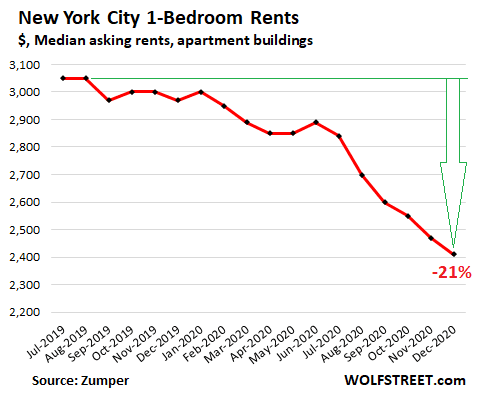
Rents in New York and San Francisco are far less expensive than before the pandemic. It’s been a boon for the suburbs, the south and the midwest, one that’s likely to continue unless Biden steps in. Before the pandemic, rent in San Francisco for a one bedroom apartment averaged over $3700 per month. New York rent was similar. People paid it because these cities offered robust business and entertainment, the best restaurants and bars, the best salons and clubs, the best music, museums, universities, and theater. New York was Wall Street, Madison Avenue and Broadway; San Francisco was Silicon valley and Hollywood. These cities were the place to be, and then the pandemic hit.
Post COVID-19, the benefits of big city life are gone, and replaced by negatives. The great restaurants are mostly gone; the museums, theaters, and salons, shut along with Hollywood. Wall Street and Madison Ave have gone on-line, as have the universities. If you can work and study from anywhere, why do it from an expensive hotbed of Corona.
People of means left the big cities with the first lockdowns. Wall Street moved on line, with offices in New Jersey, and many followed, along with college students, and hotel and restaurant workers. New York’s unemployment rate increased from 4-5% to over 9.5% today, among the highest rates in the nation, 9.5%. It would be higher if not for the departures. Crime spiked; the murder rate doubled. To keep people from leaving, landlords have lowered rents and many will now forgive a month or two of rent to keep apartments full with some rent coming in and an illusion of exclusivity. This is good for tenants, but tough on landlords.
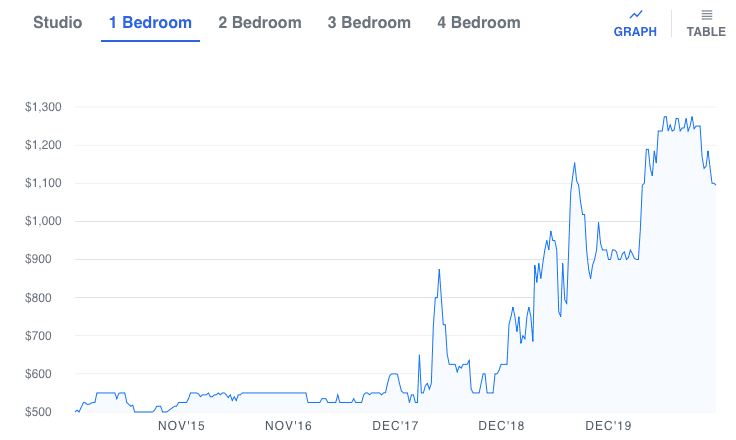
Detroit rent history, 2014 to January 2021. Rents fell a lot on election day, maybe because of Biden, or because we think the pandemic is over.
As things stand, the suburbs and smaller cities are the beneficiaries of the exodus. Among the cities benefiting the most are cities in the south and mid-west: states that are more open and are relatively low cost: Phoenix, Oakland, Cleveland, St. Petersburg, and even Detroit. Detroit’s rents were already moving up as auto manufacturing returned from Mexico, see chart. Between early 2017 and October 2020, they went from $500/month to $1250/month for a 1 bedroom apartment, according to Zumper. Detroit rents fell after election day, but are still up 20% on the year. The influx of wealthier working folk to Detroit is welcome to some, unwelcome to tenants who find their rents are raised. I think it’s is a sign of a healthy economy that people follow life-quality, and that rents follow people. Our landlords are happy, but there are a lot of Detroit renters who are not
Joe Biden has promised to step in to make things right for everyone. He promised to have the government pay people’s rent so they don’t get evicted. I presume that means paying about double to people in NY and SF as to those in Detroit. He claims he will shutter smokestack industries too, and create the good jobs of the future in computers and high tech. It’s a nice claim. I suspect it’s a bailout of big city landlords, but what would I know. I suspect that the US would be better off if Joe just sat back and let New York rents fall, while allowing Detroit to gentrify. Detroiters need not worry about rents getting too pricy here. We’ve1500 shootings per year, that 15 times more than NYC, per capita. Unless that ratio changes, Detroit will continue to be the lower rent city.
Large chunks of Michigan shut down for the prime days of hunting season, from the middle of October to early November. About 8% of the state gets a hunting license each year, some 800,000 people, all trying to “Bag a buck.” Michigan is an open carry state for rifles and holstered pistols, something seen recently in the state capitol, I’d say this was an illegal example since there is also a brandishing law, but it gives a sense of things here. About 29% of the state owns at least one gun, and usually more. There are about as many guns as people. Getting bullets, on the other hand, is near impossible, both for handguns and for most rifles, shotguns excluded.
A lot of the attraction of hunting is that you get to eat what you kill. Mot people do this or donate it to a food back. Hunting is also cheaper than golf. Rural farmers also hunt to protect their crops from crows, squirrels, rabbits, rats, snakes, and raccoons. This is legitimate hunting, in my opinion, even though you typically don’t eat crow. Some people do hunt bear, but that’s a different story (I like to be dressed). It’s possible that the bullet shortage is just a hiccup in the supply chain, “supply and demand” but it’s been going on for 12 years now so I suspect it’s here to stay.
Michigan, was once a Republican, pro-gun stronghold. It has swung Democrat and anti-gun for the last few years. Bulletes have been scare for about that long, at least since the Obama election or the Sandy Hook shooting. Behind this is a general trend of urbanization and class-action law suits. At this point, few sporting stores carry guns or bullets, and those that do, tend to hide them in a back room. Amazon carries neither bullets nor guns, and the same holds at e-bay, Craig’s list, and Walmart on line. Dunhams still sells guns but the only bullets, when I visited today were, 17 caliber, 227 and duck-hunting, shotgun shells. Gone were normal handgun calibers: 22, 25, 32, 38, 45, 357, and 9mm. The press seems OK with duck or moose hunting; not so OK with anything else.
The salesman at Dunham’s said that he had moved to bow hunting, something that’s becoming common, but it’s incredibly difficult even with modern bows. I can rarely hit a non-moving target at 50 feet on the first arrow, and I can only imagine the frustration of trying to hit a moving target after sitting in a cold blind for days waiting for one to appear whose distance and placement is unknown, and that might disappear at any moment, or attack me then disappear.
Part of the problem is that arrows travel at only about 250 ft/s, or about 1/6 the speed of a bullet. Thus, an arrow fired from 50 yards takes about 0.6 seconds to hit. In that time it drops about 6 feet and must be aimed 6 feet above the deer if you hope to hit it. A riffle bullet falls only about 2 inches, about 1/36 as much. Whaat’s more, though an arrow is about three times heavier than a hunting bullet, its slow speed means it hits with only about 1/10 the kinetic energy, about the same as hunting with a 22 from a handgun.
There are those who say the bullet shortage will go away on its own because of supply and demand. That’s true until the government steps in in the name of public safety. Though recreational marijuana and moonshine are both legal, government regulation means that prices are high and supply is limited, with a grey market of people buying high and selling higher. I’m seeing the same with ammunition; there is tight supply, a grey market, and a fair number of people trying to reload spent ammunition using match-tips for primers. Talk about white lightning.
Before a pacifist buys a gun, there are two critical questions to ask: One is ‘how would I feel if I killed a criminal?” The other is ‘how would I feel if I missed and killed someone else? In my case, I’d feel awful either way. My thinking, even with the criminal, is that I tried my best to do more good than bad, and part of that is to minimize the chance of killing needlessly. Statistics suggest that gun carrying, in general, does good by deterring violent criminals. To be able to stop a deadly attack, while minimizing the chance of killing– particularly an innocent bystander — I’m inclined to a low power gun that’s easy to conceal and easy to aim well. This leads me to suggest a 22 revolver with a barrel that’s not too long to conceal, nor too short for good aiming, 2.5-4″ seems ideal.
An analysis of what percent of people stop attacking when hit by one bullet of different calibers. The 32 and shotgun are the best, in part because the shooter tends to stop shooting at one shot. With a 9 mm, the shooter keeps on shooting, likely doing more damage than necessary.
At this point I’d like to say that I am not a gun expert. I’ve fired perhaps 15 guns in my life including 5 revolvers. The easiest of these to shoot was a Glock 9mm, heavy, large and powerful, but it think it would be too large to carry or draw in a deadly situation, and the Glock was not cheap. The 22s were all smaller guns, and the 22 cartridges, especially the 22lr, are dirt cheap, costing 8 to10¢ each, or $40-$50 for a box of 500. It’s not the 9mm are super expensive, but they cost 25-30¢ each or $25 to $30 for a box of 100. The price is higher today, over $1 each, because of an ammo shortage, but it’s coming down.
Another advantage of the 22 is that the kill power is lower. A 9mm round will go through the person you are shooting at, and kill the person behind, and can kill on a riccoshet. I like that the 22 won’t do this. I also like that the 22, more effective than almost any other round at stropping a criminal, and getting him to go away. As the chart above shows, there is a 60% stop after the perpetrator is hit once, and that’s my goal — getting him to go away. A shotgun is far more effective as a deterrence, over 80%, but it is much more likely to kill, and much harder to conceal carry. The chart above is from a wonderful analysis of the effect of different calibers used in crimes, read it here. The author, Greg Ellifritz, suggests that the reason the 22 is so effective at stopping a criminal is psychological: criminals stop if shot even once, especially from a civilian, and only civilians use 22s. Larger calibers are better appear to be less effective, though they will be better at stopping a really determined attacker, e.g. someone on PCP. But that’s not the environment I work in, and I suspect it’s not the majority of crime. Overall, one shot from a 9mm does not do a good job stopping an attacker. Another good option is a 32. It was the choice of Theodore Roosevelt and J. Edgar Hoover. It tends to be used by detectives and other professionals, but the bullets are expensive.
I’ve done a meta-analysis of Greg Ellifritz’s death data, and confirm that the 22 is the second least deadly of all bullet types, after the .25. Of 154 people hit with 22 bullets, there 28% fatalities, 43 deaths. The 9mm is more deadly: of those hit with a 9 mm bullet, 44% died, in part because people shooting 9mm tend to shoot more bullets, nearly twice as many as 22 shooters in danger situations.
It takes two hands to cock a semi-automatic, that is to draw the first round into the chamber. Gif from ammuniotndepot.com
Handguns for 9mm rounds tend to be semi-automatic with light triggers and large magazines. Guns for 22 tend to be revolvers with heavier triggers and small loads, 5 to 7 rounds. I suspect that a light trigger leads to more missed shots and misfires, and I notice that many folks with semiautomatics, find they jam in danger situations. In the famous duel between Hamilton and Burr, Hamilton hit the branch above Burr’s head, likely because he’d set his trigger very light. Burr’s trigger was set heavy, and he shot straight. When you are nervous, gun with a light trigger can go off early and miss or kill the wrong person. A lot of the people killed with guns in Detroit, I notice, were killed by mistake, because the shooter missed, or because of a ricochet (I did an analysis of Detroit crime early on in this blog). A ricocheting 22 has very little kill power left.
A single action revolver requires cocking by that can be done with one hand; a double action doesn’t need any cocking. Gif from ammuniotndepot.com
Every semi-automatic I’ve tried required a two handed, “racking” step, see above. Thus, unless you leave a cartridge in the chamber while walking around, you need two free hands and an extra second or two to rack the first bullet before you can shoot. That’s OK on a range, but in a danger situation racking is a problem. Even trained policemen with semi-automatics have been killed by knife-wilding criminals because the criminal didn’t need the extra second or two while the policeman racked the first round.
Racking takes strength and coordination, plus an awareness of legal isuess. If you rack too soon and the situation de-escalates, you could be charged with “brandishing.” In most states it’s illegal to brandish a weapon in a non-deadly situation. You have to wait with your gun in your pocket or holster until you are in mortal danger. With a revolver, you don’t need to rack. Even a single action revolver can be cocked with one hand while the weapon is in your pocket. See the process in the figure above. Double-action revolvers don’t require cocking, and that can be a plus. On the other hand, I figure that the sound of a gun cocking might be useful to signal to a criminal that you are serious without getting you into the problems of brandishing.
De-cocking a single action revolver.
Revolvers have another interesting plus in that it’s easy to un-cock revolver, even using one hand, see gif. With semi-automatic pistols, there rarely a graceful way to remove the bullet from the chamber, certainly not with one hand. In theory, you can shoot from your pocket too; it’s something I’ve seen in the movies, but a semi-automatic will almost certainly jam if you try. If the assailant grabs your arm, or otherwise attacks you, you have every right to fire, but you don’t want a jam, or to hit yourself. Most defensive shootings are from close range.
Speaking of jamming, even experts get jams on a fairly regular basis, and beginners have this problem a lot. They forget to hold the gun tightly enough, or they buy rounds that don’t quite match the gun. Rounds that are too weak or powerful cause problems for semi-automatics. I’ve never seen a revolver jam, and if the round doesn’t fire, you can click again, and another round will appear. With a semi-automatic, clearing a jam is a lot of work: more than I can expect in a danger situation.
I should mention that the folks from ammunition depot, the place I got the gifs, recommends 9mm semi-automatics for personal protection because of the extra “stopping power”. Read their opinion here. I disagree, and here is one last reason: Like many other suppliers, they are out of 9mm cartridges, and have been for months. Perhaps it’s panic buying like with toilet paper, or a manufacturing disruption; 22 lr cartridges are still in stock. Supply problems will likely go away, but it’s another reason to look at the 22.
Robert Buxbaum, December 11, 2020. Some vocabulary words: a bullet is the projectile that comes out the barrel. A round = a cartridge. It’s the thing that you put in the gun before shooting. There are several 22s, all with the same size (diameter) bullet, 0.223″ OD, but with different lengths and power, from short to wmr. Different guns can use different cartridges. Meir Kahane was killed by a 22, as was Bobby Kennedy.
Most people know that aspirin can reduce blood clots and thus the risk heart attack, as shown famously in the 1989 “Physicians’ Health Study” where 22,000 male physicians were randomly assigned to either a regular aspirin (325 mg) every other day or an identical looking placebo. The results are shown in the table below, where “Myocardial Infarction” or “MI” is doctor-speak for heart attack.
Treatment
Myocardial Infarctions
No Infarction
Total
fraction with MI
Aspirin
139
10,898
11,037
139/11,037 = 0.0126
Placebo
239
10,795
11,034
239/11,034 = 0.0217
Over the 5 years of the study, the physicians had 378 MI events, but mostly in the group that didn’t take aspirin: 1.28% of the doctors who took aspirin had a heart attack as opposed to 2.17% for those with the placebo. The ratio 1.28/2.17 = 0.58 is called the risk ratio. Apparently, aspirin in this dose reduces your MI risk to 58% of what it was otherwise — at least in white males of a certain age.
A blood clot showing red cells held together by fibrin fibers. Clots can cause heart attack, stroke, and breathing problems. photo: Steve Gschmeissner.
Further study showed aspirin benefits with women and other ethnicities, and benefits beyond hear attack, in any disease that induces disseminated intravascular coagulopathy. That’s doctor speak for excessive blood clots. Aspirin produced a reduction in stroke and in some cancers (Leukemia among them) and now it now seems likely that aspirin reduces the deadliness of COVID-19. Data from Wuhan showed that excessive blood clots were present in 71% of deaths vs. 0.4% of survivors. In the US, some 30% of those with serious COVID symptoms and death show excessive blood clots, particularly in the lungs. Aspirin and Vitamin D seem to help.
.The down-side of aspirin use is a reduction in wound healing and some intestinal bleeding. The intestinal bleeding is known as aspirin burn. Because of these side-effects it is common to give a lower dose today, just one baby aspirin per day, 81 mg. While this does does some good, It is not clear that it is ideal for all people. This recent study in the Lanset (2018) shows a strong relationship between body weight and aspirin response. Based on 117,279 patients, male and female, the Lanset study found that the low dose, baby aspirin provides MI benefits only in thin people, those who weigh less than about 60 kg (130 lb). If you weigh more than that, you need a higher dose, perhaps two baby aspirin per day, or a single adult aspirin every other day, the dose of the original doctors study.
In this study of COVID patients, published in July, those who had been taking aspirin fared far better than those who did not A followup study will examine the benefits of one baby aspirin (81 mg) with and without Vitamin D, read about it here. I should note that other pain medications do not have this blood-thinning effect, and would not be expected to have the same benefit.
While it seems likely that 2 baby aspirins might be better in fat people, or one full aspirin every other day, taking a lot more than this is deadly. During the Spanish flu some patients were given as much as 80 adult aspirins per day. It likely killed them. As Paracelsus noted, the difference between a cure and a poison is the dose.
I’m not crazy about the COVID isolation, but there are up-sides that I’ve come to appreciate. You might too. Out of boredom, I was finally got into meditation. It was better than just sitting around and doing nothing.
It’s best not to look at isolation as a problem, but an opportunity. I’ve developed a serious drinking opportunity.
And it’s an opportunity to talk to myself. I told myself I’ should quit drinking. Then I figured, why should I listen to a drunk who talks to himself.
A friend of mine was on drugs, but then quit. Everyone in his house is happy, except for the lamp. The lamp won’t talk to him anymore.
The movies are closed, and the bars, and the gyms. It gives me another reason not to go to the gym.
Did you know that, before the crowbar was invented, crows used to drink at home.
The real reason dogs aren’t allowed in bars: lots of guys can’t handle their licker.
There’s time to spend with my children. And they look like me.
I like that I don’t commute. Family events are over zoom, funerals (lots of funerals), meetings, lectures. They come in via the computer, and I don’t have to dress or attend. No jacket, no pants… no travel …. no job.
My children are spending more time with us at home. We have virtual meals together. I discovered that I have a son named Tok. He seems to like my dad-jokes.
My wife is finding it particularly tough. Most every day I see her standing by the window, staring, wondering. One of these days, I’ll let her in.
I asked wife why she married me. Was it for my looks, or my income, or my smarts. She smiled and said it was my sense of humor. 🙂
My wife is an elementary school teacher. She teaches these days with a smart board. If the board were any smarter, it would go work for someone else. It’s necessary, I guess. If you can’t beat them, you might as well let the smart board teach. I think the smart board stole the election. It began by auto-correcting my spelling. Then it moved to auto correct my voting. The board is smarter and better than me (Hey, who wrote this?)
I’ve learned to love masks, though some of them are hot.
You’d think they’d reduce the number of administrators in the schools, given that it’s all remote. Or reduce the price of college. It would be nice if they’d up the number of folks who can attend. So far no. Today the Princeton alumni of Michigan is sponsoring video-talk by Princeton alumnus, George Will. I wanted to attend, but found there was limited seating, so I’m on the waiting list (true story). By keeping people out, they show they are exclusive. Tuition is $40,000 / year, and they keep telling us that the college is in service of humanity. If they were in the service of humanity, they’d charge less, and stream the talk to whoever wants to listen in. I have to hope this will change sooner or later.
Shopping for toilet paper was a big issue at the beginning of the pandemic, but I’ve now got a dog to do it for me. He goes to the store, brings it back. Brings back toothpaste too. He’s a lavatory retriever. (I got this joke from Steve Feldman; the crowbar joke too.)
I don’t mind that there are few new movies. There are plenty of old movies that I have not seen, and old TV shows too.
This fellow is the new head of Biden’s COVID-19 task force. He’s got a science-based plan for over-population and the disease.
I like that people are leaving New York and LA. It’s healthy, and saves on rent. Folks still travel there, mostly for the rioting, but lockdowns are nicer in Michigan.
More people are hunting, and hiking, and canoeing. These are active activities that you can do on lockdown. The old activities were passive, or going out to eat. Passive activities are almost a contradiction in terms.
We’re cooking more at home, which is healthier. And squirrel doesn’t taste half bad. If I live through this, I’ll be healthy.
I’m reading more, and have joined goodreads.com. I’ve developed a superpower: I find can melt ice cubes, just by looking at them. It takes a while but they melt.
A lot more folks have dogs. And folks have gotten into religion. Wouldn’t it be great, if after death we fond that dyslexic folks were right. There really is a dog.
Let’s love the virus. If we don’t, the next crisis will be worse.
There was an election last week. My uncles voted for Biden, which really surprised me. They were staunch Republicans when they were alive. My aunt got the ballot and convinced them. She was a Democrat when she was alive.
Before COVID, the other big crisis was global warming. Al Gore and Greta Thunberg claimed we had to shutter production and stop driving to save the planet. COVID-19 has done it. The next crisis is over-population. COVID is already curing that problem — not so much in China, but in the US, Europe, and South America.
Just As a final thought, let’s look at the bright side of the virus. If we don’t, the next crisis will be worse. Take Monty Python’s advice and Always look at the bright side of life.