Category Archives: Detroit

Change your underwear, bomber; of mites and men

The underware bomber mites make it right.

Umar, the underwear bomber.

For those who don’t know it, the underwear bomber, Umar Farook Abdulmutallab, wore his pair of explosive underwear for 3 weeks straight before trying to detonate them while flying over Detroit in 2009. They didn’t go off, leaving him scarred for life. It’s quite possible that the nasty little mites that live in underwear stopped the underwear bomber. They are a main source of US allergens too.

Dust mite, skin, and pollen seen with a light  microscope. Gimmie some skin.

Dust mite, skin, and pollen seen with a light microscope. Gimmie some skin.

If you’ve ever used an electron microscope to look at household objects, you’ll find them covered with brick-like flakes of dried out skin-cells: yours and your friends’. Each person sheds his or her skin every month, on average. The outer layer dries out and flakes off as new skin grows in behind it. Skin flakes are the single largest source of household dust, and if not for the fact that these flakes are the main food for mites, your house would be chock full of your left over skin. When sunlight shines in your window, you see the shimmer of skin-flakes hanging in the air. Under the electron microscope, the fresh skin flakes look like bricks, but mite-eaten skin flakes look irregular. Less common, but more busy are the mites.

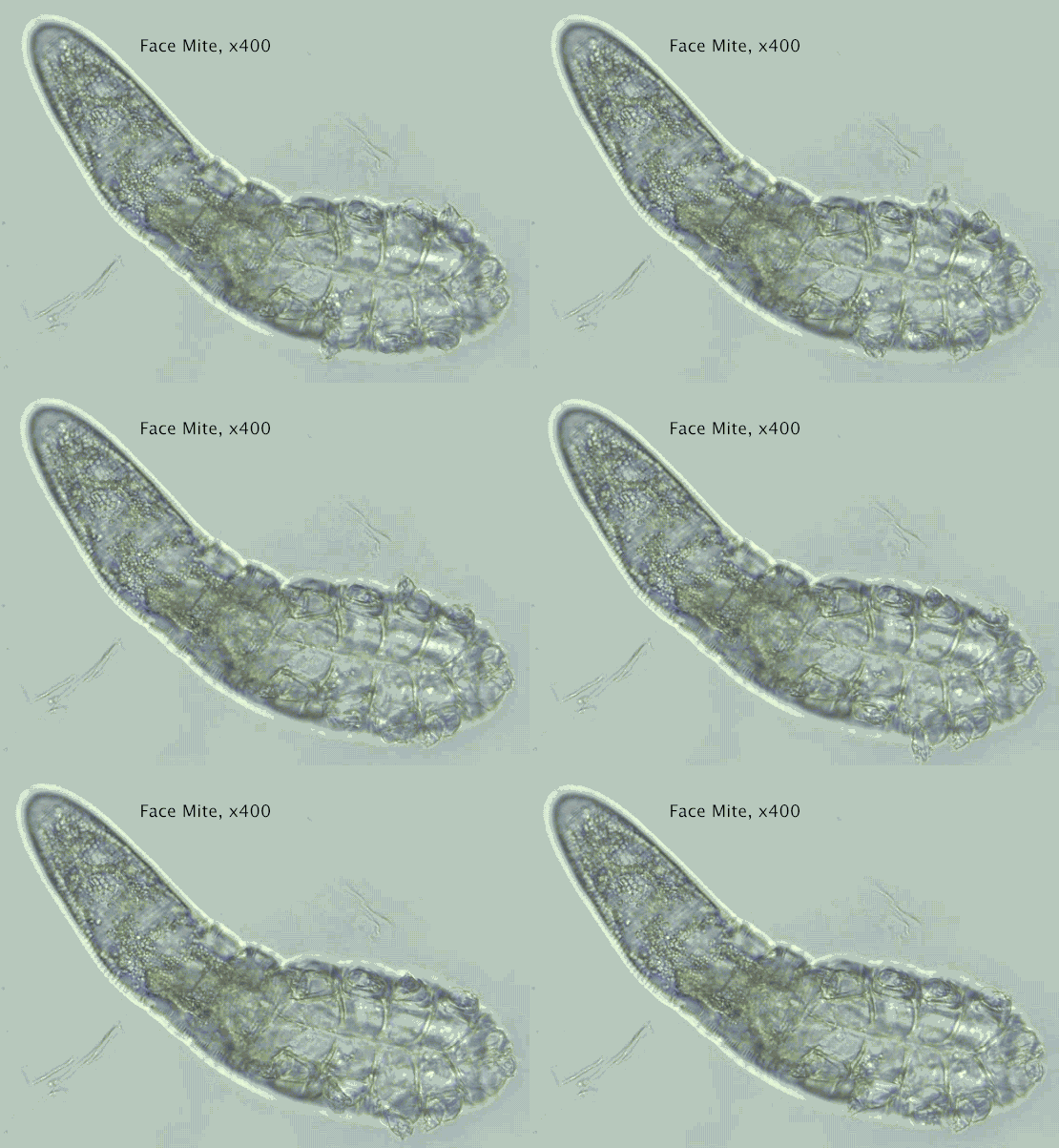
The facial mite movie. They live on in us, about 1 per hair follicle, particularly favoring eyelashes. Whenever you shower, your shower with a friend.

The facial mite movie. They live on in us, about 1 per hair follicle, particularly favoring eyelashes. Whenever you shower, you shower with a friend.

Dry skin is mostly protein (keratin), plus cholesterol and squalene. This provides great nutrition for dust mites and their associated bacteria. In warm, damp environments, as in your underwear or mattress, these beasties multiply and eat the old skin. The average density of dust mites on a mattress is greater than 2500/gram of dust.[1]  The mites leave behind excrement and broken off mite-limbs: nasty bits that are the most common allergens in the US today.

An allergy to dust shows up as sneezing, coughing, clogged lungs, and eczema. The most effective cure is a high level of in-home hygiene; mites don’t like soap or dry air. You’ve go to mop and vacuum regularly. Clean and change your clothing, particularly your undergarments; rotate your mattresses, and shake the dust out of your bedding. Vacuuming is less-effective as a significant fraction of the nasties go through the filter and get spread around by the vacuum blower.

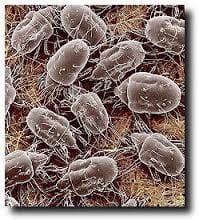
As it turns out, dust mites and their bacteria eat more than skin. They also eat dried body fluids, poop residue, and the particular explosive used by Umar Farook, pentaerythritol tetra nitrate, PETN (humans can eat and metabolize this stuff too — it’s an angina treatment). The mites turn PETN into less-explosive versions, plus more mites.

Mighty mites as seen with electron microscopy. They eat more than skin.

Mighty mites as seen with electron microscopy. They eat more than skin.

There are many varieties of mite living on and among us. Belly button mites, for example, and face mites as shown above (click on the image to see it move). On average, people have one facial mite per hair follicle. It’s also possible that the bomber was stopped by poor quality control engineering and not mites at all. Religion tends to be at odds with a science like quality control, and followers tend to put their faith in miracles.

Chigger turning on a dime

Chigger turning on a dime

larger than the dust mite is the chigger, shown at left. Chiggers leave visible bites, particularly along the underwear waste-band. There are larger-yet critters in the family: lice, bed bugs, crabs. Bathing regularly, and cleaning your stuff will rid yourself of all these beasties, at least temporarily. Keeping your hair short and your windows open helps too. Mites multiply in humid, warm environments. Opening the windows dries and cools the air, and blows out mite-bits that could cause wheezing. Benjamin Franklin and took air-baths too: walking around naked with the windows open, even in winter. It helped that he lived on the second floor. Other ways to minimize mite growth include sunlight, DOT (a modern version of DDT), and eucalyptus oil. At the very minimum, change your underwear regularly. It goes a long way to reduce dust embarrassing moments at the jihadist convention.

Dr. Robert E. Buxbaum, Sept 21, 2014. Not all science or life is this weird and wonderful, but a lot is, and I prefer to write about the weird and wonderful bits. See e.g. the hazards of health food, the value of sunshine, or the cancer hazard of living near a river. Or the grammar of pirates.

Marijuana, paranoia, and creativity

Many studies have shown that marijuana use and paranoid schizophrenia go together, the effect getting stronger with longer-term and heavy use. There also seems to be a relation between marijuana (pot) and creativity. The Beetles and Stones; Dylan, DuChaps, and Obama: creative musicians painters, poets and politicians, smoked pot. Thus, we can ask what causes what: do crazy, creative folks smoke pot, or does pot-smoking cause normal folks to become crazy and creative, or is there some other relationship. Dope dealers would like you to believe that pot-smoking will make you a creative, sane genius, but this is clearly false advertising. If you were not a great artist, poet, or musician before, you are unlikely to be one after a few puffs of weed.

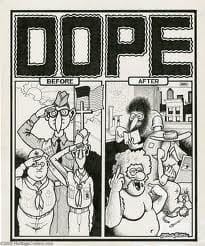
The Freak Brothers, by Gilbert Shelton. While these boys were not improved by dope, It would be a shame to put the artist in prison for any length of time.

The Freak Brothers, by Gilbert Shelton. What’s the relationship?

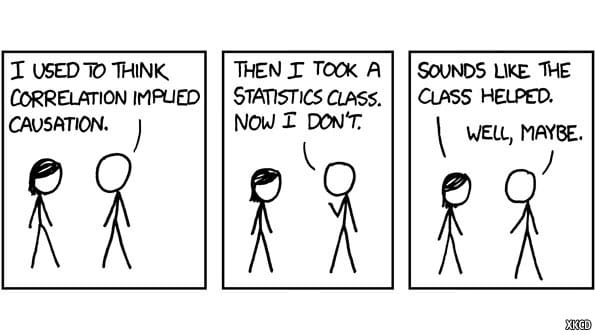
When things go together, we apply inductive reasoning. There are four possibilities: A causes B (pot makes you crazy and/or creative), B causes A (crazy folks smoke pot, perhaps as self medication), A and B are caused by a third thing C (in this case, poverty culture, or some genetic mutation). Finally, it’s possible there’s no real relationship but a failure to use statistics right. If we looked at how many golf tournaments were won by people with W last names (Woods, Wilson, Watson) we might be fooled to think it’s a causal relationship. Key science tidbit: correlation does not imply causation.

The most likely option, I suspect is that some of all of the above is going on here: There is an Oxford University study that THC, the main active ingredient in pot, causes some, temporary paranoia, and another study suggests that pot smoking and paranoid insanity may be caused by the same genetics. To this mix I’d like to add another semi-random causative: that heavy metals and other toxins that are sometimes found in marijuana are the main cause of the paranoia — while being harmful to creativity.

marijuana -paranoia

Pot cultivation is easy — that’s why it’s called weed– and cultivation is often illegal, even in countries with large pot use, like Jamaica. As a result, I suspect pot is grown preferentially in places contaminated with heavy metal toxins like vanadium, cadmium, mercury, and lead. No one wants to grow something illegal on their own, good crop-land. Instead it will be grown on toxic brownfields where no one goes. Heavy metals are known to absorb in plants, and are known to have negative psychoactive properties. Inhalation of mercury is known to make you paranoid: mad as a hatter. Thus, while the pot itself may not drive you nuts, it’s possible that heavy metals and other toxins in the pot-soil may. The creativity would have to come from some other source, and would be diminished by smoking bad weed.

I suspect that creativity is largely an in-born, genetic trait that can be improved marginally by education, but I also find that creative people are necessarily people who try new things, go off the beaten path. This, I suspect, is what leads them to pot and other “drug experiments.” You can’t be creative and walk the same, standard path as everyone else. I’d expect, therefore, that in high use countries, like Jamaica, creative success is preferentially found in the few, anti-establishment folks who eschew it.

Robert E. (landslide) Buxbaum, September 4, 2014. The words pot, marijuana, dope, and weed all mean the same but appear in different cultural contexts. To add to the confusion, Jamaicans refer to pot as ganja or skiff, and their version of paranoid schizophrenia is called “ganja psychosis”. I’m not anti-pot, but favor government regulation— perhaps along the lines of beer regulation, or perhaps the stricter regulation of Valium. My most recent essay was on the tension-balance between personal freedom and government control. I was recently elected in Oak Park’s 3rd voting district. My slogan: “A Chicken in every pot, not pot in every chicken”. I won by one vote. For those who are convinced they’ve become really deep, creative types without having to create anything, let me suggest the following cartoon about talent. Also, if pot made you smart, Jamaica would be floating in Einsteins.

High minimum wages hurt the poor; try a negative tax

It is generally thought (correctly I suspect) that welfare is a poor way to help the poor as it robs them of the dignity of work. Something like welfare is needed to keep the poor from starving, and the ideal alternative to welfare seems to be a minimal job — that is one that is easy enough for a minimally skilled worker to do it, and high-paying enough so that this worker is able to support a family of 4. Such jobs are hard to produce, and hard to sell to those currently getting welfare — that is those getting paid the same amount for no work at all. I’d like to propose something better, a negative tax along with the removal of our minimum wage.

I suspect that our current system of minimum wage hurts the desperate poor and middle class at least as much as it helps the working poor. One problem with it is that it flattens the wage structure, hurting the ego and incentive of those who work harder or with higher skills. The minimum wage encourages lax work, and reduces the incentive of workers to improve. A higher talented or more experienced worker should make more than an unskilled beginner, but with the current minimum wages they hardly do. Our high minimum wage also hurts the desperate poor by cutting the lower rungs off of the employment ladder. Poor, unskilled, young folks are not hired because it will take a while before they’re productive enough to justify the minimum wage. And anyway, why should the minimum wage number assume that every worker lives independently (or should) and that every job deserves to support a family of four. Most unskilled workers are neither independent nor are they supporting a family of four. Most unskilled workers are not independent, nor are they the sole support of a family.

I suspect that people push for high minimum wages as a way to help without giving themselves. The cost is borne by the company, and companies are seen as evil, faceless oppressors. They prefer not to notice that the a high minimum wage creates high unemployment in central cities and other low skill areas, like Detroit before bankruptcy, and Puerto Rico today. In Detroit before bankruptcy, the living wage was set so high that companies could not compete and went bankrupt or fled. The ones that stayed hired so selectively that the unskilled were basically unemployable. Even the city couldn’t pay its wages and bills.

A high minimum wage increases the need for welfare, as some workers will be unemployable — because of disability, because of lack of skill, or from an ingrained desire to not work. The punishments a community can mete out are limited, and sooner or later some communities stop working and stop learning as they see no advantage.

The difficulties of taking care of the genuinely needy and disabled while the lazy and unskilled has gotten even some communist to reconsider wealth as a motivator. The Chinese have come to realize that workers work better at all levels if there is a financial reward to experience and skill at all levels. But that still leaves the question of who should pay to help those in need and how.  Currently the welfare system only helps the disabled and the “looking” unemployed, but I suspect they should do more replacing some of the burden that our minimum wage laws places on the employers of unskilled labor. But I suspect the payment formula should be such that the worker ends up richer for every additional hour of work. That is, each dollar earned by a welfare recipient should result in less than one dollar reduction in welfare payment. Welfare would thus be set up as a negative tax that would continue to all levels of salary and need so that there is no sudden jump when the worker suddenly starts having to pay taxes. The current and proposed tax / welfare structure is shown below:

Currently someone's welfare check decreases by $1 for each dollar earned. I propose a system of negative tax (less than 100%) so each dollar earned puts a good fraction in his/her pocket.

Currently (black) someone’s welfare check decreases by $1 for each dollar earned, then he enters a stage of no tax — one keeps all he earns, and then a graduated tax. I propose a system of negative tax (red) so each dollar earned adds real income.

The system I propose (red line) would treat identically someone who is  incapacitated as someone who decided not to work, or to work at a job that paid $0/hr (e.g. working for a church). In the current system treats them differently, but there seems to be so much law and case-work and phony doctor reports involved in getting around it all that it hardly seems worth it. I’d use money as the sole motivator (all theoretical, and it may not work, but hang with me for now).

In the proposed system, a person who does not work would get some minimal income based on family need (there is still some need for case workers). If they are employed the employer would not have to pay minimum wage (or there would be a low minimum wage — $3/hr) but the employer would have to report the income and deduct, for every dollar earned some fraction in tax — 40¢ say. The net result would be that the amount of government subsidy received by the worker (disabled or not) would decrease by, for 40¢ for every dollar earned. At some salary the worker would discover that he/she was paying net tax and no longer receiving anything from the state. With this system, there is always an incentive to work more hours or develop more skills. If the minimum wage were removed too, there would be no penalty to hiring a completely unskilled worker.

At this point you may ask where the extra money will come from. In the long run, I hope the benefit comes from the reduced welfare rolls, but in the short-term, let me suggest tariffs. Tariffs can raise income and promote on-shore production. Up until 1900 or so, they were the main source of revenue for the USA. As an experiment, to see if this system works, it could be applied to enterprise zones, e.g. in Detroit.

R. E. Buxbaum, June 27, 2014. I worked out the math for this while daydreaming in an economics lecture. It strikes me as bizarre, by the way, that one can contract labor for barter, pay a pizza for two hours labor, but you can’t contract labor for less than the minimum cash-rate $7.45/hr. You can go to jail by paying less than this in cash, but not in food. In Canada they have something even more bizarre: equal wages for equal skills — a cook and a manager must earn the same, independent of how well the cook cooks or how needed the work is. No wonder violent crime is higher in Canada.

Criminal Punishment Theory

I’ve often wondered about the theory of criminal punishment. How long should sentences be? For which crimes and external circumstances should people be let off, for which should there be alternative punishments, like civic work, or a fine instead of jail time. I’ve a few ideas, but here are some thought cases:

Someone steals an expensive handbag from a clothing store. What should the punishment be for (a) a ghetto black with no job, (b) a middle-class, college sophomore (c) a famous actress? Should it be the same for all? Is jail the best punishment — it costs money, and doesn’t help the criminal or the store. If jail, how long is appropriate? Should the length of stay correspond to the cost of the bag? If the punishment is money or civic service, how should the fine vary with the wealth of the thief, or if the person is a repeat offender? Many countries have corporal punishment — why or why not?

My sense is that sentences should be shorter for less-expensive items, and longer for more expensive. My sense is that a fine or civic service is appropriate for most first offenses, and while jail seems necessary for serious crimes, if only to keep criminals off the streets, the sentences should be reasonably short and include rehabilitation. I suspect that long sentences don’t help the criminal or society. I suspect that victimless crimes, e.g. prostitution or drug sales should have very short sentences or non-jail punishments, and I’m not quite sure what to do if the thief reforms in prison or appears to.

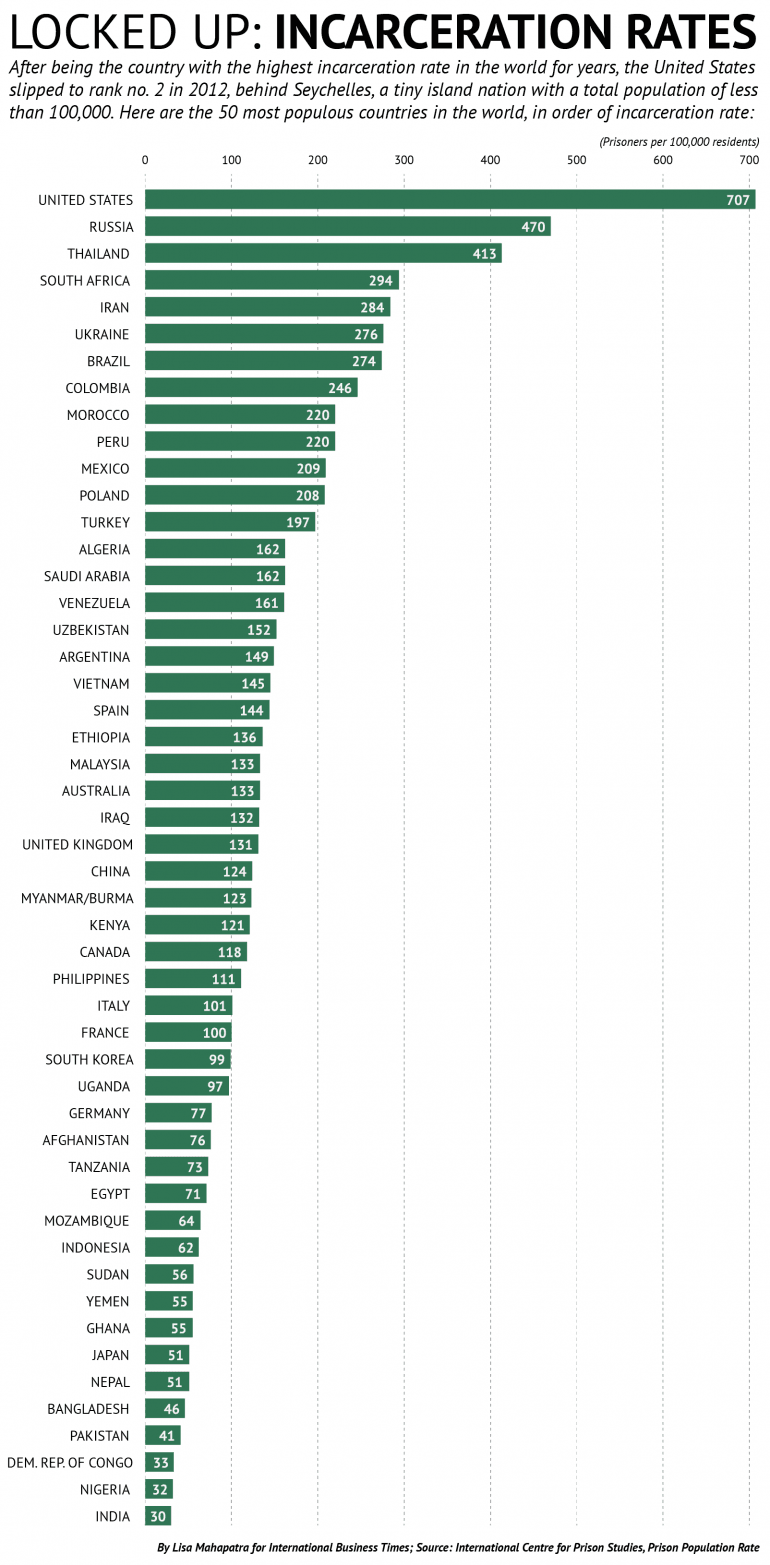
The US leads Russia, China, South Africa, and all of Europe in terms of percent of population is prison.

The US leads Russia, China, Cuba, India, and all of Europe in terms of percent of population in prison. It’s caused byvery long sentences, a product of fixed minimums. Strangely, our crime rate is low. Chart from the international business times.

Regarding prostitution perhaps it should be policed by the clergy, that’s why they get tax breaks. And why is sex between consenting adults punished as prostitution if money changes hands but not otherwise, or if the only pay is dinner? Why should the professional offender (the prostitute) pay more than the casual (the john). Why is drug use punished more than alcohol. Many drug and alcohol users live happy productive lives. To the extent that these crimes should be punished, it seems to me that fines, community service, or corporal punishment might be appropriate — I can not see prison healing a moral failing or reforming a victimless criminal.

And then there is rape. As a crime, the definition of rape has a long slippery slope, but the punishment does not. It isn’t quite clear where consensual become criminal, but the punishment is strict and undivided. We treat some cases as extreme crimes and others are let completely free. We have cases where the sex-criminal man or woman marries his or her underage partner, but is still guilty of statutory rape, and is then listed forever as a sex-criminal.

Children under 21 can not drink alcohol in the US, but they can in many other countries, and in some countries even older people can not drink at all. Is Saudi Arabia a very productive country; is Germany falling apart because of young drinkers? It seems not, so why is 21 the drinking age when you can choose to marry or join the army at 18. Soldiers are allowed to drink earlier than non-soldiers, but young marrieds are not afforded the same benefit. I don’t see why. The punishment for underage drinking varies too, as does the punishment for underage driving.

The Bible has some enlightened ideas on punishment, prescribing the use of fines of double or four or five times the value going to the victim (the thief pays 4 times for a stolen sheep, 5 times for a stolen cow, for example), but in other cases, it’s positively draconian prescribing death for homosexuality, violating the sabbath or for taking God’s name in vain. A seducer has to marry his seducee, but can not divorce her (assuming she agrees) but what if it’s an unhappy marriage? There is no room for judicial leniency in the bible, but there is in traditional applications; I’m not sure that’s not an improvement.

Robert E. Buxbaum, May 30, 2014. I’ve been wondering about the theory of appropriate punishment for at least 35 years. Are we protecting society, extracting vengeance, helping the criminal or doing some vague combination. My sense is we’re just bumbling blindly, and sorry to say, I have no answers.

Buddhists, Hindus and dentists joke

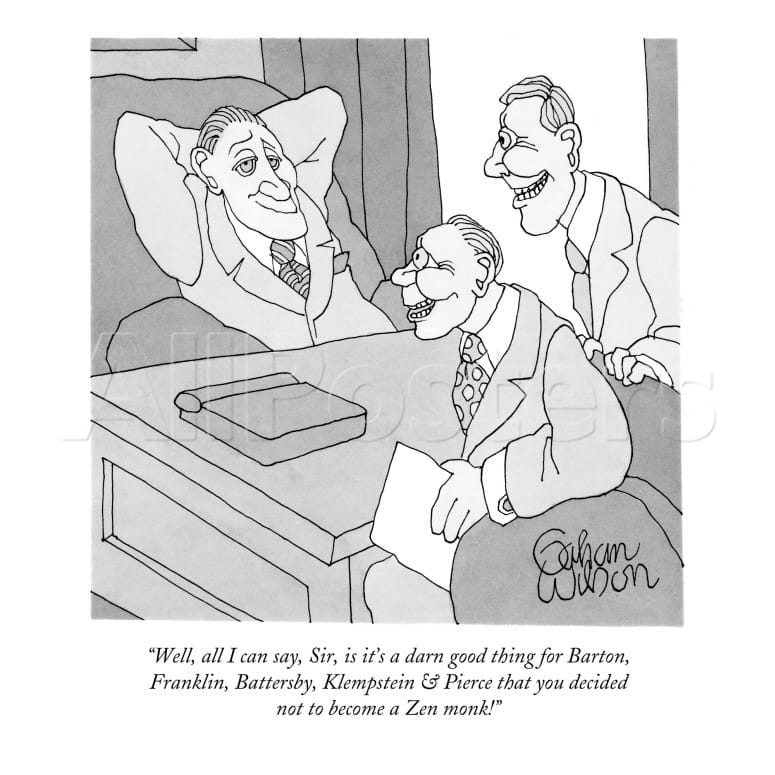
At the dentists’ office, Buddhist and Hindu monks don’t need anesthesia to have their teeth worked on. They transcend dental medication.

It’s funny because it’s a 3 word pun, and because there is something magical about the ability of people to conquer pain through meditation.

Focussed meditation can keep you from worry and other pain.

Focused meditation can keep you from worry and some physical pain. As for thugs, that’s more controversial. It’s possible that laughter, or looking at a spot will do as much. Gahan Wilson

The types of meditation, as I understand it, are two which are four. The two are focused and non-focused. focused meditation is supposed to allow you to conquer pain, both physical and spiritual. You concentrate on your breathing, or some other rhythmic action and thought; and whenever you realize that your mind is wandering you bring it back. A popular version is called square breathing: you breath in, hold, breath out, hold, etc. In time there is a sense of calm with the world. In theory, you can transcend dental medication, but I use the normal western practice of Novocaine plus gas. Meditation practitioners claim that directed meditation can also protect you from villains and bring peace in the world; I suspect that’s true, but also suspect that humor, or staring at a spot will do as much. I suspect that Dr Seuss has done wonders for peace in the world.

The second major version of mediation is non-focused; it can bring enlightenment if you use it right. You repeat a mantra slowly and let your mind wander along some general paths. The classic incantatory mantra is OM, and the classic paths include: what am I doing with my life, imagine a stick with one end, what is the sound of a hand clapping. The enlightenment that is supposed to arise is supposed to promote non-violence, charity, and a sense of oneness with the all. In general, I’ve found that letting one’s mind wander is a great way to solve difficult problems and to help one decide whether certain situations are worth being involved with. To the extent I’ve used a mantra, it’s versions of “radiator not leaking, mind leaking,” or “computer solution not unstable, mind unstable.” In the calm of realizing there is a solution, I’ve generally been able to find a solution.

Enlightenment can be as simple as realizing that you're there already or that you shouldn't manage a country that's unlike you and dislikes you.

Enlightenment can be as simple as realizing that you’re there already.

As for the other 2 types of meditation, it depends. To some, it involves rocking to the sound of the one hand clapping (or not). To some, it’s realizing you’re there already, or that you really don’t want to get involved in an Asian war to defend and manage a country that’s completely unlike yours, and that dislikes yours as well, or that it’s OK to use Novocaine and gas when you have your teeth worked on. That’s what they are there for.

Robert E. Buxbaum, May 24, 2014. Some wisdom from the Jewish mystics: Wherever you go, there you are, as for your baggage, who knows? Tea, with the first sip joy, with the second, satisfaction, with the third, Danish.

The future of steamships: steam

Most large ships and virtually all locomotives currently run on diesel power. But the diesel  engine does not drive the wheels or propeller directly; the transmission would be too big and complex. Instead, the diesel engine is used to generate electric power, and the electric power drives the ship or train via an electric motor, generally with a battery bank to provide a buffer. Current diesel generators operate at 75-300 rpm and about 40-50% efficiency (not bad), but diesel fuel is expensive. It strikes me, therefore that the next step is to switch to a cheaper fuel like coal or compressed natural gas, and convert these fuels to electricity by a partial or full steam cycle as used in land-based electric power plants

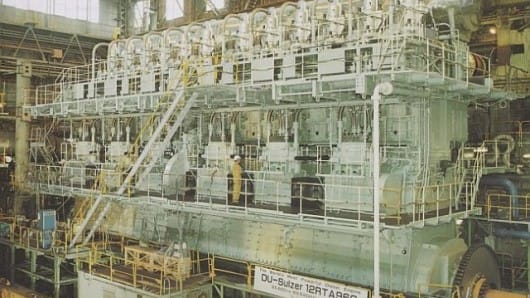
Ship-board diesel engine, 100 MW for a large container ship

Diesel engine, 100 MW for a large container ship

Steam powers all nuclear ships, and conventionally boiled steam provided the power for thousands of Liberty ships and hundreds of aircraft carriers during World War 2. Advanced steam turbine cycles are somewhat more efficient, pushing 60% efficiency for high pressure, condensed-turbine cycles that consume vaporized fuel in a gas turbine and recover the waste heat with a steam boiler exhausting to vacuum. The higher efficiency of these gas/steam turbine engines means that, even for ships that burn ship-diesel fuel (so-called bunker oil) or natural gas, there can be a cost advantage to having a degree of steam power. There are a dozen or so steam-powered ships operating on the great lakes currently. These are mostly 700-800 feet long, and operate with 1950s era steam turbines, burning bunker oil or asphalt. US Steel runs the “Arthur M Anderson”, Carson J Callaway” , “John G Munson” and “Philip R Clarke”, all built-in 1951/2. The “Upper Lakes Group” runs the “Canadian Leader”, “Canadian Provider”, “Quebecois”, and “Montrealais.” And then there is the coal-fired “Badger”. Built in 1952, the Badger is powered by two, “Skinner UniFlow” double-acting, piston engines operating at 450 psi. The Badger is cost-effective, with the low-cost of the fuel making up for the low efficiency of the 50’s technology. With larger ships, more modern boilers and turbines, and with higher pressure boilers and turbines, the economics of steam power would be far better, even for ships with modern pollution abatement.

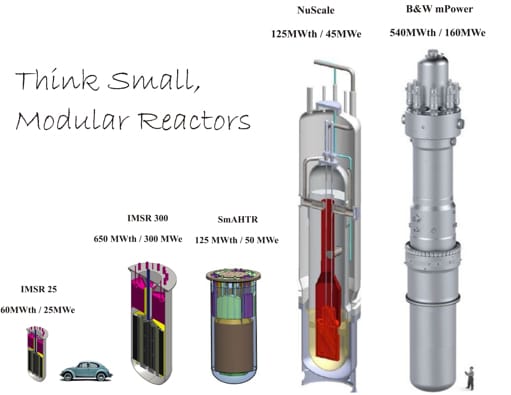
Nuclear steam boilers can be very compact

Nuclear steam boilers can be very compact

Steam powered ships can burn fuels that diesel engines can’t: coal, asphalts, or even dry wood because fuel combustion can be external to the high pressure region. Steam engines can cost more than diesel engines do, but lower fuel cost can make up for that, and the cost differences get smaller as the outputs get larger. Currently, coal costs 1/10 as much as bunker oil on a per-energy basis, and natural gas costs about 1/5 as much as bunker oil. One can burn coal cleanly and safely if the coal is dried before being loaded on the ship. Before burning, the coal would be powdered and gassified to town-gas (CO + H2O) before being burnt. The drying process removes much of the toxic impact of the coal by removing much of the mercury and toxic oxides. Gasification before combustion further reduces these problems, and reduces the tendency to form adhesions on boiler pipes — a bane of old-fashioned steam power. Natural gas requires no pretreatment, but costs twice as much as coal and requires a gas-turbine, boiler system for efficient energy use.

Todays ships and locomotives are far bigger than in the 1950s. The current standard is an engine output about 50 MW, or 170 MM Btu/hr of motive energy. Assuming a 50% efficient engine, the fuel use for a 50 MW ship or locomotive is 340 MM Btu/hr; locomotives only use this much when going up hill with a heavy load. Illinois coal costs, currently, about $60/ton, or $2.31/MM Btu. A 50 MW engine would consume about 13 tons of dry coal per hour costing $785/hr. By comparison, bunker oil costs about $3 /gallon, or $21/MM Btu. This is nearly ten times more than coal, or $ 7,140/hr for the same 50 MW output. Over 30 years of operation, the difference in fuel cost adds up to 1.5 billion dollars — about the cost of a modern container ship.

Robert E. Buxbaum, May 16, 2014. I possess a long-term interest in economics, thermodynamics, history, and the technology of the 1800s. See my steam-pump, and this page dedicated to Peter Cooper: Engineer, citizen of New York. Wood power isn’t all that bad, by the way, but as with coal, you must dry the wood, or (ideally) convert it to charcoal. You can improve the power and efficiency of diesel and automobile engines and reduce the pollution by adding hydrogen. Normal cars do not use steam because there is more start-stop, and because it takes too long to fire up the engine before one can drive. For cars, and drone airplanes, I suggest hydrogen/ fuel cells.

US cancer rates highest on the rivers, low in mountains, desert

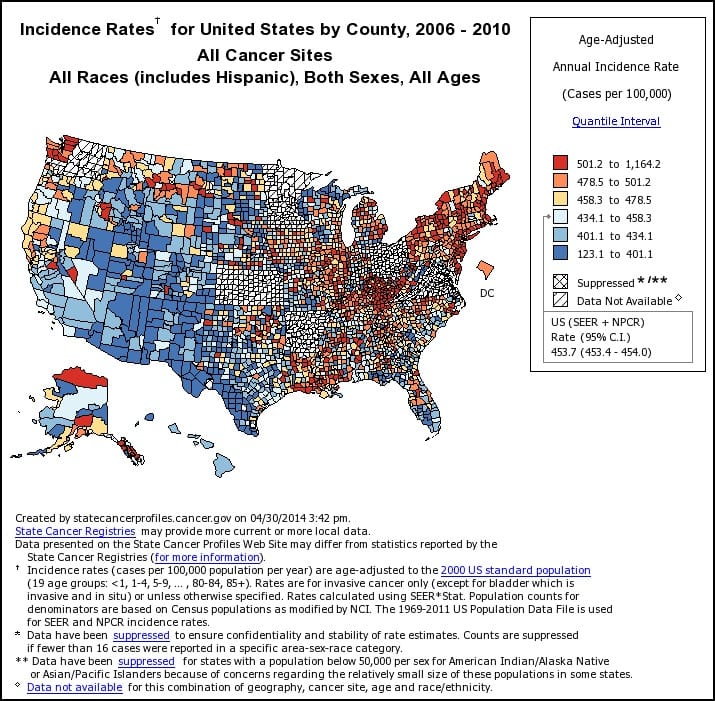
Sometimes I find I have important data that I can’t quite explain. For example, cancer rates in the US vary by more than double from county to county, but not at random. The highest rates are on the rivers, and the lowest are in the mountains and deserts. I don’t know why, but the map shows it’s so.

Cancer rate map of the US age adjusted

Cancer death rates map of the US age adjusted 2006-2010, by county. From www.statecancerprofiles.cancer.gov.

Counties shown in red on the map have cancer death rates between 210 and 393 per 100,000, more than double, on average the counties in blue. These red counties are mostly along the southern Mississippi, the Arkansas branching to its left; along the Alabama, to its right, and along the Ohio and the Tennessee rivers (these rivers straddle Kentucky). The Yukon (Alaska) shows up in bright red, while Hawaii (no major rivers) is blue; southern Alaska (mountains) is also in blue. In orange, showing less-elevated cancer death, you can make out the Delaware river between NJ and DC, the Missouri heading Northwest from the Mississippi, the Columbia, and the Colorado between the Grand Canyon and Las Vegas. For some reason, counties near the Rio Grande do not show elevated cancer death rates. nor does the Northern Mississippi and the Colorado south of Las Vegas.

Contrasting this are areas of low cancer death, 56 to 156 deaths per year per 100,000, shown in blue. These appear along the major mountain ranges: The Rockies (both in the continental US and Alaska), the Sierra Nevada, and the Appalachian range. Virtually every mountain county appears in blue. Desert areas of the west also appear as blue, low cancer regions: Arizona, New Mexico, Utah, Idaho, Colorado, south-west Texas and southern California. Exceptions to this are the oasis areas in the desert: Lake Tahoe in western Nevada and Lake Meade in southern nevada. These oases stand out in red showing high cancer-death rates in a sea of low. Despite the AIDS epidemic and better health care, the major cities appear average in terms of cancer. It seems the two effects cancel; see the cancer incidence map (below).

My first thought of an explanation was pollution: that the mountains were cleaner, and thus healthier, while industry had polluted the rivers so badly that people living there were cancer-prone. I don’t think this explanation fits, quite, since I’d expect the Yukon to be pollution free, while the Rio Grande should be among the most polluted. Also, I’d expect cities like Detroit, Cleveland, Chicago, and New York to be pollution-heavy, but they don’t show up for particularly high cancer rates. A related thought was that specific industries are at fault: oil, metals, chemicals, or coal, but this too doesn’t quite fit: Utah has coal, southern California has oil, Colorado has mining, and Cleveland was home to major Chemical production.

Another thought is poverty: that poor people live along the major rivers, while richer, healthier ones live in the mountains. The problem here is that the mountains and deserts are home to some very poor counties with low cancer rates, e.g. in Indian areas of the west and in South Florida and North Michigan. Detroit is a very poor city, with land polluted by coal, steel, and chemical manufacture — all the worst industries, you’d expect. We’re home to the famous black lagoon, and to Zug Island, a place that looks like Hades when seen from the air. The Indian reservation areas of Arizona are, if anything, poorer yet. 

Cancer incidence map

Cancer incidence,age adjusted, from statecancerprofiles.cancer.gov

My final thought was that people might go to the river to die, but perhaps don’t get cancer by the river. To check this explanation, I looked at the map of cancer incidence rates. While many counties repress their cancer rate data, the pattern in the remaining ones is similar to that for cancer death: the western mountain and desert counties show less than half the incidence rates of the counties along the southern Mississippi, the Arkansas, and the Ohio rivers. The incidence rates are somewhat elevated in the north-east, and lower on the Yukon, but otherwise it’s the same map as for cancer death. Bottom line: I’m left with an observation of the cancer pattern, but no good explanation or model.

Dr. Robert E. Buxbaum, May 1, 2014. Two other unsolved mysteries I’ve observed: the tornado drought of the last few years, and that dilute toxins and radiation may prevent cancer. To do science, you first observe, and then try to analyze.

In praise of tariffs

In a previous post I noted that we could reduce global air pollution if we used import taxes (tariffs) to move manufacture to the US from China and other highly polluting countries. It strikes me that import tariffs can have other benefits too, they can keep US jobs in the US, provide needed taxes, and they’re a tool of foreign policy. We buy far more from China and Russia than they buy from us, and we get a fair amount of grief — especially from Russia. An appropriate-sized tariff should reduce US unemployment, help balance the US, and help clean the air while pushing Russia in an alternative to war-talk.

There is certainly such a thing as too high a tariff, but it seems to me we’re nowhere near that. Too high a tariff is only when it severely limits the value of our purchasing dollar. We can’t eat dollars, and want to be able to buy foreign products with them. Currently foreign stuff is so cheap thought, that what we import is most stuff we used to make at home — often stuff we still make to a small extent, like shoes, ties, and steel. An import tax can be bad when it causes other countries to stop buying from us, but that’s already happened. Except for a very few industries, Americans buy far more abroad than we sell. As a result, we have roughly 50% of Americans out of well-paying work, and on some form government assistance. Our government spends far more to care for us, and to police and feed the world than it could possibly take in, in taxes. It’s a financial imbalance that could be largely corrected if we bought more from US manufacturers who employ US workers who’d pay taxes and not draw unemployment. Work also benefits folks by developing, in them, skills and self-confidence.

Cartoon by Daryl Cagle. Now why is Russia a most favorable trade partner?

Cartoon by Daryl Cagle. Trade as foreign policy. Why is Russia a most favorable trade partner?

In a world without taxes or unemployment, and free of self-confidence issues, free trade might be ideal, but taxes and unemployment are a big part of US life. US taxes pay for US roads and provide for education and police. Taxes pay for the US army, and for the (free?) US healthcare. With all these tax burdens, it seems reasonable to me that foreign companies should pay at least 5-10% — the amount an American company would if the products were made here. Tariff rates could be adjusted for political reasons (cartoon), or environmental — to reduce air pollution. Regarding Russia, I find it bizarre that our president just repealed the Jackson Vanik tariff, thus giving Russia most favored trade status. We should (I’d think) reinstate the tax and ramp it up or down if Russia invades again or if they help us with Syria or Iran.

A history of US tariff rates. There is room to put higher tariffs on some products or some countries.

A history of US tariff rates. Higher rates on some products and some countries did not harm the US for most of our history.

For most of US history, the US had much higher tariffs than now, see chart. In 1900 it averaged 27.4% and rose to 50% on dutiable items. Our economy did OK in 1900. By 1960, tariffs had decreased to 7.3% on average (12% on duty-able) and the economy was still doing well. Now our average tariff is 1.3%, and essentially zero for most-favored nations, like Russia. Compare this to the 10% that New York applies to in-state sales, or the 6% Michigan applies, or the 5.5% that Russia applies to goods imported from the US. Why shouldn’t we collect at least as high a tax on products bought from the non-free, polluting world as we collect from US manufacturers.

Some say tariffs caused the Great Depression. Countries with lower tariffs saw the same depression. Besides the Smoot-Hawley was 60%, and I’s suggesting 5-10% like in 1960. Many countries today do fine today with higher tariffs than that.

Robert E. Buxbaum, March 25, 2014. Previous historical posts discussed the poor reviews of Lincoln’s Gettysburg address, and analyzed world war two in terms of mustaches. I’ve also compared military intervention to intervening in a divorce dispute. My previous economic post suggested that Detroit’s very high, living wage hurt the city by fostering unemployment.

Where does industrial CO2 come from? China mostly.

The US is in the process of imposing strict regulations on carbon dioxide as a way to stop global warming and climate change. We have also closed nearly new power plants, replacing them with cleaner options like a 2.2 billion dollar solar-electric generator in lake Ivanpah, and this January our president imposed a ban on lightbulbs of 60 W and higher. But it might help to know that China produced twice as much of the main climate change gas, carbon dioxide (CO2) as the US in 2012, and the ratio seems to be growing. One reason China produces so much CO2 is that China generates electricity from dirty coal using inefficient turbines.

Where the CO2 is coming from: a fair amount from the US and Europe, but mostly from China and India too.

From EDGAR 4.2; As of 2012 twice as much carbon dioxide, CO2 is coming from China as from the US and Europe.

It strikes me that a good approach to reducing the world’s carbon-dioxide emissions is to stop manufacturing so much in China. Our US electric plants use more efficient generating technology and burn lower carbon fuels than China does. We then add scrubbers and pollution reduction equipment that are hardly used in China. US manufacture thus produces not only less carbon dioxide than China, it also avoids other forms of air pollution, like NOx and SOx. Add to this the advantage of having fewer ships carrying products to and from China, and it’s clear that we could significantly reduce the world’s air problems by moving manufacture back to the USA.

I should also note that manufacture in the US helps the economy by keeping jobs and taxes here. A simple way to reduce purchases from China and collect some tax revenue would be to impose an import tariff on Chinese goods based, perhaps on the difference in carbon emissions or other pollution involved in Chinese manufacture and transport. While I have noted a lack of global warming, sixteen years now, that doesn’t mean I like pollution. It’s worthwhile to clean the air, and if we collect tariffs from the Chinese and help the US economy too, all the better.

Robert E. Buxbaum, February 24, 2014. Nuclear power produces no air pollution and uses a lot less land area compared to solar and wind projects.

Stoner’s prison and the crack mayor

With the release of a video of Rob Ford, the Mayor of Toronto, smoking crack while in office, and the admission that at least two US presidents smoked pot, as did the Beatles, Stones, and most of Hollywood, it seems worthwhile to consider the costs and benefits of our war on drugs, especially pot. Drugs are typically bad for productivity and usually bad for health. Thus, it seems worthwhile to regulate it, but most countries do not punish drug sale or use nearly as harshly as we do in the US.

The Freak Brothers by Gilbert Shelton. Clearly these boys were not improved by drugs, but perhaps we could do better than incarcerating them, and their fans, for years, or life.

The Freak Brothers by Gilbert Shelton. Clearly these boys were not improved by drugs, but perhaps we could do better than incarcerating them, and their fans, for years, or life.

While US penalties vary state by state, most states have high minimum penalties that a judge can not go below. In Michigan, where I live, medical marijuana is legalized, but all supply is still illegal. Marijuana cultivation, even for personal medical use, is a felony carrying a minimum punishment of 4 years in state prison and a $20,000 fine. For cultivation of more than 20 plants the minimum sentence is 7 years in prison and $500,000; and cultivating 200 or more plants results in 15 years plus a $10,000,000 fine. These are first-time, minimum sentences where the judge can not consider mitigating circumstances, like a prescription, for a drug that was accepted for use in the US in the 70s, is legal in Holland, legalized in Colorado, and is near-legal in Belgium. While many pot smokers were not served by the herb, many went on to be productive, e.g. our current president and the Beatles.

In Michigan, the mandatory minimums get worse if you are a repeat offender, especially a 3 time offender. Possession of hard drugs; and sales or cultivation of marijuana makes you a felon; a gun found on a felon adds 2 years and another felony. With three felonies you go to prison for life, effectively, so there is little difference between the sentence of a repeat violent mugger and a kid selling $10 rocks of crack in Detroit. America has more people in prison than Russia, China, or almost every industrialized nation, per capita, and the main cause is long minimum sentences.

In 2011, Michigan spent an average of $2,343 per month per prisoner, or $28,116/year: somewhat over 1.3 billion dollars per year in total. To this add the destruction of the criminal’s family, and the loss of whatever value he/she might have added to society. Reducing sentences by 10 or 20% would go a long way towards paying off Detroit’s bankruptcy, and would put a lot of useful people back into the work-force where they might do some good for themselves and the state. 60.8% of drug arrestees were employed before they were arrested for drugs, with an average income of $1050/month. That’s a lot of roofers, electricians, carpenters, and musicians — useful people. As best we can tell, the long sentences don’t help, but lead to higher rates of recidivism and increased violent behavior. If you spend years in jail, you are likely to become more violent, rather than less. Some 75% of drug convicts have no prior record of violent crime, so why does a first-time offense have to be a felony. If we need minimums, couldn’t it be 6 months and a $1000 fine, or only apply if there is violence.

Couldn’t we allow judges more leeway in sentencing, especially for drugs? Recall that Michiganders thought they’d legalized marijuana for medical use, and that even hard-drugs were legal not that long ago. There was a time when Coca-Cola contained cocaine and when Pope Leo was a regular drinker of cocaine laced wine. If the two presidents smoked pot, and the Mayor of Toronto could do a decent job after cocaine, why should we incarcerate them for life? Let’s balance strict justice with mercy; so the fabric of society is not strained to breaking.

Robert Buxbaum, Jan 16, 2014. Here are some other thoughts on Detroit and crime.