Author Archives: R.E. Buxbaum

About R.E. Buxbaum

Robert Buxbaum is a life-long engineer, a product of New York's Brooklyn Technical High School, New York's Cooper Union to Science and Art, and Princeton University where he got a PhD in Chemical Engineering. From 1981 to 1991 he was a professor of Chemical Engineering at Michigan State, and now runs an engineering shop in Oak Park, outside of Detroit, Michigan. REB Research manufactures and sells hydrogen generation and purification equipment. He's married with 3 wonderful children who, he's told, would prefer to not be mentioned except by way of complete, unadulterated compliments. As of 2016, he's running to be the drain commissioner/ water resources commissioner of Oakland county.

On gays, God, and owning Canadians

Here’s a great letter to Dr. Laura. I don’t know what Dr. Laura said to get this guy started, but I’ll answer at the end as if it came to me. I get good comments too, but mine are more thoughtful, and  less funny.

Dear Dr. Laura:

Thank you for doing so much to educate people regarding God’s Law. I have learned a great deal from your show, and try to share that knowledge with as many people as I can. When someone tries to defend the homosexual lifestyle, for example, I simply remind them that Leviticus 18:22 clearly states it to be an abomination. End of debate. I do need some advice from you, however, regarding some other elements of God’s Laws and how to follow them.

1. Leviticus 25:44 states that I may possess slaves, both male and female, provided they are purchased from neighboring nations. A friend of mine claims that this applies to Mexicans, but not Canadians. Can you clarify? Why can’t I own Canadians?

2. I would like to sell my daughter into slavery, as sanctioned in Exodus 21:7. In this day and age, what do you think would be a fair price for her?

3. I know that I am allowed no contact with a woman while she is in her period of menstrual uncleanliness – Lev.15: 19-24. The problem is, how do I tell? I have tried asking, but most women take offense.

4. When I burn a bull on the altar as a sacrifice, I know it creates a pleasing odor for the Lord – Lev.1:9. The problem is my neighbors. They claim the odor is not pleasing to them. Should I smite them?

5. I have a neighbor who insists on working on the Sabbath. Exodus 35:2 clearly states he should be put to death. Am I morally obligated to kill him myself, or should I ask the police to do it?

6. A friend of mine feels that even though eating shellfish is an abomination, Lev. 11:10, it is a lesser abomination than homosexuality. I don’t agree. Can you settle this? Are there ‘degrees’ of abomination?

7. Lev. 21:20 states that I may not approach the altar of God if I have a defect in my sight. I have to admit that I wear reading glasses. Does my vision have to be 20/20, or is there some wiggle-room here?

8. Most of my male friends get their hair trimmed, including the hair around their temples, even though this is expressly forbidden by Lev. 19:27. How should they die?

9. I know from Lev. 11:6-8 that touching the skin of a dead pig makes me unclean, but may I still play football if I wear gloves?

10. My uncle has a farm. He violates Lev.19:19 by planting two different crops in the same field, as does his wife by wearing garments made of two different kinds of thread (cotton/polyester blend). He also tends to curse and blaspheme a lot. Is it really necessary that we go to all the trouble of getting the whole town together to stone them? Lev.24:10-16. Couldn’t we just burn them to death at a private family affair, like we do with people who sleep with their in-laws? (Lev. 20:14).

I know you have studied these things extensively and thus enjoy considerable expertise in such matters, so I’m confident you can help.

Thank you again for reminding us that God’s word is eternal and unchanging.
Your adoring fan,
James M. Kauffman,
Ed.D. Professor Emeritus,
Dept. Of Curriculum, Instruction, and Special Education University of Virginia

P.S. (It would be a damn shame if we couldn’t own a Canadian.)

And my answer is: You CAN own a Canadian: go ice fishing with the right bait; put out some Molson’s or Labatt’s while playing the “Hockey Night in Canada” theme. They’ll come, eh.

Just because the Bible allows something, that doesn’t mean it’s a general good, and just because the Bible opposes something that doesn’t mean it’s a general bad. Generally, it’s not up to the individual “believer” to correct things by smiting. Besides, figuring out what God really want’s of each person is really tricky. He appears in a cloud, as it were (Ex. 16:10; Deut. 31:15, etc.). I’d say it’s up to the preachers to try to understand individual people and help them change for the better, ideally he (or she) first improves himself (or herself). Bible literalness isn’t a great approach to religion, I’d say, not science, not threats, nor miracle stories, but real concern and a fine example. Failing at self-improvement (and I usually do) I’d leave it to God to do the smiting. He does an awfully good job of it in the Old Testament and you wouldn’t want Him to lose the knack. R. E. Buxbaum, April 28, 2014.

It's sometimes hard to guess what God wants if you just read the Bible. Gary Hart, BC.

It’s sometimes hard to guess what God wants by just reading the Bible. Gary Hart, BC.

Is ADHD a real disorder

When I was in school, ADHD hadn’t been invented. There were kids who didn’t pay attention for a good part of the day, or who couldn’t sit in their seats, but the first activity was called day-dreaming and the second “shpilkas” or “ants in your pants.” These problems were recognized but were considered “normal.” Though we were sometimes disorderly, the cause wasn’t labeled a disorder. It’s now an epidemic.

There were always plenty of kids, me included, who were day-dreamers. Mostly these were boys who would get bored after a while and would start to look around the room, or doodle, or gaze into space thinking of this or that. Perhaps I’d do some writing or math in the margin of a notebook while listening with one ear; perhaps I’d work on my handwriting, or I’d read something in another textbook. This was not called a disorder or even an attention deficit (AD), but rather day-dreaming, wool-gathering, napping, or just not paying attention. Sometimes teachers got annoyed, other times not. They went on teaching, but sometimes tossed chalk or erasers at us to get us to wake up. Kids like me took enough notes to do OK on tests and homework, though I was never at the top of the class in elementary or middle school. The report cards tended to say things like “he could do better if he really concentrated.”  It’s something that could apply to everyone.

Then there were the boys who would now be labeled HD, or “hyperactive disordered.” These were always boys: those who didn’t sit well in their chairs, or fidgeted, or were motor mouths and got up and walked about, or got into fights, or went to the bathroom; these were the class clowns, and the trouble makers — not me except for the fidgeting. Girls would fidget or talk too, and they’d pass notes to each other, but they didn’t get into fights, and they weren’t as disruptive. They tended to have great handwriting, and took lots of notes in class: every single word from the board, plus quite a bit more.

There are different measures of education, if you measure a fish's intelligence by the ability to climb a tree it will spend its life thinking it's stupid.

There are different measures of education, if you measure a fish’s skill level by the ability to climb a tree you’ll conclude the fish is ADD or worse.

Elementary and middle schools had activities to work out the excess energy that caused hyper-activity. We had dancing, shop, fire drills, art, some music, and sports. None of these helped all that much, but they did some good. I think the fire drills helped the most because we all went outside even in the winter, and eventually we calmed down without drugs. Sometimes a kid didn’t calm down, got worse, and did real damage; these kids were not called hyperactive disordered, but “bad kids” or “juvenile delinquents.” Nowadays, schools have far less art and music, and no shop or dancing. There are a lot more hyperactive kids, and the claim nowadays is that these hyperactive kids, violent or not, are disordered, ADHD, and should be given drugs. With drugs, the daydreamers take better notes, the nappers wake up, and the hyperactive kids calm down. Today about 30% of high-school seniors are given either a version of amphetamine, e.g. Adderall, or of Methylphenidate (Ritalin, etc.) The violent ones, the juvenile delinquents, are given stronger versions of the same drugs, e.g. methamphetamine, the drug at the heart of “breaking bad.”

Giving drugs to the kids seems to help the teacher a lot more than it helps the kids. According to a famous joke, giving the Ritalin to the teacher would be the best solution. When the kids are given drugs the disorderly boys (it’s usually given to boys) begin to act more like “goodie goodies”. They sit better and pay attention more; they take better notes and don’t interrupt, but I’m not sure they are learning more, or that the class is, or that they are socializing any better than before. The “goodie-goodies” in elementary school (mostly girls) did great in the early grades, but their good habits seemed to hold them back later. They worked too hard to please and tended to not notice, or pretended to not notice, when the teacher said nonsense. When it came time for independent or creative endeavors, their diligent acceptance of authority stood in the way of excellence.Venn diagram of ADHD

The hyperactive and daydreamers were more used to thinking for themselves, a prerequisite of leadership. The AD ones had gotten used to half-ignoring the teacher, and the HD ones were more openly opinionated and oppositional: obstreperous, in a word. Those bright enough to get by got more out of their education, perhaps because it was more theirs. To the extent that education was supposed to make you a leader and a thinker, the goodie-goodie behavior was a distraction and a disorder. This might be expected if education is supposed to be the lighting of a fire, not the filling of a pit. If everyone thinks the same, it’s a sign that few are thinking.

Map  of ADHD variation with location for US kids ages 6-18, Scrips Research.

Map of ADHD variation with location for US kids ages 6-18, Scrips Research. Boys are 2-3 times more often diagnosed as ADHD; diagnosis and medication increase with grade, peaking currently in early college.

This is not to say that there is no such disorder as ADHD, or no benefit from the drugs. My sense, though, is that the label is given too widely, and that the drugs are given too freely. Today drugs are pushed on virtually any kid who’s distracted, napping or hyperactive — to all the members of the big circles in the Venn diagram above, plus to athletes and others who feign ADD to get these, otherwise illegal, performance enhancing drugs. Currently, about 10% of US kids between 6 and 18 are diagnosed ADHD and given drugs, see figure. The numbers higher for boys than girls, higher in the US than abroad, and higher as the kids progress through school. It’s estimated that about 25% of US, 12th grade boys are given amphetamine or Ritalin and its homologs. My sense is that only a small fraction of these deserve drugs, only those with severe social problems, the violent or narcoleptic: those in the smaller circles of the Venn diagram. The test should not be that the kid’s behavior improves on them. Everyone’s attention improves when taking speed. ADHD appears more as an epidemic of overworked, undertrained, underfunded teachers, and a lack of outlets, not of disordered kids, or of real learning, and real learning is never pretty or easy (on all involved).

Robert Buxbaum, April 18, 2014. In general, I think people would be happier if they’d do more art, music, dance and shop, and if they’d embrace their inner weirdo. It would also help if doctors and teachers would use words rather than initials to describe people. It’s far better to be told you’re hyperactive, or that you’re not paying attention, then to be called ADD, HD, or ADHD. There’s far more room for gradation and improvement. I’m not an expert, just an observant observer.

Amazing tornado drought of 2014

At 143 days as of April 10, 2014, the span between major tornadoes (EF3s and stronger) is the 6th longest in the last 60 years, and it isn’t over yet. Even small tornadoes are becoming more scarce. Last year saw few hurricanes and tornadoes, and so far we’ve had only 100 total tornadoes (see below); in a typical year there’d be 323. The good news has gone unreported, I think, because there’s no event, no photo-opportunity; no interviews with survivors, police, and experts.

US tornadoes: typical and year to date, January 1 to April 10 2014,  NOAA

US tornadoes: typical and year to date, January 1 to April 10 2014, from NOAA, storm center

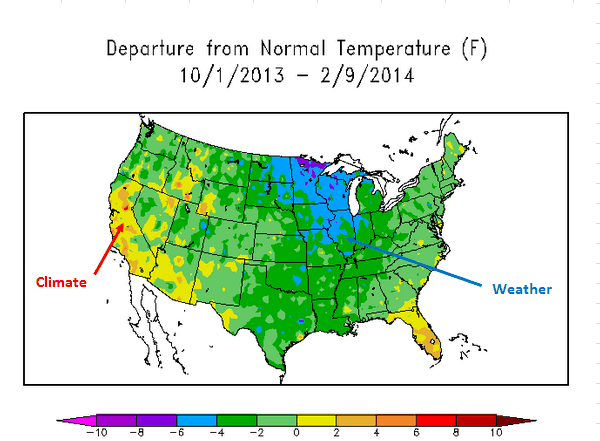
Perhaps this is a bonuses from global warming, or from the very cold winter just passed, or from the chaotic, weather; it’s hard to tell weather from climate. Whatever the reason, it’s happening and good. Here’s how tornadoes lift stuff up, with video (Einstein’s explanation). Here’s an explanation of hurricanes (my explanation).

Robert E. Buxbaum, April 11, 2014. In other good news, the ozone hole is shrinking. genetically modified foods don’t seem to cause cancer, and many bad things are good for you, like sunlight. Enjoy the good.

Dada, or it’s hard to look cool sucking on a carrot.

When it’s done right, Dada art is cool. It’s not confusing or preachy; it’s not out there, or sloppy; just cool. And today I found the most wonderful Dada piece: “Attention”, by Gabriel -Belladonna, shown below from “deviant art” (sorry about the water-mark).

At first glance it’s an advertisement against smoking, drinking, and eating sweets. The smoker has blackened lungs, the drinker has an enlarged liver, and the eater of sweets a diseased stomach. But something here isn’t right; the sinners are happy and young. These things are clearly bad for you but they’re enjoyable too and “cool” — Smoking is a lot cooler than sucking on a carrot.

Dada at it's best: Attention by Mio Belladonna. The sinners are happy.

Dada at it’s best: “Attention” by Dadaist Gabriel (Mio) Belladonna, 2012; image from deviant art. If I were to choose the title it would be “But it’s hard to look cool sucking on a carrot.”

At its best, Dada turns advertising and art on its head; it uses the imagery of advertising to show the shallowness of that, clearly slanted medium, or uses art-museum settings to show the narrow definition of what we’ve come to call “art”. In the above you see the balance of life- reality and the mind control of advertising.

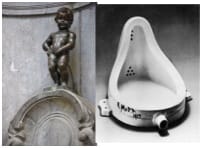
Marcel Duchamp's fountain and "Manikken Pis" Similar idea, Manikken is better executed, IMHO.

Marcel Duchamp’s fountain and “Manikken Pis.”

Any mention of dada should also, I suppose, mention Duchamp’s fountain (at right, signed fancifully by R. Mutt). In 2004, fountain was voted “the most influential artwork of the 20th century” by a panel of artists and art historians. The basic idea was to show the slight difference between art and not-art (to be something, there has to be a non-something, as in this joke). Beyond this, the idea would be that same as for the Manikken Pis sculpture in Brussels. Duchamp’s was done with a lot less work — just by signing a “found object.” He submitted the work for exhibition in 1917, but it was rejected as not being art — proving, I guess, the point. Fountain is related to man: his life, needs, and vain ambitions; it’s sort-of beautiful, so why ain’t it art? (It has something to do with skill, I’d say.)

Duchamp designed two major surrealist exhibitions — a similar approach, but surrealism typically employs more skill and humor than Dada, with less shock. Below is another famous work of dada, Oppenheim’s fur-lined tea-cup (Breakfast in fur — see it at the Modern Museum in NYC) compared to a wonderful (and in my mind similar) surreal work, “Ruby lips” by Dali. Oppenheim made the tea-cup and spoon disgusting by making it out of a richer material, fur. That’s really cool, and sort-of shocking, even today.

Duchap's tea cup (left), and Dali's ruby lips (right). Similar ideas treated as Dada or Surreal.

Meret Oppenheim’s fur tea-cup (Breakfast in fur) and Dali’s ruby lips; the same idea (I think); dada vs surreal.

Dali’s “ruby libs” brooch took more skill than gluing fur to a cup and spoon; that adds to the humor, I’d say, but took from the shock. It’s made from real rubies and pearls: hard materials for something that should be soft; it’s sort of disgusting this way, and the message is more or less the same as Oppenheim’s, I’d say, but the message gets a little lost in the literal joke (pearly teeth, ruby lips…). I could imagine someone wearing Dali’s brooch, but no one would use the fur-lined cup. 

There is a lot of bad dada, too unfortunately, and it tends to be awful: incomprehensible, trite, or advertising. An unfortunate tendency is to collect some found pieces of garbage, and set it out in an attempt to scandalize the art world, or put down “the man” for his closed mindset. But that’s fountain, and it’s been done. A key way to tell if it’s good dada — is it cool; is it something that makes you say “Wow.” Christo’s surrounded islands certainly have the wow-cool factor, IMHO. 

Christo's wrapped Islands. Islands near Miami Beach wrapped in pink (fuscha) plastic.

Christo’s surrounded Islands: Islands near Miami Beach wrapped in pink (fuchsia) plastic.

A nice thing about Christo is that he takes it down 2 weeks or so after he makes the sculptures. Thus, the wow factor of his work never has a chance to go stale. Sorry to say, most dada stays around. Duchamp’s “fountain” sits in a museum and has grown stale, at least to me and Duchamp. What was scandalous and shocking in 1917 is passé and boring in 2014. The decline in shock is somewhat less for “breakfast in fur,” I think because the work is better crafted, a benefit I see in “Attention” too; skill matters.

Paris Street art. I don't know the artist, but it's cool.

Paris Street art; it’s just cool.

At the height of his success, Duchamp left art for 30 years and played chess. He became a chess grand master (life is as strange as art) and played for France in international tournaments. He later came back to art and did one, last, final piece, a very fine one, seen only through a peephole. Here’s some further thoughts on good vs bad modern art, and on surrealism, and on the aesthetic of strength in engineering: what materials to use; how strong should it be, and on architecture humor. 

Robert E. Buxbaum. April 4-7, 2014. Here is a link to my attempt at good Dada: Kilroy with eyes that follow you, and at right some Paris street art that I consider good dada too. As far as what the word “dada” means, I translate it as “cool,” “wow,” “gnarly,” or “go go.” It’s dada, man, y’ dig?

Einstein’s fuzzy slippers — and a fetish lawyer joke

First, the joke about the fetishistic lawyer: He got off on a technicality.

Get it?  it’s a double entendre, like this zen joke, a multi-word, sexual homophone (no insult  to the homophone community). It also relates to a fact as true and significant as any in life. What a person considers enjoyable, fun (or not) depends mostly on what’s in his mind. Whether judging sexy or scary; pleasant or disagreeable, it has relatively little to do with a physical reality, and is mostly in the imagination of the person. As a result, the happiest people seem to be those who embrace their inner weirdness. They try to find jobs that they are good at, that allow them to take perverse pleasure in their own weird way within the bounds of a civil society.

Take pleasure in your own weirdness.

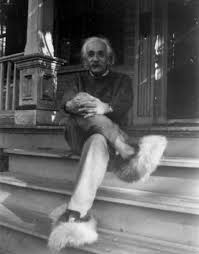
Einstein in fuzzy slippers outside of his Princeton home; take pleasure in your own weirdness.

Einstein, at left, seems to have enjoyed doing physics, playing the violin, and wearing odd clothes: sweaters, and these (pink) fuzzy slippers. the odd clothes didn’t detract from his physics, and may have even helped him think. Boris Spassky (the Russian chess champion) was asked which he preferred: sex or chess, he said: “it very much depends on the position.” Do what you like, and like what you do. As the old joke goes, “I don’t suffer from insanity: I enjoy every moment.”

Robert Buxbaum. April 1, 2014; I mostly blog about science and hydrogen, but sometimes, like here, about personal relations, or last week economics (dismal). Here’s a thermodynamic look at life. And a picture of an odd sculpture I made. I take my own advice, by the way: this blog doesn’t get me any money but it’s fun, and maybe I’ll help some day — e.g. maybe it’ll spark my creativity. Here’s a bit about Einstein’s mustache, and the universe being curved in.

In praise of tariffs

In a previous post I noted that we could reduce global air pollution if we used import taxes (tariffs) to move manufacture to the US from China and other highly polluting countries. It strikes me that import tariffs can have other benefits too, they can keep US jobs in the US, provide needed taxes, and they’re a tool of foreign policy. We buy far more from China and Russia than they buy from us, and we get a fair amount of grief — especially from Russia. An appropriate-sized tariff should reduce US unemployment, help balance the US, and help clean the air while pushing Russia in an alternative to war-talk.

There is certainly such a thing as too high a tariff, but it seems to me we’re nowhere near that. Too high a tariff is only when it severely limits the value of our purchasing dollar. We can’t eat dollars, and want to be able to buy foreign products with them. Currently foreign stuff is so cheap thought, that what we import is most stuff we used to make at home — often stuff we still make to a small extent, like shoes, ties, and steel. An import tax can be bad when it causes other countries to stop buying from us, but that’s already happened. Except for a very few industries, Americans buy far more abroad than we sell. As a result, we have roughly 50% of Americans out of well-paying work, and on some form government assistance. Our government spends far more to care for us, and to police and feed the world than it could possibly take in, in taxes. It’s a financial imbalance that could be largely corrected if we bought more from US manufacturers who employ US workers who’d pay taxes and not draw unemployment. Work also benefits folks by developing, in them, skills and self-confidence.

Cartoon by Daryl Cagle. Now why is Russia a most favorable trade partner?

Cartoon by Daryl Cagle. Trade as foreign policy. Why is Russia a most favorable trade partner?

In a world without taxes or unemployment, and free of self-confidence issues, free trade might be ideal, but taxes and unemployment are a big part of US life. US taxes pay for US roads and provide for education and police. Taxes pay for the US army, and for the (free?) US healthcare. With all these tax burdens, it seems reasonable to me that foreign companies should pay at least 5-10% — the amount an American company would if the products were made here. Tariff rates could be adjusted for political reasons (cartoon), or environmental — to reduce air pollution. Regarding Russia, I find it bizarre that our president just repealed the Jackson Vanik tariff, thus giving Russia most favored trade status. We should (I’d think) reinstate the tax and ramp it up or down if Russia invades again or if they help us with Syria or Iran.

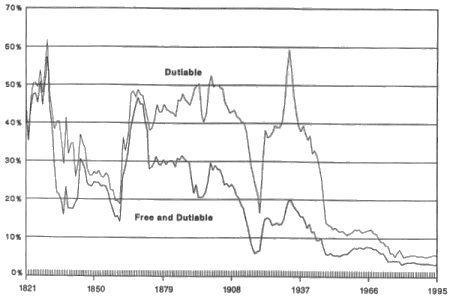
A history of US tariff rates. There is room to put higher tariffs on some products or some countries.

A history of US tariff rates. Higher rates on some products and some countries did not harm the US for most of our history.

For most of US history, the US had much higher tariffs than now, see chart. In 1900 it averaged 27.4% and rose to 50% on dutiable items. Our economy did OK in 1900. By 1960, tariffs had decreased to 7.3% on average (12% on duty-able) and the economy was still doing well. Now our average tariff is 1.3%, and essentially zero for most-favored nations, like Russia. Compare this to the 10% that New York applies to in-state sales, or the 6% Michigan applies, or the 5.5% that Russia applies to goods imported from the US. Why shouldn’t we collect at least as high a tax on products bought from the non-free, polluting world as we collect from US manufacturers.

Some say tariffs caused the Great Depression. Countries with lower tariffs saw the same depression. Besides the Smoot-Hawley was 60%, and I’s suggesting 5-10% like in 1960. Many countries today do fine today with higher tariffs than that.

Robert E. Buxbaum, March 25, 2014. Previous historical posts discussed the poor reviews of Lincoln’s Gettysburg address, and analyzed world war two in terms of mustaches. I’ve also compared military intervention to intervening in a divorce dispute. My previous economic post suggested that Detroit’s very high, living wage hurt the city by fostering unemployment.

Seeing entropy, the most important pattern in life

One evening at the Princeton grad college a younger fellow (an 18-year-old genius) asked the most simple, elegant question I had ever heard, one I’ve used ever since: “tell me”, he asked, “something that’s important and true.” My answer was that the entropy of the universe is always increasing. It’s a fundamentally important pattern, one I discovered to have a lot of applications and meaning. Let me explain the concept and why it’s true and useful. After that, why I find it’s meaningful.

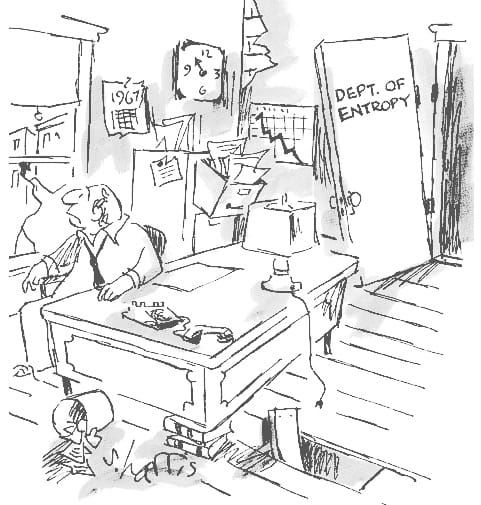
Famous entropy cartoon, Harris

Famous entropy cartoon, Harris

The entropy of the universe is not something you can measure directly, but indirectly, from the availability of work in any corner of it. It’s related to randomness and the arrow of time. If you have, for example, an ice cube and a hot cup of water, you can get useful work from these by way of a thermocouple placed between them. You’ll get work until the two are at the same temperature. To get useful work out, you’ll have to add some other item.

Now, here’s how you can tell if time is moving forward: put an ice-cube into hot water, if the cube dissolves and the water becomes cooler, time is moving forward — or, at least it’s moving in the same direction as you are. If you can reach into a cup of warm water and pull out an ice-cube while making the water hot, time is moving backwards. — or rather, you are living backwards. Within any closed system, one where you don’t add things or energy (sunlight say), you can tell that time is moving forward because the forward progress of time always leads to the lack of availability of work. In the case above, you generated some electricity from the ice-cube and the hot water, but could not from the glass of warm water at the end.

You can not extract work from a heat source alone; to extract work some heat must be deposited in a cold sink. At best the entropy of the universe remains unchanged. More typically, it increases.

You can not extract work from a heat source alone; to extract work some heat must be deposited in a cold sink. At best the entropy of the universe remains unchanged.

This observation is about as general and fundamental as any to understanding the world; it is the basis of the second law of thermodynamics: you can never extract useful work from a uniform temperature item, by making that item cooler say. To get useful work, you always need to make something else hotter, or colder, or you have to provide some chemical, altitude or other change that can not be reversed without adding more energy back. Thus, so long as time moves forward, everything “runs down” in terms of work availability.

The concept of entropy is the result of this observation along with another observation that energy is conserved. That is, if you want to heat some uniform substance, you must put in work and/or heat in any combination. And, if you want to cool something back to the original state, that same amount of heat + work must be taken out. In equation form, we say that, for any change, q +w is constant, where q is heat, and w is work. It’s the sum that’s constant, not the individual values so long as you count every 4.174 Joules of work as if it were 1 calorie of heat. If you input more heat, you have to add less work, and visa versa, but it’s always the same sum. When adding heat or work to the substance, we say that q or w is positive; when extracting heat or work, we say that q or w are negative quantities. So long as each 4.174 joules counts as if it were 1 calorie you get the same temperature change. This conservation of energy observation is called the first law of thermodynamics.

Now, since for every path between two states, q +w is the same, we say that q + w represents a path-independent quantity for the system, one we call internal energy, U where ∆U = q + w. This is a mathematical form of the first law of thermodynamics: you can’t take q + w out of nothing, or add it to something without making a change in the properties of the thing. The only way to leave things the same is if q + w = 0. We notice also that for any pure thing or uniform mixture undergoing a temperature change, the sum q +w that is needed to make that temperature change is proportional to the mass of the stuff. We can thus say that internal energy is an intensive quality. q + w = n ∆u where n is the grams of material, and ∆u is the change in internal energy per gram.

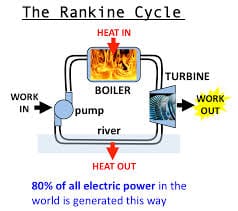
We are now ready to put the first and second laws together. We find we can extract work from a system if we take heat from a hot body (the hot water, say) and deliver some of it to something at a lower temperature (the ice-cube say). This can be done with a thermocouple, as above, or with a steam engine (Rankine cycle, shown above), or a Sterling engine, etc. These engines extract work only when there is a difference of temperatures. It’s is similar to a water wheel: a water wheel can extract work only when there is a flow of water from a high level to low; similarly in a heat engine, you only get work by taking heat energy from a hot heat-source and exhausting some of it to at a lower temperature. The remainder of that heat energy leaves the engine as work. That is, q1 -q2 = w. energy is always conserved. If you returned the amount of heat and work, you could return the hot source to its original condition. The second law isn’t violated either; there is no way you could run the engine without the cold sink. Accepting this as reasonable, we can now derive some very interesting, non-obvious truths.

We begin with the famous Carnot cycle. The Carnot cycle is an idealized heat engine with the interesting feature that it can be made to operate reversibly. That is, you can make it run forwards, taking a certain amount of work from a hot source, producing a certain amount of work and delivering a certain amount of heat to the cold sink; and you can run the same process backwards, as a refrigerator, taking in the same about of work and the same amount of heat from the cold sink and delivering the same amount to the hot source. Carnot showed by the following proof that all other reversible engines would have the same efficiency as his cycle and no engine, reversible or not, could be more efficient. The proof: if an engine could be designed that will extract a greater percentage of the heat as work when operating between a given hot source and cold sink it could be used to drive his Carnot cycle backwards. If the pair of engines were now combined so that the less efficient engine removed exactly as much heat from the sink as the more efficient engine deposited, the excess work produced by the more efficient engine would leave with no effect besides cooling the source. This combination would be in violation of the second law, something that we’d said was impossible.

Now let us try to understand the relationship that drives useful energy production. The ratio of heat in to heat out has got to be a function of the in and out temperatures alone. That is, q1/q2 = f(T1, T2). Similarly, q2/q1 = f(T2,T1) Now lets consider what happens when two Carnot cycles are placed in series between T1 and T2, with the middle temperature at Tm. For the first engine, q1/qm = f(T1, Tm), and similarly for the second engine qm/q2 = f(Tm, T2). Combining these we see that q1/q2 = (q1/qm)x(qm/q2) and therefore f(T1, T2) must always equal f(T1, Tm)x f(Tm/T2) =f(T1,Tm)/f(T2, Tm). In this relationship we see that the second term Tm is irrelevant; it is true for any Tm. We thus say that q1/q2 = T1/T2, and this is the limit of what you get at maximum (reversible) efficiency. You can now rearrange this to read q1/T1 = q2/T2 or to say that work, W = q1 – q2 = q2 (T1 – T2)/T2.

A strange result from this is that, since every process can be modeled as either a sum of Carnot engines, or of engines that are less-efficient, and since the Carnot engine will produce this same amount of reversible work when filled with any substance or combination of substances, we can say that this outcome: q1/T1 = q2/T2 is independent of path, and independent of substance so long as the process is reversible. We can thus say that for all substances there is a property of state, S such that the change in this property is ∆S = ∑q/T for all the heat in or out. In a more general sense, we can say, ∆S = ∫dq/T, where this state property, S is called the entropy. Since as before, the amount of heat needed is proportional to mass, we can say that S is an intensive property; S= n s where n is the mass of stuff, and s is the entropy change per mass. 

Another strange result comes from the efficiency equation. Since, for any engine or process that is less efficient than the reversible one, we get less work out for the same amount of q1, we must have more heat rejected than q2. Thus, for an irreversible engine or process, q1-q2 < q2(T1-T2)/T2, and q2/T2 is greater than -q1/T1. As a result, the total change in entropy, S = q1/T1 + q2/T2 >0: the entropy of the universe always goes up or stays constant. It never goes down. Another final observation is that there must be a zero temperature that nothing can go below or both q1 and q2 could be positive and energy would not be conserved. Our observations of time and energy conservation leaves us to expect to find that there must be a minimum temperature, T = 0 that nothing can be colder than. We find this temperature at -273.15 °C. It is called absolute zero; nothing has ever been cooled to be colder than this, and now we see that, so long as time moves forward and energy is conserved, nothing will ever will be found colder.

Typically we either say that S is zero at absolute zero, or at room temperature.

We’re nearly there. We can define the entropy of the universe as the sum of the entropies of everything in it. From the above treatment of work cycles, we see that this total of entropy always goes up, never down. A fundamental fact of nature, and (in my world view) a fundamental view into how God views us and the universe. First, that the entropy of the universe goes up only, and not down (in our time-forward framework) suggests there is a creator for our universe — a source of negative entropy at the start of all things, or a reverser of time (it’s the same thing in our framework). Another observation, God likes entropy a lot, and that means randomness. It’s his working principle, it seems.

But before you take me now for a total libertine and say that since science shows that everything runs down the only moral take-home is to teach: “Let us eat and drink,”… “for tomorrow we die!” (Isaiah 22:13), I should note that his randomness only applies to the universe as a whole. The individual parts (planets, laboratories, beakers of coffee) does not maximize entropy, but leads to a minimization of available work, and this is different. You can show that the maximization of S, the entropy of the universe, does not lead to the maximization of s, the entropy per gram of your particular closed space but rather to the minimization of a related quantity µ, the free energy, or usable work per gram of your stuff. You can show that, for any closed system at constant temperature, µ = h -Ts where s is entropy per gram as before, and h is called enthalpy. h is basically the potential energy of the molecules; it is lowest at low temperature and high order. For a closed system we find there is a balance between s, something that increases with increased randomness, and h, something that decreases with increased randomness. Put water and air in a bottle, and you find that the water is mostly on the bottom of the bottle, the air is mostly on the top, and the amount of mixing in each phase is not the maximum disorder, but rather the one you’d calculate will minimize µ.

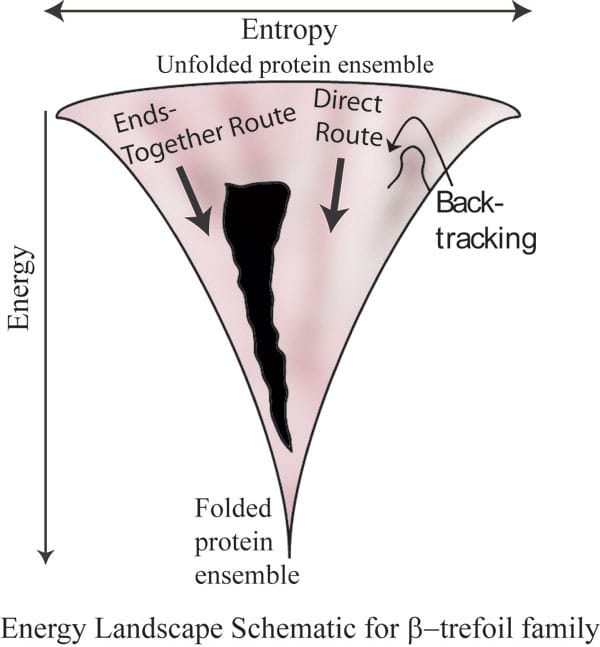
As the protein folds its randomness and entropy decrease, but its enthalpy decreases too; the net effect is one precise fold that minimizes µ.

As a protein folds its randomness and entropy decrease, but its enthalpy decreases too; the net effect is one precise fold that minimizes µ.

This is the principle that God applies to everything, including us, I’d guess: a balance. Take protein folding; some patterns have big disorder, and high h; some have low disorder and very low h. The result is a temperature-dependent  balance. If I were to take a moral imperative from this balance, I’d say it matches better with the sayings of Solomon the wise: “there is nothing better for a person under the sun than to eat, drink and be merry. Then joy will accompany them in their toil all the days of the life God has given them under the sun.” (Ecclesiastes 8:15). There is toil here as well as pleasure; directed activity balanced against personal pleasures. This is the µ = h -Ts minimization where, perhaps, T is economic wealth. Thus, the richer a society, the less toil is ideal and the more freedom. Of necessity, poor societies are repressive. 

Dr. Robert E. Buxbaum, Mar 18, 2014. My previous thermodynamic post concerned the thermodynamics of hydrogen production. It’s not clear that all matter goes forward in time, by the way; antimatter may go backwards, so it’s possible that anti matter apples may fall up. On microscopic scale, time becomes flexible so it seems you can make a time machine. Religious leaders tend to be anti-science, I’ve noticed, perhaps because scientific miracles can be done by anyone, available even those who think “wrong,” or say the wrong words. And that’s that, all being heard, do what’s right and enjoy life too: as important a pattern in life as you’ll find, I think. The relationship between free-energy and societal organization is from my thesis advisor, Dr. Ernest F. Johnson.

Ivanpah’s solar electric worse than trees

Recently the DoE committed 1.6 billion dollars to the completion of the last two of three solar-natural gas-electric plants on a 10 mi2 site at Lake Ivanpah in California. The site is rated to produce 370 MW of power, in a facility that uses far more land than nuclear power, at a cost significantly higher than nuclear. The 3900 MW Drax plant (UK) cost 1.1 Billion dollars, and produces 10 times more power on a much smaller site. Ivanpah needs a lot of land because its generators require 173,500 billboard-size, sun-tracking mirrors to heat boilers atop three 750 foot towers (2 1/2 times the statue of liberty). The boilers feed steam to low pressure, low efficiency (28% efficiency) Siemens turbines. At night, natural gas provides heat to make the steam, but only at the same, low efficiency. Siemens makes higher efficiency turbine plants (59% efficiency) but these can not be used here because the solar oven temperature is only 900°F (500°C), while normal Siemens plants operate at 3650°F (2000°C).

The Ivanpau thermal solar-natural gas project will look like The Crescent Dunes Thermal-solar project shown here, but will be bigger.

The first construction of the Ivanpah thermal solar-natural-gas project; Each circle mirrors extend out to cover about 2 square miles of the 10mi2 site.

So far, the first of the three towers is operational, but it has been producing at only 30% of rated low-efficiency output. These are described as “growing pains.” There are also problems with cooked birds, blinded pilots, and the occasional fire from the misaligned death ray — more pains, I guess. There is also the problem of lightning. When hit by lightning the mirrors shatter into millions of shards of glass over a 30 foot radius, according to Argus, the mirror cleaning company. This presents a less-than attractive environmental impact.

As an exercise, I thought I’d compare this site’s electric output to the amount one could generate using a wood-burning boiler fed by trees growing on a similar sized (10 sq. miles) site. Trees are cheap, but only about 10% efficient at converting solar power to chemical energy, thus you might imagine that trees could not match the power of the Ivanpah plant, but dry wood burns hot, at 1100 -1500°C, so the efficiency of a wood-powered steam turbine will be higher, about 45%. 

About 820 MW of sunlight falls on every 1 mi2 plot, or 8200 MW for the Ivanpah site. If trees convert 10% of this to chemical energy, and we convert 45% of that to electricity, we find the site will generate 369 MW of electric power, or exactly the output that Ivanpah is rated for. The cost of trees is far cheaper than mirrors, and electricity from wood burning is typically cost 4¢/kWh, and the environmental impact of tree farming is likely to be less than that of the solar mirrors mentioned above. 

There is another advantage to the high temperature of the wood fire. The use of high temperature turbines means that any power made at night with natural gas will be produced at higher efficiency. The Ivanpah turbines output at low temperature and low efficiency when burning natural gas (at night) and thus output half the half the power of a normal Siemens plant for every BTU of gas. Because of this, it seems that the Ivanpah plant may use as much natural gas to make its 370 MW during a 12 hour night as would a higher efficiency system operating 24 hours, day and night. The additional generation by solar thus, might be zero. 

If you think the problems here are with the particular design, I should also note that the Ivanpah solar project is just one of several our Obama-government is funding, and none are doing particularly well. As another example, the $1.45 B solar project on farmland near Gila Bend Arizona is rated to produce 35 MW, about 1/10 of the Ivanpah project at 2/3 the cost. It was built in 2010 and so far has not produced any power.

Robert E. Buxbaum, March 12, 2014. I’ve tried using wood to make green gasoline. No luck so far. And I’ve come to doubt the likelihood that we can stop global warming.

Climate change, and the metaphysical basis of humor

It’s funny because ….. it’s metaphysical, it deals with what’s real and relevant, and what’s secondary and transient– an aspect as fundamental as it is funny. We claim we understand the real, but realize (down deep) that we don’t. A classic of old-time comedy is the clever slave, the sympathetic stooges, of the brave coward, or the most common version– the stupid person who does clever things at the right moment. A typical comic structure is to establish, early on, that this person is stupid (as well as being low, and crooked); he may say some stupid, low things, so we accept it as so, or perhaps someone in authority tells us, as in “Puddin’head Wilson”. But as the story progresses, we see the person do something clever, or show loyalty and bravery. The viewer begins to laugh because he knows that reality is sort-of this way, though our minds must keep people pigeonholed. The reader already knows, perhaps from other comedies, that the slave will turn out to be the hero, the stupid one will one-up the smart and the chicken will save the day– somehow.

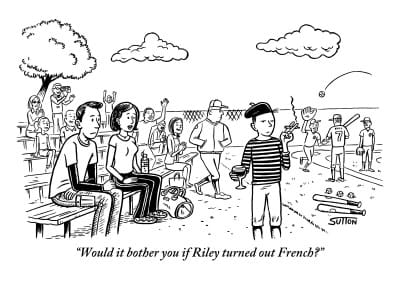
Ward Sullivan in the New Yorker

Ward Sullivan in the New Yorker. It’s unsettling when you don’t know if this is a new reality or a passing phase.

In life, we grab on to the patters we see because the alternative, chaos, is worse. All winters are cold, but will this winter be longer or shorter than normal; perhaps the groundhog knows, or perhaps the president of the US knows? We’ve learned to ignore the groundhog, but trust the president. Once we accept, from authority, that winters are getting warmer, we resist any effort to think we may be wrong, or that the pattern of the past may have changed; uncertainty seems worse. But we laugh at comedy, and occasionally get mad. How much evidence before one accepts that the temporary is permanent, or that ones original assessment was flawed? In comedy there’s always a stuffed-shirt character who tries to show off and gets hurt, perhaps by a pie in the face. Then it happens again, and again. The injuries and slow acceptance of the new reality create the humor. A common ending is to discover that the clever slave is a half-nobleman, perhaps the son of the stuffed-shirt, and the crowd goes home happy, with someone new we can trust.

With global warming and climate change, I see the same comedy being played out, and I expect it to reach the same, happy ending. For 20-30 years, till about 1998, there were a string warming winters; as a result we come to believe things will keep getting warmer. Then the president says we have to stop it, and laws are passed but not implemented; Al Gore gets a nobel prize for his efforts to stop global warming; the computer experts predict global disaster if we don’t change by 2005. The studies predict 4-6°C warming per century warming with massive flooding; we make new laws and point to shrinking of Himalayan glaciers, shrinking polar ice, and the lack of snow on Kilimanjaro — all justifications for the need to act fast and sacrifice for the future, and the warming stops. So far it’s been 16 years and no warming, the snow’s comes back to Kilimanjaro, and the seas have not risen. A few scientists start saying there may be a problem with the models, and the president gets mad about the headless chicken skeptics.

The US is then/now hit with the coldest temperatures since the early 1900s, with as much snow as 1904, but it’s never clear if this is a fluke or the new normal reality. Has the real pattern of warming changed, or maybe it never was. Kilimanjaro’s still snow-capped, the glaciers have returned to the Himalayas, and the antarctic ice swells to record size. The US sees a year with no major hurricanes.  We can laugh, but there’s no laughter from the President of The US, or the Prince of England or any who solemnly predicted disaster. Like the stuffed shirts in a comedy, they double down, and roar at the deniers; “They’re pawns of the lobbyists.” And I suspect the resolution will be that some climate denier will be crowned as the new expert, and we’ll go on to worry about a new disaster.

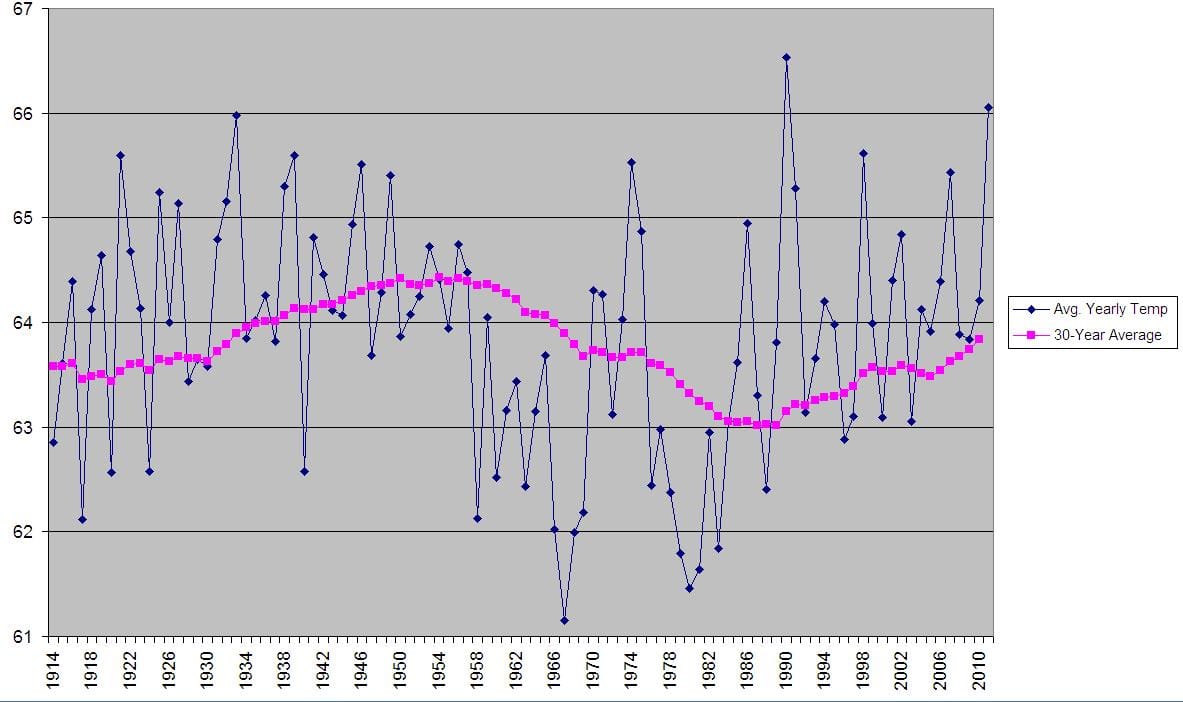
For what it’s worth, the weather seems to be chaotic (Chaos is funny); we appear to have been seeing part of a cycle that has an up-period and a down period. Something like that is shown by the 100 year plot of temperature data from Charlotte Carolina shown below.

Charlotte SC average temperatures over the last century.

Charlotte SC average temperatures over the last century. Perhaps the recent warming is part of a cycle. Is it clear there has been a change in climate. If so, where does the change start?

Robert E. Buxbaum, March 9, 2014. Surrealism is funny because it taps into the ridiculousness of life. Metaphysics humor is behind a statistics joke, an architecture cartoon, and my zen joke.  Physics is funny too.

Nuclear fusion

I got my PhD at Princeton University 33 years ago (1981) working on the engineering of nuclear fusion reactors, and I thought I’d use this blog to rethink through the issues. I find I’m still of the opinion that developing fusion is important as the it seems the best, long-range power option. Civilization will still need significant electric power 300 to 3000 years from now, it seems, when most other fuel sources are gone. Fusion is also one of the few options for long-range space exploration; needed if we ever decide to send colonies to Alpha Centauri or Saturn. I thought fusion would be ready by now, but it is not, and commercial use seems unlikely for the next ten years at least — an indication of the difficulties involved, and a certain lack of urgency.

Oil, gas, and uranium didn’t run out like we’d predicted in the mid 70s. Instead, population growth slowed, new supplies were found, and better methods were developed to recover and use them. Shale oil and fracking unlocked hydrocarbons we thought were unusable, and nuclear fission reactors got better –safer and more efficient. At the same time, the more we studied, the clearer it came that fusion’s technical problems are much harder to tame than uranium fission’s.

Uranium fission was/is frighteningly simple — far simpler than even the most basic fusion reactor. The first nuclear fission reactor (1940) involved nothing more than uranium pellets in a pile of carbon bricks stacked in a converted squash court at the University of Chicago. No outside effort was needed to get the large, unstable uranium atoms split to smaller, more stable ones. Water circulating through the pile removed the heat released, and control was maintained by people lifting and lowering cadmium control rods while standing on the pile.

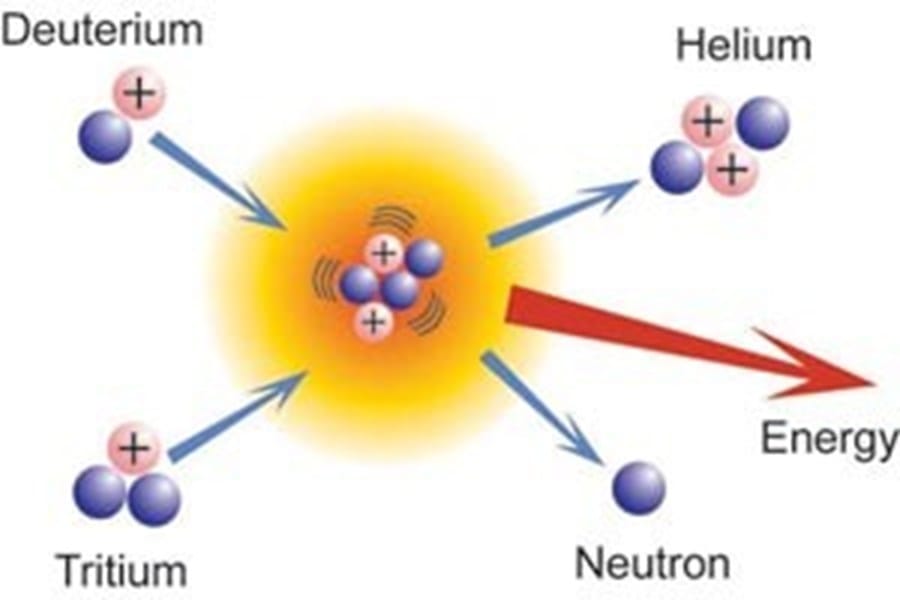
A fusion reactor requires high temperature or energy to make anything happen. Fusion energy is produced by combining small, unstable heavy hydrogen atoms into helium, a bigger more stable one, see figure. To do this reaction you need to operate at the equivalent of about 500,000,000 degrees C, and containing it requires (typically) a magnetic bottle — something far more complex than a pile of graphic bricks. The reward was smaller too: “only” about 1/13th as much energy per event as fission. We knew the magnetic bottles were going to be tricky, e.g. there was no obvious heat transfer and control method, but fusion seemed important enough, and the problems seemed manageable enough that fusion power seemed worth pursuing — with just enough difficulties to make it a challenge.

Basic fusion reaction: deuterium + tritium react to give helium, a neutron and energy.

Basic fusion reaction: deuterium + tritium react to give helium, a neutron and energy.

The plan at Princeton, and most everywhere, was to use a TOKAMAK, a doughnut-shaped reactor like the one shown below, but roughly twice as big; TOKAMAK was a Russian acronym. The doughnut served as one side of an enormous transformer. Hydrogen fuel was ionized into a plasma (a neutral soup of protons and electrons) and heated to 300,000,000°C by a current in the TOKOMAK generated by varying the current in the other side of the transformer. Plasma containment was provided by enormous magnets on the top and bottom, and by ring-shaped magnets arranged around the torus.

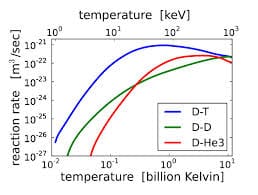
As development went on, we found we kept needing bigger and bigger doughnuts and stronger and stronger magnets in an effort to balance heat loss with fusion heating. The number density of hydrogen atoms per volume, n, is proportional to the magnetic strength. This is important because the fusion heat rate per volume is proportional to n-squared, n2, while heat loss is proportional to n divided by the residence time, something we called tau, τ. The main heat loss was from the hot plasma going to the reactor surface. Because of the above, a heat balance ratio was seen to be important, heat in divided by heat out, and that was seen to be more-or-less proportional to nτ. As the target temperatures increased, we found we needed larger and larger nτ reactors to make a positive heat balance. And this translated to ever larger reactors and ever stronger magnetic fields, but even here there was a limit, 1 billion Kelvin, a thermodynamic temperature where the fusion reaction went backward and no energy was produced. The Princeton design was huge, with super strong, super magnets, and was operated at 300 million°C, near the top of the reaction curve. If the temperature went above or below this temperature, the fire would go out. There was no room for error, but relatively little energy output per volume — compared to fission.

Fusion reaction options and reaction rates.

Fusion reaction options and reaction rates.

The most likely reaction involved deuterium and tritium, referred to as D and T. This was the reaction of the two heavy isotopes of hydrogen shown in the figure above — the same reaction used in hydrogen bombs, a point we rarely made to the public. For each reaction D + T –> He + n, you get 17.6 million electron volts (17.6 MeV). This is 17.6 million times the energy you get for an electron moving over one Volt, but only 1/13 the energy of a fission reaction. By comparison, the energy of water-forming, H2 + 1/2 O2 –> H2O, is the equivalent of two electrons moving over 1.2 Volts, or 2.4 electron volts (eV), some 8 million times less than fusion.

The Princeton design involved reacting 40 gm/hr of heavy hydrogen to produce 8 mol/hr of helium and 4000 MW of heat. The heat was converted to electricity at 38% efficiency using a topping cycle, a modern (relatively untried) design. Of the 1500 MWh/hr of electricity that was supposed to be produced, all but about 400 MW was to be delivered to the power grid — if everything worked right. Sorry to say, the value of the electricity did not rise anywhere as fast as the cost of the reactor and turbines. Another problem: 1100 MW was more than could be easily absorbed by any electrical grid. The output was high and steady, and could not be easily adjusted to match fluctuating customer demand. By contrast a coal plant’s or fuel cell’s output could be easily adjusted (and a nuclear plant with a little more difficulty).

Because of the need for heat balance, it turned out that at least 9% of the hydrogen had to be burnt per pass through the reactor. The heat lost per mol by conduction to the wall was, to good approximation, the heat capacity of each mol of hydrogen ions, 82 J/°C mol, times the temperature of the ions, 300 million °C divided by the containment time, τ. The Princeton design was supposed to have a containment of about 4 seconds. As a result, the heat loss by conduction was 6.2 GW per mol. This must be matched by the molar heat of reaction that stayed in the plasma. This was 17.6 MeV times Faraday’s constant, 96,800 divided by 4 seconds (= 430 GW/mol reacted) divided by 5. Of the 430 GW/mol produced in fusion reactions only 1/5 remains in the plasma (= 86 GW/mol) the other 4/5 of the energy of reaction leaves with the neutron. To get the heat balance right, at least 9% of the hydrogen must react per pass through the reactor; there were also some heat losses from radiation, so the number is higher. Burn more or less percent of the hydrogen and you had problems. The only other solution was to increase τ > 4 seconds, but this meant ever bigger reactors.

There was also a material handling issue: to get enough fuel hydrogen into the center of the reactor, quite a lot of radioactive gas had to be handled — extracted from the plasma chamber. These were to be frozen into tiny spheres of near-solid hydrogen and injected into the reactor at ultra-sonic velocity. Any slower and the spheres would evaporate before reaching the center. As 40 grams per hour was 9% of the feed, it became clear that we had to be ready to produce and inject 1 pound/hour of tiny spheres. These “snowballs-in-hell” had to be small so they didn’t dampen the fire. The vacuum system had to be able to be big enough to handle the lb/hr or so of unburned hydrogen and ash, keeping the pressure near total vacuum. You then had to purify the hydrogen from the ash-helium and remake the little spheres that would be fed back to the reactor. There were no easy engineering problems here, but I found it enjoyable enough. With a colleague, I came up with a cute, efficient high vacuum pump and recycling system, and published it here.

Yet another engineering challenge concerned the difficulty of finding a material for the first-wall — the inner wall of the doughnut facing the plasma. Of the 4000 MW of heat energy produced, all the conduction and radiation heat, about 1000 MW is deposited in the first wall and has to be conducted away. Conducting this heat means that the wall must have an enormous coolant flow and must withstand an enormous amount of thermal stress. One possible approach was to use a liquid wall, but I’ve recently come up with a rather nicer solid wall solution (I think) and have filed a patent; more on that later, perhaps after/if the patent is accepted. Another engineering challenge was making T, tritium, for the D-T reaction. Tritium is not found in nature, but has to be made from the neutron created in the reaction and from lithium in a breeder blanket, Li + n –> He + T. I examined all possible options for extracting this tritium from the lithium at low concentrations as part of my PhD thesis, and eventually found a nice solution. The education I got in the process is used in my, REB Research hydrogen engineering business.

Man inside the fusion reactor doughnut at ITER. He'd better leave before the 8,000,000°C plasma turns on.

Man inside the fusion reactor doughnut at ITER. He’d better leave before the 8,000,000°C plasma turns on.

Because of its complexity, and all these engineering challenges, fusion power never reached the maturity of fission power; and then Three-mile Island happened and ruined the enthusiasm for all things nuclear. There were some claims that fusion would be safer than fission, but because of the complexity and improvements in fission, I am not convinced that fusion would ever be even as safe. And the long-term need keeps moving out: we keep finding more uranium, and we’ve developed breeder reactors and a thorium cycle: technologies that make it very unlikely we will run out of fission material any time soon.

The main, near term advantage I see for fusion over fission is that there are fewer radioactive products, see comparison.  A secondary advantage is neutrons. Fusion reactors make excess neutrons that can be used to make tritium, or other unusual elements. A need for one of these could favor the development of fusion power. And finally, there’s the long-term need: space exploration, or basic power when we run out of coal, uranium, and thorium. Fine advantages but unlikely to be important for a hundred years.

Robert E. Buxbaum, March 1, 2014. Here’s a post on land use, on the aesthetics of engineering design, and on the health risks of nuclear power. The sun’s nuclear fusion reactor is unstable too — one possible source of the chaotic behavior of the climate. Here’s a control joke.