Author Archives: R.E. Buxbaum

About R.E. Buxbaum

Robert Buxbaum is a life-long engineer, a product of New York's Brooklyn Technical High School, New York's Cooper Union to Science and Art, and Princeton University where he got a PhD in Chemical Engineering. From 1981 to 1991 he was a professor of Chemical Engineering at Michigan State, and now runs an engineering shop in Oak Park, outside of Detroit, Michigan. REB Research manufactures and sells hydrogen generation and purification equipment. He's married with 3 wonderful children who, he's told, would prefer to not be mentioned except by way of complete, unadulterated compliments. As of 2016, he's running to be the drain commissioner/ water resources commissioner of Oakland county.

The funeral joke.

One day, while having a latte at my favorite Starbucks, I noticed a most unusual funeral. Instead of one hearse, there were two, one after the other, moving slowly down the street. Behind the hearse, there walked a man with a dog an a leash. Perhaps 80 other men walked behind him, single file.

As this was very unusual, I went up to the man with the dog and asked about it as respectfully as I could. I don’t want to intrude on your sorrow, sir, but I couldn’t help notice this funeral procession. Who passed away, if I may ask. The man looked at me and said that the first hearse contained his wife. “She’d gotten real mad at the dog, and the dog attacked her and killed her.” “I see,” I said, but what about the second hearse? After a pause, the man said, “That’s my mother-in-law. She started to beat the dog, and and the dog went and killed her too.” There then passed a moment of silent brotherhood between me and the fellow.

“Can I borrow the dog?”

“Get in line.”

Robert Buxbaum, January 7, 2014. It’s another shaggy dog story. Long story, sort of pointless; common phrase at the end. It’s funny because it’s a mini-mystery. All the clues were there from the start. Every now and again, I post jokes: engineering jokes, buddhist jokes, a dwarf joke and a Canadian joke, art, architecture.

Of Scrooge and rising wheat production

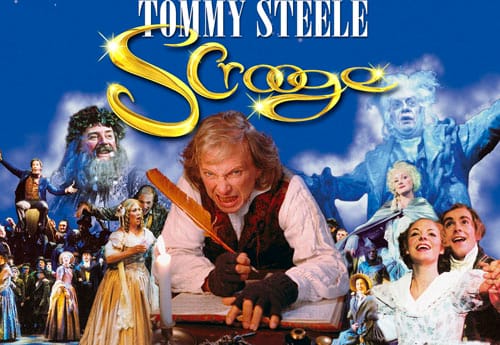
The Christmas Carol tells a tale that, for all the magic and fantasy, presents as true an economic picture of a man and his times as any in real-life history. Scrooge is a miserable character at the beginning of the tale, he lives alone in a dark house, without a wife or children, disliked by those around him. Scrooge has an office with a single employee (Bob Cratchit) in a tank-like office heated by a single lump of coal. He doesn’t associate much with friends or family, and one senses that he has few customers. He is poor by any life measure, and is likely poor relative to other bankers. At the end, through giving, he finds he enjoys life, is liked more, and (one has the sense) he may even get more business, and more money.

Scrooge (as best I can read him) believes in Malthus’s economic error of zero-sum wealth: That there is a limited amount of food, clothing, jobs, etc. and therefore Scrooge uses only the minimum, employs only the minimum, and spends only the minimum. Having more people would only mean more mouths to feed. As Scrooge says, “I can’t afford to make idle people merry. I help to support the establishments I have mentioned [the workhouses]. They cost enough, and … If they [the poor] would rather die,” said Scrooge, “they had better do it, and decrease the surplus population.”

Scrooge, the poor rich man.

Scrooge, the poor rich man with a tiny carbon footprint.

The teaching of the spirits is the opposite, and neither that of the Democrats or Republicans. Neither that a big government is needed to redistribute the wealth, nor that the free market will do everything. But, as I read it, the spirits bring a spiritual message of personal charity and happiness. That one enriches ones-self when one give of and by ones-self — just from the desire to be good and do good. The spirit of Christmas Present assures Scrooge that no famine will result from the excess population, but tells him of his 1800 brothers and shows him the unending cornucopia of food in the marketplace: spanish onions, oranges, fat chestnuts, grapes, and squab. Christmas future then shows him his funeral, and Tim’s: the dismal end of all men, rich and not:  “Will you decide what men shall live, what men shall die? It may be, that in the sight of Heaven, you are more worthless and less fit to live.” And Scrooge reforms, learns: gives a smile and a laugh, and employs a young runner to get Cratchit a fat goose. He visits his nephew Fred, a cheerful businessman for dinner, and laughs while watching Tom Topper court Fred’s plump sister-in-law.

The spirits do not redistribute Scrooge’s wealth for him, and certainly don’t present a formula for how much to give whom. Instead they present a picture of the value of joy and societal fellowship (as I read it). The spirits help Scrooge out of his mental rut so he’s sees worthy endeavors everywhere. Both hoarding and redistribution are Malthusian-Scroogian messages, as I read them. Both are based on the idea that there is only so much that the world can provide.

World wheet production

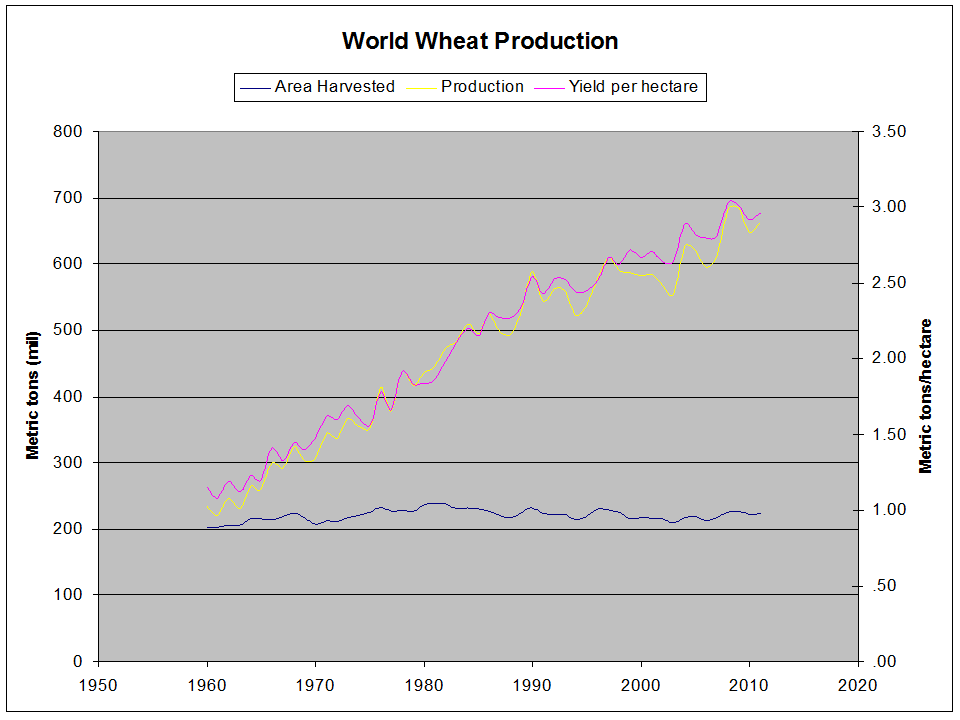
World wheat production tripled from 1960 to 2012 (faostat.fao.org), but acreage remained constant. More and more wheat from the same number of acres.

The history of food production suggests the spirits are right. The population is now three times what it was in Dickens’s day and mass starvation is not here. Instead we live among an “apoplectic opulence” of food. In a sense these are the product of new fertilizers, new tractors, and GMOs (Genetically modified organisms), but I would say it’s more the influence of better people. Plus, perhaps some extra CO2 in the air. Britons now complain about being too fat — and blame free markets for making them so. Over the last 50 years, wheat production has tripled, while the world population doubled, and the production of delicacies, like meat has expanded even faster. Unexpectedly, one sees that the opulence does not come from bringing new fields on-line — a process that would have to stop — but instead from increased production by the same tilled acres.

The opulence is not uniformly distributed, I should note. Countries that believe in Malthus and resort to hoarding or redistribution have been rewarded to see their grim prophesies fulfilled, as was Scrooge. Under Stalin, The Soviet Union redistributed grain from the unworthy farmer to the worth factory worker. The result was famine and Stalin felt vindicated by it. Even after Stalin, production never really grew under Soviet oversight, but remained at 75 Mtons/year from 1960 until the soviet collapse in 1990. Tellingly, nearly half of Soviet production was from the 3% of land under private cultivation. An unintended benefit: it appears the lack of Soviet grain was a major motivation for détente.  England had famine problems too when they enacted Malthusian “corn acts” and when they prevented worker migration Irish ownership during the potato famine. They saw starvation again under Attlee’s managed redistribution. In the US, it’s possible that behaviors like FDR scattering the bonus army may have helped prolong the depression. My sense is that the modern-day Scrooges are those against immigration “the foreigners will take our jobs,” and those who oppose paying folks on time, or nuclear and coal for fear that we will warm the planet. Their vision of America-yet-to-be matches Scrooge’s: a one-man work-force in a tank office heated by a single piece of coal.

Now I must admit that I have no simple formula for the correct charity standard. How does a nation provide enough, but not so much that it removes motivation– and the joy of success. Perhaps all I can say is that there is a best path between hoarding and false generosity. Those pushing the extremes are not helping, but creating a Dickensian world of sadness and gloom. Rejoice with me then, and with the reformed Scrooge. God bless us all, each and every one.

Robert Buxbaum, January 7, 2015. Some ideas here from Jerry Bowyer in last year’s Forbes.

What is learning?

It is common to spend the most of one’s youth in school — presumably learning something. The financial cost for primary education is a few hundred thousand dollars, borne by the state, plus 13 years or so of the student’s life. College learning costs another $50,000 to $200,000, borne by the student, plus another 4-6 years of life. The indication that you’ve learned something appears, in many majors by the ability to get a job that pays more than the school financial cost. But there is also a sense that you’ve learned something, and this is perhaps the only reward for students of film, religion, or archeology. My question is based mostly on this part: what is this learning. Is it the same as knowledge, a set of facts, or satisfaction — perhaps you could be as satisfied by ignorance or drugs. How do you evaluate the spiritual payback from 4-6 years of college? I don’t have all the answers, but ask to exercise my ignorance.

It would seem to me that an important standard of learning is that it should develop the mind and not corrupt it. But how do you recognize the difference? it seems to me one should leave with a set of mental skills should be new to you, recognizable to a normal outsider, and somewhat useful, as in the poem “Botany” even if you don’t use it. I’m not sure if the skills have to be true, by the way, or how useful they have to be. Perhaps developing a new confusion is better than having false notions — knowing that you doubt something.

sometimes education is the removal of false notions.

Sometimes learning can be the development of doubt.

If you’ve been educated in music, it seems to me you should be able to make sounds that appear pleasant to a normal listener; if you’ve been educated in mechanics, you should be able to make machines that work, and if you’ve been educated to think… perhaps then you should be able to walk into a discussion about something you once thought was true, and show that it is really false to an extent that others would accept it (and act upon it?). That is, my suspicion is that learning should involve an identifiable change –not only internal satisfaction, and I also suspect learning the new must involve unlearning the old.

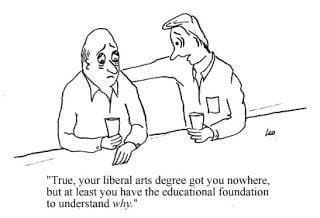
Liberal Education may not be useful, or elevating

Education that isn’t useful isn’t particularly elevating

And that leads us to facts and methods: knowledge. Facts are good, they are the fuel and  substance of learning. Without facts there is nothing for the learning to attach to. But facts are often wrong — the ignorance of others, and even when right, they can be  deceptive. If you’ve learned the moon is made of rock, or out of green cheese, it’s pretty much the same unless there is a reason to think the fact you’ve learned is true, and unless you’ve a good understanding of what the fact ‘means.’ I can imagine a rock that is organic (a gall stone) and less solid than some (old) green cheese. The word rock or cheese must mean something to you to be a fact. Similarly in all subjects; if you learn that Shakespeare is a better writer than Poe, you should have a reason to believe it, and a clear understanding of the word ‘better’ in this context.

Turning to the knowledge of methods. It seems to me that learning a new method of thought, action, or argument is a necessary component of learning– one might even call it virtue, but this too seems to have limitations if it is not directed to use. A person is half-educated if he leaves school knowing how to do geometric proofs, but never doing any, or knowing how to run a great business, but never running one. A science graduate should at least be able to use the techniques learned to demonstrate that the world is made of atoms, and that the sun does not circle the earth and perhaps more. An argument can be made for traditional education areas of logic, rhetoric, mathematics, and dialectic. But these seem useless unless they are applied to a worthy end. One should do more with the new methods than to win drawing-room arguments.

There should be some satisfaction to accomplishments, but I'm not sure how it's learned.

Learning should provide satisfaction –in particular religious learning — but it’s nicer if it goes with doing good for someone (not only the poor) and the ability to earn an honest income.

There should be a moral component of learning too, but here I feel less certain in describing it, or describing how it should be taught. Theodore Roosevelt said that “An uneducated man can steal from a rail car, “but an educated one can steal the whole railroad.” but perhaps stealing the railroad isn’t such a bad thing if it’s done legally. And as I don’t quite know when the honest stock deal is moral, I’m even more in the dark as to how to teach one to recognize the moral from the immoral in these situations. Two thoughts here: a student deserves some satisfaction from his or her learning and (from Aristotle’s Nicomachean Ethics) to be moral, the student has to earn an honest income. One who can not earn a living is bound to steal from someone sooner or later.

A final sign of learning, and perhaps it’s crown, is creativity, the ability to come to new understandings and develop new things. To do this productively requires some knowledge of the past plus an indescribable view of the future. A spark? A divine madness? Schools do not seem to be able to teach that, but it can help or hinder by either encouraging it, or beating it down. If you did not possess this ability when you entered school, you are unlikely to leave with it, even if you just did drugs, but school can teach one to direct the spark productively.

I’ve noticed that our high schools focus little on the above areas, perhaps because they are hard to test. Rather classes aim to the exams, and the exams test (as best I can tell), memorization, aptitude, and exposure. A surprisingly large fraction of our students leave diagnosed as ADHD. Still, strangely, our graduates do better than the Europeans.

Dr. Robert E. Buxbaum, December 29, 2014 (I taught in college). Here’s some advice I wrote for my 16 year old daughter in high school.

Our expanding, black hole universe

In a previous post I showed a classical derivation of the mass-to-size relationship for black -holes and gave evidence to suggest that our universe (all the galaxies together) constitute a single, large black hole. Everything is inside the black hole and nothing outside but empty space — We can tell this because you can see outside from inside a black hole — it’s only others, outside who can not see in (Finkelstein, Phys Rev. 1958). Not that there appear to be others outside the universe, but if they were, they would not be able to see us.

In several ways having a private, black hole universe is a gratifying thought. It provides privacy and a nice answer to an easily proved conundrum: that the universe is not infinitely big. The black hole universe that ends as the math requires, but not with a brick wall, as i the Hitchhiker’s guide (one of badly-laid brick). There are one or two problems with this nice tidy solution. One is that the universe appears to be expanding, and black holes are not supposed to expand. Further, the universe appears to be bigger than it should be, suggesting that it expanded faster than the speed of light at some point. its radius now appears to be 40-46 billion light years despite the universe appearing to have started as a point some 14 billion years ago. That these are deeply disturbing questions does not stop NASA and Nova from publishing the picture below for use by teachers. This picture makes little sense, but it’s found in Wikipedia and most, newer books.

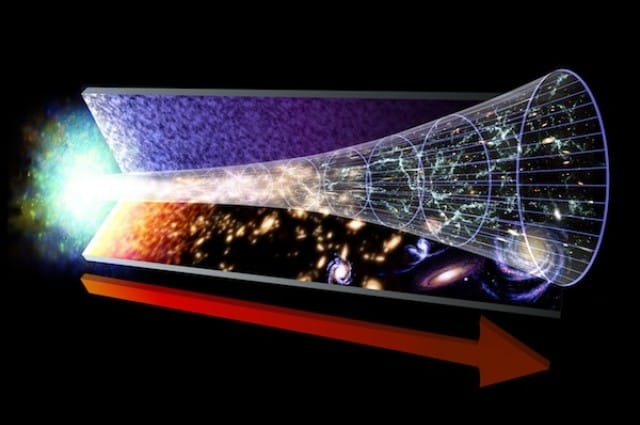
Standard picture of the big bang theory. Expansions, but no contractions.

Standard picture of the big bang theory: A period of faster than light expansion (inflation) then light-speed, accelerating expansion. NASA, and Wikipedia.

We think the creation event occurred some 14 billion years ago because we observe that the majority of galaxies are expanding from us at a rate proportional to their distance from us. From this proportionality between the rate of motion and the distance from us, we conclude that we were all in one spot some 14 billion years ago. Unfortunately, some of the most distant galaxies are really dim — dimmer than they would be if they were only 14 billion light years away. The model “explains this” by a period of inflation, where the universe expanded faster than the speed of light. The current expansion then slowed, but is accelerating again; not slowing as would be expected if it were held back by gravity of the galaxies. Why hasn’t the speed of the galaxies slowed, and how does the faster-than-light part work? No one knows. Like Dr. Who’s Tardis, our universe is bigger on the inside than seems possible.

Einstein's preferred view of the black-hole universe is one that expands and contracts at some (large) frequency. It could explain why the universe is near-uniform.

Einstein’s oscillating universe: it expands and contracts at some (large) frequency. Oscillations would explain why the universe is near-uniform, but not why it’s so big or moving outward so fast.

Einstein’s preferred view was of an infinite space universe where the mass within expands and contracts. He joked that two things were infinite, the universe and stupidity… see my explanation... In theory, gravity could drive the regular contractions to an extent that would turn entropy backward. Einstein’s oscillating model would explain how the universe is reasonably stable and near-uniform in temperature, but it’s not clear how his universe could be bigger than 14 billion light years across, or how it could continue to expand as fast as it does. A new view, published this month suggests that there are two universes, one going forward in time the other backward. The backward in time part of the universe could be antimatter, or regular matter going anti entropy (that’s how I understand it — If it’s antimatter, we’d run into the it all the time). Random other ideas float through the physics literature: that we’re connected to other space through a black hole/worm hole, perhaps to many other universes by many worm holes in fractal chaos, see for example, Physics Reports, 1992.

The forward-in-time expansion part of the two universes model.

The forward-in-time expansion part of the two universes model. This drawing, like the first, is from NASA.

For all I know, there are these many black hole  tunnels to parallel universes. Perhaps the universal constant and all these black-hole tunnels are windows on quantum mechanics. At some point the logic of the universe seems as perverse as in the Hitchhiker guide.

Something I didn’t mention yet is the Higgs boson, the so-called God particle. As in the joke, it’s supposed to be responsible for mass. The idea is that all particles have mass only by interaction with these near-invisible Higgs particles. Strong interactions with the Higgs are what make these particles heavier, while weaker – interacting particles are perceived to have less gravity and inertia. But this seems to me to be the theory that Einstein’s relativity and the 1919 eclipse put to rest. There is no easy way for a particle model like this to explain relativistic warping of space-time. Without mass being able to warp space-time you’d see various degrees of light bending around the sun, and preferential gravity in the direction of our planet’s motion: things we do not see. We’re back in 1900, looking for some plausible explanation for the uniform speed of light and Lawrence contraction of space.As likely an explanation as any the_hitchhikers_guide_to_the_galaxy

Dr. r µ ßuxbaum. December 20, 2014. The  meaning of the universe could be 42 for all I know, or just pickles down the worm hole. No religion seems to accept the 14 billion year old universe, and for all I know the God of creation has a wicked sense of humor. Carry a towel and don’t think too much.

Einstein failed high-school math –not.

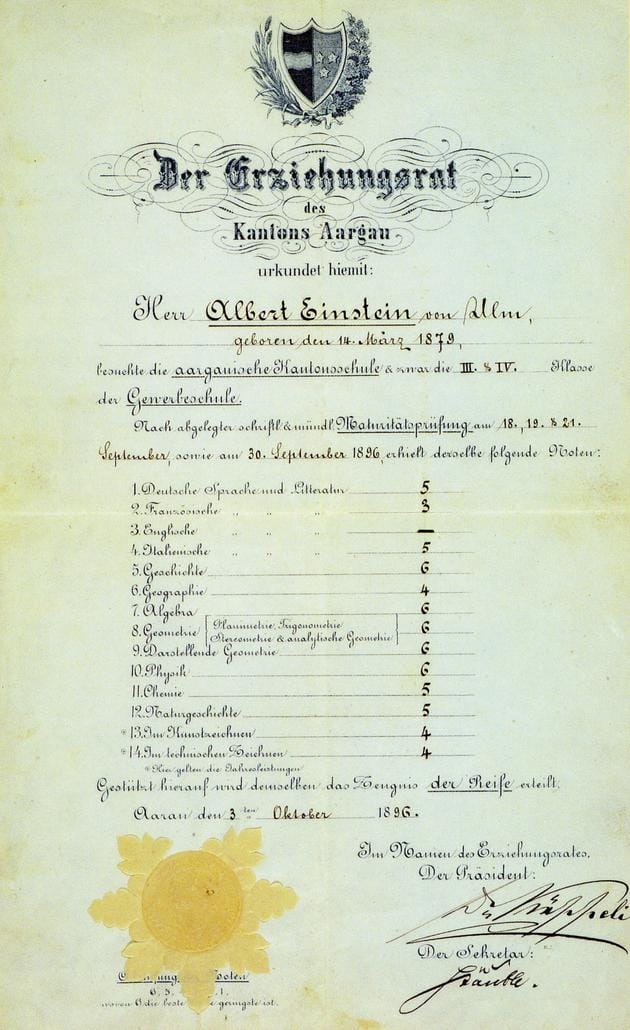
I don’t know quite why people persist in claiming that Einstein failed high school math. Perhaps it’s to put down teachers –who clearly can’t teach or recognize genius — or perhaps to stake a claim to a higher understanding that’s masked by ADHD — a disease Einstein is supposed to have had. But, sorry to say, it ain’t true. Here’s Einstein’s diploma, 1896. His math and physics scores are perfect. Only his English seems to have been lacking. He would have been 17 at the time.

Einstein's high school diploma

Albert Einstein’s high school diploma, 1896.

Robert Buxbaum, December 16, 2014. Here’s Einstein relaxing in Princeton. Here’s something on black holes, and on High School calculus for non-continuous functions.

Statistics of death and taxes — death on tax day

Strange as it seems, Americans tend to die in road accidents on tax-day. This deadly day is April 15 most years, but on some years April 15th falls out on a weekend and the fatal tax day shifts to April 16 or 17. Whatever weekday it is, about 8% more people die on the road on tax day than on the same weekday a week earlier or a week later; data courtesy of the US highway safety bureau and two statisticians, Redelmeier and Yarnell, 2014.

Forest plot of individuals in fatal road crashes over 30 years. X-axis shows relative increase in risk on tax days compared to control days expressed as odds ratio. Y-axis denotes subgroup (results for full cohort in final row). Column data are counts of individuals in crashes. Analytic results expressed with 95% confidence intervals setting control days as referent. Results show increased risk on tax day for full cohort, similar increase for 25 of 27 subgroups, and all confidence intervals overlapping main analysis. Recall that odds ratios are reliable estimates of relative risk when event rates are low from an individual driver’s perspective.

Forest plot of individuals in fatal road crashes for the 30 years to 2008  on US highways (Redelmeier and Yarnell, 2014). X-axis shows relative increase in risk on tax days compared to control days expressed as odds ratio. Y-axis denotes subgroup (results for full cohort in final row). Column data are counts of individuals in crashes (there are twice as many control days as tax days). Analytic results are 95% confidence intervals based on control days as referent. Dividing the experimental subjects into groups is a key trick of experimental design.

To confirm that the relation isn’t a fluke, the result of well-timed ice storms or football games, the traffic death data was down into subgroups by time, age, region etc– see figure. Each groups showed more deaths than on the average of the day a week before and after.

The cause appears unrelated to paying the tax bill, as such. The increase is near equal for men and women; with alcohol and without, and for those over 18 and under (presumably those under 18 don’t pay taxes). The death increase isn’t concentrated at midnight either, as might be expected if the cause were people rushing to the post office. The consistency through all groups suggests this is not a quirk of non-normal data, nor a fluke but a direct result of  tax-day itself.Redelmeier and Yarnell suggest that stress — the stress of thinking of taxes — is the cause.

Though stress seems a plausible explanation, I’d like to see if other stress-related deaths are more common on tax day — heart attack or stroke. I have not done this, I’m sorry to say, and neither have they. General US death data is not tabulated day by day. I’ve done a quick study of Canadian tax-day deaths though (unpublished) and I’ve found that, for Canadians, Canadian tax day is even more deadly than US tax day is for Americans. Perhaps heart attack and stroke data is available day by day in Canada (?).

Robert Buxbaum, December 12, 2014. I write about all sorts of stuff. Here’s my suggested, low stress income tax structure, and a way to reduce/ eliminate income taxes: tariffs– they worked till the Civil war. Here’s my thought on why old people have more fatal car accidents per mile driven.

von NotHaus, the terrorist who uttered money.

Bernard von NotHaus was sentenced two days ago, December 3, 2014 in Federal court, North Carolina on charges of terrorism for the crime of making token coinage. This crime is called uttering money in English common law, but it is not generally considered terrorism, or generally prosecuted at all in modern times. The sentencing was covered by only one newspaper, The New York Sun. The New York Times and others, I guess, found it wasn’t news fit to print. But I find it newsworthy enough to blog about.

The current price of silver (as I write) is $16.60 per ounce. Had Bernard von NotHaus limited himself to selling ordinary, one ounce, silver medallions for $20 each, he could have made money on each, and perhaps been awarded a medal for his artistry. Instead, von NotHaus stands convicted as a terrorist against the US economy. The problem: his $20 medallions include the symbol “$20” and the word “dollar” on the coins. The government’s claim is that people might come to use his silver medallions to buy $20 worth of products, and this, it was argued, could bring down the government. Also incendiary was the phrase “Trust in God.” The federal prosecutor argued this was too close to our government’s, “In God we Trust.”

A liberty dollar. The crime is terrorism by uttering money -- saying that this coin should be used as $20 currency.

A liberty $20 piece The crime is terrorism, undermining the US by suggesting people use this coin as currency.

Von NotHaus was arrested on June 6, 2009, and had his coins and metal confiscated. He was convicted of terrorism March, 2011. Among the evidence are gold coins with the image of Ron Paul and certificates with von NotHaus’s image marked as 1 Dollar negotiable currency. Making these items isn’t quite counterfeiting, as the coins and certificates don’t look like US currency, but the US government decided it’s worse: economic terrorism. Anne Tompkins, the federal prosecutor successfully argued that von NotHaus is suggesting that the currency of the US is somehow deficient, and perhaps that the president and his crowd are doing something wrong in their efforts to drive inflation by printing excess currency. Ms. Tompkins successfully argued that such “attempts to undermine the legitimate currency of this country are simply a unique form of domestic terrorism” and that they “represent a clear and present danger to the economic stability of this country.” I’d say that’s over-reacting.

The Liberty Dollar. It's not counterfeiting, but the crime of terrorism by uttering money. Printing certificates with the intent of having them used as currency.

The Liberty Dollar. It’s not counterfeiting, but terrorism. 20 of these can be exchanged for a silver coin. US currency is non-negotiable; you have no right to change

The mechanism whereby these items are supposed to undermine the economic stability is the reverse of Gresham’s law. Gresham’s law is that the worse currency will stay in circulation and the better will be driven out. Applied here, Gresham would predict that people will hoard these liberty dollars and will spend only the paper. That’s what happens with ordinary art, or gold bars. But our government’s terrorism argument assumes Gresham’s theories are wrong, and that people will hoard Obama’s paper while spending von NotHaus’s coins. On that chance, Mr. von NotHaus stands convicted of terrorism. Mr. von NotHaus’s defense is that he never claimed his medallions should be used as currency. The judge rejected this defense. For all I know, Ms Tompkins could now pursue Von NotHaus for sedition: suggesting there is something wrong with the way we pursue minters.

The Ron Paul $1000, weapon of mass destruction.

The Ron Paul, $1000 weapon of national destruction.

At sentencing yesterday, Judge Voorhees ignored rules that should have condemned von NotHause to life in prison. Instead, he ruled for 6 month’s house arrest and 3 years probation saying he didn’t believe von NotHaus was motivated by evil intent, but rather by philosophical speech (something partially protected by the first amendment). I’m always glad for lenient sentencing, especially when the argument involves freedom of speech. I’m also glad for philosophy, but that does not mean I’m happy about the outcome. To me, von NotHaus deserves a medal; he is the Rosa Parks of hard currency. And I think that’s fit to print.

Part of the reason this conviction bugs me is that I got a free education courtesy of Peter Cooper, the citizen industrialist of the 19th century who founded the greenback party. He published (uttered) $3 bread notes to advertise his cause. Robert Buxbaum is a good US citizen, who uses only non-negotiable, fiat currency; none of this negotiable stuff for me. December 5, 2014.

Hong Kong and Palestine; what makes a country?

As I write this, Hong Kong protesters are battling for a degree of independence from China — something China seemed to have agreed to when taking over the province in 1997. While there is some sympathy for the protesters, not one country so far supports them. Meanwhile, by a vote of 138 to 9, the United Nations has accepted Palestine as an independent, observer state, the same status as the Vatican and Switzerland. A majority of nations have further stated that it is illegal for Israel to erect a wall between itself and Palestine as the wall implies a de-facto border. Why the differences, and what’s wrong with borders?

Distinctive dress, traditions, or physiology can justify a country's independence, as can a military tradition.

Britain has been shaved of many of its possessions since WWII, The possessions have demanded independent nation status based on their distinctive dress, language, history, traditions, or physiology.

Perhaps a good place to start is with British ownership of Hong Kong and Israel/Palestine. Britain acquired both by war, and both were possessions during World War II. Hong Kong island was ceded to Great Britain by the Treaty of Nanking ending the first Opium War. British control of Israel/ Palestine was achieved by invasion in World War I and confirmed by the League of Nations. Following WWII, British Palestine was split into several nations: Egypt, Israel, Jordan, Saudi Arabia … Israel declared independence in 1948 — and was accepted to the United Nations in 1949 following its war of independence. Hong Kong did not fight any war, but was handed to China in 1997 in return for guarantees of autonomy. If Hong Kong had not been handed over, it would probably be independent today, like Ireland, Canada, Jamaica, Belize, Micronesia, Malaysia, Bali, Indonesia, etc.

Clearly part of the reason no one accepts Hong Kong as a country, while a majority of the UN accepts Palestine (and Israel?) as countries, is that both Arab Palestine and Israel have fought wars for independence, while Hong Kong has been a peaceful go-along. Another difference is related to how the world perceives China and Arab Palestine. China may be a semi-autocratic, one party oppressor of Inner Mongolia and Tibet, but its economic and military power helps insure that China is considered the respected, socialist owner of semi-democratic HK. Israel is much weaker, and much less-well regarded. It is viewed as a dispensable, European annoyance stuck improbably into the Middle east, and thus its claim on existence is weakened. The UN resolved in 1975 that Zionism is racism, and world leaders routinely called Israel a racist or apartheid occupier, as a state religion is considered anathema to freedom — they don’t have this problem with the state religions of the Vatican or Saudi Arabia. Ex-president Jimmy Carter calls Israel an occupier state, suggesting that Israel has no right to exist, and many western religious and academic groups agree or have voted to treat it as such. In 2013 alone, the UN passed 21 resolutions of protest against Israel, and only 3 against all other nations combined (A historical list is presented here). But disdained or not Israel goes on, in part by military might, in part by meeting the Montevideo requirements of 1933.

Comparison Hong Kong and Gaza

A map used to support Hong Kong Independence showing that Hong Kong is roughly 4 times the size of Gaza; and about twice the population. The government is more stable, and less divided too.

The UN’s grudging acceptance of Israel rests in part, on its meeting the four Montevideo conference (1933) requirements. A country must have: 1. a fixed population (more-or-less met) 2. fixed borders (war gains are an issue here, as is Palestine’s claim to all of Israel). 3. an internal government with internal control (here Israel exceeds Arab Palestine having a stable government. While Palestine manages to keep some law on a local level there are no unified elections, and only minimal education and healthcare. The two halves would likely shoot each other if they could shoot over Israel). The final Montevideo requirement, 4 is that a country must have the ability to make binding foreign treaties. This something Israel has, while neither Hong Kong nor Arab Palestine does. Both Palestine and Hong Kong are prevented from making treaties– with Israel and with China. Some in The United Nations have seen fit to waive this requirement for Palestine, but not Hong Kong.

While neither the Montevideo protocols nor the UN requires that a country must be democratic in any sense (most every country signing was a monarchy or dictatorship, and many still are (Jordan, Syria, Cuba, China….), there is a growing consensus that the age of kings is over, or ending. That a united Palestine would likely be a dictatorship, or kleptocracy thus runs afoul of another, uniquely American approach to state-hood — natural law, and the Rights of Man.

The United States, at its inception, appealed to the self-evident, Rights of Man, as a justification for its independence. That is to Justice, and to “Nature and Nature’s God.” We never claimed to have clear borders, or a fixed population, or any other Montevideo requirement. Instead we claimed nation-status by “the powers of the earth.” It was never clear what the legal limits of these powers were, not what Nature’s God demanded, but the idea is not mere poetry, but shows up throughout the policy speeches of Lincoln, Wilson, and Kennedy and Reagan. I’ve speculated that the poor reviews Lincoln got for his Gettysburg Address were due to the foreign-ness of these claims back in 1863, but 150 years later many thinkers seem to accept, at least as an ideal, that the legitimacy of a county rests on the will of its people, freely exercised. It’s a standard that hardly any country of the 19th century met, but that Israel meets, while Arab Palestine does not.

And that brings us back to the first and oldest basis of statehood: force of arms; self-preservation as a raison d’estat. If the people see death around them and are willing fight hard enough to keep out an enemy, they become a country. Even if they can not keep fixed borders, and even if they disband their army later, the fight for independence makes them so. (Micronesia has no army, but presumably would fight if they had to, and while Costa Rica had army once, the president disbanded it after he took over by military coup — it’s a threat to his life-long leadership). This view is the grim side of Nature’s law, that country is any organized horde who manage, by any means, to keep from being killed or disbanded. So long as the group survives, anywhere, it’s a nation. The Confederate States are not any sort of country, largely because the union has had such a stronger military that their army could operate against us, nor could the paramilitary remnant (the KKK) remain as an operational horde within our borders. China so over-matches Hong Kong that there can be no independent Hong Kong without China’s approval. Israel’s army, similarly, is strong enough to defeat any likely invasion or civil insurrection, though it might lose land, or gain it. It’s the dark version of natural law: the strong and vigorous survive at the expense of the weak and willing.

My observation is that neither Hong Kong nor Palestine is ready for independent statehood, via any of the justifications above, while Israel is a country by all of them. As for when to step in to create a state, my answer is only rarely; see my essay, when to enter a neighbor’s war.

Robert Buxbaum, December 4, 2014.

Seniors are not bad drivers.

Seniors cause accidents, but need to get places too

Seniors are often made fun of for confusion and speeding, but it’s not clear they speed, and it is clear they need to get places. Would reduced speed limits help them arrive alive?

Seniors have more accidents per-mile traveled than middle age drivers. As shown on the chart below, older Canadians, 75+, get into seven times more fatal accidents per mile than 35 to 55 year olds. At first glance, this would suggest they are bad drivers who should be kept from the road, or at least made to drive slower. But I’m not so sure they are bad drivers, and am pretty certain that lower speed limits should not be generally imposed. I suspect that a lot of the problem comes from the a per-mile basis comparison with folks who drive long distances on the same superhighways instead of longer, leisurely drives on country roads. I suspect that, on a per-hour basis, the seniors would look a lot safer, and on a per highway-mile basis they might look identical to younger drivers.

Canadian Vehicle Survey, 2001, Statistics Canada, includes drivers of light duty vehicles.

Deaths per billion km. Canadian Vehicle Survey, 2001, Statistics Canada, includes light duty vehicles.

Another source of misunderstanding, I find, is that comparisons tend to overlook how very low the accident rates are. The fatal accent rate for 75+ year old drivers sounds high when you report it as 20 deaths per billion km. But that’s 50,000,000 km between fatalities, or roughly one fatality for each 1300 drives around the earth. In absolute terms it’s nothing to worry about. Old folks driving provides far fewer deaths per km than 12-29 year olds walking, and fewer deaths per km than for 16-19 year olds driving.

When starting to research this essay, I thought I’d find that the high death rates were the result of bad reaction times for the elderly. I half expected to find that reduced speed limits for them helped. I’ve not found any data directly related to reduced speeds, but now think that lowered speed limits would not help them any more than anyone else. I note that seniors drive for pleasure more than younger folks and do a lot more short errand drives too — to the stores, for example. These are places where accidents are more common. By contrast, 40 to 70 year olds drive more miles on roads that are relatively safe.

Don't walk, especially if you're old.

Don’t walk, especially if you’re old. Netherlands data, 2001-2005 fatalities per billion km.

The Netherlands data above suggest that any proposed solution should not involve getting seniors out of their cars. Not only do seniors find walking difficult, statistics suggest walking is 8 to 10 times more dangerous than driving, and bicycling is little better. A far better solution, I suspect, is reduced speeds for everyone on rural roads. If you’re zipping along a one-lane road at the posted 40, 55, or 60 mph and someone backs out of a driveway, you’re toast. The high posted speeds on these roads pose a particular danger to bicyclists and motorcyclists of all ages – and these are folks who I suspect drive a lot on the rural roads. I suspect that a 5 mph reduction would do quite a lot.

For automobiles on super-highways, it may be worthwhile to increase the speed limits. As things are now, the accident fatality rates are near zero, and the main problem may be the time wasted behind the wheel – driving from place to place. I suspect that an automobile speed limit raise to 80 mph would make sense on most US and Canadian superhighways; it’s already higher on the Autobahn in Germany.

Robert Buxbaum, November 24, 2014. Expect an essay about death on tax-day, coming soon. I’ve also written about marijuana, and about ADHD.

A simple, classical view of and into black holes

Black holes are regions of the universe where gravity is so strong that light can not emerge. And, since the motion of light is related to the fundamental structure of space and time, they must also be regions where space curves on itself, and where time appears to stop — at least as seen by us, from outside the black hole. But what does space-time look like inside the black hole.

NASA's semi-useless depiction of a black hole -- one they created for educators. I'm not sure what you're supposed to understand from this.

NASA’s semi-useless depiction of a black hole — one they created for educators. Though it’s sort of true, I’m not sure what you’re supposed to understand from this. I hope to present a better version.

From our outside perspective, an object tossed into a black hole will appear to move slower as it approaches the hole, and at the hole horizon it will appear to have stopped. From the inside of the hole, the object appears to just fall right in. Some claim that tidal force will rip it apart, but I think that’s a mistake. Here’s a simple, classical way to calculate the size of a black hole, and to understand why things look like they do and do what they do.

Lets begin with light, and accept, for now, that light travels in particle form. We call these particles photons; they have both an energy and a mass, and mostly move in straight lines. The energy of a photon is related to its frequency by way of Plank’s constant. E = hν, where E is the photon energy, h is Plank’s constant and ν is frequency. The photon mass is related to its energy by way of the formula m=E/c2, a formula that is surprisingly easy to derive, and often shown as E= mc2. The version that’s relevant to photons and black holes is:

m =  hν/c2.

Now consider that gravity affects ν by affecting the energy of the photon. As a photon goes up, the energy and frequency goes down as energy is lost. The gravitational force between a star, mass M, and this photon, mass m, is described as follows:

F = -GMm/r2

where F is force, G is the gravitational constant, and r is the distance of the photon from the center of the star and M is the mass of the star. The amount of photon energy lost to gravity as it rises from the surface is the integral of the force.

∆E = – ∫Fdr = ∫GMm/r2 dr = -GMm/r

Lets consider a photon of original energy E° and original mass m°= E°/c2. If ∆E = m°c2, all the energy of the original photon is lost and the photon disappears. Now, lets figure out the height, r° such that all of the original energy, E° is lost in rising away from the center of a star, mass M. That is let calculate the r for which ∆E = -E°. We’ll assume, for now, that the photon mass remains constant at m°.

E° = GMm°/r° = GME°/c2r°.

We now eliminate E° from the equation and solve for this special radius, r°:

r° =  GM/c2.

This would be the radius of a black hole if space didn’t curve and if the mass of the photon didn’t decrease as it rose. While neither of these assumptions is true, the errors nearly cancel, and the true value for r° is double the size calculated this way.

r° = 2GM/c2

r° = 2.95 km (M/Msun).

schwarzschild

Karl Schwarzschild 1873-1916.

The first person to do this calculation was Karl Schwarzschild and r° is called the Schwarzschild radius. This is the minimal radius for a star of mass M to produce closed space-time; a black hole. Msun is the mass of our sun, sol, 2 × 1030 kg.  To make a black hole one would have to compress the mass of our sun into a ball of 2.95 km radius, about the size of a small asteroid. Space-time would close around it, and light starting from the surface would not be able to escape.

As it happens, our sun is far bigger than an asteroid and is not a black hole: we can see light from the sun’s surface with minimal space-time deformation (there is some seen in the orbit of Mercury). Still, if the mass were a lot bigger, the radius would be a lot bigger and the density would be less. Consider a black hole the same mass as our galaxy, about 1 x1012 solar masses, or 2 x 1042  kg. This number is ten times what you might expect since our galaxy is 90% dark matter. The Schwarzschild radius with the mass of our galaxy would be 3 x 1012 km, or 0.3 light years. That’s far bigger than our solar system, and about 1/20 the distance to the nearest star, Alpha Centauri. This is a very big black hole, though it is far smaller than our galaxy, 5 x 10¹⁷ km, or 50,000 light years. The density, though is not all that high.

Now let’s consider a black hole comprising 15 billion galaxies, the mass of the known universe. The folks at Cornell estimate the sum of dark and luminous matter in the universe to be 3 x 1052 kg, about 15 billion times the mass of our galaxy. This does not include the mass hidden in the form of dark energy, but no one’s sure what dark energy is, or even if it really exists. A black hole encompassing this, known mass would have a Schwarzschild radius about 4.5 billion light years, or about 1/3 the actual size of the universe when size is calculated based on its Hubble-constant age, 14 billion years. The universe may be 2-3 times bigger than this on the inside because space is curved and, rather like Dr. Who’s Tardis it’s bigger on the inside, but in astronomical terms a factor of 3 or 10 is nothing: the actual size of the known universe is remarkably similar to its Schwarzschild radius, and this is without considering the mass its dark energy must have if it exists.

Standard picture of the big bang theory. Dark energy causes the latter-stage expansion.

Standard picture of the big bang theory. Dark energy causes the latter-stage expansion.

The evidence for dark energy is that the universe is expanding faster and faster instead of slowing. See figure. There is no visible reason for the acceleration, but it’s there. The source of the energy might be some zero-point effect, but wherever it comes from, the significant amount of energy must have significant mass, E = mc2. If the mass of this energy is 3 to 10 times the physical mass, as seems possible, we are living inside a large black hole, something many physicists, including Einstein considered extremely likely and aesthetically pleasing. Einstein originally didn’t consider the possibility that the hole could be expanding, but a reviewer of one of his articles convinced him it was possible.

Based on the above, we now know how to calculate the size of a black hole of any mass, and we now know what a black hole the size of the universe would look like from the inside. It looks just like home. Wait for further posts on curved space-time. For some reason, no religion seems to embrace science’s 14 billion year old, black-hole universe (expanding or not). As for the tidal forces around black holes, they are horrific only for the small black holes that most people write about. If the black hole is big, the tidal forces are small.

 Dr. µß Buxbaum Nov 17, 2014. The idea for this post came from an essay by Isaac Asimov that I read in a collection called “Buy Jupiter.” You can drink to the Schwarzchild radius with my new R° cocktail.