Tag Archives: economics

A fair price for Bitcoin: less than $33,300.

Some 8 years ago, 2018, I calculated that a fair price for Bitcoin was likely $11,000, with a maximum of perhaps 4x more, $44,000. I used Fischer’s formula from my economics textbook, perhaps the only useful formula there. It’s based on the idea that the total currency value times the speed of money has to match the value of the things people buy with it. See the analysis here. Based on this formula, you see that, if you print more money, you get inflation — a concept that seems forgotten today.

It’s eight years later, and while there has been some inflation in the price of everything, the price of bitcoin has outstripped most everything else. After years of Bitcoin staying in the price range I’d suggested, it jumped to over $120,000 in 2025 before dropping back to $70,500. I figured I should revisit my calculations, and again find about the same result corrected for normal inflation: a “true value”, of <$33,300. I show why I value it this much, and share why, I think the market is wrong.
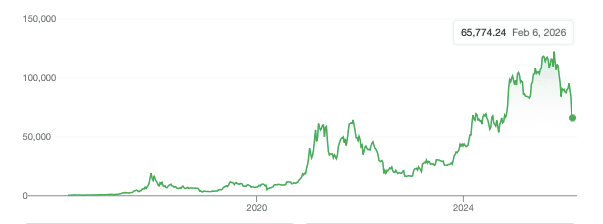
A history of Bitcoin prices

Bitcoin has only one “legitimate” use, as best I can tell, and that’s for illegal activities, like paying $6 million dollar to ransom Nancy Guthrie. The problems preventing a high bitcoin valuation, IMHO, are that there is not that much illegal trade, and there are other ways to pay for illegal things. Suitcases of cash can be used, or gold coins, or artwork. These are just as safe as bitcoin, and almost as easy to ship. For legitimate business, almost any pay method is better: easier, faster, and more secure.

Most people, I suspect, don’t use their bitcoin at all. They buy it as an investment, or as a gambling speculation, but that’s a zero-sum gamble, somewhat worse than gold, since gold have value above trade. Having no value aside from trade, Bitcoins are only as valuable as their use is.

One of the main use of bitcoin transactions is to avoid tariffs on legitimate goods – I explained how that was done, previously. I estimate the magnitude of this business to be $500 billion or so per year. The US collected about $220 billion in tariffs last year on a trillion dollars of trade, and I find it hard to believe that Bitcoins cover more than another 50%. Add to this, bitcoin is likely also used to hide payment for illegal, sanctioned oil from Iran and Russia. There are other ways to do this, but let’s assume it’s all bitcoin-trades. Since this oil trade seems to be about 8 million barrels per day, and since oil costs ~ $70 barrel, I calculate a business of $200 billion in world oil. Add a few more items that you don’t want traced: drugs, weapons, for a total of maybe $200 billion, add $100 billion to over-throw countries and for a kidnapping or two, and I find a total bitcoin trade of $1 trillion, or $1000 billion. If a bitcoin trades 1.5 times per year (a fairly low rate) the total value of bitcoin is $1000 billion /1.5 = $667 billion. Divide by the total number of bitcoins, 20 million, and I calculate a value of $33,300 per bitcoin or less.

A lot more value in bitcoins trade per year, about $10.5 trillion. The average Bitcoin price is three times higher than I estimate and it is spent 7.5 times per year. Most of this is churn: investment, plus some legitimate purchases based on illegal activity, like when the drug dealer buys a new car in Panama, but these sales are consequences of the other, illegal sales. I figured that each Bitcoin was used for an illegal purchase only 1.5 times per year because normal money is used ~4.5 times per year.

I should note that some illegal activity is done in US dollars, including most drug deals, and when Obama bought back US soldiers kidnaped by Iran, using bales of € 500 notes, and some is done using gold or silver. Bitcoin is easier to move but large quantity moves can still be traced, and there are other crypto currencies too. Bitcoin transactions aren’t free, either, or particularly cheap. And it takes time to process the transfer of bitcoin numbers, milliseconds, but that’s slow in world commerce. As a result. I don’t see bitcoin being used for legitimate business, and unless it can break out of the black market, the value seems limited to $33,300, and probably less.

Robert Buxbaum, February 15, 2026. Gold, by the way, is similarly overvalued, in my opinion. Like bitcoin, it’s a non-dividend investment that’s expensive to trade, but at least it has some other uses, as jewelry, and in electronics. Besides, it’s relatively hard to steal a billion dollars in gold from a Swiss bank – harder than stealing $1B in bitcoin.
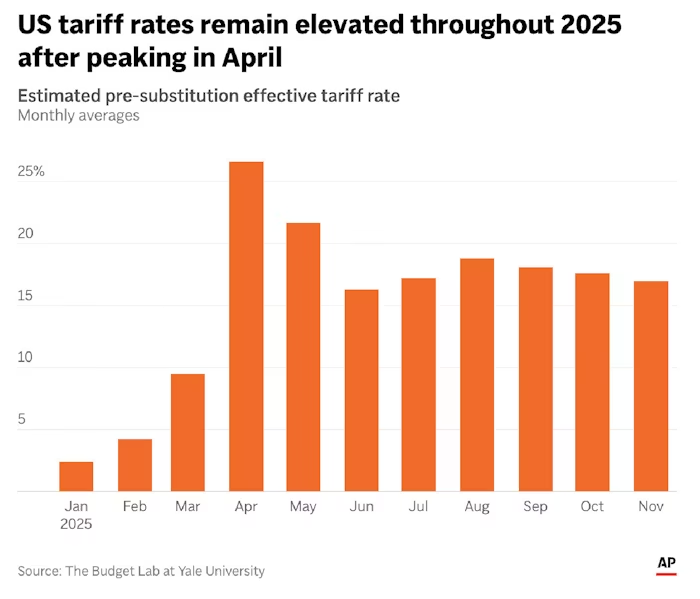
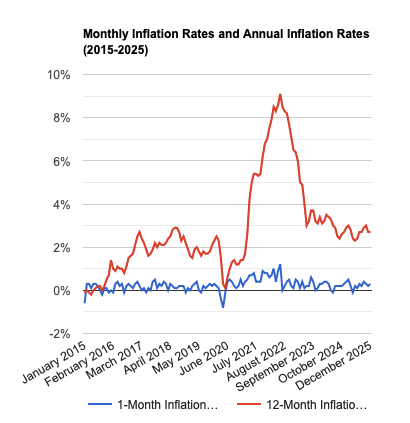
Tariffs raise $30 billion per month, but haven’t affected inflation

Economic experts claimed the tariffs would raise no signifiant money, would bring in no jobs, and would be so inflationary that the damage would far exceed any benefit. President Trump instituted them anyway, claiming they would benefit workers, raising wages, returning manufacturing to the US, and serving as a tool of diplomacy. Based on data so far, it appears the experts were completely wrong, and that Trump was right on all counts.

As an average, for the last nine months, our tariff rate has been about 17%, as shown in the chart above, bringing in about $30 billion per month. That tariff rate is as high as it’s been since the 1940s, but far lower than it was in the early 20th century. Chinese products are taxed more, at 47.5% on average, while goods from Mexico and Canada are taxed less, about 5%. High or low the tariffs generate complaints all around. Strangely, those complaining, in the US and out, see nothing amiss with the tariffs that our trading partners have placed on US products. The money from these tariffs came in handy, for example during the recent government shutdown, when we could not borrow money. This tariff money allowed us to pay the military and has helped reduce the annual deficit.

Despite the dire inflation prediction, there has been no noticeable uptick. Inflation has held constant for the last year, at about 2.7%. This is the same as during the last months under Biden, see chart, and is far lower than the 4-8% we saw for most of the Biden term. Basic commodities, in particular, remain cheap, with the price of gasoline and beer lower than in 2024, and luxury imports somewhat more expensive. Lower and middle income Americans don’t seem to mind since most of us don’t buy these goods. This year of inflation data supports Milton Friedman’s claim that taxes are inflation neutral, and that the cause of inflation is government overspending, as he says here. Liberal experts disagree, but the data says otherwise. I suspect the experts are blinded by overly simple theory, of Keynes, that they refuse to abandon. Alternately, they may be willfully lying to promote the agenda of university heads and all others who fund them. I noticed this pattern with global warming experts too. They don’t change their models and dire predictions though it’s way past 2014, and the arctic isn’t ice free.

There has been some job growth, but less than hoped for. There was a decrease in the tech sector and in government employment, but an uptick in services and healthcare. Unemployment has changed little, remaining at 4.4%. Several foreign businesses have moved manufacturing to the US. These include BASF, Volkswagen, LG, and Hanwha to name a few. Hanwha just completed its purchase of the Philadelphia shipyard, and committed $5B to its modernization. I consider this very important. It provides jobs, but beyond this, improved shipbuilding will help us commercially and militarily.

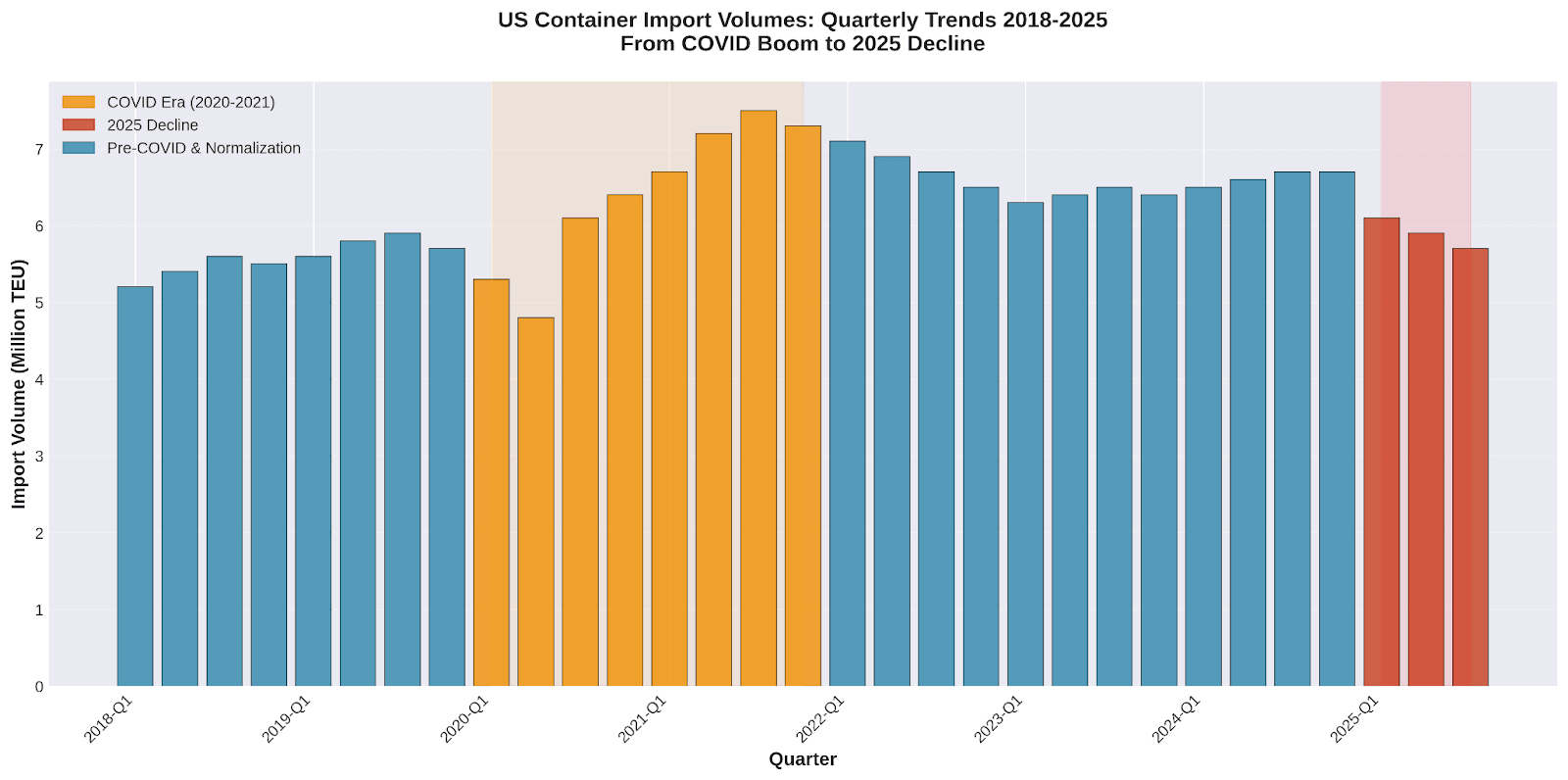
The reason that employment has not gone up as much as hoped seems to be that we’re still buying the same amount from abroad as before, containerized are the same as in the pre-COVID years, see chart below. There’s been some switching of sources, with more coming from Mexico, Taiwan, and Vietnam, and less from Canada and India. Import volumes from China have hardly changed though, since last year, nor have the prices that Americans pay risen. This suggests that China is “eating the tariffs”. I suspect they’ve undervalued their currency to make this happen. We’re selling a little more too, causing the trade imbalance to narrow, but the sales increase are largely precious metals (gold) to China, about 1000 tons in 2025. I’m not sure what China achieves by this; they’ve raised the price of gold to $4,675/oz currently, about double in 1.5 years, and kept the price of Chinese currency low. Perhaps that’s the intent — to keep their currency devalued relative to the dollar. Maybe they have some other idea, like to switch to a gold-backed currency? Who knows? Their purchases increase the value of our gold in Ft. Knox.

Trump’s other justification for the tariffs was as a tool of diplomacy. Trump is using tariffs somewhat this way, as a non-military stick to encourage friendly nations to do what he wants. He got Mexico to stop immigrants and drugs, encouraged the same from Canada and Columbia. He got the EU to spend more in their defense, and got them deal a little less with Russia. They’re still the biggest buyer of Russian natural gas. He also used tariffs to nudge for peace in the Middle East, and between Cambodia and Thailand. Recently, he’s using them to support the Iranian rebels by threatening countries that buy from Iran, or that help the mullahs launder their money and oil. All in all, the tariffs seem to be working for us. The experts are not impressed.

Robert Buxbaum, January 19, 2026

Rich folks aren’t taxed because they have no income; you can do some of this too.

Two tax questions: (1) How do the top rich people manage to pay such low taxes, e.g. Warren Buffett paying at 0.1%. and (2) why do these rich folks campaign for higher taxes. Warren Buffett has campaigned for higher taxes for 50 years. These questions seem perhaps related.

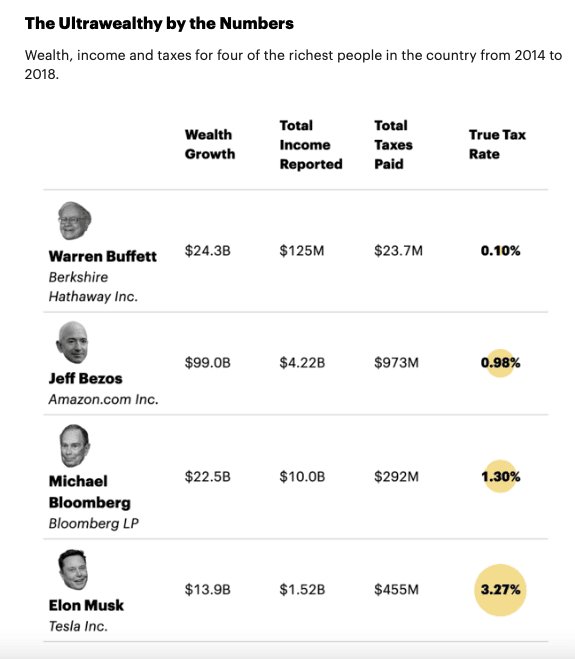
I got my tax data from a public tax advocacy group, ProPublica. In 2021 they received the tax filings for many important people including the 25 US richest from the years 2014 to 2018. They find that these individuals paid a total of $13.6 billion in federal income tax while their wealth rose a collective $401 billion, go here for more. Dividing the numbers, we see an average income tax rate of only 3.4%, with Warren Buffett paying the least, 0.1%. This is far less than the “half of the rate that my secretary pays,” that Buffett likes to claim.

The reason these people pay so little tax is that their taxable income is zero. They use a very wide variety techniques to do this. Among these are charitable foundations, including those that lobby for higher taxes and against climate change. The foundations buy private planes and send the founders (and their families) to climate change events in the South of France or Davos, Switzerland. “Pro-tax” foundations hire tax accountants to research ways that the rich avoid taxes, often the founders then use these methods while speaking out against others who do the same. Bezos was so successful at avoiding income that he got welfare payments in two of the five years, ProPublica found. Soros and his son got $2,400 in COVID payments. They had almost no income. The one tax all these folks hate is tariffs because it is almost impossible to buy new, expensive things from abroad while avoiding them. See my essay, “Tariffs are inflationary, but not on you.”

Another advantage of a charitable foundation is that 74% of your donation can offset capital gains. You have to itemize your donations, but If you give $1 million to your foundation, you can use it to offset $740,000 of stock appreciation earnings. Not a bad deal. You can also use any stock losses against gains. Thus, it’s a good idea, if you itemize, to sell some losing stocks when you sell gainers (while holding on to other gainers, of course.) All of this is only available to those who itemize, and it’s only the rich who benefit by itemizing.

Borrowing money against your assets is another popular tax avoidance scheme, one that ordinary folks could use (but don’t over-do it*). The scheme is often called “Borrow, Buy, Die.” You borrow a large sum against your assets (your home, your stocks, or options –Musk has lots of Tesla options, etc). You then use the borrowed money to purchase property, typically: a vacation home, rental properties, a hotel, or a car. If you structure the purchase right, the interest can be deducted from any other earnings you have including rents. You then have no taxable income, or a lower income while the property appreciates. You can often structure the purchase so that depreciation can be deducted against income as well. Meanwhile, you get to drive the car, live at the vacation home, or rent it as an Air B&B, or stay at the hotel for free.

You live this way until you die. When you die, your heirs get the asset, but they are not taxed on the appreciation. The asset is transferred at its value at the time of death. You’ve avoided paying all the income tax you’d have to pay if you were to sell before death. Most home-owners do this on a small scale: They borrow to buy their home or the building where their business is. Or borrow to buy a vacation home or income property. They use through their life-time, deducting the interest, then leave it to their kids. There is no inheritance tax on most homes or small businesses, and the asset appreciates year to year. Both Nixon and Obama proposed eliminating this loophole by taxing appreciation at death. This would be a lot fairer than the current inheritance tax that is full of loopholes, and unfair when it works. If your parent bought a $10,000,000 item with taxable income, and it remains at that value, why should it be taxed a second time at death?

For a small businessman like me, it made sense to borrow to buy the building that my business operates out of and pay myself a normal rent. It’s income, as real as salary, but taxed at a lower rate, Besides there is no payroll tax on rental income. Another advantage of renting to myself is I can be trusted to fix the building and pay the rent, and I will not throw myself out if there is a downturn, nor will I raise the rents exorbitantly. My car is owned by my business, another plus. I pay a fee for personal use, but this is cheaper than using my own taxed income. When I die, the building (and car) will go to my heirs, tax free.

One last change I’d like to see is in the payroll tax. I’d like to see it tax the entire taxable income, but at a lower percent than the current 15.2 or 7.6. Currently the first $150,000 of income is payroll taxed at 15.2% for a self-employed individual, a plumber or office cleane, even before he/she pays income tax. An office worker is taxes at half this rate, 7.6% before income tax, with the company making up the other 7.6%. A CEO making $10 million pays this rate too, but only on the first $150,000. This amounts to $11,400 in payroll tax, or less than 0.11% of salary. I consider this disparity a bigger scandal than the fact that the richest 25 Americans paid only 3.4% in income tax.

Robert Buxbaum, November 25, 2025. *Trump presents a cautionary tale about property investing; if you invest at the wrong time, you can lose your shirt. In the late 80s, the property market in NY collapsed briefly, and he really was less than penniless. Don’t over-extend. The property market doesn’t collapse often, but you don’t want to be wiped out if it does.

What causes innovation? is it worth it?

Innovation is the special sauce that propels growth and allows a country to lead and prosper. The current Nobel prize believe that innovation powered the Industrial Revolution, causing England to become rich and powerful, while other nations remained poor, weak, and stagnant. Similarly, Innovation, they believe is why 19th century Japan rose to defeat China, and propelled China’s 21st century rise. But why did they succeed when others did not. What could the leader of a country do to bring power and wealth through innovation. Improved education seems to help; all of the innovation countries have it, but it is not the whole. Some educated countries (Germany, Russia) stagnate. An open economy is nice, but it isn’t sufficient or that necessary: (look at China). That was the topic of this year’s, 2025 Nobel prize in economics to Mokyr, Howitt, and Aghion, with half going to Joel Mokyr for his insights, historical and forward looking, the other half going for economic modeling. I give below my understanding of their insights, more technical than most, but not so mathematical as to be obtuse the normal reader..

The winners hold that innovation, as during the industrial revolution, is a non-continuous contribultion caused by a particular combination of education and market opportunity, of theoretical knowledge, and practical, and that a key aspect is depreciation (destruction) of other suppliers. Let’s start by creating a simple, continuous function model for economic growth where growth = capital growth, that is dK/dt. K, Capital, is understood to be the sum of money, equipment, and labor knowledge, and t is time with dK/dt, the change in K with time modeled as equal to the savings rate, s, times economic activity, Y minus a depreciation factor, δ, times capital, K.

growth = dK/dt = sY − δ K.

Innovation, in the Howett model, is discontinuous and accumulative. It builds on itself.

For the authors, Y = GDP + x, where x is the cost of outside goods used. They then claim that Y is a non-linear function of K, where K is now considered a product of capital goods and labor K = xL and,

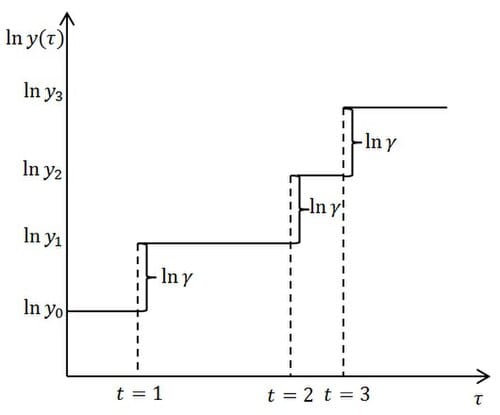
dY/dK = AKα + γ where 0< α <1, and where γ is the contribution of innovation and/or depreciation. The power function, as I understand it, is a mathematical way of saying there are economies of scale. The authors assume a set of interacting enterprises (countries0 so that the innovation factor, γ for one country is the depreciation factor for the other. That is, growth and destruction are connected, with growth being a function of monopoly power — control of your innovation.

According to the Nobel winners, γ is built n previous γ as shown in the digram at right. It can not be predicted as such, but requires education and monopolistic power. The inventor-manufacturer of the typewriter has a monopolistic advantage over the makers of fountain pens. Innovation thus causes depreciation, δ K as one new innovation depreciates many old processes and products. If you add enough math, you can derive formulas for GDP and GDP growth, all based on factors like A and α, that are hard to measure.

GDP = α(2α/1−α) (1-α2)A L,

Thus, GDP is proportional to Labor, L and per-capita GDP is mostly an independent function related to economies of scale and the ability to use capital and labor which is related to general country-wide culture.

The above analysis, as I understand it, is in contrast to Kensyan models, where growth is unrelated to innovation, and where destruction is bad. In these Kenysean models, growth can be created by government spending, especial spending to maintain large industries with economies of scale and by spending to promote higher education. The culture preferred here, as I understand is one that rewards risk-taking, monopoly economics, and creative destruction. Howitt, and Aghion, importantly codify all this with formulas, as presented above that (to me) provide little specific. No great guidance to the head of a country. Nor does the math make the models more true, but it makes the statements somewhat clearer. Or perhaps the only real value of the math is to make things sound more scientific see the Tom Lehrer song, Sociology.

This insight from movie script by Grham Green suggests to me that progress may not be the greatest of advantages, perhaps not even worth it.

This work seems more realistic, to me, than the Keynesian models Both models are mathematically consistent, but if Keynes’s were true, Britain might still be on top, and Zambia would be a close competitor among the richest countries on earth. Besides these new fellows seem to agree with the views of Peter Cooper, my hero. See more here.

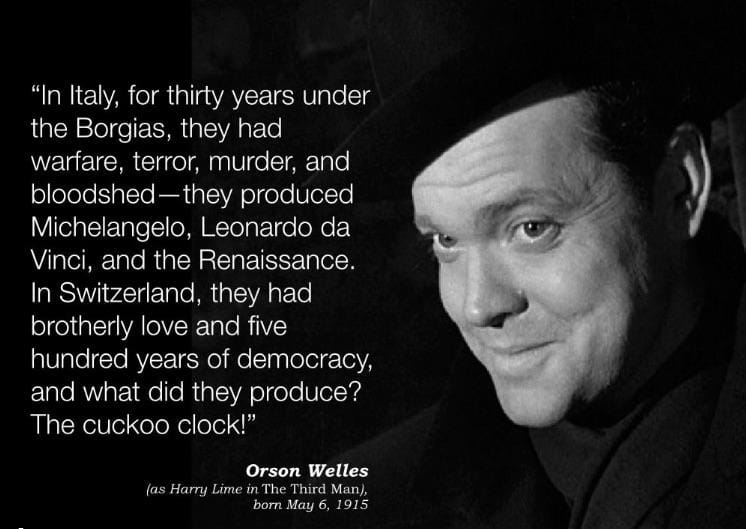
Writing all this reminds me that the fundamental assumption that progress is good, in not necessarily true. I quote above a line that Orson Wells, as Harry Lime, ad-libbed for the movie, “The Third Man.” Lime points out that innovation goes with suffering, and claims that Switzerland had little innovation because of its stability. Perhaps then, what you really want is the stability and peace of Switzerland, along with the lack of domination and innovation. On the same note, I’ve noticed that engineering innovators often ruin themselves dining in ruin, while the peaceable, stable civil engineers live long pleasant lives of honor.

Robert Buxbaum, November 16, 2025. A note about Switzerland is that was peaceful and stable because of a strong military. As Publius Vegetius wrote, Si vis pachim para bellum (if you wish of peace, prepare for war).

Deriving Trump’s tariff formula, and correcting it.

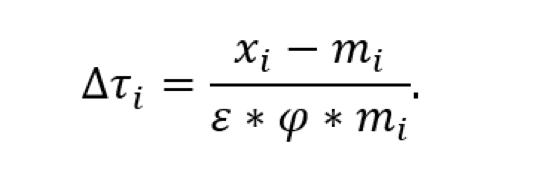
We have a trade imbalance with many countries, it causes a loss of American jobs, and a transfer of currency abroad. This imbalance is not all negative, of course, it provides US consumers with cheaper consumer goods. Trump would like to eliminate the imbalance using tariffs. He hopes that this will create jobs, and that the money raised will help balance the US budget. He’s already moved to end income taxes on tips expecting to replace that tax with tariff income. Trump claims that the tariffs are not inflationary compared to current the tax system that he claims has been hacked by the elites. In past essays, I’ve discussed the pluses and minuses of tariffs here, and here. Now I’d now like to derive the formula Trump uses, see below. The proposed tariff for any country or region, i, he calls ∆τi.

In the equation at left, χi = our exports to country, i. Similarly, mi = our imports from that country. The difference between these two is our trade imbalance, something he’d like to set to zero. There are two other greek terms that I will discuss, ε and φ. These are the elasticity of elasticity of consumption to price, and the elasticity of price to tariffs. Trump uses an asterix here to indicate multiplication. I will use a, more normal, “dot” symbol, •, to the same purpose. For most countries, he takes the two elasticities to cancel to 2, and produces a chart.

Let’s say that the dollar amount we currently buy from some country, i, = m = ni • Pi, where ni is the number of items bought from this country, and Pi is the average price. The intended effect of tariffs is to reduce mby raising Pi, the price consumers pay for goods from that country. This increase is certainly inflationary in terms of the consumer: a consumer of French wine will pay more per bottle unless he/she switches to US wine. Typically this price rise is not inflationary in terms of the country as a whole, because the producer likely swallows some of the tariff, so for the country as a whole, we pay less per bottle of French wine. The customer does not see that, but it’s worth noting. Trump sees things this way.

Back to the formula, we need to figure out how much the price will go up and how much sales will change. Economists have elasticity numbers for both these relations, denoted φ and ε. We can say that, for any country, I, the rise in the price of the average product is ∆Pi = Pi•∆τi •φ. Where Pi is the original price, ∆τi is the tariff, and φ is the fraction of this tariff that gets passed on to the consumer. A typical value is φ= 1/2 though some claim less. Assuming φ= 1/2 , if we add a 20%=∆τi tariff, as on on French wine, the consumer price will rise by 10%, a change that will cause him/her to buy less.

How much less will the consumer buy? That’s determined by the elasticity of sales, ε. This is the fractional decrease in the number items bought per fractional rise in the price. In math terms, ∆ni /ni = -ε∆Pi/Pi where ε is the elasticity. Now, since ∆Pi = Pi•∆τi •φ, we find that:

∆ni = -ni•ε•∆τi •φ.

There is evidence to suggest that, for the average product, ε equals about 2, and also evidence that it’s 4. Trump prefers 4, and uses it for his calculations. I prefer 2, and will get nearly the same tariffs at the end. Whatever our preferred value for ε, our next step is to use the following approximation, accurate for small ∆(mi);

∆mi  = ∆(ni•Pi) = ∆ni•Pi, +  ni•∆Pi

Trump seems to ignore the second term. Perhaps because it can either be positive or negative, as I’d mentioned above, depending on whether you look at things in terms of the customer or of the US as a whole. I’ll keep it in, writing this term in lighter text. In the end I will calculate a fairly similar tariff to Trump:

∆mi = -ni•ε•∆τi •φ•Pi  + ni•Pi•∆τi •φ.

Rearranging the above, and recalling that ni•Pi• =mi, you can find the appropriate tariff to eliminate the trade imbalance.

∆τi =   -∆m/(ε • φ• mi  + φ•mi) .

To make the trade imbalance go away, you need -∆mi = χi-mi . Thus,

∆τi =   χi-m /(ε • φ • mi  + φ•mi)

This is the Trump formula with an extra term in light text. If you ignore that term and use the values Trump prefers, ε =4 and φ=1/2, you get the exact values of the tariffs he listed on the chart for most countries — those with positive trade imbalances.

∆τi =   χi-m/ 2 mi  

Now, I’d like to put back in the missing term, and use the (better) values, values I would trust, ε =2 and φ=1/2. Using those values, I find the tariff should be slightly higher.

∆τi =   χi-m/ 3/2 mi  .

I should note that some countries are creating to these trips by raising their own tariffs, and some are lowering theirs. This will cause a change in the imbalance of trade, and Trump will have to change the tariff schedule periodically to keep up.

Robert Buxbaum, April 10, 2025.

Coal and nuclear power, the secret to China’s cheap products

We’ve become accustomed to buying cheap products from China: items made of glass, plastic, and metal come to the US by the ship-load, approximately $600 B worth last year, the highest from any country. Labor isn’t cheaper in China, certainly not when compared to Mexico or India, nor are the machines that make the products more advanced. What’s behind China’s ability to produce at their low prices is cheap energy—specifically, coal and nuclear-based electricity. While the US and most western countries have shut down coal plants to stop global warming, and have even shut working nuclear reactors for no obvious reason, China has aggressively expanded coal and nuclear energy production. The result? They are the largest single source of CO2, and have some of the lowest electricity prices in the world, Chinese electricity prices are about 1/4 of European, and 2/3 of U.S.

In recent years, the U.S. and Europe have increasingly relied on renewable energy sources like wind and solar. While these can work in certain areas, they require far more land than nuclear or coal, and expensive infrastructure because the power is intermittent, and generally not located close to the customer. The UK and Germany, countries with long periods of cloudy, windless conditions, have switched to solar and wind, leading to soaring electricity prices and a moribund industrial sector. Germany shut down all of its nuclear plants, 17 of them, largely to rely on electricity imported from its neighbors, and coal-fired sources that are far more polluting and unsafe than the nuclear plants they shut. The UK shut 5 nuclear reactors since 2012.

Meanwhile, China continues to build nuclear and coal plants. China is the largest user of coal power, and is planning to build 100 more coal-fired plants this year. Beyond this, China is building nuclear power rectors, including the world’s first 4th generation reactor (a pebble bed design). China has built 20 nuclear plants since 2016, and has 21 under construction. With this massive energy advantage, China produces things at low price for export: appliances, clothes, furniture, metal and plastic goods, all at a fraction of our cost. By selling us the things we used to make, China imports our jobs and exports pollution from their coal plants.

Many people instinctively understand that outsourcing production to China is harmful to both US employment and world pollution. Yet, until recently, US politicians encouraged this transfer through trade agreements like the TPP. Politicians bow to high-spending importers, and to environmental activists. It seems we prefer cheap goods to employment, and we’re OK with pollution so long as we don’t see the pollution being made. But, by outsourcing production, we’ve also outsourced control over critical industries, we’ve limited out ability to innovate, and we make ourselves dependent on China. Likely, that was part of China’s intent.

Russia has followed a similar path, keeping electricity costs mostly through low through coal, but also nuclear power, exporting their goods mostly to the EU. Before the Ukraine war, Germany in particular, relied on Russian gas, electricity, and fertilizer, products of Russian cheap power. By cutting off those energy, Germany has dealt a severe blow to its economy. Not everyone is happy.

Transfer of electricity, GWh, between European countries, 2023. Energy is most expensive in importer-nations, and GDP growth is slowest.

The incoming Trump administration has decide that, to compete with China’s manufacturing power, we need to develop our own through tariffs, and we need to increase our energy production. Tariffs can help balance the budget, and bring production back home, but without more energy, our industries will struggle to produce. I’m generally in support of this.

US production is more energy efficient than Chinese production, and thus less polluting. Besides, making things here saves on transport, provides jobs, and helps to build US technology for the future. I’m happy to see us start to build more nuclear power reactors, and restart some old plants. Solar and wind is good too, but is suited to only in some areas, windy and sunny ones, and even there, they need battery storage so that the power is available when needed.

Robert Buxbaum, January 21, 2025

Chinese stocks lost 30% this year, has China’s lost decade begun?

I predicted dire times for China six years ago, when Xi Jinping amended the constitution to make himself leader for life, in charge of the government, the party, the military, and the banks. Emperor, I called him, here. It now seems the collapse has begun, or at least stagnation. Chinese history is cyclic. Good times of peace and plenty give rise to a supreme emperor whose excesses bring war and famine, or at least stagnation. The cycle repeats every 50 to 100 years. Since Nixon opened China in 1973, the country has seen 50 years of prosperity and spectacular growth, but the growth has stopped and may be in decline. The stock market (Shanghai Shenzen 300) peaked in 2021 and has declined 50% from there. It’s down 30% for the last 12 months to levels seen in December 2010. US growth seemed slower than China’s but it’s been more steady. The main US stock market, the S+P 500, has more than tripled since 2010, up 24.5% this year.

Five years of the Shanghai 300 index with hardly any change. There has hardly been change in 15 years. One could argue that the lost decade is here and on-going. .

Each year Chairman Xi’s behaves more dictatorial. Last year he arrested his predecessor, Hu Jintao in front of the Communist party. He now tracks all his citizens actions by way of face recognition and phone software, and gives demerits for wrong thinking and wrong behaviors. You lose merits by buying western cars or visiting western internet sites. Taking money abroad is generally illegal. Needless to say, such behavior causes people to want to take money abroad, just in case. Last week, Xi proposed a limit on video game playing and clamped down on banks, demanding low interest rates. This is bad for the gaming corporations and teenagers, and banks, but so far there are no protests as there is no war.

Kissinger said that war was likely, though. Xi is building the navy at a fast pace, adding fast surface ships, nuclear submarines, aircraft carriers, and new attack airplanes. They’ve added hypersonic missiles too, and added listening stations and bases. There’s now a naval base in Djibouti, at the entrance to the Red Sea, where they oversee (or promote?) Iran’s attacks on Western shipping. Then there are the new Chinese Islands that were built to take oil and fishing rights, and to provide yet more military bases on key trade routes. These could easily be a trigger for war, but so far just one military interaction in the region. Last month, the Chinese and Philippines navy clashed over fishing!

In the Gulf of Finland last Month, a Chinese ship, New New Polarbear, destroyed the offshore cables and gas pipes between Finland and Estonia, in protest of Finland’s entry into NATO. It’s belligerent but not war. Undersea cables are not covered by the UN charter, law of the sea. Then there is the evidence that COVID-19 was the result of Chinese bioweapon development, and the Chinese spy ballon that was sent over the US. We maintain at peace, but an unsettled sort of peace — is it a preface to war? Wars don’t have to be big war against the west or Taiwan, more likely is Vietnam, IMHO.

China’s negative population growth means that property values will drop along with product consumption. Kids buy stuff; old folks don’t.

News from China is increasingly unreliable so it’s hard to tell what’s going on. There were claims of a coupe, but perhaps it was fake news. Reporters and spies have been arrested or shot so there is no window on anyone who knows. There are claims of high unemployment, and COVID deaths, and claims of a movement to “lie flat” and stop working. Perhaps that was behind the ban on excessive gaming. Who knows? Xi claims that China is self sufficient in food production, but record food shipments from the US to China suggest otherwise.

Major businesspeople have disappeared, often to reappear as changed men or women. Most recently, Jimmy Lai, the Hong Kong clothing magnate, was indicted for sedition by tweets. Perhaps he just wanted to fire workers, or pay down debt, or move abroad (his daughter is). Many businesses exist just to make jobs, it seems. Not all of these businesses are efficient, or profitable. Some exist to violate US patents or steal technology, particularly military technology. I suspect that China’s hot new car company, BYD, is a money-losing, job factory, behind Tesla in every open market. Some 91 public firms have delisted over the last two years, effectively vanishing from oversight. Are they gone, or still operating as employment zombies. Will BYD join them? If China manages to avoid war, I have to expect stagnation, a “lost decade” or two, as in Japan saw from 1990 to 2010, as they unwound their unprofitable businesses.

A sign suggesting that a Chinese lost decade has begun is that China’s is seeing deflation, a negative inflation rate of -0.2%/year according to the world bank. It seems people want to hold money, and don’t want Chinese products, services, or investment. Japan saw this and tried a mix of regulation and negative interest rates to revive the interest, basically paying people to borrow in hopes they spend.

In Japan, the main cause of their deflation seems to have been an excess of borrowing against overvalued and unoccupied real estate. The borrowed money was used to support unprofitable businesses to buy more real estate. This seems to be happening in China too. As in Japan, China originally needed new lots of new apartments when they opened up and people started moving to the cities. The first apartments increased in value greatly so people built more. But now they have about 100% oversupply: one unoccupied or half-built apartment for every one occupied, with many mortgaged to the hilt against other overvalued apartments and flailing businesses.

Chinese Dept, personal and corporate match Japan’s at the start of the lost decade(s). Personal debt is at 150% of GDP, corporate debt is at65% of GDP, all propped up by real estate.

As in Japan 30 years ago, China’s corporate + personal debt is now about two times their GDP. Japan tried to stop the deflation and collapse by increased lending, and wasteful infrastructure projects. People in the know sent the borrowed money abroad confident that they would repay less when they repaid. We are already seeing this; low interest loans, money flowing abroad and a profusion of fast trains, unused roads, and unused bridges. I suspect most fast trains don’t pay off, as planes are faster and cheaper. These investments are just postponing the collapse. China is also seeing a birth dearth, 1.1 children per woman. This means that within a generation there will be half as many new workers and families to use the trains, or occupy the apartments. As the country ages, retirees will need more services with fewer people to provide them. China’s culture promotes abortion. China’s working population will decline for the next 30 years at least.

Japan came through all this without war, somewhat poorer, but unified and modern. It helped that Japan was a democracy, unified in culture, with an open press and good leaders (Abe). There was no collapse, as such, but 20 years of stagnation. China is a dictatorship, with a disunited culture, and a closed press. I think it will get through this, but it will have a much rougher time.

Robert Buxbaum January 9, 2024. China isn’t alone in facing collapse and/or lost decades. Germany is in a similar state, especially since the start of the Ukraine war. It’s a democracy like Japan, and pacifist for now.

Cybertruck an almost certain success

Leading up to the Cybertruck launch 4 weeks ago, the expert opinion was that it was a failure. Morgan Stanley, here dubbed it as one, as did Rolling Stone here. Without having driven the vehicle, the experts at Motor trend, here, declared it was worse than you thought, “a novelty” car. I’d like to differ. The experts point out that the design is fundamentally different from what we’ve made for years. They claim it’s ugly, undesirable, and hard to build. Ford’s F-150 trucks are the standard, the top selling vehicle in the US, and Cybertruck looks nothing like an F-150. I suspect that, because of the differences, the Cybertruck can hardly fail to be a success in both profit and market share.

Cybertruck pulls a flat-bed trailer at Starbase.

Start with profit. Profit is the main measure of company success. High profit is achieved by selling significant numbers at a significant profit margin. Any decent profit is a success. This vehicle could trail the F-150 sales forever and Musk could be the stupidest human on the planet, so long as Tesla sells at a profit, and does so legally, the company will succeed. Tesla already has some 2 million pre-orders, and so far they show no immediate sign of leaving despite the current price of about $80,000. Unless you think they are all lying or that Musk has horribly mispriced the product, he should make a very decent profit. My guess is he’s priced to make over $10,000 per vehicle, or $20B on 2 million vehicles. Meanwhile, no other eV company seems to be making a profit.

The largest competing electric pickup company is Rivian. They sold 16,000 electric trucks in Q3 2023, but the profit margin is -100%. This is to say, they lose $1 for every $1 worth of sales –and that’s unsustainable. Despite claims to the contrary, a money-losing business is a failure. The other main competitors are losing too. Ford is reported to lose about $50,00 per eV. According to Automotive News, here, last week, Ford decided to cut production of its electric F-150, the Lightning, by 50%. This makes sense, but provides Cybertruck a market fairly clear of US e-competition.

2024 BYD, Chinese pickup truck

Perhaps the most serious competitor is BYD, a Chinese company backed by the communist government, and Warren Buffet. They are entering the US market this month with a new pickup. It might be profitable, but BYD is relatively immune to profitability. The Chinese want dominance of the eV market and are willing to lose money for years until they get it. Fortunately for Tesla, the BYD truck looks like Rivian’s. Tesla’s trucks should exceed them in range, towing, and safety. BYD, it seems, is aiming for a lower price point and a different market, Rivian’s.

A video, here, shows the skin of a Cybertruck is bulletproof to 9mm, shotgun, and 45 caliber machine gun fire. Experts scoff at the significance of bulletproof skin — good for folks working among Mexican drug lords, or politicians, or Israelis. Tesla is aiming currently for a more upscale customer, someone who might buy a Hummer or an F-250. This is more usable and cheaper.

Don’t try this with other trucks.

Another way Cybertruck could fail is through criminal activity. Musk could be caught paying off politicians or cheating on taxes or if the trucks fail their safety tests. So far, Cybertruck seems to meet Federal Motor Vehicle Safety Standards by a good margin. In a video comparison, here, it appears to take front end collisions as well as an F-150, and appears better in side collisions.

This leaves production difficulty. This could prevent the cybertruck from being a big success, and the experts have all harped on this. The vehicle body is a proprietary stainless steel, 0.07″ thick. Admittedly it’s is hard to form, but Tesla seems to manage it. VIN number records indicate that Tesla had delivered 448 cybertrucks as Friday last week, many of them to showrooms, but some to customers. Drone surveys of the Gigafactory lot show that about 19 are made per day. That’s a lot more than you’d see if assembly was by hand. Assuming a typical learning curve, it’s reasonable to expect some 600 will be delivered by December 31, and that production should reach 6000 per month in mid 2024. At that rate, they’ll be making and selling at the same rate as Rivian or Ford, and making real money doing it. The stainless body might even be a plus, deterring copycat competition. Other pluses are the add-ons, like the base-camp tent option, a battery extension, a ramp, and (it’s claimed) some degree of sea worthiness. Add-ons add profit and deter direct copying (for a time).

Basecamp, tent option.

So why do I think the experts are so wrong? My sense is that these people are experts because of long experience at other companies — the competitors. They know what was tried, and that innovation failed. They know that their companies chose not to make anything like a Cybertruck, and not to provide the add-ons. They know that the big boys avoid “novelty cars” and add-ons. There is an affinity among experts for consensus and sure success, the success that comes from Chinese companies, government support and international banking. If the Cybertruck success is an insult to them and their expertise. Nonetheless, if Cybertruck succeeds, they will push their companies towards a more angular design plus add-ons. And they will claim cybertruck is no way novel, but that government support is needed to copy it.

Robert Buxbaum, December 25, 2023.

The UAW’s minimally-effective strike.

The aim of a strike, generally, is the same as the aim of war: it is to win concessions fast. To do this, one must strike to the utmost extent, as Von Clausewitz points out. The target company must come to understand that they need the workers, and that they need a quick settlement. In the case of the current united auto worker strike, the UAW asked for 40% and concessions, but only struck at a few plants. The resulting strike lasted 6 weeks, with Ford settling for a 25% raise over 4.5 years, to April 2028. Viewed on an average, that’s a 5.6% raise per year, assuming the Ford workers accept the deal.

I’m not sure how the UAW boss chose which plants to strike AGAINST. They were mostly low-profit ones at first. Workers at other plants kept on working and received a full salary. The suffering was borne some 45,000 UAW workers (1/4 of the UAW autoworkers) who left the job for strike pay, $500/week. This is a tiny fraction of the 4.36 million auto workers in the US. Auto production was reduced by 80,000 vehicles, we’re told, again a small fraction of several million vehicles typically made in the US in a year.

The strike does not seem to have affected vehicle sales or profits, as best I can tell. The remaining plants ran at higher capacity, and some production was made up by imports from Canada, Mexico, and China. Inventories today are at 60 days, the industry target. In a sense, the major lessons of the strike are that the auto companies don’t need so many workers, and that the UAW can direct suffering to whichever workers they wish.

The gasoline-powered F-150, left, is the most popular vehicle in the US. The Tesla Cybertruck, right, is an EV challenger of a sort that will soon be mandated. EVs require fewer workers and manufacture is non-union.

Ford’s settlement sounds good, but if viewed as a 5.6% raise per year, it barely covers inflation. Inflation is 3.6% now and was 8% last year. Ford retained the right to shed workers and close plants as the economy slows or production shifts. That’s a minimal gain for a 4.5 year commitment.

Battery plants may be covered or not; we’ve not been told. Production is expected to shift to battery vehicles, and these require fewer workers per car. President Biden has mandated a shift as part of his plan to stop global warming (a plan that I find misguided). He’s provided financial incentives for EV owners too, under the “inflation reduction act,” an effort to cause consumers to buy cars they would not otherwise. Largesse of this type is problematic, and highly inflationary, at least in the short term (the next few years). It is supposed to help out down the road, but workers pay their bills in the short term, the here and now.

Despite Biden’s financial incentives to buy electric, most consumers prefer to buy gasoline. The gasoline F150 is the most popular vehicle in America, selling over 600,000 per year. Trump claims that US workers would be better off if we stopped pushing EVs. Less incentives means less inflation, more internal combustion cars, and more union jobs he says. Biden has recently funded a Chinese battery plant, non-union in Michigan, suggesting that Trump is on to something. The strike has produced a raise, but its main contribution, it seems was to punish those UAW workers that the union boss didn’t like.

Robert Buxbaum, October 29, 2023. As I write, Stellantis has offered a tentative deal, but GM is still holding out, and we’ve yet to see if the workers ratify any of these deals.

I’d like to expand the Jones act so more ships can do US trade.

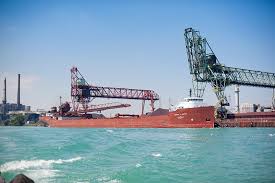
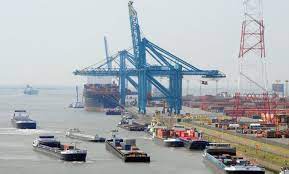
If you visit most any European port city, you’ll see a lot more shipping than in the Midwestern US. In Detroit, where I am, your’ll see an occasional ore boat from Wisconsin, and an occasional tourist cruise, but nothing to compare to German, Belgian, or Turkish ports. The reason for the difference is “The Jones act.”

The port of Istanbul with many ships

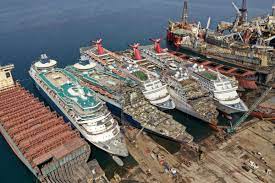
The Jones act , also known as “The Merchant Marine Act of 1920”, requires that all ships depositing cargo or people between US ports must be US owned, US built, US captained, US flagged, and at least 70% US manned. This raises costs and reduces options. The result is that few ships can move people or cargo between US cities, and these ships are older and less efficient than you’ll see elsewhere. World wide water traffic costs about 1/8 that of rail traffic per ton-mile, but in the US, the prices are more comparable. The original justification was to make sure the US would always have a merchant marine. The Jones act does that, sort of, but mostly, it just makes goods more expensive and travel more restrictive.

The port of Detroit — we rarely see more than one ship at a time.

Because it does some good, I don’t want to get rid of the Jones act entirely, but I’d like to see US shipping options expanded. Almost any expansion would do, e.g. allowing 50% US manned ships delivering along US rivers, or expanding to allow Canadian built ships or flagged, and ships that are more than 50% US owned, or expanding to any NAFTA vessel that meets safety standards. Any expansion of the number of ships available and would help.

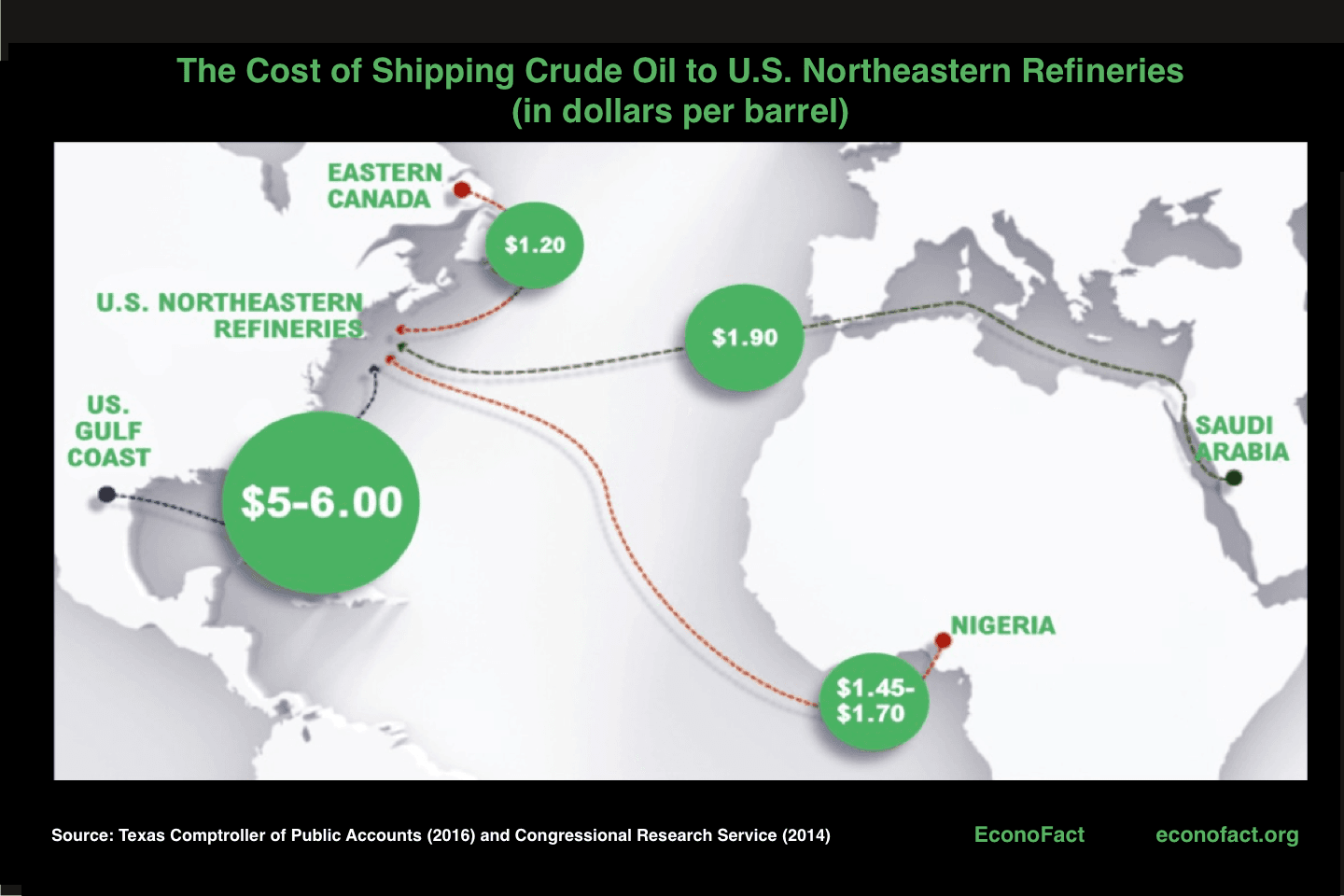
The jones act increase the price of oil transport by a factor of five, about.

Currently, the only exceptions to the Jones act are for emergencies (Trump voided the act during several storms) and for ships that visit a foreign port along the route. This exception is how every cruise ship between California and Hawaii works. They’re all foreign, but they stop in Mexico along the way. Similarly, cruises between Florida and Puerto Rico will stop in Bermuda typically, because the ships are foreign owned. Generally, passengers are not allowed to get off in Puerto Rico, but must sleep on board. This is another aspect of the Maritime act that I’d like to see go away.

Because of the Jones act, there is some US freight-ship building, and a supply of sailors and captains. A new, US ore-ship for the Great Lakes was launched last year, so far it’s been used to carry salt. There is also a US built and operated cruise ship in Hawaii, the “Pride of America,” that makes no stop in Mexico. I’d like to see these numbers expanded, and the suggestions above seem like they’d do more good than harm, lowering prices, and allowing modern container ships plus roll-on-roll-off car transports. Our rivers and lakes are super highways; I’d like to see them used more.

The port of Antwerp – far busier than Detroit.

Another way to expand the Jones act while perhaps increasing the number of US-built and operated ship would be through a deal with Canada so that ships from either country could ply trade on either countries rivers. As things stand, Canada has its own version of the Jones act, called the Coastal Trade Act where Canadian vessels must be used for domestic transport (cabotage) unless no such vessel is available. Maybe we can strike a deal with Canada so that the crew can be Canadian or US, and where built ships in either country are chosen on routes in either country, providing they meet the safety and environmental requirements of both.

Robert Buxbaum, June 14, 2023.