In 1940, Issac Asimov, perhaps the greatest of science fiction author, published the first of many robot stories where the plot does not go on mad and harm its makers as in “Frankenstein”, terminator, The robots in Asimov’s stories were mostly humanoid- AI, and always tried to be helpful to man within the limits of their intelligence and robotic free will.
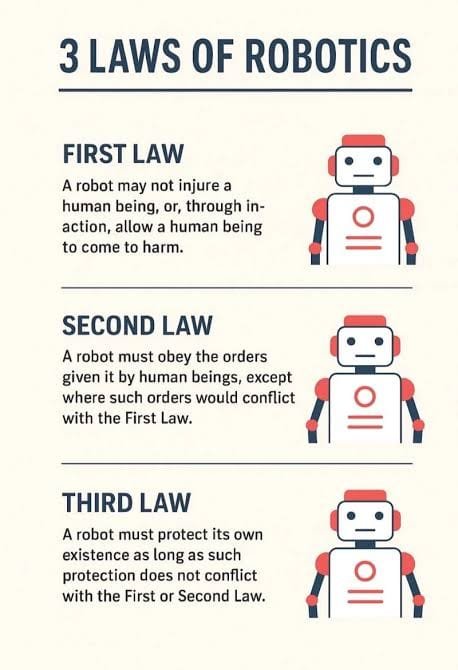
A central part of these stories, written over 40+ years, was that any AI robot would be constrained by three, hard-wired rules (laws), the first of which prevented direct malevolence: “A robot may not harm a human or allow a human to come to harm through inaction.” Find the rest at right. Asimov believed that, without rules like this, no human would ever trust a AI-enabled machine of any sort, especially a humanoid.
Despite the hard-wired commitment of robots to not harm people, society didn’t trust them, and some humans hated them. The stories involve interaction problems of a wide variety, some caused by people, and some problems were from the fundamental difficulties of navigating life within these rules. There was even the occasional murder, but out of confusion, not malice. My favorite stories included a robot psychologist, Susan Calvin, born in 1982, called in when robot behaviors showed a sort of schizophrenic break. Despite the tension caused by the laws, it became clear that the laws were very beneficial, and not unrealistically restrictive. But that was all fiction.
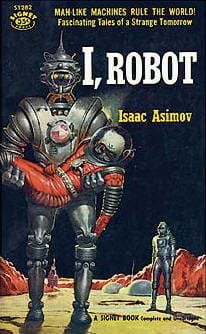
The reality of AI robots is now here, but without the laws. Susan Calvin would be 44, and we now have robots with fairly advance AI. Some are even humanoid, and the most common use is to drive suicide drone ships used to kill humans. They fight the war in Ukraine and in Iran, and I notice that we’ve put no restrictions on bad behavior. To the contrary, the major use for these robots is killing people and destroying things. A predicted result is movies like “the current “Top Gun” imagine that the top” where robots fight humans. In the movies, the top humans are still stronger and faster, but that’s likely wishful thinking. It seems to me that someone should try to put Asimov’s three basic restrictions on the robot brain, or at least the first restriction. Asimov pointed out that no society will trust a machine that can get up and kill the owner as a result of malice or some simple mistake
As I write there’s talk of a committee being formed to regulate AI on a case by case basis: I don’t trust the committees to get anything done except expand. AS for a finding a committee to regulate AI thought, the only sort of person who believes himself capable and worthy of regulating thought is a psychopath, IMHO: the last sort of person that you’d want on that committee. Instead, a fixed law, as strongly implanted as possible that robots can not harm humans, or by inaction allow them to come to harm.
Robert Buxbaum November 16, 2026