The following is Elizabeth Warren’s law registration for the state of Texas, 1986 claiming she is an American Indian. There was very little evidence for it and an genetic test showed she was somewhere between 1/256 and 1/1000 Indian. My son was determined to have 1/1000 Indian blood in a similar test, and we have no Indian ancestors at all, as best as I can tell. Still, as an Indian Ms. Warren is entitled to affirmative action; she’s to get preferential hiring financial, and educational treatment over someone more qualified, but without Indian blood. Affirmative action was institute as a way to redress the suffering of Indians and other minorities, but it is not clear that is serves this purpose when someone with so little, or no blood can take the advantage. There is no requirement of proof that you are at all Indian by blood, and even if you are 1/1000 Indian, what about the other 999/1000? Why don’t they count to give yo lower standing than someone who is 1/10 Indian, say. How indian should you have to be to get benefits.
Related to the question of how much Indian blood you should have to have to get benefits is the question of making other folks suffer to provide this benefit. Many of the people who suffer because of affirmative action are dependents of immigrant minorities, Jews, Italians, and Chinese, and these folks have not had it that well. The Italians were discriminated against in hiring, as mandated by the city council, see announcement below, and Chinese immigrants had very limited migration and work rights, as specified under The Chinese Exclusion Act of 1882. This act was not repealed until 1943 as part of our war against Japan.
In the late 1800s anti Italian discrimination was common. In part this was the Tammany Hall Irish doing their best to keep out an upstart immigrant group. Should Italians have affirmative action preferences?
At maximum Ms. Warren is less than 1% indians and thus over 99% Texan. This is to suggest that the majority of her bloodline is descent is from those who displaced the Indians, but her preferential hiring was likely in preference to other minorities who suffered too, and who likely have a purer bloodline to that suffering and exclusion than Ms Warren has. Is this what we want from affirmative action? The form we’ve got benefits, for the most part, only the most crooked, connected members of society. People like Ms Warren. I think this has to change.
Some days, I spend hours at a time on facebook, and when I’m done, I often feel it was a complete waste of time. I do not make friends this way, and I have little evidence that I’ve convinced anyone. Still, for some reason, I can’t seem to stay off for long, so I figure I might as well look for the attraction.
One positive thing I do (did) with FB was to run for office. I lost, but I was able to speak to more people using FB in a day than I could have otherwise. Another thing I do is to spread articles — those I find interesting, and my own writing, blog posts, mostly. I write these posts for free, and while I imagine my blog posts do some good. I sometimes get nice comments suggesting people read the blogs and think about what I say. Still, it does not make money, and takes a fair amount of effort.
I can imagine I help mankind in some subtle, long range way, or perhaps gain some long-range fame. But who cares about long-range fame? And, as for helping people, it is also possible I will hurt them too. Computers sit analyzing my words, and everyone’s, tracking their views and using the data for what. I’m just feeding the computer, and that makes me think my writing may harm more than help. What I write on FB is owned by FB. It’s free content for the owners of FB to re-use to sell: my personality, capsulated, my friends likes and dislikes, for sale at a price. My posts turn me and my friends into commodities — and there isn’t even remuneration.
It is claimed that, in the 2016 election, Trump was able to win, at low cost, through a Russian-managed facebook campaign. The educated elites of politics were not able to come with the wiley Russians, for all their brain-power, and despite help from the FBI, or so the theory goes. If so, it’s a warning that all the information I provide to facebook is available to Trump and the Russians to use against me. The management of facebook was committed to Ms Clinton in 2016, and is completely committed to Trump’s removal as best I can tell. If they are not able to beat the Russians, maybe I should not try. Then again, maybe they’re not as elite as they think.
Sometimes I imagine that the alternative of not-posting is worse; it is to have no voice at all, and to have no information of the common discussion. The newspapers seem no less biassed than those on my FB. I write then in a bizarre chasm between hope for posterity, and a better world, and out of desperation that to be an unheard, quiet one, is to be dead. I suspect I’m not unique here.
Free will is generally considered a good thing — perhaps a unique gift from the creator to man-kind. Legal philosophers contend that it is free will that makes us liable to legal punishment for our crimes. while piranhas and machines are not. We would never think of jailing a gun or a piranha even it harmed a child.
It’s not totally clear that we have free will, though, nor is it totally clear what free will is. The common test is that no one can tell what I will do. If this is the only requirement, though, it seems a random number generator should be found to have free will. One might want to add some degree of artificial intelligence so that the random numbers are used to make decisions that are rational in some sense, say choosing between tea and coffee, for example, and not tea and covfefe, but this should not be difficult. With that modification, we should find that the random device would make free decisions as boldly or conservatively as any person.
The numbers should be truly random, but even if they are not quite, this should not be a barrier. We generally take statistical things to be random, the speed of the wind tomorrow at 3:00 PM for example even though there is a likely average, and 500 mph is exceedingly unlikely. And, if that isn’t quite random enough, one could use quantum mechanics. One could devise a system that measures the time between the next two radioactive decays to an accuracy many times greater than the likely time between. If the sample has a decay every 100 seconds or so, the second and third digit of this time after the decimal is random to an extent that most would accept, and that one can predict it at all — or so we understand it. (God might be an exception here, but since He is outside of time, prediction becomes an oxymoron). Using these quantum mechanic random numbers, one should be able to make decisions showing as much free will as any person shows, and likely more . Most folks are fairly predictable.
Since God is considered to be outside of time, any mention of his fore-knowledge or pre-determination is an oxymoron. There is no pre or fore if you’re outside of time, as I’d understand things
I notice that few people would say that a radioactive atom has free will, though, and that many doubt that people have free will. Still no one seems interested in handing major issues to a computer, or holding the machine liable if things turn out poorly. And if one wants to argue that people have no free will, it seems to me that the argument for punishment would get rather weak. Without free will, shy would it be more wrong to kill a person than a piranha, or a plant.
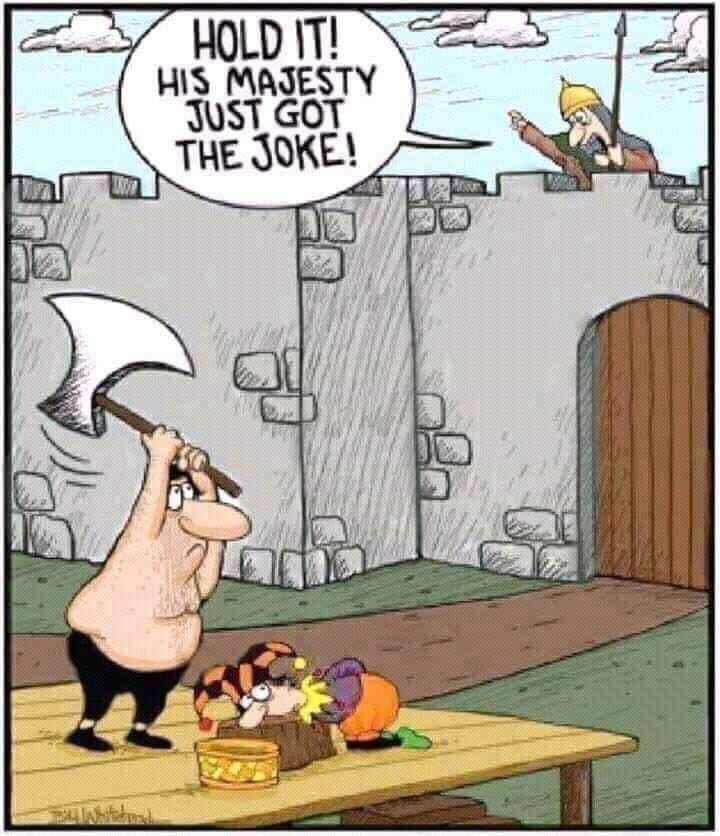
One big danger of political humor is that some folks just don’t get the joke. You say something outrageous and they don’t get that you were exaggerating, but think you were lying, or ignorant, or worse yet they take you at your word, and think you were telling the truth.
Daniel Boone liked to claim things that were not true; he claimed he jumped the Mississippi and that he lassoed a tornado and that he killed a bear (with his bear hands) when he was three. The joke was on anyone who took him seriously, and I’m sure there were those who did: “Why that’s not true!” “You’re a liar!” or worse yet “Wow, how did you do that!” It’s a sort of brag-joke that, today is called “trolling.”
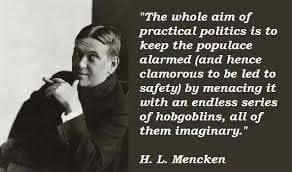
H.L. Menken on the fake news of the early – mid 20th century.
But there is a bigger danger with political jokes, and that happens when you’re not quite making a joke and folks realize you are telling the truth, or at least that there is a dagger of threat thats being passed off within a joke, or as part of an exaggeration. Basically, they realize that this joke was no joke at all.
A recent case in point, two weeks ago Trump was speaking to Jewish businessmen, and told them about his troubles building the US embassy in Jerusalem (read the whole speech here), but within the funny story is a hook:
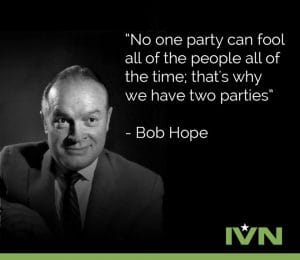
Bob Hope told the truth but hid it in a funny delivery.
“And I called David Friedman. I said, “David, I need some help. I just approved an embassy, and they want to spend $2 billion to build the embassy. And I know what that means: You’re never going to get it built. It’ll take years and years.” I said, “You know what’s going on here? …. So we’re going to spend 2 billion, and one of them was going to buy a lousy location. A lot of you are in the real estate business because I know you very well. You’re brutal killers. (Laughter.) Not nice people at all. But you have to vote for me; you have no choice. You’re not going to vote for Pocahontas, I can tell you that. (Laughter and applause.) You’re not going to vote for the wealth tax. “Yeah, let’s take 100 percent of your wealth away.” No, no. Even if you don’t like me; some of you don’t. Some of you I don’t like at all, actually. (Laughter.) And you’re going to be my biggest supporters because you’ll be out of business in about 15 minutes, if they get it. So I don’t have to spend a lot of time on that. But David calls me back and he goes, “Sir” — he always used to call me “Donald.”
The press claimed the above was vile and anti-semitic. It almost sounds otherwise when quoted in context, but they are not totally off. There is truth inside that jest. Such truths lose the humor, but they do get the message across. A lot has to do with the delivery. Ideally the folks that you want to get the point will, and the rest will think you mean nothing by it. It’s a hard act.
A common opinion of Samuel Johnson was that “No man but a blockhead ever wrote except for money”. It’s recorded by Boswell on April 5, 1776 well into the revolution, and applied equally to the American revolutionaries and all other unpaid enthusiasts. Johnson wrote for money. He wrote sermons for priests, he wrote political speeches for Troys, he wrote serialized travel logs, and at one point a tearful apology for a priest about to be hanged for forgery. That he was paid was proof that he was good at writing, though not 100% convincing. The priest was forgiven and acquitted in the public eye, but he was hanged for the forgery none-the-less.
Some Samuel Johnson Quotes about America
Johnson was unequivocal in his opinion of American independence. His pamphlet ,”Taxation no Tyranny” 1775 (read it here) makes a semi-convincing Tory argument that taxation without representation is in no way tyranny, and is appropriate for America. America, it’s argued, exists for the good of the many, and that’s mainly for the good of England. He notes that, for the most part, Americans came to the land willingly, and thus gave up their rights: “By his own choice he has left a country, where he had a vote and little property, for another, where he has great property, but no vote.” Others left other lands or were sent as criminals. They “deserved no more rights than The Cornish people,” according to Johnson. Non-landed people, in general had no vote, and he considered that appropriate. Apparently, if they had any mental value, they’d be able to afford an estate. His views of Irish Catholics were somewhat similar , “we conquered them.” By we, Johnson meant Cromwell over a century earlier, followed by William of Orange. Having beat the Irish Catholics at the battle of the Boyne meant that that the Protestants deserved to rule despite the Catholics retaining a substantial right to land. I am grateful that Johnson does not hide his claim to rulership in the will of God, or in some claim to benefit the Irish or Americans, by the way. It is rule of superior over inferior, pure and simple. Basically, ‘I’m better than you, so I get to rule.’
One must assume that Johnson realized that the US founders wrote well, as he admitted that some Whigs (Burke) wrote well. Though he was paid for writing “Taxation no Tyranny”, Johnson justifies the rejection of US founding fathers’ claims by noting they are motivated by private gain. He calls American leaders rascals, robbers, and pirates, but is certain that they can be beat into submission. The British army , he says, is strong enough that they can easily “burn and destroy them,” and advises they should so before America gets any stronger. He tells Boswell, “Sir, they are a race of convicts, and ought to be thankful for anything we allow them short of hanging.” Even after a treaty was signed, he confides, “I am willing to love all mankind, except an American.”
I’ve come to love Johnson’s elitism, his justification for rule and exploitation based purely on his own superiority and that of his fellow British. It allows him to present his prejudices uncommonly clearly, mixing in enough flattery to be convincing to those who accept his elitist perspective. That makes his words eminently quotable. It doesn’t make them right, nor does it mean that his was a useful way to deal with people or problems. Adam Smith was willing to admit that the Americans had a gripe, and suggests the simple remedy of giving Americans a voice in Parliament. His solution might have kept the empire whole. Edward Gibbon, an expert on Rome who opposed rights for Americans, at least admitted that we might win the war. Realistic views like this are more productive, but far less marketable. If you are to sell your words, it helps to be a pig-headed bigot and a flatterer of those who agree with you. This advantage of offending your opponents was not lost on Johnson as the quote below shows.
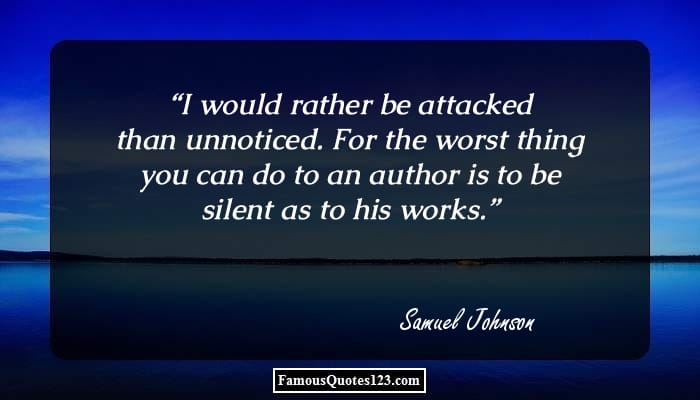
Johnson writing about notoriety, a very American attitude.
I’m left to wonder about the source of Johnson’s hatred for Americans though — and for the Irish, Cornish, and Scots. In large part, I think it stems from a view of the world as a zero-sum game. Any gain for the English servant is a loss to the English gentleman. The Americans, like the Irish and Cornish, were subject peoples looking for private benefit. Anything like low taxes was a hurt to the income of him and his fellows. The zero sum is also the view of Scrooge in a Christmas Carol; it is a destructive view.
As for those acted in any way without expectation of pay, those who would write for posterity, or would fight the Quixotic fight, such people were blockheads in his view. He was willing to accept that there were things wrong in England, but could not see how an intelligent person would favor change that did not help him. This extended to his beliefs concerning education of children: “I would not have set their future friendship to hazard for the sake of thrusting into their heads knowledge of things for which they might not perhaps have either taste or necessity. You teach your daughters the diameters of the planets, and wonder when you have done that they do not delight in your company. No science can be communicated by mortal creatures without attention from the scholar; no attention can be obtained from children without the affliction of pain, and pain is never remembered without resentment.” This is more of Johnson’s self-interest: don’t teach anything that will bring resentment and no return benefit. Teach the sons of the greats that they are great and that they are to lead. Anything more is a waste or an active harm to the elite.
But what happens when America succeeds? Johnson was still alive and writing in 1783. If the Americans could build an army and maintain prosperous independence, they would have to be respected as an equal or near-equal. Then what of the rest of the empire? How do you admit that this one servant is your equal and not admit that your other servants may be too? This is the main source of his hatred, I think, and also of the hatred the Scrooge has for mankind. It’s the hatred of the small soul for the large, of the sell-out for the enthusiast. If the other fellow’s sacrifice produces a great outcome, that suggests a new order in the stars — it suggests that everything you’ve done was wrong, or soon will be. The phrase “novus ordo seclorum” on our dollars alludes to just that idea, ‘there is a new order in the heavens.’. He must have realized the possibility, and trembled. Could there be something to the rabble, something beyond cash, safety and rule by the elite? I suspect the very thought of it insulted and angered poor Samuel. At his death, he could be comforted that, at least the Irish, Indians, and Canadians remained subservient.
Robert Buxbaum, December 2, 2019. This essay started out as a discussion of paid writing. But I’ve spent many years of my life dealing with elitists who believed that being paid proved they were right. I too hope that my writing will convince people, and maybe I’ll be paid as an expert (Water commissioner?) To hope for personal success, while trying to keep humble is the essential glorious folly of man.
Before Brexit, I opined, against all respectable economists, that a vote for Bexit would not sink the British economy. Switzerland, I argued, was outside the EU, and their economy was doing fine. Similarly, Norway, Iceland, and Israel — all were outside the EU and showed no obvious signs of riots, food shortages, or any of the other disasters predicted for an exited Britain. Pollsters were sure that Britain would vote “No” but, as it happened, they voted yes. The experts despaired, but the London stock market surged. It’s up 250% since the Brexit vote.
Lodon stock market prices from January 2016 through the Brexit vote, August 2016, to the Boris Johnson election, August 2019. The price has risen by more than 250%.
A very similar thing happened with the election of Trump and of Boris Johnson. In 2016 virtually every news paper supported Ms Clinton, and every respectable economic expert predicted financial disaster if he should, somehow win. As with Brexit, the experts were calmed by polls showing that Trump would, almost certainly lose. He won, and as with Brexit, the stock market took off. Today, after a correction that I over-worried about, the S+P index remains up 35% from when Trump was elected. As of today, it’s 2872, not far from the historic high of 3049. Better yet, unemployment is down to record levels, especially for black and hispanic workers, and employment is way up, We’ve added about 1% of adult workers to the US workforce, since 2017, see Federal Reserve chart below.
Returning to Britain, the economic establishment have been predicting food shortages, job losses and a strong stock market correction unless Brexit was re-voted and rejected. Instead, the ruling Conservative party elected Boris Johnson to prime-minister, “no deal” Brexiter. The stock market responded with a tremendous single day leap. See above
Ratio of Civilian Employment to US Population. Since Trump’s election, we’ve added about 1% of the working age US population to the ranks of the employed.
You’d think the experts would show embarrassment for their string of errors. Perhaps they would save some face by saying they were blinded by prejudice, or that their models had a minor flaw that they’ve now corrected, but they have not said anything of the sort. Paul Krugman of the New York Times, for example, had predicted a recession that would last as long as Trump did, and has kept up his predictions. He’s claimed a bone rattling stock crash continuously for nearly three years now, predicting historic unemployment. He has been rewarded with being wrong every week, but he’s also increased the readership of the New York Times. So perhaps he’s doing his job.
I credit our low un-employment rate to Trump’s tariffs and to immigration control. When you make imports expensive, folks tend to make more at home. Similarly, with immigration, when you keep out illegal workers, folks hire more legal ones. I suspect the same forces are working in Britain. Immigration is a good thing, but I think you want to bring in hard-working, skilled, honest folks to the extent possible. I’m happy to have fruit pickers, but would like to avoid drug runners and revolutionaries, even if they have problems at home.
I still see no immediate stock collapse, by the way. One reason is P/E analysis, in particular Schiller’s P/E analysis (he won a Nobel prize for this). Normal P/E analysis compares the profitability of companies to their price and to the bond rate. The inverse of the P/E is called the earnings yield. As of today, it’s 4.7%. This is to say, every dollar worth of the average S+P 500 stock generates 4.7¢ in profits. Not great, but it’s a lot better than the 10-year bond return, today about 1.5%.
The Schiller P/E is an improved version of this classic analysis. It compares stock prices to each company’s historic profitability, inflation adjusted for 10 years. Schiller showed that this historic data is a better measure of profitability than this year’s profitability. As of today, the Schiller P/E is 29.5, suggesting an average corporate profitability of 3.5%. This is still higher than the ten-year bond rate. The difference between them is 2%, and that is about the historic norm. Meanwhile, in the EU, interest rates are negative. The ten year in Germany is -0.7%. This suggests to me that folks are desperate to avoid German bank vaults, and German stocks. From my perspective, Trump, Johnson, and the Fed seem to be doing much better jobs than the EU bankers and pendents.
I learned a lot about social interactions from a comic of my youth called “Archie“. A very popular comic for 65 years, from 1941 through the 2010s, the social structure of Archie remained remarkably constant from when I first read it, in the early 60’s to when I read it to my children in the late 90’s. The comic mostly follows the title character, a love struck teenager with two (or more) gorgeous girlfriends, shown below, and his various relationships. I find the original stories to have been hyper-true, that is more true than truth. There are also several spin-offs, including a TV series, “Riverdale“, and an underground comic “Anarchie“. Both have a degree of charm, but the original stands out for it’s wide readership and long run; clearly, it resonated. Riverdale is a far grittier take, further from hyper-reality.
Archie enjoys a malt with Veronica left and Betty right. Archie prefers Veronica. Betty is a doormat. Though Veronica is rich, she never pays.
In Archie comics, the poorer folks worked, as in real life, at relatively dull jobs. Their parents do too, and the poorer kids are visible poorer. Archie always wore the same clothes and drives (or drove) a junker car. The few rich folks do not work in the same way, as one might expect. In the TV series, and in most TV series’s, everyone has food, friends and a car, without any serious jobs, and little social hierarchy. It’s an ideal world of sorts, but somehow everyone’s messed up.
In the old time comic, one rich character in particular, Reggie Mantle, like to flaunt his wealth and make fun of Archie and his proletarian friend, Jughead. The comic book Veronica was also something of a bitch. Her dad, while occasionally charming, could be a bully as well. He certainly displayed, and benefitted from his exceptional wealth. Meanwhile, in the comic at least, while all the poorer folks worked (except Jughead), not all of them did a good job, most of those who worked did not enjoy it. There was humor in this engaging, realistic take on life.
The school lunch lady, Miss Beasley, was relatable in her extreme dislike for her job. What pleasure she gets, seems to come from making and serving bad food. Though the details of her employment are scarce, my guess was that she was unionized. Otherwise, she would have been fired years ago. There is no similar character in TV’s Riverdale.
Weatherbee and Flootsnoot
The principal, Mr. Weatherbee, also seemed to have trouble with his job, though his relationships were more nuanced. He takes his job seriously and runs an effective school, but he’s overweight, and over-stressed — a walking heart attack. Unlike most of the people at the school, “the bee” does not take out his anger on the kids, or on his fellow faculty. He keeps it in, while tormented by the students, by the parents, by the janitor, Svenson, and in particular by Mr. Flootsnoot, the science teacher. Flootsnoot seems to delight in causing trouble, giving Archie explosives, acid, and animals. My guess is that Flootsnoot is angling for Weatherby’s job, and is not patient enough to wait for Weatherbee’s heart to give out on its own. He’s a character right out of Hitchcock, IMHO.
Ms Grundy, Archie’s teacher was also drawn a victim of playing by the rules in a crooked game. In the original comic, as i read it in the mid 60s, she’s a puritan spinster in a black dress with a tall, laced collar. She seems to dislike Archie and Jughead, but not the other kids, nor her job as such. It makes sense that she’d dislike Archie and Jughead, since Jughead is lazy, and Archie is a skirt chasing cad. By the 90’s when I read Archie with my daughters, Miss Grundy had become a Ms, and was more at peace with her position, and a lot of the humor is gone. In the TV version, Riverdale, Ms Grundy, is in a sexual relationship with Archie. It’s a lot less healthy, and not very humorous.
The main focus, of course is Archie, a workin-class teen, and straight D student. How does he have two (or more) gorgeous girlfriends? After a few years of reading, the explanation becomes obvious, and fairly depressing. Each of his many girlfriends are motivated by jealousy for the others. His first girl is Betty. She’s pretty, poor, hard-working, and a doormat. She’s always there to help out. She is treated like dirt by her richer, “best friend,” Veronica. As best I can tell, Veronica and the others mostly like Archie because Betty does. To some extent Veronica also likes to annoy her rich dad, who is portrayed as confident and proud, except when dealing with his spoiled daughter. This is old-time humor that you’ll also see in Spongebob, or (going further back) Balzac’s “Pere Goriot“.
Veronica bosses her dad around but also makes his life worthwhile, it seems. I assume he once had a wife that he loved. Now he’s got a white-haired companion, a butler, and some rich friends. The love-of-his-life is his daughter, it seems, and she is dating a free-loading cad. Veronica’s rival Betty comes from the same stable, modest backroad as Archie, but. Archie prefers life at Veronica’s house. The food is better, and there is a pool. Mr Lodge barely tolerates Archie and friends. The butler, Smithers, is less excitable, but not as tolerant.
The school also has two psychopaths, Midge and Moose, a dangerous pair. Moose Mason is a football player, dumb or brain damaged, and violently jealous of Midge. Midge, of course, flirts with everyone, and does it in front of Moose. The result is that Moose beats up any boys who respond, much to Midge’s delight. They are a sick and dangerous pair, but very realistic. Jughead, the only normal person in the comic, dislikes the pair, and dislikes both Veronica and Reggie. Jughead has a dog, and a little sister “Jellybean,” who he adores. he also has, to his chagrin, a female stalker, “Big” Ethel. She’s ugly and chases Jughead; Jughead avoids her. Jughead seems to like Archie, though, and is always loyal to him; it’s another of Jughead’s good traits. He’s always pointing Archie to Betty, as a good friend would. Meanwhile, Moose-the-homicidal is protected by “Coach Kleats,” a highly flawed character who’s obsessed with winning, and seems to have been hit in the head one time too many.
A bit more about Jughead (he got his own spinoff comic for a while). Jughead is a classic humor character from antiquity. He’s the Harlequin, the semi-loyal servant: poor, clever, resourceful, and always hungry. He’s the bird man of The Magic Flute. He’s Figaro, and the servant in Don Giovani. He’s Harlie Quinn in Batman. A harlequin makes his own clothes from patchwork, and true to type, Jughead is seen, virtually always wearing a sort-of crown, a “whoopee cap” of his own construction. Because Jughead is poor and lazy, everyone thinks him stupid, but he’s the only one clever enough to size up Midge and Veronica. Jughead’s crown is appropriate since he’s his own master. Archie comics were banned in Saudi Arabia because the Saudis took offense at the concept of a self-crowned king. It’s an unusual concept. In Riverdale, Jughead is a tortured poet who still wears a handmade crown for no obvious reason.
All these relationships had a surreal character. The relationships are funny because they are more real than reality. They also presented a simpler form of humor in that the lowly usually win, while the high and talented usually lose. Reggie commonly loses, as does Weatherbee. Then things began to change in the 2000’s when two token black characters were added: a top scholar/athlete, Chuck Clayton, and his dad, Floyd (or Harry) a wise, athletic, co-coach. These are characters without major flaws, and as such they are not funny. If a writer feels he must include a character like this, a writer should use him as a straight-man, Zeppo Marx for example. And even Zeppo Marx is presented as having a horrible flaw. In Marx Bros. movies, Zeppo is presented as being Groucho’s son. Comedy is built on flawed characters like this, who succeed, and on arrogant ones who fail. With the Claytons, you’re left wondering what comedy do they bring to the situation. Also, why do these individuals tolerate crazy Moose on the team?
In 2010, the writers added an openly gay character, Kevin Keller. A nice fellow, with no flaws who everyone likes. Really? Is there a teenager so comfortable with himself? Are there no homophobes anywhere in this school? By 2012, Kevin has grown up and is an anti-gun senator. Archie dies taking an assassin’s bullet for him. That’s heroic, and it solves some other ugly problems, but it killed the series. You don’t want an unhappy ending for a comedy. For a hint of what to do, consult Shakespeare.
Anarchy Andrews deals with his cool, pot-smoking father, Fred.
Turning now to my favorite spin-off, the underground comic, Anarchie. It’s the same batch of teenagers, more or less, navigating the same issues, but theirs is an ideal, socialist world where the revolution has won. In this world, everyone has plenty, drugs are legal, and there is no sexism, agism, racism, or shape-ism. This is a color-blind world where black and white live together, and where the gay fellow would fit right in, if anyone thought to draw them in. There is no work, but even without that pressure, and the old problems, everything isn’t great for the kids. There is still school, and Weatherby still hates Archie. The kids still have to deal with parents, even when the parents have turned-on to drugs and act cool. It’s good comedy, an up-ending of the social expectations. Most teens of my day seemed to think that socialism would solve all their problems.
Jughead in the socialist future is a broken druggie, but still something of his own man.
For those who have not seen it, how would you expect the Archie to relate to a perfect socialist world. The answer is not well. His father smokes dope, but that doesn’t help. He’s also into recycling and yoga (yuck). Archie remains the same love stuck, philanderer disinterested in most everything else but girls. His friend, Jughead fares far worse, he’s a pock-marked, druggie, a far more likely outcome than Riverdale’s where Jughead is a tortured poet. Without societal pressures and a normal family, Jughead becomes an anarchis’s anarchist. A ruined misfit surrounded in the workers’ paradise. Jughead (now called “Ludehead” still has his crown, and is still his own person, after a fashion, but there is little room for that in a socialist utopia where all are equal.
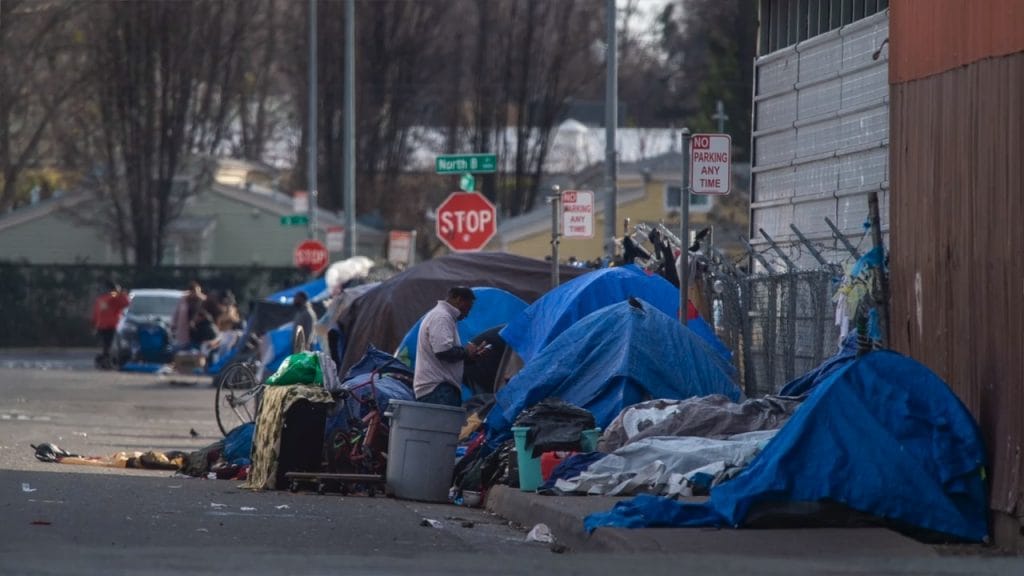
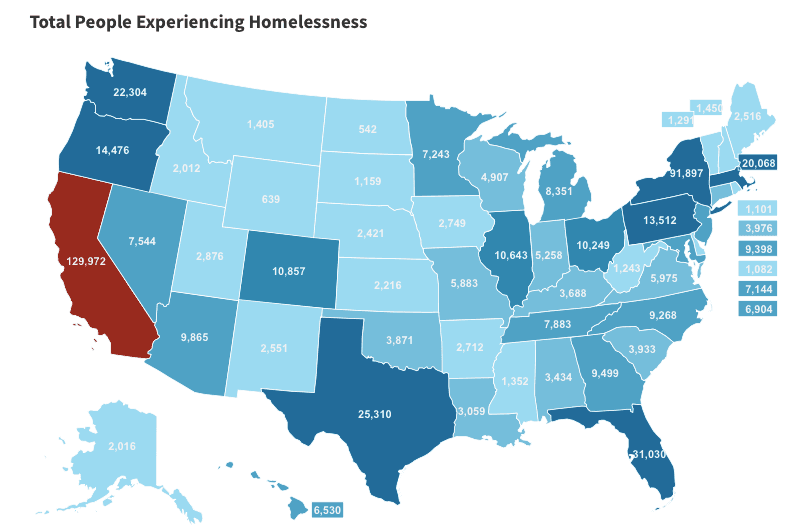
California likely leads the nation in socially activist government kindness. It also leads the nation in homelessness, chronic homelessness, and homeless veterans. The US Council on Homelessnesses estimates that, on any given day, 129,972 Californians are homeless, including 6,702 family households, and 10,836 veterans; 34,332 people are listed among “the chronic homeless”. That is, Californians with a disability who have been continuously homeless for one year or cumulatively homeless for 12 months in the past three years. No other state comes close to these numbers. The vast majority of these homeless are in the richer areas of two rich California cities: Los Angeles and San Francisco (mostly Los Angeles). Along with the homeless in these cities, there’s been a rise in 3rd world diseases: cholera, typhoid, typhus, etc. I’d like to explore the relationship between the policies of these cities and the rise of homelessness and disease. And I’d like to suggest a few cures, mostly involving sanitation.
A homeless encampment in LosAngeles
Most of the US homeless do not live in camps or on the streets. The better off US homelessness find it is a temporary situation. They survive living in hotels or homeless shelters, or they “couch-serf,” with family or friends. They tend to take part time jobs, or collect unemployment, and they eventually find a permanent residence. For the chronic homeless things are a lot grimmer, especially in California. The chronic unemployed do not get unemployment insurance, and California’s work rules tend to mean there are no part time jobs, and there is not even a viable can and bottle return system in California, so the homeless are denied even this source of income*. There is welfare and SSI, but you have to be somewhat stable to sign up and collect. The result is that California’s chronic homeless tend to live in squalor strewn tent cities, supported by food handouts.
Californians provide generous food handouts, but there is inadequate sewage, or trash collection, and limited access to clean water. Many of the chronic homeless are drug-dependent or mentally ill, and though they might benefit from religion-based missions, Los Angeles has pushed the missions to the edges of the cities, away from the homeless. The excess food and lack of trash collection tends to breed rats and disease, and as in the middle ages, the rats help spread the diseases.
Total homelessness by state, 2018; California leads the nation. The better off among these individuals do not live on the streets, but in hotels or homeless shelters. For most, this is a short term situation. The rest, about 20%, are chronically homeless. About half of these live on the streets without adequate sewage and water. Many are drug-dependent.
The first major outbreaks of the homeless camps appeared in Los Angeles in August and September of 2017. They reappeared in 2018, and by late summer, rates were roughly double 2017’s. This year, 2019, looks like it could be a real disaster. The first case of a typhoid infected police officer showed up in May. By June there were six police officers with typhoid, and that suggests record numbers are brewing among the homeless.
To see why sanitation is an important part of the cure, it’s worth noting that typhoid is a disease of unclean hands, and a relative of botulism. It is spread by people who go to the bathroom and then handle food without washing their hands first. The homeless camps do not, by and large, have hand washing stations. and forced hygiene is prohibited. Los Angeles has set up porta-potties, with no easy hand washing. The result is typhoid epidemic that’s even affecting the police (six policemen in June!).
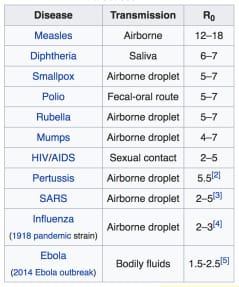
R-naught, reproduction number for some diseases, CDC.
Historically, the worst outbreaks of typhoid were spread by food workers. This was the case with “typhoid Mary of the early 20th century.” My guess is that some of the police who got typhoid, got it while trying to feed the needy. If so, this fellow could become another Typhoid Mary. Ideally, you’d want shelters and washing stations where the homeless are. You’d also want to pickup the dirtier among the homeless for forced washing and an occasional night in a homeless shelter. This is considered inhumane in Los Angeles, but they do things like this in New York, or they did.
Typhus is another major disease of the California homeless camps. It is related to typhoid but spread by rodents and their fleas. Infected rodents are attracted to the homeless camps by the excess food. When the rodents die, their infected fleas jump to the nearest warm body. Sometimes that’s a person, sometimes another animal. In a nastier city, like New York, the police come by and take away old food, dead animals, and dirty clothing; in Los Angeles they don’t. They believe the homeless have significant squatters rights. California’s kindness here results in typhus.
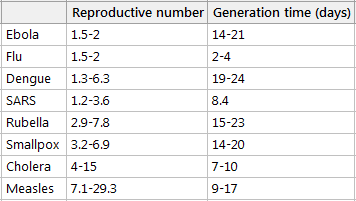
Reproduction number and generation time for some diseases.
The last of the major diseases of the homeless camps is cholera. It’s different from the others in that it is not dependent on squalor, just poor health. Cholera is an airborne disease, spread by coughing and sneezing. In California’s camps, the crazy and sick dwell close to each other and close to healthy tourists. Cholera outbreaks are a predictable result. And they can easily spread beyond the camps to your home town, and if that happens a national plague could spread really fast.
I’d discussed R-naught as a measure of contagiousness some months ago, comparing it to the reproductive number of an atom bomb design, but there is more to understanding a disease outbreak. R-naught refers merely to the number of people that each infected person will infect before getting cured or dying. An R-naught greater than one means the disease will spread, but to understand the rate of spread you also need the generation time. That’s the average time between when the host becomes infected, and when he or she infects others. The chart above shows that, for cholera, r-naught is about 10, and the latency period is short, about 9 days. Without a serious change in California’s treatment of the homeless, each cholera case in June will result in over 100 cases in July, and well over 10,000 in August. Cholera is somewhat contained in the camps, but once an outbreak leaves the camps, we could have a pandemic. Cholera is currently 80% curable by antibiotics, so a pandemic would be deadly.
Hygiene is the normal way to prevent all these outbreaks. To stop typhoid, make bathrooms available, with washing stations, and temporary shelters, ideally these should be run by the religious groups: the Salvation Army, the Catholic Church, “Loaves and Fishes”, etc. To prevent typhus, clean the encampments on a regular basis, removing food, clothing, feces and moving squatters. For cholera, provide healthcare and temporary shelters where people will get clean water, clean food, and a bed. Allow the homeless to work at menial jobs by relaxing worker hiring and pay requirements. A high minimum wage is a killer that nearly destroyed Detroit. Allow a business to hire the homeless to sweep the street for $2/hour or for a sandwich, but make a condition that they wash their hands, and throw out the leftovers. I suspect that a lot of the problems of Puerto Rico are caused by a too-high minimum wage by the way. There will always be poor among you, says the Bible, but there doesn’t have to be typhoid among the poor, says Dr. Robert Buxbaum.
July 30, 2019. I ran for water commissioner in Oakland county, Michigan, 2016. If there is interest, I’ll run again. One of my big issues is clean water. Oakland could use some help in this regard.
As of this month, the District of Columbia has joined 15 states in a pact to would end the electoral college choice of president. These 15 include New York, California, and a growing list of solid-blue (Democratic party) states. They claim the electoral must go as it robed them of the presidency perhaps five times: 2016, 2000, 1888, 1876, and perhaps 1824. They would like to replace the electoral college by plurality of popular vote, as in Mexico and much of South America.
All the big blue states and some small blue states have joined a compact to end the electoral college. As of 2019, they are 70% of the way to achieving this.
As it happens, I had to speak on this topic in High School in New York. I for the merits of the old system beyond the obvious: that it’s historical and works. One merit I found, somewhat historical, is that It was part of a great compromise that allowed the US to form. Smaller states would not have joined the union without it, fearing that the federal government would ignore or plunder them without it. Remove the vote advantage that the electoral college provides them, and the small states might have the right to leave. Federal abuse of the rural provinces is seen, in my opinion in Canada, where the large liberal provinces of Ontario and Quebec plunder and ignore the prairie provinces of oil and mineral wealth.
Several of the founding federalists (Jay, Hamilton, Washington, Madison) noted that this sort of federal republic election might bind “the people” to the president more tightly than a plurality election. The voter, it was noted, might never meet the president nor visit Washington, nor even know all the issues, but he could was represented by an elector who he trusted, he would have more faith in the result. Locals would certainly know who the elector favored, but they would accept a change if he could justify it because of some new information or circumstance, if a candidate died, for example, or if the country was otherwise deadlocked, as in 1800 or 1824.
Historically speaking, most electors vote their states and with their previously stated (or sworn) declaration, but sometimes they switch. In, 2016 ten electors switched from their state’s choice. Sven were Democrats who voted against Hillary Clinton, and three were Republicans. Electors who do this are called either “faithless electors” or “Hamilton electors,” depending on whether they voted for you or against you. Hamilton had argued for electors who would “vote their conscience” in Federalist PaperNo. 68. One might say these electors threw away their shot, as Hamilton did not. Still, they showed that elector voting is not just symbolic.
Federalist theory aside, it seems to me that the current system empowers both large and small states inordinately, and swing states, while disempowering Alabama and Massachussetts. Change the system and might change the outcome in unexpected ways.
That the current system favors Rhode Island is obvious. RI has barely enough population for 1 congressman, and gets three electors. Alabama, with 7 congressmen, gets 9 electors. Rhode Islanders thus get 2.4 times the vote power of Alabamans.
It’s less obvious that Alabama and Massachussetts are disfavored compared to New Yorkers and Californians. But Alabama is solid red, while New York and California are only sort of blue. They are majority Democrat, with enough Republicans to have had Republican governors occasionally in recent history. Because the electoral college awards all of New York’s votes to the winner, a small number Democrat advantage controls many electors.
In 2016, of those who voted for major party candidates in New York, 53% voted for the Democrat, and 47% Republican. This slight difference, 6%, swung all of NY’s 27 electors to Ms Clinton. If a popular vote are to replace the electoral college, New York would only have the net effect of the 6% difference; that’s about 1 million net votes. By contrast, Alabama is about 1/3 the population of New York, but 75% Republican. Currently its impact is only 1/3 of New York’s despite having a net of 2.5 million more R voters. Without the college, Alabama would have 2.5 times the impact of NY. This impact might be balanced by Massachusetts, but at the very least candidates would campaign in these states– states that are currently ignored. Given how red and blue these states are, it is quite possible that the Republican will be more conservative than current, and the Democrat more liberal, and third party candidates would have a field day as is common in Mexico and South America.
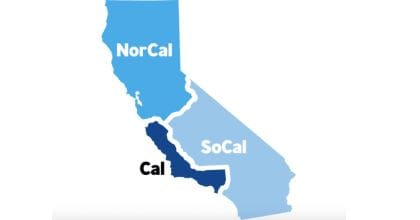
Proposed division of California into three states, all Democrat-leaning. Supposedly this will increase the voting power of the state by providing 4 more electors and 4 more senators.
California has petitioned for a different change to the electoral system — one that should empower the Democrats and Californians, or so the theory goes. On the ballot in 2016 was bill that would divide California into three sub-states. Between them, California would have six senators and four more electors. The proposer of the bill claims that he engineered the division, shown at right, so skillful that all three parts would stay Democrat controlled. Some people are worried, though. California is not totally blue. Once you split the state, there is more than three times the chance that one sub-state will go red. If so, the state’s effect would be reduced by 2/3 in a close election. At the last moment of 2016 the resolution was removed from the ballot.
Turning now to voter turnout, it seems to me that a change in the electoral college would change this as well. Currently, about half of all voters stay home, perhaps because their state’s effect on the presidential choice is fore-ordained. Also, a lot of fringe candidates don’t try as they don’t see themselves winning 50+% of the electoral college. If you change how we elect the president we are sure find a new assortment of voters and a much wider assortment of candidates at the final gate, as in Mexico. Democrats seem to believe that more Democrats will show up, and that they’ll vote mainstream D, but I suspect otherwise. I can not even claim the alternatives will be more fair.
In terms of fairness, Marie de Condorcet showed that the plurality system will not be fair if there are more than two candidates. It will be more interesting though. If changes to the electoral college system comes up in your state, be sure to tell your congressperson what you think.
Newspapers remain the primary source for verified news. Facts presumed to be sifted to avoid bias, while opinions and context is presumed to be that of the reporter whose name appears as the byline. We may look to other media sources for confirmation and fact-checking: news magazines, Snopes, and Facebook. Since 2016 these sources have been unanimous in their agreement about the dangers of biassed news. Republicans, including the president have claimed that the left-media spreads “fake news”, against him, while Democrats claim that Trump and the Russians have been spreading pro-Trump, fake news, While Trump and the Republicans claim that the left-media spreads fake news. In an environment like this, it’s worthwhile to point out that the left-wing and right-wing press is owned by a very few rich people, and none of it is free of their influence. An example of this is the following compilation of many stations praising their news independence: CBS, ABC, NBC, and FOX, praising their independence in exactly the same words.
It costs quite a lot to buy a newspaper or television station, and a lot more to keep it running. Often these are money-losing ventures, and as a result, the major newspapers tend to be owned by a few mega-rich individuals who have social or political axes to grind. As the video above shows, one main axe they have is convincing you of their own independence and reliability. The Sinclair news service, owned by the Smith news family came up with the text, and all the independent journalists read it in as convincing a voice as they could muster. This is not to say. that all the news is this bad or that the mega rich don’t provide a service by providing us the news, but it’s worth noting that they extract a fee by controlling what is said, and making sure that the news you see fits their agendas – agendas that are often obvious and open to the general view.
Perhaps the most prominent voice on the right is Rupert Murdoch who owns The New York Post, and The Wall Street Journal. He used to own Fox too, and is still the majority controller and guiding voice, but Fox is now owned by Disney who also owns ABC. Murdoch uses his many media outlets to make money and promote conservative and Republican causes. You might expect him to support Trump, but he has a person feud with him that boils up in the Post’s cover pages. Disney’s ABC tends to present news on the left, but as in the compilation above, left and right journalists have no problem parroting the same words. Here is another, older compilation, more journalistl saying the same thing in the same words, e.g. playing up the Conan O’Brian show.
Another media master is Ted Turner. He tends to own media outlets on the left including CNN. Turner manages to make CNN, and his other properties profitable, in part by courting controversy. His wife for a time was Jane Fonda, otherwise known as Hanoi Jane.
Another left-leaning media empire (whatever that means) is MSNBC. It is owned by Time-Warner, also owner of The Huffington Post. Both are anti-israel, and both promote zero-tariff, Pacific-rim trade, but as seen above, MSNBC anchors will read whatever trash they are told to read, and often it’s the same stuff you’d find on Fox.
Rounding out the list of those with a complete US media empires, I include the Emir of Qatar, perhaps the richest man in the world. He operates Al Jazeera, “the most respected news site for Middle east reporting” as an influence-buying vehicle. Al Jazeera is strongly anti-fracking, anti nuclear, and anti oil (Qatar is Asia’s latest supplier of natural gas). It is strongly anti-Israel, and anti Saudi. Qatar propagandist, Jamal Khashoggi worked for AlJazeera, and was likely killed for it. They’re also reliably pro-Shia, with positive stories about Hamas, The Muslim Brotherhood, and Iran, but negative stories about Sunni Egypt and Turkey. They present news, but not unbiassed.
But you don’t have to buy a complete media empire to present your politics as unbiassed news. Jeff Bezos, founder Amazon, bought The Washington Post for $250 million (chump change to hm). For most of the past two years, the paper mostly promoted anti-tariff views, and liberal causes, like high tax rates on the rich. Amazon thrives on cheep Chinese imports, and high tax rates don’t hurt because Amazon manages to not pay any taxes on $11 billion/year profits (by clever accounting they actually get a rebate). Recently Joe Biden made the mistake of calling out Amazon for not paying on $11 billion in profits, and The Washington Post has returned the favor by bashing Biden. As for why Bezos bought the money-losing Post, he said: “It is the newspaper in the Capital City of the most important country in the world… [As such] … “it has an incredibly important role to play in this democracy.”
Moving on to The New Your Times, its editorial slant is controlled by another contestant for world’s richest man: telecom mogul, Carlos “Slim” Helú. Carlos’s views are very similar to Bezos’s, with more of an emphasis on free trade with Mexico. Steve Jobs’s widow runs “The Atlantic” for the same reasons. It’s free on line, well written and money losing. Like with the above, it seems to be a vanity project to promote her views. It’s a hobby, but sh can afford it.
Like her, Chris Hughes, Facebook’s Co-founder and Zuckerberg room-mate, bought and runs the money losing “The New Republic“. He was Facebook’s director of marketing and communications before joining the Obama campaign as it internet marketing head. The New Republic’s had a stellar reputation, back in the day. Zuckerberg himself runs a media empire, but it’s different from the above: it’s social media where people pay for placement, and where those whose views he doesn’t like get censored: put in Facebook jail. He’s gotten into trouble over it, but as a media giant, there seem to have been no consequences.
H.L. Menken on the fake news of the early – mid 20th century.
And it’s not only rich individuals who turn trusted news sources into propaganda outlets. The US CIA did this for years, and likely still do. Then there are the Russians, the Chinese, the Israelis, the British (BBC) and our very own NPRt. These sources present news that benefits them in the most positive light and scream about dangers to democracy and the world if their position is touched or their veracity is questioned. As these sources are all government funded, there is a they are unanimous supporters big governments as a cure to all ills. Closer to home, I’d like to mention that Detroit has two major papers, but only one owner. The left leaning Detroit Free Press, and the right-leaning Detroit News are owned by the same people, share a considerable staff, and generally agree on important issues. There are a dozen smaller papers in Metro Detroit; all but one is owned by one media group.
I’d like to end with a positive note. Not every reporter is in this sad grab-bag. In Detroit, Setve Neveling, “the motor-city muckraker” manages to present is independent, active news. Then there is Los Angeles’s Biotech billionaire, Patrick Soon-Shiong. He bought the LA Times in June 2018, claiming he will use it to fight fake news, “the cancer of our time.” I wish him luck. So far, I’d say, he’s made the LA Times is the best Newspaper in the US with The NY Post a close second ( love the snarky headlines).