Category Archives: Philosophy

Of God and gauge blocks

Most scientists are religious on some level. There’s clear evidence for a big bang, and thus for a God-of-Creation. But the creation event is so distant and huge that no personal God is implied. I’d like to suggest that the God of creation is close by and as a beginning to this, I’d like to discus Johansson gauge blocks, the standard tool used to measure machine parts accurately.
jo4

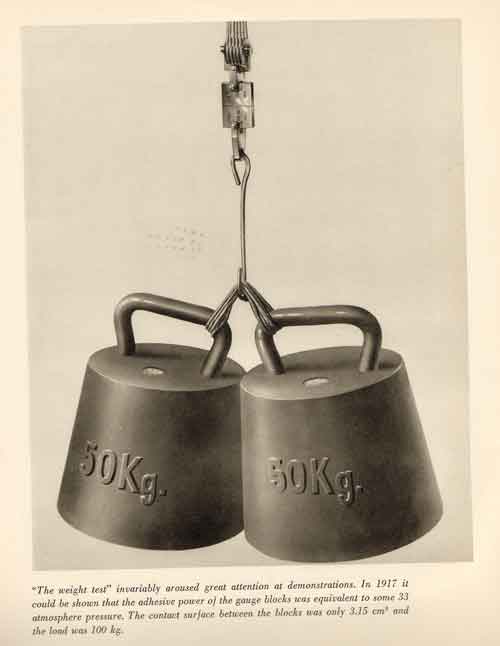
A pair of Johansson blocks supporting 100 kg in a 1917 demonstration. This is 33 times atmospheric pressure, about 470 psi.

Lets say you’re making a complicated piece of commercial machinery, a car engine for example. Generally you’ll need to make many parts in several different shops using several different machines. If you want to be sure the parts will fit together, a representative number of each part must be checked for dimensional accuracy in several places. An accuracy requirement of 0.01 mm is not uncommon. How would you do this? The way it’s been done, at least since the days of Henry Ford, is to mount the parts to a flat surface and use a feeler gauge to compare the heights of the parts to the height of stacks of precisely manufactured gauge blocks. Called Johansson gauge blocks after the inventor and original manufacturer, Henrik Johansson, the blocks are typically made of steel, 1.35″ wide by .35″ thick (0.47 in2 surface), and of various heights. Different height blocks can be stacked to produce any desired height in multiples of 0.01 mm. To give accuracy to the measurements, the blocks must be manufactured flat to within 1/10000 of a millimeter. This is 0.1µ, or about 1/5 the wavelength of visible light. At this degree of flatness an amazing thing is seen to happen: Jo blocks stick together when stacked with a force of 100 kg (220 pounds) or more, an effect called, “wringing.” See picture at right from a 1917 advertising demonstration.

This 220 lbs of force measured in the picture suggests an invisible pressure of 470 psi at least that holds the blocks together (220 lbs/0.47 in2 = 470 psi). This is 32 times the pressure of the atmosphere. It is independent of air, or temperature, or the metal used to make the blocks. Since pressure times volume equals energy, and this pressure can be thought of as a vacuum energy density arising “out of the nothingness.” We find that each cubic foot of space between the blocks contains, 470 foot-lbs of energy. This is the equivalent of 0.9 kWh per cubic meter, energy you can not see, but you can feel. That is a lot of energy in the nothingness, but the energy (and the pressure) get larger the flatter you make the surfaces, or the closer together you bring them together. This is an odd observation since, generally get more dense the smaller you divide them. Clean metal surfaces that are flat enough will weld together without the need for heat, a trick we have used in the manufacture of purifiers.
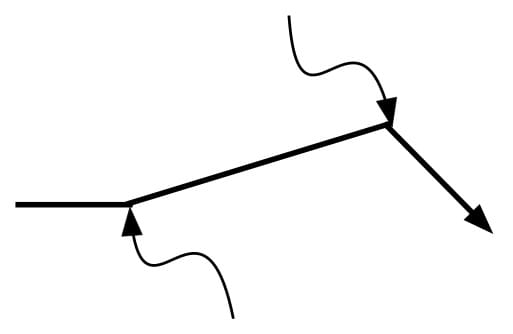
A standard way to think of quantum scattering is that the particle is scattered by invisible bits of light (virtual photons), the wavy lines. In this view, the force that pushes two flat surfaces together is from a slight deficiency in the amount of invisible light in the small space between them.

A standard way to think of quantum scattering of an atom (solid line) is that it is scattered by invisible bits of light, virtual photons (the wavy lines). In this view, the force that pushes two blocks together comes from a slight deficiency in the number of virtual photons in the small space between the blocks.

The empty space between two flat surfaces also has the power to scatter light or atoms that pass between them. This scattering is seen even in vacuum at zero degrees Kelvin, absolute zero. Somehow the light or atoms picks up energy, “out of the nothingness,” and shoots up or down. It’s a “quantum effect,” and after a while physics students forget how odd it is for energy to come out of nothing. Not only do students stop wondering about where the energy comes from, they stop wondering why it is that the scattering energy gets bigger the closer you bring the surfaces. With Johansson block sticking and with quantum scattering, the energy density gets higher the closer the surface, and this is accepted as normal, just Heisenberg’s uncertainly in two contexts. You can calculate the force from the zero-point energy of vacuum, but you must add a relativistic wrinkle: the distance between two surfaces shrinks the faster you move according to relativity, but measurable force should not. A calculation of the force that includes both quantum mechanics and relativity was derived by Hendrik Casimir:

Energy per volume = P = F/A = πhc/ 480 L4,

where P is pressure, F is force, A is area, h is plank’s quantum constant, 6.63×10⁻³⁴ Js, c is the speed of light, 3×10⁸ m/s, and L is the distance between the plates, m. Experiments have been found to match the above prediction to within 2%, experimental error, but the energy density this implies is huge, especially when L is small, the equation must apply down to plank lengths, 1.6×10⁻³⁵ m. Even at the size of an atom, 1×10⁻¹⁰m, the amount of the energy you can see is 3.6 GWhr/m3, 3.6 Giga Watts. 3.6 GigaWatt hrs is one hour’s energy output of three to four large nuclear plants. We see only a tiny portion of the Plank-length vacuum energy when we stick Johansson gauge blocks together, but the rest is there, near invisible, in every bit of empty space. The implication of this enormous energy remains baffling in any analysis. I see it as an indication that God is everywhere, exceedingly powerful, filling the universe, and holding everything together. Take a look, and come to your own conclusions.

As a homiletic, it seems to me that God likes friendship, but does not desire shaman, folks to stand between man and Him. Why do I say that? The huge force-energy between plates brings them together, but scatters anything that goes between. And now you know something about nothing.

Robert Buxbaum, November 7, 2018. Physics references: H. B. G. Casimir and D. Polder. The Influence of Retardation on the London-van der Waals Forces. Phys. Rev. 73, 360 (1948).
S. Lamoreaux, Phys. Rev. Lett. 78, 5 (1996).

Einstein’s theory of happiness

Note for a talk in Tokyo: Einstein's theory of happiness.

Note for a talk in Tokyo: Einstein’s theory of happiness.

In 1922, Einstein was in Tokyo to give a speech, and had just recently been informed that he would win the Nobel prize. He knew that he’d be more famous than he had been, and everyone else did too. The prize money and more had already been contracted out to his wife for his divorce, but most people didn’t know that, and the few who did, didn’t realize that even after receiving the prize, he’d remain as poor as he had been. Anyway, shortly after the announcement a bell boy delivered something to his room, but Einstein had no money available. Instead he gave the bell-boy two scraps of thoughts for the talk, one of them on the Tokyo hotel stationery. The more famous one, “his theory of happiness” says, In German:

“A calm and modest life brings more happiness than the pursuit of success combined with constant restlessness.” The note is signed, Albert Einstein, dated November 1922 Tokyo. It sold at action October, 2018 for $1.56 million, not a bad tip, in both senses of the word. Einstein told the bell-boy that this note would probably be worth more than the usual tip. It was, and is.

In general Einstein told people to avoid academia, and instead go into something productive that you can do well for an income. Do your creative work, he advised, in your spare time, he advised; it ruins the enjoyment of creativity to always have to discover something new for your income, “always have to pull a rabbit out of your hat.” Einstein’s happiest time, and his most productive were his years working at the patent office in Bern, Switzerland, while doing physics in his spare time at home. Einstein produced relatively little of permanent physics value in the years following 1922. The discovery that Einstein’s theories predicted gravitational waves was not Einstein’s, nor was the discovery that his equations suggested an expanding universe. The former was the suggestion of, Howard Robertson, a reviewer of a paper by Einstein, and the latter was made by a Belgian scientist-priest named Georges Lemaitre. it was only after Hubble observed an expanding universe in 1929 that Einstein realized that Lemaitre had been right, and only in 1936 that he came to accept gravitational waves. Gravitational waves were finally observed in 2016. The observation earned Rainer Weiss, Barry Barish, and Kip Thorne the 2017 Nobel Prize in physics.

I’ve written about Einstein a few times. He seems to have been among the few creative people who lived a happy, productive life and died well liked by all. Here are some life lessons, and some thoughts on how you tel a genius from a nut. You can find out more about Einstein’s love letters and his divorce here, including about the divorce settlement.

Robert Buxbaum, November 2, 2018. The essence of a nice gift is in the note.

Of God and Hubble

Edwin Hubble and Andromeda Photograph

Edwin Hubble and Andromeda Photograph

Perhaps my favorite proof of God is that, as best we can tell using the best science we have, everything we see today, popped into existence some 14 billion years ago. The event is called “the big bang,” and before that, it appears, there was nothing. After that, there was everything, and as best we can tell, not an atom has popped into existence since. I see this as the miracle of creation: Ex nihilo, Genesis, Something from nothing.

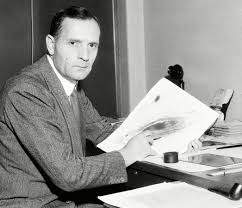
The fellow who saw this miracle first was an American, Edwin P. Hubble, born 1889. Hubble got a law degree and then a PhD (physics) studying photographs of faint nebula. That is, he studied the small, glowing, fuzzy areas of the night sky, producing a PhD thesis titled: “Photographic Investigations of Faint Nebulae.” Hubble served in the army (WWI) and continued his photographic work at the Mount Wilson Observatory, home to the world’s largest telescope at the time. He concluded that many of these fuzzy nebula were complete galaxies outside of our own. Most of the stars we see unaided are located relatively near us, in our own, local area, of our own, “Milky Way” galaxy, that is within a swirling star blob that appears to be some 250,000 light years across. Through study of photographs of the Andromeda “nebula”, Hubble concluded it was another swirling galaxy quite like ours, but some 900,000 light years away. (A light year is 5,900,000,000,000 miles, the distance light would travel in a year). Finding another galaxy was a wonderful find; better yet, there were more swirling galaxies besides Andromeda, about 100 billion of them, we now think. Each galaxy contains about 100 billion stars; there is plenty of room for intelligent life. 

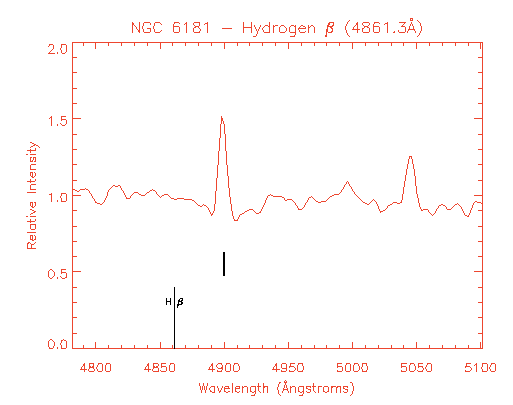
Emission from Galaxy NGC 5181. The bright, hydrogen ß line should be at but it's at

Emission spectrum from Galaxy NGC 5181. The bright, hydrogen ß line should be at 4861.3 Å, but it’s at about 4900 Å. This difference tells you the speed of the galaxy.

But the discovery of galaxies beyond our own is not what Hubble is most famous for. Hubble was able to measure the distance to some of these galaxies, mostly by their apparent brightness, and was able to measure the speed of the galaxies relative to us by use of the Doppler shift, the same phenomenon that causes a train whistle to sound differently when the train is coming towards you or going away from you. In this case, he used the frequency spectrum of light for example, at right, for NGC 5181. The color of the spectral lines of light from the galaxy is shifted to the red, long wavelengths. Hubble picked some recognizable spectral line, like the hydrogen emission line, and determined the galactic velocity by the formula,

V= c (λ – λ*)/λ*.

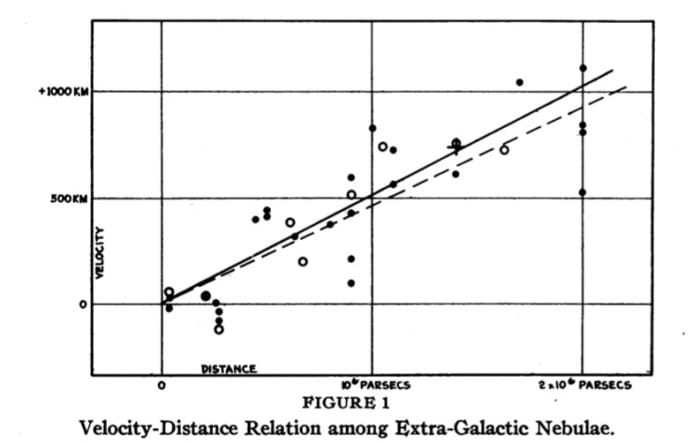
In this equation, V is the velocity of the galaxy relative to us, c is the speed of light, 300,000,000 m/s, λ is the observed wavelength of the particular spectral line, and λ*is the wavelength observed for non-moving sources. Hubble found that all the distant galaxies were moving away from us, and some were moving quite fast. What’s more, the speed of a galaxy away from us was roughly proportional to the distance. How odd. There were only two explanations for this: (1) All other galaxies were propelled away from us by some, earth-based anti-gravity that became more powerful with distance (2) The whole universe was expanding at a constant rate, and thus every galaxy sees itself moving away from every other galaxy at a speed proportional to the distance between them.

This second explanation seems a lot more likely than the first, but it suggests something very interesting. If the speed is proportional to the distance, and you carry the motion backwards in time, it seems there must have been a time, some 14 billion years ago, when all matter was in one small bit of space. It seems there was one origin spot for everything, and one origin time when everything popped into existence. This is evidence for creation, even for God. The term “Big Bang” comes from a rival astronomer, Fred Hoyle, who found the whole creation idea silly. With each new observation of a galaxy moving away from us, the idea became that much less silly. Besides, it’s long been known that the universe can’t be uniform and endless.

Hubble’s plot: Recession velocity vs distance from us in parsecs

Whatever we call the creation event, we can’t say it was an accident: a lot of stuff popped out at one time, and nothing at all similar has happened since. Nor can we call it a random fluctuation since there are just too many stars and too many galaxies in close proximity to us for it to be the result of random atoms moving. If it were all random, we’d expect to see only one star and our one planet. That so much stuff popped out in so little time suggests a God of creation. We’d have to go to other areas of science to suggest it’s a personal God, one nearby who might listen to prayer, but this is a start. 

If you want to go through the Hubble calculations yourself, you can find pictures and spectra of galaxies here for the 24 or so original galaxies studied by Hubble: http://astro.wku.edu/astr106/Hubble_intro.html. Based on your analysis, you’ll likely calculate a slightly different time for creation from the standard 14 billion, but you’ll find you calculate something close to what Hubble did. To do better, you’ll need to look deeper into space, and that would take a better telescope, e.g.  the “Hubble space telescope”

Robert E. Buxbaum, October 28, 2018.

A Pastor to Trump’s Soul

Trump’s religious connection is so different from the norm that most people think it must be fake, but the truth of his connection to Christianity, as best I can determine it, is even more bizarre than the assumption that there is none. From the time that he was six years old, Donald Trump attended a famous church in New York City, The Marble Collegiate Presbyterian Church. He attended along with his grandfather, his parents, his brother, and his sisters. He was married in this church as was his sister. Both his parents funerals were in the sanctuary, and unlike most children in a family church, he seems to have been generally moved by the sermons — moved to change his life.

Trump and NVP

Various scenes of Trump and his family with Dr. Norma Vincent Peale.

The pastor of the church and the author of these sermons was not a standard Christian, though. It was Norman Vincent Peele, author of “The Power of Positive Thinking.” According to President Trump, he loved the sermons almost from the beginning. They went on for an hour or so and as Trump remembers it, the Reverend Peele could have spoken for twice as long at least. Dr. Peale did not talk fo sin, but rather of success and other of the most positive things. Peale claimed that you could do anything you wanted with the help of God and proving you believed in your self and didn’t let anything anyone said interfere. He backed up this take on the bible by a cherry-picked selection from all the positive lines in the Bible — Lines that are really there, but that most pastors avoid because they can make a person arrogant (or seem arrogant). A source for all of president Trumps bizarre self-image ideas can be found in Peele’s “The power of positive thinking,”I  find.presidents-billy-right-960x640BG-Kennedy-960x640

Dwight Eishenhouer

Some other US presidents with Reverend Billy Graham.

Most other American pastors have emphasized self reflection and humility. They would pray for the power to avoid bragging or other forms of puffing one’s self up —  the very opposite approach of Dr. Peale’s. The most popular of the alternates approaches, one embraced by virtually every president from 1952 to today was Billy Graham’s fire humility.

Eisenhower golfed with Graham regularly, as did Kennedy, Johnson, Nixon, Ford, and G. H.W. Bush. Graham was a feature at prayer breakfasts with Johnson and Reagan, and Carter. In time of trouble it was Billy Graham who counseled Carter, Clinton, and Nixon, and it was Graham who got George W. Bush to give up drinking. After a time, one could imagine that Billy Graham’s quiet humility and fiery faith was the real American belief. Or at least that this was the form of American soul that one associated with success.bill graham reagan BG-JOHNSON

After decades of seeing Billy Graham at the White House, one began to believe that his was the image of the believing American. To believe meant to see oneself as a sinner who often made mistakes but was genuinely sorry for these failures. A believing American was genuinely penitent, but not too loudly. Was reborn, but didn’t make too much fuss of it. Thus it’s more than a little shock to find believer in God’s plan who claims to believes that God wants him to have success, money, and power, and who claims, as Trump does, that those who criticize him are “fake news”.

I’ve mentioned before that a strong belief in ones self has a positive side for leaders, but it strikes me that perhaps it’s also good for religion. These lines really do appear in the Bible, Humility is there too, of course, but we could all use a reminder that “God gives to all who believe in Him.”

Robert Buxbaum, September 3, 2018

Most traffic deaths are from driving too slow

About 40,100 Americans lose their lives to traffic accidents every year. About 10,000 of these losses involve alcohol, and about the same number involve pedestrians, but far more people have their lives sucked away by waiting in traffic, IMHO. Hours are spent staring at a light, hoping it will change, or slowly plodding between destinations with their minds near blank. This slow loss of life is as real as the accidental type, but less dramatic.

Consider that Americans drive about 3.2 trillion miles each year. I’ll assume an average speed of 30 mph (the average speed registered on my car is 29 mph). Considering only the drivers of these vehicles, I calculate 133 billion man-hours of driving per year; that’s 15.2 million man-years or 217,000 man-lifetimes. If people were to drive a little faster, perhaps 10% faster, some 22,000 man lifetimes would be saved per year in time wasted. The simple change of raising the maximum highway speed to 80 mph from 70, I’d expect, would save half this, maybe 10,000 lifetimes. There would likely be some more accidental deaths, but not more accidents. Tiredness is a big part of highway accidents, as is highway congestion. Faster speeds decreases both, decreasing the number of accidents, but one expects there will be an increase in the deadliness of the accidents.

Highway deaths for the years before and after Nov. 1995. Most states raised speeds, but some left them unchanged.

Highway deaths for the years before and after speed limit were relaxed in Nov. 1995. At that time most states raised their speed limits, but some did not, leaving them at 65 rural, 55 urban; a few states were not included in this study because they made minor changes.

A counter to this expectation comes from the German Autobahn, the fastest highway in the world with sections that have no speed limit. German safety records show that there are far fewer accidents per km on the Autobahn, and that the fatality rate per km is about 1/3 that on other stretches of highway. This is about 1/2 the rate on US highways (see safety comparison). For a more conservative comparison, we could turn to the US experience of 1995. Before November 1995, the US federal government limited urban highway speeds to 55 mph, with 65 mph allowed only on rural stretches. When these limits were removed, several states left the speed limits in place, but many others raised their urban speed limits to 65 mph, and raised rural limits to 70 mph. Some western states went further and raised rural speed limits to 75 mph. The effect of these changes is seen on the graph above, copied from the Traffic Operations safety laboratory report. Depending on how you analyze the data, there was either a 2% jump (institute of highway safety) in highway deaths or perhaps a 5% jump. These numbers translate to a 3 or 6% jump because the states that did not raise speeds saw a 1% drop in death rates. Based on a 6% increase, I’d expect higher highway speed limits would cost some 2400 additional lives. To me, even this seems worthwhile when balanced against 10,000 lives lost to the life-sucking destruction of slow driving.

Texas has begun raising speed limits. Texans seem happy.

Texas has begun raising speed limits. So far, Texans seem happy.

There are several new technologies that could reduce automotive deaths at high speeds. One thought is to only allow high-speed driving for people who pass a high-speed test, or only for certified cars with passengers who are wearing a 5-point harness, or only on roads. More relevant to my opinion is only on roads with adequate walk-paths — many deaths involve pedestrians. Yet another thought; auto-driving cars (with hydrogen power?). Computer-aided drivers can have split second reaction times, and can be fitted with infra-red “eyes” that see through fog, or sense the motion of a warm object (pedestrian) behind an obstruction. The ability of computer systems to use this data is limited currently, but it is sure to improve.

I thought some math might be in order. The automotive current that is carried by a highway, cars/hour, can be shown to equal to the speed of the average vehicle multiplied by the number of lanes divided by the average distance between vehicles. C = v L/ d.

At low congestion, the average driving speed, v remains constant as cars enter and leave the highway. Adding cars only affects the average distance between cars, d. At some point, around rush hour, so many vehicles enter the highway that d shrinks to a distance where drivers become uncomfortable; that’s about d = 3 car lengths, I’d guess. People begin to slow down, and pretty soon you get a traffic jam — a slow-moving parking lot where you get less flow with more vehicles. This jam will last for the entirety of rush hour. One of the nice things about auto-drive cars is that they don’t get nervous, even at 2 car lengths or less at 70 mph. The computer is confident that it will brake as soon as the car in front of it brakes, maintaining a safe speed and distance where people will not. This is a big safety advantage for all vehicles on the road.

I should mention that automobile death rates vary widely between different states (see here), and even more widely between different countries. Here is some data. If you think some country’s drivers are crazy, you should know that many of the countries with bad reputations (Italy, Ireland… ) have highway death rates that are lower than ours. In other countries, in Africa and the mid-east death rates per car or mile driven are 10x, 100x, or 1000x higher than in the US. The countries have few cars and lots of people who walk down the road drunk or stoned. Related to this, I’ve noticed that old people are not bad drivers, but they drive on narrow country roads where people walk and accidents are common.

Robert Buxbaum, June 6, 2018.

Japanese zen art – just go away

Japanese zen spiral -- it's a cartoon about meditation. It looks like a monk and a spiral, and note that both ends point inward.

Japanese zen spiral — it’s a cartoon about meditation. It looks like a monk and a spiral, and note that both ends point inward. Cute.

The purpose of art is not generally to show the world as it is, but to show a new, better way to look at the world. As such, my take on Japanese zen art, is that it is a very cool, fun way to say “just go away.” What follows are some nice (to my eyes) examples, with my commentary.

As with most Japanese art, the zen art looks simpler and more free-form than western religious art. In a sense that is true: there are far fewer lines, but the paintings take as long to make, to a good estimate, since they only appear to have been made with casual ease: flicks of the wrist and waves of the hand. In actuality the artist had a vision of what he wanted, and then made free-hand waving copy after copy until he had some correct, free-looking ones ready for delivery. Because of this, you can look for a meaning in every wiggle — something that you would not do with US free-form abstracts, or with religious paintings of the 1600s. Take daVinci’s last supper — the grand layout is clearly planned and meaningful, the details of the wrinkles, not really. With these, though, no detail is accidental, and the non-accidental sense, as I see it, is “just go away.”

Buddhist Master. I can imagine this work is effective at keeping guests from over-staying their welcome.

Buddhist Master. Art like this keeps away guests.

Take the spiral at left. It’s sort of cool, and claims to be an allusion to meditation. Mystic, no? As I look carefully a the spiral, the first remarkable thing I see is that it circles in on itself at both ends. At a simple level, I think that’s an allusion to the inward nature of meditation, but note that, at the top end of the coil there’s a wiggle that looks like a face. I take that to be a monk’s face, looking away. The geometry of the coil then suggests the legs and thighs of the rest of the monk (sitting?). If that’s the image (and I think it is) the fact that the monk is facing away from you, leaving you behind suggests to me that the owner has no desire to have you join him. I see nothing in this that would cause another person to want to meditate either. There is nothing attractively persuasive as in western religious art. Here’s an essay I wrote on meditation.

Perhaps it’s just me, but I also imagine these artists living on an industrial treadmill, making painting after painting in his shop and throwing most away because, for example, the monk’s back extended past the paper. Western expressionism also sometimes puts many paintings on a single canvas, but the hidden image stays, at least in a sort-of half shadow. And the wiggles strive to be less learned, even if the faces of some western religious art is distant –even more distant often. At right, above, you’ll find another popular zen-art approach. It shows a zen master in nearly full face. As with most zen art, the master (Buddha or a disciple) looks calm -ish with a sense of the put-upon, as if he were Christ carrying the cross of you being there. Perhaps the intent was to make you go off and meditate, or to see society as worthless, but I think the more-likely message in the master’s look is “why me Lord.” The master looks like he isn’t unhappy with life, just unhappy with you being there. I imagine that this work was placed in a noble’s living room or study for the same reason that many American today put up a picture of Yosemite Sam, sometimes (for those who don’t get art) “Keep Out! This means you.”

A monkey looks at the moon in a well. Don't touch, the moon seems to say.

A monkey looks at the moon in a well. Don’t touch, the moon seems to say.

As with the Warner-bros. classic, there is a flowing look to the brushwork, but a fair amount of detail. As with the Warner Bros. cartoon, the casual lines seem to serve the purpose of keeping the viewer from taking offense at the message. Sort of like, “Don’t go away mad, just go away.” Cool, but I also like Western cartooning.

As one last example, at left you’ll see a painting illustrating a zen parable. in this case it’s the parable of the monkey’s and the image of the moon. Shown is the moon’s reflection in the water of a well — moon is that big round face. A monkey is about to touch the moon-image, and as we can expect, when the monkey touches the image, it disappears. There are several understandings to be gained from this, e.g. that all is illusion (similar to Plato and his cave), or suggesting that it is better to look at life than to interact with it. Which is the main meaning? In this picture, my sense is that the moon seems put-upon, and afraid. Thus, the lesson I take from the picture is one of inaction: “don’t touch the reflection.” Once again, the choice to depict a frightened moon rather than an impassive one, seems to be the painter’s way of saying “please go away.” Very cool image, but as messages go, that’s the one I see in most Japanese zen art.

Robert Buxbaum, August 17, 2017. I’ve also written on surreal art (I like it a lot, and find it ‘funny’) and on Dada, and conceptual (I like it too, playfully meaningful, IMHO). If you like zen jokes (and who doesn’t) here’s a story of the Buddhist and the hot-dog vendor, and how many zen Buddhists does it take to change a lightbulb? Four. See why.

Heraclitus and Parmenides, time jokes

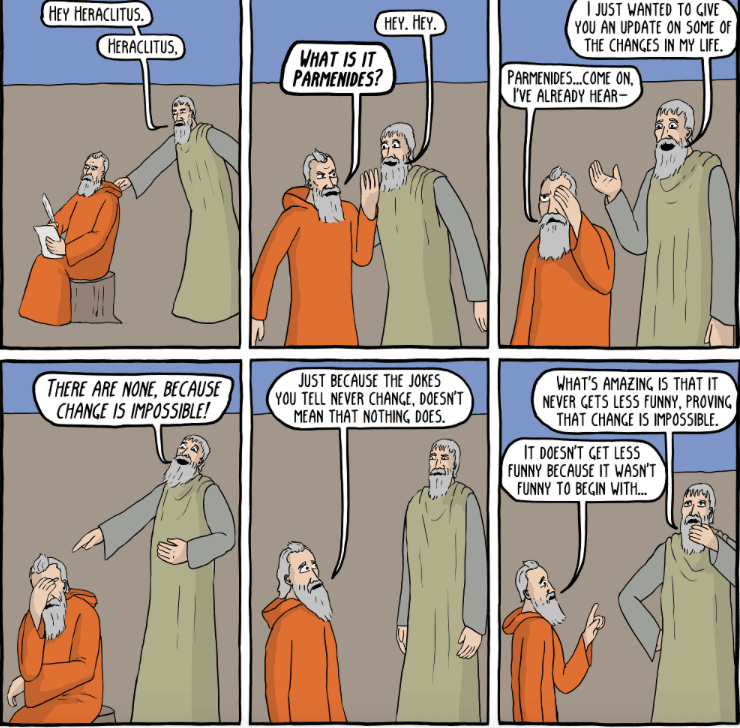
From Existential Commics

From Existential Comics; Parmenides believed that nothing changed, nor could it.

For those who don’t remember, Heraclitus believed that change was the essence of life, while  Parmenides believed that nothing ever changes. It’s a debate that exists to this day in physics, and also in religion (there is nothing new under the sun, etc.). In science, the view that no real change is possible is founded in Schrödinger’s wave view of quantum mechanics.

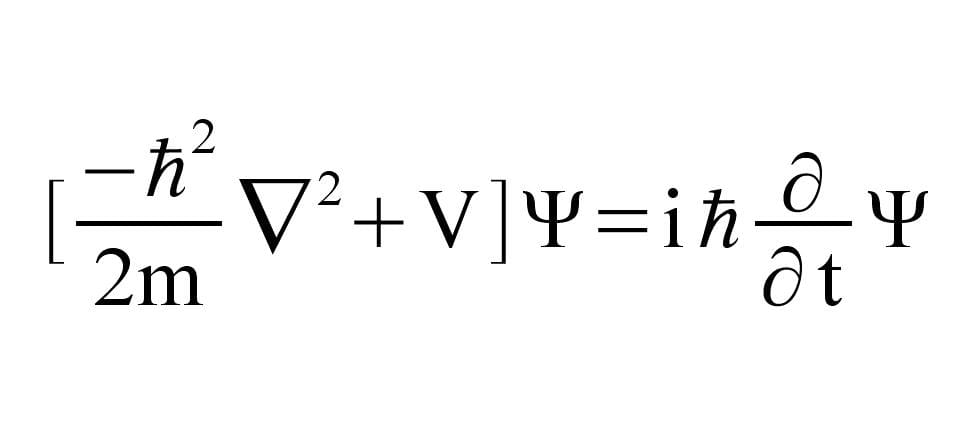
Schrödinger's wave equation, time dependent.

Schrödinger’s wave equation, time dependent.

In Schrödinger’s wave description of reality, every object or particle is considered a wave of probability. What appears to us as motion is nothing more than the wave oscillating back and forth in its potential field. Nothing has a position or velocity, quite, only random interactions with other waves, and all of these are reversible. Because of the time reversibility of the equation, long-term, the system is conservative. The wave returns to where it was, and no entropy is created, long-term. Anything that happens will happen again, in reverse. See here for more on Schrödinger waves.

Thermodynamics is in stark contradiction to this quantum view. To thermodynamics, and to common observation, entropy goes ever upward, and nothing is reversible without outside intervention. Things break but don’t fix themselves. It’s this entropy increase that tells you that you are going forward in time. You know that time is going forward if you can, at will, drop an ice-cube into hot tea to produce lukewarm, diluted tea. If you can do the reverse, time is going backward. It’s a problem that besets Dr. Who, but few others.

One way that I’ve seen to get out of the general problem of quantum time is to assume the observed universe is a black hole or some other closed system, and take it as an issue of reference frame. As seen from the outside of a black hole (or a closed system without observation) time stops and nothing changes. Within a black hole or closed system, there is constant observation, and there is time and change. It’s not a great way out of the contradiction, but it’s the best I know of.

Predestination makes a certain physics and religious sense, it just doesn't match personal experience very well.

Predestination makes a certain physics and religious sense, it just doesn’t match personal experience very well.

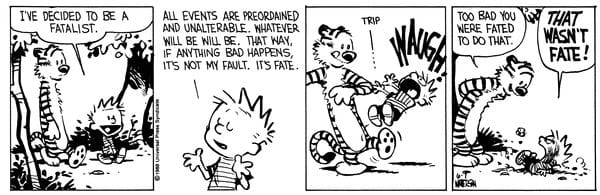
The religion version of this problem is as follows: God, in most religions, has fore-knowledge. That is, He knows what will happen, and that presumes we have no free will. The problem with that is, without free-will, there can be no fair judgment, no right or wrong. There are a few ways out of this, and these lie behind many of the religious splits of the 1700s. A lot of the humor of Calvin and Hobbes comics comes because Calvin is a Calvinist, convinced of fatalistic predestination; Hobbes believes in free will. Most religions take a position somewhere in-between, but all have their problems.

Applying the black-hole model to God gives the following, alternative answer, one that isn’t very satisfying IMHO, but at least it matches physics. One might assume predestination for a God that is outside the universe — He sees only an unchanging system, while we, inside see time and change and free will. One of the problems with this is it posits a distant creator who cares little for us and sees none of the details. A more positive view of time appears in Dr. Who. For Dr. Who time is fluid, with some fixed points. Here’s my view of Dr. Who’s physics.  Unfortunately, Dr. Who is fiction: attractive, but without basis. Time, as it were, is an issue for the ages.

Robert Buxbaum, Philosophical musings, Friday afternoon, June 30, 2017.

Solving the savings dilemma (how to have savings)

A few days ago, I wrote a post about the lack of savings in America, the social causes for it, and the damage it causes. I had some governmental suggestions, but suspect I didn’t emphasize that the main responsibility is personal: if you want savings, you’ve got to save.

Every rich person spends less than he earns. If you aspire to be rich, spend less on clothes than you can afford.

Every rich person spends less than he earns. If you aspire to be rich, spend less on clothes than you can afford.

If you want to have savings, it is up to you to spend less than you earn. If you don’t, you’ll never be rich, you won’t even have net-economic worth, and you’ll always be strung-out over emergencies. Income and gifts can’t help if spending rises to match. At all incomes, the people who get richer are those who tailor spending to be less than earnings.

There is another personal honesty issue here, and a marriage issue too. If you spend more than you earn, someone will be cheated, and that person (your wife, husband, neighbor, friend) is likely to get mad. Earn $100 and spend $99.99, you can be honest and well liked. if you earn $1000 and spend $1000.01 and you will cheat someone you love sooner or later. Be an honest fellow and spend less. Clothes is a good place to start: say no to the fancy dress and the fancy wedding, and to fancy clothes in general. If you smoke, vaping can be a life and money saver. And try to avoid pot-smoking, at $400/oz that’s got to be a killer. And here are some water savers.

A good way to know if you are doing things right :Start a bank account, and check the balance and resolve to see it $10 higher at the end of the week than before. And that’s my two cents.

Robert Buxbaum, April 26, 2017.

Edward Elric’s Flamel

Edward Elric, the main character of a wonderful Japanese manga, Full Metal Alchemist, wears an odd symbol on his bright-red cloak. It’s called a Flamel, a snake on a cross with a crown and wings above. This is the symbol of a famous French author and alchemist of the 1300s, Nicholas Flamel who appears also, tangentially, in Harry Potter for having made a philosopher’s stone. But where does the symbol come from?

Edward Elrich with Flammel on back.

Edward Elric wears a snake-cross, “Flamel” on his back.

s03_ama

Current symbol of the AMA

A first thought of a source is that this is a version of the Asclepius, the symbol of the American Medical Association. Asclepius was an ancient Greek doctor who, in 85 BC distinguished between chronic and acute disease, developed theories on diet and exercise, and cured parasitic snakes under the skin by wrapping them around a stick. In mythology, he was chosen to be ship’s doctor on Jason’s voyage, and was so good at curing that Hades told Zeus he revived the dead. Zeus then killed him and set him among the stars as a constellation (the snake-handler, visible in the winter sky between Scorpius and Hercules). Though the story shows some similarities to Full Metal Alchemist, the Asclepius symbol don’t look like Elric’s Flamel. Asclepius had two daughters, Hygeia (hygiene), and Panacea (drugs?); the cup of Hygeia, below, is similar to the Asclepius but not to Ed’s Flamel.

The cup of Hygia, the symbol of pharmacy.

The cup of Hygeia, the symbol of pharmacy.

Staff of Hermes, symbol of the AMA till 2005

Staff of Hermes, symbol of the AMA till 2005

Another somewhat-similar symbol is the Caduceus, symbol of Hermes/ Mercury, left. It was the symbol of the AMA until 2005, and it has wings, but there are two snakes, not one, and no cross or crown. The AMA switched from the Caduceus when they realized that Hermes was not a god of healing, but of merchants, liars, and thieves. Two snakes fighting each other is how the Greeks viewed business. The wings are a symbol of speed. The AMA, it seems, made a Freudian mistake picking this symbol, but it seems unlikely that Flamel made the same mistake.

The true source of the Flamel, I think, is the Bible. In Numbers 21:8-9, the Jews complain about the manna in the desert, and God sends fiery serpents to bite them. Moses prays and is told to put a bronze snake on staff as a cure – look upon it and you are healed. While one might assume the staff was a plain stick like the Asclepius, it might have been a cross. This opinion appears on a German, coin below. The symbol lacks wings and a crown. Still, it’s close to the Flamel. To get the crown and wings, we can turn to the New Testament, John 3:16-17. “Just as Moses lifted up the snake in the wilderness, so the Son of man must be lifted up … “that everyone who believes in Him may have eternal life.” The quote seems to suggest that the snake itself was being lifted up, to holiness perhaps or to Devine service. In either case, this quote would explain the crown and wings as an allusion to Jesus.

German coin, 1500s showing Jesus, a snake and cross on one side. Christ on the other. Suggests two sides of the same.

German “taller” coin, 1500s showing Jesus on the cross on one side, a snake on the cross on the other. Suggests two sides of the same holiness.

I should mention that Flamel’s house is the oldest still standing in Paris, and that it contains a restaurant — one that would be nice to visit. Flamel died in 1418. His tomb has this symbol but was found to be empty. A couple of other odds and ends: the snake on the cross also appears in a horror story, the curse of the white worm, by Bram Stoker. In the story (and movie), it seems there are serpent-worshipers who believe it was the serpent who died for our sins. If you re-read the lines from John, and take the word “Him” to refer to the serpent, you’d get backing for this view. Edward might have adopted this, either as part of his mission, or just for the hell of it. The following exchange might back up Ed’s desire to be controversial.

Roy: I thought you didn’t believe in gods, Full metal.

Edward: I don’t. That’s the thing. I think they can tell, and it pisses them off.

salvation-army

As for the color red, the color may allude to blood and or fire. In this direction, the Salvation Army symbol includes a red “S” on a cross with a crown and the words “Blood and Fire.” In the manga, life-blood and fire appear to be the ingredients for making a philosopher’s stone. Alternately, the red color could relate to a nonvolatile mercury compound, red mercury or mercuric oxide, a compound that can be made by oxidation of volatile mercury. Flamel claimed the symbol related to “fixing the volatile.” Either that’s making oxide of mercury, or putting a stop in death.

Robert E. Buxbaum, February 9, 2017. I’ve also opined on the Holy Grail, and on Jack Kelly of Newsies, and on the humor of The Devine comedy. If you have not read “Full Metal Alchemist,” do.

Of grails: holy, monetary, and hip

The holy grail is pictured as either a cup or a plate that Jesus used at the Last supper. It either held the wine or the bread upon which he said: this wine is my blood and this bread (or cake*) is my body. The British have a legend, or made-up story, that this cup or plate made it to England somehow, and because of divine grace was revealed to king Arthur. The story is important because it underlies the idea of divine grace favoring the English crown  — that God favors England, and English royalty over other nations and the common folk.

A George III coin, engrailed for decoration and to keep people from carving off silver.

A George III coin, engrailed for decoration and to keep people from carving off silver.

What makes this item holy is that, by oral tradition, but not the gospels, Jesus’s blood was saved into the same plate or cup that he’d used at the last supper, but what about this plate or cup makes it a grail.

As it turns out, there are many unholy grails on runs into. The edges of many US coins are engrailed. That is, they are decorated with cut lines at the edges. They are there for decoration, and to make it unlikely that someone would cut off a piece. I suppose these coins are monetary grails, though I’ve never seen them described literally that way. They are engrailed, and one can presume that the holy cup or plate was engrailed the same way. Perhaps as decoration like on the coins, or perhaps for some aspect of use.

The grille on the front of a Ford is not only for decoration; it allows air to flow through. Some plates, and most broilers have grilles like this to that allow crumbs or gravy to drop through.

The front grille (or grill) on a Ford. It allows air to flow through. Broilers and some plates have through-slots like this; did The Grail?

The front end of most cars include a grille, or grill, an area cut all the way through to allow air to flow to the engine. Some plates and most barbecues are made this way to allow crumbs or blood from the barbecue to flow through. If this is flow through grill were the holy grail, it might have held Jesus’s bread, but not his wine or his blood.

And finally we come to an entirely modern type of grail, or grill, the one on the mouth of some rappers. The point is not entirely decorative, but to make one think more highly of the rapper. Clearly, a person with teeth like this, is a person to be respected. Clearly successful, the idea is make you think of the fellow as chosen by God to be a leader. There is a certain magic in wearing a grille.

Wholly Grilled, not the holly grail.

Wholly Grilled, but not the holly grail.

Robert Buxbaum, July 8, 2016. One of my Grad School chums, Al Rossi, tells me that, in the original Greek version of the gospels, Jesus says ‘this cake is my body.’  The normal version, ‘this bread’ comes from the Latin translation of St. Jerome. He also tells me there is no comment about this being Passover. As for how Jesus could celebrate passover with bread or cake and not matzoh, he claims it’s an example of having one’s cake and eating it too, as it were.