Category Archives: Hydrogen

Another Quantum Joke, and Schrödinger’s waves derived

Quantum mechanics joke. from xkcd.

Quantum mechanics joke. from xkcd.

Is funny because … it’s is a double entente on the words grain (as in grainy) and waves, as in Schrödinger waves or “amber waves of grain” in the song America (Oh Beautiful). In Schrödinger’s view of the quantum world everything seems to exist or move as a wave until you observe it, and then it always becomes a particle. The math to solve for the energy of things is simple, and thus the equation is useful, but it’s hard to understand why,  e.g. when you solve for the behavior of a particle (atom) in a double slit experiment you have to imagine that the particle behaves as an insubstantial wave traveling though both slits until it’s observed. And only then behaves as a completely solid particle.

Math equations can always be rewritten, though, and science works in the language of math. The different forms appear to have different meaning but they don’t since they have the same practical predictions. Because of this freedom of meaning (and some other things) science is the opposite of religion. Other mathematical formalisms for quantum mechanics may be more comforting, or less, but most avoid the wave-particle duality.

The first formalism was Heisenberg’s uncertainty. At the end of this post, I show that it is identical mathematically to Schrödinger’s wave view. Heisenberg’s version showed up in two quantum jokes that I explained (beat into the ground), one about a lightbulb  and one about Heisenberg in a car (also explains why water is wet or why hydrogen diffuses through metals so quickly).

Yet another quantum formalism involves Feynman’s little diagrams. One assumes that matter follows every possible path (the multiple universe view) and that time should go backwards. As a result, we expect that antimatter apples should fall up. Experiments are underway at CERN to test if they do fall up, and by next year we should finally know if they do. Even if anti-apples don’t fall up, that won’t mean this formalism is wrong, BTW: all identical math forms are identical, and we don’t understand gravity well in any of them.

Yet another identical formalism (my favorite) involves imagining that matter has a real and an imaginary part. In this formalism, the components move independently by diffusion, and as a result look like waves: exp (-it) = cost t + i sin t. You can’t observe the two parts independently though, only the following product of the real and imaginary part: (the real + imaginary part) x (the real – imaginary part). Slightly different math, same results, different ways of thinking of things.

Because of quantum mechanics, hydrogen diffuses very quickly in metals: in some metals quicker than most anything in water. This is the basis of REB Research metal membrane hydrogen purifiers and also causes hydrogen embrittlement (explained, perhaps in some later post). All other elements go through metals much slower than hydrogen allowing us to make hydrogen purifiers that are effectively 100% selective. Our membranes also separate different hydrogen isotopes from each other by quantum effects (big things tunnel slower). Among the uses for our hydrogen filters is for gas chromatography, dynamo cooling, and to reduce the likelihood of nuclear accidents.

Dr. Robert E. Buxbaum, June 18, 2013.

To see Schrödinger’s wave equation derived from Heisenberg for non-changing (time independent) items, go here and note that, for a standing wave there is a vibration in time, though no net change. Start with a version of Heisenberg uncertainty: h =  λp where the uncertainty in length = wavelength = λ and the uncertainty in momentum = momentum = p. The kinetic energy, KE = 1/2 p2/m, and KE+U(x) =E where E is the total energy of the particle or atom, and U(x) is the potential energy, some function of position only. Thus, p = √2m(E-PE). Assume that the particle can be described by a standing wave with a physical description, ψ, and an imaginary vibration you can’t ever see, exp(-iωt). And assume this time and space are completely separable — an OK assumption if you ignore gravity and if your potential fields move slowly relative to the speed of light. Now read the section, follow the derivation, and go through the worked problems. Most useful applications of QM can be derived using this time-independent version of Schrödinger’s wave equation.

My steam-operated, high pressure pump

Here’s a miniature version of a duplex pump that we made 2-3 years ago at REB Research as a way to pump fuel into hydrogen generators for use with fuel cells. The design is from the 1800s. It was used on tank locomotives and steamboats to pump water into the boiler using only the pressure in the boiler itself. This seems like magic, but isn’t. There is no rotation, but linear motion in a steam piston of larger diameter pushes a liquid pump piston with a smaller diameter. Each piston travels the same distance, but there is more volume in the steam cylinder. The work from the steam piston is greater: W = ∫PdV; energy is conserved, and the liquid is pumped to higher pressure than the driving steam (neat!).

The following is a still photo. Click on the YouTube link to see the steam pump in action. It has over 4000 views!

Mini duplex pump. Provides high pressure water from steam power. Amini version of a classic of the 1800s Coffee cup and pen shown for scale.

Mini duplex pump. Provides high pressure water from steam power. A mini version of a classic of the 1800s Coffee cup and pen shown for scale.

You can get the bronze casting and the plans for this pump from Stanley co (England). Any talented machinist should be able to do the rest. I hired an Amish craftsman in Ohio. Maurice Perlman did the final fit work in our shop.

Our standard line of hydrogen generators still use electricity to pump the methanol-water. Even our latest generators are meant for nom-mobile applications where electricity is awfully convenient and cheap. This pump was intended for a future customer who would need to generate hydrogen to make electricity for remote and mobile applications. Even our non-mobile hydrogen is a better way to power cars than batteries, but making it mobile has advantages. Another advance would be to heat the reactors by burning the waste gas (I’ve been working on that too, and have filed a patent). Sometimes you have to build things ahead of finding a customer — and this pump was awfully cool.

Metals and nonmetals

Hydrogen is both a metal an a non-metal. It says so on the specially produced coffee cups produced by my company (and sold by my company) but not on any other periodic table i’ve seen. That’s a shame for at least two reason. First, on a physiochemical level, while hydrogen is a metal in the sense that it combines with non-metals like chlorine and oxygen to form HCl and H2O, it’s not a metal in how it looks (not very shiny, malleable, etc.). Hydrogen acts like a chemical non-metal in the sense that it reacts with most metals to form metal hydrides like NaH CaH2 and YH3 (my company sells metal hydride getters, and metal membranes that use this property), and it also looks like a non-metal; it’s a gas like non-metallic chlorine, fluorine, and oxygen.

REB Research, Periodic table coffee cup

REB Research, Periodic table coffee cup

Most middle schoolers and high schoolers learn to differentiate metals and nonmetals by where they sit on the periodic tables they are given, and by general appearance and feel, that is by entirely non-scientific methods. Most of the elements on the left side of their periodic tables are shiny and conduct electricity reasonably well, so students come to believe that these are fundamental properties of metals without noting that boron and iodine (on the right side) are both shiny and conduct electricity, while hydrogen (presumably the first metal) does not. Students note that many metals are ductile without being told that calcium and chromium are brittle, while boron and tin (non-metals) are ductile. And what’s with the jagged dividing line: some borderline cases, like aluminum, look awfully metallic by normal standards.

The actual distinction, and the basis for the line, has nothing to do with the descriptions taught in middle school, but everything to do with water. When an element is oxidized to its most common oxide and dissolved in water the solution will be either acidic or basic. This is the basis of the key distinction: we call something a metal if the metal oxide solution is basic. We call something a non-metal if the oxide solution is an acid. To make sulfuric acid or nitric acid: you dissolve the oxides of sulfur or nitrogen respectively, in water. That’s why nitrogen and sulfur are nonmetals. Similarly, since you make boric acid by dissolving boron oxide in water boron is a non-metal. Calcium is a metal because calcium oxide is lime, a strong base. Aluminum and antimony are near borderline cases, because their oxides are nearly neutral.

And now we return to hydrogen and my cup. hydrogen is the only element listed as both a metal and a non-metal because hydrogen oxide is water. It is entirely neutral. When water dissolves in water the pH is 7; by definition, hydrogen is the only real borderline case. It is not generally shown that way, but it is shown as a metal and a non metal is on a cup produced by my company.

Chernobyl radiation appears to cure cancer

In a recent post about nuclear power, I mentioned that the health risks of nuclear power are low compared to the main alternatives: coal and natural gas. Even with scrubbing, the fumes from coal burning power plants are deadly once the cumulative effect on health over 1000 square miles is considered. And natural gas plants and pipes have fairly common explosions.

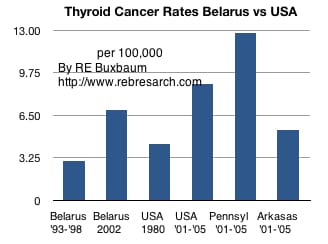
With this post I’d like to discuss a statistical fluke (or observation), that even with the worst type of nuclear accident, the broad area increased cancer incidence is generally too small to measure. The worst nuclear disaster we are ever likely to encounter was the explosion at Chernobyl. It occurred 27 years ago during a test of the safety shutdown system and sent a massive plume of radioactive core into the atmosphere. If any accident should increase the cancer rate of those around it, this should. Still, by fluke or not, the rate of thyroid cancer is higher in the US than in Belarus, close to the Chernobyl plant in the prime path of the wind. Thyroid cancer is likely the most excited cancer, enhanced by radio-iodine, and Chernobyl had the largest radio-iodine release to date. Thus, it’s easy to wonder why the rates of Thyroid cancer seem to suggest that the radiation cures cancer rather than causes it.

Thyroid Cancer Rates for Belarus and US; the effect of Chernobyl is less-than clear.

Thyroid Cancer Rates for Belarus and US; the effect of Chernobyl is less-than clear.

The chart above raises more questions than it answers. Note that the rate of thyroid cancer has doubled over the past few years, both in the US and in Belarus. Also note that the rate of cancer is 2 1/2 times as high in Pennsylvania as in Arkansas. One thought is test bias: perhaps we are  better at spotting cancer in the US than in Belarus, and perhaps better at spotting it in Pennsylvania than elsewhere. Perhaps. Another thought is coal. Areas that use a lot of coal tend to become sicker; Europe keeps getting sicker from its non-nuclear energy sources, Perhaps Pennsylvania (a coal state) uses more coal that Belarus (maybe).

Fukushima was a much less damaging accident, and much more recent. So far there has been no observed difference in cancer rate. As the reference below says: “there is no statistical evidence of a difference in thyroid cancer caused by the disaster.” This is not to say that explosions are OK. My company, REB Research, makes are high pressure, low temperature hydrogen-extracting membranes used to reduce the likelihood of hydrogen explosions in nuclear reactors; so far all the explosions have been hydrogen explosions.

Sources: for Belarus: Cancer consequences of the Chernobyl accident: 20 years on. For the US: GEOGRAPHIC VARIATION IN U.S. THYROID CANCER INCIDENCE, AND A CLUSTER NEAR NUCLEAR REACTORS IN NEW JERSEY, NEW YORK, AND PENNSYLVANIA.

R. E. Buxbaum, April 19, 2013; Here are some further, updated thoughts: radiation hormesis (and other hormesis)

Link

Some 2-3 years ago I did an interview where I stood inside one of our hydrogen generator shacks (with the generator running) and poked a balloon filled with hydrogen with a lit cigar — twice. No fire, no explosion, either time. It’s not a super hit, but it’s gotten over 5000 views so far. Here it is

New hydrogen generator from REB Research

Here’s the new, latest version of our Me150 hydrogen generator with our wonder-secretary, Libby, shown for scale. It’s smaller and prettier than the previous version shown at left (previous version of Me150, not of secretary). Hydrogen output is 99.9999% pure, 9.5 kg/day, 75 slpm, 150 scfh H2; it generates hydrogen from methanol reforming in a membrane reactor. Pricing is $150,000. Uses about 7 gal of methanol-water ($6 worth) per kg of H2 (380 ft3). Can be used to fill weather balloons, cool electric dynamos, or provide hydrogen fuel for 2-10 fuel cell cars.

New REB Research hydrogen generator 150 scfh of 99.9999% H2 from methanol reforming

New REB Research hydrogen generator 150 scfh of 99.9999% pure H2 from methanol-water reforming against metal membranes.

Dr. Robert E. Buxbaum

Nuclear Power: the elephant of clean energy

As someone who heads a hydrogen energy company, REB Research, I regularly have to tip toe about nuclear power, a rather large elephant among the clean energy options. While hydrogen energy looks better than battery energy in terms of cost and energy density, neither are really energy sources; they are ways to transport energy or store it. Among non-fossil sources (sources where you don’t pollute the air massively) there is solar and wind: basically non-reliable, low density, high cost and quite polluting when you include the damage done making the devices.

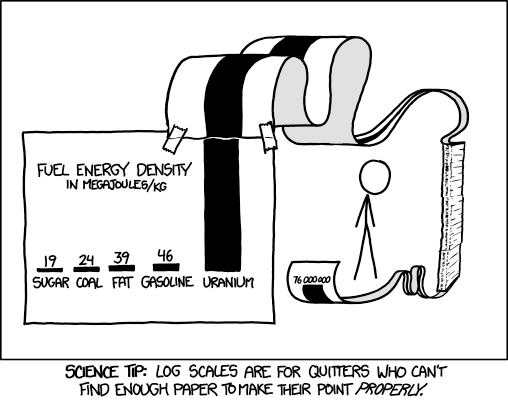
Compared to these, I’m happy to report that the methanol used to make hydrogen in our membrane reactors can come from trees (anti-polluting), even tree farming isn’t all that energy dense. And then there’s uranium: plentiful, cheap and incredibly energy dense. I try to ignore how energy dense uranium is, but the cartoon below shows how hard that is to do sometimes. Nuclear power is reliable too, and energy dense; a small plant will produce between 500 and 1000 MW of power; your home uses perhaps 2 kW. You need logarithmic graph paper just to compare nuclear power to most anything else (including hydrogen):

log_scale

A tiny amount of uranium-oxide, the size of a pencil will provide as much power as hundreds of train cars full of coal. After transportation, the coal sells for about $80/ton; the sells for about $25/lb: far cheaper than the train loads of coal (there are 100-110 tons of coal to a train-car load). What’s more, while essentially all of the coal in a train car ends up in the air after it’s burnt, the waste uranium generally does not go into the air we breathe. The coal fumes are toxic, containing carcinogens, carbon monoxide, mercury, vanadium and arsenic; they are often radioactive too. All this is avoided with nuclear power unless there is a bad accident, and bad accidents are far rarer with nuclear power than, for example, with natural gas. Since Germany started shutting nuclear plants and replacing them with coal, it appears they are making all of Europe sicker).

It is true that the cost to build a nuclear plant is higher than to build a coal or gas plant, but it does not have to be: it wasn’t that way in the early days of nuclear power, nor is this true of military reactors that power our (USA) submarines and major warships. Commercial nuclear reactors cost a lot largely because of the time-cost for neighborhood approval (and they don’t always get approval). Batteries used for battery power get no safety review generally though there were two battery explosions on the Dreamliner alone, and natural gas has been known to level towns. Nuclear reactors can blow up too, as Chernobyl showed (and to a lesser extent Fukushima), but almost any design is better than Chernobyl.

The biggest worry people have with nuclear, and the biggest objection it seems to me, is escaped radiation. In a future post, I plan to go into the reality of the risk in more detail, but the worry is far worse than the reality, or far worse than the reality of other dangers (we all die of something eventually). The predicted death rate from the three-mile island accident is basically nil; Fukushima has provided little health damage (not that it’s a big comfort). Further, bizarre as this seems the thyroid cancer rate in Belarus in the wind-path of the Chernobyl plant is actually slightly lower than in the US (7 per 100,000 in Belarus compared to over 9 per 100,000 in the USA). This is clearly a statistical fluke; it’s caused, I believe, by the tendency for Russians to die of other things before they can get thyroid cancer, but it suggests that the health risks of even the worst nuclear accidents are not as bad as you might think. (BTW, Our company makes hydrogen extractors that make accidents less likely)

The biggest real radiation worry (in my opinion) is where to put the waste. Ever since President Carter closed off the option of reprocessing used fuel for re-use there has been no way to permanently get rid of waste. Further, ever since President Obama closed the Yucca Mountain burial repository there have been no satisfactory place to put the radioactive waste. Having waste sitting around above ground all over the US is a really bad option because the stuff is quite toxic. Just as the energy content of nuclear fuel is higher than most fuels, the energy content of the waste is higher. Burying it deep below a mountain in an area were no-one is likely to live seems like a good solution: sort of like putting the uranium back where it came from. And reprocessing for re-use seems like an even better solution since this gets rid of the waste permanently.

I should mention that nuclear power-derived electricity is a wonderful way to generate electricity or hydrogen for clean transportation. Further, the heat of hot springs comes from nuclear power. The healing waters that people flock to for their health is laced with isotopes (and it’s still healthy). For now, though I’ll stay in the hydrogen generator business and will ignore the clean elephant in the room. Fortunately there’s hardly any elephant poop, only lots and lots of coal and solar poop.

Statistics Joke

A classic statistics joke concerns a person who’s afraid to fly; he goes to a statistician who explains that planes are very, very safe, especially if you fly a respectable airline in good weather. In that case, virtually the only problem you’ll have is the possibility of a bomb on board. The fellow thinks it over and decides that flying is still too risky, so the statistician suggests he plant a bomb on the airplane, but rig it to not go off. The statistician explains: while it’s very rare to have a bomb onboard an airplane, it’s really unheard of to have two bombs on the same plane.

It’s funny because …. the statistician left out the fact that an independent variable (number of bombs) has to be truly independent. If it is independent, the likelihood is found using a poisson distribution, a non-normal distribution where the greatest likelihood is zero bombs, and there are no possibilities for a negative bomb. Poisson distributions are rarely taught in schools for some reason.

By Dr. Robert E. Buxbaum, Mar 25, 2013. If you’ve got a problem like this (particularly involving chemical engineering) you could come to my company, REB Research.

Hydrogen versus Battery Power

There are two major green energy choices that people are considering to power small-to-medium size, mobile applications like cars and next generation, drone airplanes: rechargeable, lithium-ion batteries and hydrogen /fuel cells. Neither choice is an energy source as such, but rather a clean energy carrier. That is, batteries and fuel cells are ways to store and concentrate energy from other sources, like solar or nuclear plants for use on the mobile platform.

Of these two, rechargeable batteries are the more familiar: they are used in computers, cell phones, automobiles, and the ill-fated, Boeing Dreamliner. Fuel cells are less familiar but not totally new: they are used to power most submarines and spy-planes, and find public use in the occasional, ‘educational’ toy. Fuel cells provided electricity for the last 30 years of space missions, and continue to power the international space station when the station is in the dark of night (about half the time). Batteries have low energy density (energy per mass or volume) but charging them is cheap and easy. Home electricity costs about 12¢/kWhr and is available in every home and shop. A cheap transformer and rectifier is all you needed to turn the alternating current electricity into DC to recharge a battery virtually anywhere. If not for the cost and weight of the batteries, the time to charge the battery (usually and hour or two), batteries would be the obvious option.

Two obvious problems with batteries are the low speed of charge and the annoyance of having to change the battery every 500 charges or so. If one runs an EV battery 3/4 of the way down and charges it every week, the battery will last 8 years. Further, battery charging takes 1-2 hours. These numbers are acceptable if you use the car only occasionally, but they get more annoying the more you use the car. By contrast, the tanks used to hold gasoline or hydrogen fill in a matter of minutes and last for decades or many thousands of fill-cycles.

Another problem with batteries is range. The weight-energy density of batteries is about 1/20 that of gasoline and about 1/10 that of hydrogen, and this affects range. While gasoline stores about 2.5 kWhr/kg including the weight of the gas tank, current Li-Ion batteries store far less than this, about 0.15 kWhr/kg. The energy density of hydrogen gas is nearly that of gasoline when the efficiency effect is included. A 100 kg of hydrogen tank at 10,000 psi will hold 8 kg of hydrogen, or enough to travel about 350 miles in a fuel-cell car. This is about as far as a gasoline car goes carrying 60 kg of tank + gasoline. This seems acceptable for long range and short-range travel, while the travel range with eVs is more limited, and will likely remain that way, see below.

The volumetric energy density of compressed hydrogen/ fuel cell systems is higher than for any battery scenario. And hydrogen tanks are far cheaper than batteries. From Battery University. http://batteryuniversity.com/learn/article/will_the_fuel_cell_have_a_second_life

The volumetric energy density of compressed hydrogen/ fuel cell systems is higher than for any battery scenario. And hydrogen tanks are far cheaper than batteries. From Battery University. http://batteryuniversity.com/learn/article/will_the_fuel_cell_have_a_second_life

Cost is perhaps the least understood problem with batteries. While electricity is cheap (cheaper than gasoline) battery power is expensive because of the high cost and limited life of batteries. Lithium-Ion batteries cost about $2000/kWhr, and give an effective 500 charge/discharge cycles; their physical life can be extended by not fully charging them, but it’s the same 500 cycles. The effective cost of the battery is thus $4/kWhr (The battery university site calculates $24/kWhr, but that seems overly pessimistic). Combined with the cost of electricity, and the losses in charging, the net cost of Li-Ion battery power is about $4.18/kWhr, several times the price of gasoline, even including the low efficiency of gasoline engines.

Hydrogen prices are much lower than battery prices, and nearly as low as gasoline, when you add in the effect of the high efficiency fuel cell engine. Hydrogen can be made on-site and compressed to 10,000 psi for less cost than gasoline, and certainly less cost than battery power. If one makes hydrogen by electrolysis of water, the cost is approximately 24¢/kWhr including the cost of the electrolysis unit.While the hydrogen tank is more expensive than a gasoline tank, it is much cheaper than a battery because the technology is simpler. Fuel cells are expensive though, and only about 50% efficient. As a result, the as-used cost of electrolysis hydrogen in a fuel cell car is about 48¢/kWhr. That’s far cheaper than battery power, but still not cheap enough to encourage the sale of FC vehicles with the current technology.

My company, REB Research provides another option for hydrogen generation: The use of a membrane reactor to make it from cheap, easy to transport liquids like methanol. Our technology can be used to make hydrogen either at the station or on-board the car. The cost of hydrogen made this way is far cheaper than from electrolysis because most of the energy comes from the methanol, and this energy is cheaper than electricity.

In our membrane reactors methanol-water (65-75% Methanol), is compressed to 350 psi, heated to 350°C, and reacted to produce hydrogen that is purified as it is made. CH3OH + H2O –> 3H2 + CO2, with the hydrogen extracted through a membrane within the reactor.

The hydrogen can be compressed to 10,000 psi and stored in a tank on board an automobile or airplane, or one can choose to run this process on-board the vehicle and generate it from liquid fuel as-needed. On-board generation provides a saving of weight, cost, and safety since you can carry methanol-water easily in a cheap tank at low pressure. The energy density of methanol-water is about 1/2 that of gasoline, but the fuel cell is about twice as efficient as a gasoline engine making the overall volumetric energy density about the same. Not including the fuel cell, the cost of energy made this way is somewhat lower than the cost of gasoline, about 25¢/kWhr; since methanol is cheaper than gasoline on a per-energy basis. Methanol is made from natural gas, coal, or trees — non-imported, low cost sources. And, best yet, trees are renewable.

Why the Boeing Dreamliner’s batteries burst into flames

Boeing’s Dreamliner is currently grounded due to two of their Li-Ion batteries having burst into flames, one in flight, and another on the ground. Two accidents of the same type in a small fleet is no little matter as an airplane fire can be deadly on the ground or at 50,000 feet.

The fires are particularly bad on the Dreamliner because these lithium batteries control virtually everything that goes on aboard the plane. Even without a fire, when they go out so does virtually every control and sensor. So why did they burn and what has Boeing done to take care of it? The simple reason for the fires is that management chose to use Li-Cobalt oxide batteries, the same Li-battery design that every laptop computer maker had already rejected ten years earlier when laptops using them started busting into flames. This is the battery design that caused Dell and HP to recall every computer with it. Boeing decided that they should use a massive version to control everything on their flagship airplane because it has the highest energy density see graphic below. They figured that operational management would insure safety even without the need to install any cooling or sufficient shielding.

All lithium batteries have a negative electrode (anode) that is mostly lithium. The usual chemistry is lithium metal in a graphite matrix. Lithium metal is light and readily gives off electrons; the graphite makes is somewhat less reactive. The positive electrode (cathode) is typically an oxide of some sort, and here there are options. Most current cell-phone and laptop batteries use some version of manganese nickel oxide as the anode. Lithium atoms in the anode give off electrons, become lithium ions and then travel across to the oxide making a mixed ion oxide that absorbs the electron. The process provides about 4 volts of energy differential per electron transferred. With cobalt oxide, the cathode reaction is more or less CoO2 + Li+ e– —> LiCoO2. Sorry to say this chemistry is very unstable; the oxide itself is unstable, more unstable than MnNi or iron oxide, especially when it is fully charged, and especially when it is warm (40 degrees or warmer) 2CoO2 –> Co2O+1/2O2. Boeing’s safety idea was to control the charge rate in a way that overheating was not supposed to occur.

Despite the controls, it didn’t work for the two Boeing batteries that burst into flames. Perhaps it would have helped to add cooling to reduce the temperature — that’s what’s done in lap-tops and plug-in automobiles — but even with cooling the batteries might have self-destructed due to local heating effects. These batteries were massive, and there is plenty of room for one spot to get hotter than the rest; this seems to have happened in both fires, either as a cause or result. Once the cobalt oxide gets hot and oxygen is released a lithium-oxygen fire can spread to the whole battery, even if the majority is held at a low temperature. If local heating were the cause, no amount of external cooling would have helped.

battery-materials-energy-densities-battery-university

Something that would have helped was a polymer interlayer separator to keep the unstable cobalt oxide from fueling the fire; there was none. Another option is to use a more-stable cathode like iron phosphate or lithium manganese nickel. As shown in the graphic above, these stable oxides do not have the high power density of Li-cobalt oxide. When the unstable cobalt oxide decomposed there was oxygen, lithium, and heat in one space and none of the fire extinguishers on the planes could put out the fires.

The solution that Boeing has proposed and that Washington is reviewing is to leave the batteries unchanged, but to shield them in a massive titanium shield with the vapors formed on burning vented outside the airplane. The claim is that this shield will protect the passengers from the fire, if not from the loss of electricity. This does not appear to be the best solution. Airbus had planned to use the same batteries on their newest planes, but has now gone retro and plans to use Ni-Cad batteries. I don’t think that’s the best solution either. Better options, I think, are nickel metal hydride or the very stable Lithium Iron Phosphate batteries that Segway uses. Better yet would be to use fuel cells, an option that appears to be better than even the best batteries. Fuel cells are what the navy uses on submarines and what NASA uses in space. They are both more energy dense and safer than batteries. As a disclaimer, REB Research makes hydrogen generators and purifiers that are used with fuel-cell power.

More on the chemistry of Boeing’s batteries and their problems can be found on Wikipedia. You can also read an interview with the head of Tesla motors regarding his suggestions and offer of help.