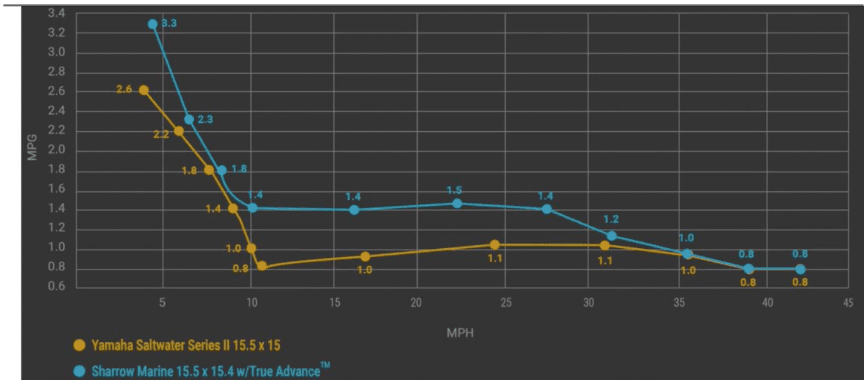
Sharrow Marine introduced a new ship propeller design two years ago, at the Miami International Boat show. Unlike traditional propellers, there are no ends on the blades. Instead, each blade is a connecting ribbon with the outer edge behaving like a connecting winglet. The blade pairs provide low-speed lift-efficiency gains, as seen on a biplane, while the winglets provide high speed gains. The efficiency gain is 9-30% over a wide range of speeds, as shown below, a tremendous improvement. I suspect that this design will become standard over the next 10-20 years, as winglets have become standard on airplanes today.
A Sharrow propeller, MX-1
The high speed efficiency advantage of the closed ends of the blades, and of the curved up winglets on modern airplanes is based on avoiding losses from air (or water) going around the end from the high pressure bottom to the low-pressure top. Between the biplane advantage and the wingtip advantage, Sharrow propellers provide improved miles per gallon at every speed except the highest, 32+ mph, plus a drastic decrease in vibration and noise, see photo.
The propeller design was developed with paid research at the University of Michigan. It was clearly innovative and granted design patent protection in most of the developed world. To the extent that the patents are respected and protected by law, Sharrow should be able to recoup the cost of their research and development. They should make a profit too. As an inventor myself, I believe they deserve to recoup their costs and make a profit. Not all inventions lead to a great product. Besides, I don’t think they charge too much. The current price is $2000-$5000 per propeller for standard sizes, a price that seems reasonable, based on the price of a boat and the advantage of more speed, more range, plus less fuel use and less vibration. This year Sharrow formed an agreement with Yamaha to manufacture the propellers under license, so supply should not be an issue.
Vastly less turbulence follows the Sharrow propeller.
China tends to copy our best products, and often steals the technology to make them, employing engineers and academics as spys. Obama/Biden have typically allowed China to benefit for the sales of copies and the theft of intellectual property, allowing the import of fakes to the US with little or no interference. Would you like a fake Rolex or Fendi, you can buy on-line from China. Would you like fake Disney, ditto. So far, I have not seen Chinese copies of the Sharrow in the US, but I expect to see them soon. Perhaps Biden’s Justice Department will do something this time, but I doubt it. By our justice department turning a blind eye to copies, they rob our innovators, and rob American workers. His protectionism is one thing I liked about Donald Trump.
The Sharrow Propeller gives improved mpg values at every speed except the very highest.
With the sun setting earlier, and the threat of new COVID lockdowns, there is a real threat of a depression, seasonal and isolation. A partial remedy is exercise; it helps fight depression whether you take other measures not. An article published last month in the Journal of Affective Disorders reviewed 22 studies of the efficacy of exercise, particularly as an add-on to drugs and therapy. Almost every study showed that exercise helped, and in some studies it helped a lot. See table below. All of the authors are from the University of British Columbia. You can read the article here.
From “Efficacy of exercise combined with standard treatment for depression compared to standard treatment alone: A systematic review and meta-analysis of randomized controlled trials.” by JacquelineLee1 et al.In virtually every study, exercise helps fight depression.
For those who are willing to exercise, there are benefits aside from mental health. Even a daily walk around the block helps with bone strength, weight control, heart disease, plus the above mentioned improvement in mood. More exercise does more. If you bicycle without a helmet, you’re likely to live longer than if you drive.
For those who can’t stand exercise, or if exercise isn’t quite enough to send away the blues, you can try therapy, medication, and/or diet. There is some evidence that food that are high in lithium help fight depression. These food include nuts, beans, tomatoes, some mineral waters, e.g. from Lithia springs, GA. The does is about 1/100 the dose given as a bipolar treatment, but there is evidence that even such small doses help. Lithium was one of the seven ingredients in seven up — it was the one that was supposed to cheer you up. See some research here.
It is a fundamental of science that that the properties of every pure one-phase material is totally fixed properties at any given temperature and pressure. Thus for example, water at 0°C is accepted to always have a density of 0.998 gm/cc, a vapor pressure of 17.5 Torr, a viscosity of 1.002 centipoise (milliPascal seconds) and a speed of sound of 1481 m/s. Set the temperature and pressure of any other material and every other quality is set. But things go screwy near surfaces, and this is particularly true for water where the hydrogen bond — a quantum bond — predominates.
its vapor pressure rises and it becomes less inclined to condense or freeze. I use this odd aspect of thermodynamics to keep my platinum-based hydrogen getter catalysis active at low temperatures where they would normally clog. Normal platinum catalysts are not suitable for hydrogen removal at normal temperatures, eg room temperature, because the water that forms from hydrogen oxidation chokes off the catalytic surface. Hydrophobic additions prevent this, and I’d like to show you why this works, and why other odd things happen, based on an approximation called the Van der Waals equation of state:
(1)
This equation described the molar volume of a pure material, , of any pure material based not the pressure, the absolute temperature (Kelvin) and two, substance-specific constants, and . These constants can be understood as an attraction force term, and a molecular volume respectively. It is common to calculate a and b from the critical temperature and pressure as follows, where Tc is absolute temperature:
, (2 a,b)
For water Tc = 647 K (374°C) and 220.5 bar. Plugging in these numbers, the Van der Waals gives reasonable values for the density of water both as a liquid and a gas, and thus gives a reasonable value for the boiling point.
Now consider the effect that an inert surface would have on the effective values of a and b near that surface. The volume of the molecules will not change, and thus b will not change, but the value of a will change, likely by about half. This is because, the number of molecules surrounding any other molecule is reduced by about half while the inert surface adds nothing to the attraction. Near a surface, surrounding molecules still attract each other the same as before, but there are about half as many molecules at any temperature and pressure.
To get a physical sense of what the surface does, consider using the new values of a and b to determine a new value for Tc and Pc, for materials near the surface. Since b does not change, we see that the presence of a surface does not affect the ratio of Tc and Pc, but it decreases the effective value of Tc — by about half. For water, that is a change from 647 K to 323.5K, 50.5°C, very close to room temperature. Pc changes to 110 bar, about 1600 psi. Since the new value of Tc is close to room temperature, the the density of water will be much lower near the surface, and the viscosity can be expected to drop. The net result is that water flows more readily through a teflon pipe than through an ordinary pipe, a difference that is particularly apparent at small diameters.
This decrease in effective Tc is useful for fire hoses, and for making sailing ships go faster (use teflon paint) and for making my hydrogen removal catalysts more active at low temperatures. Condensed water can block the pores to the catalyst; teflon can forestall this condensation. It’s a general trick of thermodynamics, reasonably useful. Now you know it, and now you know why it works.
I’m an enemy of unity and a harborer of prejudice. During the election, I was told that all Republicans are, and I’ve come to accept it as true. I’d run for county water commissioner (drain commissioner) as a Republican, see web-site, and the charge is fair. I wasn’t happy to that George Will write to not for any Republicans because, in his opinion, we’re all prejudiced, and thus a Democrat is better for all jobs. When George, or anyone else, talks about getting rid of the prejudiced, it sounds to me like he wants to get rid of me and those who think like me. We’re to be replaced by those who think like him, or (since he has few solid ideas) whose ideas are gleaned as an average of those running the respectable media (It turns out there are only a fairly few people running the respectable media).
Biden seems to have fallen into the presidency. He didn’t campaign, but the press and a lot of people didn’t like Trump, and could not settle on anyone with opinions.
I didn’t like how the Water department was run, or how the costs were distributed, and some of this has to do with prejudice — engineering aesthetics, I call it. After living with these prejudices or aesthetics, I’ve come to think of them as part of me. I worked to form my opinions — opinions of what was fair, and who was likely to do good work, and what was good engineering. My prejudices and opinions were developed over many years. They’re not perfect, but I like them. I don’t want to have to exchange my opinions and prejudices for the government’s. If I felt otherwise, I would not have run for office. I also resent sensitivity training — the person running them rarely shows any sensitivity, IMHO.
One of the things that anti-racists hate, and I support is zionism. It’s a founding principle of Black Lives Matter that black people in the US can’t be free so long as the zionist state (Israel) exists. Why is this? There is an assumption that all black peoples are one, and that zionists are oppressors. Not that you could tell a Palestinian from a zionist by skin color, but it’s a truth that the faculty of Princeton endorses.
Not long ago the faculty of Princeton University voted unanimously for BDS including a ban on any zionist speaker from speaking on campus. The faculty also picked George Will as the graduation speaker in 2020. Most of the professors chose to not vote, but of those who did (1/7 of the total including many Jews) the pro-BDS vote was unanimous. As a result, if Einstein were to rise from the grave, with the unified field equations finally worked out, he’d have to speak off-campus because he was a zionist, and the university is committed to BLM and anti prejudice. (Tell me again, how does anti-zionism help black lives to matter?; how does BLM help you get clean water or good sewage treatment?)
In terms of sewage treatment or bringing clean water, I’ve found that the sort of person willing to do the work is usually someone with an opinion, and that usually it’s a rough opinion. My sense is to let people have their opinions and to say, if you treat the sewage right, I treat you right. Good work isn’t cheap, and people who do it can’t be culled from those with the right views and political opinions.
While campaigning I told leaders of the pipe-fitters union that I could tell that the Pontiac sewage plant was badly run just by smelling the air around the plant — you shouldn’t be able to smell a sewage plant from miles away. They said that was a racist statement. I then told them that the boilers were rusty, and that at the roof of the digester cad caved in, at least a year ago. They said they’d already endorsed the Democrat, and only spoke to me as a courtesy.
We just got a new toilet. Commonly called a commode, and it’s got a cool feature that I’d seen often in Europe but rarely in the US: two levels of flush strength. There is a “small flush” option that delivers, about 3 liters, intended for yellow waste, and a “big flush” option that delivers 6 liters. It’s intended for brown waste, or poop.
The main advantage of two mode flushing, in my opinion, is that the small flush is quieter than the normal. The quality of the flush is quite acceptable, even for brown waste because the elongated shape of the bowl seems better suited to pushing waste to the back, and down the drain. The flush valve is simple too, and I suspect the valve will last longer than the “flapper valve” of my older, one mode commodes. The secondary advantage is from some cost savings on water. That was about 1¢ per small flush in our area of Michigan, but the water department changed how they charge for water in our area and the cost savings have largely disappeared. Even under the old system, the savings in water cost amounted to only about $15 per year. At that rate it would take 15 years or more to pay for the new commode.
There is no real need for water savings in Michigan, and particularly not in our area, metro-Detroit. In other states there often is, but our drinking water comes from the Detroit river, and the cleaned up waste goes back to the river. It’s a cycle with no water lost no matter how much you flush, and no matter how big shower heads. I’d written in favor of allowing big flush toilets and big shower heads in our state, but the Obama administration ruled otherwise. Trump had promised to change that, but was impeached before he could. Even Trump had changed this, Biden has reversed virtually every Trump order related to resource use including those prohibiting China from providing critical technology to our water and power systems. Bottom line, you have to have a low-flush toilet, and you might as well get a two-mode.
Our commode has an elongated front, and I’d recommend that too. It can minimize floor dribbles, and that’s a good thing. The elongated shape also seems to provide a smoother flush path with less splatter. I would not recommend a “power flush” though for several reasons, among them that you get extra splatter and a louder flush noise. We’d bought a power flush some years ago, and in my opinion, it flushed no better than the ordinary toilet. It was very loud, and had a tendency to splatter. There was some slight water savings, but not worth it, IMHO.
Robert Buxbaum, February 8, 2021. I ran for water commissioner with several goals, among them to improve the fairness of billing, to decrease flooding, and to protect our water system from cyber attack.
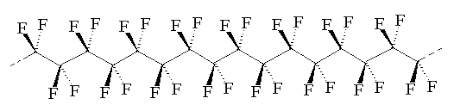
When I was eight or nine year old, I went to the 1963-64 World’s Fair in New York. Among the attractions, in “the kitchen of the future”, I saw the first version of an amazing fry-pan that was coated with plastic. You could cook an egg on that plastic without any oil, and the egg didn’t stick. The plastic was called teflon, a DuPont innovation, whose molecule is shown below.
The molecular structure of Teflon. There is an interior carbon backbone that is completely enclosed with tightly bound fluorine atoms. The net result is a compound that does not bind readily to anything else.
Years later, I came to understand that Teflon’s high-temperature stability and non-stick properties derive from the carbon-fluorine bonds. These bonds are much stronger than the carbon-hydrogen bonds found in food, and most solid, organic things. Because of the strength of the carbon-fluorine bond, Teflon is resistant to oxidation, and to chemical interaction with other molecules, e.g. in food. It does not even interact with water, making it hydrophobic and non-wetting on metals. The carbon-carbon bonds in the middle remained high temperature stable, in part because they were completely shielded by the fluorine atoms.
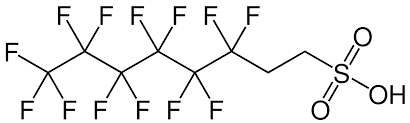
This is a PFAS. The left side is just like teflon, and very hydrophobic. The right side is hydrophilic and highly bonding to pans, and many other things like water or cotton.
But as remarkable as teflon’s non-stick properties are, perhaps the most amazing thing was that it somehow sticks to the pan. For the first generation pans I saw, it didn’t stick very well. Still, the DuPont engineers had found a way to stick non-stick Teflon to a metal for long enough to cook many meals. If they had not found this trick, teflon would not have the majority of its value, but how did they do it? It turns out they used a thin coating of a di-functional compound called PFAS, a a polyfluoro sulphonyl (or polyfluoroalkyl) substance. The molecular structure of a common PFAS, is shown above.
Each molecule of PFAS has one end that’s teflon-like and another end that’s different. The non-Teflon end, in this case a sulfonyl group, is chosen to be both high temperature stable and sticky to metal oxides. The sulphonyl group above is highly polar, and acidic. Acidic will bind to bases, like metal oxides. The surface of the metal pan is prepared by applying a thin layer of oxide or amidine, making it a polar base. The PFAS is then applied, then Teflon. The Teflon-end of the PFAS is bound to teflon by the hydrophobicity of everything else rejecting it.
There are many other uses for PFAS. For example, PFAS is applied to clothing to make it wrinkle free and stain resistant. It can also be used as a super soap, making uncommonly stable foams and bubbles. It is also used in fire-fighting and plane de-icing. Finally, PFAS is the main component of Nafion, the most common membrane for PEM fuel cells. (I can think of yet other applications..) There is just one small problem with PFAS, though. Like teflon, this molecule is uncommonly stable. It doesn’t readily decompose in nature. That would be a small problem if we were sure that PFAS was safe. As it happens it seems safe, but we’re not totally sure.
The safety of PFAS was studied extensively before PFAS-teflon pans was put on the market, but the methodology has been questioned. Large doses of PFAS were fed to test animals, and their health observed. Since the test animals showed no real signs of ill-health though some showed a slight liver enlargement, PFAS was accepted as safe for humans at a lower exposure dose. PFAS was approved for use on pans and allowed to be dumped under conditions where humans would be exposed to 1/1000 of that used on the animals. The assumption was that there would be little or no health hazard at these low exposure levels.
But low risk is not no risk, and today one can sue for even the hint of an effect though use of a class action suit. That is, lawyers sue on behalf of all the people who might have been damaged. My city was sued successfully this way for complicity in sewage over-flows. Of course, since the citizens being paid by the suit are the same ones who have to pay for the damage, only the lawyers benefit. Still, the law is the law, and at least for some judges, putting anyone at risk is enough evidence of willful disregard to hand down a stinging judgement against the evil doer. Judges have begun awarding large claims for PFAS too. While no individual can get the claim more than a tiny amount of money, the lawyers can do very well.
There is no new evidence that PFAS is dangerous, but none is needed if you can get yourself the right judge. In this regard, an industry of judicial tourism has sprung up, where class-action lawyers travel to districts where the judges are favorable. For Teflon suits, the bust hunting grounds are in New York, New Hampshire, and California, and the worst are blood-red states like Wyoming and Utah. Just as different judges promote different precedents, different states allow vastly different PFAS concentrations in the water. A common standard, one used by Michigan, is 70 ppt, 1 billion times stricter than the amounts tested on animals. This is roughly 500 times stricter than the acceptable concentratios for lead, a known poison. The standard in New York is 7 times stricter than Michigan, 10 ppt. The standard in North Carolina is 140,000 ppt, in in several states there is no legal limit to PFAS dumping. There is no scientific logic to all of this, and skeptical view is that the states that rule more strictly for PFAS than lead do so make money for lawyers. Lead is everyone in the natural environment, so you can’t sue as easily for lead. PFAS is a man-made intruder, though, and a strict standard helps lawyers sue. You can find a summary of state by state regulations here.
Any guideline stricter than about 1000 ppt, presents a challenge to the water commissioner who must measure it and enforce the law. There are tricks, though. You can use the surfactant quality of PFAS to concentrate it by a factor of 100 or more. To do this, you take a sample of river water and create bubbles. Any bubbles that form will be highly concentrated in PFAS. Once PFAS can be identified this way, and the concentrators estimated, the polluters can be held liable. Whether we benefit from the strict rulings is another story. If I were making the law for Michigan, I’d probably choose a limit about 1 ppb, but I’m not making the law. The law, as written, may be an idiot, as Bumble said, but the Law is the Law.
In terms of Michigan fishing, while some rivers have PFAS concentrators above the MI-legal limit, they are generally not far over the line. I would trust the fish in the Huron River, even west of Wixom road but I’d suggest you avoid any foam you find floating there. The PFAS content of foam will be much higher than that of the water in general.
Robert E. Buxbaum, June 30, 2020, edited July 8, 2020. There are seven compounds known as PFAS’s: perfluorooctanesulfonic acid (PFOS), perfluorooctanoic acid (PFOA), perfluorononanoic acid (PFNA), perfluorohexanesulfonic acid (PFHxS), perfluoroheptanoic acid (PFHpA), and perfluorobutanesulfonic acid (PFBS).
A typical plant in Oakland county treats 2,000,000 gallons per day of this stuff, with the bio-reactor receiving liquid waste containing about 200 ppm of soluble and colloidal biomass. That’s 400 dry gallons for those interested, or about 3200 dry lbs./day. About half of this will be oxidized to CO2 and water. The rest (cell bodies) are removed with insoluble components, and applied to farmers fields or buried, or burnt in an incinerator.
There is another type of reactor used in Oakland County. It’s mostly used for secondary treatment, converting consolidated sludge to higher-quality sludge that can be sold or used on farms with less restriction, but it is a type of reactor used at the South Lyon treatment plant, for primary treatment. It is a Continually stirred tank reactor, or CSTR, a design that is shown in schematic below.
As of some years ago, the South Lyon system involved a single largish pond lined with plastic with a volume about 2,000,000 gallons total. About 700,000 gallons per day of sewage liquids went into the lagoon, at 200 ppm soluble organics. Air was bubbled through the liquid providing a necessary reactant, and causing near-perfect mixing of the contents. The aim of the plant managers is to keep the soluble output to the, then-acceptable level of 10 ppm; it’s something they only barely managed, and things got worse as the flow increased. Assume as before, a value V and a flow Q.
We will call the concentration of soluble organics C, and call the initial concentration, the concentration that enters, Ci. It’s about 200 ppm. We’ll call the output concentration Co, and for this type of reactors, Co = C. The reaction is first order, approximately, so that, if there were no flow into or out of the reactor, the concentration of organics would decrease at the rate of
dC/dt = -kC.
Here k is a reaction constant, dependent on temperature oxygen and cell content. It’s typically about 0.5/hour. For a given volume of tank the rate of organic removal is VkC. We can now do a mass balance on soluble organics. Since the rate of organic entry is QCi and the rate leaving by flow is QC. The difference must be the amount that is reacted away:
QCi – QC = VkC.
We now use algebra, to find that
Co = Ci/(1 + kV/Q).
V/Q is sometimes called a residence time; for the system. At normal flow, the residence time of the South Lyon system is about 2.8 days or 68.6 hours. Plugging these numbers in, we find that the effluent from the reactor leaves at 1/35 of the input concentration, or 5.7 ppm, on average. This would be fine except that sometimes the temperature drops, or the flow increases, and we start violating the standard. A yet bigger problem was that the population increased by 50% while the EPA standard got more stringent to 2 ppm. This was solved by adding another, smaller reactor, volume = V2. Using the same algebraic analysis, as above you can show that, with two reactors,
Co = Ci/ [(1 + kV/Q)(1+kV2/Q)].
It’s a touchy system, but it meets government targets, just barely, most of the time. I think it is time to switch to a plug-flow reactor system, as used in much of Oakland county. In these, the fluid enters a channel and is reacted as it flows along. Each gallon of fluid, in a sense moves by itself as if it were its own reactor. In each gallon, we can say that dC/dt = -kC. We can thus solve for Co in terms of the total residence time, where t again is V/Q. We can rearrange this equation and integrate: ∫dC/C = – ∫kdt. We then find that,
ln(Ci/Co) = kt = kV/Q
To convert 200 ppm sewage to 2 ppm we note that Ci/Co = 100 and that V = Q ln(100)/k = Q (4.605/.5) hours. An inflow of 1000,000 gallons per day = 41,667 gal/ hour, and we find the volume of tank is 41,667 x 9.21 = 383,750 gallons. This is quite a lot smaller than the CSTR tanks at South Lyon. If we converted the South Lyon tanks to a plug-flow, race-track design, it would allow it to serve a massively increased population, discharging far cleaner sewage.
Our county, like many in the US and Canada, is served by thousands of miles of lead pipes. Some of these are the property of the government, others sit beneath our homes and are the property of the home-owner. These pipes are usually safe, but sometimes poison us. There is also problem of lead-tin solder. It was used universally to connect iron and copper pipes until it was outlawed in 1986. After years of sitting quietly, this lead caused a poisoning crisis in DC in 2004, and in Flint in 2015-16. Last month my town, Oak Park, registered dangerous lead levels in the drinking water. In an attempt to help, please find the following summary of the relevant lead chemistry. Maybe people in my town, or in other towns, will find some clue here to what’s going on, and what they can do to fix it.
lead pipes showing the three oxides: brown, yellow, and red, PbO2, PbO, and Pb2O3.
Left to itself, lead and solder pipe could be safe; lead is not soluble in clean water. But, if the water becomes corrosive, as happens every now and again, the lead becomes oxidized to one of several compounds that are soluble. These oxides are the main route of poisoning; they can present serious health issues including slow development, joint and muscle pain, memory issues, vomiting, and death. The legal limit for lead content in US drinking water is 15 ppb, a level that is far below that associated with any of the above. The solubility of PbO, lead II oxide, is more than 1000 times this limit 0.017 g/L, or 17,000 ppb. At this concentration serious health issues will show up.
PbO is the yellow lead oxide shown in the center of the figure above, right; the other pipes show other oxides, that are less-soluble, and thus less dangerous. Yellow lead oxide and red lead oxides on the right were used as paint colors until well into the 20th century. Red lead oxide is fairly neutral, but yellow PbO is a base; its solubility is strongly dependent on the PH of the water. In neutral water, its solution can be described by the following reaction.
PbO + H2O(l) –> Pb2+(aq) + 2 OH–(aq).
In high pH water (basic water), there are many OH–(aq) ions, and the solubility is lower. In low pH, acidic water the solubility is even higher. For every 1 point of lower pH the lowubility increases by a factor of 10, for every 1 point of higher pH, it decreases by a factor of ten. In most of our county, the water is slightly basic, about pH 8. It also helps that our water contains carbonate. Yellow lead forms basic lead carbonate, 2PbCO3·Pb(OH)2, the white lead that was used in paint and cosmetics. Its solubliity is lower than that of PbO, 110 ppb, in pure water, or within legal limit in water of pH 8. If you eat white lead, though, it reacts with stomach acid, pH 2, and becomes quite soluble and deadly. Remember, each number here is a factor of ten.
A main reason lead levels a very low today are essentially zero, even in homes with lead solder or pipe, involves involves the interaction with hypochlorite. Most water systems add hypochlorite to kill bacteria (germs) in the water. A side benefit is significant removal of lead ion, Pb2+(aq).
Pb2+(aq) + 2 ClO–(aq) –> Pb(ClO)2(s).
Any dissolved lead reacts with some hypochlorite ion reacts to form insoluble lead hypochlorite. Lead hypochlorite can slowly convert to Lead IV oxide — the brown pyrophilic form of lead shown on the left pipe in the figure above. This oxide is insoluble. Alkaline waters favor this reaction, decreasing solubility, but unlike with PbO, highly alkaline waters provide no significant advantage.
Lead IV oxide, PbO2 was used in old-fashioned matches; it reacts violently with phosphorus or sulfur. People were sometimes poisoned by sucking on these matches. In the stomach, or the presence of acidic drinking water, PbO2 is decomposed forming soluble PbO:
PbO2(s) +2 H+(aq) + 2 e– –> PbO(s) + H2O(l).
You may wonder at the presence of the two electrons in the reaction above. A common source in water systems is the oxidation of sulphite:
SO3-2(aq)–> SO4-2(aq) + 2 e–.
The presence of sulphite in the water means that hypochlorite is removed.
ClO–(aq) + 2 H+(aq) + 2 e– —> Cl–(aq) + H2O(l).
Removal of hypochlorite can present a serious danger, in part because the PbO2(s) slowly reverts to PbO and becomes soluble, but mostly because bacteria start multiplying. In the Flint crisis of 2016, and in a previous crisis in Washington DC, the main problem, in my opinion was a lack of hypochlorite addition. The lead crisis was preceded by an uptick in legionnaires disease; It killed 12 people in Flint in 2014 and 2015, and 87 were sickened, all before the lead crisis. Eventually, it was the rise of legionaries disease that alerted water officials in Virginia that there was something seriously wrong in Flint. Most folks were unaware because Flint water inspectors seem to have been fudging the lead numbers to make things look better.
Most US systems add phosphate to remove lead from the water. Flint water folks could have stopped the lead crisis, but not the legionnaires, by adding more phosphate. Lead phosphate solubility is 14 ppb at 20°C, and my suspicion is that this is the reason that the legal limit in the US is 15 ppb. Regulators chose 15 ppb, I suspect, not for health reasons, but because the target could be met easily through the addition of phosphate. Some water systems in the US and Canada disinfect with chloramine, not hypochlorite, and these systems rely entirely on phosphate to keep lead levels down. Excess phosphate is used in Canada to lower lead levels below 10 ppb. It works better on systems with hypochlorite.
Chloramine is formed by reacting hypochlorite with ammonia. It may be safer than hypochlorite in terms of chlorite reaction products, a real problem when the water source is polluted. But chloramine is not safe. It sickened 72 soldiers, 36 male and 36 female in 1998. They’d used ammonia and bleach for a “cleaning party” on successive days. Here’s a report and first aid instructions for the poisoning. That switching to chloramine can expose people to lead is called “the chloramine catch”.
Unlike PbO, PbO2is a weak acid. PbO2 and PbO can react to form red lead, PbO•PbO2(s), the red stuff on the pipe at right in the picture above. Red lead can react with rust to form iron plumbable, an insoluble corrosion resister. A simple version is:
PbO•PbO2(s) + Fe2O3(s) —> 2FePbO3(s).
This reaction is the basis of red-lead, anti-rust compounds. Iron plumbable is considered to be completely insoluble in water, but like PbO it is soluble in acid. Bottom line, slightly basic water is good, as are hypochlorite in moderation, and phosphate.
Robert Buxbaum, November 18, 2019. I ran for water commissioner, and might run again. Even without being water commissioner, I’ll be happy to lend my expertise, for free, to any Michigan town or county that is not too far from my home.
Most towns have at least one water tower. Oakland county, Michigan has four. When they are sized right, they serve several valuable purposes. They provide water in case of a power failure; they provide increased pressure in the morning when people use a lot of water showering etc.; and they allow a town to use smaller pumps and to pump with cheaper electricity, e.g. at night. If a town has no tower, all these benefits are gone, but a town can still have water. It’s also possible to have a situation that’s worse than nothing. My plan is to show, at the end of this essay, one of the ways that can happen. It involves thermodynamic properties of state i a situation where there is no expansion headspace or excess drain (most towers have both).
A typical water tower — spheroidal design. A tower of the dimensions shown would contain about 1/2 million gallons of water.
The typical tower stands at the highest point in the town, with the water level about 170 feet above street level. It’s usable volume should be about as much water as the town uses in a typical day. The reason for the height has to do with the operating pressure of most city-level water pipes. It’s about 75 psi and each foot of water “head” gives you about 0.43 psi. You want pressures about 75 psi for fire fighting, and to provide for folks in apartment buildings. If you have significantly higher pressures, you pay a cost in electricity, and you start losing a lot of water to leaks. These leaks should be avoided. They can undermine the roads and swallow houses. Bob Dadow estimates that, for our water system the leakage rate is between 15 and 25%.
Oakland county has four water towers with considerably less volume than the 130 million gallons per day that the county uses. I estimate that the South-east Oakland county tower, located near my home, contains, perhaps 2 million gallons. The other three towers are similar in size. Because our county’s towers are so undersized, we pay a lot for water, and our water pressure is typically quite low in the mornings. We also have regular pressure excursions and that leads to regular water-boil emergencies. In some parts of Oakland county this happens fairly often.
There are other reasons why a system like ours should have water towers with something more like one days’ water. Having a large water reserve means you can benefit from the fact that electric prices are the lowest at night. With a days’ volume, you can avoid running the pumps during high priced, day times. Oakland county loses this advantage. The other advantage to having a large volume is that it gives you more time to correct problems, e.g. in case of an electric outage or a cyber attack. Perhaps Oakland thinks that only one pump can be attacked at one time or that the entire electric grid will not go out at one time, but these are clearly false assumptions. A big system also means you can have pumps powered by solar cells or other renewable power. Renewable power is a good thing for reliability and air pollution avoidance. Given the benefits, you’d expect Oakland county would reward towns that add water towers, but they don’t, as best I can tell.
Here’s one way that a water column can cause problems. You really need those pressure reliefs.
Now for an example of the sort of things that can go wrong in a water tower with no expansion relief. Every stand-pipe is a small water tower, and since water itself is incompressible, it’s easy to see that a small expansion in the system could produce a large pressure rise. The law requires that every apartment hose water system has to have expansion relief to limit these increases; The water tower above had two forms of reliefs, a roof vent, and an overflow pipe, both high up so that pressure could be maintained. But you can easily imagine a plumber making a mistake and installing a stand pipe without an expansion relief. I show a system like that at left, a 1000 foot tall water pipe, within a skyscraper, with a pump at the bottom, and pipes leading off at the sides to various faucets.
Lets assume that the pressure at the top is 20 psi, the pressure at the bottom will be about 450 psi. The difference in pressure (430 psi) equals the weight of the water divided by the area of the pipe. Now let’s imagine that a bubble of air at the bottom of the pipe detaches and rises to the top of the pipe when all of the faucets are closed. Since air is compressible, while water is not, the pressure at the bubble will remain the same as the bubble rises. By the time the bubble reaches the top of the pipe, the pressure there will rise to 450 psi. Since water has weight, 430 psi worth, the pressure at the bottom will rise to 880 psi = 450 + 430. This is enough to damage pump and may blow the pipes as well. A scenario like this likely destroyed the New Horizon oil platform to deadly consequences. You really want those pressure reliefs, and you want a competent plumber / designer for any water system, even a small one.
Robert Buxbaum, September 28- October 6, 2019. I ran for water commissioner is 2016.
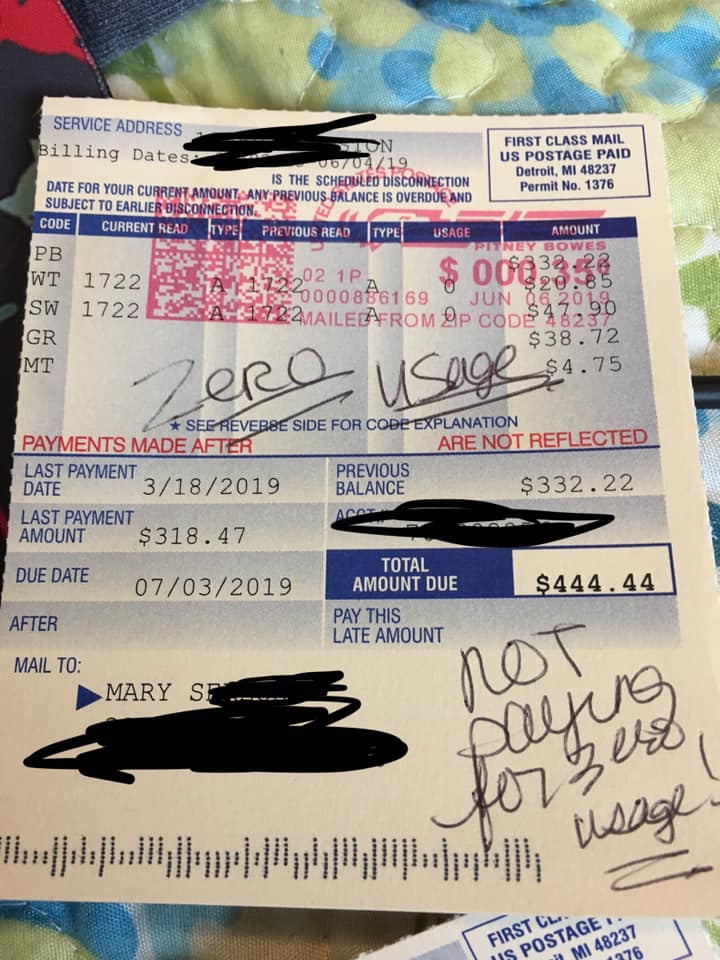
Water costs vary greatly about Oakland county, and around the US, and I have struggled in vain to find out why. In part the problem is that each city gets to add as much maintenance and management costs as the city government thinks appropriate. High management and infrastructure fees can increase to the cost of water, but I also not that different cities about Oakland County Michigan get their water at different rates from the multi-county organization that oversees water in South East Michigan: GLWA, The Great Lakes Water Authority.
$112 water bill for zero usage. The base charge is so large that prices are essentially independent of useage.
I’ve attended meetings, both local and multi county and have tried to find out why one town gets its water at a far lower rate than another, near by. Towns get lower rates if they have a water tower, but it is not at all clear what the formula is. It also helps to separate the storm sewage from the sanitary sewage — something that I have proposed for all of Oakland county, but if there is fixed formula of how that affects rates, I’ve not seen it. And I wonder how well communities monitor the amount of storm sewage they generate.
The water itself is free. For the most part, in this county, we pump it from the Detroit river. Some of the rest of the water is pumped from wells. None of this costs anything. There is a pump cost, but it is manicure. Pumping 1 gallon of water up 75 feet, costs about 0.002¢ in pumping cost. The rest of the cost is infrastructure: the cost of the pumps, the pipes, the treatment, the billing and sewage. Among the sewage fees is a pollution penalty, and Oakland county pays plenty of pollution penalties. When it rains, we generate more sewage than the system will handle, and we dump the rest into the rivers and lakes. This results in closed beaches and poisoned fish, and fines too. The county pays the EPA when we do this, and the county passes the cost to the cities. I don’t know what the formula for fee distribution is, and don’t even know what it should be. What I do know is that we do this vastly too often. I’d really like us to stop this by moving to separate the sewers so that, as a city, we don’t spend so much on treating rainwater and we don’t pollute so often.
Another oddity is that we do a propaganda campaign to tell folks to use less water. Why? I’d much prefer if people would use more. We could then charge a lower base charge, and then collect the rest on per-gallon fees. As with much that is socialist, the current system is inefficient, but pleasant for the management. Or, for those cheapskates and environmentalists who wish to save water, here are some ideas.




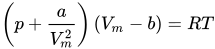 (1)
(1) , of any pure material based not the pressure, the absolute temperature (Kelvin) and two, substance-specific constants,
  and
and  . These constants can be understood as an attraction force term, and a molecular volume respectively. It is common to calculate a and b from the
 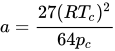 ,
,  (2 a,b)