Category Archives: Detroit

My steam-operated, high pressure pump

Here’s a miniature version of a duplex pump that we made 2-3 years ago at REB Research as a way to pump fuel into hydrogen generators for use with fuel cells. The design is from the 1800s. It was used on tank locomotives and steamboats to pump water into the boiler using only the pressure in the boiler itself. This seems like magic, but isn’t. There is no rotation, but linear motion in a steam piston of larger diameter pushes a liquid pump piston with a smaller diameter. Each piston travels the same distance, but there is more volume in the steam cylinder. The work from the steam piston is greater: W = ∫PdV; energy is conserved, and the liquid is pumped to higher pressure than the driving steam (neat!).

The following is a still photo. Click on the YouTube link to see the steam pump in action. It has over 4000 views!

Mini duplex pump. Provides high pressure water from steam power. Amini version of a classic of the 1800s Coffee cup and pen shown for scale.

Mini duplex pump. Provides high pressure water from steam power. A mini version of a classic of the 1800s Coffee cup and pen shown for scale.

You can get the bronze casting and the plans for this pump from Stanley co (England). Any talented machinist should be able to do the rest. I hired an Amish craftsman in Ohio. Maurice Perlman did the final fit work in our shop.

Our standard line of hydrogen generators still use electricity to pump the methanol-water. Even our latest generators are meant for nom-mobile applications where electricity is awfully convenient and cheap. This pump was intended for a future customer who would need to generate hydrogen to make electricity for remote and mobile applications. Even our non-mobile hydrogen is a better way to power cars than batteries, but making it mobile has advantages. Another advance would be to heat the reactors by burning the waste gas (I’ve been working on that too, and have filed a patent). Sometimes you have to build things ahead of finding a customer — and this pump was awfully cool.

Zen and the hotdog vendor (a joke)

What did the Zen master ask from the hot dog vendor?

“Can you make me one — with everything?”

The vendor (so the story goes) replied “That will be $1.50.” The Master handed him $10 and the vendor handed him a hot-dog and said, “change comes from within.” (thought you’d like to know).

If you think this is funny, you may also like my previous Zen joke or (for all I know), my recent personal relationship cartoon.

Camless valves and the Fiat-500

One of my favorite automobile engine ideas is the use of camless, electronic valves. It’s an idea whose advantages have been known for 100 years or more, and it’s finally going to be used on a mainstream, commercial car — on this year’s Fiat 500s. Fiat is not going entirely camless, but the plan is to replace the cams on the air intake valves with solenoids. A normal car engine uses cams and lifters to operate the poppet valves used to control the air intake and exhaust. Replacing these cams and lifters saves some weight, and allows the Fiat-500 to operate more efficiently at low power by allowing the engine to use less combustion energy to suck vacuum. The Fiat 500 semi-camless technology is called Multiair: it’s licensed from Valeo (France), and appeared as an option on the 2010 Alfa Romeo.

How this saves mpg is as follows: at low power (idling etc.), the air intake of a normal car engine is restricted creating a fairly high vacuum. The vacuum restriction requires energy to draw and reduces the efficiency of the engine by decreasing the effective compression ratio. It’s needed to insure that the car does not produce too much NOx when idling. In a previous post, I showed that the rate of energy wasted by drawing this vacuum was the vacuum pressure times the engine volume and the rpm rate; I also mentioned some classic ways to reduce this loss (exhaust recycle and adding water).

Valeo’s/Fiat’s semi-camless design does nothing to increase the effective compression ratio at low power, but it reduces the amount of power lost to vacuum by allowing the intake air pressure to be higher, even at low power demand. A computer reduces the amount of air entering the engine by reducing the amount of time that the intake valve is open. The higher air pressure means there is less vacuum penalty, both when the valve is open even when the valve is closed. On the Alfa Romeo, the 1.4 liter Multiair engine option got 8% better gas mileage (39 mpg vs 36 mpg) and 10% more power (168 hp vs 153 hp) than the 1.4 liter cam-driven engine.

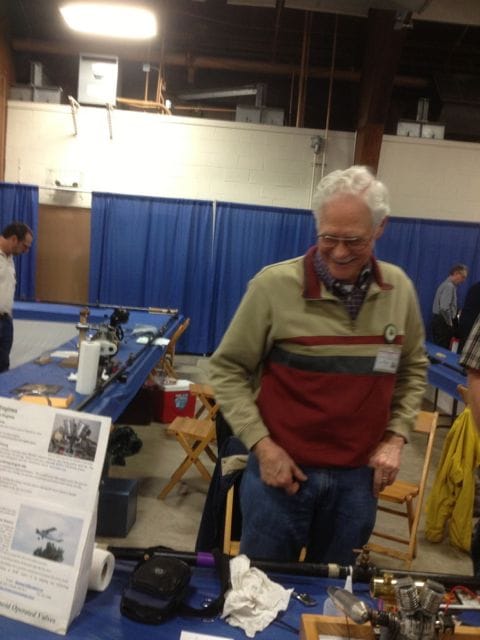
David Bowes shows off his latest camless engines at NAMES, April 2013.

David Bowes shows off his latest camless engines at NAMES, April 2013.

Fiat used a similar technology in the 1970s with variable valve timing (VVT), but that involved heavy cams and levers, and proved to be unreliable. In the US, some fine engineers had been working on solenoids, e.g. David Bowes, pictured above with one of his solenoidal engines (he’s a sometime manufacturer for REB Research). Dave has built engines with many cycles that would be impractical without solenoids, and has done particularly nice work reducing the electric use of the solenoid.

Durability may be a problem here too, as there is no other obvious reason that Fiat has not gone completely camless, and has not put a solenoid-controlled valve on the exhaust too. One likely reason Fiat didn’t do this is that solenoidal valves tend to be unreliable at the higher temperatures found in exhaust. If so, perhaps they are unreliable on the intake too. A car operated at 1000-4000 rpm will see on the order of 100,000,000 cycles in 25,000 miles. No solenoid we’ve used has lasted that many cycles, even at low temperatures, but most customers expect their cars to go more than 25,000 miles without needing major engine service.

We use solenoidal pumps in our hydrogen generators too, but increase the operating live by operating the solenoid at only 50 cycles/minute — maximum, rather than 1000- 4000. This should allow our products to work for 10 years at least without needing major service. Performance car customers may be willing to stand for more-frequent service, but the company can’t expect ordinary customers to go back to the days where Fiat stood for “Fix It Again Tony.”

How Theodore Roosevelt survived being shot

Two more pictures of Theodore Roosevelt. The first is an x-ray showing the bullet he received as he entered a hall to give a 90 minute speech in 1912. How he survived the shooting: he did nothing. He left the bullet stay where it was for the rest of his life. It seems that both McKinley and Garfield had died from infection of their shooting wounds after doctors poked around trying to extract the bullet. It’s quite possible that Lincoln died the same way (Lincoln’s doctor was the one who killed Garfield by poking around this way).X-ray of Teddy Roosevelt showing the bullet where he let it lie.

X-ray of Teddy Roosevelt showing the bullet where he let it lie. The stripes look like lead paint, used to mark the spot.

Roosevelt knew from hunting that a shot animal could last for years with the bullet still inside him. Roosevelt (and his doctors) knew, or suspected, that his bullet had stopped in a place where it would be harmless unless someone tried to extract it.

T. Roosevelt with Rhino, 1909.

T. Roosevelt with Rhino, 1909. Teddy would be shot 3 years later, in 1912.

In the speech, Roosevelt said, “it takes more than that to stop a Bull Moose.” He ought to know. For more T. Roosevelt pictures, click here.

Detroit: maximum punishment

Some moths ago, I argued that getting rid of its extra-high minimum wage was perhaps the single best thing that Detroit could do to improve its bankrupt finances and to provide jobs for its youth. I argued that this living wage of $11 or $14/hr, depending on whether healthcare was provided, was too much for the city to pay for it’s minimal skill workers. I also argued that a lower minimum wage would help the city finances, and would allow the unskilled of Detroit to find jobs: it would provide the first rung of a ladder. Well, sort-of good news: Detroit’s living wage has been declared unenforceable by the Michigan Supreme court.

Unenforceable does not mean that wages will lower immediately: anyone working for the city will keep their high salary job, so the finances of the city will remain strained. Also, private companies can not lower anyone’s contracted wages. The only difference is that workers on non-city jobs who agree to be paid $7.50 to $14/hr, can no longer sue to recover additional dollars to meet Detroit’s “living wage.” Bit by bit I expect that more low-skilled workers will be hired, and that their wages will stabilize downward to a free-market value.

The next big things that are needed are reduced crime and increased population who are employed in businesses other than selling drugs or themselves. One way to reduce crime, I think is to have less-stiff minimum penalties for non-violent crimes like drug possession and driving with a suspended license. Currently the penalty for possession runs to 15-20 years. No one who spends that much time in prison will fit back into society. Let’s do them and ourselves a favor by reducing minimum sentences so that the normal sentence is only 1-5 years (ideally with < 1 oz marijuana possession punished by a fine).

Another horror is the penalty for driving with a suspended license. It’s $3000 for a start (a reasonable amount, I think), but then the state adds a $4000 per year penalty for the next 3 years: a total of $15,000. That’s too much for a minimum-wage earner to pay, but the minimum wage earner needs a car to get to work. So he/she can’t work, or he/she drives without a license or insurance. Is this what we want? Lets give a second chance and lower the penalty to produce more working, law-abiding citizens. There is nothing wrong with Detroit that could not be fixed by 200,000 more, law-abiding, employed Detroiters.

R.E. Buxbaum owns REB Research, a maker of hydrogen purifiers and hydrogen generators. We used to be located in Detroit, but are now in Oakland county, 1/2 mile north of the Detroit border.

Robert Buxbaum is now on the board of a new charity

I’m now on the board of directors for two non-profits (lucky me), plus for my own hydrogen company, REB Research. My first charity seat is for The Jewish Heritage Foundation; it’s really one rabbi who takes donations to make tapes about topics he finds interesting. He then gives away or sells the tapes. We meet once a year to go over the finances and decide what his salary ought to be — basically we rubber stamp.

The second board seat, one I’ve been elected/appointed to just this week, is with a group call “The First Covenant Foundation” they’re semi-religious, trying to get people to behave decently. The first covenant is the one with Noah — God won’t destroy the earth but we have to behave sort-of OK. It’s certainly worthwhile to get people to keep to this minimal standard: no murder, no bestiality, don’t eat the limbs off of living creatures… Then again, if God has trouble keeping folks to this standard, I’m not sure how effective the 1st covenant will be. So far they’ve done nothing illegal or immoral that I’ve seen, so that’s good. Unlike with my first my board position, my contract with first covenant includes a sanity clause. They’re more inclusive that way; as expected, the Jewish heritage group didn’t believe in any sanity clause.

As for REB Research, our aims are simpler: to make and sell good hydrogen-related products, to make money, to pay our workers and creditors, and to develop our workers through training associated with the making and selling of good hydrogen products. Simple enough. My board meets 3 or 4 times a year over pizza; the salary of board members is the pizza. So far we haven’t done anything illegal either, that I know of — and we’re even making money.

Dwarf joke

I tripped over a dwarf the other day; I know — bad news. The fellow gets all huffy with me, and seems to think I was looking down on him (So weird, if I’d been looking down on him, I’d never have tripped!).

At any rate he says, “I’m not happy.” “That’s OK.” I say, “So which one are you?” And he gets all upset. These dwarves are all the same, they’re so small. 

A visit to the Buxbaum laboratory from Metromedia

It’s a slow news day in Detroit, so the folks from Metromedia came to visit my laboratory at REB Research. You can visit too. We’re doing cool stuff most of the time, we’re working on a hydrogen-fueled plane that stays aloft for weeks (not that cool, actually, the Hindenberg did it in the 30s). On this particular day I’ve got a cool hat on, and a beige suit. I’m putting hydrogen in my car. Hydrogen increases the speed of combustion, and so it adds to milage — or it has when we’ve added it from electrolysis sources.buxbaum-003

The fun thing about science is that there are always surprises.

Adding hydrogen to a Malibu at REB Research

Adding hydrogen to a Malibu at REB Research

Newfie joke (Newfie’s are Canadians from Newfinland)

Here’s a Newfie joke; it was originally another joke, but I tweaked it because I was in Frankenmuth today watching folks snow sculpt and ice-fish. As for Newfinland, it’s basically the Appalachia of Canada. The folks there aren’t considered to be particularly bright. Anyway.

So this Newfie decides it’s time he took up ice fishing. It’s winter and all his other Newfie friends ice fish. So he gets a setup with an ice drill, a few short fishing poles, a plastic pail to sit on, and a little tent, and he goes to set it up on the ice early one morning.

He finds a nice, empty spot, but as soon as he’s set up the pail and tent but he hears a voice from somewhere around him, “Go home, there are no fish under the ice.” He looks all around but he can’t see anyone. Who said that? Was that comment for him? He goes back to start drilling, and he hears the voice again. “Go home; there are no fish under the ice.” Well, he still can’t see anyone, but figures that maybe he should go to a different spot. He picks up his stuff, moves about 50 feet away and starts to set up again, when he hears the voice again, just as loud. “Go home, there are no fish under the ice.” “Who are you?” yells the Newfie to no-one in particular, “God?” “I’m the rink manager. There are no fish under the ice.”

Helium leak detector repaired and refurbished in Frankenmuth

To those who know Frankenmuth, MI, it is generally as “Little Bavaria,” the German-themed vacation town of quaint houses and shops; of cheese, wurst, beer, Christmas ornaments, and Oom Pa Pa bands. I know it in a slightly different way as the only town to get your helium leak detector repaired. There are at least three shops in Frankenmuth that repair helium leak detectors (or make new specialty versions), and this is the source of the reference leaks that most qualified shops use. So I was here yesterday and today, both for the World-class snow sculpture contest, and to get my helium leak detector looked at. It was acting funny; it turns out there was a leak in the leak detector plus a bad potentiometer on a switchover circuit. The leak is already fixed, and I should have it back in my shop next week (Wednesday).

Snow-sculpting in Frankenmuth 2013; I was there to have my helium leak detector fixed.

Snow-sculpting in Frankenmuth 2013; I was there to have my helium leak detector fixed.

veeco He-leak detector at REB Research.