Category Archives: Business

Detroit 1967 to 2017: unemployment comes down, murder rate doesn’t.

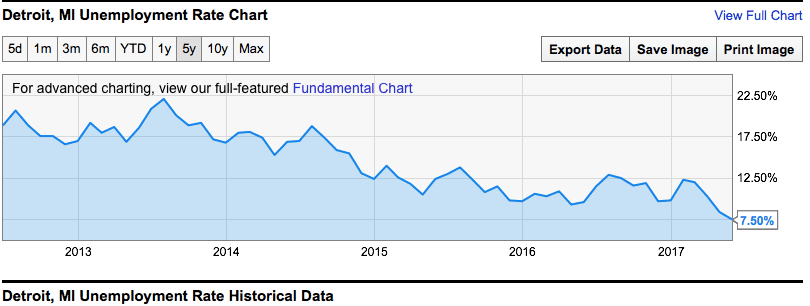
Almost 50 years ago today, July 23, 1967 white policemen raided an unlicensed, “blind pig” bar in a black neighborhood, the 12th street of Detroit, and the city responded with four days of rioting, 43 killings (33 black, 10 white), 2509 stores looted, and over 1000 fires. In 2017, at last the city is beginning to show signs of recovery. By 2015 the city’s unemployment had gone down from about 20% to 12%, and  in the first six months 2017, the firs six months of the Trump presidency, 2017 it’s gone down again to 7 1/2%. It’s not that 7 1/2% unemployment is good, but it’s better. Per-hour salaries are hardly up, but I take that as better than having a high average salary at very low employment. As a point of reference, the unemployment rate in Detroit in 1967, before the riots was 3.4%. Within weeks, 150,000 jobs were lost, and anyone who could leave the city, did.

Detroit Unemployment rates are way down, but the city still looks like a mess.

Detroit Unemployment rates are way down, but the city still looks like a mess.

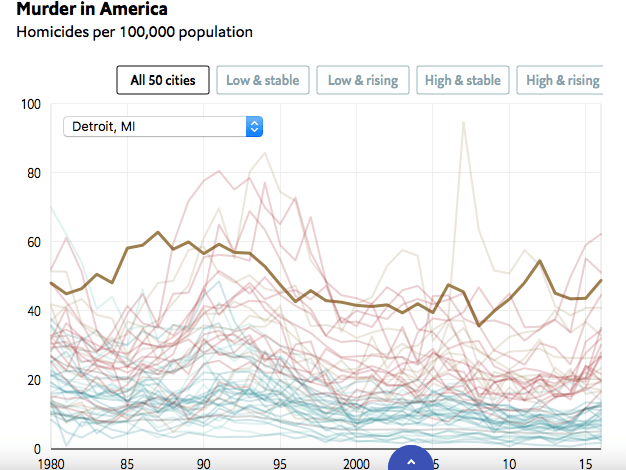
Another issue for Detroit is its uncommonly high murder rate. In the mid-80s, Detroit had the highest murder rate in the US, about 55 murders per 100,000 population per year (0.055%/year). As of February 1, 2017, the murder rate was virtually unchanged: 50 per 100,000 or 0.05%/year, but two cities have higher rates yet. At present rates, you have a 3.5% of dying by homicide if you live in Detroit for 70 years — even higher if you’re male. The rate in the rest of the US is about 1/10th this, 0.005%/year, or 5 per 100,000, with a dramatic difference between rural and urban populations.

Murder rate in 50 cities with Detroit highlighted. From The Economist, February 2017.

Murder rate in 50 cities with Detroit highlighted, from The Economist.

One of the causes of the high murder rate in Detroit, and in the US generally, I suspect, is our stiff, minimum-penalties for crime. As sir Thomas Moose pointed out, when crime is punished severely, there is a tendency to murder. If you’re going to spend the next 20 years behind bars, you might as well try any means you can to escape. Another thought — the one favored by social liberals — is that it’s the presence of guns in the US encourages murder. It may, but it also seems to prevent crime by allowing the victim to defend himself or herself. And the effect on murder is not so clear, if you consider suicide as a form of murder. In countries like Canada with few guns, people kill themselves by hanging or by throwing themselves off high buildings. My hope is that Detroit’s murder rate will drop in 2017 to match its improved economic condition, but have no clear reason to think it will.

Robert Buxbaum, July 20, 2017. Here are some suggestions I’ve made over the years.

If the wall with Mexico were covered in solar cells

As a good estimate, it will take about 130,000 acres of solar cells to deliver the power of a typical nuclear facility, 26 TWhr/year. Since Donald Trump has proposed covering his wall with Mexico with solar cells, I came to wonder how much power these cells would produce, and how much this wall might cost. Here goes.

Lets assume that Trump’s building a double wall on a strip of land one chain (66 feet) wide, with a 2 lane road between. Many US roads are designed in chain widths, and a typical, 2 lane road is 1/2 chain wide, 33 feet, including its shoulders. I imagine that each wall is slanted 50° as is typical with solar cells, and that each is 15 to 18 feet high for a good mix of power and security. Since there are 10 square chains to an acre, and 80 chains to a mile we find that it would take 16,250 miles of this to produce 26 TWhr/year. The proposed wall is only about 1/10 this long, 1,600 miles or so, so the output will be only about 1/10 as much, 2.6 TWhr/year, or 600 MW per average daylight hour. That’s not insignificant power — similar to a good-size coal plant. If we aim for an attractive wall, we might come to use Elon Musk’s silica-coated solar cells. These cost $5/Watt or $3 Billion total. Other cells are cheaper, but don’t look as nice or seem as durable. Obama’s, Ivanpah solar farm, a project with durability problems, covers half this area, is rated at 370 MW, and cost $2.2 Billion. It’s thus rated to produce slightly over half the power of the wall, at a somewhat higher price, $5.95/Watt.

Elon Musk with his silica solar panels.

Elon Musk with his, silica-coated, solar wall panels. They don’t look half bad and should be durable.

It’s possible that the space devoted to the wall will be wider than 66 feet, or that the length will be less than 1600 miles, or that we will use different cells that cost more or less, but the above provides a good estimate of design, price, and electric output. I see nothing here to object to, politically or scientifically. And, if we sell Mexico the electricity at 11¢/kWhr, we’ll be repaid $286 M/year, and after 12 years or so, Republicans will be able to say that Mexico paid for the wall. And the wall is likely to look better than the Ivanpah site, or a 20-year-old wind farm.

As a few more design thoughts, I imagine an 8 foot, chain-link fence on the Mexican side of the wall, and imagine that many of the lower solar shingles will be replaced by glass so drivers will be able to see the scenery. I’ve posited that secure borders make a country. Without them, you’re a tribal hoard. I’ve also argued that there is a pollution advantage to controlling imports, and an economic advantage as well, at least for some. For comparison, recent measurement of the Great Wall of China shows it to be 13,170 miles long, 8 times the length of Trump’s wall with China.

Dr. Robert E. Buxbaum, June 14, 2017.

Solving the savings dilemma (how to have savings)

A few days ago, I wrote a post about the lack of savings in America, the social causes for it, and the damage it causes. I had some governmental suggestions, but suspect I didn’t emphasize that the main responsibility is personal: if you want savings, you’ve got to save.

Every rich person spends less than he earns. If you aspire to be rich, spend less on clothes than you can afford.

Every rich person spends less than he earns. If you aspire to be rich, spend less on clothes than you can afford.

If you want to have savings, it is up to you to spend less than you earn. If you don’t, you’ll never be rich, you won’t even have net-economic worth, and you’ll always be strung-out over emergencies. Income and gifts can’t help if spending rises to match. At all incomes, the people who get richer are those who tailor spending to be less than earnings.

There is another personal honesty issue here, and a marriage issue too. If you spend more than you earn, someone will be cheated, and that person (your wife, husband, neighbor, friend) is likely to get mad. Earn $100 and spend $99.99, you can be honest and well liked. if you earn $1000 and spend $1000.01 and you will cheat someone you love sooner or later. Be an honest fellow and spend less. Clothes is a good place to start: say no to the fancy dress and the fancy wedding, and to fancy clothes in general. If you smoke, vaping can be a life and money saver. And try to avoid pot-smoking, at $400/oz that’s got to be a killer. And here are some water savers.

A good way to know if you are doing things right :Start a bank account, and check the balance and resolve to see it $10 higher at the end of the week than before. And that’s my two cents.

Robert Buxbaum, April 26, 2017.

Black folks have no savings (poor whites too)

The wealth of the mean American household has dropped since 2007, a result of  de-industrialization, and unmet expectations. On average, America is richer, but we’ve increased the economic divide. The richest have left behind the working and bourgeoise classes. Though we are beginning to come back, with home ownership rising, a particularly nasty legacy remains, especially among black families. Some 47% of black families have no liquid savings  — a far greater fraction than in 2007. This. has to change if black folks are ever to get ahead as a group.

College graduation rates have increased among black students, and black salaries, but I’m not sure the degrees are in productive fields (true for white students too). As of 2015, 22.5% of black students and 15.5% of Hispanic students had completed four years of college. That’s less than the 36.2% of white students, an inequality, but not a horrible one. As of 2013, the average salary of a black college grad was over $1000/week, somewhat less than the average for white grads, but enviable compared to the world as whole. The big problem I see is that black workers save very little compared to other ethnic groups, or compared to previous savings rates as shown by the graphic below. By 2013, the net worth of the median black family (savings, plus paid-off part of home and car) was $11,000 (Pew Research Data, below), down from $19,200 six years earlier. This is much lower than the net worth of white families (also down since 2007). In terms of liquid savings the mean is near zero, and this is the mean. Half of all black families are doing worse.

Net worth disparity 2007 - 2011. Black folks are doing poorly and it's getting worse.

Net worth disparity 2007 – 2011. Black folks are doing poorly and it’s getting worse.

The combination of low savings and low net worth puts black folks at a distinct disadvantage to their condition six years earlier. Without savings, it is near-impossible to weather the loss of a job, or even to fix a car or pay a ticket; a major disease is basically a one-way ticket to the welfare office. Six years ago, when people saved more and prices were lower, problems like this were annoyances. Now, it’s a family disaster.

A person without savings will not have a savings account or a checking account. As such, he or she will not have a credit card or check cashing privileges. The only way to cash a check will be via a for-fee service, and these tend to come at a steep cost (2-5%). The growth of check-cashing services in black neighborhoods is a symptom of this. People with savings accounts cash checks essentially for free, and can usually borrow money by way of a credit card. Black people and poor whites tend to use debit cards instead. They look and work like credit cards, but they incur fees upon use, and do not provide instant loans. When black folks and poor whites need quick cash, their options are the loan-shark or the pawn shop: high-cost options.

While black individuals have lower incomes than whiteindividuals, most of the blame seems to be family stability. Employed, college-educated blacks earn, on average, 95% as much as employed, college-educated whites — not great, and I trust that will improve. The bigger problem is not being able to show up for work because of family instability., Single-parent families are significantly more common among black folks. Roughly 40% of black families are single-mother, or mother+grandparent households compared to “only” 26% in the population generally. In both populations, the number of single parent households have increased dramatically in the last few years, a result I suspect of the government’s desire to help. The government gives more aid to a split-up couple than to one that stays together, but the aid brings with it long-term damage to net worth. A family with one parent will naturally have a lower-income and savings rate than a family with two. The lack of stability that comes from a single parent family, I suspect, has contributed to crime, births out-of-wedlock, and the tendency of black folks to drop out of college.

Black families don't benefit as much from college --in part a result of the choice of courses.

Black families don’t benefit much from college –in part a result of course choices, in part the result of borrowing. (Forbes, 2015).

Some white do-gooders want to eliminate check cashing businesses and pawn shops in a misguided desire to help the low-income neighborhoods, but the success of these companies tell me that they are needed. Though check services and pawn brokers take a nasty bite, urban life would be much worse without them, I suspect.

Another so-called solution of the do-gooders, is to tax savings and transfer the wealth to the poor. This form of wealth redistribution has been a cornerstone of the Democratic party for the last century. The idea of the tax is that it will transfer “idle wealth” from rich savers to poor folks who will spend it immediately. The problem is that great swathes of the nation don’t save at all currently; net worth is down all across the US — among white and black families both. Taxing savings will almost-certainly reduce the savings rate even further. Besides, savings are the stuff of self-determination and dreams — far more than spending, it is savings that allows a person to start a new business. One does not provide for the dreams of one group by taking them from another — particularly when the merit of the receiving group is that they are immediate spenders. The danger of this is seen by looking at Detroit.

As it is, inner city children do not see a path out via education. Detroit school attendance hovers around 50%, and business startups are lacking. With higher savings rates and higher family stability, folks could start businesses, and/or take advantage of job opportunities that come along, and that would help the community more than redistribution.  It sometimes seems that the only successful businesses in Detroit are check cashing, pawn brokers, churches, hair-salons, fast food, and medical marijuana — businesses that provide little community return. Detroit has lost its manufacturing center, and now has more medical marijuana providers than groceries — a sad state of affairs.

The Check cashing services of south-eastern MI are concentrated in poor black and white neighborhoods.

The Check cashing services of south-eastern MI are concentrated in poor black and white neighborhoods.

In 2016, both presidential candidates touted major building projects to help the inner city poor. In principle this could help, but the  inner city youth lack the training or licenses to build roads and bridges. They have barely the math skills to manage a McDonald’s. For another thing, many of the project aren’t needed. They’re form of income redistribution and graft. Surely we can do better. Trump makes the case for tariffs (reducing free trade) as a way to rebuild the industrial base of cities like Detroit. It’s an approach with merit, I think. He’s also and has suggested closing the border to low-wage workers. This is expected to raise the price of California lettuce and NY hotel stays, but it’s likely to increase employment and wages among lower-skilled, black and white Americans. Small steps, I think, to solving a serious problem.

One more thing: open a bank account if you don’t have one. Mine is at a credit union. I opened it with $5, and opened a checking account at the same time. Have your wages deposited automatically, if you can. And avoid the check cashing services. Let your savings grow.

Robert E. Buxbaum, April 21, 2017.  I ran for water commissioner 2016 (Republican) and lost. If you find my comments insensitive, that could be why I lost.

pee in the shower and other water savers

Do you want to save the planet and save money at the same time? Here are some simple tips:

The first money and planet saver, is to pee in the shower. For those who don’t have a lawn, or who don’t water, your single biggest water cost is likely the toilet. Each person in your household will use it several times per day, at roughly 1.6 gallons per flush. In Oak Park, Michigan the cost of water is 1.5¢/gallon, so each flush costs you, roughly 2.5¢. If you pee in the shower every morning, you’ll save yourself about one flush per day, or 2.5¢. Over the course of a year you’ll have used about 500 gallons less, and will have saved yourself somewhere between $5 and $10. Feel good about yourself every morning; the effort involved is truly minimal.

Related to peeing in the shower, I should mention that many toilets leak. A significant part of your water bill can often be cut by replacing the “flapper valve on the inside of your toilet tank, and/or by cleaning the needle fill valve. To see if you need this sort of help, put a few drops of food dye in the toilet when you leave in the morning. If the color is largely gone by the time you get back, the toilet is leaking the equivalent of a few volumes per day, that is at least as much water as is flushed. If the color goes faster, or you hear the tank refill when no one used it, you’re leaking more. Check the flapper and replace it if it’s worn — it’ll cost about $3 — and check the needle-fill valve. They don’t work forever. Cleanliness is near godliness.

Mulch is good, this is too much concentrated by the tree trunk. Use only 2 inches and spread it out to save water and weeding.

Mulch is good, this is too much concentrated by the tree trunk. Use only 2-3 inches and spread it out from the trunk to save water and weeding without attracting bugs.

If your valve is leaking and you decide to replace it, you may want to replace with a variable flush valve. Typically, there are two options: a big vale for big flush (1.6 gal) and a small valve for small flush (1 gal or less). These are widely used in Europe. You can make up for this cost rather quickly at 1.5¢/gallon.

The next big issue is lawn-care. If you water your lawn and flowers daily, you’ve likely noticed that you pay about $300/month for water in the summer: a lot more than in the winter, or than your lazes-faire neighbor in the summer. Every $150 of summer-excess, water bill you pay represents about 10,000 gallons applied to your lawn. That’s a cubic foot, or 1¢ to 2¢ of water applied per ft2 per month for typical watering. While many sites advise that you can save by adding a rain barrel, I disagree. Rain barrels are costly, ugly, and are a lot of work ago plumb in. And each barrel only holds 55 gallons of water, 82¢ worth when full. You do a lot better, IMHO by putting down an inch or two of mulch around your flowers and vegetables. This mulch requires no work and will keep you from needing to water these areas for the 3-4 days after every rainfall. A layer of 1″ to 2″ will help your soil hold 0.5 to 1 gallon of water per square foot. At typical prices of mulch and water, this will pay for itself in 1-2 years and will help you avoid weeding. Mulch is a far better return than the rain-barrels that are often touted, and there’s far less effort involved. Buy the mulch, not the barrel, but don’t put down too more than 2″ on flowers and vegetable. Trees can take 3 -4″; don’t use more. Avoid a mulch mountain right next to a tree, it causes the roots to grow weird, and provides a home for bugs and undesirable anaerobic molds.

A little more work than the above is to add a complete rain garden or bioswale. Build it at the bottom of any large incline on your property, where the water runs off (It’s likely a soggy swamp already). Dig the area deeper and put, at the bottom of the hole, a several-inch layer of mulch and gravel. Top it off with the soil you just removed, ideally raising the top high enough that, if the rain garden should fill, the water will run off to the street. Plant in the soil at the top long-rooted grasses, or flowers, vegetables, or water-tolerant trees. You may want to direct the water from your home’s sump pump here too (It can help to put a porous pipe at the bottom to distribute this water). If you do this right, you’ll get vegetables or trees and you won’t have to water the garden, ever. Also, you’ll add value to your property by removing the swampy eyesore. You’ll protect your home too, since a major part of home flooding comes from the water surge of sump water to the sanitary sewer.

Robert E. Buxbaum, April 14, 2017. I ran for water commissioner, Oakland County, MI, Nov. 2016. Among my other thoughts: increased retention to avoid flooding, daylighting rivers, and separating the sanitary from the storm sewers. As things stand, the best way to save money on water– get the same deal the state gave to Nestle/ Absopure: they pay only $200/year to pump 200 gal/minute. That is, they pay only 1/3000 of what you and I pay. It helps to have friends in government.

The argument for free trade is half sound

In 1900, the average tariff on imported goods was 27.4% and there was no income tax. Import tariffs provided all the money to run the US government and there was no minimum wage law. The high tariffs kept wage rates from falling to match those in the 3rd world. Currently, the average tariff is near-zero: 1.3%. There is a sizable income tax and a government income deficit; minimum wage laws are used to prop up salaries. Most economists claim we are doing things right now, and that the protective tariffs of the past were a mistake. Donald Trump claimed otherwise in his 2016 campaign. Academic economists are appalled, and generally claim he’s a fool, or worse. The argument they use to support low tariffs was made originally by Adam Smith (1776): “It is the maxim of every prudent master of a family, never to attempt to make at home what it will cost him more to make than to buy…. If a foreign country can supply us with a commodity cheaper than we ourselves can make it, better buy it of them with some part of the produce of our own industry.” As a family benefits from low cost products, a country must too. How stupid would you have to be to think otherwise?

A cartoon from Puck 1911. Do you cut tariffs, and if so how much. High tariffs provide high wages and expensive prices for the consumer. Low tariffs lead to cheap products and low wages. Uncle Sam is confused.

A cartoon from Puck, 1911. Should tariffs be cut, and if so, how much. High tariffs provide high prices and high wages. Low tariffs lead to low prices for the consumer, but low wages. Uncle Sam is confused.

Of course, a country is not a family, and there are certain benefits in keeping manufacturing and employment here, in not exporting jobs and expertise. It is clear that some people benefit from a flood of cheap, imported products, while some folks suffer. Consumers and importers benefit, while employees generally do not. They are displaced from work, or find they must compete with employees in very low wage countries, and often with child labor or slave labor. The cartoon at right shows the conundrum. Uncle Sam holds a knife labeled “Tariff Revision” trying to decide where to cut. Any cut that helps consumers hurts producers just as much. Despite the cartoon, it seems to me there is likely an optimal, non-zero tariff rate that allows productive trade, but also provides revenue and protects American jobs.

A job-protecting tariff was part of the Republican platform from Lincoln’s time, well into the 20th century, and part of the Whig platform before that. Democrats, especially in the south, preferred low tariffs, certainly no more than needed to provide money for government operation. That led to a diminution of US tariffs, beginning in the mid- 1800s, first for US trade with developed countries, and eventually with third world as well. By the 1930s, we got almost no government income from tariffs, and almost all from an ever-larger income tax. After WWII low tariff reductions became a way to promote world stability too: our way of helping the poor abroad get on their feet again. In the 2016 campaign, candidate Donald Trump challenged this motivation and the whole low-tariff approach as anti- American (amor anti America-first). He threatened to put a 35% tariff on cars imported from Mexico as a way to keep jobs here, and likely to pay for the wall he claimed he would build as president. Blue-collar workers loved this threat, whether they believed it or not, and they voted Republican to an extent not seen in decades. Educated, white collar folks were uniformly appalled at Trump’s America-first insensitivity, and perhaps (likely) by the thought that they might have to pay more for imported goods. As president, Trump re-adjusted his threat to 20%, an interesting choice, and (I suspect) a good one.

The effect of a 20% tariff can be seen better, I think, by considering a barter-economy between two countries, one developed, one not: Mexico and the US, say with an without a 20% tax. Assume these two countries trade only in suits and food. In the poor country, the average worker can make either 4 suits per month or 200 lbs of food. In the developed country, workers produce either 10 suits or 1000 lbs of food. Because it’s a barter economy with a difference in production, we expect that, in the poor country, a suit costs 50 lbs of food; in the rich country, 100 lbs of food. There is room here to profit by trade.

The current state of tariffs world-wide. Quite a few countries have tariffs much higher than ours. Among those, Mexico.

Tariffs world-wide. We put no tax on most imported products while much of the world taxes our products heavily.

With no tariff, totally free trade, an importer will find he can make a profit bringing 100 lbs of US food to Mexico to trade for 2 suits. He can return two suits to the US having gotten his two suits at the price of one, less the cost of transport, lawyers, and middlemen (relatively low). Some US suit-makers will suffer, but the importer benefits immediately, and eventually US consumers and Mexican suit workers will benefit too. Eventually, US suit prices will go down, and Mexican wages up, We will have cheaper suits and will shift production to what we make best —  food.

In time, we can expect that an American suit maker will move his entire production to Mexico bringing better equipment and better management. Under his hand, lets assume his Mexican workers make 6 suits per month. The boss can now pay them better, perhaps 100 lbs of food and two suits per month. He still makes a nice profit, more than before: he ships two suits to the US to buy the 200 lbs of food, and retains now two suits as profit. Hillary Clinton believed this process was irreversible. “Those jobs are gone and they’re not coming back,” her campaign told CNN. She claimed she’d train the jobless “for the jobs of the future” and redistribute the wealth of the rich, a standard plank of the democratic platform since 1896. But, for several reasons, industrial voters didn’t trust her to succeed, or even to try. Redistribution of wealth rarely works because, even if a politician has the will, and most don’t, manufacturers can usually keep their profits off-shore, and they do.

A very high tariff would stop all trade, but lets see what would happen with Trump’s 20% tariff. With a 20% tariff, when the first two suits come to the US, we’d extract 0.4 suits in tax revenue. The importer still makes a profit, but it’s now 0.6 suits, the equivalent of 60 lbs of food. He can sell suits for less than the American, but not as much less. If the manufacturer moves to Mexico he makes more money, but not quite as much. Tax is still collected on every suit brought to America — now 20% of the 3 suits per Mexican worker that the Boss must export. The American worker’s wages are depressed but he/she isn’t forced to compete with the Mexican dollar-for-dollar (suit for suit). In barter terms, he isn’t required to make 6 suits for every 100 lbs of food.lincoln-national-bank-internal-improvements-tariffs

We find that, in the above fictional economy, a 50% tariff in the maximum to allow any profitable suit trade: the first two suits might enter the US; but they’d be taxed at one suit, just enough to pay for the 100 lbs of food that he’d have to barter for the 2 suits. At that rate, there would be no profit for the importer, and he/she would stop importing. A 50% tariff is thus counter-productive to the consumer and the US gov’t: we would get no imported goods, and we’d collect no import revenue – a bad situation in general, though good for the manufacturer. Lincoln’s “protective tariffs” of 1861 contributed to Southern succession and the start of the civil war. It seems to me that some modest tariff of 10% to 20% is fair and productive — tariff rates that Trump seems to have intuited, and that many other countries have adopted, see map-chart above. As for the academic economists, I note that they also predicted a stock market crash should Trump be elected; it’s gone nearly straight up since November 8, 2016. I find that most economists are not rich despite claiming to be experts on money.

Robert E. Buxbaum, March 27, 2017. I learned such economics as I have from my one course in economics, plus comic books like the classic “Once upon a dime” produced by the New York Federal Reserve. Among the lessons learned: that money is a distraction, just a more convenient way to carry around a suit, 100 lbs of food, or a month of work. If you want to understand economics, I think it helps to work things out in terms of barter, as above.

Rethinking fluoride in drinking water

Every now and again, it pays to rethink what everyone knows is so. As it happens I was asked to rethink fluoride in the drinking water. So here goes.

Fluoride is a poison, toxic for a small child in doses of 500 mg, and toxic to an adult in doses of a few thousand mg. It is a commonly used rat poison that kills by robbing the brain of its ability to absorb oxygen. In the form of hydrofluoric acid, it is responsible for the deaths of more famous chemists than any other single compound: Humphrey Davy died trying to isolate fluorine; Paul Louyet and Jerome Nickles, too. Thomas Knox nearly died, and Henri Moissan’s life was shortened. Louis-Joseph Gay Lussac, George Knox, and Louis- Jacques Thenard suffered burns and similar, George Knox was bedridden for three years. Among the symptoms of fluoride poisoning is severe joint pain and that your brain turns blue.

In low doses, though, fluoride is thought to be safe and beneficial. If true, this would be an example of hormesis. It’s found that many things that are toxic at high doses are beneficial at low. Most drugs fall into this category; chemotherapy works this way. Sunshine and radioactivity show hormesis too. Fluoride seems to be like this. In small doses, Fluoride is associated with strong teeth, and few cavities, and no obvious health risks. It is found at ppm levels many well water systems, and has shown no sign of toxicity, either for humans or animals at these ppm levels. Following guidelines set by the AMA, most US cities have been putting fluoride in drinking water since the 1960s, typically at concentrations between 0.7 and 1.2 ppm. We have seen no deaths or clear evidence of any injury from this, but there has been controversy. Much of the controversy stems from a Chinese study that links fluoride to diminished brain function, and passivity (Anti-fluoriders falsely attribute this finding to a Harvard researcher, but the Harvard study merely cites the Chinese). The American dental association strongly maintains that worries based on this study are groundless, and that the advantage in lower cavities more than off-sets any other risks. Notwithstanding, I thought I’d take another look. The typical US adult consumes 1-3 mg/day the result of drinking 1-3 liters of fluoridated water (1 ppm = 1 mg/liter). This < 1/1000 the toxic dose,

While there is no evidence that people who drink high-fluoride well water are any less-healthy than those who drink city water, or distilled / filtered water, that does not mean that our city levels are ideal. Two months ago, while running for water commissioner, I was asked about fluoride, and said I would look into it. Things have changed since the 1960s: our nutrition has changed, we have vitamin D milk, and our toothpastes now contain fluoride. My sense is we can reduce the water concentration. As shown below, many industrial countries that don’t add fluoride have similar tooth decay rates to the US.

World Health Organization data on tooth decay and fluoridation.

World Health Organization data on tooth decay and fluoridation.

This chart should not be read to suggest that fluoride doesn’t help; all the countries shown use fluoride toothpaste, and some give out fluoride pills, too. And some countries that don’t add fluoride have higher levels of cavities. Norway and Japan, for example. They don’t add fluoride and have 50% more cavities than we do. Germany doesn’t add fluoride, and has fewer cavities, but they hand out fluoride pills, To me, the chart suggests that our levels should be lower than the AMA guidance, though not zero. In 2015, the Department of Health recommend lowering the fluoride level to 0.7 ppm, the lower end of the previous range, but based on the experience of Europe, I’d pick 1/2 the original dose: 0.6 to 0.35 ppm. I’d then revisit the data in another 15 years.

Having picked my target fluoride concentration, I checked to see what the levels we use in my county, Oakland county, MI. I was happy to discover that the levels were already below the AMA guide. The water the county drinks, provided by Detroit Water and Sewage, NOCWA and SOCWA contains 0.43-0.55 ppm fluoride, in the center of in the range I would have picked. Fluoride concentrations are higher in towns that use well water, about  0.65-0.85 ppm. I do not know if this is because the well water comes from the ground with these fluoride concentrations or if the towns add more, aiming at the Department of Health target. In either case, I don’t find these levels alarming. If you live in one of these towns, or outside of Oakland county, check your fluoride levels. If they seem high, write to your water commissioner or add a filter to your tap. You can also switch from fluoride toothpaste to non-fluoride, or baking soda. In any case, remember to brush. That does make a difference, and it’s completely non-toxic.

Robert Buxbaum, January 9, 2017. Another toxic additive is chlorine. I discuss chlorine addition a bit in this essay. As a side issue, a main mechanism of sewer pipe decay is related to tooth decay. The roofs of sewer pipes grow acid-producing, cavity causing bacteria that live off of the foul sewer gas. In time these bacteria destroy concrete sewer pipes. The remedies for this erosion is to clean sewer pipes regularly, after having them checked by a professional, about once per year. As with death, one should repair cavities early. Here too, it seems high fluoride cement resists cavities better.

A British tradition of inefficiency and silliness

While many British industries are forward thinking and reasonably efficient, i find Britons take particular pride in traditional craftsmanship. That is, while the Swiss seem to take no particular pride in their coo-coo clocks, the British positively glory in their handmade products: hand-woven, tweed jackets, expensive suits, expensive whiskey, and hand-cut diamonds. To me, an American-trained engineer, “traditional craftsmanship,” of this sort is another way of saying silly and in-efficient. Not having a better explanation, I associate these behaviors with the decline of English power in the 20th century. England went from financial and military preëminence in 1900 to second-tier status a century later. It’s an amazing change that I credit to tradition-bound inefficiency — and socialism.

Queen Elizabeth and Edward VII give the Nazi solute.

Queen Elizabeth and Edward VII give the Nazi solute.

Britain is one of only two major industrial nations to have a monarch and the only one where the monarch is an actual ambassador. The British Monarchy is not all bad, but it’s certainly inefficient. Britain benefits from the major royals, the Queen and crown prince in terms of tourism and good will. In this she’s rather like our Mickey Mouse or Disneyland. The problem for England has to do with the other royals, We don’t spend anything on Mickey’s second cousins or grandchildren. And we don’t elevate Micky’s relatives to military or political prominence. England’s royal leaders gave it horrors like the charge of the light brigade in the Crimean war (and the Crimean war itself), Natzi-ism doing WWII, the Grand Panjandrum in WWII, and the attack on Bunker Hill. There is a silliness to its imperialism via a Busby-hatted military. Britain’s powdered-wigged jurors are equally silly.

Per hour worker productivity in the industrial world.

Per hour worker productivity in the industrial world.

As the chart shows, England has the second lowest per-hour productivity of the industrial world. Japan, the other industrial giant with a monarch, has the lowest. They do far better per worker-year because they work an ungodly number of hours per year. French and German workers produce 20+% more per hour: enough that they can take off a month each year and still do as well. Much of the productivity advantage of France, Germany, and the US derive from manufacturing and management flexibility. US Management does not favor as narrow a gene pool. Our workers are allowed real input into equipment and product decisions, and are given a real chance to move up. The result is new products, efficient manufacture, and less class-struggle.

The upside of British manufacturing tradition is the historical cachet of English products. Americans and Germans have been willing to pay more for the historical patina of British whiskey, suits, and cars. Products benefit from historical connection. British suits remind one of the king, or of James Bond; British cars maintain a certain style, avoiding fads of the era: fins on cars, or cup-holders, and electric accessories. A lack of change produces a lack of flaws too, perhaps the main things keeping Britain from declining faster. A lack of flaws is particularly worthwhile in some industries, like banking and diamonds, products that have provided an increasing share of Britain’s foreign exchange. The down-side is a non-competitive military, a horrible food industry, and an economy that depends, increasingly on oil.

Britain has a low birthrate too, due in part to low social mobility, I suspect. Social mobility looked like it would get worse when Britain joined the European Union. An influx of foreign workers entered taking key jobs including those that with historical cachet. The Brits reacted by voting to leave the EC, a vote that seems to have taken the upper class by surprise, With Brexit, we can hope to see many years more of manufacturing by the traditional and silly.

Robert Buxbaum, December 31, 2016. I’ve also written about art, good and bad, about the US aesthetic of strength, about the French tradition of innovation, And about European vs US education.

The game is rigged and you can always win.

A few months ago, I wrote a rather depressing essay based on Nobel Laureate, Kenneth Arrow’s work, and the paradox of de Condorcet. It is mathematically shown that you can not make a fair election, even if you wanted to, and no one in power wants to. The game is rigged.

To make up for that insight, I’d like to show from the work of John Forbes Nash (A Beautiful Mind) that you, personally, can win, basically all the time, if you can get someone, anyone to coöperate by trade. Let’s begin with an example in Nash’s first major paper, “The Bargaining Problem,” the one Nash is working on in the movie— read the whole paper here.  Consider two people, each with a few durable good items. Person A has a bat, a ball, a book, a whip, and a box. Person B has a pen, a toy, a knife, and a hat. Since each item is worth a different amount (has a different utility) to the owner and to the other person, there are almost always sets of trades that benefit both. In our world, where there are many people and everyone has many durable items, it is inconceivable that there are not many trades a person can make to benefit him/her while benefiting the trade partner.

Figure 3, from Nash’s, “The bargaining problem.” U1 and U2 are the utilities of the items to the two people, and O is the current state. You can improve by barter so long as your current state is not on the boundary. The parallel lines are places one could reach if money trades as well.

Good trades are even more likely when money is involved or non-durables. A person may trade his or her time for money, that is work, and any half-normal person will have enough skill to be of some value to someone. If one trades some money for durables, particularly tools, one can become rich (slowly). If one trades this work for items to make them happy (food, entertainment) they can become happier. There are just two key skills: knowing what something is worth to you, and being willing to trade. It’s not that easy for most folks to figure out what their old sofa means to them, but it’s gotten easier with garage sales and eBay.

Let us now move to the problem of elections, e.g. in this year 2016. There are few people who find the person of their dreams running for president this year. The system has fundamental flaws, and has delivered two thoroughly disliked individuals. But you can vote for a generally positive result by splitting your ticket. American society generally elects a mix of Democrats and Republicans. This mix either delivers the outcome we want, or we vote out some of the bums. Americans are generally happy with the result.

A Stamp act stamp. The British used these to tax every transaction, making it impossible for the ordinary person to benefit by small trade.

A Stamp act stamp,. Used to tax every transaction, the British made it impossible for ordinary people to benefit by small trades.

The mix does not have to involve different people, it can involve different periods of time. One can elect a Democrat president this year, and an Republican four years later. Or take the problem of time management for college students. If a student had to make a one time choice, they’d discover that you can’t have good grades, good friends, and sleep. Instead, most college students figure out you can have everything if you do one or two of these now, and switch when you get bored. And this may be the most important thing they learn.

This is my solution to Israel’s classic identity dilemma. David Ben-Gurion famously noted that Israel had the following three choices: they could be a nation of Jews living in the land of Israel, but not democratic. They could be a democratic nation in the land of Israel, but not Jewish; or they could be Jewish and democratic, but not (for the most part) in Israel. This sounds horrible until you realize that Israel can elect politicians to deliver different pairs of the options, and can have different cities that cater to thee options too. Because Jerusalem does not have to look like Tel Aviv, Israel can achieve a balance that’s better than any pure solution.

Robert E. Buxbaum, July 17-22, 2016. Balance is all, and pure solutions are a doom. I’m running for water commissioner.

A plague of combined sewers

The major typhoid and cholera epidemics of the US, and the plague of the Al Qaeda camps, 2009 are understood to have been caused by bad sewage, in particular by the practice of combining sanitary + storm sewage. Medieval plagues too may have been caused by combined sewers.

Combined sewer system showing an rain-induced overflow, a CSO.

A combined sewer system showing an rain-induced overflow, a CSO.

A combined system is shows at right. Part of the problem is that the outfall is hard to contain, so they tend to spew sewage into the lakes and drinking water as shown. They are also more prone to back up during rain storms; separated systems can back up too, but far less often. When combined sewers back up, turds and other infected material flows into home basements. In a previous post, “follow the feces,” I showed the path that Oakland county’s combined sewers outfalls take when they drain (every other week) into Lake St. Clair just upstream of the water intake, and I detailed why, every few years we back up sewage into basements. I’d like to now talk a bit more about financial cost and what I’d like to do.

The combined sewer system shown above includes a small weir dam. During dry periods and small rain events, the dam keeps the sewage from the lake by redirecting it to the treatment plant. This protects the lakes so that sometimes the beaches are open, but there’s an operation cost: we end up treating a lot of rain water as if it were sewage. During larger rains, the dam overflows. This protects our basements (usually) but it does so at the expense of the drinking water, and of the water in Lake St. Clair and Lake Erie.

As a way to protect our lakes somewhat Oakland county has added a retention facility, the George W. Kuhn. This facility includes the weir shown above and a huge tank for sewage overflows. During dry periods, the weir holds back the flow of toilet and sink water so that it will flow down the pipe (collector) to the treatment plant in Detroit, and so it does not flow into the lake. Treatment in Detroit is expensive, but nonpolluting. During somewhat bigger rains the weir overflows to the holding tank. It is only during yet-bigger rains (currently every other week) that the mixture of rain and toilet sewage overwhelms the tank and is sent to the river and lake. The mess this makes of the lake is shown in the video following. During really big rains, like those of August 2014, the mixed sewage backs up in the pipes, and flows back into our basements. With either discharge, we run the risk of plague: Typhoid, Cholera, Legionnaires…

Some water-borne plagues are worse than others. With some plagues, you can have a carrier, a person who can infect many others without becoming deathly sick him or herself. Typhoid Mary was a famous carrier of the 1920s. She infected (and killed) hundreds in New York without herself becoming sick. A more recent drinking water plague, showed up in Milwaukee 25 years ago. Some 400,000 people were infected, and 70 or so died. Milwaukee disinfected its drinking water with chlorine and a bacteria that entered the system was chlorine tolerant. Milwaukee switched to ozone disinfection but Detroit still uses chlorine.

Combined sewers require much larger sewage treatment plants than you’d need for just sanitary sewage. Detroit’s plant is huge and its size will need to be doubled to meet new, stricter standards unless we bite the bullet and separate our sewage. Our current system doesn’t usually meet even the current, lower standards. The plant overflows and operation cost are high since you have to treat lots of rainwater. These operation costs will keep getter higher as pollution laws get tougher.

In Oakland county, MI we’ve started to build more and more big tanks to hold back and redirect the water so it doesn’t overwhelm the sewage plants. The GWK tank occupies 1 1/2 miles by about 100 feet beneath a golf course. It’s overwhelmed every other week. Just think of the tank you’d need to hold the water from 4″ of rain on 900 square mile area (Oakland county is 900 square miles). Oakland’s politicians seem happy to spend money on these tanks because it creates jobs and graft and because it suggests that something is being done. They blame politics when rain overwhelms the tank. I say it’s time to end the farce and separate our sewers. My preference is to separate the sewers through the use of French drains or bio-swales, and through the use of weir dams. I’m running for drain commissioner. Here’s something I’ve written on the chemistry of sewage, and on the joy of dams.

Dr. Robert E. Buxbaum, July 1-Sept 16, 2016.