Category Archives: Business

Puerto Rico’s minimum wage and statehood

Puerto Rico is in deep trouble and it’s getting worse. Unemployment is at 12%, double the next worst state or territory (Alaska). Tourism is down and poverty is at 41%. US tourists have begun going elsewhere where prices are lower: Bermuda, Haiti, Jamaica, and Cuba. The island is effectively bankrupt and would have filed for bankruptcy last year except that, as a US territory, they legally can’t. But neither can they pay their bills. The territory will go into default in 2 weeks, on July 1, 2016 unless congress creates a new funding mechanism for them. Statehood would allow Puerto Rico to go bankrupt, but there is no way for statehood to be achieved by July 1. Nor will bankruptcy help them, long term.

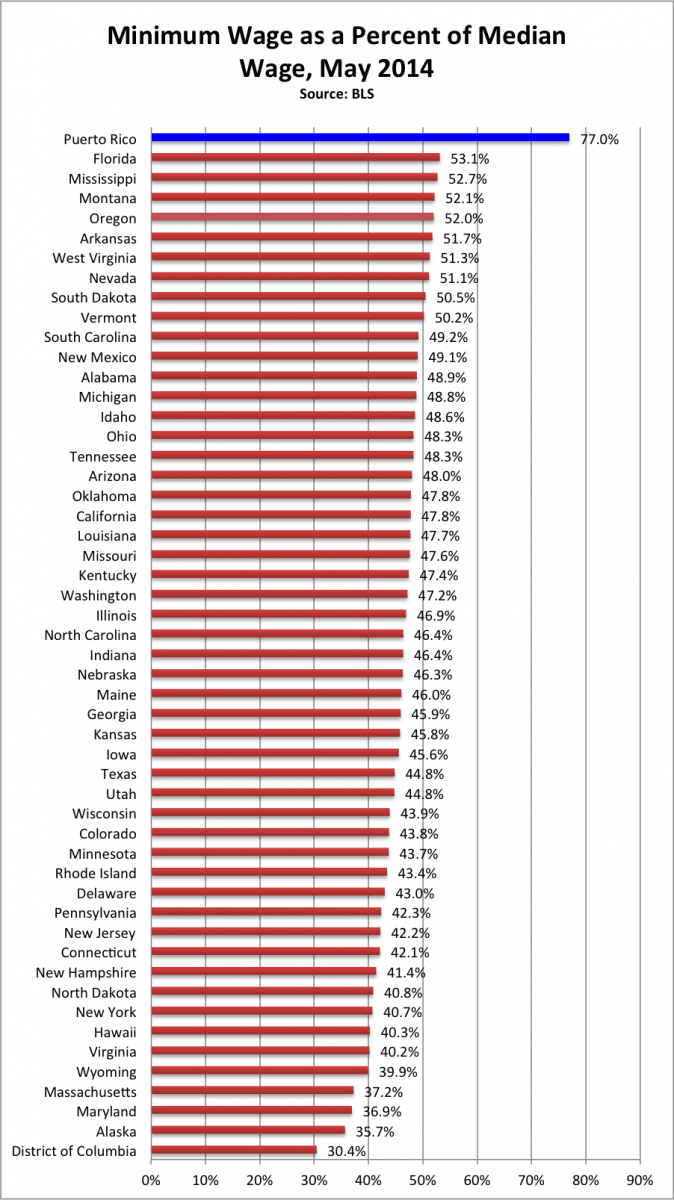
Puerto Rico's minimum wage is vastly too high; here it is compared with other US states.

Puerto Rico’s minimum wage is vastly too high for its median wage. From Preston Cooper, Economics21.

It is worthwhile to ask why Puerto Rico is in such bad shape. Why are they worse off than Guam, for example; Guam is far more isolated. Puerto Rico is run poorly, but it’s no worse than Guam or  Illinois. One problem particular to Puerto Rico is that their minimum wage is way too high relative to the median wage.

Because of the climate, living expense are low in Puerto Rico, but Puerto Rico’s economy is mostly tourism. It competes for tourist dollars with lower-wage Caribbean countries, Jamaica, Haiti, and Cuba. Neither Alaska nor Guam must compete this way, with a nearby, low cost alternative. Puerto Rico could compete better if they could lower their minimum wage. Tourism would be more attractive, and the government would not have to spend as much either for minimal-skill workers.

With a lower minimum wage, more Puerto Ricans would be able to find jobs, and the government would likely manage to balance its books. But Puerto Rico is part of the US, and we set the minimum wage. I think the federal government should grant them an exemption. Without one, there is no obvious way for Puerto Rico to pay its bills.

Four years ago, in my first blog post, I suggested that Detroit should lower its $15/hour ‘living wage‘, a wage rate that unduly burdened the city budget, and added to Detroit’s rampant unemployment and corruption. A year later, the city dropped it as part of bankruptcy, and saw significant improvementsI’m not alone in suggesting a lower minimum wage. It’s better than state-hood and immediate bankruptcy.

Robert Buxbaum, June 19, 2016.

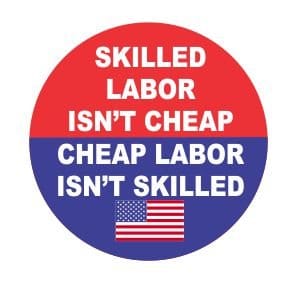
Skilled labor isn’t cheap; cheap labor isn’t skilled

Popular emblem for hard hats in the USA. The original quote is attributed to Sailor Jack, a famous tattoo artist.

Popular emblem for hard hats in the USA. The original quote is attributed to Sailor Jack, a famous tattoo artist.

The title for this post is a popular emblem on US hard-hats and was the motto of a famous, WWII era tattoo artist. It’s also at the heart of a divide between the skilled trade unions and the labor movement. Skilled laborers expect to be paid more than unskilled, while the labor movement tends to push for uniform pay, with distinctions based only on seniority or courses taken. Managers and customers prefer skilled work to not, and usually don’t mind paying the skilled worker more. It’s understand that, if the skilled workers are not rewarded, they’ll go elsewhere or quit. Management too tends to understand that the skilled laborer is effectively a manager, often more responsible for success than the manager himself/herself. In this environment, a skilled trade union is an advantage as they tend to keep out the incompetent, the addict, and the gold-brick, if only to raise the stature of the rest. They can also help by taking some burden of complaints. In the late 1800s, it was not uncommon for an owner to push for a trade union, like the Knights of Labor, or the AFL, but usually just for skilled trades for the reasons above.

An unskilled labor union, like the CIO is a different animal. The unskilled laborer would like the salary and respect of the skilled laborer without having to develop the hard-to-replace skills. Management objects to this, as do the skilled workers. A major problem with unions, as best I can tell, is a socialist bent that combines the skilled and unskilled worker to the disadvantage of the skilled trades.

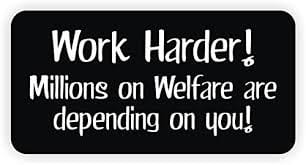
Not all unionists harbor fondness for welfare or socialism.

Also popular. Few workers harbor a fondness for welfare or socialism. Mostly they want to keep their earnings.

Labor union management generally prefer a high minimum wage — and often favor high taxes too as a way of curing societal ills. This causes friction, both in wage-negotiation and in political party support. Skilled workers tend to want to be paid more than unskilled, and generally want to keep the majority of their earnings. As a result, skilled laborers tend to vote Republican. Unskilled workers tend to vote for Democrats. Generally, there are more unskilled workers than skilled, and the union management tends to favor Democrats. Many union leaders have gone further — to international socialism. They push for high welfare payments with no work requirement, and for aid the foreign socialist poor. The hard-hats themselves tend to be less than pleased with these socialist pushes.

During the hippie-60’s and 70’s the union split turned violent. It was not uncommon for unionized police and construction workers to hurl insults and bricks on the anti-war leftists and non-working students and welfare farmers. Teamster boss Jimmy Hoffa, supported Nixon, Vietnam, and the idea that his truckers should keep their high wages at the expense of unskilled. Rival teamster boss, Frank Fitzsimmons pushed for socialist unity with the non-working of the world, a split that broke the union and cost Hoffa his life in 1975. Eventually the split became moot. The war ended, US factories closed and jobs moved overseas, and even the unskilled labor and poor lost.

Skilled workers are, essentially managers, and like to be treated that way.

Skilled workers are, essentially managers, and like to be treated that way.

The Americans with Disability Act is another part of the union split. The act was designed to protect the sick, pregnant and older worker, but has come to protect the lazy, nasty, and slipshod, as well as the drug addict and thief. Any worker who’s censored for these unfortunate behaviors can claim a disability. If the claim is upheld the law requires that the company provide for them. The legal status of the union demands that the union support the worker in his or her claim of disability. In this, the union becomes obligated to the worker, and not to the employer, customer, or craft — something else that skilled workers tend to object to. Skilled workers do not like having their neighbors show them high-priced, badly made products from their assembly line. Citing the ADA doesn’t help, nor does it help to know that their union dues support Democrats, welfare, and legislation that takes money from the pocket of any one who takes pride in good work. We’ll have to hope this split in the union pans out better than in 1860.

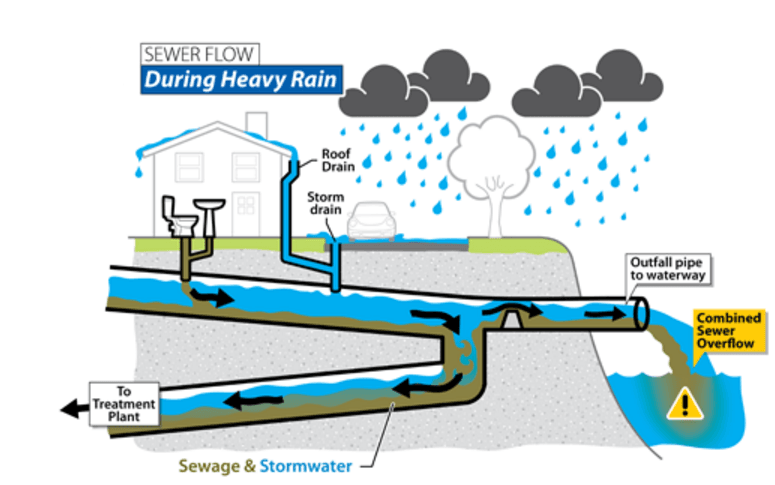
Robert Buxbaum, June 5, 2016. I’m running for water commissioner. I’d like to see my skilled sewer workers rewarded for their work and skill. Currently experienced workers get only $18/hour and that’s too little for their expertise. If they took off, they’d be irreplaceable, and the city would likely fall to typhus or the plague.

Of horses, trucks, and horsepower

Horsepower is a unit of work production rate, about 3/4 of a kW, for those who like standard international units. It is also the pulling force of a work horse of the 1700s times its speed when pulling, perhaps 5 mph. A standard truck will develop 200 hp but only while accelerating at about 60 mph; to develop those same 200 horsepower at 1 mph it would have to pull with 200 times more force. That is impossible for a truck, both because of traction limitations and because of the nature of a gasoline engine when attached to typical gearing. At low speed, 1 mph, a truck will barely develop as much force as 4-5 horses, suggesting a work output about 1 hp. This is especially true for a truck pulling in the snow, as shown in the video below.

Here, a semi-truck (of milk) is being pulled out of the snow by a team of horses going perhaps 1 mph. The majority of work is done by the horse on the left — the others seem to be slipping. Assuming that the four horses manage to develop 1 hp each (4 hp total), the pull force is four times a truck at 1 mph, or as great as a 200 hp truck accelerating at 50 mph. That’s why the horse succeed where the truck does not.

You will find other videos on the internet showing that horses produce more force or hp than trucks or tractors. They always do so at low speeds. A horse will also beat a truck or car in acceleration to about the 1/4 mile mark. That’s because acceleration =force /mass: a = F/m.

I should mention that DC electric motors also, like horses, produce their highest force at very low speeds, but unlike horses, their efficiency is very low there. Electric engine efficiency is high only at speeds quite near the maximum and their horse-power output (force times speed) is at a maximum at about 1/2 the maximum speed.

Steam engines (I like steam engines) produce about the same force at all speeds, and more-or-less the same efficiency at all speeds. That efficiency is typically only about 20%, about that of a horse, but the feed cost and maintenance cost is far lower. A steam engine will eat coal, while a horse must eat oats.

March 4, 2016. Robert Buxbaum, an engineer, runs REB Research, and is running for water commissioner.

The Parker house waitstaff hates you

There are many offensive Americans, but perhaps the most offensive must be those who eat at the famous Parker House restaurant, Boston; see photo taken by a friend of mine, historian Jim Wald. Parker House is the home of Parker House rolls and Boston Cream Pie. It’s also famous for its customers: e.g. the Saturday club of Emerson, Longfellow, Holmes, Agassiz, Dana, and Charles Dickens (Dickens lived in the Parker Hotel for two years). But more remarkable still is that a good number of the staff have so hated their customers that they went off and became revolutionary enemies of all things capitalist and American. And it only took a few months working at the Parker House.

The Parker House restaurant, Dec. 2015, photo by jim Wald, perhaps showing the next world leader.

Among Parker House employees we find Malcolm X, he worked as a busboy under his original, given name: Malcolm Little. We also find Ho Chi Minh, a pseudonym taken — it means, the enlightened one or the one who will enlighten (strangely enough, Genghis Kahn also means the enlightened one — in Mongol) was a pastry chef. he arrived in Boston as a ships cook, and worked in the hotel as Nguyen Cung. After Boston, he moved to Paris where he again made cakes and pies but changed his name to Nguyen O Phap (Nguyen who hates the French). Eventually, he and Malcolm X revolted against America and managed to turn the tables, as it were, on their customers.

Why do Parker House workers go off this way. Perhaps it’s because the hotel tries to hire hard-working, intelligent workers. You’ll notice, in the photo above that the waiters look at least as sharp as the customers and more physically fit. Beyond this, I suspect that the waitstaff are constantly exposed to socialist discussions from the customers. They are then sent off for coffee, or ignored, or perhaps insulted or groped, or not tipped. The Hotel seems to attract liberal libertarians — it was a favorite spot for John F. Kennedy.

My guess is that Malcolm X and Ho Chi Minh became socialist revolutionaries because of what they experienced from the customers at Parker House. So what can you do if you eat at Parker House, or any fancy restaurant? I think it pays to tip. Don’t do it in a way that makes your server feel like a beggar. It would help to chat too, I think. It’s important if your waiter is homicidal — or if your waiter becomes famous some day, or writes a book, or becomes a world dictator. You’d like to get a positive mention in that book, or have a positive story to tell — “I gave Genghis his first $10 bill…” And tipping is important so he/she doesn’t hate you. I’m given to understand that one main reasons people hate Satan so much is you can serve him, but he never tips.

Robert Buxbaum, February 29, 2016, updated August 24, 2017. I run REB Research, and I’m running for drain commissioner. Vote for me.

Michigan, an emerging economy

Between 2009 and 2014, Michigan’s per-capita GDP grew at 14% per year, an amazing growth rate similar to that of an emerging, tiger economies. According tot the Bureau of Economic analysis, the only US states that grew faster were Texas and North Dakota, and these oil states were hit badly in the current year 2015-16.
GDPGROWTH


Unfortunately, Michigan remains relatively poor despite it’s growth. Its per-capita GDP, $20,263 (2016), lags behind even perennial backwaters like Vermont, Oklahoma, and Missouri. The wealth gap in Michigan is growing, as in an emerging economy, and the cities, e.g. Detroit and Flint, are known for high murder rates, and a large-scale bankruptcy.

Michigan population change, Detroit Free Press

Michigan population change, Detroit Free Press

Then there’s pollution and flooding. Our beaches close for e-coli after every major rain, and we recently found that the drinking water in Flint was contaminated with lead; it seems other MI cities have lead problems too. Add to this, that we’ve  had major floods, a result of mismanagement, cronyism, and rampant growth, and Michigan keeps looking more and more like Vietnam, China, and India.

Everything here isn’t third world, though. We replaced our hapless, ex-governor Granholm with a relatively competent (in my opinion) nerd, Rick Snyder. We’ve jailed the of worst crooks, e.g. Detroit’s walking-crime-wave mayor, Kwame Kilpatrick, and his father, “Pay-for-play”, and the corrupt city manager, Bobby Ferguson. Under the previous administration, the state population shrank. It is now growing slowly.

Flood of 2014; the view at 696 and Mound rd. It's just incompetence.

Flood of 2014; the view at 696 and Mound rd. It’s part incompetence and part growth.


We passed a needed roads bill. Taxes are high, but not as bad as Illinois, and even Detroit is beginning to look good, at least in the center city. Industry is coming back, and so is Michigan real-estate. Here are some of my ideas going forward: pay our teachers well, and don’t imprison for so long. Some ideas to keep us on the upswing.

Robert Buxbaum, February 23, 2016. I’m running to be the Oakland county water commissioner, by the way.

Advanced windmills + 20 years = field of junk

Everything wears out. This can be a comforting or a depressing thought, but it’s a truth. No old mistake, however egregious, lasts forever, and no bold advance avoids decay. At best, last year’s advance will pay for itself with interest, will wear out gracefully, and will be recalled fondly by aficionados after it’s replaced by something better. Water wheels, and early steamships are examples of this type of bold advance. Unfortunately, it is often the case that last years innovation turns out to be no advance at all: a technological dead end that never pays for itself, and becomes a dangerous, rotting eyesore or worse, a laughing-stock blot or a blot on the ecology. Our first two generations of advanced windmill farms seem to match this description; perhaps the next generation will be better, but here are some thoughts on lessons learned from the existing fields of rotting windmills.

The ancient design windmills of Don Quixote’s Spain (1300?) were boons. Farmers used them to grind grain or cut wood, and to to pump drinking water. Holland used similar early windmills to drain their land. So several American presidents came to believe advanced design windmills would be similar boons if used for continuous electric power generation. It didn’t work, and many of the problems could have been seen at the start. While the farmer didn’t care when his water was pumped, or when his wood is cut. When you’re generating electricity, there is a need to match the power demand exactly. Whenever the customer turns on the switch, electricity is expected to flow at the appropriate amount of Wattage; at other times any power generated is a waste or a nuisance. But electric generator-windmills do not produce power on demand, they produce power when the wind blows. The mismatch of wind and electric demand has bedeviled windmill reliability and economic return. It will likely continue to do so until we find a good way to store electric power cheaply. Until then windmills will not be able to produce electricity at competitive prices to compete with cheap coal and nuclear power.

There is also the problem of repair. The old windmills of Holland still turn a century later because they were relatively robust, and relatively easy to maintain. The modern windmills of the US stand much taller and move much faster. They are often hit, and damaged by lightning strikes, and their fast-turning gears tend to wear out fast, Once damaged, modern windmills are not readily fix, They are made of advanced fiberglass materials spun on special molds. Worse yet, they are constructed in mountainous, remote locations. Such blades can not be replaces by amateurs, and even the gears are not readily accessed to repair. More than half of the great power-windmills built in the last 35 years have worn out and are unlikely to ever get repair. Driving past, you see fields of them sitting idle; the ones still turning look like they will wear out soon. The companies that made and installed these behemoth are mostly out of the business, so there is no-one there to take them down even if there were an economic incentive to do so. Even where a company is found to fix the old windmills, no one would as there is not sufficient economic return — the electricity is worth less than the repair.

Komoa Wind Farm in Kona, Hawaii June 2010; Friends of Grand Ronde Valley.

Komoa Wind Farm in Kona, Hawaii, June 2010; A field of modern design wind-turbines already ruined by wear, wind, and lightning. — Friends of Grand Ronde Valley.

A single rusting windmill would be bad enough, but modern wind turbines were put up as wind farms with nominal power production targeted to match the output of small coal-fired generators. These wind farms require a lot of area,  covering many square miles along some of the most beautiful mountain ranges and ridges — places chosen because the wind was strong

Putting up these massive farms of windmills lead to a situation where the government had pay for construction of the project, and often where the government provided the land. This, generous spending gives the taxpayer the risk, and often a political gain — generally to a contributor. But there is very little political gain in paying for the repair or removal of the windmills. And since the electricity value is less than the repair cost, the owners (friends of the politician) generally leave the broken hulks to sit and rot. Politicians don’t like to pay to fix their past mistakes as it undermines their next boondoggle, suggesting it will someday rust apart without ever paying for itself.

So what can be done. I wish I could suggest less arrogance and political corruption, but I see no way to achieve that, as the poet wrote about Ozymandias (Ramses II) and his disastrous building projects, the leader inevitably believes: “I am Ozymandias, king of kings; look on my works ye mighty and despair.” So I’ll propose some other, less ambitious ideas. For one, smaller demonstration projects closer to the customer. First see if a single windmill pays for itself, and only then build a second. Also, electricity storage is absolutely key. I think it is worthwhile to store excess wind power as hydrogen (hydrogen storage is far cheaper than batteries), and the thermodynamics are not bad

Robert E. Buxbaum, January 3, 2016. These comments are not entirely altruistic. I own a company that makes hydrogen generators and hydrogen purifiers. If the government were to take my suggestions I would benefit.

Cross of gold democrats

While it is dangerous to paint a large organization like the Democratic party with a single, broad brush, there are always patterns that appear, in this case in every presidential platform for a century. Beginning in the late 1800s when the Democratic party gave up on slavery, a stated goal of every Democratic platform has been to help the poor and downtrodden. Republicans claim to help too, but claim to target the worthy. For Democrats, by contrast, the common aim is to provide help without reference to individual worth or work — to help just because the individual needs it. All versions of this classic Democratic goal are achieved through forms of wealth redistribution: taking from the rich to give to the poor, Robin Hood style, at least temporarily. There is some inherent tension here: if the recipient can get free money without working, why would he work — a tension that some find insulting, but others accept as part of the comic nature of society. Many Americans accept that helping poor people is such a worthy goal that they knowingly accept the tension and cheating.

Mayor Quimba of Springfield (from the Simpsons). A classical Democrat, his motto: Corrupts in Extremus

Mayor Quimby of Springfield (from the Simpsons) is a classical Democrat, he has no morals beyond, ‘whatever the public wants’. Quimby is corrupt and an awful manager, but quite likable.

Extracting money from the rich always proves difficult: the rich generally object. The most direct way to extract money is taxation, but Democratic politicians, like Mayor Quimby, right try to shy from this to avoid being branded “tax and spend Democrats.” This year, Bernie Sanders has taken this line, proposing to raise the tax rate on the wealthy to 90% of income so he can do good for the poor and curb the power of rich Republicans. He has no problem with rich Democrats like Ms. Clinton, or perhaps he does, but doesn’t say so. In Britain, under Attlee, the tax rate was raised to 95%, a rate memorialized in The Beatles song “Taxman” (there one for you nineteen for me; 19/20 = 95%). Americans oscillate between accepting high tax rates and acknowledging that the worker and creative must be able to keep most of his/her earnings or he/she will stop working.

Every few years recipient Americans revolt against the way redistribution makes rich Democrats richer, and how high taxes seem to go with crony corruption. The motto of The Simpson’s Mayor Quimby is “corruptus in extremus”, a nod to the observation of how corruption in redistribution favors friends and family of those redistributing the wealth. Redistribution also tends to create poverty. This happened in England, for example. As Quimby says: “I propose that I use what’s left of the town treasury to move to a more prosperous town and run for mayor. And, er, once elected I’ll send for you.”

An alternative many Democrats favor is to print money or borrow it. This appears to be Ms Clinton’s approach, and was proposed famously in the “cross of gold” speech of William Jennings Brian in 1896.  In this speech, one of the finest in American history, Bryan (an unknown until then) proposed to monetize silver and other assets, allowing him to print money. He would spend the money on the poor by debasing the currency, that is by inflation. Bryan claimed that the rich were anyway sitting on unused money: a useless, dangerous pile that he’d inflate away. He also claimed that the poor are the ones who owe money, a burden that he would wipe out with inflation. Bryan’s final line is immortal: “you shall not press down on the people this crown of thorns, you shall not crucify the nation on a cross of gold.” The speech managed to combine God and greed and was an enormous success. Following the speech there was stunned silence, and then whoops and hollers. Bryan was carried around the convention for an hour before being chosen the Democratic candidate for president in 1896, 1900, and 1908. His speech has appeared, to a greater or lesser extent, in the platform of every Democratic candidate since with a greater or lesser reference to God depending on the conservatism of the speaker.

Donald Trump currently the front runner for GOP president reads to his grand-daughter Chloe from that Christmas classic, 'winners aren't lots.' photo by Donald Trump, jr (Chloe's Dad) aboard their car (?) plane (?).

Donald Trump currently the front-runner for GOP president reads to his grand-daughter, Chloe from ‘winners aren’t losers.’ photo by Donald Trump, jr., Chloe’s Dad. Trump seems to revel in the lovable, rich jerk persona as no Liberal or Democrat could.

Republicans have traditionally supported property rights and harder money: gold in the old days, a balanced budget today. They claim that low inflation is good for the rich and poor alike, and especially for the small businessman. Entrepreneurs are pictured as more virtuous than the idle, wastrel Democrats. Free money, the Republicans note, discourages work. Of course, distinguishing worthy from wastrel is easier said than done. Republicans are accused of being uncharitable, and of helping the idle rich once they get into office. Presidential candidate, Donald Trump claimed that until now he’d give big donations to candidates of the left and right so they would repay the favor with interest at a later date. No one knows if it will change when he gets in office, but so far he’s avoided the major rich donors. He’s doing well running as a lovable, rich, jerk who’d do things different.

Inflation is a dangerous mistress, the middle class generally doesn’t like the way it wipes out debts and savings, while supporting a class of rich wastrels, drunks and the chronically unemployed. Many of the poor and middle class save, while the rich tend to build up debts. The rich have better credit ratings than the poor, and thus borrow more. They are also better positioned to increase their borrowing if they think inflation is coming. The money they borrow is invested in hard assets: land, homes, and businesses. When inflation slows, they can sell these assets. And if they pick wrong, the government bails them out!. William Jennings Bryan lost all three of his runs at the presidency, twice to McKinley and once to William H. Taft, who stood for doing nothing.

William Jennings Bryan: for inflation and silver; against alcohol. Lost twice to McKinley and gold.

William Jennings Bryan: for inflation and silver; against alcohol. Lost twice to McKinley and gold.

I think the American people want a balance in all things. They want a balance between helping everyone, and helping only the deserving; between high taxes to help folks, and allowing folks to keep their wealth. They don’t quite know where to draw the line, and will even help the wastrels, even those who refuse to work, because they don’t want them starving in the street. They also seem to accept rich folks getting richer, especially when a big project is needed — a ship or a bridge, for example. We elect an alternating mix of Democrats and Republicans; conservatives, and liberals to avoid false paradoxes, achieve some liberty, and establish one of the richest states known.

As for me, you might as well know, I’m a liberal Republican. I favor low income taxes, but some welfare; taxing imports (tariffs), and low inflation –“bread currency,” I like Peter Cooper, and the Greenback Party, 1876. Cooper claimed that the dollar should always have the same value “for the same reason that the foot should always have 12 inches and the pound 16 ounces.” I also think enforcing morality is a job for preachers, not politicians. For 160 years students of Peter Cooper’s union were getting a free college education and I’m one of those engineering students, see my biography of Peter Cooper.

Robert E. Buxbaum, December 30, 2015. See my view of Scrooge’s economic education in the Christmas Carol.

State bird suggestion: the turkey

state bird stamps; robin cardinal

three US states use the (american) robin as their state bird, and 7 more use the (northern) cardinal. None use the turkey

As things now stand, three states of the union, including Michigan have the robin as their state bird. Another seven have the cardinal. Not that they have different species of robin or cardinal, they use the same species: the American robin, and the Northern cardinal respectively.

A thought I’ve had is that Michigan should change to have a unique bird symbol, and I propose the turkey, in particular the eastern wild turkey shown below. The robin is found in every state of the union except for Hawaii, and is found in several countries, it’s associated with Robin Hood, and with Batman’s side-kick. By contrast, the eastern wild turkey could be a unique state symbol. It’s basically found in no other country besides the US, and found in only a few US states including Michigan.

Eastern Wild Turkey. A majestic bird, and brave Maximum height: 4 foot.

Eastern Wild Turkey. A majestic bird, and brave. Maximum height: 4 foot.

The eastern wild turkey is a far more impressive bird than the cardinal or robin. Full grown, it stands 4 foot tall. Benjamin Franklin claimed to have preferred the turkey (likely the eastern wild turkey) to the eagle as the national bird of the US. In this wonderful letter to his daughter, Sarah, he says that it is a noble bird, useful and the source of sustenance. He also claims it is unafraid to attack a British regimen, claims that also appears in this song, “the egg” in the play/movie 1776. The turkey most definitely provided food for the Indians, for the early European settlers, and still provides for Michigan hunters to this day. Further, turkey feathers are the preferred choice for quill pens. They are used for scribes writing holy works, like copies of the Torah, and it is likely they were used for the declaration of Independence. The same history and associations can not be claimed for the robins or the cardinal. Those birds are basically attractive, and nothing else.

Not that attractive is bad, nor is it bd to have a state bird associated with Batman’s side-kick, or with a Saint Louis baseball team, but I don’t think either is particularly appropriate for Michigan. Not that there are no disadvantages to the name turkey: (1) it might suggest a slow individual or project, and (2) Wild Turkey is the name of a Tennessee bourbon whiskey. Neither of these are quite a bad as being a sidekick to the bat, or to the batman, and I think both are addressed by specifying that the state bird is the eastern wild turkey, and not just some random variety. What say ye, citizens of Michigan? Let’s do it before someone else takes the turkey.

Robert Buxbaum, December 16, 2015.

Flat tax countries: Russia, Mongolia, Hungary

For no obvious reason, many Republicans and some (few) Democrats are fans of the flat tax. That is a fixed percentage tax on every dollar earned with no deductions, or very few. They see the flat tax as better, or more fair, than the progressive, graduated tax found in the US and most industrial countries. While most Republicans don’t like high taxes, as in Sweden, France, or in the UK, the flat-taxers want a single tax rate: a constant percentage for all. A common version is what Ben Carson described earlier this month, “if you earn ten million dollars your tax will be one million; if you earn ten dollars, your tax will be one dollar.” Herman Caine (R) proposed something similar eight years ago, and (surprisingly) so did Jerry Brown (D).

Ben Carson proposes a 10% flat tax. I'm guessing his source is the Bible.

Ben Carson proposes a 10% flat tax.

As it happens, of the 230 nations on the planet, several already have a flat income tax, and none of them are industrial juggernauts. I will list the larger of these countries in order their tax rate: Mongolia and Kazakhstan, 10% flat tax and hardly any services; Russia and Bolivia, 13% flat tax: moribund, raw-material-based, police-states; Romania and Hungary 16%; Lithuania and Georgia 20%; Zambia 22%; Switzerland, 35% when you include the Cantonal and municipal flat rates, and (topping the list) Greenland at 45%. Not one of these is a productive, industrial powerhouse, like the US, and there is no indication that this will change any time soon.

I suspect that the flat tax enters the minds of conservatives from the Bible, from the 10% of grain that was given to the Levites (Numb. 18:24), and the second 10% eaten of pilgrimage festivals or given to the poor (Deut. 14:22-24). If that’s the source, let me suggest a better modern version is to give out cans of food, or to support ones church. But as a model for government finance, I’d suggest it’s best to leave more in the pockets of the poor, and tax more from the rich. Even in Biblical times, the government (king) levied a substantial tax above the 10%s described above.

A measure of tax rate is the percentage of the total GDP that goes to taxes. As things go, our tax rate isn't particularly high.

A measure of tax rate is the percentage of the total GDP that goes to taxes. As things go, our tax rate isn’t particularly high.

A flat tax does not necessarily imply a low tax, either. Greenland’s flat 45% rate is among the highest in the world, and Israel had a 50% flat tax until fairly recently. It’s also worth noting that personal income isn’t the only thing one can tax. Several countries combine moderate personal income rates with high corporate rates (Venezuela, Zambia, Argentina), or add on a high sales tax, or a transaction tax. Herman Caine’s 9-9-9 tax plan included a 9% transaction tax and a 9% federal sales tax that would have gone on top of whatever the state tax would have been. The revenue collected by the 9-9-9 plan would have been no less than we had, but would be, he claimed, simpler. Cain’s flat tax wasn’t even really flat either, as there was an exclusion, an income level below which you were taxed 0%. That is, he was really proposing a two tier system, with a 0% rate at the first tier. Rand Paul seems to favor something similar today.

The two advantages of a flat tax are simplicity, and that it reins in the tendency to tax the rich too much, a tendency found with many liberal alternatives. The maximum tax rate was 95% in England under Attlee. Their 95% tax-rate appears in the Beetles’s song, Mr Taxman: “…There’s one for you, nineteen for me; ‘Cause I’m the Taxman.” High rates like this caused the destruction of many UK businesses, and caused The Beetles’s to leave and reincorporate in the Cayman Islands. Bernie Sanders recently proposed a top rate that was nearly as high, 90%, and praised Denmark (60% maximum rate) for its high social services. Sorry to say, Denmark seems to have concluded that their 60% maximum was excessive, and earlier this year reduced their maximum to 47.794%. This is below the maximum US rate if you include New York state and city income taxes. History suggests that if you tax the rich at rates like this, they leave or do other socially unacceptable things, like go black-market. On the other hand, if you tax too little, there is no money for education or basic social services, e.g. for the desperately poor. At one point, I proposed the following version of graduated to negative scheme that manages to provide a floor, a non-excessive top rate, and manages to encourage work at every income level (I’m rather proud of it). And there are other key issues necessary for success, like respect for law, and not having excessive minimum wages or other excess regulations.

Bernie Sanders: tax the rich at 90% of income.

Bernie Sanders: tax the rich at 90%; I doubt this is a good idea.

Whatever the tax structure is, there is probably an optimal average rate and an optimal size for the government sector. I suspect ours is near optimal, but have no real reason to think so (probably just nativism). I’ve found that comparing the US tax rates to other countries’ is very difficult, too. Most countries have a substantial Value Added Tax (VAT), that is a tax applied to all purchases including labor, but we do not. Some countries have import taxes (Tariffs, I’m in favor of them), while we have hardly any. And many countries tax corporate profits (and sales) at rates above 60% (France taxes them at 66.6%). To make any sort-of comparison, I’ve divided the total tax income of several countries by the country’s GDP (I got my data here). This percent is shown in the chart above. The US looks pretty average, though a little on the low side for an industrial nation: just where I like to see it.

Robert E. Buxbaum, November 29, 2015. I imagine myself to be a centrist, since all of my opinions make sense to me. When I change my mind on something, I stay at the center, but the center moves. If this subject interests you,  seems to have dedicated his life to following the flat tax.

Is cannibal tourism good for Michigan?

Governor Snyder has no appetite for it, but ex-governor Jennifer Granholm did, and some of her Democratic colleagues still do. Not cannibal tourism, as such, but movie subsidies paid for by a tax on business property independent of profits. Some seven years ago, in 2008, then-governor Granholm and a majority of our legislature instituted a $132 million/year subsidy program that provided up to 42% of movie production costs. The hope was that films would bring Hollywood-type wealth and glamor, and that they would spark tourism. As it happened, the jobs went to Hollywood transients to such an extent that the total number of MI film employees was reduced. It is now 100 lower than at the start, and virtually all of the money spent went to out-of state employees (quite often the high-priced star) who left as soon as the filming was done. The report concluded that the program returned 11¢ for every tax dollar spent. One of Governor Snyder’s first acts was to diminish the subsidies, and the legislature has just put an end to them: revenge of the nerd.

Offspring, filmed in Michigan. It does not seem to have promoted Michigan tourism.

Offspring: no jobs created, and perhaps no tourism … but think of the cool factor.

The amount spent in the early years, $132 million/year, was about 1/3 of the state’s deficit, a major misuse of funds. Reason magazine claimed it was “stone-crazy” to support movies when the state had, at the time, 14% unemployment, the highest rate in the nation. They argued that the money could be better spent on roads, or schools, or left in folks’ pockets (I agree).

The effect on tourism isn’t quite what was hoped. Movie makers tend to see Michigan as a setting for dystopian films, for example, “Offspring,” a film about cannibal tourism. This film got one of the largest state subsidies. A plot summary is:  “Survivors of a feral flesh-eating clan are chowing their way through the locals.” If this encouraged tourism, it’s not necessarily the tourists you wanted. You can tell it’s Michigan by the Michigan symbol on the police cars. Michigan funds also brought two Batman movies to Detroit, along with Michael Moor’s “Capitalism, a love story“, a  movie billed as showing how capitalism makes life in America a nightmare. The current head of the film board has noted that “realistic cannibalism; the gruesome and graphically violent depiction …. is unlikely to promote tourism in Michigan or to present or reflect Michigan in a positive light.” I can agree.

Batman and Superman in Detroit.

“Batman vs Superman.” They battle in Downtown Detroit, as do “Red Dawn” and “Transformers.”

Opposition to dropping the program came mostly from the Democratic side of the aisle. Rep. Jeremy Moss, D-Southfield, said the film incentives were creating good jobs. Rep. Kristy Pagan, D-Canton, pointed to “… the cool factor. Who doesn’t want to see Ben Affleck or Amy Adams walk down our streets?” (I don’t). In the end, three Democrats and virtually every Republican voted to end the program. Among the Republicans for keeping the program were Kathy Crawford R-Novi, and Mike McCready, R-Birmingham.

You should not feel too bad for the makers of gore films. Subsides are still available in Massachusetts, Oregon, Washington, California, Minnesota, Nevada, and several other states. Massachusetts welcomed Part 2 of The Offspring, a Massachusetts headline proclaimed the victory: “Come to Massachusetts, We Love Cannibals!” Massachusetts folks have been full of themselves for years. As for the money we saved, our Michigan legislature has finally begun balancing the budget and decreasing the destructive personal property tax that helped fund these schemes.

Robert E. Buxbaum, November 5, 2015. I should also commend the legislature for making “talk like a pirate day” a state holiday, and for passing, on November 3, a necessary roads bill. It was signed by most Republicans and two Democrats. Bipartisan-ish. With good management, Michigan might be coming back – lets hope it continues.