Author Archives: R.E. Buxbaum

About R.E. Buxbaum

Robert Buxbaum is a life-long engineer, a product of New York's Brooklyn Technical High School, New York's Cooper Union to Science and Art, and Princeton University where he got a PhD in Chemical Engineering. From 1981 to 1991 he was a professor of Chemical Engineering at Michigan State, and now runs an engineering shop in Oak Park, outside of Detroit, Michigan. REB Research manufactures and sells hydrogen generation and purification equipment. He's married with 3 wonderful children who, he's told, would prefer to not be mentioned except by way of complete, unadulterated compliments. As of 2016, he's running to be the drain commissioner/ water resources commissioner of Oakland county.

The Parker house waitstaff hates you

There are many offensive Americans, but perhaps the most offensive must be those who eat at the famous Parker House restaurant, Boston; see photo taken by a friend of mine, historian Jim Wald. Parker House is the home of Parker House rolls and Boston Cream Pie. It’s also famous for its customers: e.g. the Saturday club of Emerson, Longfellow, Holmes, Agassiz, Dana, and Charles Dickens (Dickens lived in the Parker Hotel for two years). But more remarkable still is that a good number of the staff have so hated their customers that they went off and became revolutionary enemies of all things capitalist and American. And it only took a few months working at the Parker House.

The Parker House restaurant, Dec. 2015, photo by jim Wald, perhaps showing the next world leader.

Among Parker House employees we find Malcolm X, he worked as a busboy under his original, given name: Malcolm Little. We also find Ho Chi Minh, a pseudonym taken — it means, the enlightened one or the one who will enlighten (strangely enough, Genghis Kahn also means the enlightened one — in Mongol) was a pastry chef. he arrived in Boston as a ships cook, and worked in the hotel as Nguyen Cung. After Boston, he moved to Paris where he again made cakes and pies but changed his name to Nguyen O Phap (Nguyen who hates the French). Eventually, he and Malcolm X revolted against America and managed to turn the tables, as it were, on their customers.

Why do Parker House workers go off this way. Perhaps it’s because the hotel tries to hire hard-working, intelligent workers. You’ll notice, in the photo above that the waiters look at least as sharp as the customers and more physically fit. Beyond this, I suspect that the waitstaff are constantly exposed to socialist discussions from the customers. They are then sent off for coffee, or ignored, or perhaps insulted or groped, or not tipped. The Hotel seems to attract liberal libertarians — it was a favorite spot for John F. Kennedy.

My guess is that Malcolm X and Ho Chi Minh became socialist revolutionaries because of what they experienced from the customers at Parker House. So what can you do if you eat at Parker House, or any fancy restaurant? I think it pays to tip. Don’t do it in a way that makes your server feel like a beggar. It would help to chat too, I think. It’s important if your waiter is homicidal — or if your waiter becomes famous some day, or writes a book, or becomes a world dictator. You’d like to get a positive mention in that book, or have a positive story to tell — “I gave Genghis his first $10 bill…” And tipping is important so he/she doesn’t hate you. I’m given to understand that one main reasons people hate Satan so much is you can serve him, but he never tips.

Robert Buxbaum, February 29, 2016, updated August 24, 2017. I run REB Research, and I’m running for drain commissioner. Vote for me.

Michigan, an emerging economy

Between 2009 and 2014, Michigan’s per-capita GDP grew at 14% per year, an amazing growth rate similar to that of an emerging, tiger economies. According tot the Bureau of Economic analysis, the only US states that grew faster were Texas and North Dakota, and these oil states were hit badly in the current year 2015-16.
GDPGROWTH


Unfortunately, Michigan remains relatively poor despite it’s growth. Its per-capita GDP, $20,263 (2016), lags behind even perennial backwaters like Vermont, Oklahoma, and Missouri. The wealth gap in Michigan is growing, as in an emerging economy, and the cities, e.g. Detroit and Flint, are known for high murder rates, and a large-scale bankruptcy.

Michigan population change, Detroit Free Press

Michigan population change, Detroit Free Press

Then there’s pollution and flooding. Our beaches close for e-coli after every major rain, and we recently found that the drinking water in Flint was contaminated with lead; it seems other MI cities have lead problems too. Add to this, that we’ve  had major floods, a result of mismanagement, cronyism, and rampant growth, and Michigan keeps looking more and more like Vietnam, China, and India.

Everything here isn’t third world, though. We replaced our hapless, ex-governor Granholm with a relatively competent (in my opinion) nerd, Rick Snyder. We’ve jailed the of worst crooks, e.g. Detroit’s walking-crime-wave mayor, Kwame Kilpatrick, and his father, “Pay-for-play”, and the corrupt city manager, Bobby Ferguson. Under the previous administration, the state population shrank. It is now growing slowly.

Flood of 2014; the view at 696 and Mound rd. It's just incompetence.

Flood of 2014; the view at 696 and Mound rd. It’s part incompetence and part growth.


We passed a needed roads bill. Taxes are high, but not as bad as Illinois, and even Detroit is beginning to look good, at least in the center city. Industry is coming back, and so is Michigan real-estate. Here are some of my ideas going forward: pay our teachers well, and don’t imprison for so long. Some ideas to keep us on the upswing.

Robert Buxbaum, February 23, 2016. I’m running to be the Oakland county water commissioner, by the way.

Ginsberg poem about Bernie Sanders

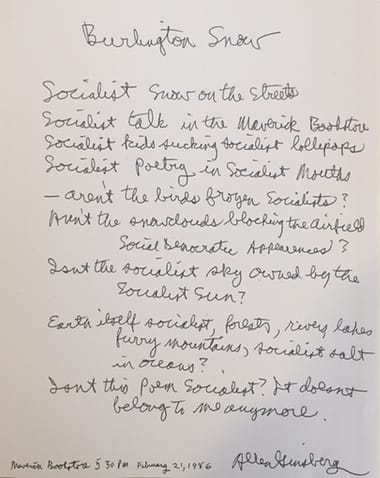
It’s 30 years to the day since Alan Ginsberg wrote “Burlington Snow” a poem inspired by Bernie Sanders, the socialist mayor of Burlington Vermont. It’s a snapshot of the wonder and contradiction of socialist government. And now Bernie is running for president.

Birlington Snows, April 24, 1996

Burlington Snow, February 21, 1996 by Alan Ginsburg.

“Socialist snow on the streets. Socialist talk in the Maverick Bookstore. Socialist kids sucking socialist lollipops. Socialist poetry in socialist mouths — aren’t the birds frozen socialists? Aren’t the snow clouds blocking the airfield social bureaucratic apprentices? Isn’t the socialist sky owned by the socialist sun? Earth itself socialist, forests rivers, lakes, furry mountains, socialist salt in oceans? Isn’t this Poem socialist? It doesn’t belong to me anymore.”

Dr. Robert Buxbaum, February 21, 2016. If anyone would write a poem about me, or water commissioner (I’m running) or pollution or drinking water, or anything like that, I’d be awfully honored. It doesn’t have to be complimentary, or even particularly good.

New REB hydrogen generator for car fueling, etc.

One of my favorite invention ideas, one that I’ve tried to get the DoE to fund, is a membrane hydrogen generator where the waste gas is burnt to heat the reactor. The result should be exceptional efficiency, low-cost, low pollution, and less infrastructure needs. Having failed to interest the government, I’ve gone and built one on my own dime. That’s me on the left, with Shua Spirka, holding the new core module (reactor, boiler, purifier and purifier) sized for personal car fueling.

Me and Shua and our new hydrogen generator core

Me and Shua and our new hydrogen generator core

The core just arrived from the shop last week, now we have to pumps and heat exchangers. As with our current products, the hydrogen is generated from methanol water, and extracted 99.99999% pure by diffusion through a metal membrane. This core fit in a heat transfer pot (see lower right) and the pot sits on a burner for the waste gas. Control is tricky, but I think I’ve got it. If it all works like it’s supposed to, the combination should be 80-90% energy-efficient, delivering about 75 slpm, 9 kg per day. That’s the same output as our largest current electrically heated generators, with a much lower infrastructure cost. The output should be enough to fuel one hydrogen-powered automobile per day, or keep a small fleet of plug-in, hydrogen-hybrids running continuously.

Hydrogen automobiles have a lot of advantages over Tesla-type electric automobiles. I’ll tell you how the thing works as soon as we set it up and test it. Right now, we’ve got other customers and other products to make.

Robert Buxbaum, February 18, 2016. If someone could supply a good hydrogen compressor, and a good fuel cell, that would be most welcome. Someone who can supply that will be able to ride in a really excellent cart of the future at this year’s July 4th parade.

Alcohol and gasoline don’t mix in the cold

One of the worst ideas to come out of the Iowa caucuses, I thought, was Ted Cruz claiming he’d allow farmers to blend as much alcohol into their gasoline as they liked. While this may have sounded good in Iowa, and while it’s consistent with his non-regulation theme, it’s horribly bad engineering.

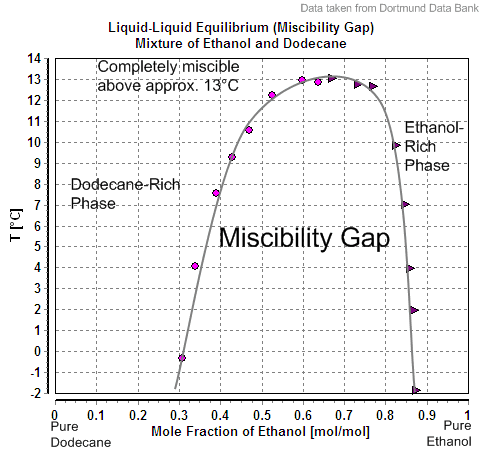
At low temperatures ethanol and gasoline are no longer quite miscible

Ethanol and gasoline are that miscible at temperatures below freezing, 0°C. The tendency is greater if the ethanol is wet or the gasoline contains benzenes

We add alcohol to gasoline, not to save money, mostly, but so that farmers will produce excess so we’ll have secure food for wartime or famine — or so I understand it. But the government only allows 10% alcohol in the blend because alcohol and gasoline don’t mix well when it’s cold. You may notice, even with the 10% mixture we use, that your car starts poorly on the coldest winter days. The engine turns over and almost catches, but dies. A major reason is that the alcohol separates from the rest of the gasoline. The concentrated alcohol layer screws up combustion because alcohol doesn’t burn all that well. With Cruz’s higher alcohol allowance, you’d get separation more often, at temperatures as high as 13°C (55°F) for a 65 mol percent mix, see chart at right. Things get worse yet if the gasoline gets wet, or contains benzene. Gasoline blending is complex stuff: something the average joe should not do.

Solubility of dry alcohol (ethanol) in gasoline. The solubility is worse at low temperature and if the gasoline is wet or aromatic.

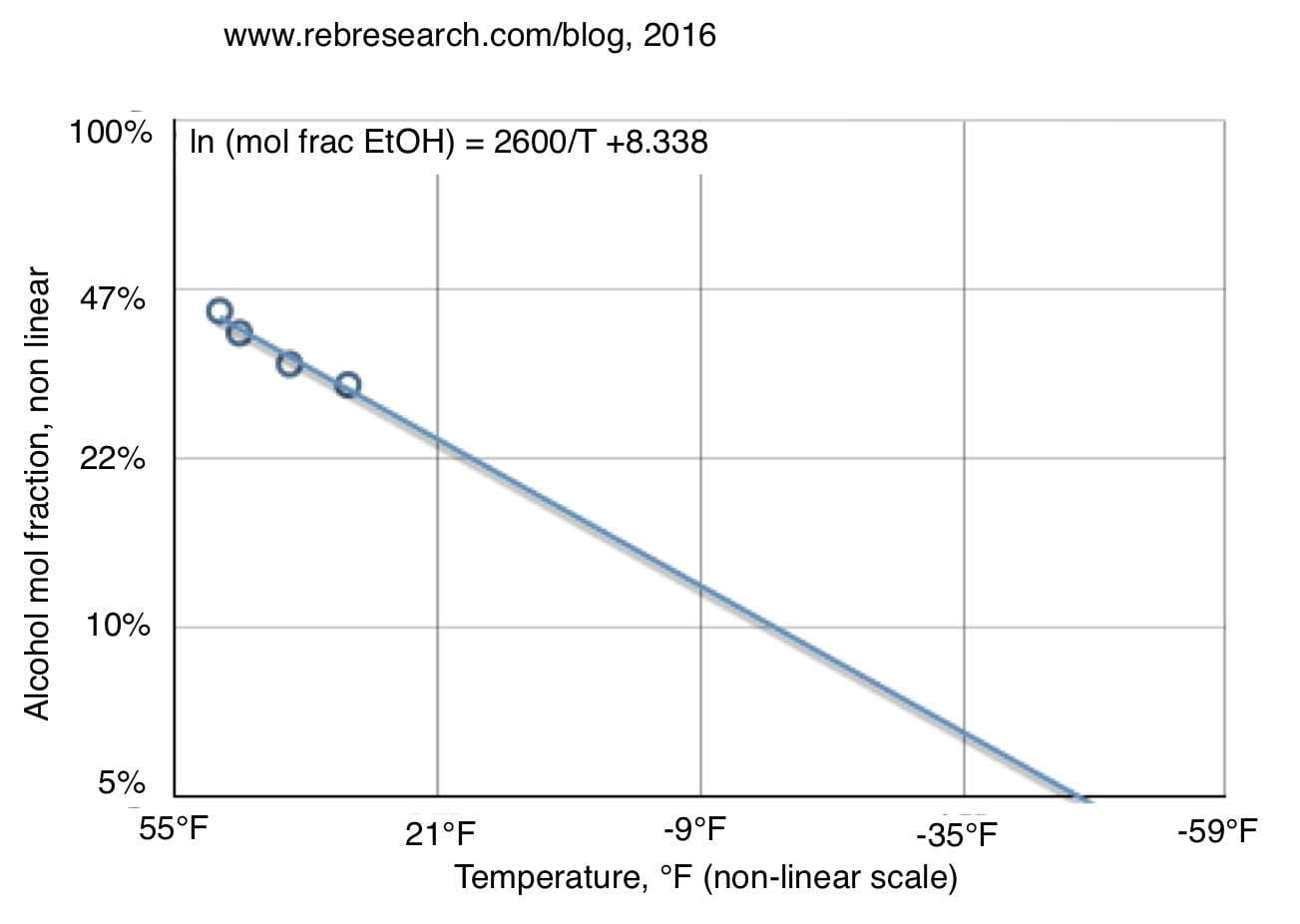
Solubility of alcohol (ethanol) in gasoline; an extrapolation based on the data above.

To estimate the separation temperature of our normal, 10% alcohol-gasoline mix, I extended the data from the chart above using linear regression. From thermodynamics, I extrapolated ln-concentration vs 1/T, and found that a 10% by volume mix (5% mol fraction alcohol) will separate at about -40°F. Chances are, you won’t see that temperature this winter (and if you you do, try to find a gas mix that has no alcohol. Another thought, add hydrogen or other combustible gas to get the engine going.

Robert E. Buxbaum, February 10, 2016. Two more thoughts: 1) Thermodynamics is a beautiful subject to learn, and (2) Avoid people who stick to foolish consistency. Too much regulation is bad, as is too little: it’s a common pattern: The difference between a cure and a poison is often just the dose.

Comic colonialism I: How the US got Guam without a fight.

America is often criticized for land it acquired by war e.g. Guam in the Spanish-American War. Though Spanish were corrupt and incompetent, and had (it seems) sunk the USS Maine by accident, the idea is that conquest is bad. Well, for better or worse, here’s how the US acquired Guam in a comic bloodless non-battle that provides an example of God laughing as he protects children, fools, and the U.S. of A.

It’s mid June, 1898, the Spanish-American War has raged for two months, and Theodore Roosevelt is in Cuba. Four ships lead by the USS Charleston leave Hawaii on a secret mission with orders to be opened only at sea. Captain Glass of the Charleston find he is to try to take Guam and destroy its fortress before proceeding to the Philippines for the major battle of the war. Glass is informed that Guam Harbor is defended Spanish warships plus a thick-walled fort housing many heavy cannon. A land assault will face, he’s told, over 1000 fighting men, dug in, heavily armed, and thoroughly familiar with the terrain. As it happens, military intelligence had vastly overstated the challenge. There are only 56 soldiers on Guam, and Span has neglected to tell the garrison that there’s a war on.

USS Charleston

The USS Charleston, victor of the non-battle of Guam.

Expecting a fierce battle, our soldiers and naval gunners practice shooting at towed targets and get excellently proficient, or so Glass believes. Fortunately, he’s wrong. On June 20, 1898, The Charleston steams into Guam’s harbor and finds no resistance. The only major ship is a Japanese trader sitting at anchor. No shots are fired, and there is no apparent activity on shore. In some confusion, Captain Glass order that 13 shots be fired at the fort. As it happens, it’s a fortuitous number. Also fortuitous, is that all the shots miss. In complete ignorance, the folks on shore think it is a 13 gun salute: that the Charleston is here for an official, state visit.

Now, the normal response would be for folks on Guam to return the 13 gun salute. If they had, it would have likely begun a cycle of death and destruction. But God is the protector of fools, and the fortress is out of gunpowder. The Spanish send an officer to the Charleston to ask for gunpowder and apologize for not returning the salute. After what must have been a most uncomfortable parlé, it is agreed that our nations were at war; that the officer was now a captured prisoner; and that he is being released to request surrender.

Coins celebrating our colonial territories.

Coins celebrating our colonial territories. None have senators or congressmen. Only DC gets to vote for president, a result of the 23rd amendment, 1961.

As soon as he is sent off, captain Glass begins to worry: maybe this is a trap. Maybe the guns are now focussed on him and his men? Maybe he should resume fire on the fort! Right about then, a friendly whaleboat sails by flying the American flag. It’s captained by Francisco “Frank”Portusach-Martinez from Chicago, an old friend of an officer aboard the Charleston. Captain Portusach comes on board, shows his US bona-fides, and explains that it’s no trap, just ignorance. Taking his advice, Captain Glass lands with a small party, arrests all 56 soldiers without a fight, and raises the American flag. The Star Spangled Banner is played, and Glass doesn’t quite know what to do next. What would you do in his shoes?

Captain Henry Glass

Captain Henry Glass, man with a mustache.

Having no experience or other orders, Captain Glass appoints Portusach as the first US Governor of Guam, and leaves to join Dewey in the Philippines. He does not destroy the fort as he finds it in such poor repair that he can claim it’s already destroyed. And that’s how we got Guam. Credit to Captain Glass for not screwing things up or angering the locals needlessly. One hundred and eighteen years later, Guam is still a US territory, though there have been movements for statehood, for union with Hawaii, and for independence. Until the folks on Guam decide otherwise, they are US citizens, but can not vote for president or have representation in congress. They pay federal income taxes, but not state taxes. Bill Clinton is the only US president to ever visit Guam.

Dr. Robert E. Buxbaum. February 1, 2016. I’ve written previously on the ways of peace, and on what makes a country, and on beards: why only communists and Republicans have them. Stay tuned for “Comic Colonialism II: Canada’s Queen.”

How to help Flint and avoid lead here.

As most folks know, Flint has a lead-poisoning problem that seems to have begun in April, 2014 when the city switched its water supply from Detroit-supplied, Lake Huron water to their own source, water from the Flint River. Here are some thoughts on how to help the affected population, and how to avoid a repeat in Oakland county, where I’m running for water commissioner. First observation, it is not enough to make sure that the source water does not contain lead. The people who decided on the switch had found that the Flint river water had no significant content of lead or other obvious toxins. A key problem, it seems: the river water did not contain anticorrosion phosphates, and none, it seems, were added by the Flint water folks. It also seems that insufficient levels of chlorine (hypochlorite) were added. After the switch, citizens started seeing disgusting, brown water come from their taps, and citizens with lead pipes or solder were poisoned with ppb-levels of lead. There was also an outbreak of legionaries disease that killed 12 people. It was the legionaries that alerted the CDC to the possibility of lead, since it seems the water folks were fudging the numbers there, and hiding that part of the problem.

Flint water, Sept 2015, before switching back to Lake Huron.

Flint water after 5 hours of flushing, Sept 2015, before switching back to Lake Huron.

The city began solving its problem by switching back to Detroit-supplied, Lake Huron water in October, 2015. Beginning in December, 2015, they started adding triple doses of phosphate to the wate. As a result, Flint tap-water is now back within EPA standards, but it’s still fairly unsafe, see here for more details.

There has been a fair amount of finger-pointing. At Detroit for raising the price of water so Flint had to switch, at water officials ignoring the early signs of lead and fudging their reports, at other employees for not adding phosphate or enough chlorine, and at “the system” for not providing Flint’s government with better oversight. My take is that a lot of the problem came from the ignorance of the water commission, and it’s commissioner. We elect our water commissioners to be competent overseers of complex infrastructure, but in may counties folks seem to pick them the same way they pick aldermen: for a nice smile, a great handshake, and an ability to remember names. That, anyway, seems to be the way that Oakland got its current water commissioner. When you pick your commissioner that way, it’s no surprise that he (or she) isn’t particularly up on corrosion chemistry, something that few people understand, and fewer care about until it bites them.

Flint river water contains corrosive chloride that probably helped dissolve the lead from pipes and solder. Contributing to the corrosion problem, I’m going to guess that Flint River water also contains, relatively little carbonate, but significant amounts of chelating chemicals, like EDTA, in 10s of ppb concentration. EDTA isn’t poisonous at these concentrations, but it’s common in industry and is the most commonly used antidote for lead poisoning. EDTA extracts lead and other metals from people and would tend to contribute to the process of extracting lead and iron oxide from the pipes surface into the drinking water. With EDTA in the water, a lot of phosphate or hypochlorite would be needed to avoid the lead poisoning problem and the deadly multiplication of disease.

Detroit ex-mayor Kwame Kilpatrick has claimed that both Flint water and Detroit water were known to be poisoned even a decade before the switch. I find these claims believable given the high levels of lead in kids blood even before the switch. Also, I note that there are areas of Detroit where the blood-lead levels are higher than Flint. Flint tested at the taps in a way that fudged the data during the first days of the poisoning, and I suspect many of our MI cities do this today — just to make the numbers look better. My first suggestion therefore is to test correctly, both at the pipes and at the taps; lead pipes are most-often found in the last few feet before the tap. In particular, we should test at all schools and other places where the state has direct authorization to fix the problem. A MI senate bill has been proposed to this effect, but I’m not sure where it stands in the MI house. It seems there are movements to add lots of ‘riders’ and that’s usually a bad sign.

Another thought is that citizens should be encouraged to test their private taps and helped to fix them. The state can’t come in and test or rip out your private pipes, even if they suspect lead, but the private owner has that authorization. The state could condemn a private property where they believe the water is bad, but I doubt they could evict the residents. It’s a democratic republic, as I understand; you have the right to be deadly stupid. But I’ll take my own suggestion to encourage you: If you think your water has lead, take a sample and call (517) 335-8184. Do it.

Another suggestion, perhaps the easiest and most important, is drink bottled water for now, and if you feel you’ve been poisoned, take an antidote.  As I understand things, the state is already providing bottles of imported water. The most common antidote is, as I’d mentioned, EDTA. Assuming that Flint River water had enough EDTA to significantly worsen the problem, the cheapest antidote might be Flint River water, assuming you drew it in lead-free pipes and chlorinated sufficiently to rid it of bugs. If there is EDTA it will help the poisoned. Another antidote is Succinic acid, something sold by REB Research, my company. As with EDTA it is non-toxic, even in fairly large doses, but its use would have to be doctor- approved.

Robert E. Buxbaum, January 19-31, 2016. I hope this helps. We’d have to check Flint River water for levels of EDTA, but I suspect we’d find biologically significant concentrations. If you think Oakland should have an engineer in charge of the water, elect Buxbaum for water commissioner.

Abraham ROFLed; Sarah LOLed.

Something is lost, and something else gained when the Bible is translated into modern terms. Some grandeur is lost, some weight, but what is gained is a sense of intimacy, a personal relationship to the events and people.

Consider, for example, Abraham’s reaction when God reveals that he will have a son (Gen. 17:17). The King James translation is “Abraham fell facedown; he laughed and said to himself, “Will a son be born to a man a hundred years old? Will Sarah bear a child at the age of ninety?” There’s grandeur, but the event is distant from me.

Similarly, The Living Torah, “Then Abraham bowed down to the ground, but he laughed to himself in disbelief. ‘How could I become a father at the age of 100?’ he thought. ‘And how can Sarah have a baby when she is ninety years old?'”

I don’t find this translation relatable either. To me, it would be better to say that Abraham did the first ROTFL (Roll on the floor laughing): “Abraham ROFLed, how grand to have a son at 100 years…” It brings up a pleasant image: of Abraham as a man of red face and good humor, a hearty companion, and a good host. Someone you’d want to visit, not a stick-in-the-mud who you visit because he owns the last hotel on the road to Sodom.

Not totally the way I see it: Sarah looks stunned, but at least this captures a jolly Abraham.

Not totally the way I see it: Sarah looks stunned, but at least this captures a jolly Abraham.

And the same with Abraham’s wife, Sarah. Her home is full of dusty tourist guests, and she feeds them steak. Do you see a silent martyr, or a jolly sort who genuinely likes guests. This is important because we are to learn from these stories, Too often the doctors of the religion seem to want martyrs, but my read of Genesis is that sh’s jolly.. Sarah listens to the tales of her guests, and when one says she will have a child at 90, she LOLs (laughs out loud, Gen. 18:12) “So Sarah laughed to herself as she thought, ‘I’m old and my husband is too, will I have fun!” If God wants something weird Sarah is up for it. To her, it sounds like fun. And after that, “Will I nurse a child?!.”

I note that these are the paradigms of humanity, individuals that God loved, and spoke to at length. So lets do the same, be open to the positive, weird future, wherever God takes us. Let’s behave as God himself does. For, as we find Psalms (2:4), “He, who sits in the heavens, laughs; He mocks those who plan against HIm.” Now, ask the doctors of your religion, why are you so serious, when “He, who sits in the heavens, laughs”

Robert E. Buxbaum, January 12, 2016. This is my third essay on religion, all of them, I guess on the lighter side. In the first, I note that science and religion are opposites, In the follow-up, that secular philosophy and religion are uncomfortable competitors, and now that God likes the jolly (you probably prefer the jolly, too.)

The Hindenburg: mainly the skin burnt

The 1937 Hindenburg disaster is often mentioned as proof that hydrogen is too flammable and dangerous for commercial use. Well hydrogen is flammable, and while the Hindenburg was full of hydrogen when it started burning, but a look at a color photograph of the fire ( below), or at the B+W  Newsreel film of the fire, suggests that it is not the hydrogen burning, but the skin of the zeppelin and the fuel. Note the red color of the majority flame, and note the black smoke. Hydrogen fires are typically invisible or very light blue, and hydrogen fires produce no smoke.

Closeup of the Hindenburg burning. It is the skin that burns, not the gaseous hydrogen

Closeup of the Hindenburg burning. It is the skin and gasoline that burns, not the gaseous hydrogen.

The Hindenburg was not a simple hydrogen balloon either. It was a 15 story tall airship with state-rooms, a dining room and an observation deck. It carried 95 or so passengers and crew. There was plenty of stuff to burn besides hydrogen. Nor could you say that a simple spark had set things off. The Hindenburg crossed the ocean often: every 2 1/2 days. Lightning strikes were common, as were “Saint Elmo’s fire,” and static electricity discharges. And passengers smoked onboard. Holes and leaks in the skin were also common, both on the Hindenburg and on earlier airships. The hydrogen-filled, Graf Zeppelin logged over 1 million flight miles and over 500 trips with no fires. And it’s not like helium-filled zeppelins and blimps are much safer. The photo below shows the fire and crash of a helium-filled Goodyear blimp, “Spirit of Safety”, June, 2011. Hydrogen has such a very high thermal conductivity that it is nearly as hard to light as helium. I recently made this video where I insert a lit cigar into a balloon filled with hydrogen. There is no fire, but the cigar goes out.  In technical terms, hydrogen is said to have a low upper combustion limit.

Helium-filled goodyear blimp catches fire and burns to destruction.

Helium-filled goodyear blimp “spirit of safety” catches fire and burns before crashing. It’s not the helium burning.

The particular problem with the Hindenburg seems to have been its paint, skin and fuel, the same problems as caused the fire aboard the “Spirit of Safety.” The skin of the Hindenburg was cotton, coated with a resin-dope paint that contained particles of aluminum and iron-oxide to help conduct static electricity. This combination is very flammable, essentially rocket fuel, and the German paint company went on to make rocket fuel of a similar composition for the V2 rockets. And the fuel was flammable too: gasoline. The pictures of the Hindenburg disaster suggest (to me) that it is the paint and the underlying cotton skin that burned, or perhaps the fuel. A similar cause seems to have beset the “Spirit of Safety.” For the Hindenburg’s replacement, The Graf II, the paint composition was changed to replace the aluminum powder with graphite – bronze, a far less flammable mixture, and more electrically conductive. Sorry to say, there was no reasonably alternative to gasoline. To this day, much of sport ballooning is done with hydrogen; statistically it appears no more dangerous than hot air ballooning.

It is possible that the start of the fire was a splash of gasoline when the Hindenburg made a bumpy contact with the ground. Another possibility is sabotage, the cause in a popular movie (see here), or perhaps an electric spark. According to Aviation Week, gasoline spoiled on a hot surface was the cause of the “Spirit of Safety fire,” and the Hindenburg disaster looks suspiciously similar. If that’s the case, of course, the lesson of the Hindenburg disaster is reversed. For safety, use hydrogen, and avoid gasoline.

Dr. Robert E. Buxbaum, January 8, 2016. My company, REB Research, makes hydrogen generators, and other hydrogen equipment. If you need hydrogen for weather balloons, or sport ballooning, or for fuel cells, give us a call.

Advanced windmills + 20 years = field of junk

Everything wears out. This can be a comforting or a depressing thought, but it’s a truth. No old mistake, however egregious, lasts forever, and no bold advance avoids decay. At best, last year’s advance will pay for itself with interest, will wear out gracefully, and will be recalled fondly by aficionados after it’s replaced by something better. Water wheels, and early steamships are examples of this type of bold advance. Unfortunately, it is often the case that last years innovation turns out to be no advance at all: a technological dead end that never pays for itself, and becomes a dangerous, rotting eyesore or worse, a laughing-stock blot or a blot on the ecology. Our first two generations of advanced windmill farms seem to match this description; perhaps the next generation will be better, but here are some thoughts on lessons learned from the existing fields of rotting windmills.

The ancient design windmills of Don Quixote’s Spain (1300?) were boons. Farmers used them to grind grain or cut wood, and to to pump drinking water. Holland used similar early windmills to drain their land. So several American presidents came to believe advanced design windmills would be similar boons if used for continuous electric power generation. It didn’t work, and many of the problems could have been seen at the start. While the farmer didn’t care when his water was pumped, or when his wood is cut. When you’re generating electricity, there is a need to match the power demand exactly. Whenever the customer turns on the switch, electricity is expected to flow at the appropriate amount of Wattage; at other times any power generated is a waste or a nuisance. But electric generator-windmills do not produce power on demand, they produce power when the wind blows. The mismatch of wind and electric demand has bedeviled windmill reliability and economic return. It will likely continue to do so until we find a good way to store electric power cheaply. Until then windmills will not be able to produce electricity at competitive prices to compete with cheap coal and nuclear power.

There is also the problem of repair. The old windmills of Holland still turn a century later because they were relatively robust, and relatively easy to maintain. The modern windmills of the US stand much taller and move much faster. They are often hit, and damaged by lightning strikes, and their fast-turning gears tend to wear out fast, Once damaged, modern windmills are not readily fix, They are made of advanced fiberglass materials spun on special molds. Worse yet, they are constructed in mountainous, remote locations. Such blades can not be replaces by amateurs, and even the gears are not readily accessed to repair. More than half of the great power-windmills built in the last 35 years have worn out and are unlikely to ever get repair. Driving past, you see fields of them sitting idle; the ones still turning look like they will wear out soon. The companies that made and installed these behemoth are mostly out of the business, so there is no-one there to take them down even if there were an economic incentive to do so. Even where a company is found to fix the old windmills, no one would as there is not sufficient economic return — the electricity is worth less than the repair.

Komoa Wind Farm in Kona, Hawaii June 2010; Friends of Grand Ronde Valley.

Komoa Wind Farm in Kona, Hawaii, June 2010; A field of modern design wind-turbines already ruined by wear, wind, and lightning. — Friends of Grand Ronde Valley.

A single rusting windmill would be bad enough, but modern wind turbines were put up as wind farms with nominal power production targeted to match the output of small coal-fired generators. These wind farms require a lot of area,  covering many square miles along some of the most beautiful mountain ranges and ridges — places chosen because the wind was strong

Putting up these massive farms of windmills lead to a situation where the government had pay for construction of the project, and often where the government provided the land. This, generous spending gives the taxpayer the risk, and often a political gain — generally to a contributor. But there is very little political gain in paying for the repair or removal of the windmills. And since the electricity value is less than the repair cost, the owners (friends of the politician) generally leave the broken hulks to sit and rot. Politicians don’t like to pay to fix their past mistakes as it undermines their next boondoggle, suggesting it will someday rust apart without ever paying for itself.

So what can be done. I wish I could suggest less arrogance and political corruption, but I see no way to achieve that, as the poet wrote about Ozymandias (Ramses II) and his disastrous building projects, the leader inevitably believes: “I am Ozymandias, king of kings; look on my works ye mighty and despair.” So I’ll propose some other, less ambitious ideas. For one, smaller demonstration projects closer to the customer. First see if a single windmill pays for itself, and only then build a second. Also, electricity storage is absolutely key. I think it is worthwhile to store excess wind power as hydrogen (hydrogen storage is far cheaper than batteries), and the thermodynamics are not bad

Robert E. Buxbaum, January 3, 2016. These comments are not entirely altruistic. I own a company that makes hydrogen generators and hydrogen purifiers. If the government were to take my suggestions I would benefit.