Author Archives: R.E. Buxbaum

About R.E. Buxbaum

Robert Buxbaum is a life-long engineer, a product of New York's Brooklyn Technical High School, New York's Cooper Union to Science and Art, and Princeton University where he got a PhD in Chemical Engineering. From 1981 to 1991 he was a professor of Chemical Engineering at Michigan State, and now runs an engineering shop in Oak Park, outside of Detroit, Michigan. REB Research manufactures and sells hydrogen generation and purification equipment. He's married with 3 wonderful children who, he's told, would prefer to not be mentioned except by way of complete, unadulterated compliments. As of 2016, he's running to be the drain commissioner/ water resources commissioner of Oakland county.

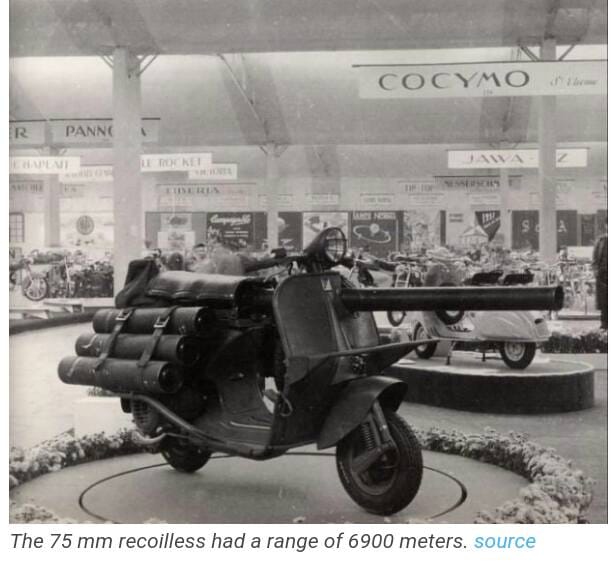
More French engineering, the Blitzkrieg motorcycle.

There’s something fascinating that I find in French engineering. I wrote a previous essay about French cars, bridges, and the Eiffel tower. Here’s a picture or two more. Things I wanted to include but didn’t. First here’s a Blitzkrieg Vespa motorcycle; the French built some 800 of these from 1947 to 1962 and used them in Vietnam and Algeria. What’s remarkable is how bizarrely light and unprotected it is. It’s a design aesthetic that follows no one, and that American engineers would not follow.

French Blitzkrieg Vespa used in Vietnam

French Blitzkrieg Vespa used in Vietnam; cannon range is 4.5 miles.

The key engineering insight that allows this vehicle to make sense is that recoil-less rifles are really recoil-less if you design them right. Thus, one can (in theory) mount them on something really light, like a Vespa. Another key (French) insight is that a larger vehicle may make the soldier more vulnerable rather than less by slowing him down and by requiring more gasoline and commissariat services.

Americans do understand the idea of light and mobile, but an American engineers idea of this is a jeep or an armored truck; not a Vespa. From my US engineering perspective, the French went way overboard here. The French copy no one, and no one copies the French, as they say. Still, these things must have worked reasonably well or they would not have made 800 of them over 15 years. A Vespa is certainly cheaper than a Jeep, and easier to transport to the battle zone….

Robert Buxbaum, February 18, 2016. The Italians have a somewhat similar design aesthetic to the French: they like light and cheap, but also like maneuverable and favor new technology. See my blog about a favorite Fiat engine.

Boy-Girl physics humor

Girl breaking up with her boyfriend: I just need two things, more space, and time.

Atoms try to understand themselves.

Atoms build physicists in an attempt to understand themselves. That’s also why physicists build physics societies and clubs.

Boyfriend: So, what’s the other thing?


Robert Buxbaum. And that, dear friend, is why science majors so rarely have normal boyfriends / girlfriends.

A female engineer friend of mine commented on the plight of dating in the department: “The odds are good, but the goods are odd.”

By the way, the solution to Einstein’s twin paradox resides in understanding that time is space. Both twins see the space ship moving at the same pace, but space shrinks for the moving twin in the space ship, not for the standing one. Thus, the moving twin finishes his (or her) journey in less time than the standing one observes.

The game is rigged and you can always win.

A few months ago, I wrote a rather depressing essay based on Nobel Laureate, Kenneth Arrow’s work, and the paradox of de Condorcet. It is mathematically shown that you can not make a fair election, even if you wanted to, and no one in power wants to. The game is rigged.

To make up for that insight, I’d like to show from the work of John Forbes Nash (A Beautiful Mind) that you, personally, can win, basically all the time, if you can get someone, anyone to coöperate by trade. Let’s begin with an example in Nash’s first major paper, “The Bargaining Problem,” the one Nash is working on in the movie— read the whole paper here.  Consider two people, each with a few durable good items. Person A has a bat, a ball, a book, a whip, and a box. Person B has a pen, a toy, a knife, and a hat. Since each item is worth a different amount (has a different utility) to the owner and to the other person, there are almost always sets of trades that benefit both. In our world, where there are many people and everyone has many durable items, it is inconceivable that there are not many trades a person can make to benefit him/her while benefiting the trade partner.

Figure 3, from Nash’s, “The bargaining problem.” U1 and U2 are the utilities of the items to the two people, and O is the current state. You can improve by barter so long as your current state is not on the boundary. The parallel lines are places one could reach if money trades as well.

Good trades are even more likely when money is involved or non-durables. A person may trade his or her time for money, that is work, and any half-normal person will have enough skill to be of some value to someone. If one trades some money for durables, particularly tools, one can become rich (slowly). If one trades this work for items to make them happy (food, entertainment) they can become happier. There are just two key skills: knowing what something is worth to you, and being willing to trade. It’s not that easy for most folks to figure out what their old sofa means to them, but it’s gotten easier with garage sales and eBay.

Let us now move to the problem of elections, e.g. in this year 2016. There are few people who find the person of their dreams running for president this year. The system has fundamental flaws, and has delivered two thoroughly disliked individuals. But you can vote for a generally positive result by splitting your ticket. American society generally elects a mix of Democrats and Republicans. This mix either delivers the outcome we want, or we vote out some of the bums. Americans are generally happy with the result.

A Stamp act stamp. The British used these to tax every transaction, making it impossible for the ordinary person to benefit by small trade.

A Stamp act stamp,. Used to tax every transaction, the British made it impossible for ordinary people to benefit by small trades.

The mix does not have to involve different people, it can involve different periods of time. One can elect a Democrat president this year, and an Republican four years later. Or take the problem of time management for college students. If a student had to make a one time choice, they’d discover that you can’t have good grades, good friends, and sleep. Instead, most college students figure out you can have everything if you do one or two of these now, and switch when you get bored. And this may be the most important thing they learn.

This is my solution to Israel’s classic identity dilemma. David Ben-Gurion famously noted that Israel had the following three choices: they could be a nation of Jews living in the land of Israel, but not democratic. They could be a democratic nation in the land of Israel, but not Jewish; or they could be Jewish and democratic, but not (for the most part) in Israel. This sounds horrible until you realize that Israel can elect politicians to deliver different pairs of the options, and can have different cities that cater to thee options too. Because Jerusalem does not have to look like Tel Aviv, Israel can achieve a balance that’s better than any pure solution.

Robert E. Buxbaum, July 17-22, 2016. Balance is all, and pure solutions are a doom. I’m running for water commissioner.

Of grails: holy, monetary, and hip

The holy grail is pictured as either a cup or a plate that Jesus used at the Last supper. It either held the wine or the bread upon which he said: this wine is my blood and this bread (or cake*) is my body. The British have a legend, or made-up story, that this cup or plate made it to England somehow, and because of divine grace was revealed to king Arthur. The story is important because it underlies the idea of divine grace favoring the English crown  — that God favors England, and English royalty over other nations and the common folk.

A George III coin, engrailed for decoration and to keep people from carving off silver.

A George III coin, engrailed for decoration and to keep people from carving off silver.

What makes this item holy is that, by oral tradition, but not the gospels, Jesus’s blood was saved into the same plate or cup that he’d used at the last supper, but what about this plate or cup makes it a grail.

As it turns out, there are many unholy grails on runs into. The edges of many US coins are engrailed. That is, they are decorated with cut lines at the edges. They are there for decoration, and to make it unlikely that someone would cut off a piece. I suppose these coins are monetary grails, though I’ve never seen them described literally that way. They are engrailed, and one can presume that the holy cup or plate was engrailed the same way. Perhaps as decoration like on the coins, or perhaps for some aspect of use.

The grille on the front of a Ford is not only for decoration; it allows air to flow through. Some plates, and most broilers have grilles like this to that allow crumbs or gravy to drop through.

The front grille (or grill) on a Ford. It allows air to flow through. Broilers and some plates have through-slots like this; did The Grail?

The front end of most cars include a grille, or grill, an area cut all the way through to allow air to flow to the engine. Some plates and most barbecues are made this way to allow crumbs or blood from the barbecue to flow through. If this is flow through grill were the holy grail, it might have held Jesus’s bread, but not his wine or his blood.

And finally we come to an entirely modern type of grail, or grill, the one on the mouth of some rappers. The point is not entirely decorative, but to make one think more highly of the rapper. Clearly, a person with teeth like this, is a person to be respected. Clearly successful, the idea is make you think of the fellow as chosen by God to be a leader. There is a certain magic in wearing a grille.

Wholly Grilled, not the holly grail.

Wholly Grilled, but not the holly grail.

Robert Buxbaum, July 8, 2016. One of my Grad School chums, Al Rossi, tells me that, in the original Greek version of the gospels, Jesus says ‘this cake is my body.’  The normal version, ‘this bread’ comes from the Latin translation of St. Jerome. He also tells me there is no comment about this being Passover. As for how Jesus could celebrate passover with bread or cake and not matzoh, he claims it’s an example of having one’s cake and eating it too, as it were.

A plague of combined sewers

The major typhoid and cholera epidemics of the US, and the plague of the Al Qaeda camps, 2009 are understood to have been caused by bad sewage, in particular by the practice of combining sanitary + storm sewage. Medieval plagues too may have been caused by combined sewers.

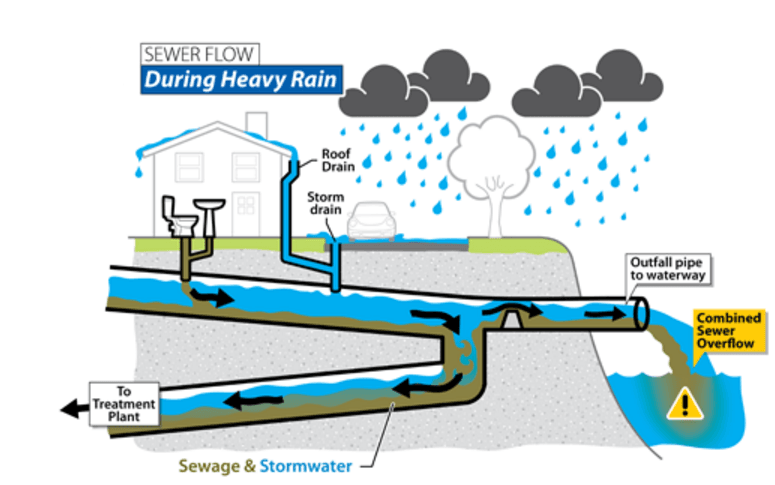
Combined sewer system showing an rain-induced overflow, a CSO.

A combined sewer system showing an rain-induced overflow, a CSO.

A combined system is shows at right. Part of the problem is that the outfall is hard to contain, so they tend to spew sewage into the lakes and drinking water as shown. They are also more prone to back up during rain storms; separated systems can back up too, but far less often. When combined sewers back up, turds and other infected material flows into home basements. In a previous post, “follow the feces,” I showed the path that Oakland county’s combined sewers outfalls take when they drain (every other week) into Lake St. Clair just upstream of the water intake, and I detailed why, every few years we back up sewage into basements. I’d like to now talk a bit more about financial cost and what I’d like to do.

The combined sewer system shown above includes a small weir dam. During dry periods and small rain events, the dam keeps the sewage from the lake by redirecting it to the treatment plant. This protects the lakes so that sometimes the beaches are open, but there’s an operation cost: we end up treating a lot of rain water as if it were sewage. During larger rains, the dam overflows. This protects our basements (usually) but it does so at the expense of the drinking water, and of the water in Lake St. Clair and Lake Erie.

As a way to protect our lakes somewhat Oakland county has added a retention facility, the George W. Kuhn. This facility includes the weir shown above and a huge tank for sewage overflows. During dry periods, the weir holds back the flow of toilet and sink water so that it will flow down the pipe (collector) to the treatment plant in Detroit, and so it does not flow into the lake. Treatment in Detroit is expensive, but nonpolluting. During somewhat bigger rains the weir overflows to the holding tank. It is only during yet-bigger rains (currently every other week) that the mixture of rain and toilet sewage overwhelms the tank and is sent to the river and lake. The mess this makes of the lake is shown in the video following. During really big rains, like those of August 2014, the mixed sewage backs up in the pipes, and flows back into our basements. With either discharge, we run the risk of plague: Typhoid, Cholera, Legionnaires…

Some water-borne plagues are worse than others. With some plagues, you can have a carrier, a person who can infect many others without becoming deathly sick him or herself. Typhoid Mary was a famous carrier of the 1920s. She infected (and killed) hundreds in New York without herself becoming sick. A more recent drinking water plague, showed up in Milwaukee 25 years ago. Some 400,000 people were infected, and 70 or so died. Milwaukee disinfected its drinking water with chlorine and a bacteria that entered the system was chlorine tolerant. Milwaukee switched to ozone disinfection but Detroit still uses chlorine.

Combined sewers require much larger sewage treatment plants than you’d need for just sanitary sewage. Detroit’s plant is huge and its size will need to be doubled to meet new, stricter standards unless we bite the bullet and separate our sewage. Our current system doesn’t usually meet even the current, lower standards. The plant overflows and operation cost are high since you have to treat lots of rainwater. These operation costs will keep getter higher as pollution laws get tougher.

In Oakland county, MI we’ve started to build more and more big tanks to hold back and redirect the water so it doesn’t overwhelm the sewage plants. The GWK tank occupies 1 1/2 miles by about 100 feet beneath a golf course. It’s overwhelmed every other week. Just think of the tank you’d need to hold the water from 4″ of rain on 900 square mile area (Oakland county is 900 square miles). Oakland’s politicians seem happy to spend money on these tanks because it creates jobs and graft and because it suggests that something is being done. They blame politics when rain overwhelms the tank. I say it’s time to end the farce and separate our sewers. My preference is to separate the sewers through the use of French drains or bio-swales, and through the use of weir dams. I’m running for drain commissioner. Here’s something I’ve written on the chemistry of sewage, and on the joy of dams.

Dr. Robert E. Buxbaum, July 1-Sept 16, 2016.

Puerto Rico’s minimum wage and statehood

Puerto Rico is in deep trouble and it’s getting worse. Unemployment is at 12%, double the next worst state or territory (Alaska). Tourism is down and poverty is at 41%. US tourists have begun going elsewhere where prices are lower: Bermuda, Haiti, Jamaica, and Cuba. The island is effectively bankrupt and would have filed for bankruptcy last year except that, as a US territory, they legally can’t. But neither can they pay their bills. The territory will go into default in 2 weeks, on July 1, 2016 unless congress creates a new funding mechanism for them. Statehood would allow Puerto Rico to go bankrupt, but there is no way for statehood to be achieved by July 1. Nor will bankruptcy help them, long term.

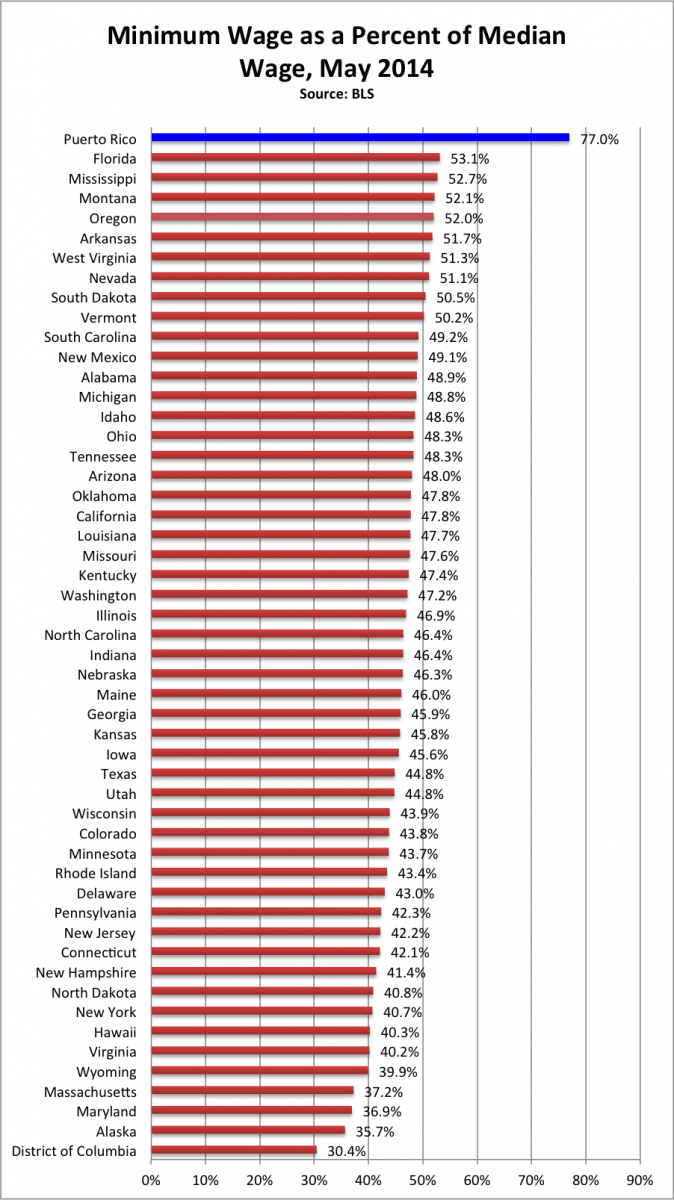
Puerto Rico's minimum wage is vastly too high; here it is compared with other US states.

Puerto Rico’s minimum wage is vastly too high for its median wage. From Preston Cooper, Economics21.

It is worthwhile to ask why Puerto Rico is in such bad shape. Why are they worse off than Guam, for example; Guam is far more isolated. Puerto Rico is run poorly, but it’s no worse than Guam or  Illinois. One problem particular to Puerto Rico is that their minimum wage is way too high relative to the median wage.

Because of the climate, living expense are low in Puerto Rico, but Puerto Rico’s economy is mostly tourism. It competes for tourist dollars with lower-wage Caribbean countries, Jamaica, Haiti, and Cuba. Neither Alaska nor Guam must compete this way, with a nearby, low cost alternative. Puerto Rico could compete better if they could lower their minimum wage. Tourism would be more attractive, and the government would not have to spend as much either for minimal-skill workers.

With a lower minimum wage, more Puerto Ricans would be able to find jobs, and the government would likely manage to balance its books. But Puerto Rico is part of the US, and we set the minimum wage. I think the federal government should grant them an exemption. Without one, there is no obvious way for Puerto Rico to pay its bills.

Four years ago, in my first blog post, I suggested that Detroit should lower its $15/hour ‘living wage‘, a wage rate that unduly burdened the city budget, and added to Detroit’s rampant unemployment and corruption. A year later, the city dropped it as part of bankruptcy, and saw significant improvementsI’m not alone in suggesting a lower minimum wage. It’s better than state-hood and immediate bankruptcy.

Robert Buxbaum, June 19, 2016.

June 14 1789, First Bourbon whiskey

June 14. On this day, in 1789, the US national spirit, whiskey, Bourbon whiskey, was first distilled by Rev Elijah Craig of Kentucky. He named his product “Bourbon whiskey” as a reference to Bourbon County, where he lived, and the fact that it was a form of whiskey, like the Rye whiskey that George Washington distilled. Rev. Craig’s innovation was to use maize (corn) instead of the typical rye with malted barley added as an enzymatic modifier. George Washington was the largest distiller in the US in the late 1700s. His whiskey was mostly rye with very little malt.

But corn is cheaper than rye, and Bourbon whiskey has a milder flavor. Because of these two reasons, US consumption of Bourbon whiskey came to far surpass that of rye whiskey. In honor of that fact, Senator Mitch McConnell here tells congress that Bourbon is the spirit of Kentucky, “the spirit of America”. Here, his speech is set to music with other news of the day, and a comment by President Obama saying he’d enjoy having a drink with Senator McConnell. What would that drink be? Straight Bourbon? or Bourbon and water, or perhaps a mint julep, the classic Kentucky concoction, made with Bourbon, sugar, and spearmint.

Related to this topic, I should mention that President Truman liked Bourbon straight, that the favorite drink of Lyndon B. Johnson, was “Bourbon and branch” (branch is water). And that Theodore Roosevelt served mint juleps at The White house (if you played tennis with him) using his own, White-house grown mint, but made with rye, not Bourbon.

GWKuhn outflow point. During a storm this outflow is filled to the roof.

GWKuhn outflow point. During a storm this outflow is filled to the roof.

June 14th is also flag day, though only celebrated as a holiday in Pennsylvania. It’s also the day of the mutiny on the HMS Bounty, and the day of the Marijuana act, 1937. Hawaii joined the union this day, and Paris fell in WWII. This is also the day I first got a tour of the George W. Kuhn sewage retention facility, the main sewage plant in our county. A few days before, I walked into the outflow pipe of the plant, see picture. It was some 60 feet wide by 22 feet tall. I was looking for convenient connection points i could use to separate the storm from the sanitary sewage flow through the facility, assuming I became water commissioner.

Robert Buxbaum, June 14, 2016. Some months ago, I suggested that Michigan might change its state bird to the wild turkey instead of the robin. It’s a common MI bird, and also a brand of good Bourbon.

Skilled labor isn’t cheap; cheap labor isn’t skilled

Popular emblem for hard hats in the USA. The original quote is attributed to Sailor Jack, a famous tattoo artist.

Popular emblem for hard hats in the USA. The original quote is attributed to Sailor Jack, a famous tattoo artist.

The title for this post is a popular emblem on US hard-hats and was the motto of a famous, WWII era tattoo artist. It’s also at the heart of a divide between the skilled trade unions and the labor movement. Skilled laborers expect to be paid more than unskilled, while the labor movement tends to push for uniform pay, with distinctions based only on seniority or courses taken. Managers and customers prefer skilled work to not, and usually don’t mind paying the skilled worker more. It’s understand that, if the skilled workers are not rewarded, they’ll go elsewhere or quit. Management too tends to understand that the skilled laborer is effectively a manager, often more responsible for success than the manager himself/herself. In this environment, a skilled trade union is an advantage as they tend to keep out the incompetent, the addict, and the gold-brick, if only to raise the stature of the rest. They can also help by taking some burden of complaints. In the late 1800s, it was not uncommon for an owner to push for a trade union, like the Knights of Labor, or the AFL, but usually just for skilled trades for the reasons above.

An unskilled labor union, like the CIO is a different animal. The unskilled laborer would like the salary and respect of the skilled laborer without having to develop the hard-to-replace skills. Management objects to this, as do the skilled workers. A major problem with unions, as best I can tell, is a socialist bent that combines the skilled and unskilled worker to the disadvantage of the skilled trades.

Not all unionists harbor fondness for welfare or socialism.

Also popular. Few workers harbor a fondness for welfare or socialism. Mostly they want to keep their earnings.

Labor union management generally prefer a high minimum wage — and often favor high taxes too as a way of curing societal ills. This causes friction, both in wage-negotiation and in political party support. Skilled workers tend to want to be paid more than unskilled, and generally want to keep the majority of their earnings. As a result, skilled laborers tend to vote Republican. Unskilled workers tend to vote for Democrats. Generally, there are more unskilled workers than skilled, and the union management tends to favor Democrats. Many union leaders have gone further — to international socialism. They push for high welfare payments with no work requirement, and for aid the foreign socialist poor. The hard-hats themselves tend to be less than pleased with these socialist pushes.

During the hippie-60’s and 70’s the union split turned violent. It was not uncommon for unionized police and construction workers to hurl insults and bricks on the anti-war leftists and non-working students and welfare farmers. Teamster boss Jimmy Hoffa, supported Nixon, Vietnam, and the idea that his truckers should keep their high wages at the expense of unskilled. Rival teamster boss, Frank Fitzsimmons pushed for socialist unity with the non-working of the world, a split that broke the union and cost Hoffa his life in 1975. Eventually the split became moot. The war ended, US factories closed and jobs moved overseas, and even the unskilled labor and poor lost.

Skilled workers are, essentially managers, and like to be treated that way.

Skilled workers are, essentially managers, and like to be treated that way.

The Americans with Disability Act is another part of the union split. The act was designed to protect the sick, pregnant and older worker, but has come to protect the lazy, nasty, and slipshod, as well as the drug addict and thief. Any worker who’s censored for these unfortunate behaviors can claim a disability. If the claim is upheld the law requires that the company provide for them. The legal status of the union demands that the union support the worker in his or her claim of disability. In this, the union becomes obligated to the worker, and not to the employer, customer, or craft — something else that skilled workers tend to object to. Skilled workers do not like having their neighbors show them high-priced, badly made products from their assembly line. Citing the ADA doesn’t help, nor does it help to know that their union dues support Democrats, welfare, and legislation that takes money from the pocket of any one who takes pride in good work. We’ll have to hope this split in the union pans out better than in 1860.

Robert Buxbaum, June 5, 2016. I’m running for water commissioner. I’d like to see my skilled sewer workers rewarded for their work and skill. Currently experienced workers get only $18/hour and that’s too little for their expertise. If they took off, they’d be irreplaceable, and the city would likely fall to typhus or the plague.

The chemistry of sewage treatment

The first thing to know about sewage is that it’s mostly water and only about 250 ppm solids. That is, if you boiled down a pot of sewage, only about 1/40 of 1% of it would remain as solids at the bottom of the pot. There would be some dried poop, some bits of lint and soap, the remains of potato peelings… Mostly, the sewage is water, and mostly it would have boiled away. The second thing to know, is that the solids, the bio-solids, are a lot like soil but better: more valuable, brown gold if used right. While our county mostly burns and landfills the solids remnant of our treated sewage, the wiser choice would be to convert it to fertilizer. Here is a comparison between the composition of soil and bio-solids.

The composition of soil and the composition of bio-solid waste. biosolids are like soil, just better.

The composition of soil and the composition of bio-solid waste. biosolids are like soil, just better.

Most of Oakland’s sewage goes to Detroit where they mostly dry and burn it, and land fill the rest. These processes are expensive and engineering- problematic. It takes a lot of energy to dry these solids to the point where they burn (they’re like really wet wood), and even then they don’t burn nicely. As shown above, the biosolids contain lots of sulfur and that makes combustion smelly. They also contain nitrate, and that makes combustion dangerous. It’s sort of like burning natural gun powder.

The preferred solution is partial combustion (oxidation) at room temperature by bacteria followed by conversion to fertilizer. In Detroit we do this first stage of treatment, the slow partial combustion by bacteria. Consider glucose, a typical carbohydrate,

-HCOH- + O–> CO+ H2O.    ∆G°= -114.6 kcal/mol.

The value of ∆G°, is relevant as a determinate of whether the reaction will proceed. A negative value of ∆G°, as above, indicates that the reaction can progress substantially to completion at standard conditions of 25°C and 1 atm pressure. In a sewage plant, many different carbohydrates are treated by many different bacteria (amoebae, paramnesia, and lactobacilli), and the temperature is slightly cooler than room, about 10-15°C, but this value of ∆G° suggests that near total biological oxidation is possible.

The Detroit plant, like most others, do this biological oxidation treatment using either large stirred tanks, of million gallon volume or so, or in flow reactors with a large fraction of cellular-material returning as recycle. Recycle is needed also in the stirred tank process because of the low solid content. The reaction is approximately first order in oxygen, carbohydrate, and bacteria. Thus a 50% cell recycle more or less doubles the speed of the reaction. Air is typically bubbled through the reactor to provide the oxygen, but in Detroit, pure oxygen is used. About half the organic carbon is oxidized and the remainder is sent to a settling pond. The decant (top) water is sent for “polishing” and dumped in the river, while the goop (the bottom) is currently dried for burning or carted off for landfill. The Holly, MI sewage plant uses a heterogeneous reactors for the oxidation: a trickle bed followed by a rotating disk contractor. These have higher bio-content and thus lower area demands and separation costs, but there is a somewhat higher capital cost.

A major component of bio-solids is nitrogen. Much of this in enters the form of urea, NH2-CO-NH2. In an oxidizing environment, bacteria turns the urea and other nitrogen compounds into nitrate. Consider the reaction the presence of washing soda, Na2CO3. The urea is turned into nitrate, a product suitable for gun powder manufacture. The value of ∆G° is negative, and the reaction is highly favorable.

NH2-CO-NH2 + Na2CO3 + 4 O2 –> 2 Na(NO3) + 2 CO2 + 2 H2O.     ∆G° = -177.5 kcal/mol

The mixture of nitrates and dry bio-solids is highly flammable, and there was recently a fire in the Detroit biosolids dryer. If we wished to make fertilizer, we’d probably want to replace the drier with a further stage of bio-treatment. In Wisconsin, and on a smaller scale in Oakland MI, biosolids are treated by higher temperature (thermophilic) bacteria in the absence of air, that is anaerobically. Anaerobic digestion produces hydrogen and methane, and produces highly useful forms of organic carbon.

2 (-HCOH-) –> COCH4        ∆G° = -33.7 Kcal/mol

3 (-HCOH-) + H2O –> -CH2COOH + CO2 +  2 1/2 H2        ∆G° = -21.9 kcal/mol

In a well-designed plant, the methane is recovered to provide heat to the plant, and sometimes to generate power. In Wisconsin, enough methane is produced to cook the fertilizer to sterilization. The product is called “Milorganite” as much of it comes from Milwaukee and much of the nitrate is bound to organics.

Egg-shaped, anaerobic biosolid digestors.

Egg-shaped, anaerobic biosolid digestors, Singapore.

The hydrogen could be recovered too, but typically reacts further within the anaerobic digester. Typically it will reduce the iron oxide in the biosolids from the brown, ferric form, Fe2O3, to black FeO.  In a reducing atmosphere,

Fe2O3 + H2 –> 2 FeO + H2O.

Fe2O3 is the reason leaves turn brown in the fall and is the reason that most poop is brown. FeO is the reason that composted soil is typically black. You’ll notice that swamps are filled with black goo, that’s because of a lack of oxygen at the bottom. Sulphate and phosphorous can be bound to ferrous iron and this is good for fertilizer. Generally you want the reduction reactions to go no further.

Weir dam on the river dour. Used to manage floods, increase residence time, and oxygenate the flow.

Weir dam on the river Dour in Scotland. Dams of this type increase residence time, and oxygenate the flow. They’re good for fish, pollution, and flooding.

When allowed to continue, the hydrogen produced by anaerobic digestion begins to reduce sulfate to H2S.

NaSO4 + 4.5 H2 –>  NaOH + 3H2O + H2S.

I’m running for Oakland county, MI water commissioner, and one of my aims is to stop wasting our biosolids. Oakland produces nearly 1000,000 pounds of dry biosolids per day. This is either a blessing or a curse depending on how we use it.

Another issue, Oakland county dumps unpasteurized, smelly black goo into Lake St. Clair every other week, whenever it rains more than one inch. I’d like to stop this by separating the storm and “sanitary” sewage. There is a capital cost, but it can save money because we’d no longer have to pay to treat our rainwater at the Detroit sewage plant. To clean the storm runoff, I’d use mini wetlands and weir dams to increase residence time and provide oxygen. Done right, it would look beautiful and would avoid the flash floods. It should also bring natural fish back to the Clinton River.

Robert Buxbaum, May 24 – Sept. 15, 2016 Thermodynamics plays a big role in my posts. You can show that, when the global ∆G is negative, there is an increase in the entropy of the universe.

Weird flow calculation

Here is a nice flow problem, suitable for those planning to take the professional engineers test. The problem concerns weir dams. These are dams with a notch in them, somethings rectangular, as below, but in this case a V-shaped notch. Weir dams with either sort of notch can be used to prevent flooding and improve the water, but they also provide a way to measure the flow of water during a flood. That’s the point of the problem below.

A series of weir dams on Blackman Stream, Maine. These are thick, rectangular weirs.

A series of weir dams with rectangular weirs in Maine.

You’ve got a classic V weir on a dam, but it is not a knife-edge weir, nor is it rectangular or compound as in the picture at right. Instead it is nearly 90°, not very tall, and both the dam and weir have rounded leads. Because the weir is of non-standard shape, thick and rounded, you can not use the flow equation found in standard tables or on the internet. Instead, you decide to use a bucket and stopwatch to determine that the flow during a relatively dry period. You measure 0.8 gal/sec when the water height is 3″ in the weir. During the rain-storm some days later, you measure that there are 12″ of water in the weir. The flow is too great for you to measure with a bucket and stopwatch, but you still want to know what the flow is. Give a good estimate of the flow based on the information you have.
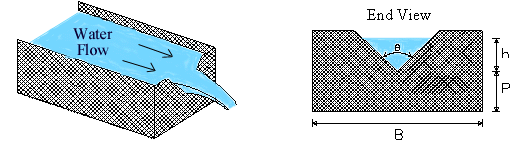
As a hint, notice that the flow in the V weir is self-similar. That is, though you may not know what the pattern of flow will be, you can expect it will be stretched the same for all heights.

As to why anyone would use this type of weir: they are easier to build and maintain than the research-standard, knife edge; they look nicer, and they are sturdier. Here’s my essay in praise of the use of dams. How dams on drains and rivers could help oxygenate the water, and to help increase the retention time to provide for natural bio-remediation.

If you’ve missed the previous problem, here it is: If you have a U-shaped drain or river-bed, and you use a small dam or weir to double the water height, what is the effect on water speed and average retention time. Work it out yourself, or go here to see my solution.

Robert Buxbaum. May 20-Sept 20, 2016. I’m running for drain commissioner. send me your answers to this problem, or money for my campaign, and win a campaign button. Currently, as best I can tell, there are no calibrated weirs or other flow meters on any of the rivers in the county, or on any of the sewers. We need to know because every engineering decision is based on the flow. Another thought: I’d like to separate our combined sewers and daylight some of our hidden drains.