Tag Archives: Canada

Lets make a Northwest Passage

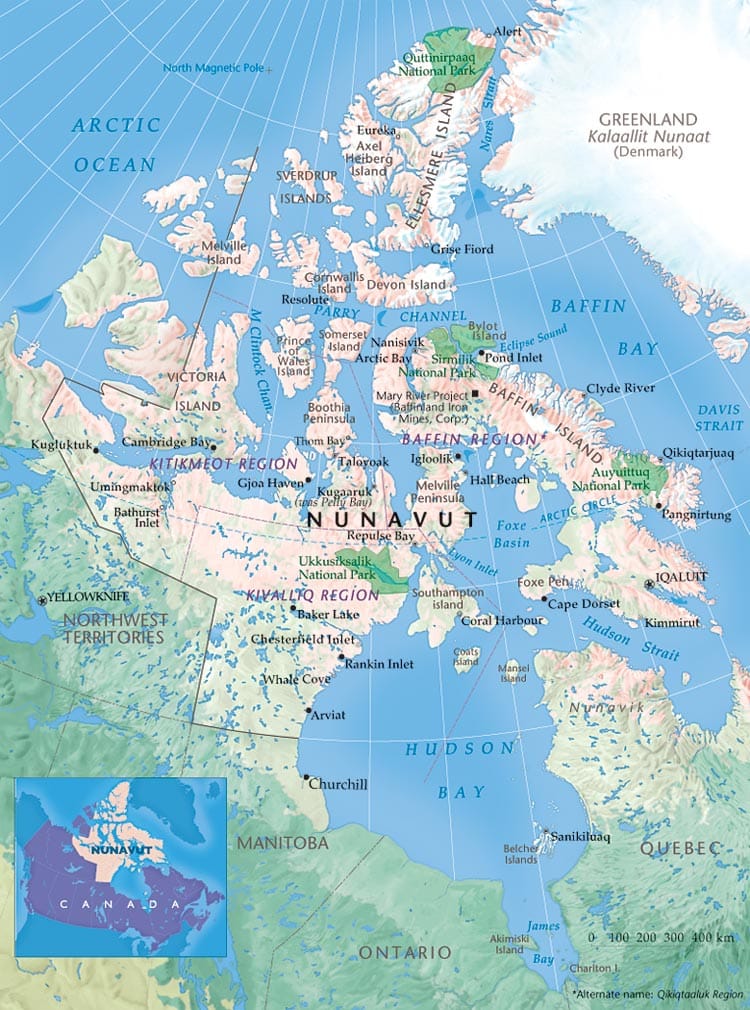
The Northwest passage opened briefly last year, and the two years before allowing some minimal shipping between the Atlantic and the Pacific by way of the Arctic ocean, but was closed in 2013 because there was too much ice. I’ve a business / commercial thought though: we could make a semi-permanent northwest passage if we dredged a canal across the Bootha peninsula at Taloyoak, Nunavut (Canada).Map of Northern Canada showing cities and the Perry Channel, the current Northwest passage. A canal north of the Bootha Peninsula would seem worthwhile.

Map of Northern Canada showing cities and the Perry Channel, the current Northwest passage. A canal north or south of the Bootha Peninsula would seem worthwhile.

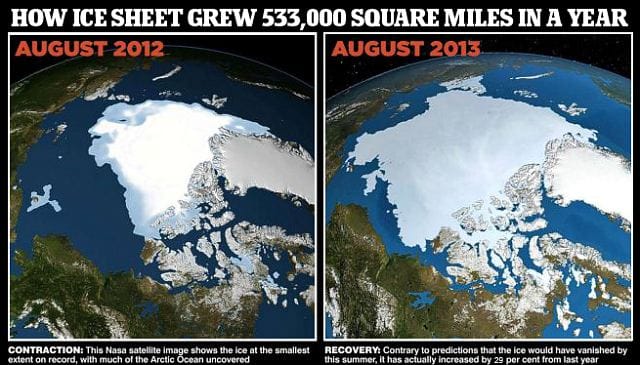
As things currently stand, ships must sail 500 miles north of Taloyoak, and traverse the Parry Channel. Shown below is a picture of ice levels in August 2012 and 2013. The proposed channels could have been kept open even in 2013 providing a route for valuable shipping commerce. As a cheaper alternative, one could maintain the Hudson Bay trading channel at Fort Ross, between the Bootha Peninsula and Somerset Island. This is about 250 miles north of Taloyoak, but still 250 miles south of the current route.

Arctic Ice August 2012-2013; both Taloyoak and Igloolik appear open this year.

The NW passage was open by way of the Perry Channel north of Somerset Island and Baffin Island in 2012, but not 2013. The proposed channels could have been kept open even this year.

Dr. Robert E. Buxbaum, October 2013. Here are some random thoughts on Canadian crime, the true north, and the Canadian pastime (Ice fishing).

Crime: US vs UK and Canada

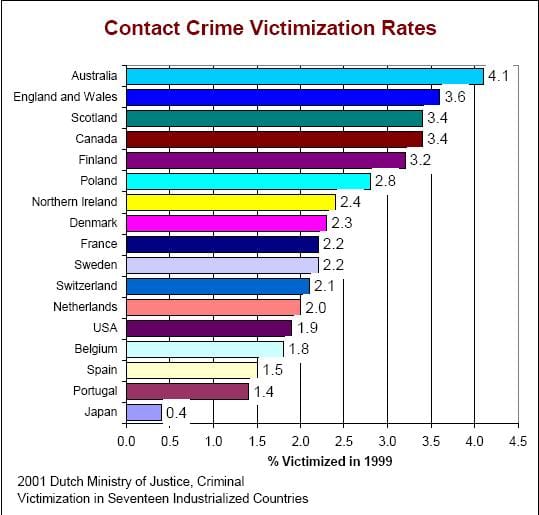
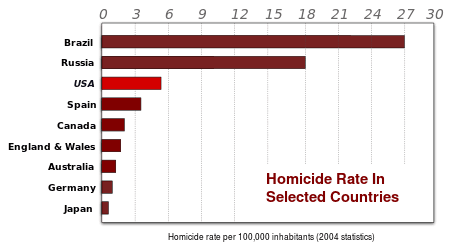
The US has a lot of guns and a lot of murders compared to England, Canada, and most of Europe. This is something Piers Morgan likes to point out to Americans who then struggle to defend the wisdom of gun ownership and the 2nd Amendment: “How do you justify 4.8 murders/year per 100,000 population when there are only 1.6/year per 100,000 in Canada, 1.2/year per 100,000 in the UK, and 1.0/year per 100,000 in Australia — countries with few murders and tough anti-gun laws?,” he asks. What Piers doesn’t mention, is that these anti-gun countries have far higher contact crime (assault) rates than the US, see below.

Contact Crime Per Country

Contact crime rates for 17 industrialized countries. From the Dutch Ministry of Justice. click here for details about the survey and a breakdown of crimes.

The differences narrow somewhat when considering most violent crimes, but we still have far fewer than Canada and the UK. Canada has 963/year per 100,000 “most violent crimes,” while the US has 420/year per 100,000. “Most violent crimes” here are counted as: “murder and non-negligent manslaughter,” “forcible rape,” “robbery,” and “aggravated assault” (FBI values). England and Wales classify crimes somewhat differently, but have about two times the US rate, 775/year per 100,000, if “most violent crimes” are defined as: “violence against the person, with injury,” “most serious sexual crime,” and “robbery.”

It is possible that the presence of guns protects Americans from general crime while making murder more common, but it’s also possible that gun ownership is a murder deterrent too. Our murder rate is 1/5 that of Mexico, 1/4 that of Brazil, and 1/3 that of Russia; all countries with strong anti-gun laws but a violent populous. Perhaps the US (Texan) penchant for guns is what keeps Mexican gangs on their, gun-control side of the border. Then again, it’s possible that guns neither increase nor decrease murder rates, so that changing our laws would not have any major effect. Switzerland (a country with famously high gun ownership) has far fewer murders than the US and about 1/2 the rate of the UK: 0.7 murders/ year per 100,000. Japan, a country with low gun ownership has hardly any crime of any sort — not even littering. As in the zen buddhist joke, change comes from within.

Homicide rate per country

Homicide rate per country

One major theory for US violence was that drugs and poverty were the causes. Remove these by stricter anti-drug laws and government welfare, and the violent crime would go away. Sorry to say, it has not happened; worse yet, murder rates are highest in cities like Detroit where welfare is a way of life, and where a fairly high fraction of the population is in prison for drugs.

I suspect that our welfare payments have hurt Detroit as much as they’ve helped, and that Detroit’s higher living wage, has made it hard for people to find honest work. Stiff drug penalties have not helped Detroit either, and may contribute to making crimes more violent. As Thomas More pointed out in the 1500s, if you are going to prison for many years for a small crime, you’re more likely to use force to avoid risk capture. Perhaps penalties would work better if they were smaller.

Charity can help a city, i think, and so can good architecture. I’m on the board of two charities that try to do positive things, and I plant trees in Detroit (sometimes).

R. E. Buxbaum, July 10, 2013. To make money, I sell hydrogen generators: stuff I invented, mostly.

Newfie joke (Newfie’s are Canadians from Newfinland)

Here’s a Newfie joke; it was originally another joke, but I tweaked it because I was in Frankenmuth today watching folks snow sculpt and ice-fish. As for Newfinland, it’s basically the Appalachia of Canada. The folks there aren’t considered to be particularly bright. Anyway.

So this Newfie decides it’s time he took up ice fishing. It’s winter and all his other Newfie friends ice fish. So he gets a setup with an ice drill, a few short fishing poles, a plastic pail to sit on, and a little tent, and he goes to set it up on the ice early one morning.

He finds a nice, empty spot, but as soon as he’s set up the pail and tent but he hears a voice from somewhere around him, “Go home, there are no fish under the ice.” He looks all around but he can’t see anyone. Who said that? Was that comment for him? He goes back to start drilling, and he hears the voice again. “Go home; there are no fish under the ice.” Well, he still can’t see anyone, but figures that maybe he should go to a different spot. He picks up his stuff, moves about 50 feet away and starts to set up again, when he hears the voice again, just as loud. “Go home, there are no fish under the ice.” “Who are you?” yells the Newfie to no-one in particular, “God?” “I’m the rink manager. There are no fish under the ice.”

True (magnetic) north

Much of my wife’s family is Canadian, so I keep an uncommon interest in Canada — for an American. This is to say, I think about it once a month or so, more often during hockey season. So here is a semi-interesting factoid:

The magnetic north pole, the “true north” has been moving northwest for some time, but the rate has increased over the last few decades as the picture shows. It has now left the northern Canadian islands, so Canada is no longer “The true north, strong and free.” (It seems to be strong and free). True north  is now moving northwest, toward Siberia. true magnetic north heading to Russia