Hamas head deposed, no peace in the middle east

Just about one month ago, the head of the head of Hamas in Syria was removed from his position atop Sheikh Abu Salah Taha’s shoulders. ISIS gave the Sheikh the metaphorical 72 virgins of severance, and his head was given a new post, a wooden pole. Though the fighting has died down since, as it were, we seem no closer to peace. As head of Hamas, Sheik Taha killed many, and ISIS has killed many more. And now, Hamas has pledged Jihad against ISIS, It’s likely ISIS heads will roll, as surviving Hamas members have joined Assad, their murderous enemy of just a few months previous.

Hamas head removed, Sheik Sala, presumed dead.

Hamas head deposed by ISIS. Sheik Salah presumed dead. Prediction: those who killed him will be killed. 

My sense is that bringing peace to the region will require 4 things: (1) one side must have a decisive military victory; (2) They must get the defeated leader to sign a surrender with some clear terms (3) They have to treat the defeated well enough that others will surrender too, and (4) They had to demonstrate the ability to govern. The surrender at Appomattox included all these things, as did Texas independence and the US revolution. By contrast, the history Mexican civil wars suggests that peace becomes near-impossible when you kill the losers, as ISIS has done in Syria. When Santa Ana killed the Texans who surrendered to him at the Alamo and at Goliad, he guaranteed that the Texans would fight on forever, no matter how desperate the odds.

When Santa Anna ordered the execution of all the Texans who surrendered he guaranteed that Texans would not surrender. That's not a road to peace.

When Santa Anna executed the Texans who surrendered at the Alamo and Goliad he guaranteed that Texans would not surrender. That’s not the road to peace.

Governance of any kind is a key distinction between countries and non-countries. In the Middle East, there is a tradition of governance by tyranny and partial genocide, but the rule cemented this way is tenuous at best. About 100 years ago, the Turks cemented their rule over Armenia by killing off many Armenians, and Russia did the same toward to Cossacks, but 70 years later Kasackstan seceded. Sadam Hussain, Bashar Assad, Col’nl Khadaffi, and Ayatollah Khomeini all ruled for reasonable times as murderous tyrants, but two of those ruler’s were killed and three of the kingdoms have descended into chaos. People who’ve seen war will often accept tyranny as a better alternative to chaos in the streets, but eventually they revolt. By contrast, Israel and Jordan have stayed reasonably stable by providing a degree of tolerance and justice.

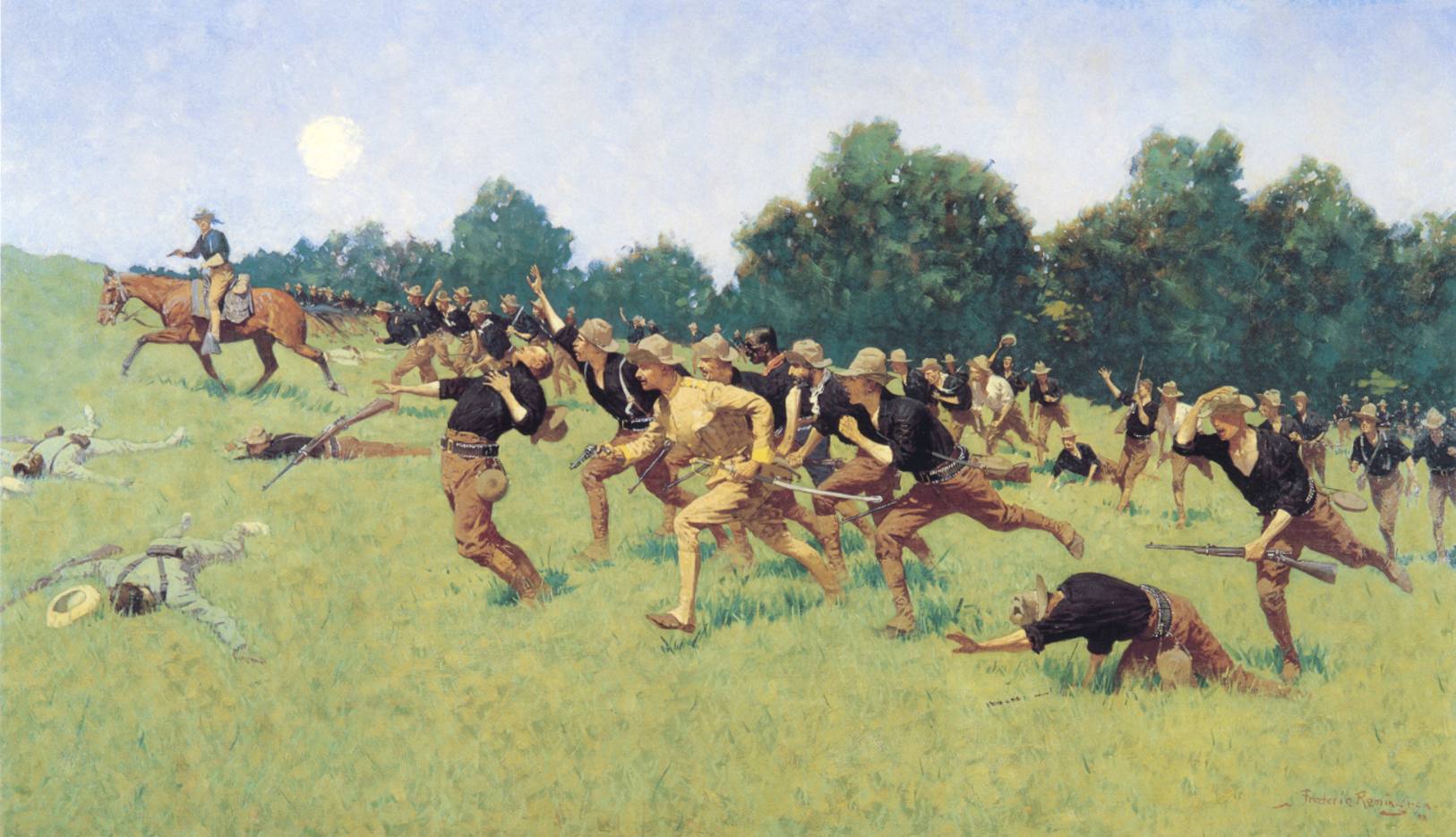
In the Mid-East peace, we’ve chosen to support tyrants: Hamas and the Iranian Khomeini, even though they are murderously anti-democracy, and even though the Ayatollah has vowed to wipe us out, and even though ISIS seems to be winning. This strategy may work for us temporarily, but I suspect these leaders will fall in a few years, and leave us to deal with anger in the wake. Faced with the options available, I’d prefer to let the war take its course, and only step in when things wind down. This is what Theodore Roosevelt did with the Russo-Japanese war: he waited for it to die down, and then stepped in to make peace when asked to do so. Syria doesn’t seem ready for peace right now, but when it is, I suspect it will be better for us if we take the role of peacemaker later than if we support a losing murder now.

Robert E. Buxbaum, May 7, 2015, edited May 11. I’ve shown previously that there is no peace with zombies until there is a cure. Until then, it’s best to run. For those who don’t know it, Roosevelt was an odd dude: here he is riding a moose.

No need to conserve energy

Earth day, energy conservation stamp from the 1970s

Energy conservation stamp from the early 70s

I’m reminded that one of the major ideas of Earth Day, energy conservation, is completely unnecessary: Energy is always conserved. It’s entropy that needs to be conserved.

The entropy of the universe increases for any process that occurs, for any process that you can make occur, and for any part of any process. While some parts of processes are very efficient in themselves, they are always entropy generators when considered on a global scale. Entropy is the arrow of time: if entropy ever goes backward, time has reversed.

A thought I’ve had on how do you might conserve entropy: grow trees and use them for building materials, or convert them to gasoline, or just burn them for power. Under ideal conditions, photosynthesis is about 30% efficient at converting photon-energy to glucose. (photons + CO2 + water –> glucose + O2). This would be nearly same energy conversion efficiency as solar cells if not for the energy the plant uses to live. But solar cells have inefficiency issues of their own, and as a result the land use per power is about the same. And it’s a lot easier to grow a tree and dispose of forest waste than it is to make a solar cell and dispose of used coated glass and broken electric components. Just some Earth Day thoughts from Robert E. Buxbaum. April 24, 2015

Zombie invasion model for surviving plagues

Imagine a highly infectious, people-borne plague for which there is no immunization or ready cure, e.g. leprosy or small pox in the 1800s, or bubonic plague in the 1500s assuming that the carrier was fleas on people (there is a good argument that people-fleas were the carrier, not rat-fleas). We’ll call these plagues zombie invasions to highlight understanding that there is no way to cure these diseases or protect from them aside from quarantining the infected or killing them. Classical leprosy was treated by quarantine.

I propose to model the progress of these plagues to know how to survive one, if it should arise. I will follow a recent paper out of Cornell that highlighted a fact, perhaps forgotten in the 21 century, that population density makes a tremendous difference in the rate of plague-spread. In medieval Europe plagues spread fastest in the cities because a city dweller interacted with far more people per day. I’ll attempt to simplify the mathematics of that paper without losing any of the key insights. As often happens when I try this, I’ve found a new insight.

Assume that the density of zombies per square mile is Z, and the density of susceptible people is S in the same units, susceptible population per square mile. We define a bite transmission likelihood, ß so that dS/dt = -ßSZ. The total rate of susceptibles becoming zombies is proportional to the product of the density of zombies and of susceptibles. Assume, for now, that the plague moves fast enough that we can ignore natural death, immunity, or the birth rate of new susceptibles. I’ll relax this assumption at the end of the essay.

The rate of zombie increase will be less than the rate of susceptible population decrease because some zombies will be killed or rounded up. Classically, zombies are killed by shot-gun fire to the head, by flame-throwers, or removed to leper colonies. However zombies are removed, the process requires people. We can say that, dR/dt = kSZ where R is the density per square mile of removed zombies, and k is the rate factor for killing or quarantining them. From the above, dZ/dt = (ß-k) SZ.

We now have three, non-linear, indefinite differential equations. As a first step to solving them, we set the derivates to zero and calculate the end result of the plague: what happens at t –> ∞. Using just equation 1 and setting dS/dt= 0 we see that, since ß≠0, the end result is SZ =0. Thus, there are only two possible end-outcomes: either S=0 and we’ve all become zombies or Z=0, and all the zombies are all dead or rounded up. Zombie plagues can never end in mixed live-and-let-live situations. Worse yet, rounded up zombies are dangerous.

If you start with a small fraction of infected people Z0/S0 <<1, the equations above suggest that the outcome depends entirely on k/ß. If zombies are killed/ rounded up faster than they infect/bite, all is well. Otherwise, all is zombies. A situation like this is shown in the diagram below for a population of 200 and k/ß = .6

FIG. 1. Example dynamics for progress of a normal disease and a zombie apocalypse for an initial population of 199 unin- fected and 1 infected. The S, Z, and R populations are shown in (blue, red, black respectively, with solid lines for the zombie apocalypse, and lighter lines for the normal plague. t= tNß where N is the total popula- tion. For both models the k/ß = 0.6 to show similar evolutions. In the SZR case, the S population disap- pears, while the SIR is self limiting, and only a fraction of the population becomes infected.

Fig. 1, Dynamics of a normal plague (light lines) and a zombie apocalypse (dark) for 199 uninfected and 1 infected. The S and R populations are shown in blue and black respectively. Zombie and infected populations, Z and I , are shown in red; k/ß = 0.6 and τ = tNß. With zombies, the S population disappears. With normal infection, the infected die and some S survive.

Sorry to say, things get worse for higher initial ratios,  Z0/S0 >> 0. For these cases, you can kill zombies faster than they infect you, and the last susceptible person will still be infected before the last zombie is killed. To analyze this, we create a new parameter P = Z + (1 – k/ß)S and note that dP/dt = 0 for all S and Z; the path of possible outcomes will always be along a path of constant P. We already know that, for any zombies to survive, S = 0. We now use algebra to show that the final concentration of zombies will be Z = Z0 + (1-k/ß)S0. Free zombies survive so long as the following ratio is non zero: Z0/S0 + 1- k/ß. If Z0/S0 = 1, a situation that could arise if a small army of zombies breaks out of quarantine, you’ll need a high kill ratio, k/ß > 2 or the zombies take over. It’s seen to be harder to stop a zombie outbreak than to stop the original plague. This is a strong motivation to kill any infected people you’ve rounded up, a moral dilemma that appears some plague literature.

Figure 1, from the Cornell paper, gives a sense of the time necessary to reach the final state of S=0 or Z=0. For k/ß of .6, we see that it takes is a dimensionless time τ of 25 or to reach this final, steady state of all zombies. Here, τ= t Nß and N is the total population; it takes more real time to reach τ= 25 if N is high than if N is low. We find that the best course in a zombie invasion is to head for the country hoping to find a place where N is vanishingly low, or (better yet) where Z0 is zero. This was the main conclusion of the Cornell paper.

Figure 1 also shows the progress of a more normal disease, one where a significant fraction of the infected die on their own or develop a natural immunity and recover. As before, S is the density of the susceptible, R is the density of the removed + recovered, but here I is the density of those Infected by non-zombie disease. The time-scales are the same, but the outcome is different. As before, τ = 25 but now the infected are entirely killed off or isolated, I =0 though ß > k. Some non-infected, susceptible individuals survive as well.

From this observation, I now add a new conclusion, not from the Cornell paper. It seems clear that more immune people will be in the cities. I’ve also noted that τ = 25 will be reached faster in the cities, where N is large, than in the country where N is small. I conclude that, while you will be worse off in the city at the beginning of a plague, you’re likely better off there at the end. You may need to get through an intermediate zombie zone, and you will want to get the infected to bury their own, but my new insight is that you’ll want to return to the city at the end of the plague and look for the immune remnant. This is a typical zombie story-line; it should be the winning strategy if a plague strikes too. Good luck.

Robert Buxbaum, April 21, 2015. While everything I presented above was done with differential calculus, the original paper showed a more-complete, stochastic solution. I’ve noted before that difference calculus is better. Stochastic calculus shows that, if you start with only one or two zombies, there is still a chance to survive even if ß/k is high and there is no immunity. You’ve just got to kill all the zombies early on (gun ownership can help). Here’s my statistical way to look at this. James Sethna, lead author of the Cornell paper, was one of the brightest of my Princeton PhD chums.

Addendum following COVID. Watch out for your politicians here. They will champion the zombie cause, moving zombies into old age homes with non-zombies, they will ignore simple protections and force you to ride the subways with zombies to provide essential services while they go to empty ballparks to watch games, and they will deny the efficacy of drugs that don’t provide money to them and promote cures that benefit them

Winning the peace at Appomattox

George A. Custer with captured confederate prisoner. Custer was a man of action but not of cruelty.

George A. Custer with a captured confederate prisoner. Custer was a man of action, but not of cruelty.

It is often forgotten that the aim of generalship is not winning a war, but winning a stable peace. In that sense, most generals and most diplomats are failures; their victories benefit only the undertaker; their peace-treaties only provide time to reload. That was the case with the Mexican civil war but not the US civil war. The choices and surrender at Appomattox, 150 years ago lead to a genuine, stable peace. It’s worthwhile, therefore to consider the how that was done here and not in Mexico, perhaps as a lesson for the future.

I begin, near the end of the war with a much-maligned general, George A Custer on April 8, 1865; this  is the day the 13th Amendment passed, four days after Lincoln walked through a defeated, smoldering Richmond, the capital of the south. The war would end soon, but would the result be peace, or chaos. George A. Custer had graduated at the very bottom of his class at West Point, the position known as goat. As is not atypical with goats, he was not particularly suited to following orders during peacetime, but was supremely suited to war and action. Custer liked to attack first and think later, but he was also a man of peace; he become the youngest Union Brevet General in US history. On April 8, with Lee at Appomattox Court House (that’s the name of the town), Custer led a small group of men to attack a nearby town, Appomattox Station, a rail depot three miles to the southwest. There he captured, without a fight, three, rail cars full of desperately needed arms, ammunition and supplies that had been sent to Lee’s army from Lynchburg.

While leaving the station, Custer’s men ran into the artillery unit of Confederate Brig. Gen. Reuben Walker, and attacked (of course) eventually capturing 25 artillery pieces, nearly 1,000 prisoners and all of their supplies. It took several attacks to win, but the results were worth it. Custer took the cannon and his troops, and positioned them on Lee’s likely escape route, on the Richmond-Lynchburg Stage Road south of Appomattox Courthouse. Lee was now nearly trapped, but didn’t know it yet.

Paining in honor of the 45th regiment colored troops: Afro-American soldier stands with flag before a bust of Washington.

Painting in honor of the 45th regiment colored troops: Afro-American soldier stands, with flag, before a bust of Washington and a depiction of battle (Fair Oaks? Petersburg?)

On the same day, April 8, General Grant sent Lee a proposition to surrender. Lee responded that he was not interested in that, but would like to meet at the McLean House at 10:00 A.M. April 9 to discuss “restoration of peace.” Grant replied that he didn’t have that power but agreed to meet Lee, none the less.

In the meantime, Lee prepared his forces to clear the Stage Road so his forces could escape south-west, to Appomattox station and home. Grant, no newcomer to war, ordered two corps (XXIV and V) under the commands of Maj. Gen. John Gibbon and Bvt. Maj. Gen. Charles Griffin to march all night to the west and north. These corps included 5000 Afro-American troops, mostly in the 45th and 116th U.S. Colored Troop Brigades. On the morning of April 9, Lee attacked to the south and managed to capture the forward pickets defending the Richmond-Lynchburg Stage Road. But when he reached the rise of the hill, he saw his escape was blocked. His 45,000 troops were surrounded by 113,000, better-armed Union soldiers, cannon and cavalry. It was then suggested that Lee disband his troops for an extended guerrilla war, an option he refused as it would lead to murdering bands roaming the county, and would make peace nearly impossible. Instead Lee rode off to discuss surrender to Grant. 

Map of the troop arrangements April 9, 1865. Checkmate. Lee's forces, x or + are out numbered, out gunned and surrounded. The end.

Map of the troop arrangements April 9, 1865. Checkmate. Lee’s forces, x or +, are out numbered, out gunned, and surrounded.

Lee’s surrender, finalized that afternoon, was penned by Grant’s aide-de camp, Lt Col’, Ely S. Parker, a Seneca Indian who had an engineering degree and studied law. The kindness to Indians may have suggested similar kindness to the surrendering Confederates. Parker eventually rose to the rank of general, and then to head of the Bureau of Indian Affairs. The terms of surrender too, were chosen to be unusually generous. Grant did not take the confederates soldiers captive, but instead allowed them to return home, relatively unmolested. Also, he allowed the officers to keep their swords and personal weapons. Kind acts like these may have eased reconstruction. Custer had demanded unconditional surrender from General Beauregard on April 9, something he probably imagined U.S. (Unconditional Surrender) Grant would have wanted; he was over-ruled by his commanding officer, Phillip Sheridan, who probably knew Grant better. 

After the war, most of the confederates swore loyalty to the US. Lee did what he could to promote reconciliation; he supported civil rights and reconstruction, and became president of Washington and Lee College. Some confederate generals and 2500 soldiers headed south to Mexico to join the French/Austrian forces of Emperor, Maximilian I, engaged in a civil war of his own. Maximilian, only 34 years old and a highly decorated Austrian officer, had little local support. He was captured and executed, June 19, 1867. Mexico then descended into chaos: a Pyrrhic victory, and a model to avoid.

Surrender at Appomattox; with Grant are Philip H. Sheridan, Orville E. Babcock, Horace Potter, Edward O.C. Ord, Seth Williams, Theodore S. Bowers, Ely S. Parker and George A. Custer. With Lee is Charles Marshall, his military secretary.

Surrender at Appomattox; with Grant are Philip H. Sheridan, Orville E. Babcock, Horace Potter, Edward O.C. Ord, Seth Williams, Theodore S. Bowers, Ely S. Parker and George A. Custer. With Lee is Charles Marshall, his military secretary. After the signing, most of the furnishings were purchased by Union officers as souvenirs. Lee shook Parker’s hand and said, I’m glad to see a real American here.” Parker replied, “We are all Americans.”

What did Mexico do wrong? For one, in order to win a peace, they failed to get the other side to agree to the peace, with clear documentation about what it is that’s been agreed to (That’s why Parker’s role is so important). Instead of killing Maximilian, they should have had him sign some sort of document and retire him to a farm or college where he could support the peace. In order to win a peace, it’s important to leave a stable country, with stable borders and a strong military, one that can govern itself fairly and well. A stable peace generally involves recognition of your government by other nations, and that too requires not killing your defeated enemy wholesale.

Robert E. Buxbaum, April 7-12, 2015. My sense is that the conditions for building a lasting peace get far too little attention in the study of war and history. I should mention that the 45th were mostly escaped slave volunteers. The 116th were ex-slaves that the Union purchased from Kentucky slave-owners at the beginning of the war to fight for the Union cause. This was thought to be a good emollient for peace, and may have helped keep Kentucky on the Union side. I should note too, that Lee freed his slaves in 1862, near the beginning of the war, a time when Grant still owned some. I’ve noted that men who choose beards tend to show a surprising republican (or communist) generosity. As Lincoln said, “Do I not defeat my enemy when I make him a friend?” For more thoughts on Lincoln’s Gettysburg Address, see here.

For All Fools Day, April 1, 2015

On this April Fools day I’m reminded of:

Democratic Senator Thomas Hart Benton, of Missouri. Before being elected to the US senate, he had been the lawyer for another Democrat, Andrew Jackson (before he was president). Like most prominent Americans of their day both men liked to settle arguments through by use of gunnery at close range. After Andrew Jackson participated in a duel with Benton’s brother, Benton himself challenged Jackson to a duel (I try to avoid this with my lawyers).

Seantor Thomas Hart Benton

Senator Thomas Hart Benton; his feud with A. Jackson, ended by common hatred of the Federal Reserve Bank

When asked about it later, Benton said, “Yes, sir, I knew him, sir; General Jackson was a very great man, sir. I shot him, sir. Afterward he was of great use to me, sir, in my battle with the United States Bank.” Ain’t that America. You can be shooting enemies one day, best of buddies the next.

In world politics and life this doesn’t happen as regularly as perhaps it should, but it happens. A few years after WWII we were allies with Germany and Italy, but enemies with the USSR. After WWI we were allies with Japan, until we weren’t; now we are again. Some day ISIS and Iran will be friends (won’t Mr A Bomb be sad).

I should also mention, and recommend the most amusing work of philosophy you are ever likely to encounter: St Erasmus of Rotterdam’s panegyric, “In Praise of Folly”. The thesis, if I may summarize: that most people like a fool and some folly; so does God. That most people don’t like long, boring lectures; neither does God. Etc. Good folly is likely to hurt you in a way you don’t mind (e.g. music, drinking, chasing women, reading long boring books if you like them); bad folly hurts others, e.g. when priest lives royally off of charity.

You might imagine that Erasmus would be executed for this but it seems he was not. It seems to me that Erasmus did something even more remarkable and made himself into a saint by claiming that God would not mind if people prayed to him for all good things. Apparently they started to, and got answered. A cheerful answer from a world of fools.

Robert E. Buxbaum, April 1, 2015.

He/she gave it to him/her/them – the new grammar of transgender

When I was in grad school, at Princeton there was a grammar joke about a ghetto kid who comes to Princeton. The kid asks, “Where’s the library at?” and is told, “This is an ivy league school. One does not end one’s sentences with a preposition here.” So the kid rephrase: “Where’s the library at, asshole?” What makes this joke poignant was that I found language divides class, and is a weapon of class war, too. At Princeton, I was of lower economic class along with virtually all of the grad school. It was not that we had less spending money, but we came from public schools, while the undergraduates were virtually all from private, “prep school”. It showed in wardrobe, tastes, and especially language.

Protesting at Fergusson; white radicals marching against cops and the system.

Ferguson rally; white radicals in a black neighborhood. Are the locals as against cops and the system?

To the prep-schooler, the working class was cheap because they were racist, or apartheid, and the preppy was trying to remedy this through activism. Rarely mentioned was that daddy was a major landlord, a college president or ambassador to Chad, or that they planned to go off to jobs in finance, law, or politics as soon as they were done rallying against class, racism, and the system. I imagine that their radical politics was partially sincere, but partially a social tool to keep the unwashed bourgeois at arm’s length. The best answer, I thought then, and now, is in grammar: we are not stingy racists, just being frugal.

The sexist label of today seems similar to the racist label of those days: partly sincere, partly a social tool built on fear, and the answer too, I think is grammar. Most people see no problem with a name change (just file the paperwork), or with a change in driver’s license sex indicator (who knows or cares?). The problem comes in with the loudly gender fluid: those who’re male today and female tomorrow and want to be respected for it. Are they a legitimate 3rd gender, or an over-pampered minority with no good claim to victimhood or anything else.

Transgender does not have to do with bed partners. Some people like to "keep it fluid" and this is where the grammar problems come in.

Transgender does not have to do with bed partners, but with self-image. Some people are confused and like (need?) to “keep it fluid”; this is where the grammar problems come in. Yet others are sons of privilege trying to make a point. Is this person confused or trying to make a point? Does it matter?

In this, and all such cases, I think it pays to respond to the legitimate complainant first and see if that answers all. One popular option is to use the words “they” or “them” when male or female labels don’t fit. Thus: “I gave my homework to them,” even though only one person received it. This is bad in my mind as it solves one problem but creates at least two others. It’s confusing to call one person many, and gives that person’s opinion extra weight. “They voted yea”, implies many people, not just one. Most Americans cringe when the queen of England says, “We request…” The queen gives her request extra weight by speaking in the plural. Similarly, “L’État, c’est moi.

More republican would be to avoid all pronouns and use the person’s name, e.g. “I gave it to Dennis”. But this can be awkward if the name is long (Hermione) or repetitively used, or if the person’s name is in flux too. What to do with someone who’s Ernestine to some, Dr. Peters to others (and Ernest in the country). Once a person settles on a single gender the grammatical problem pretty well resolves: good manners suggest one use the pronoun “him” for one who dresses male and calls himself Alphonse, not Alice.

Carrie Nation, If she says she's a woman, good manners suggests I agree

Carrie Nation, prohibitionist. If she says she’s a woman, good manners and common sense suggest we agree — no matter how masculine her behavior or dress.

There is thus a need for a good singular pronoun for the gender-fluid, and the socialists have one ready: call all people “comrade,” a word specifically chosen to be gender neutral. It further implied political solidarity and economic unity. This is fine, for some, but uncomfortable for a capitalist. Another option, one Karl Marx himself used, is “citizen.” But this word carries its own baggage from revolutionary France. Instead, I suggest “yer mate” for him/her and “matey” for he/she. Both are based on pirate lingo. Thus, ‘Matey looks t’ be drunk’. or ‘Give yer homework over to yer mate.’ It’s’s strange, but works. Give it a try on “talk like a pirate day,” September 16 every year.

It’s now to be asked, have we addressed the broader problem of those who see any gender identification as an injustice of the capitalist, repressive system? I answer, does it matter? I suspect these folks are unhappy with themselves, and will never be otherwise, but that’s just a suspicion. Even unhappy folks do good, and sometimes it’s when they try to do bad.  Here’s a poem “International Women’s Day” (1920) by–Alexandra Kollontai (1920).

Down with the world of Property and the Power of Capital! Away with Inequality, Lack of Rights and the Oppression of Women – The Legacy of the Bourgeois World! Forward To the International Unity of Working Women and Male. Workers in the Struggle for the Dictatorship of the Proletariat: The Proletariat of Both Sexes!

Suffragettes -- Meeting at Cooper Union. Not quite the poor, oppressed, but bringers of positive change, when they were not fighting for prohibition.

Suffragettes meeting at Cooper Union. Not quite the oppressed, but bringers of positive change– and also of prohibition.

Ms Kollontai was a main founder of Women’s day, and this is/ was a good thing. She was also a daughter of privilege and a fan of Stalin’s brand of social engineering: the sort that hung engineers from the lamp-posts as a warning to anti-proletarians. She was Soviet ambassador to Sweden, and as ambassador, kept Sweden from helping Poland or Finland when Stalin and Hitler joined forces to simultaneously invade those countries and murder the population. She did her good and bad together as one package. I find that the world is crazy this was, and so are the people who do things. You just have to try to take the good with the bad, and laugh if you can. Matey here owes as much to yer mate.

Robert E. Buxbaum, March 30-31, 2015.

Much of the chemistry you learned is wrong

When you were in school, you probably learned that understanding chemistry involved understanding the bonds between atoms. That all the things of the world were made of molecules, and that these molecules were fixed proportion combinations of the chemical elements held together by one of the 2 or 3 types of electron-sharing bonds. You were taught that water was H2O, that table salt was NaCl, that glass was SIO2, and rust was Fe2O3, and perhaps that the bonds involved an electron transferring between an electron-giver: H, Na, Si, or Fe… to an electron receiver: O or Cl above.

Sorry to say, none of that is true. These are fictions perpetrated by well-meaning, and sometime ignorant teachers. All of the materials mentioned above are grand polymers. Any of them can have extra or fewer atoms of any species, and as a result the stoichiometry isn’t quite fixed. They are not molecules at all in the sense you knew them. Also, ionic bonds hardly exist. Not in any chemical you’re familiar with. There are no common electron compounds. The world works, almost entirely on covalent, shared bonds. If bonds were ionic you could separate most materials by direct electrolysis of the pure compound, but you can not. You can not, for example, make iron by electrolysis of rust, nor can you make silicon by electrolysis of pure SiO2, or titanium by electrolysis of pure TiO. If you could, you’d make a lot of money and titanium would be very cheap. On the other hand, the fact that stoichiometry is rarely fixed allows you to make many useful devices, e.g. solid oxide fuel cells — things that should not work based on the chemistry you were taught.

Iron -zinc forms compounds, but they don't have fixed stoichiometry. As an example the compound at 60 atom % Zn is, I guess Zn3Fe2, but the composition varies quite a bit from there.

Iron -zinc forms compounds, but they don’t have fixed stoichiometry. As an example the compound at 68-80 atom% Zn is, I guess Zn7Fe3 with many substituted atoms, especially at temperatures near 665°C.

Because most bonds are covalent many compounds form that you would not expect. Most metal pairs form compounds with unusual stoicheometric composition. Here, for example, is the phase diagram for zinc and Iron –the materials behind galvanized sheet metal: iron that does not rust readily. The delta phase has a composition between 85 and 92 atom% Zn (8 and 15 a% iron): Perhaps the main compound is Zn5Fe2, not the sort of compound you’d expect, and it has a very variable compositions.

You may now ask why your teachers didn’t tell you this sort of stuff, but instead told you a pack of lies and half-truths. In part it’s because we don’t quite understand this ourselves. We don’t like to admit that. And besides, the lies serve a useful purpose: it gives us something to test you on. That is, a way to tell if you are a good student. The good students are those who memorize well and spit our lies back without asking too many questions of the wrong sort. We give students who do this good grades. I’m going to guess you were a good student (congratulations, so was I). The dullards got confused by our explanations. They asked too many questions, and asked, “can you explain that again? Or why? We get mad at these dullards and give them low grades. Eventually, the dullards feel bad enough about themselves to allow themselves to be ruled by us. We graduates who are confident in our ignorance rule the world, but inventions come from the dullards who don’t feel bad about their ignorance. They survive despite our best efforts. A few more of these folks survive in the west, and especially in America, than survive elsewhere. If you’re one, be happy you live here. In most countries you’d be beheaded.

Back to chemistry. It’s very difficult to know where to start to un-teach someone. Lets start with EMF and ionic bonds. While it is generally easier to remove an electron from a free metal atom than from a free non-metal atom, e.g. from a sodium atom instead of oxygen, removing an electron is always energetically unfavored, for all atoms. Similarly, while oxygen takes an extra electron easier than iron would, adding an electron is energetically unfavored. The figure below shows the classic ion bond, left, and two electron sharing options (center right) One is a bonding option the other anti-bonding. Nature prefers this to electron sharing to ionic bonds, even with blatantly ionic elements like sodium and chlorine.

Bond options in NaCl. Note that covalent is the stronger bond option though it requires less ionization.

Bond options in NaCl. Note that covalent is the stronger bond option though it requires less ionization.

There is a very small degree of ionic bonding in NaCl (left picture), but in virtually every case, covalent bonds (center) are easier to form and stronger when formed. And then there is the key anti-bonding state (right picture). The anti bond is hardly ever mentioned in high school or college chemistry, but it is critical — it’s this bond that keeps all mater from shrinking into nothingness.

I’ve discussed hydrogen bonds before. I find them fascinating since they make water wet and make life possible. I’d mentioned that they are just like regular bonds except that the quantum hydrogen atom (proton) plays the role that the electron plays. I now have to add that this is not a transfer, but a covalent spot. The H atom (proton) divides up like the electron did in the NaCl above. Thus, two water molecules are attracted by having partial bits of a proton half-way between the two oxygen atoms. The proton does not stay put at the center, there, but bobs between them as a quantum cloud. I should also mention that the hydrogen bond has an anti-bond state just like the electron above. We were never “taught” the hydrogen bond in high school or college — fortunately — that’s how I came to understand them. My professors, at Princeton saw hydrogen atoms as solid. It was their ignorance that allowed me to discover new things and get a PhD. One must be thankful for the folly of others: without it, no talented person could succeed.

And now I get to really weird bonds: entropy bonds. Have you ever noticed that meat gets softer when its aged in the freezer? That’s because most of the chemicals of life are held together by a sort of anti-bond called entropy, or randomness. The molecules in meat are unstable energetically, but actually increase the entropy of the water around them by their formation. When you lower the temperature you case the inherent instability of the bonds to cause them to let go. Unfortunately, this happens only slowly at low temperatures so you’ve got to age meat to tenderize it.

A nice thing about the entropy bond is that it is not particularly specific. A consequence of this is that all protein bonds are more-or-less the same strength. This allows proteins to form in a wide variety of compositions, but also means that deuterium oxide (heavy water) is toxic — it has a different entropic profile than regular water.

Robert Buxbaum, March 19, 2015. Unlearning false facts one lie at a time.

Brass monkey cold

In case it should ever come up in conversation, only the picture at left shows a brass monkey. The other is a bronze statue of some sort of a primate. A brass monkey is a rack used to stack cannon balls into a face centered pyramid. A cannon crew could fire about once per minute, and an engagement could last 5 hours, so you could hope to go through a lot of cannon balls during an engagement (assuming you survived).

A brass monkey cannonball holder. The classic monkeys were 10 x 10 and made of navy brass.

Small brass monkey. The classic monkey might have 9 x 9 or 10×10 cannon balls on the lower level.

Bronze sculpture of a primate playing with balls -- but look what the balls are sitting on: it's a surreal joke.

Bronze sculpture of a primate playing with balls — but look what the balls are sitting on: it’s a dada art joke.

But brass monkeys typically show up in conversation in terms of it being cold enough to freeze the balls off of a brass monkey, and if you imagine an ornamental statue, you’d never guess how cold could that be. Well, for a cannonball holder, the answer has to do with the thermal expansion of metals. Cannon balls were made of iron and the classic brass monkey was made of brass, an alloy with a much-greater thermal expansion than iron. As the temperature drops, the brass monkey contracts more than the iron balls. When the drop is enough the balls will fall off and roll around.

The thermal expansion coefficient of brass is 18.9 x 10⁻⁶/°C while the thermal expansion coefficient of iron is 11.7 x10⁻⁶/°C. The difference is 7.2×10⁻⁶/°C; this will determine the key temperature. Now consider a large brass monkey, one with 400 x 400 holes on the lower level, 399 x 399 at the second, and so on. Though it doesn’t affect the result, we’ll consider a monkey that holds 12 lb cannon balls, a typical size of 1750 -1830. Each 12 lb ball is 4.4″ in diameter at room temperature, 20°C in those days. At 20°C, this monkey is about 1760″ wide. The balls will fall off when the monkey shrinks more than the balls by about 1/3 of a diameter, 1.5″.

We can calculate ∆T, the temperature change, °C, that is required to lower the width-difference by 1.5″ as follows:

kepler conjecture, brass monkey

-1.5″ = ∆T x 1760″ x 7.2 x10⁻⁶

We find that ∆T = -118°C. The temperature where this happens is 118 degrees cooler than 20°C, or -98°C. That’s a temperature that you could, perhaps reach on the South Pole or maybe deepest Russia. It’s not likely to be a problem, especially with a smaller brass monkey.

Robert E. Buxbaum, February 21, 2015 (modified Apr. 28, 2021). Some fun thoughts: Convince yourself that the key temperature is independent of the size of the cannon balls. That is, that I didn’t need to choose 12 pounders. A bit more advanced, what is the equation for the number of balls on any particular base-size monkey. Show that the packing density is no more efficient if the bottom lawyer were an equilateral triangle, and not a square. If you liked this, you might want to know how much wood a woodchuck chucks if a woodchuck could chuck wood, or on the relationship between mustaches and WWII diplomacy.

Detroit emerges from bankruptcy. Not quite.

missing homes Detroit

While Detroit’s central core comes back, surrounding, homes burn at 220+/month, leave Detroit streets looking like the teeth of an aging hillbilly.

Detroit went bankrupt last year, the largest US city to do so since New York in 1970. As with New York’s bankruptcy, Detroit’s was used to cancel old debts and rewrite ill-thought contracts. Detroit also got to jail some crooked politicians including mayor Kilpatrick, described as “a walking crime wave.” But the city and county have no easy path out of bankruptcy as both city and county are likely insolvent. That is, they spend more than they take in despite massive out-state funding, and high taxes, 10% above the state level. To make matters worse, they are losing population at the rate of 1% or so per year. It’s hard to fund a city built for 2 million on the tax revenue of 1/3 as many, especially when they are mostly unemployed. Unless a lot changes soon, another bankruptcy is almost inevitable — likely this time at the county level.

We got in this predicament, largely as a result of a 50 year war between the black political establishment of the city, solidly Democrat, crooked, somewhat anarchist, and the white, stayed, mostly Republican out-state. The white population fled following Detroits riots of the 60s, and the richer black population soon followed. The remainder, poor, old and black, stayed, trapped in slowly decaying neighborhoods, relying on flashy, crooked politicians as the city went broke. White flight allowed the black community to develop its own, Motown culture, but except for the music industry, Detroit has not benefitted from this culture.

Detroit's murder rate, 45/100,000, is the highest in the US. It's coming down but not that fast.

Detroit’s murder rate is the highest in the US. It’s come down 10% in the last 2 years, but has far to go.

Detroiters have poor health, poor savings rates, high murder rates. The fire rate is about .22% per month, 2.6% per year. The city lacks reliable fire fighting and street plowing. Police, at one point, erected signs at the border that said, “Enter at your own risk.” There is a lack of small businesses and the services they would provide too: laundromats, grocery stores, and taxis (though no lack of bars and marijuana maintenance clinics). Employment in the auto-industry is down. And it’s not being replaced by home-grown small business – perhaps hampered by the low savings rate. A surprisingly large fraction of Detroit homes are in foreclosure, see map, and with it there’s a high abandonment rate. The high fire rate is at least half arson to collect on insurance. As pheasant and dear return, non-core Detroit is beginning to look like farm country.

Detroit foreclosures near me. Blue is occupied homes, red is unoccupied, yellow unknown, and green is destroyed homes or vacant, foreclosed land.

Detroit foreclosures near me. Homes in dark blue are occupied foreclosed, red is unoccupied, and green plots are destroyed homes or vacant, foreclosed land.

It’s not clear what political leaders should do now. The city council would like to return to their pre-bankruptcy ways where they could borrow as much as they felt they needed and spend on whatever they saw fit — often on fast friends, fast cars, gambling, and vacation homes outside of the city. But the out-state population has been reluctant to give them the credit card. Is this racist or prudent — probably both, but this war can not continue. The city and county pension funds were ransacked for ill-advised investments and consulting fees to cronies and their power-lawyers. Either the money is replaced from out-state or there will be some unhappy retirees in the not-too-distant future. My guess is that the state will have to pick up the tab for this mismanagement, but only if they don’t have to hand over management control afterwards.

Rand Paul, a potential GOP presidential candidate, has proposed rebuilding business and property values by a method that the city will almost certainly reject. His solution: cut services to low-population density areas and cut taxes on business and earned income. While this would likely bring in new people and new businesses, the people would likely be white, and the businesses white-owned/ white-serving. Black-Detroiters have too little savings, organization and income to directly benefit from this plan, and black politicians are likely to feel threatened. They are likely to claim, not without merit, that this is welfare for rich whites: a way for them to become yet-richer while doing nothing for the poor blacks of the burning neighborhoods. They are likely to demand control as the elected officials of the town: regulating business and raising the minimum wage to create “equality.” I suspect this is a bad idea.

Detroit hunger games

Detroit suffers from two populations and a divide.

To some extent we’re already seeing the return of white-owned, white-serving businesses. Classic buildings in the core of the city have been purchased by white developers – notably Dan Gilbert of Quicken Loans leading to gentrification and an influx of single, white hipsters. The newcomers are viewed as half-saviors, half-carpetbaggers. They dwell in a whiter city core with hipster bars and expensive restaurants. Does a poor city with massive debt, crime, and unemployment benefit from a core filled with high-priced, gourmet coffee and fern bars?

The author, Robert Buxbaum, enjoys a day at an artificial beach in central Detroit.

The author, Robert Buxbaum, enjoys a beer at an artificial beach-cafe in central Detroit with some, few black folks, none poor. Is this good for Detroit?

The new hipsters put a squeeze on city services too — one that’s hard to deal with fairly. Detroit can not afford to plow all the streets after a snow. Should the new high-tax white folks get plowed streets, or should they suffer equally with everyone else? Detroit education is abysmal, but the high tax-bracket folks want better. Should they get it, or suffer equally? They want extra street lights and police protection. Should they get it, or suffer equally? Is this the way up?  A solution I’d proposed some while ago was to divide the core city from the now-rural outskirts so that each could be managed more sanely. It’s not a grand a solution like Rand’s plan, but less likely to be rejected. One way or another, we seem destined to have a Detroit with a rich core and abandoned neighborhoods. I suspect it might as well be managed that way.

Robert E. Buxbaum, February 10, 2015. I don’t have solutions, but write about the city’s problems, and the partial solutions I’ve heard of as a way to clarify my thinking — and perhaps yours too.

you are what you eat?

The simplest understanding of this phrase is that you should eat good, healthy foods to be healthy, and that this will make you healthy in body and mind.

The author of the study published this book against GM foods simultaneously with release of his paper.

The author of this book against unhealthy foods faked his analysis to support the book.

Clearly there is some truth to this. Crazy people look crazy and often eat crazy. Even ‘normal’ people, if they eat too much are likely to become fat, lazy, and sick. There is a socio- economic effect (fat people earn less), and a physiological evidence that gut bacteria affects anxiety and depression (at least in rats). My sense here is at the diet extremes though. There is little, or no evidence to suggest you can make yourself more intelligent (or kind or good) by eating more of the right stuff, or just the right foods in just the right amounts. A better diet can make you look better, but there is a core lie at work when you extend this to imply that the real you is your body, or so tied to your body that a healthy mind can not be found in a sickly body. But most evidence is that the mind is the real you, and (following Socrates) that beautiful minds are found in sickly bodies. I’ve seen few (basically, no) healthy poets, writers, or great artists. Neither are there scientists of note (that I can recall) who lived without smoking, drinking, and any bad habits. Many creative people did drugs. George Orwell smoked cigarette, and died of TB, but wrote well to the end. There is no evidence that bad writing or thinking can be improved by health foods. Stupid is as stupid does, and many healthy people are clearly dolts.

Not that it’s always clear what constitutes good health, or what constitutes good food for health, or what constitutes a good mind. Skinny people may be admired and may earn more, but it is not clear they are healthy. Yule Gibbons, the natural food guru died young of stomach cancer. Adele Davis, another the author of “eat right to be healthy,” died of brain cancer. And Jim Fix, “the running doctor” died young of a heat attack while running. Their health foods may have killed them, and that unhealthy foods, like chocolate and coffee can be good for you. It’s likely a question of balance. While a person will feel better who dresses well, the extreme is probably no good. Very often, a person is drawn after his self-image to be the person he pretends. Show me a man who eats only vegetarian, and I’ll show you someone who sees himself as spiritual, or wants to be seen as spiritual. And that man is likely to be drawn to acting spiritual. Among the vegetarians you find Einstein, George B. Shaw, and Gandhi, people who may have been spiritual from the start, but may have been kept to spirituality from their diets. You also find Hitler: spirituality can take all sorts of forms.

Ward Sullivan in the New Yorker

Ward Sullivan in the New Yorker. People eat, drink, and dress like who they are. And people become like those they eat drink and dress like.

Choice of diet also helps select the people you run into. If you eat vegetarian, you’re likely to associate with other vegetarians, and you will likely behave like them. If you eat Chinese, Greek, or Mexican food, you’re likely to associate with these communities and behave like them. Similarly, an orthodox Jew or Moslem is tied to his community with every dinner and every purchase from the kosher or halal store.

And now we come to the bizarre science of bio-systems. Each person is a complex bio-system, with more non-human DNA than human, and more non-human cells than human. A person has a vast army of bugs on him, and a similarly vast pool of bugs within him. Recent research suggests that what we eat affects this bio-system, and through it our mental state. For whatever the mechanism, show me someone who drinks only 30 year Scotch or 40-year-old French wine, and I’ll show you a food snob. By contrast, show me someone who eats good, cheap food, and drinks good, cheap wine or Scotch (Lauder’s or Dewar’s), and I’ll show you a decent person very much like myself, a clever man who either is a man of the people or who wants to be known as one.”Dis-moi ce que tu manges, je te dirai ce que tu es.” [Tell me what you eat and I will tell you what you are].

Robert E. Buxbaum, February, 2015. My 16-year-old daughter asked me to write on this topic. Perhaps she didn’t know what it meant, or how true I thought it was, or perhaps she liked my challenges of being 16.