Category Archives: REB Research products

What is the best hydrogen storage medium?

Answering best questions is always tricky since best depends on situation, but I’ll cover some hydrogen storage options here, and I’ll try to explain where our product options (cylinder gas purifiers and methanol-water reformers) fit in.

The most common laboratory option for hydrogen storage is inside a tank; typically this tank is made of steel, but it can be made of aluminum, fiberglass or carbon fiber. Tanks are the most convenient source for small volume users since they are instantly ready for delivery at any pressure up to the storage pressure; typically that’s 2000 psi (135 atm) though 10,000 (1350 atm) is available by special order. The maximum practical density for this storage is about 50 g/liter, but this density ignores the weight of the tank. The tank adds a factor of 20 or to the weight, making tanks a less-favored option for mobile users. Tanks also add significantly to the cost. They also tend to add impurities to the gas, and there’s a safety issue too: tanks sometimes fall over, and compressed gas can explode. For small-volume, non-mobile users, one can address safety by chaining up ones tank and adding a metal membrane hydrogen purifier; This is one of our main products.

Another approach is liquid hydrogen; The density of liquid hydrogen is higher than of gas, about 68 g/liter, and you don’t need as a tank that’s a big or heavy. One problem is that you have to keep the liquid quite cold, about 25 K. There are evaporative losses too, and if the vent should freeze shut you will get a massive explosion. This is the storage method preferred by large users, like NASA.

Moving on to metal hydrides. These are heavy and rather expensive but they are safer than the two previous options. To extract hydrogen from a metal hydride bed the entire hydride bed has to be heated, and this adds complexity. To refill the bed, it generally has to be cooled, and this too adds complexity. Generally, you need a source of moderately high pressure, clean, dry hydrogen to recharge a bed. You can get this from either an electrolysis generator, with a metal membrane hydrogen purifier, or by generating the hydrogen from methanol using one of our membrane reactor hydrogen generators.

Borohydrides are similar to metal hydrides, but they can flow. Sorry to say, they are more expensive than normal metal hydrides and they can not be regenerated.They are ideal for some military use

And now finally, chemical materials: water, methanol, and ammonia. Chemical compounds are a lot cheaper than metal hydrides or metal borohydrides, and tend to be far more readily available and transportable being much lighter in weight. Water and/or methanol contains 110 gm of H2/liter;  ammonia contains 120 gms/liter, and the tanks are far lighter and cheaper too. Polyethylene jugs weighing a few ounces suffices to transport gallon quantities of water or methanol and, while not quite as light, relatively cheap metallic containers suffice to hold and transport ammonia.

The optimum choice of chemical storage varies with application and customer need. Water is the safest option, but it can freeze in the cold, and it does not contain its own chemical energy. The energy to split the water has to come externally, typically from electricity via electrolysis. This makes water impractical for mobile applications. Also, the hydrogen generated from water electrolysis tends to be impure, a problem for hydrogen that is intended for storage or chemical manufacture. Still, there is a big advantage to forming hydrogen from something that is completely non-toxic, non-flammable, and readily available, and water definitely has a place among the production options.

Methanol contains its own chemical energy, so hydrogen can be generated by heating alone (with a catalyst), but it is toxic to drink and it is flammable. I’ve found a  my unique way of making hydrogen from methanol-water using  a membrane reactor. Go to my site for sales and other essays.

Finally, ammonia provides it’s own chemical energy like methanol, and is flammable, like methanol; we can convert it to hydrogen with our membrane reactors like we can methanol, but ammonia is far more toxic than methanol, possessing the power to kill with both its vapors and in liquid form. We’ve made ammonia reformers, but prefer methanol.
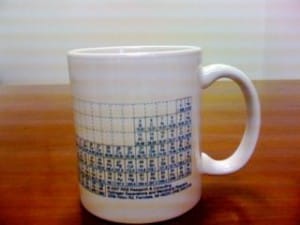
REB Research periodic table cup

Some 20 years ago I designed this periodic table cup, but with only the 103 named elements that existed then. In part this was done because I wanted a good, large, white coffee cup, in part because I often found I needed a periodic table, and didn’t like to have to look one up, and in part to people how much more area you get on a cylinder than on a flat sheet (roughly 3.14 times more area). To show that, I put all the side elements (rare earth lanthanides, and actinides) where they belonged, and not off on the side. I also put hydrogen in twice, once as a metal (HCl) and once as a non metal (NaH). The color I chose was Tryian Blue, a key color of Biblical Tyre, what you get from male purpura mollusks (the females give a shade of red that I also try to associate with REB Research).

I’ve updated the cup to add more elements: I think it’s great. You can buy it for $45 through our web-site, or for $40 by e-mailing me (reb@rebresearch.com). Or if you do something really cool, I may send you one for free.

REB Research, Periodic table coffee cup

REB Research, Periodic table coffee cup

By the way, I only use 4 digits for the atomic weight; I can think of no application where a normal person needs more.

How hydrogen and/or water can improve automobile mileage (mpg)

In case you’ve ever wondered why it was that performance cars got such poor milage, or why you got such bad milage in the city, the biggest single problem has to do with the vacuum drawn by the engine, some of the problem has to do with the speed of combustion, some has to do with rolling friction, and some with start/stop loss too. Only a very small fraction of the energy is lost on air friction until you reach highway speeds.

Lets consider vacuum loss first as it is likely the worst offender. A typical US car, e.g. a Chevy Malibu, has a 3.5 liter engine (a performance car has an engine that’s much larger). As you toodle down a street at 35 mph, your engine is going at about 2000 rpm, or 33 rps. Since the power required to move the car is far less than the 200 hp that the car could deliver, the air intake is throttled so that the engine is sucking a vacuum of about 75 kpa (10 psi for those using English units). To calculate the power loss this entails, multiply 33*3.5*80; this is about 8662 Watts, or 12 hp. To find the energy use per mile, divide by your average speed, 25 mph (it would be 35 mph, but you sometimes stop for lights). 8 kW/25 mph = .21 kW-hr/mile. One finds, as I’ll show that the car expends more energy sucking this vacuum than pushing the car itself. This is where the majority of the city mpg goes in a normal car, but it’s worse in a high performance car is worse since the engine is bigger. In city driving, the performance mpg will be lower than for a Malibu even if the performance car is lighter, if it has better aerodynamics (it does), and if you never stop at lights.

The two other big places were city mileage goes is overcoming rolling friction and the need to stop and go at lights, stop signs, etc. The energy used for rolling friction is the force it would take to push your car on level ground when in neutral times the distance. For a typical car, the push force is about 70 lbs or 32 kgs or 315 Nt; it’s roughly proportional to the car’s weight. At 35 mph, or 15.5 m/s, the amount of power this absorbs is calculated as the product of force and speed: 15.5*315 = 4882 W, or about 6.5 hp. The energy use is 4.9 kW/35 mph =.14 kWhr/mile. The energy loss from stop lights is similar to this, about .16 kWhr/mile, something you can tell by getting the car up to speed and seeing how far it goes before it stops. It’ll go about 2-3 blocks, a little less distance than you are likely to go without having to stop. Air resistance adds a very small amount at these speeds, about 2000 W, 2.7 hp, or .05 kWhr/mile; it’s far more relevant at 65 mph, but still isn’t that large.

If you add all this together, you find the average car uses about .56 kWhr/mile. For an average density gasoline of 5.6 lb/gal, and average energy-dense gasoline, 18,000 BTU/lb, and an average car engine efficiency of 11000 BTU/kWhr, you can now predict an average city gas mileage of 16.9 mpg, about what you find experimentally. Applying the same methods to highway traffic at 65 mph, you predict .38 kWhr/mile, or 25 mpg. Your rpms are the same on the highway as in the city, but the throttle is open so you get more power and loose less to vacuum.

Now, how do you increase a car’s mpg. If you’re a Detroit automaker you could reduce the weight of the car, or you the customer can clean the junk out of your trunk. Every 35 lbs or so increases the rolling friction by about 1%. These is another way to reduce rolling friction and that’s to get low resistance tires, or keep the tires you’ve got full of air. Still, what you’d really like to do is reduce the loss to vacuum energy, since vacuum loss is a bigger drain on mpg.

The first, simple way to reduce vacuum energy loss is to run lean: that is, to add more air than necessary for combustion. Sorry to say, that’s illegal now, but in the olden days before pollution control you could boost your mpg by adjusting your carburator to add about 10% excess of air. This reduced your passing power and the air pollution folks made it illegal (and difficult) after they noticed that it excess air increased NOx emissions. The oxygen sensor on most cars keeps you from playing with the carburator these days.

Another approach is to use a much smaller engine. The Japanese and Koreans used to do this, and they got good milage as a result. The problem here is that you now had to have a very light car or you’d get very low power and low acceleration — and no American likes that. A recent approach to make up for some of the loss of acceleration is by adding a battery and an electric motor; you’re now making a hybrid car. But the batteries add significant cost, weight and complexity to these cars, and not everyone feels this is worth it. So now on to my main topic: adding steam or hydrogen.

There is plenty of excess heat on the car manifold. A simile use of this heat is to warm some water to the point where the vapor pressure is, for example, 50 kPa. The pressure from this water adds to the power of your engine by allowing a reduction in the vacuum to 50 kPa or less. This cuts the vacuum loss at low speeds. At high speed and power the car automatically increases the air pressure and the water stops evaporating, so there is no loss of power. I’m currently testing this modification on my own automobile partly for the fun of it, and partly as a preface to my next step: using the car engine heat to run the reaction CH3OH + H2O –> CO2 + H2. I’ll talk more about our efforts adding hydrogen elsewhere, but thought you might be interested in these fundamentals.

http://www.rebresearch.com

How and why membrane reactors work

What follows is a shorter, easier version of my old essay on how membrane reactors work to get you past the normal limits of thermodynamics. Also, I’m happy to say, our membrane reactors designs have gotten simpler, and that deserves an update.

At left, is our current, high pressure membrane reactor design, available in one-tube to  72 tube reactor assembly; high pressure, or larger, I suppose. Typically, the area around the shell is used for heat transfer. One needs to add heat to promote endothermic reactions like methanol reforming CH3OH + H2O –> 3H2 + CO2, or ammonia cracking 2NH3 –> N2 + 3H2. You need to take away heat from exothermic reactions, like the water gas shift reaction, CO + H2O –> CO2 + H2. Generally you want to have some heat transfer to help drive the reaction.

The reactor is a shell containing metallic tubes that filter gas. Normally the idea is for hydrogen to be formed in the shell area, and leave by diffusion through the tube walls and down the tubes, leaving as pure hydrogen (only hydrogen can go through metals). We typically suggest to have the reactor sit this way, with the tubes pointed up, and the body half-filled or more with catalyst. According to normal thermodynamics, the extent of a reaction like ammonia cracking will be negatively affected by overall pressure, and the extent of the WGS reaction is only affected by operating temperature. The membrane reactor allows you to remove hydrogen while the reaction progresses, and allows you to get good conversion at higher pressures too. That’s because hydrogen removal shifts the equilibrium so the reaction goes further. The effect is particularly significant at higher pressures. By combining the steps of reaction with separation, we can operate a higher pressures, delivering ultra high purity, avoiding the normal limitations of thermodynamics.

The water-gas reaction, CO + H2O –> CO2 + H2, deserves special mention since it’s common and exothermic. In a normal reactor, your only option to drive the reaction to near completion is by operating at low temperature where the catalyst barely works, 200 °C, or lower. You also have to remove the heat of reaction. In a membrane reactor, you can operate at a much higher temperature, especially if you work at higher pressure. At higher temperature the catalysts work better, and you don’t have to work so hard to remove heat.

At our company, REB Research, we sell membrane reactors; and catalysts, membrane tubes, and consulting.

Creepy sculpture at REB Research & Consulting.

Me with Gilroy

    Me with Gilroy
During our downtime, I’ve been making a creepy sculpture that I call Gilroy. It looks a lot like Kilroy of WW2 fame, but its eyes follow you through use of a reasonably clever optical illusion. I’ve embedded a video of my secretary, Libby, standing next to our current, small version of Gilroy (Gilroy is the less hairy one on the right). If the embedded video works, you’ll see Gilroy’s eyes follow you. My secretary, Libby (more hair) is on the left. Her eyes follow you too, but less creepily .Gilroy and CL Brodman – Wi-Fi
Here’s what we do more normally at REB Research (hydrogen purifiers and hydrogen generators).