Category Archives: personal relationships

Narcissism, a horrible disease except in presidents.

Perhaps the worst sort of employee is a narcissist. A narcissist is in love with an image of himself that he sees, and that he has created. Though his behavior does not match the image — it can not –the narcissist can not, or will not accept the damage he’s caused by insubordination and undercutting. The typical narcissist is always right, and is confident of being right, even when seriously wrong. He can take some (little) advice because he sees himself as humble, but he will not take blame, and thus does not change. He can be charming in his love of you and your ideas. Still, you’ll notice his complete disdain for others and of ideas that (to you) look equally brilliant. And once he accepts your first idea as brilliant, he’s unlikely to change to accept your second, or modified version.

The Great Gatsby created an image of himself, and strove to live it. "He looked at you like the moon and the stars shone out of your eyes."

The Great Gatsby created an image of himself, and strove to live it. “He looked at you like the moon and the stars shone out of your eyes.”

The narcissist friend or boss is somewhat better. He creates a positive mental image of those around him, usually seeing them as kind, holy, or smart people. The Great Gatsby was a classic example of this. It’s nice to be in his presence, “seen as you’d wish to be seen, as if the moon and the stars shone in your eyes”. It’s an image the narcissist does his best maintain, both of you and of him, even if it kills you and him together. This is still a damaging, false image, but it has a tremendous up-side or two in a friend or boss. It’s nice to work with someone who sees you as God’s gift even if you know it’s false. Besides that, the narcissist usually has some general plan of action or knows how to get one (e.g. hire the best, consult the iChing, build a wall). The plan might not be great, but it’s usually better than having no-plan or waiting to consult the consultants at every turn. And unlike most folks, the narcissist knows he must stick to the plan or he looks like a loser. It also helps that he or she, by force of charisma, has the ability to make others stick to the plan. In times of trouble or confusion, that’s usually far better than hopeless paralysis. Also good is that narcissists tend to collect solid followers — a plus when leading a big organization where decisions are important. The leader can not hope to manage all the details of a big organization, and needs to be able to rely on loyal minions to follow general his orders and get the details right.

There are few bigger organizations than government. Government leadership has seen an uncommon concentration of narcissists, and these have done rather well, considering. In the US and elsewhere the best (and worst) leaders have been narcissists, mostly. Napoleon, FDR, Stalin, Churchill, Christ, Mohammed, Hitler, Bill Clinton, Gandhi, and Genghis Kahn; all narcissists as best I can tell. They all saw themselves as great, behaved accordingly, and got people to follow. They made grand plans and carried them out by convincing others to go along: the others providing the necessary blood, sweat, tears, and death. Their approach may appall when seen in quiet times, but it’s absolutely necessary in troubled times when the normal alternatives are confusion and despair. Jimmy Carter, a more-normal type, folded in times of trouble; he dithered in the face of the Ayatollah and of Idi Amin. Twice he started Iranian rescue operations, then called them off — in both cases at the worst possible moments. People died, friends lost hope. Carter was a normal person in a situation that required a narcissist. Meanwhile, the Ayatollah and Idi Amin did as narcissist do, for better or worse.

It’s been pointed out that Donald Trump is a narcissist (he is, congratulations). I strongly suspect that’s true of Cruz, and Sanders too. Trump’s narcissism is unusually blatant because his vision of himself is unusually brash. Cruz and Sanders, have quieter visions of themselves mixing feigned humility with their firm resolve. I don’t see these visions as better, just more normal-looking. Brash visions can be a negative, of course, both in a US president, and in a corporate president, but to have no vision is worse. Apple computer company seems to have no vision now that Steve Jobs is dead, and it’s floundering. Jeb! Bush, similarly seemed to have had no firm vision, and he ended his run as a washed-up flotsam. As for HRC, I don’t know. Fortunately, the US government has the power to rein in any (I think) narcissist, via the constitution’s balance of power. Congress and the supreme court, if they choose to use it, have the power to stop any excess of a narcissist president. The narcissist will fight, but will eventually will bend to them; the one thing the narcissist does not wish is to see himself as, is as a loser, and they have the power to portray him that way. The US will survive whoever gets elected.

Robert Buxbaum, April 10, 2016. I’m not a psychologist and might be dead wrong here, but how I see things at the moment is that Trump’s narcissism is manageable and perhaps advantageous. Besides, I’ve argued in favor of tariffs for some time, so we have some policy agreement. For April Fools day, last year, I described the duel of a famous narcissist president, Andrew Jackson, with his lawyer.
Celebrating the Eids of March

March 15, the eids of March. On this date in 44 BC (2060 years ago) 5 centuries of republican rule in Rome came to an end to be followed by chaos, civil war, and then Empire. Augustus, Claudius, Nero. That was not the aim of the senators and colleagues of Julius Caesar when they took to assassinate Julius Caesar, first citizen of Rome. They acted out of excessive republican purity, and excessive fear. Their aim was for a pure republicanism where there would be no first citizen, and their fear was that Julius might become the emperor – the emperor that Augustus, Claudius, and Nero became.

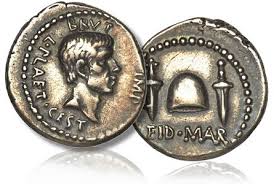
Brutus on the face side of an Eids March coin, with two daggers and the legend "Eid Mar" on the obverse. Clearly the conspirators were proud of their act

Brutus on the face side of this Roman coin and two daggers and the legend “Eid Mar” on the obverse. The conspirators were proud of their act.

Shakespeare considers Brutus to be the noblest Roman of them all, but Dante considers him among the worst of the worst. Dante’s Devine Comedy consigns Brutus to the very center of Hell along with Cassius and Judas. What do you think? BTW, why it’s this a comedy?

The difference between a republican government and a democracy is that a democracy can elect a dictator (as Germany did and Iran has) or can choose to execute a citizen for being annoying to the majority, as democratic Athens did to Socrates. In a republic, even the majority is bound by a set of constitutional limitation providing some-measure of inviolable rights, generally that life, liberty, and property can not be taken without due process or the violation of a more-or-less clear law. All other systems are, to a greater or less extent a rule of whim. When the founders of the US picked a model for government, they picked republican Rome, not democratic Athens nor a limited monarchy as existed in England. Their motivation was the observation that power corrupts, and that inequality under the law attracts the worst elements to the position of least check on their power.

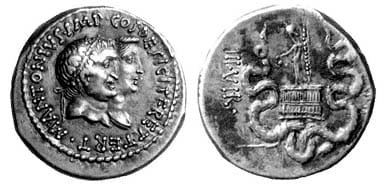
Mark Anthony and his wife, Octavia, Octavius's sister.

Mark Anthony and his wife, Octavia, Octavius’s sister.

The death of Caesar set forces in motion that would install Octavius (Augustus) Caesar and Anthony to take over as co-emperors. Here is a coin showing Mark Anthony with his wife, Octavius’s sister. already, neither look as lean as Brutus or Julius Caesar. Shortly thereafter, Octavius would have Mark Anthony killed to cement his power and republican rule would be over until 1776.

Robert E. (beware), March 14, 2016. I suspect this same drive for purity and fear is driving the Republican party today. Don’t fear the Rino, just make sure there is a balance of power.

The Parker house waitstaff hates you

There are many offensive Americans, but perhaps the most offensive must be those who eat at the famous Parker House restaurant, Boston; see photo taken by a friend of mine, historian Jim Wald. Parker House is the home of Parker House rolls and Boston Cream Pie. It’s also famous for its customers: e.g. the Saturday club of Emerson, Longfellow, Holmes, Agassiz, Dana, and Charles Dickens (Dickens lived in the Parker Hotel for two years). But more remarkable still is that a good number of the staff have so hated their customers that they went off and became revolutionary enemies of all things capitalist and American. And it only took a few months working at the Parker House.

The Parker House restaurant, Dec. 2015, photo by jim Wald, perhaps showing the next world leader.

Among Parker House employees we find Malcolm X, he worked as a busboy under his original, given name: Malcolm Little. We also find Ho Chi Minh, a pseudonym taken — it means, the enlightened one or the one who will enlighten (strangely enough, Genghis Kahn also means the enlightened one — in Mongol) was a pastry chef. he arrived in Boston as a ships cook, and worked in the hotel as Nguyen Cung. After Boston, he moved to Paris where he again made cakes and pies but changed his name to Nguyen O Phap (Nguyen who hates the French). Eventually, he and Malcolm X revolted against America and managed to turn the tables, as it were, on their customers.

Why do Parker House workers go off this way. Perhaps it’s because the hotel tries to hire hard-working, intelligent workers. You’ll notice, in the photo above that the waiters look at least as sharp as the customers and more physically fit. Beyond this, I suspect that the waitstaff are constantly exposed to socialist discussions from the customers. They are then sent off for coffee, or ignored, or perhaps insulted or groped, or not tipped. The Hotel seems to attract liberal libertarians — it was a favorite spot for John F. Kennedy.

My guess is that Malcolm X and Ho Chi Minh became socialist revolutionaries because of what they experienced from the customers at Parker House. So what can you do if you eat at Parker House, or any fancy restaurant? I think it pays to tip. Don’t do it in a way that makes your server feel like a beggar. It would help to chat too, I think. It’s important if your waiter is homicidal — or if your waiter becomes famous some day, or writes a book, or becomes a world dictator. You’d like to get a positive mention in that book, or have a positive story to tell — “I gave Genghis his first $10 bill…” And tipping is important so he/she doesn’t hate you. I’m given to understand that one main reasons people hate Satan so much is you can serve him, but he never tips.

Robert Buxbaum, February 29, 2016, updated August 24, 2017. I run REB Research, and I’m running for drain commissioner. Vote for me.

Abraham ROFLed; Sarah LOLed.

Something is lost, and something else gained when the Bible is translated into modern terms. Some grandeur is lost, some weight, but what is gained is a sense of intimacy, a personal relationship to the events and people.

Consider, for example, Abraham’s reaction when God reveals that he will have a son (Gen. 17:17). The King James translation is “Abraham fell facedown; he laughed and said to himself, “Will a son be born to a man a hundred years old? Will Sarah bear a child at the age of ninety?” There’s grandeur, but the event is distant from me.

Similarly, The Living Torah, “Then Abraham bowed down to the ground, but he laughed to himself in disbelief. ‘How could I become a father at the age of 100?’ he thought. ‘And how can Sarah have a baby when she is ninety years old?'”

I don’t find this translation relatable either. To me, it would be better to say that Abraham did the first ROTFL (Roll on the floor laughing): “Abraham ROFLed, how grand to have a son at 100 years…” It brings up a pleasant image: of Abraham as a man of red face and good humor, a hearty companion, and a good host. Someone you’d want to visit, not a stick-in-the-mud who you visit because he owns the last hotel on the road to Sodom.

Not totally the way I see it: Sarah looks stunned, but at least this captures a jolly Abraham.

Not totally the way I see it: Sarah looks stunned, but at least this captures a jolly Abraham.

And the same with Abraham’s wife, Sarah. Her home is full of dusty tourist guests, and she feeds them steak. Do you see a silent martyr, or a jolly sort who genuinely likes guests. This is important because we are to learn from these stories, Too often the doctors of the religion seem to want martyrs, but my read of Genesis is that sh’s jolly.. Sarah listens to the tales of her guests, and when one says she will have a child at 90, she LOLs (laughs out loud, Gen. 18:12) “So Sarah laughed to herself as she thought, ‘I’m old and my husband is too, will I have fun!” If God wants something weird Sarah is up for it. To her, it sounds like fun. And after that, “Will I nurse a child?!.”

I note that these are the paradigms of humanity, individuals that God loved, and spoke to at length. So lets do the same, be open to the positive, weird future, wherever God takes us. Let’s behave as God himself does. For, as we find Psalms (2:4), “He, who sits in the heavens, laughs; He mocks those who plan against HIm.” Now, ask the doctors of your religion, why are you so serious, when “He, who sits in the heavens, laughs”

Robert E. Buxbaum, January 12, 2016. This is my third essay on religion, all of them, I guess on the lighter side. In the first, I note that science and religion are opposites, In the follow-up, that secular philosophy and religion are uncomfortable competitors, and now that God likes the jolly (you probably prefer the jolly, too.)

A day of thanksgiving during the civil war

At the height of the civil war, Abraham Lincoln proclaimed a day of thanksgiving for the last Thursday of November, 1863. It’s the first time Thanksgiving was proclaimed for the date we now keep every year. The war was not going well. The Union defeat at Chickamauga, Sept. 19-20 1863, left 35,000 dead, the bloodiest two days in US history. Most citizens would have called for a day of fasting and prayer, but in Lincoln’s view, things were good, and there was a need for joy and thanksgiving:

“to thank the Almighty God” …for.. “the blessings of fruitful fields and healthful skies… “for peace that…. “has been preserved with all nations.” [That] “harmony has prevailed everywhere except in the theatre of military conflict….  “a day of Thanksgiving and Praise to our beneficent Father who dwelleth in the Heavens”…. and for … “the care all those who have become widows, orphans, mourners or sufferers in the lamentable civil strife.”  (see the whole proclamation here.)

A Civil War Thanksgiving. It's fellowship that makes peace possible.

A Civil War Thanksgiving. It’s fellowship that makes peace possible.

His was an interesting view, as important then as now. There is a need to remember that the good we have is more than the bad, and that there is a source of the good. As of today (2015) the economy is good in Michigan and the US. We are at peace with our neighbors and have civil obedience in our streets; we have food on our tables and clothes on our backs. We have cleaner air and cleaner water than in decades, blue skies, and plentiful rain. The ozone hole has shrunk, and global warming seems to have stopped. We have so much food that hardly anyone in our country suffers starvation, but only the hunger for finer, fancy things. We have roads without bandits, lighting at the flip of a switch, water at the turn of a tap, indoor heat, and (for most) indoor cooling in the summer. We have telephone communication, and radio, and television, and music at our fingertips. We have libraries with books, and free childhood education. We have a voice in our government, and information from the far ends of the earth. All these call for joy and thanksgiving.

And we can even find a cause for thanks in the things we don’t have: space travel and the diseases we can’t cure, for example. The things we don’t have provide a reason to wake up in the morning, and a motivation to do great things. We live in a country where we can change things, and it’s nice to know there are things worth changing. For ideas that lack expression, we can provide it. For diseases, we can still search for a cure. For those who lack happiness and friendship, we can help provide both (a joyful celebration is a good occasion to do so). For those who lack a job, we can help. And to those who feel a lack of meaning in life, perhaps the best answer is a celebration to explore the source of all blessings. Let us reach out to “all those who have become widows, orphans, mourners or sufferers.” A lesson Scrooge learned from the ghosts is that joy and generous celebration are self-sustaining and attractive. Let joy and good fellowship extend to all. God Bless us each and every one.

Robert Buxbaum, Detroit, November 18, 2015, The anniversary of Lincoln’s Gettysburg address is tomorrow, Nov. 19th (it wasn’t well received). As for Black Friday shopping, lets not get up from the table of thanks to jostle each other for some useless trinket.

Republicans vs conservatives

Most of the great divides of the 1800s pitted conservatives against Republicans. This was the Divide in the Mexican civil wars of the 1800s, and there were several; it is the divide in the South American wars of Independence, and in much of the US and European political debate of the 1800s as well.

Ned Flanders, cartoon conservative from "The Simpsons" He's generally well meaning and helpful, but also a bit creepy.

Ned Flanders, cartoon conservative from “The Simpsons” He’s generally well-meaning and helpful, but also a bit creepy.

In general, the difference between conservatives and republicans is that conservative governments favor religion, and religion-based leadership, while republicans favor individual liberty. In 1800s Mexico, conservatives backed two emperors (Maximilian I and Agustin I) and Santa Anna, the ruler who suspended all personal rights an ignited the war of Texan independence. Conservatives generally favor the religion of the majority: Protestantism in England, Catholicism in Central and South America, Judaism in Israel, and Islam in most of the Muslim world. This tends to annoy the irreligious and minority religious populations, who tend to become republicans. Cinco de Mayo celebrates the 1862 victory of Mexican republicans over the French-backed, conservative Maximilian I, at the battle of Puebla. The US Civil War, in essence, pitted the irreligious, industrial, republican north against the conservative, evangelical South; slavery is in the Bible so it must be good.

Conservatives usually favor government actions against sin in all it’s forms: miserliness, drunkenness, drugs, pornography, wild music, money-making, and freedom as such. Conservative-ruled countries have generally had anti-blasphemy laws and enforced “blue laws”, restrictions on business on holidays. Republican governments have few, or none of these. In pre-revolution France, the penalty for blasphemy was death, just as the Bible mandates. This changed when the republicans came into power. In England, private blasphemy was prosecuted as late as 1977. Similar penalties are still in force in Iran and other conservative Islāmic countries. Many US states still restrict the sale of alcohol on Sunday, for similar, conservative reasons. Conservatives usually favor sexual morality laws, putting strong restrictions on homosexuality, abortion, and divorce. In England, amicable divorce wasn’t legalized until 1930, and homosexuality was illegal until 1970. In the US, sexual laws are a fairly bizarre mix, in my humble opinion, the result of republicans, liberals, and conservatives making inelegant compromises.

In republican democracies like modern-day France, Holland, and Germany, sexual immorality laws are more lax than in the US. Republican governments strive to protect the rights of the individual; among these their right to property and to a fairly unbridled pursuit of pleasure. Republican countries tend to suffer from (or benefit from) significant income inequality. People can become rich due to hard work, talent, luck, or birth. And they very often become arrogant and obnoxious after they become rich — and sometimes before — to an extent that bothers conservatives and liberals alike. People can also become very poor: from laziness or bad choices, or just from bad luck or having been born to the wrong parents. Conservative and liberal elements then strive to help the very poorest, providing them with food, money and basic housing — generally achieved by taxing the rich. This is good in moderation, but taken to excess, this can lead to dependency of the poor, and redirection of the rich into less-productive fields like politics and the church. Conservatives very rarely leave a good pathway for the poor out of dependency, nor have they found a way to keep scoundrels out of the government and the church.

Scrooge McDuck. he'd likely be a Republican, if only to protect his wealth.

Scrooge McDuck, banker, railroad tycoon, steel magnate; he’d likely be republican, though not likely conservative. Motivated by money and power, he may do good, but not in any direct way, usually.

At present, the US Republican Party, the GOP, consists of approximately equal halves conservatives and republicans. That is, GOP leadership is currently an approximate balance between kindly folks like Ned Flanders who would rule by the Bible, and an equal number of rougher individuals, more like Scrooge McDuck who would rule by money.  in a sense, this is a wonderful compromise as the excesses of each group reins in the excesses of the other. In another sense though, the balance between conservatives and republicans is an ungovernable mess that leads to regular de Condorcet failures. I’m not sure how this will play out in the 2016 elections.

Fortunately, not all irreconcilable differences are as irreconcilable as one might think. Many de Condorcet problems are solvable by compromise, or by the effects of time. Compromise between charity and commerce can produce the best of all worlds, a major theme point, as I understand it, of Dickens’s Christmas Carol.

Robert E. Buxbaum, October 20, 2015. I use these essays to refine my thinking — here, more than usual. Any help you can provide will be welcome, feedback, corrections, comments. I’m trying to figure out what I, myself think. The divide between Conservatives and Liberals produces some of the most wonderful quote – exchanges, e.g. between Churchill and Attlee in 1950s England. Liberals, and I have not quite made up my understanding here, seem like a sort of like conservatives in that they believe in wealth redistribution, but without the guidance of a church, or church-based morality. At some point in the future, I’ll hope to arrange my thoughts about them, and about the difference between liberals and democrats.

Pelham G. Wodehouse would like to acknowledge

Here is the acknowledgement page of P. G. Wodehouse’s autobiography, “Over Seventy”, published 1957. Wouldn’t we all like to be able to write an acknowledgement like this (and have enough of an oeuvre to make it funny)?

Wouldn't we all like to write one like this.

You have to have a lot of hits — or an imaginary Frisby –to get away with an acknowledgement like this.

For those who don’t know, P.G. Wodehouse (1881-1975)  was the author of some 150 books and plays, plus a hundred or so short stories, radio-sketches and songs. He is best known as the creator of one of the great bromance relationships: carefree Bertram Wooster and his super-competent valet, Jeeves. Wodehouse collaborated on two dozen Broadway musicals including with Jerome Kern (Showboat), Cole Porter (Anything Goes), Guy Bolton, and George Gershwin, and once had 5 running simultaneously. But, to my knowledge, he has never sold an eel, jellied or otherwise.

Robert E. Buxbaum, September 1, 2015. “It was one of those cases where you approve the broad, general principle of an idea but can’t help being in a bit of a twitter at the prospect of putting it into practical effect. I explained this to Jeeves, and he said much the same thing had bothered Hamlet.”  (Jeeves in the Morning).

Say no to the dress

A popular reality TV show follows the struggles of young brides-to-be shopping for a wedding dress at a famous store, Kleinfeld’s. They’ve come to believe that this charming adornment will make their dream-wedding really perfect. There is some sort of idea that the perfect wedding is necessary (or desirable) to get you started on a perfect life. This is stated in various ways throughout the show with phrases like: “you deserve to be the princess,” or “you deserve your special day.”

Each woman brings a retinue to help her pick the gown, and to help advise her about what dress has the most pop, or looks best on her, or makes her look the most special. Often it’s someone in this retinue that will pay for the dress too, a father, uncle, or a close family member. The store caters to the retinue at lest at the beginning to get a commitment to the price, generally $5,000 to $10,000, but sometimes to “no limit on the price.” It then provides a dazzling variety of dresses and an old hand or two to guide the young lady to the right one. At first, the retinue chimes in, but eventually the retinue is detached, and the bride is made to embrace that it’s her special day, alone. Then, when the perfect dress is finally chosen (often at the high-end of the budget), the bride is asked: “are you ready to say yes to the dress?” She does, with tears, and everyone claps, especially the retinue. Often, there is a final shot of the beautiful bride at the beautiful wedding. It’s touching, but perhaps unnecessary. So here’s an alternate  thought: just say “no”. No to the expensive dress; no to the expensive cake (sorry, cake boss) and no to the fancy, big diamond. instead, throw a big fun wedding on the cheap, perhaps at a park in a rented gown; friends will get you through life, the big dress and big cake will not.

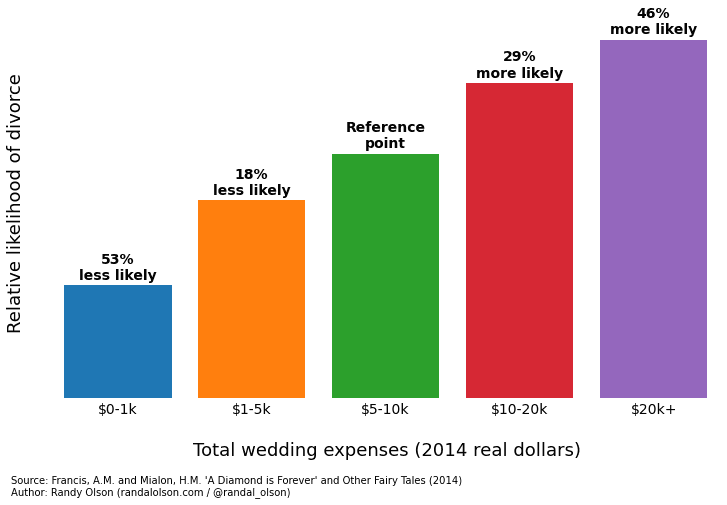
An expensive wedding didn’t keep John Kennedy faithful, nor did it help cement Elizabeth Taylors 7 husbands (two to Richard Burton). Just the opposite: a recent study on marriage stability showed that the higher priced the wedding, the more likely it is to end in divorce.

Marriage stability goes down as the wedding costs go up.

Marriage stability goes down as the wedding costs go up. If you dress costs $5,000, your wedding is unlikely to come in at less than $10k. From Francis and Mialon, “A diamond is forever and other Fairy Tales,” 2014. The average cost of a US wedding: $30,000.

The point of the wedding is to have a long, happy marriage, not a one day party, and expensive weddings appear to be counter-productive to stability. Things are worse for those who enter poor, backing up the observation that money stresses are among the main causes of marriage failure. This is not to say that you should not have a wedding party, but that spending should be watched especially if the couple isn’t that extraordinarily rich. The average, employed US 20-something earns about $26,000/year before taxes. That’s not bad money until you realize that the average US wedding costs over $30,000 not including dress, ring and honeymoon. There is a far lower chance of divorce for the couple with the $5-$10k wedding, and even lower if the couple can keep expenses in the 0-$5k range.

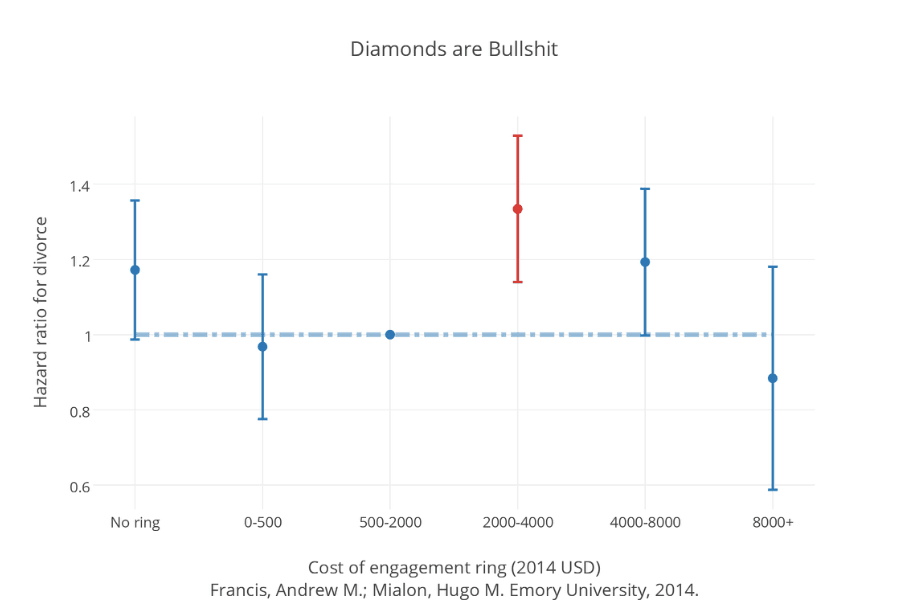
Give her a diamond ring, but the ideal cost is between $100 and $2000 (unless you're super rich)

Give her a ring, but the ideal cost is between $200 and $2000 unless you’re super rich.

Statistics suggest that spending on the diamond doesn’t help either, unless it’s a very expensive stone — and that, perhaps, is because the very expensive stone is only bought by the very rich groom. Still, even for the 1% who can afford it, the dress or stone should be considered a sunk cost, not an investment. You’ll never be able to resell that dress at all, and though you can resell a diamond it is virtually impossible to get even half your money back. This isn’t to say that you should not give a ring — without a ring the bride will feel cheated, but most grooms will be better served giving one in the $100-$2000 range.

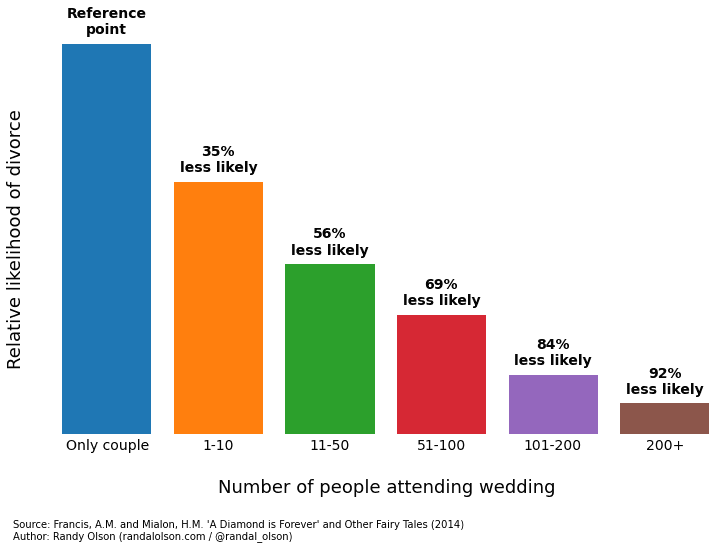
It seems that having lots of people at the wedding is perhaps the single best thing you can do for marriage stability. On the other hand, this graph might show that the sort of person who has 200 good friends is the sort of person to remain happily married.

Having lots of people at the wedding is perhaps the single best thing you can do for marriage stability. On the other hand, this graph might show that the sort of person who has 200 good friends is the sort of person to remain happily married. ibid.

While your wedding should be cheap, or at least affordable, it should not be small. It turns out that having lots of friends and family in attendance correlates strongly with having a long, stable marriage. I’m not sure if this is entirely cause and effect: perhaps those with lots of friends and family are giving and stable than those without. Still, it strikes me that friendships are good for every couple, and very worth maintaining. These are people who will be there for advice, or just be there when things get rocky. Give them a good party, and don’t drive them away by sending a message that a large gift is expected. If you get married on the cheap, it’s likely your guests will feel more comfortable showing up in business clothes with simple affordable gifts. Most bridesmaids are happier if they don’t have to buy a big expensive dress.

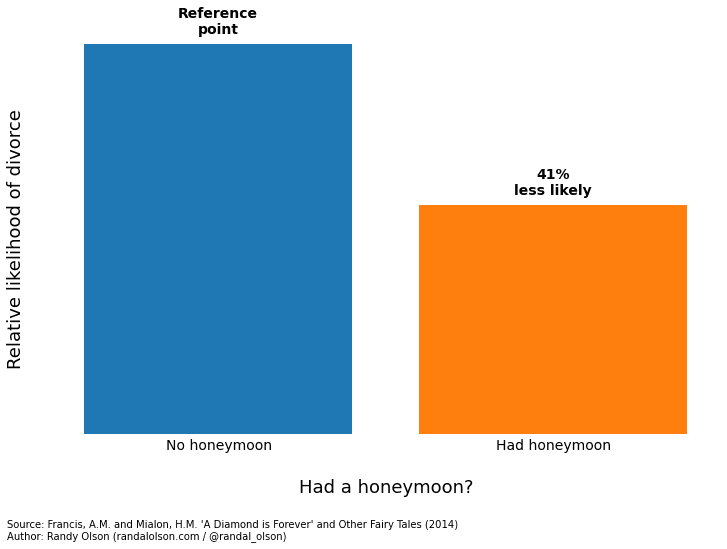
Honeymoons help malaise stability too.

Honeymoons help marriage stability too. ibid.

Robert E. Buxbaum, July 12, 2015. My 3 children are all entering marriageable age — and PhD age (I wrote a post comparing a wedding to a PhD.) The above are my thoughts before being hornswoggled into buying $5,000 worth of taffeta. They are also suggestive of the sort of work to get a PhD. Another good spending investment, I think, is to go on a honeymoon. I didn’t, and though we didn’t get divorced, in retrospect it seems like a good idea. I plan to finally go on a honeymoon for our 25th anniversary. Let’s toast (with Geritol) to finding the right mate. Good luck.

Marriage vs PhD

Marriage vs PhD, from Piled Higher and Deeper (PhD) comics.

Marriage vs PhD, from Piled Higher and Deeper (PhD) comics.

Here’s a PhD comic comparing getting married to getting a PhD. The similarities are striking. It’s funny because …


….one does not expect so many similarities between the two endeavors. On thinking a bit further, one realizes that marriage and graduate school are the main, long-term trust relationship options for young college grads, 21-23 years old who want to move out of home and don’t want to yet enter the grind of being a single, wage slave (grease monkey, computer-code monkey, secretary, etc.)

College grads expect some self-fulfillment and, as they’ve lived away from home, mostly prefer to not move back, Entry level jobs are generally less-than fulfilling, and if you move away from home as a single, living costs can eat up all your income. One could get a same-sex room-mate, but that is a low commitment relationship, and most young grads want more: they’ve an “urge to merge.” Either PhD or marriage provides this more: you continue to live away from home, you get an environment with meals and room semi-provided (sometimes in a very cool environment) and you have some higher purpose and long-term companionship that you don’t get at home, or as a secretary with a room-mate.

I suspect that often, the choice of marriage or grad-school depends on which proffers the better offer. Some PhD programs and some marriages provide you with a stipend of spending-money. In other programs or marriages, you have to get an outside job. Even so, your spouse or advisor will typically help you get that outside job. In most communities, there’s more honor in being a scholar or a wife/ husband than there is in being a single working person. And there’s no guarantee it will be over in 7 years. A good marriage can last 30-50 years, and a good PhD may lead to an equally long stay in academia as a professor or a researcher of high standing. While not all majors are worth it financially, or emotionally, you can generally do more and make more money as a PhD than with a low-pay undergraduate degree. Or you can use your college connections to marry well.

What type of job are you looking for?

Some people are just cut out for the grad-school life-style, and not particularly for normal jobs. Ask yourself: What type of job will make me happy? Could be it’s research or home-making? Then go find a mate or program.

Dr. Robert E. Buxbaum (married with children and a PhD), July 1,, 2015. Growing up is perhaps the most difficult and important thing anyone does; getting married or entering a PhD program is a nice step, though it doesn’t quite mean you’re an adult yet. Some months ago, I wrote an essay about an earlier stage in the process: being a 16-year-old girl. For those interested in research, here’s something on how it is done using induction, and here’s something on statistics.

Gatling guns and the Spanish American War

I rather like inventions and engineering history, and I regularly go to the SME, a fair of 18th to 19th century innovation. I am generally impressed with how these machines work, but what really brings things out is when talented people use the innovation to do something radical. Case in point, the Gatling gun; invented by Richard J. Gatling in 1861 for use in the Civil war, it was never used there, or in any major war until 1898 when Lieut. John H. Parker (Gatling Gun Parker) showed how to deploy them successfully, and helped take over Cuba. Until then, they were considered another species of short-range, grape-shot cannon, and ignored.

1876_Gatling_gun_NPS_Fort_Laramie_WY_by-Matthew_Trump_2004

A Gatling gun of the late 1800s. Similar, but not identical to the ones Parker brought along.

Parker had sent his thoughts on how to deploy a Gatling gun in a letter to West Point, but they were ignored, as most new thoughts are. For the Spanish-American War, Parker got 4 of the guns, trained his small detachment to use them, and registered as a quartermaster corp in order to sneak them aboard ship to Cuba. Here follows Theodore Roosevelt’s account of their use.

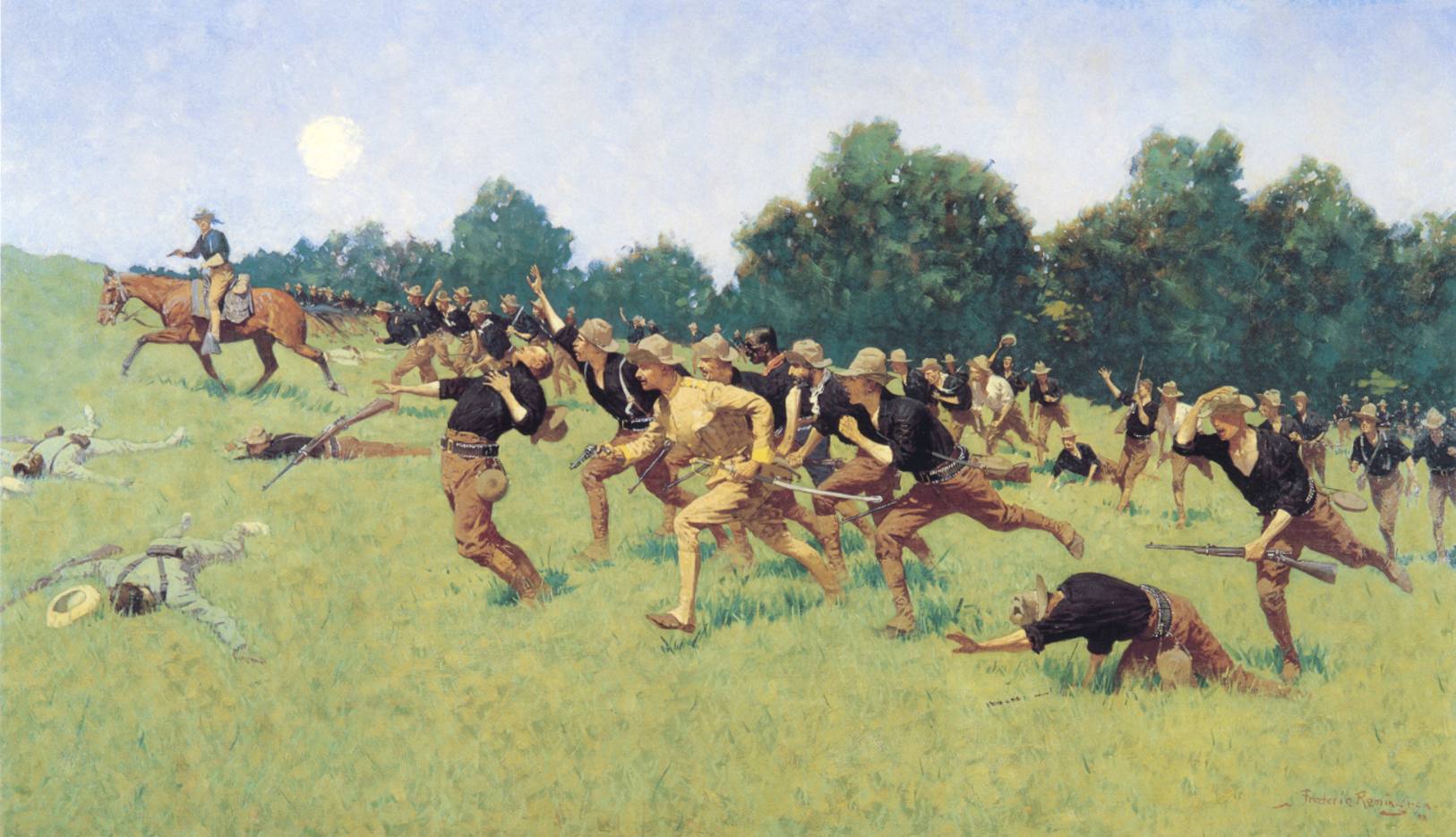
“On the morning of July 1st, the dismounted cavalry, including my regiment, stormed Kettle Hill, driving the Spaniards from their trenches. After taking the crest, I made the men under me turn and begin volley-firing at the San Juan Blockhouse and entrenchment’s against which Hawkins’ and Kent’s Infantry were advancing. While thus firing, there suddenly smote on our ears a peculiar drumming sound. One or two of the men cried out, “The Spanish machine guns!” but, after listening a moment, I leaped to my feet and called, “It’s the Gatlings, men! It’s our Gatlings!” Immediately the troopers began to cheer lustily, for the sound was most inspiring. Whenever the drumming stopped, it was only to open again a little nearer the front. Our artillery, using black powder, had not been able to stand within range of the Spanish rifles, but it was perfectly evident that the Gatlings were troubled by no such consideration, for they were advancing all the while.

Roosevelt and the charge up Kettle Hill, Frederick Remington

Roosevelt, his volunteers, and the Buffalo soldiers charge up Kettle Hill, Frederick Remington.

Soon the infantry took San Juan Hill, and, after one false start, we in turn rushed the next line of block-houses and intrenchments, and then swung to the left and took the chain of hills immediately fronting Santiago. Here I found myself on the extreme front, in command of the fragments of all six regiments of the cavalry division. I received orders to halt where I was, but to hold the hill at all hazards. The Spaniards were heavily reinforced and they opened a tremendous fire upon us from their batteries and trenches. We laid down just behind the gentle crest of the hill, firing as we got the chance, but, for the most part, taking the fire without responding. As the afternoon wore on, however, the Spaniards became bolder, and made an attack upon the position. They did not push it home, but they did advance, their firing being redoubled. We at once ran forward to the crest and opened on them, and, as we did so, the unmistakable drumming of the Gatlings opened abreast of us, to our right, and the men cheered again. As soon as the attack was definitely repulsed, I strolled over to find out about the Gatlings, and there I found Lieut. Parker with two of his guns right on our left, abreast of our men, who at that time were closer to the Spaniards than any others.

From thence on, Parker’s Gatlings were our inseparable companion throughout the siege. They were right up at the front. When we dug our trenches, he took off the wheels of his guns and put them in the trenches. His men and ours slept in the same bomb-proofs and shared with one another whenever either side got a supply of beans or coffee and sugar. At no hour of the day or night was Parker anywhere but where we wished him to be, in the event of an attack. If a troop of my regiment was sent off to guard some road or some break in the lines, we were almost certain to get Parker to send a Gatling along, and, whether the change was made by day or by night, the Gatling went. Sometimes we took the initiative and started to quell the fire of the Spanish trenches; sometimes they opened upon us; but, at whatever hour of the twenty-four the fighting began, the drumming of the Gatlings was soon heard through the cracking of our own carbines.

Map of the Attack on Kettle Hill and San Juan Hill in the Spanish American War.

Map of the Attack on Kettle Hill and San Juan Hill in the Spanish-American War, July 1, 1898 The Spanish had 760 troops n the in fortified positions defending the crests of the two hills, and 10,000 more defending Santiago. As Americans were being killed in “hells pocket” near the foot of San Juan Hill, from crossfire, Roosevelt, on the right, charged his men, the “Rough Riders” [1st volunteers] and the “Buffalo Soldiers [10th cavalry], up Kettle Hill in hopes of ending the crossfire and of helping to protect troops that would charge further up San Juan Hill. Parker’s Gatlings were about 600 yards from the Spanish and fired some 700 rounds per minute into the Spanish lines. Theyy were then repositioned on the hill to beat back the counter attack. Without the Parker’s Gatling guns, the chances of success would have been small.

I have had too little experience to make my judgment final; but certainly, if I were to command either a regiment or a brigade, whether of cavalry or infantry, I would try to get a Gatling battery–under a good man–with me. I feel sure that the greatest possible assistance would be rendered, under almost all circumstances, by such a Gatling battery, if well handled; for I believe that it could be pushed fairly to the front of the firing-line. At any rate, this is the way that Lieut. Parker used his battery when he went into action at San Juan, and when he kept it in the trenches beside the Rough Riders before Santiago.”

Here is how the Gatling gun works; it’s rather like 5 or more rotating zip guns; a pall pulls and releases the firing pins. Gravity feeds the bullets at the top and drops the shells out the bottom. Lt’ Parker’s deployment innovation was to have them hand-carried to protected positions, near-enough to the front that they could be aimed. The swivel and rapid fire of the guns allowed the shooter to aim them to correct for the drop in the bullets over fairly great distances. This provided rapid-fire accurate protection from positions that could not be readily hit. Shortly after the victory on San Juan HIll, July 1 1898, the Spanish Caribbean fleet was destroyed July 3, Santiago surrendered July 17, and all of Cuba surrendered 4 days later, July 21 (my birthday) — a remarkably short war. While TR may not have figured out how to use the Gatling guns effectively, he at least recognized that Lt. John Parker had.

A new type of machine gun,  a colt browning repeating rifle, a gift from Con'l Roosevelt to John Parker's Gatling gun detachment.

Roosevelt gave two of these, more modern, Colt-Browning repeating rifles to Parker’s detachment the day after the battle. They were not particularly effective. By WWI, “Gatling Gun” Parker would be a general; by 1901 Roosevelt would be president.

The day after the battle, Col. Roosevelt gifted Parker’s group with two Colt-Browning machine guns that he and his family had bought, but had not used. According to Roosevelt, but these rifles, proved to be “more delicate than the Gatlings, and very readily got out-of-order.” The Brownings are the predecessor of the modern machine gun used in the Boxer Rebellion and for wholesale deaths in WWI and WWII.

Dr. Robert E. Buxbaum, June 9, 2015. The Spanish-American War was a war of misunderstanding and colonialism, but its effects, by and large, were good. The cause, the sinking of the USS Maine, February 15, 1898, was likely a mistake. Spain, a decaying colonial power, was a conservative monarchy under Alfonso XIII; the loss of Cuba seems to have lead to liberalization. The US, a republic, became a colonial power. There is an inherent friction, I think between conservatism and liberal republicanism, Generally, republics have out-gunned and out-produced other countries, perhaps because they reward individual initiative.