Category Archives: Food

Presidential drinks, smokes, and other vices

I’d written about presidential desks so now presidential drinking and related vices. The US colonials were hard drinkers, and their leaders lead on this front too. The colonials who fought at Lexington and Concord loaded up at Bradford’s Tavern before greeting the British. Meanwhile, safe in Philadelphia, each of the authors of the declaration of Independence drank, on average, two pint tankards of rum per day, likely mixed with water, a mixture called “grog,” or mixed with apple cider, a mix called “the stone fence.”
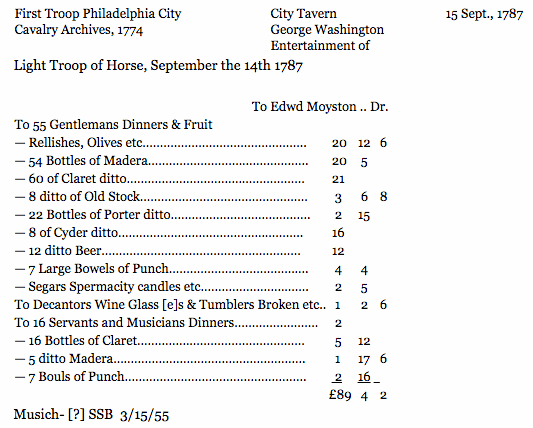
Washington's bar bill for 55 men.

Washington’s bar bill for 55 men; food was less than 1/4 of the bill, both for the officers and the servants. Note the “Segars” and broken crockery.

The standard of drinking for officers in the colonial army can be seen from the bill for the farewell dinner (right) held at City Tavern in New York. The average man drank more than two bottles of wine, about a quarter bottle of old stock (whiskey)  bottle of beer, porter or cider, and 1/2 bowl of punch. There is also a cost for “segars” and for broken cookery. The servants drank almost as much but not quite. George Washington was considered a very modest drinker in the crowd, avoiding rum mostly, and sticking to Madera wine or dark, “Philadelphia” porter, typically mixed with molasses. He smoked a pipe too, but didn’t have a mistress nor did he fight in any duels; a model for presidents to come. When Washington retired from the presidency, he become the premier distiller in the USA, making thousands of barrels of rye whiskey per year. A good man and a good president, IMHO.

John Adams considered himself a temperance man, and complained of Washington’s lack of refinement. He didn’t smoke at all, and drank only one tankard of hard cider to start the day, followed by beer, Madera and diluted rum (grog). He was priggish and disliked. He also started the pseudo war with France, spent massively to pay off the Barbary pirates, insulted most everyone, and passed the single worst law ever in US history, Our worst president, IMHO, but at least he didn’t overspend.
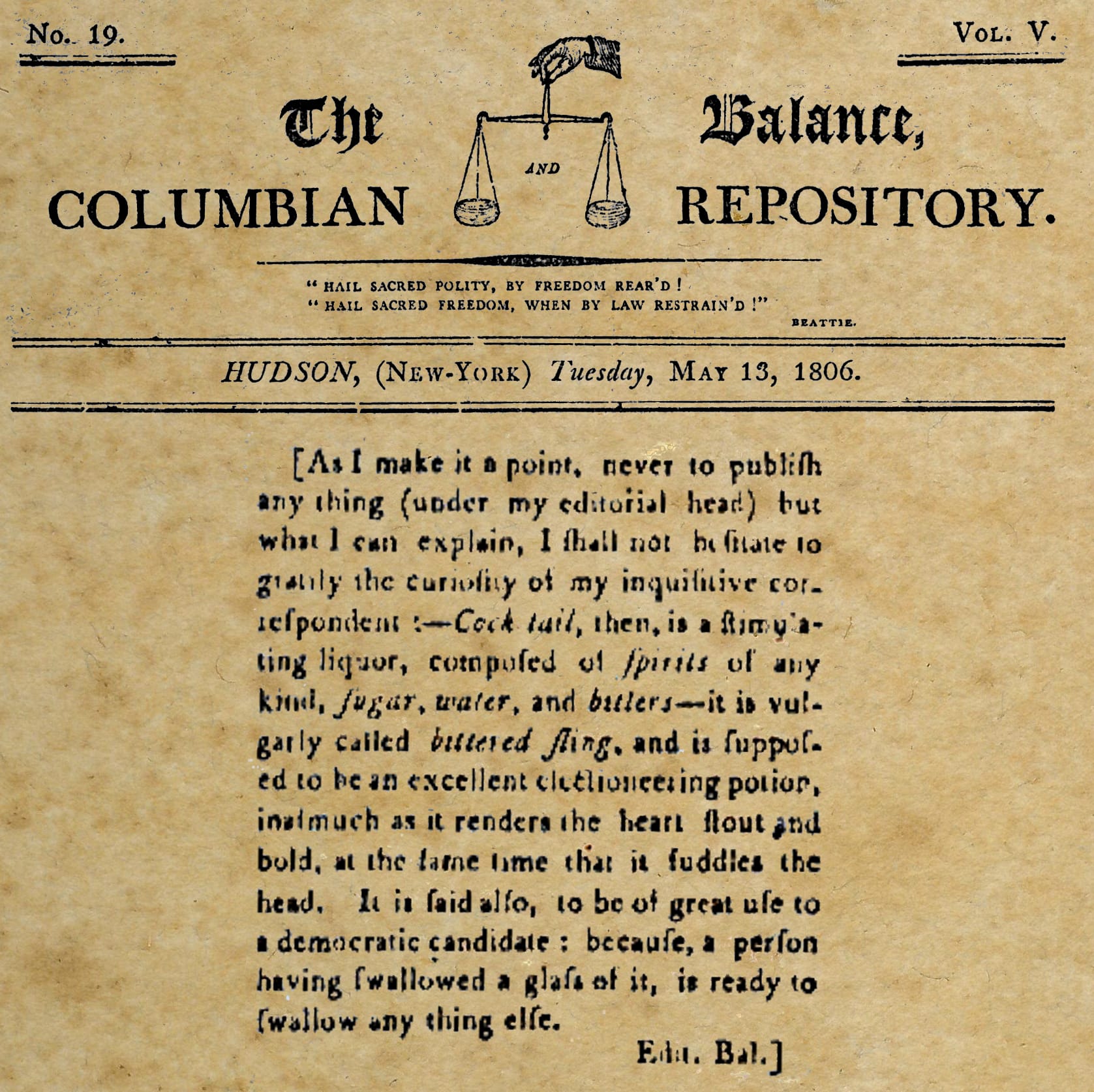
According to "The Balance, and Columbian Repository" 1806, "A cock tail is a stimulating liquor composed of spirits of any kind, sugar, water and bitters. It is supposed to be an excellent electioneering potion inasmuch as it renders the heart stout and bold, at the same time that it fuddles the head. It is said also, to be of great use to a democratic candidate: because, a person having swallowed a glass of it, is ready to swallow any thing else."

According to “The Balance, and Columbian Repository” May 15, 1806, “– Cock tail then is a stimulating liquor… an excellent electioneering potion inasmuch as it renders the heart stout and bold, at the same time that it fuddles the head… of great use to a democratic candidate: because, a person having swallowed a glass of it, is ready to swallow any thing else.”

Jefferson was a spendthrift who  spent $16,500 in the money of the day (well over $1 million today) on French wine; $11,000 for his time in the Whitehouse and $5,000 for the ministry in Paris. His wine habits, along with his book and furniture buying, led him to be bankrupt twice. The first time, he was bailed out by congress, the second time (at his death) his slaves and property were sold off to pay debts, including his red-haired, slave children. Not a good man, but a good president. He ended Adam’s the pseudo-war with France, defeated the Barbary pirates, and doubled the size of America through the Louisiana purchase.

James Madison, like Jefferson preferred French wine, mostly Champaign, but he didn’t drink much of it, according to the standard of the day. He said that, if he drank any more than 3 or so glasses or he’d wake up with a headache. He also smoked ‘seegars’ until his death at 85: a good man but a poor president. Who would declare war on the most powerful nation on earth without first preparing his army or navy? Dolly Madison is considered the first of the “First Ladies,” for her hostess prowess.

Monroe liked French Champaign and Burgundy. He was the last of the “gentleman presidents; liked as a man and as a president, doing little that was controversial, except perhaps stating the Monroe Doctrine — US control of the Caribbean. He oversaw an “era of good feelings,” where the US grew and wounds healed.

John Quincy Adams was as obnoxious and disliked as his father, “the bitter branch of the bitter tree.” He was a wine-snob who claimed to have conducted a blind taste test with 14 kinds of Madeira and correctly identified 11 of them. After his one-term as president he returned to congress where his last act was to vote against admitting Texas to the union. At least 17 male-line Adams’s have graduated from Harvard; few are remembered fondly.

Andrew Jackson was not a gentleman. He drank whiskey — home made — and smoked cigars along with his wife. He fought about 20 duels, served whiskey proudly to all his guests, and removed the requirement of land to vote. He was a drinker of coffee too, pairing it with cigars, and is reported to have said, “Doctor, I can do anything you think proper, except give up coffee and tobacco.” One famous duel was with his lawyer, Thomas Hart Benton. Benton shot him twice, and they become friends and allies for life. Jackson added the first running water in the white house. The source was soon contaminated by human waste but I can’t complain. We have similar problems in Oakland county today. He also paid down the national debt, leaving Van Buren with a surplus for the first and only time in America. I consider Jackson an excellent president, but have not decided about him as a man.

Van Buren was a heavy drinker, a pipe smoker, a corrupt Tammany man, and a bit of a spendthrift (“Martin Van Ruin”)  He is the only US president to grow up speaking Dutch, not English, and his favored drink was Schiedam, a blue-colored gin favored by New York’s Dutch. Most people could not stand Schiedam, and it led Van Buren to be called “Blue whiskey Van.” Gin is an acquired taste — one that several later presidents would acquire. My guess is that Schiedam is the reason that some modern gins come in blue bottles. Van Buren accomplished nothing of note as president.

William Henry Harrison smoked a pipe and drank nothing harder than cider. Modest drinking differentiated him from hard-drinking Van Buren. His campaign song — Tippicanoe and Tyler too — includes the line “Van is a used-up man”, but modest drinking may have killed him too. He likely died of infected water in the Whitehouse —  something that could have been cured by a bit of whiskey mixed into the infected water. (I’m running for water commissioner my campaign: clean water at an appropriate pressure for fire-fighting.
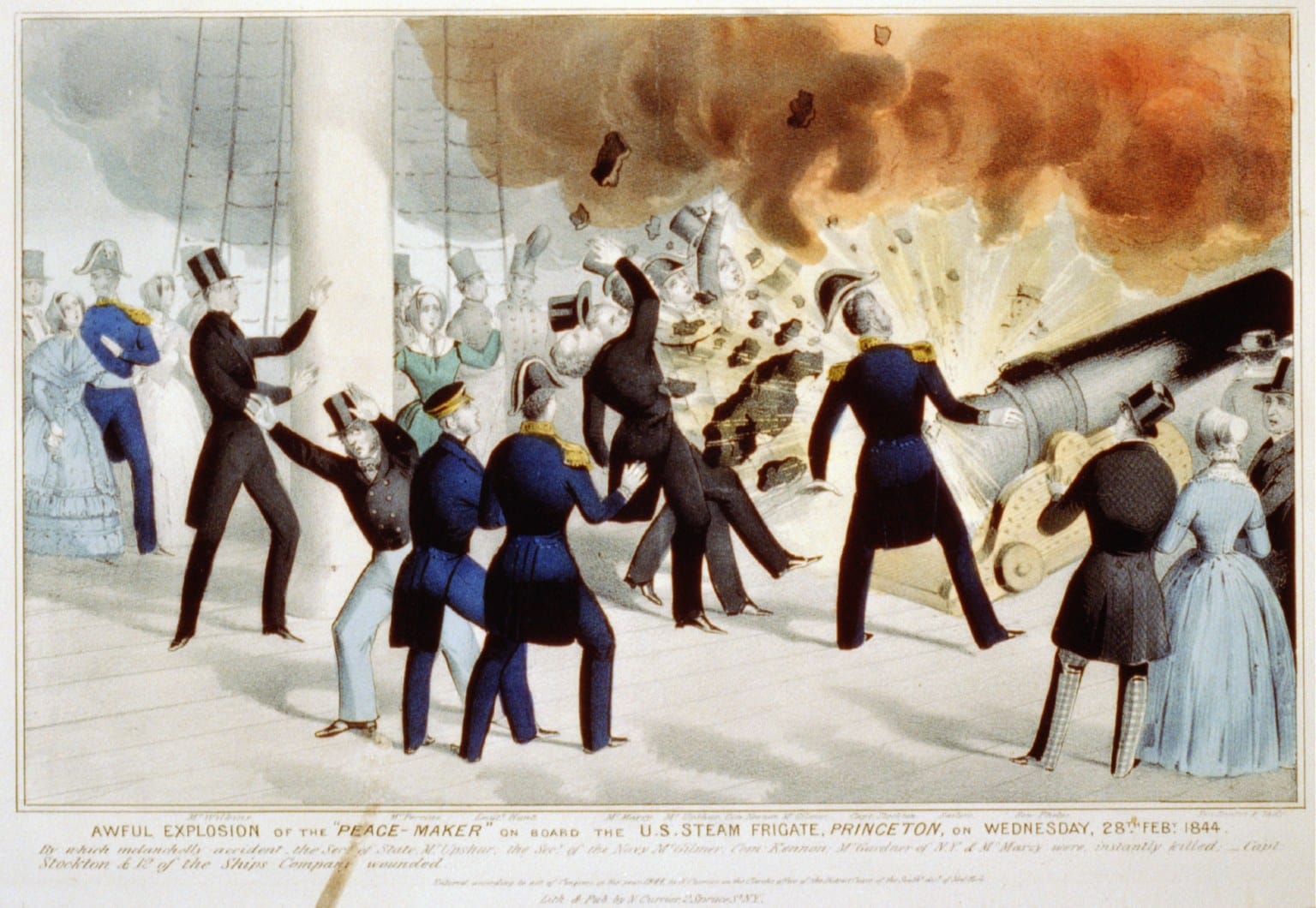
Explosion_aboard_USS_Princeton

John Tyler, Harrison’s VP, drank and smoked cigars. He kept two kegs of “Lieutenant Richardson’s whiskey” on hand, and Champaign for state dinners. He was a compromiser, who missed dying in an explosion on the USS Princeton because he’d stopped off for a drink. Most of the rest of his cabinet were not so lucky. He was rejected for re-election in favor of Clay, who opposed admission of Texas, and famously drank cocktails (a mint julep, tea mix ). Polk promised to admit Texas, and Tyler helped him do it.

James K. Polk was a modest drinker who favored the occasional wine or brandy. He survived his single term in the Whitehouse to die 105 days after leaving the Whitehouse of gastro-enteritis caused by infected water or fruit. A bit of whiskey might have helped. By admitting Texas, Polk started the Mexican – American War. This expanded the US further, all the way to California. I like and admire Polk, but most historians do not.

Zachary Taylor, a Whig, “old rough and ready” had been a whiskey man in the army but never drank as president and rarely smoked. He died 16 months after taking office, likely killed by the bad water and lack of alcohol. Tayler was against all forms of secession and against the fugitive slave compromise that Clay. I like Tayler and agree with him.

Millard Fillmore was Tayler’s vice president and another non-smoker, he drank Madera wine as had some early presidents. Always concerned with his health, and is said to have installed the first bathtub, installing with it with copper and brass pipes. I suspect that the copper pipes saved Fillmore from DC’s bad water as copper is a fine anti-microbial. Though opposed to slavery, Fillmore signed the fugitive slave compromise that brought California into the union as a free state. The civil war is sometimes blamed on Fillmore, unfairly I think. It could not have been stopped. He died at the ripe age of 74, long after having left the Whitehouse.

Franklin Pierce, a Democrat and alcoholic, was “the hero of many a well-fought bottle”. Not a bad president, in my opinion. He saw the inevitable civil war coming and could not stop it, His wife lost her mind and his children all died. The last one, Benny, by beheading in front of him when a train Pierce and his wife were about to board broke its axle and slid down a hill. Pierce added the Gadson purchase, made the civil service less corrupt, made treaties with Britain and opened Japan. He too is blamed for the civil war by current historians as if they could have done better. He died of cirrhosis at 65, 13 years after leaving office.

James Buchanan, another Democrat was likely our only homosexual president. Buchanan was a life-long bachelor who drank quite a lot. His favorite was originally “Old Monongahela” but switched to J. Baer “finer than the best Monongahela,” buying ten gallons of J.Baer (rye) per week, direct from the distillery. “The Madeira and sherry that he has consumed would fill more than one old cellar, and the rye whiskey that he has ‘punished’ would make Jacob Baer’s heart glad.” Like Pierce, he is blamed by historians for not saving the union, as if this were an easy job that anyone could have done. Buchanan had no problem with the White House water, but was heart-broken when his housemate, William King left to become minister to France.

Lincoln didn’t drink or chew tobacco, nor did he have mistresses, or apparent trouble with the water. He was depressive though, told wonderful stories, some of them true, smoked a pipe, and once almost fought a duel with swords that broken up by the wives of the duelers. A good man and a great president. His son, Robert was present at his murder, and at two other presidential shootings.

Andrew Johnson drank and smoked occasionally, but had a low tolerance. Johnson added Alaska by purchase (Seward’s folly) but is not liked or respected by historians. I consider this unfair: he compares unfavorably to Lincoln, but don’t we all, and he could not smooth reconstruction, a near impossible task. His main impeachment crime was bombastic speech, by the way, a vice he shares with Andrew Jackson and Donald Trump. Like Buchanan and Pierce, I consider him a good president doing a near-impossible job.

Ulysses S. Grant was a Republican, a heavy cigar smoker, but a light drinker. Grant smoked as many as 20 cigars per day (a Grant cigar is 5″ long by 42 ring), but drank only brandy for his health, and not too much of that. Later in life he drank a mixture of wine and cocaine for throat pain from cancer. This stuff, a favorite of Pope Leo, was the inspiration for Coca-Cola. Grant’s campaign song, “Grant Grant Grant” specifically mentions his opposition to the KKK. He did a good job with reconstruction though the Democrats hated him for it. They mocked him as a drunk and worse: “I smoke my weed and drink my gin, playing with the people’s tin.” Grant wrote a great autobiography with the help of Mark Twain.

Hayes, a Republican, didn’t drink at all and opposed others’ drinking. Elected in 1876, he banned liquor of all sorts in the white house, and his wife was known as “Lemonade Lucy.” Hayes is criticized for corruption and for reducing the burdens of reconstruction. His opponent, Tammany Tilden, was at least as corrupt, and a stronger opponent of reconstruction.

Garfield was a beer man who “drank little else.” He tried to reform the civil service, but died from a gunshot and doctor-caused infection shortly after taking office. If his wound had been disinfected he would have probably lived. That’s what Roosevelt did when he was shot.

Chet Arthur, a cigar smoker and enthusiastic drinker, was Garfield’s vice president. When pressured for a no-liquor policy in the White House, he responded: “Madam, I may be the president of the United States, but what I do with my private life is my own damned business!” Arthur liked late night dining that he would finish with Champagne and a cigar. Though his background was in corrupt civil service, as president he did his best to remove this corruption from the civil service. A good president, IMHO.
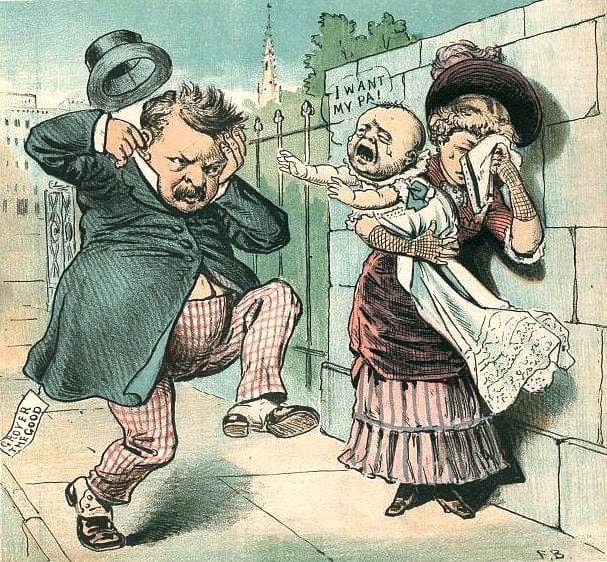
Ma ma, Ma ma, where's my pa?

Ma ma, Ma ma, where’s my pa?

Grover Cleveland was a cigar and beer man. Weighing 250 lbs, he was known as ‘Big Steve’ or ‘Uncle Jumbo,” In the white house, he limited himself to a gallon of beer a night. That is he drank four tankards of 1 liter each. He’d drank more before becoming mayor of Baltimore. He fathered a child at that time by seduction, perhaps date rape, of Maria Halpin, a 38-year-old sales clerk. She named the child Oscar Folsom Cleveland, the two last names suggesting she was not sure of the father. Cleveland and Folsom had Maria sent to an insane asylum (she was not crazy) and had Oscar was sent to an orphanage. In the end, Maria was freed and Oscar was adopted by Dr. King a trustee of the orphanage. None of this horrible behavior stopped Cleveland from becoming mayor and president. Cleveland married the 21-year-old daughter of his friend, Folsom. Rutherford Hayes was revolted by it all: “Cleveland … is a brute with women.” Cleveland smoked foot-long, ‘supercoronas’ that he received as gifts, using these cigars to influence people and conversations, similar to Churchill. Not a good man, nor a particularly good president, IMHO. Baby Ruth candy was not named after Cleveland’s daughter Ruth, but after the baseball player. IMHO, the candy company claimed otherwise only to avoid paying royalties. Cleveland is remembered fondly by historians, but not by me. I read two of his books.

Benjamin Harrison didn’t drink, but he did smoke cigars and he allowed liquor in the white house though prohibition was a growing issue. He annexed Hawaii, improved the navy, and replaced the “spoils system” for civil service jobs with a merit system. He also tried unsuccessfully to provide voting rights for African-Americans. The move failed in the senate. Cleveland defeated him in his run for a second term by pointing out that tariffs were too high. A tariff battle would dominate the Democrat / Republican split for a generation, and has recently reappeared. Modern historians don’t much like Harrison as he didn’t succeed in providing civil rights, as if that were an easy battle.
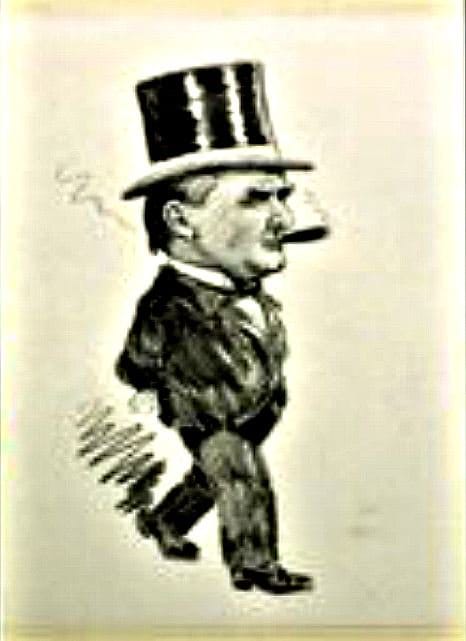
mckinleyMcKinley drank scotch whiskey — Dewar’s, a brand provided by Andrew Carnegie, and he smoked several cigars per day. He would not smoke in public though there is artwork, as at right, and the comment that “one never saw McKinley without a cigar in his mouth except at meals or when asleep.’. The McKinley delight is a variant of the Manhattan made with 3 oz of rye whiskey (at least 100 proof), 1 oz. sweet vermouth, 2 dashes of cherry brandy, and 1 dash absinthe. McKinley was shot and started to recover before dying from doctor-caused infection (he used the same doctor the Garfield had).

Theodore Roosevelt, was McKinley’s VP, and is one of the most beloved and colorful presidents in US history. He smoked cigars starting when he was 8, but swore off them later. He drank modestly, a version of the mint julep and served it to anyone who’d play tennis with him. Roosevelt’s version used rye plus brandy instead of Bourbon: 2-3 oz of rye whiskey, 10 to 12 fresh mint leaves “muddled” with a splash of water, a sugar cube, ¼ oz. of brandy and a sprig or two of mint as a garnish. The fresh mint was grown on the Whitehouse grounds. T. Roosevelt wrote some 30 books (I’ve read four or five) they are all wonderful. Roosevelt did daring things, like ride a moose, and survived being shot by leaving the bullet where is was; here’s a photo and essay. I don’t understand why so many US presidents drank rye and not Bourbon (Bourbon — corn whiskey — had been invented in the late 1700s and is tastier, IMHO). One of TR’s most famous speeches, “the man in the arena”, was given at the Sorbonne 1910. He claimed that being a critic was not much of an achievement.

William H. Taft smoked cigars and like Champaign, but rarely drank; he was on a perpetual diet. He tried to continue Roosevelt’s programs, but got little done. Still the country did well. He’s most remembered for the “7th inning stretch” break near the end of every baseball game.

Woodrow Wilson drank scotch and smoked cigarettes. His campaign slogan, “Wilson that’s all” was a whiskey slogan. Prohibition began during Wilson’s time in office: it was supposed to help women, but did not. It brought corruption and misery. Here’s an anti-alcohol song of the day: “behind those swinging doors.”
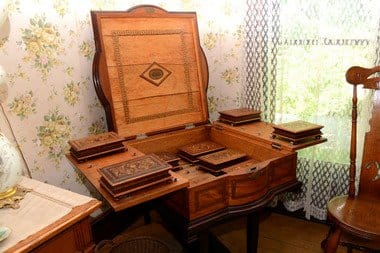
Harding's humidor - a massive thing

Harding’s humidor – a massive thing

Despite prohibition, Harding had poker nights twice a week where he smoked cigars, and the whiskey flowed freely. He also had at least 7 mistresses; he got two of them pregnant. Not a good man or a particularly good president. He died in office, perhaps killed by his wife or by his lifestyle.

Calvin Coolidge was Harding’s VP. Coolidge smoked cigars and drank sweet, Tokay wine. As president he cut spending and taxes, paid down the debt, and did not say much. Much of the detail work was done by his secretary of commerce, Herbert Hoover. Here is the Coolidge cooler: 1.5 oz. of Vermont White vodka, ½ oz. of American whiskey, 2 oz. of orange juice, Club soda. A good man and a good president, IMHO.
hoover

hoover

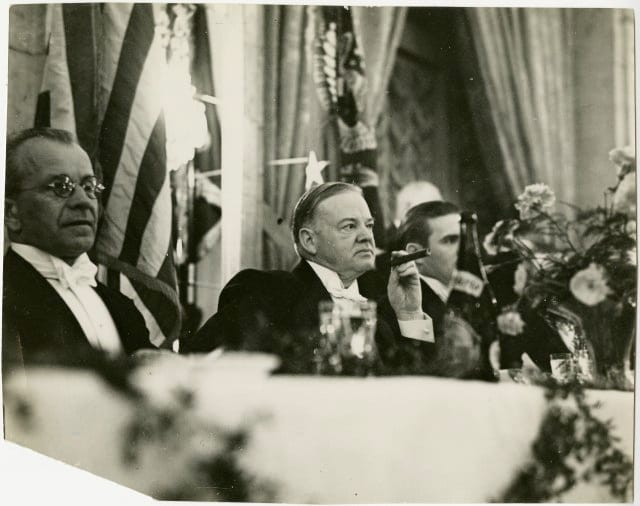
H. Hoover liked good wine and dry gin-martinis, but didn’t drink either in the white house as he respected prohibits as his predecessors did not. Also, his wife poured out his extensive wine collection. He is blamed for the great depression, unfairly I think. The depression hit all other industrial countries at the same time (most economies revered before ours did). Hoover’s dying request, at 80, was for a good, dry martini. He is the first gin man since Van Buren, but not the last.
FDR and Churchill

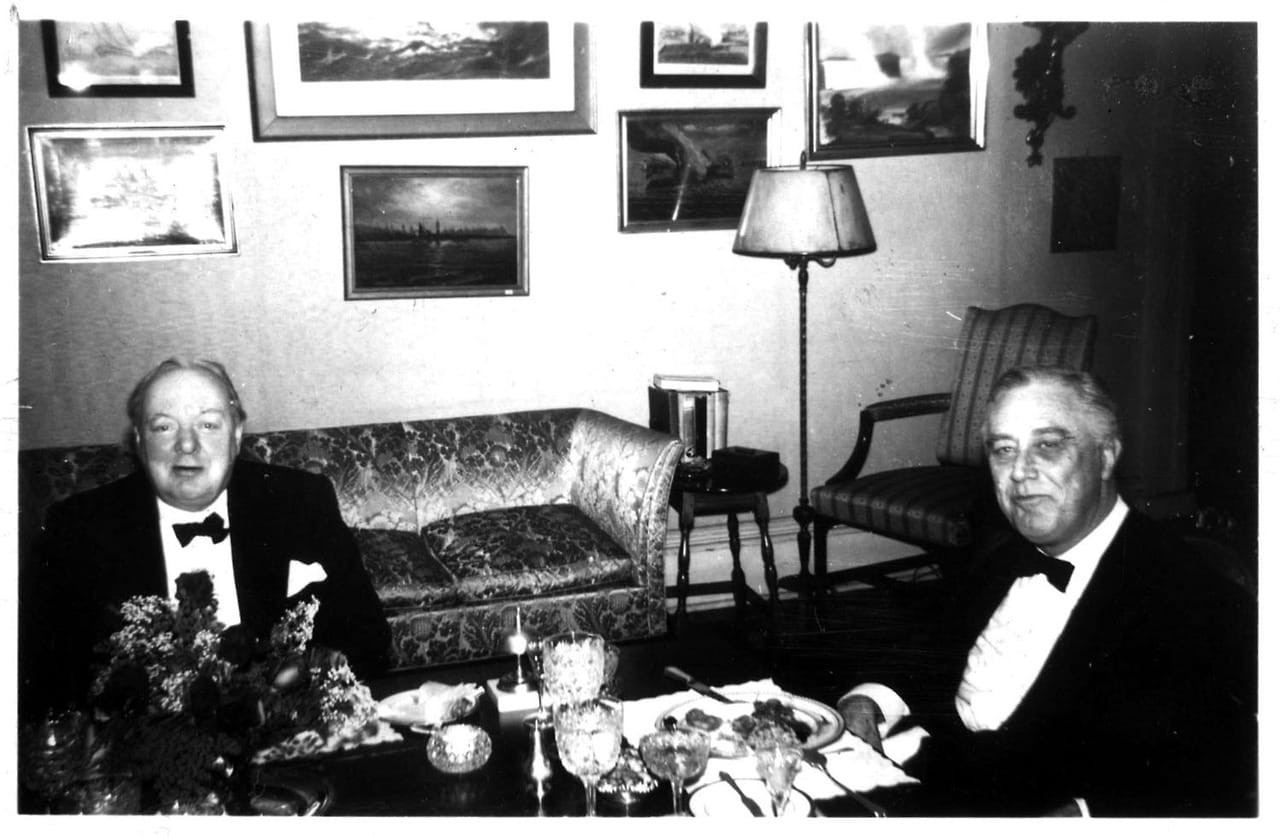
FDR and Churchill. They drank Champaign and whiskey.

FDR was the first gentleman president since Monroe. He smoked 2 packs of cigarettes per day and drank gin martinis, very dry. Also, “old-fashioneds”, and daiquiris mixed with orange juice (a rum sizzle it’s called). The old-fashioned is made of whiskey, sugar, water, and bitters. FDR spent his last day with one of his mistresses (his wife had a mistress too) and his last words were to recount how much Churchill drank. FDR also took cocaine. It was a fairly normal medication at the time. He took some before giving the famous speech “December 7, 1941….” I question the harsh sentences we now give to users of this drug.

Truman was not a gentleman, but a fine president, IMHO. He swore with abandon, was a bourbon man, and liked to play poker with his buddies late into the night. He liked to include a shot of bourbon with his breakfast before his morning walk, took another shot “for freedom” when he entered the senate, drank bourbon with his poker buddies, and sometimes had bourbon with dinner. Truman’s buddies and colleagues were impressed that he was always up early though, and ready for work. He worked hard, didn’t smoke, and was true to his wife. He lived a long life, dying at 88 in 1972.
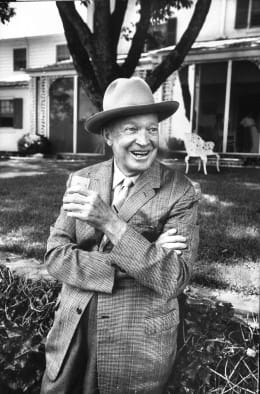
Eisenhower typically drank scotch with ice.

Eisenhower drank scotch over ice.

Eisenhower liked scotch, golf, smoking cigarettes and cigars, and entertaining. He had a mistress (his driver) and mostly entertained business men who he would sound out for advice on the issues of the day. He limited himself to only one drink a day or a bit of a second because of his health. It’s a good standard. Eisenhower was one of the first presidents to have a secret-service nickname, “scorecard” because of his love of golf. Before him, only Wilson played more golf.

John F. Kennedy had many mistresses, and was the last to smoke cigars in public while president. He drank classy drinks like Daiquiris, Bloody Marys and Heineken beer, imported from Holland. The Daiquiri is made of rum, lime, sugar, and water. Kennedy lived on amphetamines from “Dr Feelgood,” his personal physician. He is supposed to have tried LSD and marijuana too, His secret service nickname was “Lancer”, a reference to Lancelot, the philandering knight of Camelot fame. A famous story of Kennedy is that, right before signing the embargo of Cuba, he instructed an assistant to buy up every Cuban cigar he could find. He bought over 1000 and then signed the embargo. Not one of my favorite presidents. Jacquline Kennedy smoked like a train, Salems.
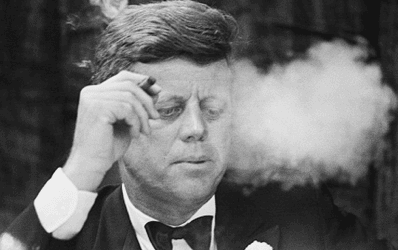
Screen Shot 2018-09-13 at 10.58.11 PMLBJ was a cigarette smoker and a heavy drinker who’s responsible for “Bourbon and Branch” becoming the semi-official drink of Texans. Branch water is just another name for water, BTW. He also drank scotch: Cutty Sark or Teachers, and used his ability to hold liquor in negotiations. He’d greet congressional opponent with two bottles, requesting that they finish them before talking. After that, they were pliable, especially since, sometimes he’d have his diluted. A very good president, IMHO: he was able to implement civil right law that had eluded a century of presidents.
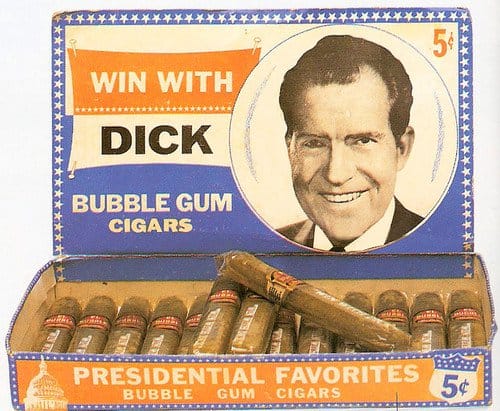
nixon-cigars

Nixon is hated, unfairly I think. He liked fine wine and fruity mixed drinks like Mai Tais, but served mediocre wine to guests. He was an ex-smoker of cigarettes – switched to cigars by the time he was president, but smoking them in private, and handing out bubble gum cigars as a campaign prop. Mai Tais are wonderful drinks, the recipe is 60 ml Jamaican and Martinique Rums, 25 ml Fresh Lime Juice, 15 ml Orange Curaçao, 15 ml Orgeat, 3-4 Crushed Ice Cubes. Nixon ended the Vietnam war and began good relations with Russia and China. I also started the EPA, and is the first president to deal well with the Indians, dividing Alaska land nicely. Watergate was his downfall, helped in part by Deep Throat, the second in command of the FBI who was bypassed for a promotion.

Gerald Ford smoked a pipe in public, and liked gin martinis during lunch or with friends, or gin and tonics in the summer. He didn’t drink to excess, and most people liked him. He’s criticized for thinking Russia was an enemy, and for not stopping inflation, as if anyone else could have done it.

Carter didn’t drink or smoke, and was critical of those who did, a possible swipe at Ford. When he had an arms summit with the Soviets, Carter toasted the soviets with a small glass of white wine. He’s the least favorite president of my life-time; he backed tyrants and thought that deficit spending would cure the economy. He got nothing more than foreign policy abuse and stag-flation (inflationary recession). Carter’s secret service name was “Deacon,” because of his church leanings. 114000446
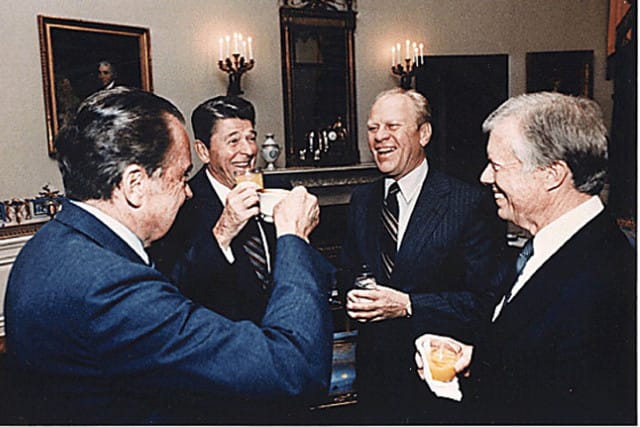
Reagan liked California wine and the Orange Blossom Special: 1 oz. (or slightly less) vodka, 1 oz. of either grenadine or sweet vermouth, 2 oz. fresh orange juice, served over ice. Reagan smoked before becoming president, and ate jelly beans as a way of quitting. They became his signature dish. As president, Reagan was a deficit spender but he got better results than Carter had perhaps because he achieved his deficit by lowering taxes.

George HW Bush drank beer or vodka martinis in moderation, and smoked the occasional cigar. He may have had a mistress, too. A vodka martini is a mix of vodka and dry vermouth mixed in at about 4 to 1. I find it flavorless. He liked (likes) sailing and skydiving. Of the recent presidents, he is the fondest remembered by the white house staff. The soviet union collapsed in his day. A good president and a good man.

Screen Shot 2018-09-13 at 10.58.40 PMBill Clinton smoked pot in college and after, though he claims to have not inhaled. In the white house he smoked cigars, but not in public, and liked an English drink called a snake-bite: 50% beer, 50% hard cider. His secret service name was “eagle,” perhaps because of his eagle eye for women. Several women claimed that he’d pressured them into sex. Clinton denied all charges until one, a 22-year-old intern, turned up with the stained dress. He was a good president but a lousy person. His cigar of choice, the Gurkha Grand Reserve, is slightly longer and wider than the Grant cigar, 6 inches by 50 ring.

George W. Bush had been a heavy drinker in college but completely swore off by the time he was president. When his father had been president, his secret service name had been “Tumbler,” a reference to his drinking and its ill-effects. He requested a different nickname as president, Timberwolf. It sounds vaguely like Tumbler. His main presidential accomplishment was the war on terror, such as it is.

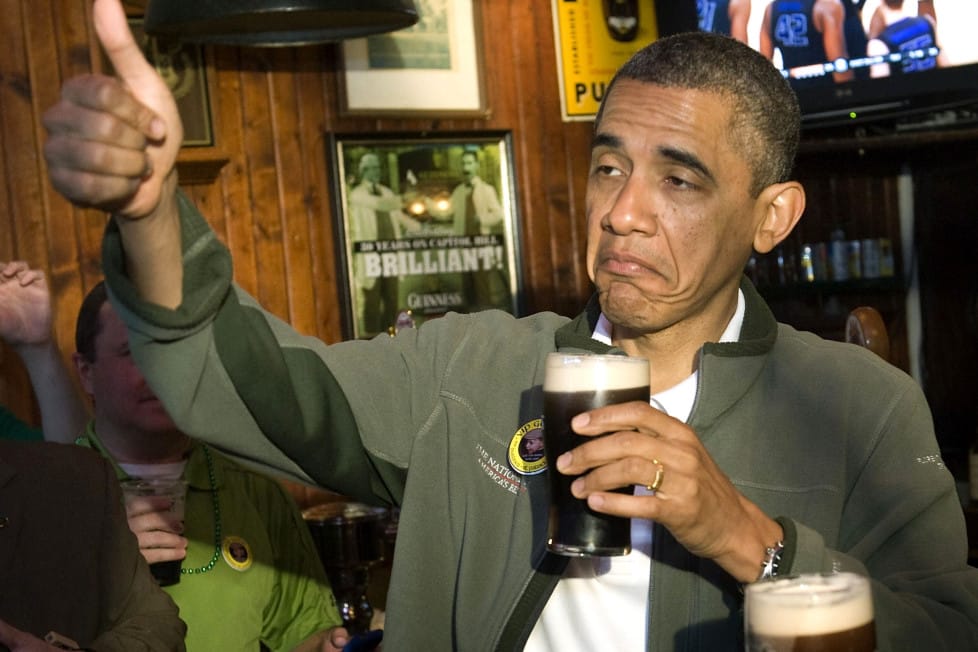
Obama, like Clinton, smoked pot in his youth. He switched to beer and cigarettes in the White house but doesn’t do either in public. The picture at right has him holding the glass. His secret service name is “Renegade,” and his main achievement, seems to have been a close rapport with the countries of Islam. While I can’t say that pot helped either of these men, it does not seem to have hurt them, or society. Thus, I can not favor harsh sentencesusa-whitehouse-beer-1

Trump does not drink or smoke. He has had some affairs before becoming president, but they seem to have been consensual, and he seems to have stopped by the time he entered the Whitehouse. Trump’s church leaning is positivist, and his secret service nickname is “Mogul.” He seems committed to tariffs as a way to restart the economy and as a way to bring down the debt. I wish him success.

It is not clear who is in charge when the president is drunk, nor is the law clear about presidential smoking in the Whitehouse: It is both a public building and a private residence

Robert E. Buxbaum, October 18, 2018. As a side note: The 23rd Prime Minister of Australia, Bob Hawke (1954) held the Guinness Record for fast beer drinking: 2.5 pints in under 11 seconds !

The wealth of nations in beer

We generally compare the wealth of nations in dollars per capita, but this is a false comparison. You can not eat dollars, and even if dollars can be exchanged for products or other countries’ currencies with minimum cost, the same is not true for their products. A sack of rice in America costs more than in India; you can not easily buy it at the Indian price. Nonetheless we generally measure the wealth of a county as if all products cost the same everywhere. Based on this, we declare that the citizens of Lichtenstein are the richest on the planet, followed by Norway and Denmark. US citizens not far behind, vastly richer than the people of Africa who we picture living on pennies per day. But pennies in Africa buy more than pennies in America; wealth is spent locally, and things are expensive where people have money.

GDP for various countries in pints of beer per person per year in main city bar or restaurant

GDP for various countries in pints of beer per person per year in main city bar or restaurant

To correct for this local value of money effect, some economists modify consider the ratio of per-capita GDP by relation to the cost of a basket of goods. This is called purchasing power parity, or ppp. By this measure, American’s are not as much richer than Africans, but the problem remains that people don’t all buy the same basket of goods. The Economist magazine has thus suggested correcting ppp by choosing a single consumable, the MacDonald’s Big Mac, a standard product available world-wide. The Economist’s “Big Mac Index” is quite good in my opinion, but it could be better, and I decided to make it better by using beer instead of Big Macs.

It strikes me that typical Africans don’t eat Big Macs — the price is out of range. Meanwhile, in rich countries mostly it’s the poor who eat MacDonald’s (and Donald Trump). The advantage of using beer to measure the wealth of nations is it’s something most-everyone consumes across all social strata. A country is wealthy in terms of many pints of beer a person can buy based on his or her, per-capita GDP.

Shown at left is the top countries from a table I made by dividing the GDP per capita by the price of a pint (or half-liter) of local beer as served in a tavern or restaurant of the major city. Measured this way I find Lichtenstein is still the richest country on earth, now followed by Saudi Arabia and the Czech Republic. Norway is no longer among the richest countries — beer is expensive there, as is labor. The Czech Republic, normally considered a middle-to-poor country, is number 3 because of the low cost of its excellent beer. The US is several stages down, just below Denmark, and barely above Hungary and Kazakhstan. The socialist countries: Russia, Cuba, and Venezuela are as poor in beer as they are in dollars. Socialism distributes wealth without creating it.

Number of beers one can buy on a month's minimum wage in Europe

Number of beers one can buy on a month’s minimum wage in Europe, by Reddit:adilu.

By now you’re wondering about my use of per-capita GDP. Perhaps a better comparison — one where socialism looks better would involve the minimum wage. At right I show a map of Europe in terms of the number of beers one can buy per month based on 40 hour weeks at the minimum wage. Several countries are greyed out: Italy, Austria, Sweden, Finland, Lichtenstein, etc. These are mostly rich countries bu have no minimum wage. Based on the data, Belgium’s working classes are the best off, with Ireland and England not far behind. Germany’s workers look like they are doing well, but they don’t really have a minimum wage (the chart, by Reddit editor adieu assumes one based on a proposal). The United States’s minimum worker is poorer in beer (327/month) based on a minimum wage of $7.85 and an average cost of beer about $4/pint (bar + supermarket). He is richer than the French, Poles, Italians, Norwegians, Danes, Austrians and Swedes in beer, and better off than the Turks and Russians too. It’s clear that high minimum wages harm community wealth and job prospects. Though some at the bottom of the work scale are left dry at the bar.

Robert Buxbaum, July 18, 2018. I write these blogs to help me think. If you’d like to see more of the wealth of nations in beer, I’ll be happy to provide.

Map of Italian pasta


From the taste atlas of the world, Italy

Fresh from the taste atlas of the world.

As a brief explanation to the above map, Italy has had a troubled history over the last 2000 years. As the Roman Empire fell, the north-east got taken over by Germans. It still speaks German, and drinks beer. Spätzle is an Austrian pasta. The Italian northwest has been under French domination, off and on and it shows in the thick cream sauces. The south was controlled by the Moores for 1000 years, leaving dishes with fennel and olives. And then there is the amazing innovation: the tomato, a gift from Spanish America that seems to have found its home on the eastern seaboard, though Spain controlled the west. I don’t know why. Enjoy.

Robert Buxbaum, May 1, 2018

Yogurt making for kids

Yogurt making is easy, and is a fun science project for kids and adults alike. It’s cheap, quick, easy, reasonably safe, and fairly useful. Like any real science, it requires mathematical thinking if you want to go anywhere really, but unlike most science, you can get somewhere even without math, and you can eat the experiments. Yogurt making has been done for centuries, and involves nothing more than adding some yogurt culture to a glass of milk and waiting. To do this the traditional way, you wait with the glass sitting outside of any refrigeration (they didn’t have refrigeration in the olden days). After a few days, you’ll have tasty yogurt. You can get taster yogurt if you add flavors. In one of my most successful attempts at flavoring, I added 1/2 ounce of “skinny syrup” (toffee flavor) to a glass of milk. The results were most satisfactory, IMHO.

My latest batch of home-made flavored yogurt, made in a warm spot behind this urn.

My latest batch of home-made flavored yogurt, made in a warm spot behind this coffee urn.

Now to turn yogurt-making into a science project. We’ll begin with a hypothesis. I generally tell people to not start with a hypothesis, (it biases your thinking), but here I will make an exception as I have a peculiarly non-biased hypothesis to suggest. Besides, most school kids are told they need one. My hypothesis is that there must be better ways to make yogurt and worse ways. A hypothesis should be avoided if it contains any unfounded assumptions, or if it points to a particular answer — especially an answer that no one would care about.

As with all science you’ll want to take numerical data of cause and effect. I’d suggest that temperature data is worth taking. The yogurt-making bacteria is called lactose thermophillis, and this suggests that warm temperatures will be good (lact = milk in Latin, thermophilic = loving heat). Also making things interesting is the suspicion that if you make things too warm, you’ll cook your organisms and you won’t get any yogurt. I’ve had this happen, both with over-heat and under-heat. My first attempt was to grow yogurt in the refrigerator, but I got no results. I then tried the kitchen counter and got yogurt, and then I heated things a bit more by growing next to a coffee urn, and got better yogurt; yet more heat and nothing.

For a science project, you might want to make a few batches of yogurt, at least 5, and these should be made at 2-3 different temperatures. If temperature is a cause for the yogurt to come out better or worse, you’ll need to be able to measure how much “better”? You may choose to study taste, and that’s important, but it’s hard to quantify, so that should not be the whole experiment. I would begin by testing thickness, or the time to a get some fixed degree of thickness; I’d measure thickness by seeing if a small weight sinks. A penny is a cheap, small weight, and I know it sinks in milk, but not in yogurt. You’ll want to wash your penny first, or no one will eat the yogurt. I used hot water from the urn to clean and sterilize my pennies.

Another thing that is worth testing is the effect of using different milks: whole milk, 2%, 1% or skim; goat milk, or almond milk. You can also try adding stuff to it, or starting with different starter cultures, or different amounts. Keep numerical records of these choices, then keep track of how they effect how long it takes for the gel to form, and how the stuff looks or tastes to you. Before you know it, you’ll have some very good product at half the price of the stuff in the store. If you really want to move forward fast, you might apply semi-random statistics to your experimental choices. Good luck.

Robert Buxbaum, March 2, 2018. My latest observation: what happens if you leave the yogurt to mold too long? It doesn’t get moldy, perhaps the lactic acid formed kills germs (?), but the yogurt separated into curds and whey. I poured off the whey, the unappealing, bitter yellow liquid. The thick white remainder is called “Greek” yogurt. I’m not convinced this tastes better, or is healthier, BTW.

Penicillin, cheese allergy, and stomach cancer

penecillin molecule

The penicillin molecule is a product of the penicillin mold

Many people believe they are allergic to penicillin — it’s the most common perceived drug allergy — but several studies have shown that most folks who think they are allergic are not. Perhaps they once were, but when people who thought they were allergic were tested, virtually none showed allergic reaction. In a test of 146, presumably allergic patients at McMaster University, only two had their penicillin allergy confirmed; 98.6% of the patients tested negative. A similar study at the Mayo Clinic tested 384 pre-surgical patients with a history of penicillin allergy; 94% tested negative. They were given clearance to receive penicillin antibiotics before, during, and after surgery. Read a summary here.

08

Orange showing three different strains of the penicillin mold; some of these are toxic.

This is very good news. Penicillin is a low-cost, low side-effect antibiotic, effective against many diseases including salmonella, botulism, gonorrhea, and scarlet fever. The penicillin molecule is a common product of nature, produced by a variety of molds, e.g. on the orange at right, and in cheese. It is thus something people have been exposed to, whether they realize it or not.

Penicillin allergy is a deadly danger for the few who really are allergic, and it’s worthwhile to find out if that means you. The good news: that penicillin is found in common cheeses suggests, to me, a simple test for penicillin allergy. Anyone who suspects penicillin allergy and does not have a general dairy allergy can try eating appropriate cheese: brie, blue, camembert, or Stilton. That is any of the cheeses made with penicillin molds. If you don’t break out in a rash or suffer stomach cramps, you’re very likely not allergic to penicillin.

There is some difference between cheeses, so if you have problems with Roquefort, but not brie or camembert, there’s still a good chance you’re not allergic to penicillin. Brie and camembert have a white fuzzy mold coat of Penicillium camemberti. This mold exudes penicillin — not in enough quantity to cure gonorrhea, but enough to give taste and avoid spoilage, and enough to test for allergy. Danish blue and Roquefort, shown below, have a different look and a sharper flavor . They’re made with blue-green, Penicillium roqueforti. This mold produces penicillin, but also a small amount of neurotoxin, roquefortine C. It’s not enough to harm most people, but it could cause an allergic reaction to folks who are not allergic to penicillin. Don’t eat a moldy orange, by the way; some forms of the mold produce a lot of neurotoxin.

For people who are not allergic, a thought I had is that one could, perhaps treat heartburn or ulcers with cheese; perhaps even cancer? H-Pylori, the bacteria associated with heartburn, is effectively treated by amoxicillin, a penicillin variant. If a penicillin variant kills the bacteria, it seems plausible that penicillin cheese might too. And since amoxicillin, is found to reduce the risk of gastric cancer, it’s reasonable to expect that penicillin or penicillin cheese might be cancer-protective. To my knowledge, this has never been studied, but it seems worth considering. The other, standard treatment for heartburn, pantoprazole / Protonix, is known to cause osteoporosis, and increase the risk of cancer, and it doesn’t taste as good as cheese.

A culture of Penicillium roqueforti. Most people are not allergic to it.

The blue in blue cheese is Penicillium roqueforti. Most people are not allergic.

Penicillin was discovered by Alexander Fleming, who noticed that a single spore of the mold killed the bacteria near it on a Petrie dish. He tried to produce significant quantities of the drug from the mold with limited success, but was able to halt disease in patients, and was able to interest others who had more skill in large-scale fungus growing. Kids looking for a good science fair project, might consider penicillin growing, penicillin allergy, treatment of stomach ailments using cheese, or anything else related to the drug. Three Swedish journals declared that penicillin was the most important discovery of the last 1000 years. It would be cool if the dilute form, the one available in your supermarket, could be shown to treat heartburn and/or cancer. Another drug you could study is Lysozyme, a chemical found in tears, in saliva, and in human milk (but not in cow milk). Alexander Fleming found that tears killed bacteria, as did penicillin. Lysozyme, the active ingredient, is currently used to treat animals, but not humans.

Robert Buxbaum, November 9, 2017. Since starting work on this essay I’ve been eating blue cheese. It tastes good and seems to cure heartburn. As a personal note: my first science fair project (4th grade) involved growing molds on moistened bread. For an incubator, I used the underside of our home radiator. The location kept my mom from finding the experiment and throwing it out.

Fat people live longer, show less dementia

Life expectancy is hardly affected by weight in the normal - overweight- obese range. BMI 30-34.9 = obese.

Life expectancy is hardly affected by weight in the normal – overweight – obese range. BMI 30-34.9 = obese.

Lets imagine you are a 5’10” man and you weigh 140 lbs. In that case, you have a BMI of 20, and you probably think you’re pretty healthy, or perhaps you think you’re a bit overweight. Our institutes of health will say that you are an “average-wight” or “normal-weight” American, and then claim that the average-weight American is overweight. What they don’t tell you, is that low weight, and so-called average weight people in the US live shorter lives. Other things being equal, the morbidity (chance of death) for a thin American, BMI 18.5 is nearly triple that of someone who’s obese, BMI 32. The morbidity of the normal-weight American is better, but is still nearly double that of the obese fellow whose BMI is 32.

Our NIH has created a crisis of overweight Americans, that is not based on health. They work hard to solve this obesity crisis by telling people to jog to work, and by creating ever-more complicated food pyramids. Those who listen live shorter lives. A prime example is Jim Fixx, author of several running books including “The complete Book of Running.” He was 52 when he died of a heart attack while running. Similar to this is the diet-expert, Adelle Davis, author of “Let’s eat right to keep fit”. She died at 70 of cancer — somewhat younger than the average American woman. She attributed her cancer to having eaten junk food as a youth. I would attribute it to being thin. Not only do thin people live shorter lives, but their chances of recovering from cancer, or living with it, seem to improve if you start with some fat.

The same patter exists where age-related dementia is concerned. If you divide the population into quartiles of weight, the heaviest has the least likelihood of dementia, the second heaviest has the second-least, the third has the third-least, and the lightest Americans have the highest likelihood of dementia. Here are two studies to that effect, “Association between late-life body mass index and dementia”, The Kame Project, Neurology. 2009 May 19; 72(20): 1741–1746. And “BMI and risk of dementia in two million people over two decades: a retrospective cohort study” The Lancet, Volume 3, No. 6, p431–436, June 2015.

Morbidity and weight, uncorrected data, and corrected by removing the demented.

Morbidity and weight, uncorrected data, and corrected by removing the demented. The likelihood of dementia decreases with weight.

Now you may think that there is a confounding, cause and effect here: that crazy old people don’t live as long. You’d be right there, crazy people don’t live as long. Still, if you correct the BMI-mortality data to remove those with dementia, you still find that in terms of life-span, for men and women, it pays to be overweight or obese but not morbidly so. The study concludes as follows: “Weight loss was related to a higher mortality risk (HR = 1.5; 95% CI: 1.2,1.9) but this association was attenuated when persons with short follow-up or persons with dementia were excluded.” As advice to those who are planning a weight loss program, you might go crazy and reduce your life-span a lot, but if you don’t go crazy, you’re only reducing your life-span a little.

In terms of health food, I’ve noticed that many non-health foods, like alcohol and chocolate are associated with longevity and mental health. And while low-impact exercise helps increase life-span, that exercise is only minimally associated with weight loss. Mostly weight loss involves changing the amount you eat and changing your clothes choices to maximize radiant heat loss.

Dr. Robert E. Buxbaum, October 26, 2017. A joke: Last week I was mugged by a vegan. You may ask how I know it was a vegan. He told be before running off with my wallet.

June 14 1789, First Bourbon whiskey

June 14. On this day, in 1789, the US national spirit, whiskey, Bourbon whiskey, was first distilled by Rev Elijah Craig of Kentucky. He named his product “Bourbon whiskey” as a reference to Bourbon County, where he lived, and the fact that it was a form of whiskey, like the Rye whiskey that George Washington distilled. Rev. Craig’s innovation was to use maize (corn) instead of the typical rye with malted barley added as an enzymatic modifier. George Washington was the largest distiller in the US in the late 1700s. His whiskey was mostly rye with very little malt.

But corn is cheaper than rye, and Bourbon whiskey has a milder flavor. Because of these two reasons, US consumption of Bourbon whiskey came to far surpass that of rye whiskey. In honor of that fact, Senator Mitch McConnell here tells congress that Bourbon is the spirit of Kentucky, “the spirit of America”. Here, his speech is set to music with other news of the day, and a comment by President Obama saying he’d enjoy having a drink with Senator McConnell. What would that drink be? Straight Bourbon? or Bourbon and water, or perhaps a mint julep, the classic Kentucky concoction, made with Bourbon, sugar, and spearmint.

Related to this topic, I should mention that President Truman liked Bourbon straight, that the favorite drink of Lyndon B. Johnson, was “Bourbon and branch” (branch is water). And that Theodore Roosevelt served mint juleps at The White house (if you played tennis with him) using his own, White-house grown mint, but made with rye, not Bourbon.

GWKuhn outflow point. During a storm this outflow is filled to the roof.

GWKuhn outflow point. During a storm this outflow is filled to the roof.

June 14th is also flag day, though only celebrated as a holiday in Pennsylvania. It’s also the day of the mutiny on the HMS Bounty, and the day of the Marijuana act, 1937. Hawaii joined the union this day, and Paris fell in WWII. This is also the day I first got a tour of the George W. Kuhn sewage retention facility, the main sewage plant in our county. A few days before, I walked into the outflow pipe of the plant, see picture. It was some 60 feet wide by 22 feet tall. I was looking for convenient connection points i could use to separate the storm from the sanitary sewage flow through the facility, assuming I became water commissioner.

Robert Buxbaum, June 14, 2016. Some months ago, I suggested that Michigan might change its state bird to the wild turkey instead of the robin. It’s a common MI bird, and also a brand of good Bourbon.

State bird suggestion: the turkey

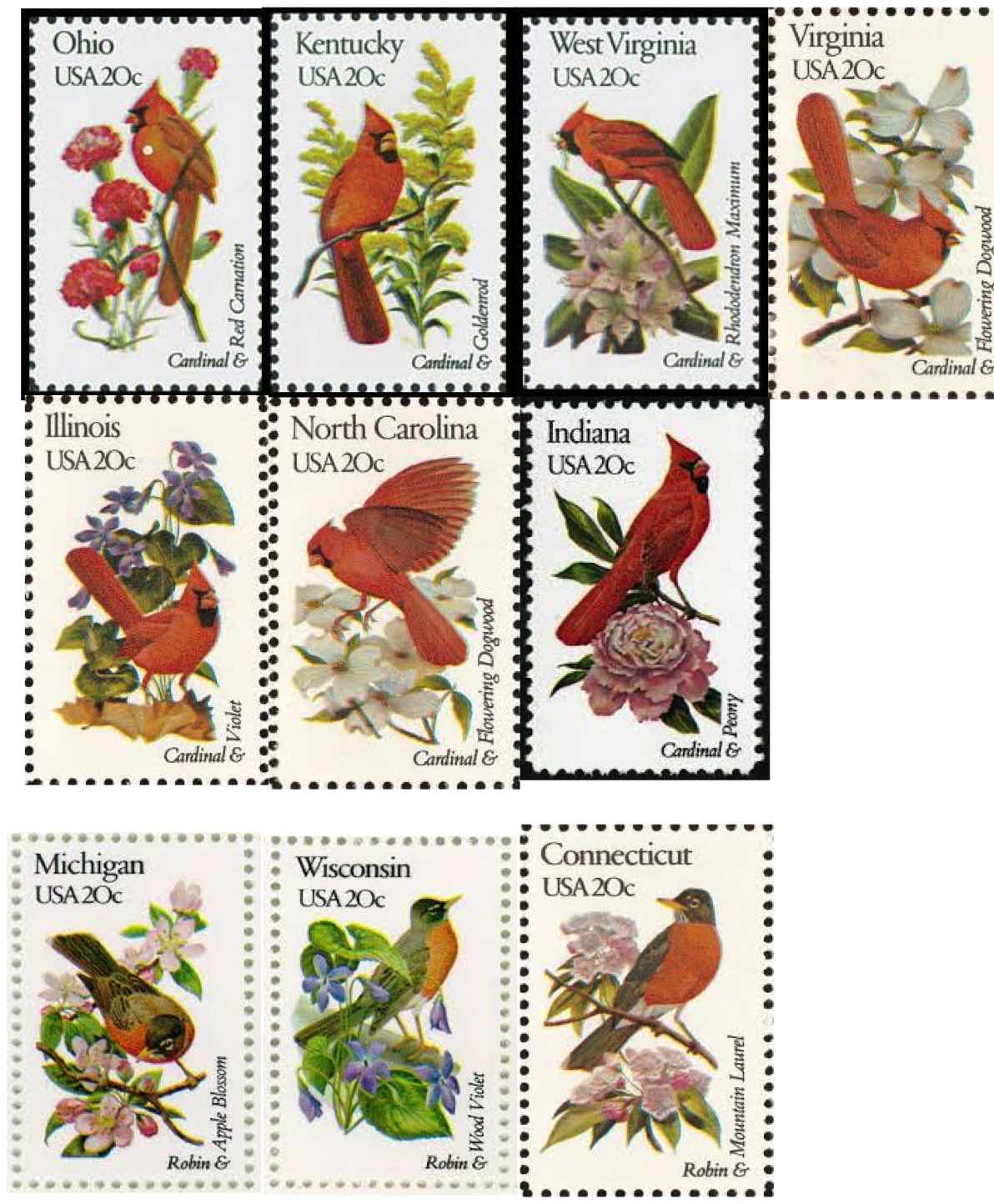
state bird stamps; robin cardinal

three US states use the (american) robin as their state bird, and 7 more use the (northern) cardinal. None use the turkey

As things now stand, three states of the union, including Michigan have the robin as their state bird. Another seven have the cardinal. Not that they have different species of robin or cardinal, they use the same species: the American robin, and the Northern cardinal respectively.

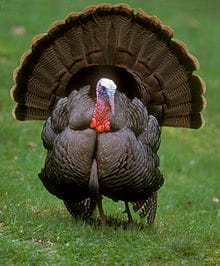
A thought I’ve had is that Michigan should change to have a unique bird symbol, and I propose the turkey, in particular the eastern wild turkey shown below. The robin is found in every state of the union except for Hawaii, and is found in several countries, it’s associated with Robin Hood, and with Batman’s side-kick. By contrast, the eastern wild turkey could be a unique state symbol. It’s basically found in no other country besides the US, and found in only a few US states including Michigan.

Eastern Wild Turkey. A majestic bird, and brave Maximum height: 4 foot.

Eastern Wild Turkey. A majestic bird, and brave. Maximum height: 4 foot.

The eastern wild turkey is a far more impressive bird than the cardinal or robin. Full grown, it stands 4 foot tall. Benjamin Franklin claimed to have preferred the turkey (likely the eastern wild turkey) to the eagle as the national bird of the US. In this wonderful letter to his daughter, Sarah, he says that it is a noble bird, useful and the source of sustenance. He also claims it is unafraid to attack a British regimen, claims that also appears in this song, “the egg” in the play/movie 1776. The turkey most definitely provided food for the Indians, for the early European settlers, and still provides for Michigan hunters to this day. Further, turkey feathers are the preferred choice for quill pens. They are used for scribes writing holy works, like copies of the Torah, and it is likely they were used for the declaration of Independence. The same history and associations can not be claimed for the robins or the cardinal. Those birds are basically attractive, and nothing else.

Not that attractive is bad, nor is it bd to have a state bird associated with Batman’s side-kick, or with a Saint Louis baseball team, but I don’t think either is particularly appropriate for Michigan. Not that there are no disadvantages to the name turkey: (1) it might suggest a slow individual or project, and (2) Wild Turkey is the name of a Tennessee bourbon whiskey. Neither of these are quite a bad as being a sidekick to the bat, or to the batman, and I think both are addressed by specifying that the state bird is the eastern wild turkey, and not just some random variety. What say ye, citizens of Michigan? Let’s do it before someone else takes the turkey.

Robert Buxbaum, December 16, 2015.

Chinese jokes

At college, my chinese room-mate wanted to make a surprise birthday dinner for his girlfriend.

….. But someone let the cat out of the bag.

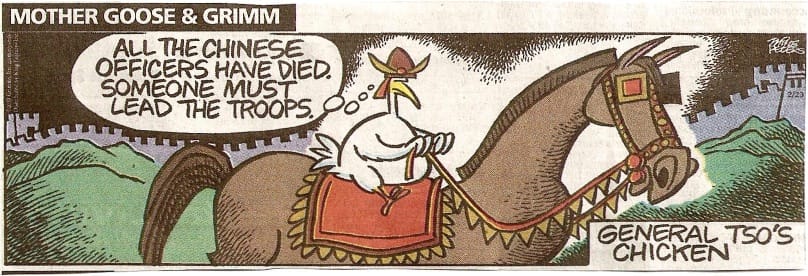
Then there was the fellow who broke into the Fortune Cookie Factory with a hammer and broke virtually all the fortune cookies — as many as he could find — in an act of wonton destruction.

And finally,

I don’t believe racial jokes are evil, but suppose it all comes down on your idea of good humor. Comedy always involves odd people, or people doing things differently. The difference doesn’t have to be insulting, just different, and all good jokes provide some new insight.

Robert E. Buxbaum, October 29, 2015. Every now and again I post jokes– and then I analyze them to death (it’s funny because ….). Recent ones include an Italian Funeral joke, a fetish lawyer joke, and things on, engineers, dentists, piratessurrealism. Just click the “jokes” tab at right for the whole, unsightly assortment.

you are what you eat?

The simplest understanding of this phrase is that you should eat good, healthy foods to be healthy, and that this will make you healthy in body and mind.

The author of the study published this book against GM foods simultaneously with release of his paper.

The author of this book against unhealthy foods faked his analysis to support the book.

Clearly there is some truth to this. Crazy people look crazy and often eat crazy. Even ‘normal’ people, if they eat too much are likely to become fat, lazy, and sick. There is a socio- economic effect (fat people earn less), and a physiological evidence that gut bacteria affects anxiety and depression (at least in rats). My sense here is at the diet extremes though. There is little, or no evidence to suggest you can make yourself more intelligent (or kind or good) by eating more of the right stuff, or just the right foods in just the right amounts. A better diet can make you look better, but there is a core lie at work when you extend this to imply that the real you is your body, or so tied to your body that a healthy mind can not be found in a sickly body. But most evidence is that the mind is the real you, and (following Socrates) that beautiful minds are found in sickly bodies. I’ve seen few (basically, no) healthy poets, writers, or great artists. Neither are there scientists of note (that I can recall) who lived without smoking, drinking, and any bad habits. Many creative people did drugs. George Orwell smoked cigarette, and died of TB, but wrote well to the end. There is no evidence that bad writing or thinking can be improved by health foods. Stupid is as stupid does, and many healthy people are clearly dolts.

Not that it’s always clear what constitutes good health, or what constitutes good food for health, or what constitutes a good mind. Skinny people may be admired and may earn more, but it is not clear they are healthy. Yule Gibbons, the natural food guru died young of stomach cancer. Adele Davis, another the author of “eat right to be healthy,” died of brain cancer. And Jim Fix, “the running doctor” died young of a heat attack while running. Their health foods may have killed them, and that unhealthy foods, like chocolate and coffee can be good for you. It’s likely a question of balance. While a person will feel better who dresses well, the extreme is probably no good. Very often, a person is drawn after his self-image to be the person he pretends. Show me a man who eats only vegetarian, and I’ll show you someone who sees himself as spiritual, or wants to be seen as spiritual. And that man is likely to be drawn to acting spiritual. Among the vegetarians you find Einstein, George B. Shaw, and Gandhi, people who may have been spiritual from the start, but may have been kept to spirituality from their diets. You also find Hitler: spirituality can take all sorts of forms.

Ward Sullivan in the New Yorker

Ward Sullivan in the New Yorker. People eat, drink, and dress like who they are. And people become like those they eat drink and dress like.

Choice of diet also helps select the people you run into. If you eat vegetarian, you’re likely to associate with other vegetarians, and you will likely behave like them. If you eat Chinese, Greek, or Mexican food, you’re likely to associate with these communities and behave like them. Similarly, an orthodox Jew or Moslem is tied to his community with every dinner and every purchase from the kosher or halal store.

And now we come to the bizarre science of bio-systems. Each person is a complex bio-system, with more non-human DNA than human, and more non-human cells than human. A person has a vast army of bugs on him, and a similarly vast pool of bugs within him. Recent research suggests that what we eat affects this bio-system, and through it our mental state. For whatever the mechanism, show me someone who drinks only 30 year Scotch or 40-year-old French wine, and I’ll show you a food snob. By contrast, show me someone who eats good, cheap food, and drinks good, cheap wine or Scotch (Lauder’s or Dewar’s), and I’ll show you a decent person very much like myself, a clever man who either is a man of the people or who wants to be known as one.”Dis-moi ce que tu manges, je te dirai ce que tu es.” [Tell me what you eat and I will tell you what you are].

Robert E. Buxbaum, February, 2015. My 16-year-old daughter asked me to write on this topic. Perhaps she didn’t know what it meant, or how true I thought it was, or perhaps she liked my challenges of being 16.