Author Archives: R.E. Buxbaum

About R.E. Buxbaum

Robert Buxbaum is a life-long engineer, a product of New York's Brooklyn Technical High School, New York's Cooper Union to Science and Art, and Princeton University where he got a PhD in Chemical Engineering. From 1981 to 1991 he was a professor of Chemical Engineering at Michigan State, and now runs an engineering shop in Oak Park, outside of Detroit, Michigan. REB Research manufactures and sells hydrogen generation and purification equipment. He's married with 3 wonderful children who, he's told, would prefer to not be mentioned except by way of complete, unadulterated compliments. As of 2016, he's running to be the drain commissioner/ water resources commissioner of Oakland county.

The boon of e-cigarettes

E-cigarette use is rising fast among US smokers, and have passed traditional cigarette smoking among US High Schoolers, according to a recent CDC surveyAmong the advantages: e-cigarettes are less regulated and cheaper than regular cigarettes. The vapors smell better. The smoke is supposed to be 95% less unhealthy. And the vape (e-cigarette “smoke”) doesn’t stain teeth like regular cigarettes. Not everyone is thrilled to see a safer cigarette alternative, though. A 2014 Harvard Study, The E-cigarette Quandary, points out that 95% less dangerous is not the same as 100%, that kids might come to smoke who might not otherwise, and that one could still get unwelcome, second-hand nicotine from exhaled vape. To correct these issues, some 200 regulation and prohibition bills have been introduced in 40 states in the past year alone. Among these, prohibitions on selling to minors, prohibitions on vaping where smoking is prohibited, and a National Park Service prohibition on e-cigarette use anywhere in a national park. 

Inside an e-cigarette

Inside an e-cigarette

My sense is that, for some people, those who already smoke, a 95% less dangerous alternative has got to be a boon, unless (as seems unlikely) people come to smoke twenty times more e-cigarettes than regular. To the contrary, It appears that e-cigarettes seem to help smokers quit tobacco, even with no help from a smoking cessation service. And over time, e-smokers tend to reduce the amount of nicotine in the juice, in that way reducing the toxic burden of the e-cigarette too. This is an option that is not possible with traditional, combustion cigarettes.

The claim that e-cigarettes are 95% less harmful than combustion cigarettes is based on a comparison between the concentrations of poisonous vapors inhaled, as measured for a study published in the journal, Addiction. Sorry to say, you have to pay to read the whole article, but you can read the abstract for free, or read a blog post by the lead author, Dr. Konstantinos Farsalinos. A British study supports this too, as described in a more-recent report by Public Health England. While it is not 100% clear that a 95% reduction in harmful vapor means that e-cigarettes are 95% less dangerous, that would seem to be the conclusion on a puff-per-puff basis, assuming no change in the formulation of e-cigarette “juice”, and only if the smokers don’t end up smoking vastly more.

Have e-cigarettes caused  the decrease of regular smoking, or is it a threat to the decrease in regular smoking?

E-cigarette use among US High School students, 2014. The rise in e-cigarette use parallels a decrease regular smoking; perhaps it’s the cause of the decrease. From “The E-cigarette Quandary.”

For the reasons above, I gave an e-cigarette device to an employee who smokes. So far, it seems he likes it, and I’m happy that he doesn’t have to go outside to smoke. It also seems to have saved him some money and his teeth look a bit whiter as best I can tell. Interestingly, he claims he has less of a desire for regular cigarettes, too matching observations among high school use, and among the population in general. My first impression, the e-cigarette seems to be a boon, a good thing, for him at least.

Despite the sense that e-cigarettes are a boon, that sense is rooted in cæteris paribus, the assumption at all else remains static. Without regulations, I expect some nasty developments — in the content of e-cigarette juice, in the operation of the cigarette, and in the product marketing. Nicotine is a drug, cigarette makers are clever, and there is money to be had. I see regulation being needed over the acceptable composition of the juice, over the operating temperatures and flows of the cigarettes, and over sales and advertising to minors. With these put into place, I see no need for further prohibitions on e-cigarettes in the work-places or the national parks — or so it appears to me today.

Dr. Robert E. Buxbaum, November 8, 2015.

Is cannibal tourism good for Michigan?

Governor Snyder has no appetite for it, but ex-governor Jennifer Granholm did, and some of her Democratic colleagues still do. Not cannibal tourism, as such, but movie subsidies paid for by a tax on business property independent of profits. Some seven years ago, in 2008, then-governor Granholm and a majority of our legislature instituted a $132 million/year subsidy program that provided up to 42% of movie production costs. The hope was that films would bring Hollywood-type wealth and glamor, and that they would spark tourism. As it happened, the jobs went to Hollywood transients to such an extent that the total number of MI film employees was reduced. It is now 100 lower than at the start, and virtually all of the money spent went to out-of state employees (quite often the high-priced star) who left as soon as the filming was done. The report concluded that the program returned 11¢ for every tax dollar spent. One of Governor Snyder’s first acts was to diminish the subsidies, and the legislature has just put an end to them: revenge of the nerd.

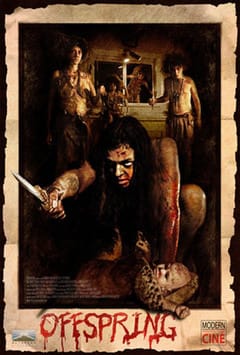
Offspring, filmed in Michigan. It does not seem to have promoted Michigan tourism.

Offspring: no jobs created, and perhaps no tourism … but think of the cool factor.

The amount spent in the early years, $132 million/year, was about 1/3 of the state’s deficit, a major misuse of funds. Reason magazine claimed it was “stone-crazy” to support movies when the state had, at the time, 14% unemployment, the highest rate in the nation. They argued that the money could be better spent on roads, or schools, or left in folks’ pockets (I agree).

The effect on tourism isn’t quite what was hoped. Movie makers tend to see Michigan as a setting for dystopian films, for example, “Offspring,” a film about cannibal tourism. This film got one of the largest state subsidies. A plot summary is:  “Survivors of a feral flesh-eating clan are chowing their way through the locals.” If this encouraged tourism, it’s not necessarily the tourists you wanted. You can tell it’s Michigan by the Michigan symbol on the police cars. Michigan funds also brought two Batman movies to Detroit, along with Michael Moor’s “Capitalism, a love story“, a  movie billed as showing how capitalism makes life in America a nightmare. The current head of the film board has noted that “realistic cannibalism; the gruesome and graphically violent depiction …. is unlikely to promote tourism in Michigan or to present or reflect Michigan in a positive light.” I can agree.

Batman and Superman in Detroit.

“Batman vs Superman.” They battle in Downtown Detroit, as do “Red Dawn” and “Transformers.”

Opposition to dropping the program came mostly from the Democratic side of the aisle. Rep. Jeremy Moss, D-Southfield, said the film incentives were creating good jobs. Rep. Kristy Pagan, D-Canton, pointed to “… the cool factor. Who doesn’t want to see Ben Affleck or Amy Adams walk down our streets?” (I don’t). In the end, three Democrats and virtually every Republican voted to end the program. Among the Republicans for keeping the program were Kathy Crawford R-Novi, and Mike McCready, R-Birmingham.

You should not feel too bad for the makers of gore films. Subsides are still available in Massachusetts, Oregon, Washington, California, Minnesota, Nevada, and several other states. Massachusetts welcomed Part 2 of The Offspring, a Massachusetts headline proclaimed the victory: “Come to Massachusetts, We Love Cannibals!” Massachusetts folks have been full of themselves for years. As for the money we saved, our Michigan legislature has finally begun balancing the budget and decreasing the destructive personal property tax that helped fund these schemes.

Robert E. Buxbaum, November 5, 2015. I should also commend the legislature for making “talk like a pirate day” a state holiday, and for passing, on November 3, a necessary roads bill. It was signed by most Republicans and two Democrats. Bipartisan-ish. With good management, Michigan might be coming back – lets hope it continues.

Michigan’s road bill — why not?

Stagnating before the Michigan Senate is a road improvement bill that passed the Michigan house 10 days ago. Though it’s not great, I hope they sign the bill. The bill would raise raise $600 million to $1.2 billion/year, an increase of $60 to $120 per person per year ratcheting up over the next six years. The first stage of the bill would take effect in October 2016, and would raise $400 million by increasing our car/ truck registration fees by about 40%. People with normal sedans would pay about $60 more per car per year. Those with more expensive, heavier vehicles would pay more. Though our registration fee is already among the highest in the nation, raising it further has the potential (It seems to me) to be the most fair and reasonable source of additional revenue. People with fancy cars, I imagine, are wealthy and those with heavy cars (I imagine) do the most road damage. This is the part of the bill that has proven the most contentious.

The next stage would begin in early 2018. It would raise $200 million by increasing Michigan diesel and gasoline taxes. The larger part would be on diesel fuel, an increase of 7.3 cents/gal presumably to soak out-of-state truckers who come through Michigan. These individuals deserve extra taxation, I imagine, because they don’t pay registration fees and probably damage our roads even more than those with fancy cars. Besides, they don’t vote in Michigan. The gas tax increase is smaller, 3.3 cents/ gal on regular gas, but Democrats are correct to point out that it is regressive. It takes a greater fraction from the poorer than from the rich. The hope is that, by the time the tax increase takes effect, we’ll have some inflation and also some more fuel-efficient cars so the bite won’t be as bad. Sorry to say, we already pay the 10th highest gas tax in the country.

The final phase of the road funding bill would not take full effect until 2021. The idea is to transfer $600 million from the general fund to pay for the roads with money left over to reduce home-owner taxes. Underlying the ability to do this is an assumption that Michigan industry and home prices will recover enough between now and then that we’ll be able to stop using the gasoline taxes to fund our schools, ideally with money left over from the regular income and sales tax. While I’d like to see this happen, and while this is possible given that the last few years have seen the state’s GDP recover at a 15.5+% growth rate (third highest in the nation) there is also a basis to say the assumptions are over- optimistic. On the other hand, the Democratic plan, based on 1.6% growth next year is likely over-pessimistic. As The Yogi says, “Predictions are always difficult, especially about the future.”

Whatever your views of the future, our roads are crumbling now, and new money is needed to fix them now before they get worse. If taxes must be raised, I’m inclined to do it with use -taxes, that is by charging those who use the services most. This is a philosophical preference of mine. Not all Republicans agree with this, and only one House Democrat has signed on so far. It was the view of the old-time, labor Democrats I grew up with, but not of today’s Democrats who prefer to tax “the rich” for any and all goods and services. Their point: that there are struggling, poor people who drive heavy, expensive cars. They’ve something of a point on the heavy cars, but I have less sympathy for the rest. I wrote a comic story about a poor guy trying to dispose of an expensive car, a Viper. My guess is that struggling rappers and poser politicians would not find it funny.

Dollars per capita spent on roads, 2013. From MDoT's road funding proposal.

Dollars per capita spent on roads, 2013. From MDoT’s road funding proposal.

Part of the way that MDoT (the Michigan Department of Transportation) justified its target of $600 million to $1.2 billion was by comparison with surrounding states — not my favorite way of analysis. The MDoT graphic shows that Michiganians spend about $57 less per capita on roads than folks in Illinois, Wisconsin, or Ohio, and about $100 less than folks in Indiana or Pennsylvania. Multiply $57 by our state’s population, 10 million, and they conclude we should spend some $570 million more per year. Multiply by $100, and you get $1.0 billion.

While the need for at least $600 million/year sounds about right, I note that the per-capita spending justification seems dubious. If you calculate instead on the basis of dollars per lane-mile, as below, you find that Michiganians are already paying more per mile than Minnesota, Wisconsin, or Indiana. You’ll also note that Ohio and Illinois pays about 1 1/2 times as much their roads aren’t much better. A major part of the variation, I suspect, is corruption, and the rest, I guess is incompetence. Illinois, perhaps the most corrupt state in the mid-west, has seen 4 of its past 5 governors go to jail, along with innumerable Chicago Aldermen and lesser officials. Citizens of Illinois pay for this corruption in over-size construction projects, and over-size construction fees. After the $600 million increase, we’ll pay $8,950 per lane mile suggesting we are still not quite as costly per lan-mile as Illinois or Ohio. If it turns out we need the full $1.2 billion extra, it will suggest we are even more incompetent or corrupt than Illinois.

Road funding state by state comparison.

Road funding state by state comparison, from the same MDoT report, 2013.

An ideal way I’d like to reduce the costs of Michigan’s roads would be to reduce corruption, a trend that’s already helped to revitalize Detroit since the Justice department jailed the mayor and his father plus some associates for “pay for play”. I’m sure it also helped to remove the chief of police (millions in his ceiling) and Bobby Ferguson of the useless, expensive Jail project and Guardian building scandal.

Conviceted IL

It’s somewhat hard to judge the level of general incompetence in a state, and even harder to find a fix. Minnesota had a bridge collapse in 2007, and we had the Zilwaukee in 1982 (and 2008), the 9 mile bridge collapse of 2009, and the Southfield overpass collapse of 2014. It’s been proposed that we should be able to fix both our corruption and our incompetence problems by holding the contractors responsible for any failures. If only it were that easy. Holding contractors responsible might get some contractors to allow the concrete cure for longer periods under water before opening a road, but I’m not sure the public would stand for it. A more-likely outcome is that crooked contractors would charge more for the same bad work, and then go bankrupt as soon as the road fails. If their company were appropriately structured, they could re-appear the next day: the same people and equipment, operating under a new corporate name.

The biggest single incompetence issue that I can see appears to be poor under-road drainage. In Oakland county, where I am, the drain department looks responsible for the major flood of last summer. We’ve had rains this big in previous years without this massive flooding. I suspect a lack of dry-wells, but don’t know. From what I see, the drainage is bad beneath many Oakland roads, too. It seems like the concrete slabs are not deteriorating as much as they are coming apart. That’s a sign of bad drainage. I also see sink-holes, new lakes, and places where the sidewalks sink. Again, that’s a sign of bad drainage; a sign there is a swamp near or beneath the road. If the ground below a major road is a swamp, there is no practical way a contractor can build a long-lasting road over it. Until the drains get better, or the corruption subsides, we’re going to have to replace the roads often at a cost of another $600 million/year. We might as well acknowledge our problems and sign the bill.

Robert Buxbaum, November 2-3, 2015. If you feel like getting involved, contact your state senator and tell him/her to vote yes (or no). Our senator is Vince Gregory. And if anyone would like to put me on a drainage board, I’d be happy to serve for free.

Chinese jokes

At college, my chinese room-mate wanted to make a surprise birthday dinner for his girlfriend.

….. But someone let the cat out of the bag.

Then there was the fellow who broke into the Fortune Cookie Factory with a hammer and broke virtually all the fortune cookies — as many as he could find — in an act of wonton destruction.

And finally,

I don’t believe racial jokes are evil, but suppose it all comes down on your idea of good humor. Comedy always involves odd people, or people doing things differently. The difference doesn’t have to be insulting, just different, and all good jokes provide some new insight.

Robert E. Buxbaum, October 29, 2015. Every now and again I post jokes– and then I analyze them to death (it’s funny because ….). Recent ones include an Italian Funeral joke, a fetish lawyer joke, and things on, engineers, dentists, piratessurrealism. Just click the “jokes” tab at right for the whole, unsightly assortment.

What happened to Jack Kelly of Newsies

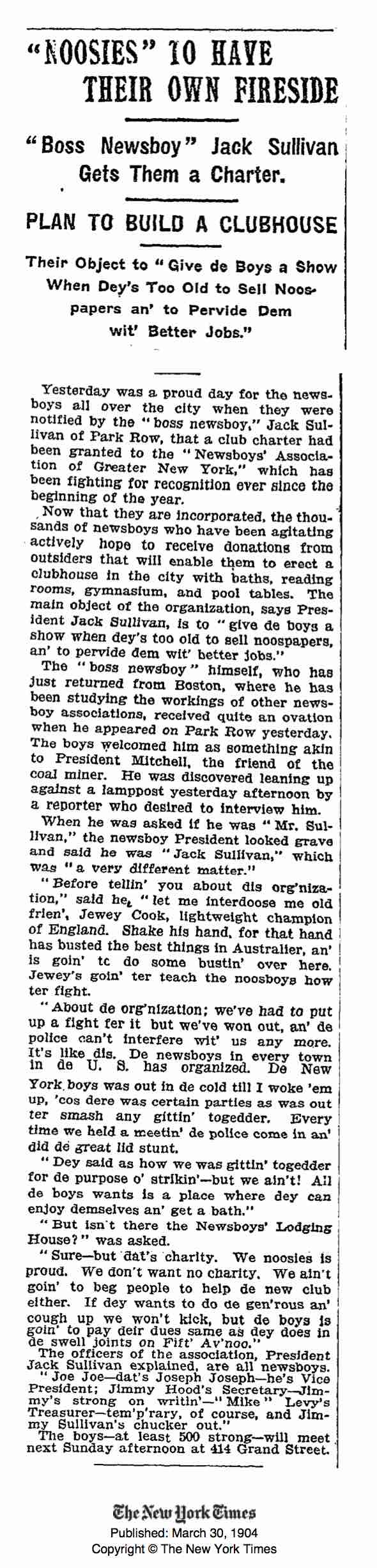
As my daughters are fans of the Disney play and movie, “Newsies,” and as I’ve taken interest in the early 20th century, they’ve asked me to find out what happened to Jack Kelly, the main character of the play/movie. If you’ve never seen it, Newsies is a musical about the New York newsboy strike of 1899. According to the play/ movie, as soon as the strike ends (the newsboys win), the strike leader, “cowboy” Jack Kelly goes off with Theodore Roosevelt, presumably headed to Santa Fé, New Mexico to become a real cowboy. But a simple search did not reveal what actually happened to the real Jack Kelly; here’s what I found. Noosies NYT

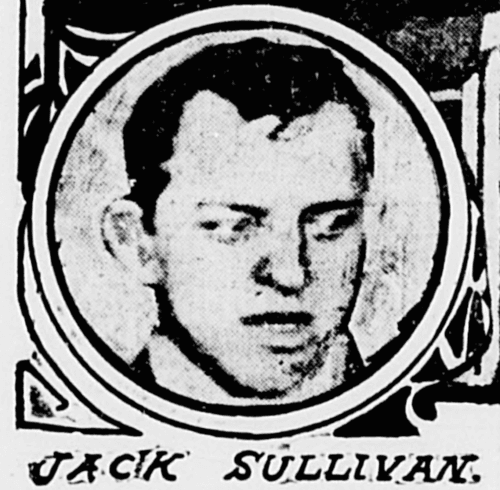
Without looking, I told my daughters that, if Jack Kelly had gone to Santa Fé in 1899, he would have found something very interesting: a cowboy school for young men. As it happened one of Roosevelt’s rough riders from the battle of San Juan Hill, retired to Santa Fé and set up a cowboy school for boys in the mountains above the town. He built a very outdoorsy operation in an area called “Los Alamos”. It ran until 1942 when the location was taken over to become “Site Y” of the Manhattan Project. This is where J. Robert Oppenheimer and co designed and built the first Atom Bombs. That Jack would have gone there would make for a nice, tidy story, but the truth appears to have been more messy, and more interesting. Jack got involved with William Hearst and George M. Cohan, the Titanic, a famous murder, and eventually with the fall of Tammany Hall. Here’s a picture.

Jack Sullivan

Jack Sullivan, head Newsie. He isn’t ugly, but isn’t Christian Bale either.

First, there was an actual newsboy strike in 1899; it was about raising the price the newsboys paid per paper, but the problem was that the price had been raised earlier, for the Spanish-American War, and not decreased after the war ended. The newsboys did win, and there was a leader named Jack, but according to the papers, the name of the leader was “Jack Sullivan”, not Jack Kelly or Francis Sullivan. The New York Tribune, July 22, 1899, lists Jack Sullivan as the leader of the strike Arbitration Committee and a leader of “the first group of newsboys to declare and demand their rights.” There are other leaders too: Louis “Kid Blink” Baletti, and David “Dave/ Yaller” Simmons. “Kid Blink” (he wore an eye patch and appears in the movie) got an award from the newsboys for making the best speech. I’ll guess that the Dave “the mouth” character is based on David “Yaller” Simmons, but it is not clear that he had any close relationship with Sullivan.

As for the movie showing Jack leaving with T. Roosevelt. it might have suited Roosevelt, but the real Jack appears to have stayed in New York, and appears to have taken a job as a bodyguard for William Randolph Hearst, one of the newspaper moguls who’d raised his rates and precipitated the strike. But it doesn’t end there. In 1904, Jack Sullivan, “the Boss Noosie” has gotten a charter for a Newsies Club to be set-up on 4th street in lower New York (the Bowery). A New York Times article (at left) includes an interview with Jack that fans should find pleasing, if only for his grammar. He uses the word, “papes” instead of papers or newspapers. I suspect this is a put-on affect for benefit of Times-readers, but who knows? It is sometimes the height of wisdom to appear stupid.

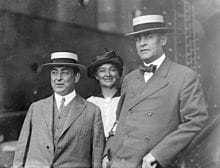
By 1909, Jack has lost control of his newsboy’s club. He appears to have used the club to teach boxing (how crude) and on at least one occasion used club assets to post bail for women accused of “loitering,” a jail-able offense in corrupt, Tammany-era New York. The club closed 2 years later. And then Jack gets married (November 27, 1910), and it appears that Jack’s real name was not Sullivan at all, but Reich. He marries Sarah Siegel at the Ohav Tzedek synagogue as “Jacob Reich”. The name Jacob Reich appears on his marriage license, on his death certificate, and on various court records, though he still appears as Jack Sullivan in other activities. Jack/ Jacob appears to have chosen the Irish-sounding name “Sullivan” as an homage to the leader of the Tammany (Democratic) machine, “Big Tim” Sullivan, shown in the photo below.

Turn of the century Tammany boss, "Big Tim" Sullivan, shown at right.

Turn of the century Tammany boss, “Big Tim” Sullivan, shown at right.

By March, 1912, Jack appears again in the news, this time suing two film companies for use of his story and likeness without payment to him. It’s a film called “the Gangsters.” It would be interesting to see if a copy still exists.

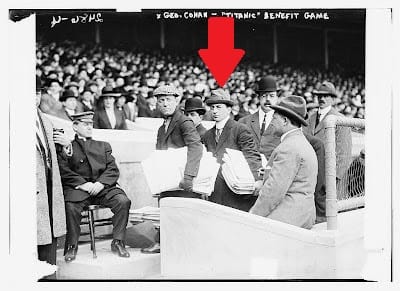
A month later, April 15, 1912, The unsinkable Titanic goes down, and six days after that, April 21, 1912, Jack is selling papers at a charity baseball game to benefit the survivors. The game takes place on a Sunday, normally prohibited by New York blue laws, between The New York Giants and The New York Yankees (the Yankees are still called the Highlanders in those days, but are already wearing pinstripes). In the picture below, Jack is under the red arrow with lots of “papes” under his arm, just behind famous song-writer, playwright, George M. Cohan. Both are dressed as newsies. George M. Cohan, known for the WWI song “Over there”, had four plays on Broadway at the time. He is one of the very few successful New Yorkers to have avoided major attachment to the crooked, New York political machine.

Jack Sullivan with George M Cohan, April 1912 selling a special newspaper to help survivors of the Titanic.

Jack Sullivan (arrow) with George M Cohan, April 1912 selling a special newspaper to help survivors of the Titanic.

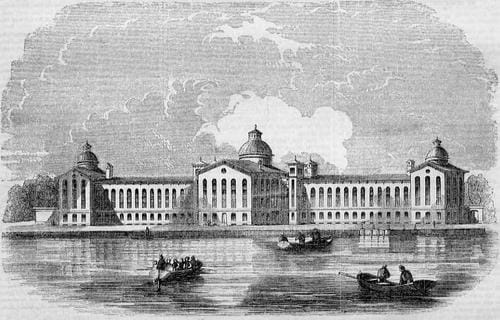
New York Refuge

The New York house of refuge

And now Jack Kelly / Sullivan/ Reich enters history as a tragic bystander. When he got married, Jack borrowed $1000, from a Jewish gambler and gambling hall owner, Herman (Beansy) Rosenthal. Rosenthal was a good friend of his, and of “Big Tim” Sullivan, but he (and Sullivan) had enemies. Among them, the crooked police Lieutenant, Charles Becker, who headed the city vice squad and delighted in shaking down the gamblers, pimps, etc for protection money. Becker wanted Rosenthal dead, in part to keep him from going to the newspapers with stories of police corruption.

By 1912, “Big Tim” lost control of the Tammany organization and was put in seclusion under Tammany guard. Within a year he’d be dead. Someone (Becker?) then hired four hit men to kill Rosenthal (1:30 AM, July 16, 1912 in front of The Metropole Hotel). It’s an event recounted in “The Great Gatsby.” Several beat-policemen were there to see the shooting, but every one looked away. Not one shot back or took the license of the car. In fact, the police did nothing to catch the murderers except to lock up the only honest witness to keep him from testifying. Before the shooting, Becker took Jack Sullivan out for an evening at Madison Square Garden; he then dropped Jack at the Metropole just before the 1:30 shooting. Becker and the police then blamed Jack and four others for the murder based on testimony that they had concocted. In the end, Jack was acquitted, but not the other four, or Becker. All five went to the electric chair; all five protested their innocence.

Becker was the first US police lieutenant to be put to death for murder. It seems unlikely that he was innocent, but was he a murderer, or just an accomplice. As for the other four, perhaps they were guilty, perhaps not; it’s hard to tell from Tammany-era records. The judge was crooked; Police chief Devery was at least as crooked as Becker in terms of shaking down hoodlums. And Devery had as much motive as Becker to want Rosenthal dead. The witnesses were lying from a script they’d been given — that’s what justice was like in those days. Within a year of the murder, Big Tim was dead and Charles Francis Murphy had gained firm control of Tammany Hall. The police spent the next decade in criminal activities while trying to pin something on Jack, now a cigar store owner. He was busted for gambling and related offenses, but nothing much came of it. Jack cleared his name from the charge of murder only in 1936, two years before his death — three years after Fiorello La Guardia was elected mayor. Republican/ Fusion candidate, La Guardia ran against Tammany and did much to end their police corruption.

As for The Refuge, The New York House of Refuge is a real place. It sat on Randal’s Island between Manhattan, The Bronx, and Queens. The Island is now famous as the center of The Triborough Bridge. There is now a park where The Refuge was. Was The Refuge run honestly? If it was, it would have been virtually the only public institutions to run that way. Tammany was corrupt to the core.

Robert E. Buxbaum, October 25, 2015. Much of the information here comes from a tumbler exchange called, “newsies historical research.” I organized it and added some background about Baseball, Tammany, etc. If you like Newsies, or the era, I can recommend the novel (and movie), The Great Gatsby, or Fiorello!, a musical version of La Guardia’s unlikely rise to power. Hearst is treated somewhat positively in Newsies, but less-so as “Citizen Kane.” If someone’s seen, or has a link to “The Gangsters” please tell me.

Republicans vs conservatives

Most of the great divides of the 1800s pitted conservatives against Republicans. This was the Divide in the Mexican civil wars of the 1800s, and there were several; it is the divide in the South American wars of Independence, and in much of the US and European political debate of the 1800s as well.

Ned Flanders, cartoon conservative from "The Simpsons" He's generally well meaning and helpful, but also a bit creepy.

Ned Flanders, cartoon conservative from “The Simpsons” He’s generally well-meaning and helpful, but also a bit creepy.

In general, the difference between conservatives and republicans is that conservative governments favor religion, and religion-based leadership, while republicans favor individual liberty. In 1800s Mexico, conservatives backed two emperors (Maximilian I and Agustin I) and Santa Anna, the ruler who suspended all personal rights an ignited the war of Texan independence. Conservatives generally favor the religion of the majority: Protestantism in England, Catholicism in Central and South America, Judaism in Israel, and Islam in most of the Muslim world. This tends to annoy the irreligious and minority religious populations, who tend to become republicans. Cinco de Mayo celebrates the 1862 victory of Mexican republicans over the French-backed, conservative Maximilian I, at the battle of Puebla. The US Civil War, in essence, pitted the irreligious, industrial, republican north against the conservative, evangelical South; slavery is in the Bible so it must be good.

Conservatives usually favor government actions against sin in all it’s forms: miserliness, drunkenness, drugs, pornography, wild music, money-making, and freedom as such. Conservative-ruled countries have generally had anti-blasphemy laws and enforced “blue laws”, restrictions on business on holidays. Republican governments have few, or none of these. In pre-revolution France, the penalty for blasphemy was death, just as the Bible mandates. This changed when the republicans came into power. In England, private blasphemy was prosecuted as late as 1977. Similar penalties are still in force in Iran and other conservative Islāmic countries. Many US states still restrict the sale of alcohol on Sunday, for similar, conservative reasons. Conservatives usually favor sexual morality laws, putting strong restrictions on homosexuality, abortion, and divorce. In England, amicable divorce wasn’t legalized until 1930, and homosexuality was illegal until 1970. In the US, sexual laws are a fairly bizarre mix, in my humble opinion, the result of republicans, liberals, and conservatives making inelegant compromises.

In republican democracies like modern-day France, Holland, and Germany, sexual immorality laws are more lax than in the US. Republican governments strive to protect the rights of the individual; among these their right to property and to a fairly unbridled pursuit of pleasure. Republican countries tend to suffer from (or benefit from) significant income inequality. People can become rich due to hard work, talent, luck, or birth. And they very often become arrogant and obnoxious after they become rich — and sometimes before — to an extent that bothers conservatives and liberals alike. People can also become very poor: from laziness or bad choices, or just from bad luck or having been born to the wrong parents. Conservative and liberal elements then strive to help the very poorest, providing them with food, money and basic housing — generally achieved by taxing the rich. This is good in moderation, but taken to excess, this can lead to dependency of the poor, and redirection of the rich into less-productive fields like politics and the church. Conservatives very rarely leave a good pathway for the poor out of dependency, nor have they found a way to keep scoundrels out of the government and the church.

Scrooge McDuck. he'd likely be a Republican, if only to protect his wealth.

Scrooge McDuck, banker, railroad tycoon, steel magnate; he’d likely be republican, though not likely conservative. Motivated by money and power, he may do good, but not in any direct way, usually.

At present, the US Republican Party, the GOP, consists of approximately equal halves conservatives and republicans. That is, GOP leadership is currently an approximate balance between kindly folks like Ned Flanders who would rule by the Bible, and an equal number of rougher individuals, more like Scrooge McDuck who would rule by money.  in a sense, this is a wonderful compromise as the excesses of each group reins in the excesses of the other. In another sense though, the balance between conservatives and republicans is an ungovernable mess that leads to regular de Condorcet failures. I’m not sure how this will play out in the 2016 elections.

Fortunately, not all irreconcilable differences are as irreconcilable as one might think. Many de Condorcet problems are solvable by compromise, or by the effects of time. Compromise between charity and commerce can produce the best of all worlds, a major theme point, as I understand it, of Dickens’s Christmas Carol.

Robert E. Buxbaum, October 20, 2015. I use these essays to refine my thinking — here, more than usual. Any help you can provide will be welcome, feedback, corrections, comments. I’m trying to figure out what I, myself think. The divide between Conservatives and Liberals produces some of the most wonderful quote – exchanges, e.g. between Churchill and Attlee in 1950s England. Liberals, and I have not quite made up my understanding here, seem like a sort of like conservatives in that they believe in wealth redistribution, but without the guidance of a church, or church-based morality. At some point in the future, I’ll hope to arrange my thoughts about them, and about the difference between liberals and democrats.

Why are glaciers blue

i recently returned from a cruse trip to Alaska and, as is typical for such, a highlight of the trip was a visit to Alaska’s glaciers, in our case Hubbard Glacier, Glacier bay, and Mendenhall Glacier. All were blue — bright blue, as were the small icebergs that broke off. Glacier blocks only 2 feet across were bright blue like the glaciers themselves.

Hubbard Glacier, Alaska. Note how blue the ice is

Hubbard Glacier, Alaska. My photo. Note how blue the ice is

What made this interesting/ surprising is that I’ve seen ice sculptures that are 5 foot thick or more, and they are not significantly blue. They have a very slight tinge, but are generally more colorless than glass to my ability to tell. I asked the park rangers why the glaciers were blue, but was given no satisfactory answer. The claim was that glacier ice contained small air bubbles that scattered light the same way that air did. Another park ranger claimed that water is blue by nature, so of course the glaciers were too. The “proof” to this was that the sea was blue. Neither of these seem quite true to me, though there seamed some grains of truth. Sea water, I notice, is sort of blue, but isn’t this shade of blue, certainly not in areas that I’ve lived. Instead, sea water is a rather grayish similar to mud and sea-weeds that I’d expect to find on the sea floor. What’s more, if you look through the relatively clear water of a swimming-pool water to the white-tile bottom, you see only a slight shade of blue-green, even at the 9 foot depth where the light you see has passed through 18 feet of water. This is far more water than an iceberg thickness, and the color is nowhere near as pure blue and the intensity nowhere near as strong.

Plymouth, MI Ice sculpture -- the ice is fairly clear, like swimming pool water

Plymouth, MI Ice sculpture — the ice is fairly clear, like swimming pool water

As for the bubble explanation, it doesn’t seem quite right, either. The bubble size would be non-uniform, with many quite large resulting in a mix of scattered colors — an off white– something seen with the sky of mars. Our earth sky is a purer blue, but this is not because of scattering off of ice-crystals, dust or any other small particles, but rather scattering off the air molecules themselves. The clear blue of glaciers, and of overturned icebergs, suggests (to me) a single-size scattering entity, larger than air molecules, but much smaller than the wavelength of visible light. My preferred entity would be a new compound, a clathrate structure compound, that would be formed from air and ice at high pressures.

An overturned ice-burg is remarkably blue: far bluer than an Ice sculpture. I claim clathrates are the reason.

An overturned ice-burg is remarkably blue: far bluer than an Ice sculpture. I claim clathrates are the reason.

Sea-water forms clathrate compounds with natural gas at high pressures found at great depth. My thought is that similar compounds form between ice and one or more components of air (nitrogen, oxygen, or perhaps argon). Though no compounds of this sort have been quite identified, all these gases are reasonably soluble in water so that suggestion isn’t entirely implausible. The clathrates would be spheres, bigger than air molecules and thus should have more scattering power than the original molecules. An uneven distribution would explain the observation that the blue of glaciers is not uniform, but instead has deeper and lighter blue edges and stripes. Perhaps some parts of the glacier were formed at higher pressures one could expect that these would form more clathrate compounds, and thus more blue. One sees the most intense blue in overturned icebergs — the parts that were under the most pressure.

Robert Buxbaum, October 12, 2015. By the way, some of Alaska’s glaciers are growing and others shrinking. The rangers claimed this was the bad effect of global warming: that the shrinking glaciers should be growing and the growing ones shrinking. They also worried that despite Alaska temperatures reaching 40° below reasonably regularly, it was too warm (for whom?). The lowest recorded temperature in Fairbanks was -66°F in 1961.

A prison tale (fiction) by R. E. Buxbaum

I’m writing from the Michigan Department of Corrections; Mail-stop 5678 E, Jackson, MI, awaiting trial on auto-related charges. So, legally speaking, I’m still innocent, if not quite free. So, here’s my  story, and my bargain. The whole situation, it seems, is more comical than criminal. At its source, at bottom, all I was trying to do was take care of some left over issues from unofficial jobs I was doing for the city. For his honor, the mayor. That’s K.K., Kwamie Kilpatrick, the ex-mayor to you, but always his honor to me; great guy. Anyway, cars that fall in the river aren’t that unusual in this town, and it’s not like I planned to smuggle anything to Canada. You’ll notice my case doesn’t involve theft, or injuring anyone but myself. Just trespass, though I wouldn’t mind a short prison stay if it can be arranged. Sort of like Shawshank redemption.

Anyway, my minor crime was committed a week ago, Thursday, and involved a Dodge Viper. One that I own, straight-up, with a partner and the bank: a yellow, convertible viper costing some $220,000 when new. Beautiful machine; tinted glass, and capable of doing 180 mph without breaking a sweat. I use it, or did, to take care of errands for his honor. He tips nice, and helps out when I’m in a jam, so I did get paid for the work, but for the most part, it’s like I’m like a patriot-servant to the city. I’m using my own car for city business. In better days, those errands included taking judges for the occasional joy ride, to the airport or lunch, plus other deliveries. Not generally on the water, like last Thursday, and yes that’s me, waving in the photo. Shame about the car.

As to how I got the viper, I got it at the dealer on Woodward, just over the 8 mile bridge, and paid for it mostly myself, with a loan from First Federal. At the time I had a good job running errands for his honor, as I mentioned. Now I’m so of unemployed. What sort of errands? The sort of ones you’d want to run in a viper, Duh. Aside from driving judges to meetings, there were girl errands; some boy errands; some money errands. Occasionally a disposal — nothing illegal, but embarrassing maybe. When you’re disposing of city property, you don’t look too carefully at the item. When you’re carrying something big, or someone’s wife or girlfriend, or a lot of money, it’s nice to be able to move quickly. Judges and senators like to move fast too, behind tinted windows. They still do.

Anyway, after his honor goes to prison (real shame, that), and my job becomes near-ended. There’s still some errands to to, but not so many, and I’ll grant that the viper has become more of a liability than an asset. Not that there’s insurance fraud behind me ending up in the river, just good-ole fun, and maybe a little reckless driving. I’m owing like 165k still on the machine, and my brother and I came up with this great plan for a movie — no fraud intended. There’s this great spot that we know by Zug Island, where the Rouge meets the Detroit river. It’s pretty well deserted, with a pier and a boat ramp. We used it all the time, back in the day for meetings and such. No-one goes there because of the smells. There’s always an oil slick and the water there will dissolve most anything metal. The Zug Island folks make sure of there are no cameras or loiterers either — just so no-one steals their secrets. Anyway, my brother and I figured that, if I got the viper up to about 30- 40 mph on the pier we could sail it out over the rocks and garbage into the river, land softly in the water, and make for a great movie. We never planned to file an insurance claim like we’d lost the car or it was stolen. Anyway, the water’s only about 8′ below the end of the pier, so it’s sort of like a high-dive. I figured I’d get out of the sinking car swim up to the boat ramp, and walk to my brother’s car on the street. The car would dissolve to rust in a week; the water’s pretty nasty there. He’d film the whole thing. I’d dry off; we’d drive home, have a beer or two, then sell the film. Probably pull the rust out of the river in a week, just to keep everything in it’s pure, pristine state. Though, now that I think of it, insurance might still cover most of the value of the car. You never know.

So the first part goes OK. We drive to the pier about 9:00 PM, Thursday, just as the sun’s setting. There’s that good, reddish light over the Windsor skyline, and the pier is empty. There are two winos off far from my intended route. My brother and I take down the top and line up the vehicle so I avoid unwanted bumps and garbage as I sail out on my way to glory. And, with a shot of Jack, and a wave to my brother (It’s on the film), I go shooting out down the pier and over the water. Fine. No bumps, no rocks. Nice flight. No soft landing, though. The car hits water like a pumpkin on concrete. Ouch! The thing bends in the middle sealing the door shut and me inside. There’s hardly any spring to the seats anyway, and what little there once was is lost. My back gets twisted into the steering wheel. I can barely turn and I can’t quite get out. Then, about 5 minutes later, the air bag goes off. Guess they didn’t design for this accident. My back, is now twisted into the sat-back, and I’m in pain.

I think it’s some sort of Sprite Healey fracture like Kevin Everett got last year. I can walk, thanks, but it needs medical attention that I’m not likely to get on Medicaid. Anyway, like I said, I’m trapped inside the vehicle, and suppose I’d be dead if the car sank like we planned, bit it don’t sink. The thing floats. Like, forever. The car weighs like two tons and it floats! Who knew. I’m carried by my momentum and by some random Rouge current out past Zug Island into the main channel between Detroit and Windsor where I’m almost run down by an ore boat. Anyway, the yellow metal Viper-dingy I’m in gets noticed by the boat lookout and by some fishermen, but no one helps. Everyone’s seems to think it’s really funny. They’re all taking pictures, and texting, and calling their friends. And everyone is laughing but me. It’s funny, like a fart in a space suit. Meanwhile my brother’s been driving along by the river, filming everything and hoping I get out and can somehow swim to safety, and I keep floating off to Canada. Finally, someone calls the coast guard, but when the come, it turns out I’m in Canadian waters. So the Canadians come, and they’re all think it’s a boot. I’m a celebrity with pictures of me in my car floating all over the internet. And well, here I am, a relatively innocent man, with a junked car and a bad back. And I’m ready to make a deal. I’ll admit it looks like I was planning to defraud someone, but there’s no evidence. I’ll admit to trespass if you like, but not fraud or endangerment. There was no one there to endange, and no one endangered, except of me. And I won’t press charges (little joke).

What with all the publicity, I figure you want to press more than just trespass, and what I was thinking of is reckless driving. I’ll admit to that with no contest. Looked at the right way, that’s like a 60 day sentence, maybe 90 days, and that’s just fine with me. I don’t have the cleanest record, but it’s not like I’ve done this before. I think it would be fair if I got 60 to 90-days of incarceration with medical benefits and job rehabilitation. I’d like to learn a new trade, like auto repair. That’s a win-win for everyone. You close the case, and I get cured and put my job skills to work just as soon as I get out. But I really need the medical though. My health insurance doesn’t cover injury-in-performance-of-a-crime — it’s right there on page 28. And Medicare is garbage. Next time you get insurance, your honor, make sure to read the contract.

Anyway, you have the tape and the pictures, and can check with my brother. We have plenty of people who will testify for us, even folks in congress and in the police department. They’ll all tell you, we’re just a couple of good fellows, somewhat down on our luck, waiting to get out and go straight. Thanks for your help, and God-bless.

R. E. Buxbaum. Sept 30, 2015. Some weeks ago, I wrote an essay, “What is comedy.” So I thought I’d try writing one. Tell me how you think I did. No one in the story is meant to be anyone real, except for “his honor,’ who’s meant to be a fictional version of His Honor.

Marie de Condorcet and the tragedy of the GOP

This is not Maire de Condorcet, it's his wife Sophie. Marie (less attractive) was executed by Robespierre for being a Republican.

Marie Jean is a man’s name. This is not he, but his wife, Sophie de Condorcet. Marie Jean was executed for being a Republican in Revolutionary France.

During the French Revolution, Marie Jean de Condorcet proposed a paradox with significant consequence for all elective democracies: It was far from clear, de Condorcet noted, that an election would choose the desired individual — the people’s choice — once three or more people could run. I’m sorry to say, this has played out often over the last century, usually to the detriment of the GOP, the US Republican party presidential choices.

The classic example of Condorcet’s paradox occurred in 1914. Two Republican candidates, William H. Taft and Theodore Roosevelt, faced off against a less-popular Democrat, Woodrow Wilson. Despite the electorate preferring either Republican to Wilson, the two Republicans split the GOP vote, and Wilson became president. It’s a tragedy, not because Wilson was a bad president, he wasn’t, but because the result was against the will of the people and entirely predictable given who was running (see my essay on tragedy and comedy).

The paradox appeared next fifty years later, in 1964. President, Democrat Lyndon B. Johnson (LBJ) was highly unpopular. The war in Vietnam was going poorly and our cities were in turmoil. Polls showed that Americans preferred any of several moderate Republicans over LBJ: Henry Cabot Lodge, Jr., George Romney, and Nelson Rockefeller. But no moderate could beat the others, and the GOP nominated its hard liner, Barry Goldwater. Barry was handily defeated by LBJ.

Then, in 1976; as before the incumbent, Gerald Ford, was disliked. Polls showed that Americans preferred Democrat Jimmy Carter over Ford, but preferred Ronald Regan over either. But Ford beat Reagan in the Republican primary, and the November election was as predictable as it was undesirable.

Voters prefer Bush to Clinton, and Clinton to Trump, but Republicans prefer Trump to Bush.

Voters prefer Bush to Clinton, and Clinton to Trump, but Republicans prefer Trump to Bush.

And now, in 2015, the GOP has Donald Trump as its leading candidate. Polls show that Trump would lose to Democrat Hillary Clinton in a 2 person election, but that America would elect any of several Republicans over Trump or Clinton. As before,  unless someone blinks, the GOP will pick Trump as their champion, and Trump will lose to Clinton in November.

At this point you might suppose that Condorcet’s paradox is only a problem when there are primaries. Sorry to say, this is not so. The problem shows up in all versions of elections, and in all versions of decision-making. Kenneth Arrow demonstrated that these unwelcome, undemocratic outcomes are unavoidable as long as there are more than two choices and you can’t pick “all of the above.” It’s one of the first great applications of high-level math to economics, and Arrow got the Nobel prize for it in 1972. A mathematical truth: elective democracy can never be structured to deliver the will of the people.

This problem also shows up in business situations, e.g. when a board of directors must choose a new location and there are 3 or more options, or when a board must choose to fund a few research projects out of many. As with presidential elections, the outcome always depends on the structure of the choice. It seems to me that some voting systems must be better than others — more immune to these problems, but I don’t know which is best, nor which are better than which. A thought I’ve had (that might be wrong) is that reelections and term limits help remove de Condorcet’s paradox by opening up the possibility of choosing “all of the above” over time. As a result, many applications of de Condorcet’s are wrong, I suspect. Terms and term-limits create a sort of rotating presidency, and that, within limits, seems to be a good thing.

Robert Buxbaum, September 20, 2015. I’ve analyzed the Iran deal, marriage vs a PhD, and (most importantly) mustaches in politics; Taft was the last of the mustached presidents. Roosevelt, the second to last.

Comedy: what is comedy?

It’s a mistake, I think, to expect that comedy will be funny; the Devine comedy isn’t, nor are Shakespeare’s comedies. It seems, rather, that comedy is the result of mistakes, fakes, and drunks stumbling along to a (typically) unexpected outcome. That’s sometimes funny, as often not. Our expectation is that mistakes and fools will fail in whatever the try, but that’s hardly ever the outcome in literature. Or in life. As often as not, the idiot ends up as king with the intelligent man working for him. It’s as if God is a comic writer and we are his creation. Perhaps God keeps us around for our amusement value, and drops us when we get stale.

It’s not uncommon to have laughs in a comedy; a Shakespearian comedy has some, as does life. But my sense is that you find more jokes in a tragedy, e.g. Romeo and Juliet, or Julius Caesar. What makes these tragedies, as best I can tell, is the great number of honorable people behaving honorably. Unlike what Aristotle claims, tragedy doesn’t have to deal with particularly great people (Romeo and Juliet aren’t) but they must behave honorably. If Romeo were to say “Oh well, she’s dead, I’ll find another,” it would be a comedy. When the lovers choose honorable death over separation, that’s tragedy.

hell viewed as a layer cake. Here is where suicides end up.

Dante’s hell viewed as a layer cake. The “you” label is where suicides end up; it’s from an anti-suicide blog.

Fortunately for us, in real life most people behave dishonorably most of the time, and the result is usually a happy ending. In literature and plays too, dishonorable behavior usually leads to a happy ending. In literature, I think it’s important for the happy ending to come about semi-naturally with some foreshadowing. God may protect fools, but He keeps to certain patterns, and I think a good comic writer should too. In one of my favorite musicals, the Music Man, the main character, a lovable con man is selling his non-teaching of music in an Iowa town. In the end, he escapes prison because, while the kids can’t play at all, the parents think they sound great. It’s one of the great Ah hah moments, I think. Similarly at the end of Gilbert and Sullivan’s Mikado, it’s not really surprising that the king (Mikado) commutes the death sentence of his son’s friends on the thinnest of presence: he’s the king; those are his son’s friends, and one of them has married a horrible lady who’s been a thorn in the king’s side. Of course he commutes the sentence: he’s got no honor. And everyone lives happily.

Even in the Divine Comedy (Dante), the happy ending (salvation) comes about with a degree of foreshadowing. While you meet a lot of suffering fools in hell and purgatory, it’s not totally unexpected to find some fools and sinners in heaven too. Despite the statement at the entrance of hell, “give up all hope”, you expect and find there is Devine grace. It shows up in a sudden break-out from hell, where a horde of the damned are seen to fly past those in purgatory for being too pious. And you even find foolish sinning at the highest levels of heaven. The (prepared) happy ending is what makes it a good comedy, I imagine.

There is such a thing as a bad comedy, or a tragic-comedy. I suspect that “The merchant of Venice” is not a tragedy at all, but a poorly written, bad comedy. There are fools aplenty in merchant, but too many honorable folks as well. And the happy ending is too improbable: The disguised woman lawyer wins the case. The Jew loses his money and converts, everyone marries, and the missing ships reappear, as if by magic. A tragic-comedy, like Dr Horrible’s sing along blog; is something else. There are fools and mistakes, but not totally unexpected ending is unhappy. It happens in life too, but I prefer it when God writes it otherwise.

It seems to me that the battle of Bunker Hill was one of God’s comedies, or tragic-comedies depending on which side you look. Drunken Colonials build a bad fort on the wrong hill in the middle of the night. Four top British generals agree to attack the worthless fort with their best troops just to show them, and the result is the greatest British loss of life of the Revolutionary war — plus the British in charge of the worthless spit of land. It’s comic, despite the loss of life, and despite that these are not inferior people. There is a happy ending from the American perspective, but none from the British.

I can also imagine happy tragedies: tales where honorable people battle and produce a happy result. It happens rarely in life, and the only literature example I can think of is  1776 (the musical). You see the cream of the colonies, singing, dancing, and battling with each other with honorable commitment. And the result is a happy one, at least from the American perspective.

Robert E. Buxbaum, September 17-24, 2015. I borrowed some ideas here from Nietzsche: Human, All too Human, and Birth of Tragedy, and added some ideas of my own, e.g. re; God. Nietzsche is quite good on the arts, I find, but anti-good on moral issues (That’s my own, little Nietzsche joke, and my general sense). The original Nietzsche is rather hard to read, including insights like: “A joke is an epigram on the death of a feeling.”