Fifty years ago, when I was in college, black holes were treated as science fiction entities. According to Einstein and Summerfeld, time stopped at the event horizon, and information vanished, but they were not though to exist, except for a tantalizing theory that our universe could be one giant big black hole! A major problem back then, and today, is that the universe clearly contains a lot of “dark matter” (see here), but no one know what it was. The two theories, such were either Massive Astrophysical Objects (MACHOs) or Weakly Interacting Massive Particles (WIMPs). In a blog some years back, I put forth a version of the WIMP theory here, with lighter particles. I now have a better thought, based black holes.
In the last 30 years we started seeing evidence that black holes were real. At first these were gravitational lenses, large mass concentrations that made distant galaxies seem close. Then, more recent evidence was gravitational waves, a jiggling of space-time, postulated by Einstein, but measured only ten years ago, in September, 2015. The apparent source of the jiggle, the combination of two black holes.
As our telescopes got better, we’ve found more and more black holes visually, including a particularly large black hole near our galactic center, in the constellation Sagittarius. It’s called Sgr A*, with a mass of roughly 4 million suns, and its discovery got the Nobel Prize, 2020. One of the stars that move around this spot travels at speeds up to 3% the speed of light, and it’s paired with a gas blob that moves much faster. See video here, with relativity shifts. You might think that our galaxy revolves around this black hole, but it doesn’t; it it did, we would not have galactic arms.
A recent explanation for dark matter has been proposed, saying that it is black holes, or neutron stars. To make this theory work, there would have to be many black holes in our galaxy and in others, and between them, and the laws of physics would have to change too, so it’s quite speculative. Still, we keep finding more black holes, including a large one near us, relatively, Gaia-BH3, with about 33 million suns mass. It emits no light, and is orbited every 11.6 years by a gas giant. What makes this model scary, and perhaps not true, is that a model like this would seem to suggest a chaotic dance of death that should tear the galaxy apart. Something like this happens in a recent, Chinese Science Fiction book, “Three Body Problem” (also a TV series).
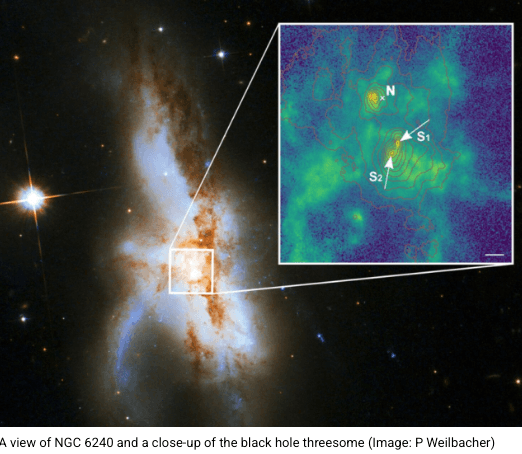
If our galaxy had many many black holes could it be stable? Could it have lasted as long as it has. One thought is we’re doomed. The galaxy NGC6240 contains three large black holes rotating among themselves, see picture. Their dance seems to be destroying the galaxy as we watch. A possible way out of this appears in a recent video blog by Sabine Hossenfelder based on a paper saying the black holes may not be black holes at all, but clouds. I’m not sure that makes things any more stable, but I enjoyed the video content, so I linked to it.
One thing I like about this whole idea is that the existence of many black holes like this would solve a conundrum I presented in one of my earliest posts, that the universe could not be infinitely big and uniform. If it were, I argued, we’d be cooked by all the solar radiation. But if there were lots of black holes (they have to be real black holes) they would be a place for all that light to sink into, and the universe could be infinitely big and uniform. As for how that sort of universe starts or remains stable, or expands, it’s not clear. Maybe if you dark energy, something else that no one understands, but that lots of folks believe iin.
Robert Buxbaum, April 15, 2026. Three Body problem is decent Sci Fi, despite its strong political message and weak characters. We’re attacked by advanced aliens from a dying, 3 sun system, and earthlings help them. The message, emphasized by the author at the end of the book, is that you should not trust outsiders from a more high tech society (like the USA).