Category Archives: History

Political tensegrity: the west is best

We are regularly lectured about the lack of kindness and humility of the western countries. Eastern and communist leaders in Russia, Iran, Saudi Arabia point to Western pollution, consumerism, unemployment as prof you need a strong leader and central control to do good by regulation, thought policing, and wealth redistribution.

Let me point out that the good these leaders provide is extracted from the populace, and the advantage of central control is rarely as clear to the populous as to the leadership. When leaders redistribute wealth or place limits on the internet, movies or books, the leaders are generally exempted, and the populous are not made more moral or generous either. One does not say a prisoner or slave-worker is more generous of moral than one on the outside despite the prisoner working for free. The leaders feel certain they are protecting their people from thought and greed, but it isn’t clear outside of the leadership that these dangers are as great as the danger of despotism or rule by whim.

Authors and thoughts are blocked in the East by the whim of a supreme leader who also determines who is an infidel or enemy, or friend, and which businesses should flourish, and who should be rich (his buddies). By contrast, two fundamentals of western society — things that lead to purported immorality, are citizen rights and the rule of law: that citizens can possess things and do things for their own reasons, or no reason at all, and that citizens may stand as equals before a bar of law, to be judged by spelled-out laws or freed, with equal believability and claim.

In Russia or Iran, the Commissar and Imam have special rights: they can take possessions from others at whim, shut down businesses at whim; imprison at whim  — all based on their own interpretation of God’s will, the Koran, or “the good of the state.” Only they can sense the true good, or the true God well enough to make these decisions and laws. And when they violate those laws they are protected from the consequences; the masses can be prosecuted to the full extent of the law, and then some, not even requiring a trial in many places (Gaza, for example) if the leader feels speed is needed. The rule of law with equal treatment is a fundamental of western civilization (republicanism). It is commanded by Moses in the Bible at least seven times: Numbers 15:15, Numbers 15:16, Numbers 15:29, Exodus 12:49, Numbers 9:14, and Leviticus 24:22, “One law and one ordinance you should have, for the home-born, and the foreigner who dwells among you.”

The equal treatment under the law: for rich and poor, king and commoner, citizen and foreigner is a revolutionary idea of the west; that justice is blind. Another idea is personal possessions and freedoms. There is no concept of equality under business law unless there is a business that you can own, and personal possessions and rights. These are not in place in eastern theocracies: they tend to treat the preachers (imams) better than non preachers because they are presumed smarter and better; similarly men are treated better than women, who have few rights, and the state religion is treated better than infidels. In communist countries and dictatorships the dictator can get away with anything. Admittedly, in capitalistic states the rich and powerful find loopholes while the poor find prison, but not always (our Detroit’s ex-mayor is in prison) and it’s not the law. A feature of Eastern theocracies and dictatorships is that they lack a free press, and thus no forum for public exposure of legal mischief.

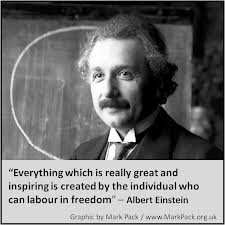
Einstein on freedom producing good. I'd say freedom is also a good in itself

Einstein on freedom producing good. I’d say freedom is also a good in itself.

The strongest arguments for socialist dictatorship and theocracy is that this is needed to protect the weak. Clement Attlee (labor socialist British Prime Minister, 1945 -56) explained his government’s take over of almost all British business: “There was a time when employers were free to work little children for sixteen hours a day… when employers were free to employ sweated women workers on finishing trousers at a penny halfpenny a pair. There was a time when people were free to neglect sanitation so that thousands died of preventable diseases. For years every attempt to remedy these crying evils was blocked by the same plea of freedom for the individual. It was in fact freedom for the rich and slavery for the poor. Make no mistake, it has only been through the power of the State, given to it by Parliament, that the general public has been protected against the greed of ruthless profit-makers and property owners.”  (Quotes from Spartacus.edu). it’s a brilliant speech, and it taps into the government’s role in the common defense, but it’s not at all clear that a chinless bureaucrat will be a better boss than the capitalist who built the firm. Nor is it clear that you help people by preventing them from work at a salary you decide is too low

England suffered a malaise from public ownership and the distribution of profit by those close the liberal party. Under Attlee there was lack of food and coal while the rest of Europe, and particularly Germany prospered, and passed England in productivity. Germany had no minimum wage, and  still doesn’t have one. In eastern countries, ingenuity is deadened by the knowledge that whatever a genius or worker achieves is taken by the state and redistributed. A cute joke exchange: Churchill and Attlee are supposed to have found themselves in adjoining stalls of the men’s room of Parliament. Churchill is supposed to have moved as far as possible from Attlee. “Feeling standoffish, Winston” Attlee is supposed to have said. “No. Frightened. “Whenever you see something large you try to nationalize it.” Perhaps more telling is this Margret Thatcher’s comment, and exchange. Making everyone’s outcome equal does more to penalize those with real pride in their ideas and work than it does to help the truly needy.

While there is a need for government in regards to safety, roads, and standards, and to maintain that equality of law. It seems to me the state should aid the poor only to the extent that it does not turn them into dependents. There is thus a natural tension between private good and public service similar to the tensegrity that holds cells together. Capitalists can only make money by providing desired goods and services at worthwhile rate, and paying enough to keep workers; they should be allowed to keep some of that, while some must be taken from them to get great things done. I’ve related the tensegrity of society to the balance between order and disorder in a chemical system.

Robert E. Buxbaum August 27, 2014. This essay owes special thanks to a Princeton chum, Val Martinez. Though my training is in engineering, I’ve written hobby pieces on art, governance, history, and society. Check out the links at right.

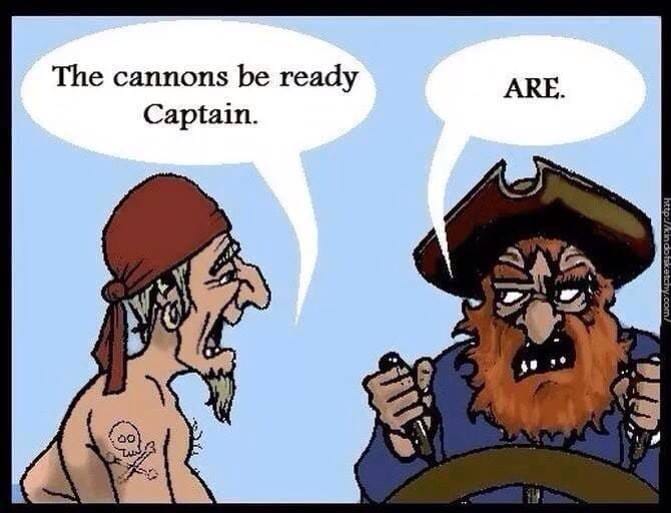
Grammar on the high seas, pirate joke, trans ready

Grammar Pirate by Scott Clark, 2013.

Grammar Pirate by Scott Clark, 2013.

Pirate grammar has a special place in American English. The father of our country’s navy was likely John Paul Jones, a pirate; he redesigned our ships, captured some 16 British merchant vessels in the Revolution, and helped supply Washington’s army with guns and powder. Jean Lafitte, pirate hero of the war of 1812, may have been Jewish! The state of Michigan officially celebrates “Talk LIke a Pirate Day” September 19, the day before national pickle day.

No other country states in their constitution that a purpose of the government is to give out letters of marque — that is to mint pirates. Piracy is a great way to fight a war –severely underestimated. ISIS does it quite well. By taking supplies from the other side you weaken them while strengthening yourself. Assuming you need the stuff, you avoid the cost of manufacture, shipping, and logistics, and even if you don’t need some of it, you can usually trade these items you for items you need. It’s a great way to make foreign friends and allies. Ben Franklin sold our pirates’  captured stuff for them during the American Revolution making himself and us better liked — we had no direct need for red uniforms, for example. Pirates should not kill captured merchant seamen, I think, but ransom them , or put them to service in the cause. The Somali pirates do this; not everyone is impressed. Pirate beards may encourage bravery by showing commitment to a revolution. Here’s a song relating beards to piracy: mannen met baarden (men with beards). Bet your aaars, it’s in Dutch.

Pirate grammar is a dialect, not a sign of poor education or lack of success. I suspect that pirate grammar is more useful than standard for referring to people on the fringes of society. For example, how would you introduce a patent lawyer who’s a some-time cross-dresser? It’s simple in pirate-speak: ‘Ms Smith, pleased to meet Johnson, arrrgh patent lawyer.’ Pirate speak can also avoid the uncomfortable he/she by use of the pirate “e”: ‘E’s a scurvy sea dog, e is.’

Robert Buxbaum, July 2, 2014. I think I’ll be havin’ a rum now, and toast to Arrrgh country.

My solution to the world’s problems: better people

Most of the problems of the world are caused by people. Look at war, it’s caused by people; look at pollution, people; look at overeating, or welfare, or gun violence. You name it, the problem is people. My simple solution, then: better people. Immigration is a simple solution for a county that can do it selectively (take in the best, leave the rest); it’s worked for the US and it doesn’t have to beggar the third world. Education is another way to help, but we’re not quite sure what sort of education makes people better. “An uneducated man may steel from a boxcar, an educated one may steal the whole railroad.” Theodore Roosevelt is supposed to have quipped.

Those who claim they are uncommonly moral and good at teaching have barely any proof that they are. American schools produce financially successful people, but not particularly moral ones; Europe’s approach is different, but there’s no indication they’ve done better at moral education. We look to the 18th century, or the Greeks, but they were no more moral than us, as best I can tell. The Taliban, the communists, or similar fundamentalists claim moral superiority over the west, but from my perspective, they look even worse. 

I notice that people learn morality from one another — that is each person acts like his neighbor. I also note that people tend to act better when they are involved, and feel part of whatever country, city or group they are in. Targeted immigration might bring in better people–honest, hard working, non-violent — and these people might help improve and motivate the locals. And even if we don’t improve by interaction, perhaps lazy Americans will ride on the backs of the hard-working immigrants. But it strikes me that the disconnect between world problems of high unemployment, world hunger, and lots of open, US jobs is a moral problem that could be solved by targeted love. Allowing some increased mobility from country to country and job to job (plus better preaching?). If you can move you are more-likely to find a job or place where you feel fulfilled, and you are likely to do better and more there. Even the countries and jobs that are left might benefit by being rid of their malcontents. And we don’t have to take everyone.

From "Hispanic-hope."

From “Hispanic-hope.”, an interesting combination of Bible-study and immigration morality.

Living in America is desirable for most people from most countries. Far more people want to live here than we can accept. As a result, we are in a position to target the bright, honest, hard-working Peoples from virtually any country. These folks are helpful to industry and to the US tax base as these immigrants tend to work out — or get deported. In the short-term they might displace Americans or depress salaries, but even that is not certain. There is no fixed slate of US jobs nor a fixed amount of work need. Yesterday’s job taker is tomorrow’s job creator. Our country is built on immigrants, and has not suffered from it. We should not take those who hate the US, or those who hate freedom, or have no skills, criminals and the sick. Nor should we give citizenship immediately. But that still leaves plenty who we’d want, and who want to be here. Th. Roosevelt said, “you can not take in too many of the right people, and even one of the wrong type is too many.” I suspect this is true.

I suspect we’d have 90+% odds picking good people from a crowd. The Immigration system does a good job now, and the great colleges have done better for years. The past is usually a great indicator. If someone is well, and has worked for years, or has been here in school; if they’ve managed to stay productive and out of trouble, he/she is a good candidate. A first step would be a work permit, and in a few years they can apply for permanent residence or citizenship. Many of the most successful people in America are either immigrants or descendents of immigrants. The founders of Google and Facebook; the builders and the shakers. These people have the ‘get-up and go.’ You can tell because they’ve gotten up and gone.

Dr. Robert Buxbaum, June 16, 2014. I’m a child of an immigrant, went to public school, got a PhD at Princeton, have built my own company, and have (so far) avoided arrest, imprisonment or serious scandal. With the help of my Canadian-immigrant wife, I’ve produced three Buxbaum clones, my biggest contribution to improving the US and the world.

American education sucks, how do we succeed?

Despite my PhD from a top American college, Princeton University, I find I lag ordinary Europeans in languages and history. I can claim to know some math, and a little Latin and a little Greek, but in my case it’s two short friends, Manuel Ramos and Stanos Platsis. It was recently reported that one fourth of college-educated Americans did not know that the earth spun on an axis. With an education system of this sort, how is it that the US has the largest GDP, and nearly the largest per-capita GDP. We have a grosser national product than any European country despite a degree of science ignorance that would be inconceivable there.

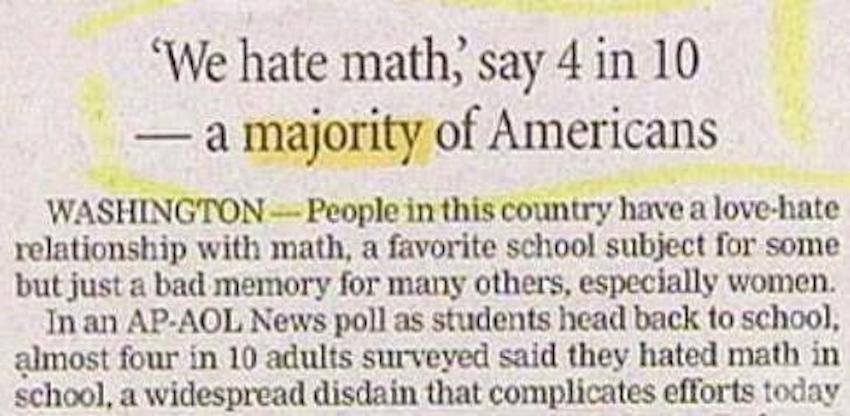
Americans hate math.

Americans hate math.

One part of US success is imported talent, of course. We import Nobel lauriate chemists, Russian dancers, German rocket scientists…, but we don’t import that many. The majority of our immigrants are more in the wretched refuse category, and even these appear to do better here in the US than their colleagues that they left behind. Otto von Bismark once joked that, “God protects children, drunks, and the United States of America.” But I’d like to suggest that our success is based on optimism, pronia: a can-do belief in ourselves that our education provides, at least to our more creative citizens.

Most of the great successful businesses of the USA are not started by the A students, it is clear, but by the C students who develop the greatness of the little they know. Consider Colonel Harlen Sanders, founder of Kentucky Fried Chicken. He believed in the greatness of his chicken recipe, and developed to skills to sell it fast. He did not have to know astronomy, whether the earth goes round the sun. It’s an important fact, but only relevant if you can use it, as Sherlock Holmes points out. I suspect that few Europeans could use the knowledge that the earth spins productively, and suspect that the majority of those that might, lack the confidence to do so (I provide some at the end of this essay).

Benjamin Jowett. His students included the heads of 6 colleges and the head of Eaton

Benjamin Jowett, Master of Balliol College, Oxford.

A classic poem about European education describes Benjamin Jowett, shown at right. It goes: “The first come I, my name is Jowett. There is no knowledge, but that I know it. I am master of this college. What I don’t know isn’t knowledge.” Benjamin Jowett was Master of Balliol College, Oxford. By the time he died in 1893, his ex-student pallbearers included the heads of 6 colleges, and the head of Eaton. Most English heads of state and industry were his students directly or second-hand. All left university with a passing knowledge of Greek, Latin, Plato, law, science, theology, classics, math, rhetoric, logic, and grammar. Only people so educated were deemed suited to run banks or manage backward nations like India or Rhodesia. It worked for a while but showed its limitations, e.g. in the Boer Wars.

In France and continental Europe, the education system is similar, to this day ,to England’s under Jowett. There is a fixed set of knowledge and a fixed rate to learn it. Government and industry jobs go largely to those who’ve demonstrated their ability to give the fixed, correct answers to tests on this knowledge. In schools across France, the same page is turned virtually simultaneously in the every school– no student is left behind, but none jump ahead either or deviate. As new knowledge is integrated, the approved text books are updated and the correct answers are adjusted. Until then, the answers in the book are God’s truth, and those who master it can comfort themselves to have mastered the truth. The European system appears to benefit the many, providing useful skills (and useless tidbits) but it is oppressive to others with forward-thinking, imaginative minds, or who see a new truth a year before the test acknowledges it. College, it is said, “..is a place where pebbles are polished but diamonds are dimmed.” The system work well in areas that barely change like French grammar, geometry, law, and the map of Europe. It does not work so well in music, computers, or the art of war. For creative students, bright or otherwise, schooling is “another brick in the wall.” These students need learning in ‘how to get along without a teacher.’

The American approach leans, or perhaps leaned, towards independence of thought, for good or bad. American graduates can live without the teacher, but leave school knowing no language but English, knowing hardly and maths or science, and hardly any grammar. We can hardly find another country on a map, and often can’t find our own. Teachers will take incorrect answers as correct as a way to build self-esteem, so students leave with the view that there is no such thing as truth. Strangely, this model works, at least in music, engineering, and science where change is fast, creativity is king, and nature itself is a teacher. American graduate-schools are preeminent in these areas. In reading, history and math our graduates might well be described as galumphing ignorants.

Every now and again the US tries to Europeanize education. The “no child left behind” movement was a Republican-led effort to teach on the French model, at least in reading and math. It never caught on. Drugs are a popular approach to making American students less obstreperous, but they work only temporarily. Americans leave school ignorant, but not stupid; respectful of those who can do things, and suspicious of those with lengthy degrees. Without Latin, we do OK as managers of the most complex operations, relying on bumptious optimism and distain for hierarchy.

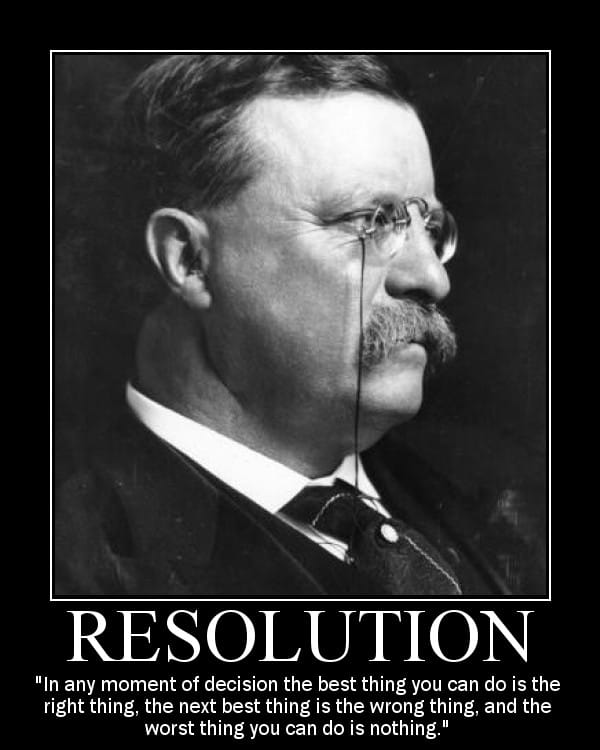
In any moment of decision, the best thing you can do is the right thing, the next bet thing is the wrong thing, and the worst thing you can do is nothing. An American attitude that sometimes blows up, but works surprisingly well at times.

Often the inability to act is worse than acting wrong.

The American-educated boss will do some damage by his ignorance but it is no more than  comes from group-think: non-truths passed as truths. America stopped burning witches far sooner than Europe, and never burned Jews. America dropped nobles quicker, and transitioned to electric lights and motor cars quicker, perhaps because we put less weight on what nobles and universities did. When dealing Europeans, we greet them in a loud, cheerful voice, appoint a subordinate to “get things done,” and get in the way until lunchtime. The Europeans are suitably appalled, both by the crassness and by the random energy.

European scholars accepted that nobility gives one a handle on leadership. This belief held back the talented, non-noble. Since religion was part of education, they accepted that state should have an established religion, Anglican, in England, Catholicism in France; scientific atheism now. They learned from the state, and accepted, that divorce was unnecessary, that homosexuality should be punished by prison or worse, In the early 60s, Turing, a brilliant mathematician and computer scientist, was chemically castrated as a way to cure his homosexuality. In America our “Yankee ingenuity,” as we call it, screwed up too, but in ways like prohibition, McCarthyism, and disco. Such screwups resolved themselves relatively fast. “Ready, fire, aim” is a European description of the American method to any problem. It’s not great, but works better than “steady as she goes.”

The best option, it seems, is when we work together with those “across the pond.” It worked well for us in WWI, WWII, and the American Revolution, benefitting from Lafayette, Baron Von Steuben, Kosciusko, etc. Heading into the world cup of football (fifa soccer) this week, we’re expected to lose badly due to our lack of talent and our general inability to pass, dribble, or strategize. Still, we’ve got enthusiasm, and we’ve got a German coach. The world’s bookies give us 0.05% odds, but our chances are 10 times that, I’d say: 5%. God protects our galumphing corn-fed ignorants when, as in the Revolution, it’s attached to European coaching.

Some businesses where it helps to know the earth spins: rocketry (military and exploratory), communication via geosynchronous satellites (they only work because the earth spins), weather prediction (the spin of hurricanes is because the earth spins), cyclone lifting. It amazes me that people ever thought everything went around the earth, by the way; Mercury and Venus never appear overhead. If authorities could have been so wrong about this for so long, what might they be wrong about today?

Dr. Robert Buxbaum, June 10, 2014 I’ve also written about ADHD on Lincoln’s Gettysburg Address, on Theodore Roosevelt, and how he survived a gun shot.

Dada, or it’s hard to look cool sucking on a carrot.

When it’s done right, Dada art is cool. It’s not confusing or preachy; it’s not out there, or sloppy; just cool. And today I found the most wonderful Dada piece: “Attention”, by Gabriel -Belladonna, shown below from “deviant art” (sorry about the water-mark).

At first glance it’s an advertisement against smoking, drinking, and eating sweets. The smoker has blackened lungs, the drinker has an enlarged liver, and the eater of sweets a diseased stomach. But something here isn’t right; the sinners are happy and young. These things are clearly bad for you but they’re enjoyable too and “cool” — Smoking is a lot cooler than sucking on a carrot.

Dada at it's best: Attention by Mio Belladonna. The sinners are happy.

Dada at it’s best: “Attention” by Dadaist Gabriel (Mio) Belladonna, 2012; image from deviant art. If I were to choose the title it would be “But it’s hard to look cool sucking on a carrot.”

At its best, Dada turns advertising and art on its head; it uses the imagery of advertising to show the shallowness of that, clearly slanted medium, or uses art-museum settings to show the narrow definition of what we’ve come to call “art”. In the above you see the balance of life- reality and the mind control of advertising.

Marcel Duchamp's fountain and "Manikken Pis" Similar idea, Manikken is better executed, IMHO.

Marcel Duchamp’s fountain and “Manikken Pis.”

Any mention of dada should also, I suppose, mention Duchamp’s fountain (at right, signed fancifully by R. Mutt). In 2004, fountain was voted “the most influential artwork of the 20th century” by a panel of artists and art historians. The basic idea was to show the slight difference between art and not-art (to be something, there has to be a non-something, as in this joke). Beyond this, the idea would be that same as for the Manikken Pis sculpture in Brussels. Duchamp’s was done with a lot less work — just by signing a “found object.” He submitted the work for exhibition in 1917, but it was rejected as not being art — proving, I guess, the point. Fountain is related to man: his life, needs, and vain ambitions; it’s sort-of beautiful, so why ain’t it art? (It has something to do with skill, I’d say.)

Duchamp designed two major surrealist exhibitions — a similar approach, but surrealism typically employs more skill and humor than Dada, with less shock. Below is another famous work of dada, Oppenheim’s fur-lined tea-cup (Breakfast in fur — see it at the Modern Museum in NYC) compared to a wonderful (and in my mind similar) surreal work, “Ruby lips” by Dali. Oppenheim made the tea-cup and spoon disgusting by making it out of a richer material, fur. That’s really cool, and sort-of shocking, even today.

Duchap's tea cup (left), and Dali's ruby lips (right). Similar ideas treated as Dada or Surreal.

Meret Oppenheim’s fur tea-cup (Breakfast in fur) and Dali’s ruby lips; the same idea (I think); dada vs surreal.

Dali’s “ruby libs” brooch took more skill than gluing fur to a cup and spoon; that adds to the humor, I’d say, but took from the shock. It’s made from real rubies and pearls: hard materials for something that should be soft; it’s sort of disgusting this way, and the message is more or less the same as Oppenheim’s, I’d say, but the message gets a little lost in the literal joke (pearly teeth, ruby lips…). I could imagine someone wearing Dali’s brooch, but no one would use the fur-lined cup. 

There is a lot of bad dada, too unfortunately, and it tends to be awful: incomprehensible, trite, or advertising. An unfortunate tendency is to collect some found pieces of garbage, and set it out in an attempt to scandalize the art world, or put down “the man” for his closed mindset. But that’s fountain, and it’s been done. A key way to tell if it’s good dada — is it cool; is it something that makes you say “Wow.” Christo’s surrounded islands certainly have the wow-cool factor, IMHO. 

Christo's wrapped Islands. Islands near Miami Beach wrapped in pink (fuscha) plastic.

Christo’s surrounded Islands: Islands near Miami Beach wrapped in pink (fuchsia) plastic.

A nice thing about Christo is that he takes it down 2 weeks or so after he makes the sculptures. Thus, the wow factor of his work never has a chance to go stale. Sorry to say, most dada stays around. Duchamp’s “fountain” sits in a museum and has grown stale, at least to me and Duchamp. What was scandalous and shocking in 1917 is passé and boring in 2014. The decline in shock is somewhat less for “breakfast in fur,” I think because the work is better crafted, a benefit I see in “Attention” too; skill matters.

Paris Street art. I don't know the artist, but it's cool.

Paris Street art; it’s just cool.

At the height of his success, Duchamp left art for 30 years and played chess. He became a chess grand master (life is as strange as art) and played for France in international tournaments. He later came back to art and did one, last, final piece, a very fine one, seen only through a peephole. Here’s some further thoughts on good vs bad modern art, and on surrealism, and on the aesthetic of strength in engineering: what materials to use; how strong should it be, and on architecture humor

Robert E. Buxbaum. April 4-7, 2014. Here is a link to my attempt at good Dada: Kilroy with eyes that follow you, and at right some Paris street art that I consider good dada too. As far as what the word “dada” means, I translate it as “cool,” “wow,” “gnarly,” or “go go.” It’s dada, man, y’ dig?

In praise of tariffs

In a previous post I noted that we could reduce global air pollution if we used import taxes (tariffs) to move manufacture to the US from China and other highly polluting countries. It strikes me that import tariffs can have other benefits too, they can keep US jobs in the US, provide needed taxes, and they’re a tool of foreign policy. We buy far more from China and Russia than they buy from us, and we get a fair amount of grief — especially from Russia. An appropriate-sized tariff should reduce US unemployment, help balance the US, and help clean the air while pushing Russia in an alternative to war-talk.

There is certainly such a thing as too high a tariff, but it seems to me we’re nowhere near that. Too high a tariff is only when it severely limits the value of our purchasing dollar. We can’t eat dollars, and want to be able to buy foreign products with them. Currently foreign stuff is so cheap thought, that what we import is most stuff we used to make at home — often stuff we still make to a small extent, like shoes, ties, and steel. An import tax can be bad when it causes other countries to stop buying from us, but that’s already happened. Except for a very few industries, Americans buy far more abroad than we sell. As a result, we have roughly 50% of Americans out of well-paying work, and on some form government assistance. Our government spends far more to care for us, and to police and feed the world than it could possibly take in, in taxes. It’s a financial imbalance that could be largely corrected if we bought more from US manufacturers who employ US workers who’d pay taxes and not draw unemployment. Work also benefits folks by developing, in them, skills and self-confidence.

Cartoon by Daryl Cagle. Now why is Russia a most favorable trade partner?

Cartoon by Daryl Cagle. Trade as foreign policy. Why is Russia a most favorable trade partner?

In a world without taxes or unemployment, and free of self-confidence issues, free trade might be ideal, but taxes and unemployment are a big part of US life. US taxes pay for US roads and provide for education and police. Taxes pay for the US army, and for the (free?) US healthcare. With all these tax burdens, it seems reasonable to me that foreign companies should pay at least 5-10% — the amount an American company would if the products were made here. Tariff rates could be adjusted for political reasons (cartoon), or environmental — to reduce air pollution. Regarding Russia, I find it bizarre that our president just repealed the Jackson Vanik tariff, thus giving Russia most favored trade status. We should (I’d think) reinstate the tax and ramp it up or down if Russia invades again or if they help us with Syria or Iran.

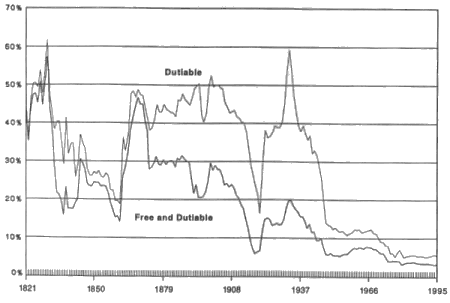
A history of US tariff rates. There is room to put higher tariffs on some products or some countries.

A history of US tariff rates. Higher rates on some products and some countries did not harm the US for most of our history.

For most of US history, the US had much higher tariffs than now, see chart. In 1900 it averaged 27.4% and rose to 50% on dutiable items. Our economy did OK in 1900. By 1960, tariffs had decreased to 7.3% on average (12% on duty-able) and the economy was still doing well. Now our average tariff is 1.3%, and essentially zero for most-favored nations, like Russia. Compare this to the 10% that New York applies to in-state sales, or the 6% Michigan applies, or the 5.5% that Russia applies to goods imported from the US. Why shouldn’t we collect at least as high a tax on products bought from the non-free, polluting world as we collect from US manufacturers.

Some say tariffs caused the Great Depression. Countries with lower tariffs saw the same depression. Besides the Smoot-Hawley was 60%, and I’s suggesting 5-10% like in 1960. Many countries today do fine today with higher tariffs than that.

Robert E. Buxbaum, March 25, 2014. Previous historical posts discussed the poor reviews of Lincoln’s Gettysburg address, and analyzed world war two in terms of mustaches. I’ve also compared military intervention to intervening in a divorce dispute. My previous economic post suggested that Detroit’s very high, living wage hurt the city by fostering unemployment.

Nuclear fusion

I got my PhD at Princeton University 33 years ago (1981) working on the engineering of nuclear fusion reactors, and I thought I’d use this blog to rethink through the issues. I find I’m still of the opinion that developing fusion is important as the it seems the best, long-range power option. Civilization will still need significant electric power 300 to 3000 years from now, it seems, when most other fuel sources are gone. Fusion is also one of the few options for long-range space exploration; needed if we ever decide to send colonies to Alpha Centauri or Saturn. I thought fusion would be ready by now, but it is not, and commercial use seems unlikely for the next ten years at least — an indication of the difficulties involved, and a certain lack of urgency.

Oil, gas, and uranium didn’t run out like we’d predicted in the mid 70s. Instead, population growth slowed, new supplies were found, and better methods were developed to recover and use them. Shale oil and fracking unlocked hydrocarbons we thought were unusable, and nuclear fission reactors got better –safer and more efficient. At the same time, the more we studied, the clearer it came that fusion’s technical problems are much harder to tame than uranium fission’s.

Uranium fission was/is frighteningly simple — far simpler than even the most basic fusion reactor. The first nuclear fission reactor (1940) involved nothing more than uranium pellets in a pile of carbon bricks stacked in a converted squash court at the University of Chicago. No outside effort was needed to get the large, unstable uranium atoms split to smaller, more stable ones. Water circulating through the pile removed the heat released, and control was maintained by people lifting and lowering cadmium control rods while standing on the pile.

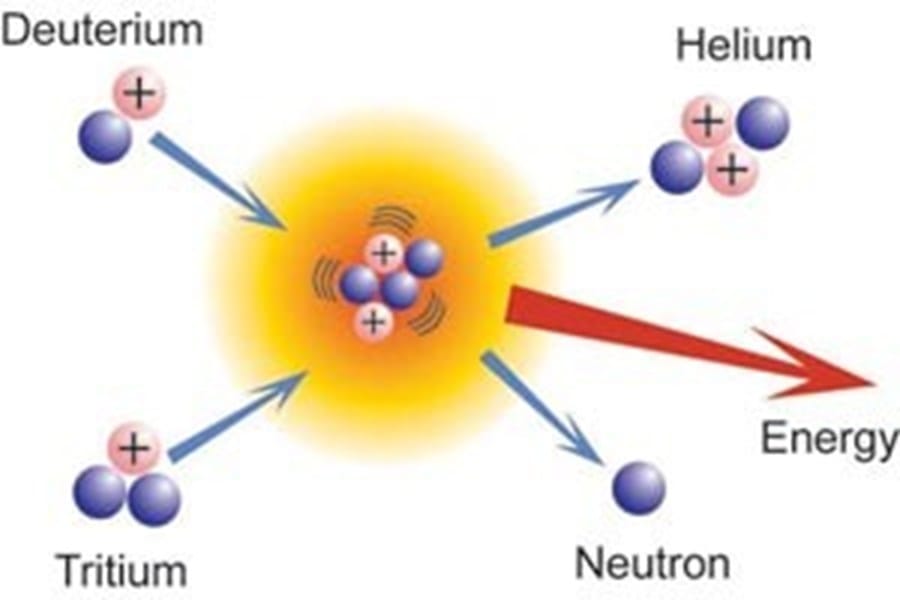
A fusion reactor requires high temperature or energy to make anything happen. Fusion energy is produced by combining small, unstable heavy hydrogen atoms into helium, a bigger more stable one, see figure. To do this reaction you need to operate at the equivalent of about 500,000,000 degrees C, and containing it requires (typically) a magnetic bottle — something far more complex than a pile of graphic bricks. The reward was smaller too: “only” about 1/13th as much energy per event as fission. We knew the magnetic bottles were going to be tricky, e.g. there was no obvious heat transfer and control method, but fusion seemed important enough, and the problems seemed manageable enough that fusion power seemed worth pursuing — with just enough difficulties to make it a challenge.

Basic fusion reaction: deuterium + tritium react to give helium, a neutron and energy.

Basic fusion reaction: deuterium + tritium react to give helium, a neutron and energy.

The plan at Princeton, and most everywhere, was to use a TOKAMAK, a doughnut-shaped reactor like the one shown below, but roughly twice as big; TOKAMAK was a Russian acronym. The doughnut served as one side of an enormous transformer. Hydrogen fuel was ionized into a plasma (a neutral soup of protons and electrons) and heated to 300,000,000°C by a current in the TOKOMAK generated by varying the current in the other side of the transformer. Plasma containment was provided by enormous magnets on the top and bottom, and by ring-shaped magnets arranged around the torus.

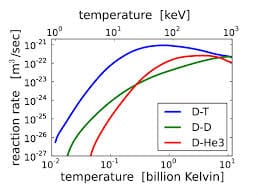
As development went on, we found we kept needing bigger and bigger doughnuts and stronger and stronger magnets in an effort to balance heat loss with fusion heating. The number density of hydrogen atoms per volume, n, is proportional to the magnetic strength. This is important because the fusion heat rate per volume is proportional to n-squared, n2, while heat loss is proportional to n divided by the residence time, something we called tau, τ. The main heat loss was from the hot plasma going to the reactor surface. Because of the above, a heat balance ratio was seen to be important, heat in divided by heat out, and that was seen to be more-or-less proportional to nτ. As the target temperatures increased, we found we needed larger and larger nτ reactors to make a positive heat balance. And this translated to ever larger reactors and ever stronger magnetic fields, but even here there was a limit, 1 billion Kelvin, a thermodynamic temperature where the fusion reaction went backward and no energy was produced. The Princeton design was huge, with super strong, super magnets, and was operated at 300 million°C, near the top of the reaction curve. If the temperature went above or below this temperature, the fire would go out. There was no room for error, but relatively little energy output per volume — compared to fission.

Fusion reaction options and reaction rates.

Fusion reaction options and reaction rates.

The most likely reaction involved deuterium and tritium, referred to as D and T. This was the reaction of the two heavy isotopes of hydrogen shown in the figure above — the same reaction used in hydrogen bombs, a point we rarely made to the public. For each reaction D + T –> He + n, you get 17.6 million electron volts (17.6 MeV). This is 17.6 million times the energy you get for an electron moving over one Volt, but only 1/13 the energy of a fission reaction. By comparison, the energy of water-forming, H2 + 1/2 O2 –> H2O, is the equivalent of two electrons moving over 1.2 Volts, or 2.4 electron volts (eV), some 8 million times less than fusion.

The Princeton design involved reacting 40 gm/hr of heavy hydrogen to produce 8 mol/hr of helium and 4000 MW of heat. The heat was converted to electricity at 38% efficiency using a topping cycle, a modern (relatively untried) design. Of the 1500 MWh/hr of electricity that was supposed to be produced, all but about 400 MW was to be delivered to the power grid — if everything worked right. Sorry to say, the value of the electricity did not rise anywhere as fast as the cost of the reactor and turbines. Another problem: 1100 MW was more than could be easily absorbed by any electrical grid. The output was high and steady, and could not be easily adjusted to match fluctuating customer demand. By contrast a coal plant’s or fuel cell’s output could be easily adjusted (and a nuclear plant with a little more difficulty).

Because of the need for heat balance, it turned out that at least 9% of the hydrogen had to be burnt per pass through the reactor. The heat lost per mol by conduction to the wall was, to good approximation, the heat capacity of each mol of hydrogen ions, 82 J/°C mol, times the temperature of the ions, 300 million °C divided by the containment time, τ. The Princeton design was supposed to have a containment of about 4 seconds. As a result, the heat loss by conduction was 6.2 GW per mol. This must be matched by the molar heat of reaction that stayed in the plasma. This was 17.6 MeV times Faraday’s constant, 96,800 divided by 4 seconds (= 430 GW/mol reacted) divided by 5. Of the 430 GW/mol produced in fusion reactions only 1/5 remains in the plasma (= 86 GW/mol) the other 4/5 of the energy of reaction leaves with the neutron. To get the heat balance right, at least 9% of the hydrogen must react per pass through the reactor; there were also some heat losses from radiation, so the number is higher. Burn more or less percent of the hydrogen and you had problems. The only other solution was to increase τ > 4 seconds, but this meant ever bigger reactors.

There was also a material handling issue: to get enough fuel hydrogen into the center of the reactor, quite a lot of radioactive gas had to be handled — extracted from the plasma chamber. These were to be frozen into tiny spheres of near-solid hydrogen and injected into the reactor at ultra-sonic velocity. Any slower and the spheres would evaporate before reaching the center. As 40 grams per hour was 9% of the feed, it became clear that we had to be ready to produce and inject 1 pound/hour of tiny spheres. These “snowballs-in-hell” had to be small so they didn’t dampen the fire. The vacuum system had to be able to be big enough to handle the lb/hr or so of unburned hydrogen and ash, keeping the pressure near total vacuum. You then had to purify the hydrogen from the ash-helium and remake the little spheres that would be fed back to the reactor. There were no easy engineering problems here, but I found it enjoyable enough. With a colleague, I came up with a cute, efficient high vacuum pump and recycling system, and published it here.

Yet another engineering challenge concerned the difficulty of finding a material for the first-wall — the inner wall of the doughnut facing the plasma. Of the 4000 MW of heat energy produced, all the conduction and radiation heat, about 1000 MW is deposited in the first wall and has to be conducted away. Conducting this heat means that the wall must have an enormous coolant flow and must withstand an enormous amount of thermal stress. One possible approach was to use a liquid wall, but I’ve recently come up with a rather nicer solid wall solution (I think) and have filed a patent; more on that later, perhaps after/if the patent is accepted. Another engineering challenge was making T, tritium, for the D-T reaction. Tritium is not found in nature, but has to be made from the neutron created in the reaction and from lithium in a breeder blanket, Li + n –> He + T. I examined all possible options for extracting this tritium from the lithium at low concentrations as part of my PhD thesis, and eventually found a nice solution. The education I got in the process is used in my, REB Research hydrogen engineering business.

Man inside the fusion reactor doughnut at ITER. He'd better leave before the 8,000,000°C plasma turns on.

Man inside the fusion reactor doughnut at ITER. He’d better leave before the 8,000,000°C plasma turns on.

Because of its complexity, and all these engineering challenges, fusion power never reached the maturity of fission power; and then Three-mile Island happened and ruined the enthusiasm for all things nuclear. There were some claims that fusion would be safer than fission, but because of the complexity and improvements in fission, I am not convinced that fusion would ever be even as safe. And the long-term need keeps moving out: we keep finding more uranium, and we’ve developed breeder reactors and a thorium cycle: technologies that make it very unlikely we will run out of fission material any time soon.

The main, near term advantage I see for fusion over fission is that there are fewer radioactive products, see comparison.  A secondary advantage is neutrons. Fusion reactors make excess neutrons that can be used to make tritium, or other unusual elements. A need for one of these could favor the development of fusion power. And finally, there’s the long-term need: space exploration, or basic power when we run out of coal, uranium, and thorium. Fine advantages but unlikely to be important for a hundred years.

Robert E. Buxbaum, March 1, 2014. Here’s a post on land use, on the aesthetics of engineering design, and on the health risks of nuclear power. The sun’s nuclear fusion reactor is unstable too — one possible source of the chaotic behavior of the climate. Here’s a control joke.

Stoner’s prison and the crack mayor

With the release of a video of Rob Ford, the Mayor of Toronto, smoking crack while in office, and the admission that at least two US presidents smoked pot, as did the Beatles, Stones, and most of Hollywood, it seems worthwhile to consider the costs and benefits of our war on drugs, especially pot. Drugs are typically bad for productivity and usually bad for health. Thus, it seems worthwhile to regulate it, but most countries do not punish drug sale or use nearly as harshly as we do in the US.

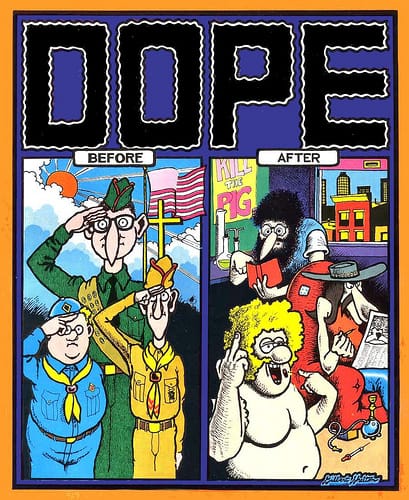
The Freak Brothers by Gilbert Shelton. Clearly these boys were not improved by drugs, but perhaps we could do better than incarcerating them, and their fans, for years, or life.

The Freak Brothers by Gilbert Shelton. Clearly these boys were not improved by drugs, but perhaps we could do better than incarcerating them, and their fans, for years, or life.

While US penalties vary state by state, most states have high minimum penalties that a judge can not go below. In Michigan, where I live, medical marijuana is legalized, but all supply is still illegal. Marijuana cultivation, even for personal medical use, is a felony carrying a minimum punishment of 4 years in state prison and a $20,000 fine. For cultivation of more than 20 plants the minimum sentence is 7 years in prison and $500,000; and cultivating 200 or more plants results in 15 years plus a $10,000,000 fine. These are first-time, minimum sentences where the judge can not consider mitigating circumstances, like a prescription, for a drug that was accepted for use in the US in the 70s, is legal in Holland, legalized in Colorado, and is near-legal in Belgium. While many pot smokers were not served by the herb, many went on to be productive, e.g. our current president and the Beatles.

In Michigan, the mandatory minimums get worse if you are a repeat offender, especially a 3 time offender. Possession of hard drugs; and sales or cultivation of marijuana makes you a felon; a gun found on a felon adds 2 years and another felony. With three felonies you go to prison for life, effectively, so there is little difference between the sentence of a repeat violent mugger and a kid selling $10 rocks of crack in Detroit. America has more people in prison than Russia, China, or almost every industrialized nation, per capita, and the main cause is long minimum sentences.

In 2011, Michigan spent an average of $2,343 per month per prisoner, or $28,116/year: somewhat over 1.3 billion dollars per year in total. To this add the destruction of the criminal’s family, and the loss of whatever value he/she might have added to society. Reducing sentences by 10 or 20% would go a long way towards paying off Detroit’s bankruptcy, and would put a lot of useful people back into the work-force where they might do some good for themselves and the state. 60.8% of drug arrestees were employed before they were arrested for drugs, with an average income of $1050/month. That’s a lot of roofers, electricians, carpenters, and musicians — useful people. As best we can tell, the long sentences don’t help, but lead to higher rates of recidivism and increased violent behavior. If you spend years in jail, you are likely to become more violent, rather than less. Some 75% of drug convicts have no prior record of violent crime, so why does a first-time offense have to be a felony. If we need minimums, couldn’t it be 6 months and a $1000 fine, or only apply if there is violence.

Couldn’t we allow judges more leeway in sentencing, especially for drugs? Recall that Michiganders thought they’d legalized marijuana for medical use, and that even hard-drugs were legal not that long ago. There was a time when Coca-Cola contained cocaine and when Pope Leo was a regular drinker of cocaine laced wine. If the two presidents smoked pot, and the Mayor of Toronto could do a decent job after cocaine, why should we incarcerate them for life? Let’s balance strict justice with mercy; so the fabric of society is not strained to breaking.

Robert Buxbaum, Jan 16, 2014. Here are some other thoughts on Detroit and crime.

Ocean levels down from 3000 years ago; up from 20,000 BC

In 2006 Al Gore claimed that industry was causing 2-5°C of global warming per century, and that this, in turn, would cause the oceans to rise by 8 m by 2100. Despite a record cold snap this week, and record ice levels in the antarctic, the US this week banned all incandescent light bulbs of 40W and over in an effort to stop the tragedy. This was a bad move, in my opinion, for a variety of reasons, not least because it seems the preferred replacement, compact fluorescents, produce more pollution than incandescents when you include disposal of the mercury and heavy metals they contain. And then there is the weak connection between US industry and global warming.

From the geologic record, we know that 2-5° higher temperatures have been seen without major industrial outputs of pollution. These temperatures do produce the sea level rises that Al Gore warns about. Temperatures and sea levels were higher 3200 years ago (the Trojan war period), without any significant technology. Temperatures and sea levels were also higher 1900 years ago during the Roman warming. In those days Pevensey Castle (England), shown below, was surrounded by water.

During Roman times Pevensey Castle (at right) was surrounded by water at high tide.If Al Gore is right, it will be surrounded by water again soon.

During Roman times the world was warmer, and Pevensey Castle (right) was surrounded by water;. If Al Gore is right about global warming, it will be surrounded by water again by 2100.

From a plot of sea level and global temperature, below, we see that during cooler periods the sea was much shallower than today: 140 m shallower 20,000 years ago at the end of the last ice age, for example. In those days, people could walk from Asia to Alaska. Climate, like weather appears to be cyclically chaotic. I don’t think the last ice age ended because of industry, but it is possible that industry might help the earth to warm by 2-5°C by 2100, as Gore predicts. That would raise the sea levels, assuming there is no new ice age.

Global temperatures and ocean levels rise and sink together

Global temperatures and ocean levels change by a lot; thousands of years ago.

While I doubt there is much we could stop the next ice age — it is very hard to change a chaotic cycle — trying to stop global cooling seems more worthwhile than trying to stop warming. We could survive a 2 m rise in the seas, e.g. by building dykes, but a 2° of cooling would be disastrous. It would come with a drastic reduction in crops, as during the famine year of 1814. And if the drop continued to a new ice age, that would be much worse. The last ice age included mile high glaciers that extended over all of Canada and reached to New York. Only the polar bear and saber-toothed tiger did well (here’s a Canada joke, and my saber toothed tiger sculpture).

The good news is that the current global temperature models appear to be wrongor highly over-estimated. Average global temperatures have not changed in the last 16 years, though the Chinese keep polluting the air (for some reason, Gore doesn’t mind Chinese pollution). It is true that arctic ice extent is low, but then antarctic ice is at record high levels. Perhaps it’s time to do nothing. While I don’t want more air pollution, I’d certainly re-allow US incandescent light bulbs. In cases where you don’t know otherwise, perhaps the wisest course is to do nothing.

Robert Buxbaum, January 8, 2014

Lincoln’s Gettysburg address, not as bad as first thought.

Three score days ago, The Harrisburg Patriot & Union retracted its unflattering 1863 review of Lincoln’s Gettysburg address. But this retraction deserves more attention, I think, than that the editors reconsidered. The Patriot & Union was a Republican journal; it carried an accurate account of the speech, and so it’s worthwhile to ask why its editors labeled this great speech, “silly remarks”, deserving “a veil of oblivion”; “without sense.” Clearly the editors saw a serious lack that we do not see today. It’s worth asking then, what made them think it was silly and lacking in sense?

The Union & Patriot has retracted their review of this 1863 speech.

Lincoln in 1863; The Union & Patriot has retracted their review of this Gettysburg speech — in the fullness of time, they’ve come to reconsider their original review.

Lincoln spoke a few words in honor of the dead, but Edward Everett spoke on this topic for two hours before Lincoln rose. This lack does not appear to be what bothered the editors: “To say of Mr. Everett’s oration that it rose to the height which the occasion demanded, or to say of the President’s remarks that they fell below our expectations, would be alike false. Neither the orator nor the jester surprised or deceived us. Whatever may be Mr. Everett’s failings he does not lack sense – whatever may be the President’s virtues, he does not possess sense. Mr. Everett failed as an orator, because the occasion was a mockery, and he knew it, and the President succeeded, because he acted naturally, without sense and without constraint, in a panorama which was gotten up more for his benefit and the benefit of his party than for the glory of the nation and the honor of the dead.” The editors came to Gettysburg (I think) to hear Lincoln to hear things that only LIncoln could provide — his real thoughts on slavery and an update on his efforts at peace. As best I can tell, it was in these areas that they saw “a veil of oblivion.” Even so, for them to call this address, “silly remarks” there must be more going on. Here are my thoughts.

Lincoln had freed southern slaves a few months earlier by the emancipation proclamation, but no one knew their status; there had been a riot over this a few days previous. Did Lincoln claim equality for these ex-slaves, and if not, what were his thoughts on the extent of their in-equality. They were confiscated as war booty; would Lincoln return them to their owners after the war was over? If so, they were not free at all. Along with this, what was Lincoln doing to end the war? It was far from clear that the North could win in 1863. Lee had many victories, and now England had entered in support of the Confederacy. In my opinion, it was Ericsson’s Monitors that allowed the North to stop the British and win, but it appears that, in 1863, only the British navy realized that their power had been neutralized, and the south was lost.

By 1863 Ericsson was turning out two of these Monitor-type sips per month, enough to keep the British from any major port in America

The North’s Monitor, right, fights the Confederate Merrimac, left, to a draw over control of Norfolk harbor. Ericsson turned out two Monitor ships per month. In my opinion is was these ships that stopped the British and won the war.

Lincoln was cryptically brief when it came to slavery or peace: 271 words. About half the speech is devoted to the brave men who struggled here; the other half speaks of “the Nation,” or the “government.” Not the United States, the Union, the North, the South, but an undefined entity that Lincoln claims came into existence 70 years earlier, in 1776. Most educated people would have said that 1776 created no nation or government, only a confederation of independent states as described by the articles of confederation. Under these articles, these 13 states could only act by consensus and had the right to leave at will. To the extent that anyone held the South was bound now, it was because of the Constitution, signed ten years later, but Lincoln does not mention the Constitution at all– perhaps because most Democrats, understood the Constitution to allow departure. Also, to the extent the Constitution mentions slavery, it’s not to promote equality, but to give each slave 3/5 the vote-power of a free man. If “created equal” is to come from anywhere, it’s the Declaration, but most people understood the intent of the Declaration differently from the vision Lincoln now presented.

As far as most people understood it, The Declaration claimed the God-given right to separate from England and gain us a measure of self-rule — something that the South now claimed for itself, but Lincoln opposed. Further, we claimed in The Declaration, that British mis-management made the separation necessary, and listed the abhorrent offenses including suspension of habeas corpus, and the confiscation of property without process of law — things Lincoln was doing even now. Even the introductory phrase, created equal, was not understood to imply that everyone was equal. Rather, as Stephen Douglass pointed out in their 1858 Chicago debate, we’d created a nation “by the white man, for the benefit of the white man, to be administered by white men, in such a manner as they should determine.”

Ulysses Grant had a slave who he freed in 1859, and had control of his wife's slaves, who became free only in 1865. Lee's slaves were freed in 1862.

Ulysses Grant had a slave he freed in 1859; his wife held slaves till 1865. Lee freed his in 1862.

Where was Lincoln coming from? What was he saying that November day? It’s been speculated that Lincoln was proposing a secular religion of administered freedom. There appears to be some legitimacy here, but more I suspect Lincoln was referring to the UNANIMITY requirement behind the Declaration — by agreement all the states had to agree to independence, or we would all stay bound to Britain. If we had to unanimously bind ourselves, we must have unanimously bound ourselves to some shared vision of the union or democracy, -presumably that all were created equal. Five years earlier, William Herndon, Lincoln’s law partner, had given Lincoln a book of the sermons of Theodore Parker, a Boston Unitarian. That volume includes the following section marked by Lincoln in reference to what the unanimous binding entailed: “‘Democracy is direct self-government, over all the people, for all the people, by all the people.” Whether Lincoln was now speaking in direct reference to this line, or more-likely, as I suspect, to a more general refutation of the claims of Southern separation and Douglas’s 1858 white man claim, Lincoln’s sense of the import of the Declaration was one that few understood or agreed with. The North still had slaves — Grant’s wife for example, and there was no obvious desire for a new birth of freedom, just an end to the war. Lincoln’s words thus must have sounded like gobbledygook to the majority of learned ears.

Based on the events and issues of the time, and the un-obvious point of the speech, I’d say the editors were justified in their ill review. Further, the issues that bothered them then, abuse of power, citizen and states’ rights, remain as relevant today as ever. Do the current editors see any import of the 9th and 10th amendment limiting the power of federal government? If so, what. Thus, I’m a bit disappointed that the Union & Patriot retracted its review of Lincoln’s short speech with nothing more than claiming to see things differently today. We stand on LIncoln’s shoulders now, and though we see the nation, and the Declaration, through his eyes, their issues remain, and the original review gives perspective on the nation as it looked at a very different time. Thus, while I understand the editors desire to look correct in retrospect, I’d prefer if the current editors would have left the review, or at least addressed the points that bothered their earlier colleagues. It’s a needed discussion. When every person thinks alike, nobody thinks very much.

January 6, 2014 by Robert E. Buxbaum, a doctor of Philosophy (in Chemical Engineering). Here is a translation of the Address into Jive. And into yeshivish. I’ve also written an essay on a previous retraction (regarding GM food). If Lincoln had a such a long address, how did he ever get mail?