Continuing my, somewhat tongue in cheek, Masculinist history, part 1: beards, I thought I’d move on to mustache history, centering on WWII. I see the conflict as big mustaches vs little mustaches leading to a peace of no face hair at all. First consider that, at the start of the war, virtually all the leaders had mustaches, with similar mustached men allied. Consider that Hitler was weird and hi’s mustache was weird, and that, within a few years of peace, virtually no major leader had a hairy lip. Why?
Let me begin by speculating that the mustache is worn by the man who wishes to be seen as manly, but who also wants to appear civilized. The message of the mustache, then: I’m a leader of great vision within a civilized society. Thus visionaries like Albert Einstein, Duke Ellington, S. Dali, and T. Roosevelt, all decided to grow mustaches. The mustache may not make men into champions of a new vision, but a man with the will to champion something new will tend to wear a mustache. It is thus no surprise that a world war would begin when all the world leaders had mustaches, or why a crazy person like Hitler would wear a crazy mustache, but why is it that so few world leaders have been mustached since. Where have all the mustaches gone? Read onward.

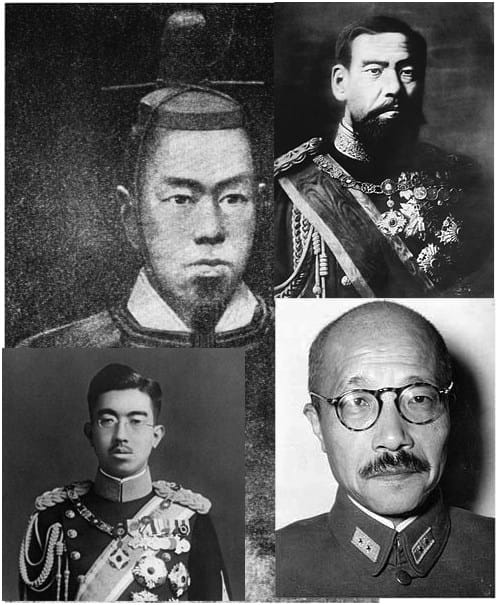
Emperor Akihito, upper left was induced to open Japan; Emperor Meiji, upper right, defeated China and Russia; WWII Emperor Hirohito, bottom left; General Tojo, bottom right, the man to take the fall. Caveat Emperor.
As WWII begins with the Japanese, lets look at the face hair on several Japanese emperors’ faces. At the upper left, Mikado (Emperor) Akihito. He had no vision, drive or mustache, and was induced to open Japan to the west in 1854 in response to his advisors and Admiral Perry who sailed 4 black warships into Tokyo harbor. His successor, Emperor Meiji (upper right, bearded) won wars against China and Russia in the late 1800s (see the significance of warlike beards). Emperor Hirohito, bottom left, wore the mustache and authorized the beginning of WWII including the bombing of Pearl Harbor and the rape of Nanking. His associate, General Tojo, bottom right, also mustached lead the actual deeds and took the blame. Akihito looks feminine and unhappy, as one might understand. Meiji looks like a holy terror; and both Hirohito and his general wear mustaches trimmed in the British style. My interpretation: their goal was to build a sea-land empire based on the British model.
After Emperor Meiji defeated China and Russia, his obvious next step should have been to attack the USA, but Meiji did not. Large-mustachioed, US President, Th. Roosevelt noticed the danger and used his “talk softly and carry a big stick” deterrent. He was a man of civilization and sent a “peace delegation” of white-pained warships to Tokyo Harbor. They were painted white for peace, and to differentiate the modern, civilized Roosevelt from President Tyler of the Black warships. The message seems to have gotten through to Meiji, and we had no more trouble from him, nor from his son (no face hair). But Meiji’s grandson, Hirohito joined with Tojo, and realized that all Americans were not like Th. Roosevelt. He ceased the opportunity of American isolationism and tried to get the job done as his grandfather would have wanted. They figured, correctly, that we didn’t want war, and incorrectly, that we would give up in the face of a single military victory. Hirohito had studied in England and admired the British empire. Seeing the power of bearded George V, he came to believe that a small, but unified island nation could take and hold a mighty empire so long as the nation was strong enough and understood modern organizational management. Surely it was time Japan made its empire by taking Hong Kong from England, Vietnam from France, The Philippines from the US, and (most importantly) Malaysia from the Dutch (Malaysia had oil). What’s the worst that could happen?
Hirohito built a world-power army and navy, and invaded China successfully. He fought Chiang Kai Shek (trimmed, British mustache; he was a modernizer himself). Meanwhile, for 15 years the Japanese military developed for empire. The military college planned an attack on Pearl Harbor based on careful organization and management. When carried out Dec. 7, 1941, the attack was brilliantly successful. The next day, Dec 8-9, the same “zero” planes that had hit Hawaii, helped destroy both the British navy near Hong Kong and the US airbase in the Philippines. We never even thought to prepare as we didn’t think the Japanese were organized or advance enough. The Mitsubishi “zero” was an advanced version of a Fiat design (see my piece on Fiat’s latest). As with other Fiat products, it was small, fast, maneuverable, efficient, and unreliable.
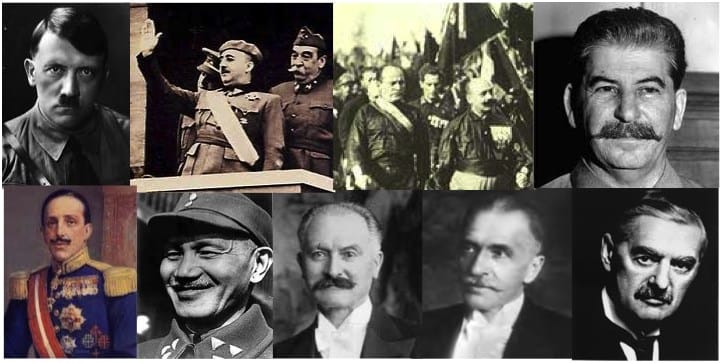
Now look at the European leaders, axis and allies, below. In the late 1930s, all sport mustaches except for Mussolini. This might suggest a world ripe for war that would benefit Mussolini: everyone’s vision can’t come to be, and most everyone might want to ally with a feminine peace-nick. At first, that’s what happened: modern military mustached Franco took over Spain from the old-fashioned, up-mustached king of Spain and his incompetent government. Mussolini was a passive ally. Big mustached Stalin took over the Baltic countries; Mussolini was his national-socialist friend. Half-mustache Hitler then allied with Mussolini and armed the Rhineland. This scares old-fashioned mustached Giraud (France) and British Chamberlain into giving him eastern Czechoslovakia. Mussolini looks on. Chamberlain comes to believe that he has achieved peace in our time, but he has not. Now, the big mustached king of Italy, Victor Emanuel chooses no-mustache Mussolini to restore Italian unity. Mussolini goes to war and takes Libya on his second try. He almost takes Greece too. Useless, clean-shaven, general Badoglio resigns. These conquests do not lead to world war or condemnation of Italy (or Germany, or Russia) The mustachioed socialists of France, Poland, England and the US have quite a lot in common with the national socialists of Germany and Italy. We hold, like they do, that the state must make the jobs if it is to pull out of the depression, and that the state must be strong, pure, and united — something best achieved by socialism and keeping immigrants out. The theme of the New York Word’s Fair in 1939 is Peace through Progress, a theme of unrealistic optimism. For now, though, the US is neutral, and all the nations have exhibitions in NY.

Top row: axis leaders at the beginning of WWII; l-r: Hitler, Franco (Spain), King Victor Emanuel and Mussolini (Italy), and Stalin Bottom row: allied leaders, l-r; King Alfonso (Spain); Chiang Kai Shek (China), François Lebrun (France), Ignazy Moscicki (Poland); N. Chamberlain (UK). All are mustached except Mussolini.
But peace isn’t in the cards as one could tell by the mustaches. Big mustache Stalin hatches a secret pact with small-mustache Hitler. They invade Poland together in September 1939. The mustache of the masses and the mustache of the pure race join to destroy Poland in a week. Because of treaties, England and France are now at war too, but they do nothing till May 1940. Not understanding that mustaches must war, they assume no war exists. This changes when Hitler sweeps his armies through Belgium and into Paris. England rejects the mustached enemies, and elects clean-shaved Winston Churchill, a Labor liberal turned Conservative. He sports a big-stick policy and wears a big-stick cigar. His cigar is like a flaming mustache, but far more mobile.
Churchill’s policies are just as mobile as his mustache. He confidently tells the masses, “We will fight them on the beaches.” And confidently tells the elites: “Remember gentlemen, it’s not just France we’re fighting for, it’s Champaign.” A cigar, unlike a mustache, can be warlike of peaceful: in your face or out depending on the group. A Republican with at cigar is a diplomat, not a dogmatist.
Churchill finds an ally in clean-shaven, cigarette holder, segregationist FDR. “Meeting FDR is like opening your first bottle of Champaign,” says Churchill, “Getting to know him is like drinking it.” The two english-speaking countries share a special relationship and similar smoking preferences. FDR, still vowing neutrality, lends England ships tanks, and money, but sends no troupes except volunteers (the Lafayette squadron). With this diplomatic, middle road in place, FDR handily defeats the shaven, cigarette smoking, war-monger, Wendell Wilkie in the 1940 election (Wilkie used to be a Democrat). The Free French take to small mustache, Charles De Gaulle, in preference to the larger mustache, Philippe Petain, or the similarly mustached Edourd Deladier and Maurice Gamelin.
De Gaulle and Churchill do not get along. De Gaulle (small mustache) wants action. He becomes the liberation of French Africa. Meanwhile, Churchill talks war, but only to defend “this rock, this England.” De Gaulle describes the differences this way: “I get angry when I’m right, and Churchill gets angry when he’s wrong; therefore we are angry at each other quite a lot.” Churchill claims that “going to war without the French is like going hunting without your bagpipe.”
Roosevelt has much in common with Churchill as might be guessed from the lack of face hair and the similar smoking choices. The two major clean-shaven leaders meet and pray together abroad the HMS Prince of Wales in August 1941. Roosevelt meets too and gets along with Mrs. Chiang Kai Shek (no face hair, needless to say). He sends Madame Chiang a less-than-well funded, volunteer force, The American Volunteer Group, otherwise known as The Flying Tigers. This group is given 99 obsolete planes that the French had ordered, and is put under the command of Claire Chennault, a mustached WWI flier, and self-appointed colonel. Chennault recruits the drunken dregs of the US army air corps with the promise of $500 per Japanese plane. In the few months before WWII, The Flying Tigers destroy nearly 200 Japanese planes while heavily outnumbered and out gunned. Most of the flyers are mustached. Ad-hoc Volunteer forces seem to work for the USA: T. Roosevelt had success as a self-appointed Lt. Colonel 40 years earlier. Eventually, The flying Tigers are re-absorbed into the Army Air Corps; Chennault and his Tigers take a shave and join the regulars.
Meanwhile, mustached, long haired, Albert Einstein (a visionary if ever there was one) comes to understand the potential of the atom bomb. While most of the world still believes that matter and energy and independent entities, Einstein realizes that even a small amount of mass converted to energy can destroy a city. Speaking of science and art, he says, “Everything that is really great and inspiring is created by individuals who labor in freedom.” Within 5 years, his visionary ideas will help end the war, and few scientists will sport face hair or labor in freedom. Einstein encourages FDR to build the A-bomb. FDR spends $3 billion ($70B in 2013 dollars) under the management of visionary, mustachioed General Leslie Groves. The best physicists and engineers of the US and Europe join together to build the device Einstein described; it’s the A Bomb built by the A Team.
Meanwhile back in Europe, weird mustached, Hitler attacks his ally Stalin and despite massive deaths seems to be winning (c.f. Napoleon, 140 years earlier). Stalin joins the shaven allies (for now) against Germany, and immediately sets to steal the secret of the A Bomb. Churchill doesn’t trust him, a good call since Stalin is still allied with the mustached Mikado of Japan in the East against Britain. And then the Pearl Harbor attack, December 7, 1941, and everything changes. On December 8 Congress declares war on Japan, and Hitler declares war on us (perhaps the stupidest move of the 20th century). Churchill says he had the first good night’s sleep in years, but does nothing to protect the English navy or air force from Japan’s zero fighters. The HMS Prince of Wales is sunk December 10. The Canadian cost and California oil tanks are attacked by Japanese submarine-fired cannon. And what about Stalin? Through all of this, he remains allied with Japan and with us (what a man). It’s something you might have expected from his mustache.

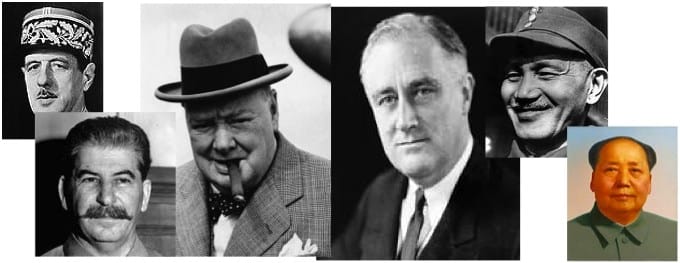
Decline of the mustache. Allied leaders early 1945. l-r: De Gaulle, Stalin, Churchill, FDR, Chiang Kai Shek, Mao Tze Tung. Only de Gaulle and Stalin have mustaches; Stalin is still an ally of Japan; Mao and Chiang at war over China. The US and UK share a special relationship.
US dollars and Russian manpower turn the tide in Europe. Hitler kills himself and is replaced by clean-shaven Keitel who sues for peace (too little, too late). Mussolini flees Italy for Switzerland, and gets help killing himself. Fascist-free Italy turns to a mustache-free leader: General Badoglio of the failed Greek invasion. Stalin takes over Poland, Romania, Czechoslovakia, Yugoslavia, Hungary, and East Germany. Churchill objects and is tossed out of office while negotiating at Yalta. He’s replaced by small mustached Clement Attlee who sees no problem with Stalin’s expansion. His is a grand (socialist) vision for England.

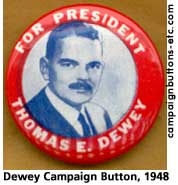
Civil-rightist NY Republican, Tom Dewey, the last mustached presidential hopeful, loses.
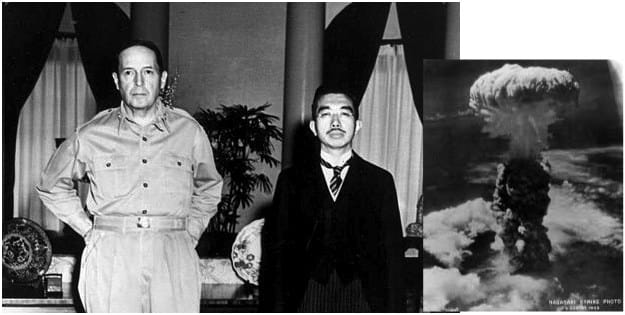
Fresh-faced, smoker, FDR dies in a liaison with a woman not his wife, and is followed by feisty, fresh-faced, non-smokier, Harry S. Truman, who continues FDR’s vision and drops two A-Bombs on Japan as twice pay-back for Pearl harbor. Stalin switches sides, sort of, for now: Japan is now his enemy, but Mao, not Chiang is a friend. Hirohito sees the new (atomic) light and the Russian army; he surrenders to the Americans. His mustache is much reduced at surrender (see below). Hirohito, still the visionary, admits he’s not a god, nor is he the gate to God (Mikado means heavenly gate; the title stops being used except for light opera). Tojo takes the blame for the war, and is executed. Mao Tze Tung conquers China after Chang Kai Shek flees to Taiwan. Stalin turns on his hairless, hapless, ex-allies. He keeps eastern Europe in contravention of the Yalta agreements, and kills a few million of his troupes: a peacetime army is dangerous. Franco keeps power in Spain.
Small-mustache Attlee builds a British A-Bomb, and takes over most of British business including The Bank of England, civil aviation, the coal mines, the steel industry, the railways, most road haulage, canals, cable and wireless, electricity and gas, and The Thomas Cooke travel agency. His grand vision provides England full employment, better work conditions, and health care, but also rationing, starvation and a lack of fuel. Attlee tries to stop Jewish migration to Israel and the formation of the state. He remains in power till 1950, becoming the last, and perhaps greatest, of several great, mustached, British prime ministers. Churchill’s shaven face returns to oversee England’s stagnation. Click for Churchill-Attlee jokes, jibes and insights.
In the US, clean-shaven Truman wins re-election against the last mustachioed presidential candidate, New York, civil-rightist, Republican, Thomas Dewey. De Gaulle is tossed out of office, but returns to build France’s A- bomb and reject NATO. De Gaulle’s little mustache is the last face hair seen on the leader of a nuclear nation.

The war ends here. Hirohito, McArthur, and Mr. A-Bomb. Hirohito now has a smaller stature and a much smaller mustache (looks like Tom Dewey, or every racist Japanese depiction). Tojo gets executed for Hirohito’s crimes. And the world moves to cautious shaven leaders and the ever-present nuclear threat.
And now the key question: why do mustaches lose favor so fast? My thought is that the Bomb is to blame. That, and the relative failures of mustached leaders in Europe. It’s a new dangerous world, with no place for men with big plans who might use the A-bomb to get-the-job-done. This is a weapon that kills more than soldiers and civilians; it could kill elites too, and no elitist wants a leader who might kill one of the elite. The A-Bomb is never again used in war, but it is always in the war room. Nuclear leaders must stay calm, and give the image of one who will use the bomb only as a last resort, to protect the home-land, or never. China, Pakistan, India, North Korea (and Israel) get “defensive” A-bombs but make no move to use them in anger. Goldwater claims he might, and is handily defeated in 1964. After WWII, all nuclear power leaders are more-or-less feminine looking, if not more feminist. Is this the future? Check out pt 1: Beards, Republicans, and Communists.
Dr. Robert E. Buxbaum, Nov. 28, 2013. I’m not sure if these post is ridiculous, or if it’s brilliant. At the least, it’s an observation of a pattern, and any observed pattern may lead to truth. I’ve written on modern architecture, art, how to climb a ladder without falling off, plus on guns, curtains, crime, healthcare, heat bills, nuclear power, and the minimum wage.
Like this:
Like Loading...