Category Archives: Literature

Disney’s Star Wars seven: muppets in space

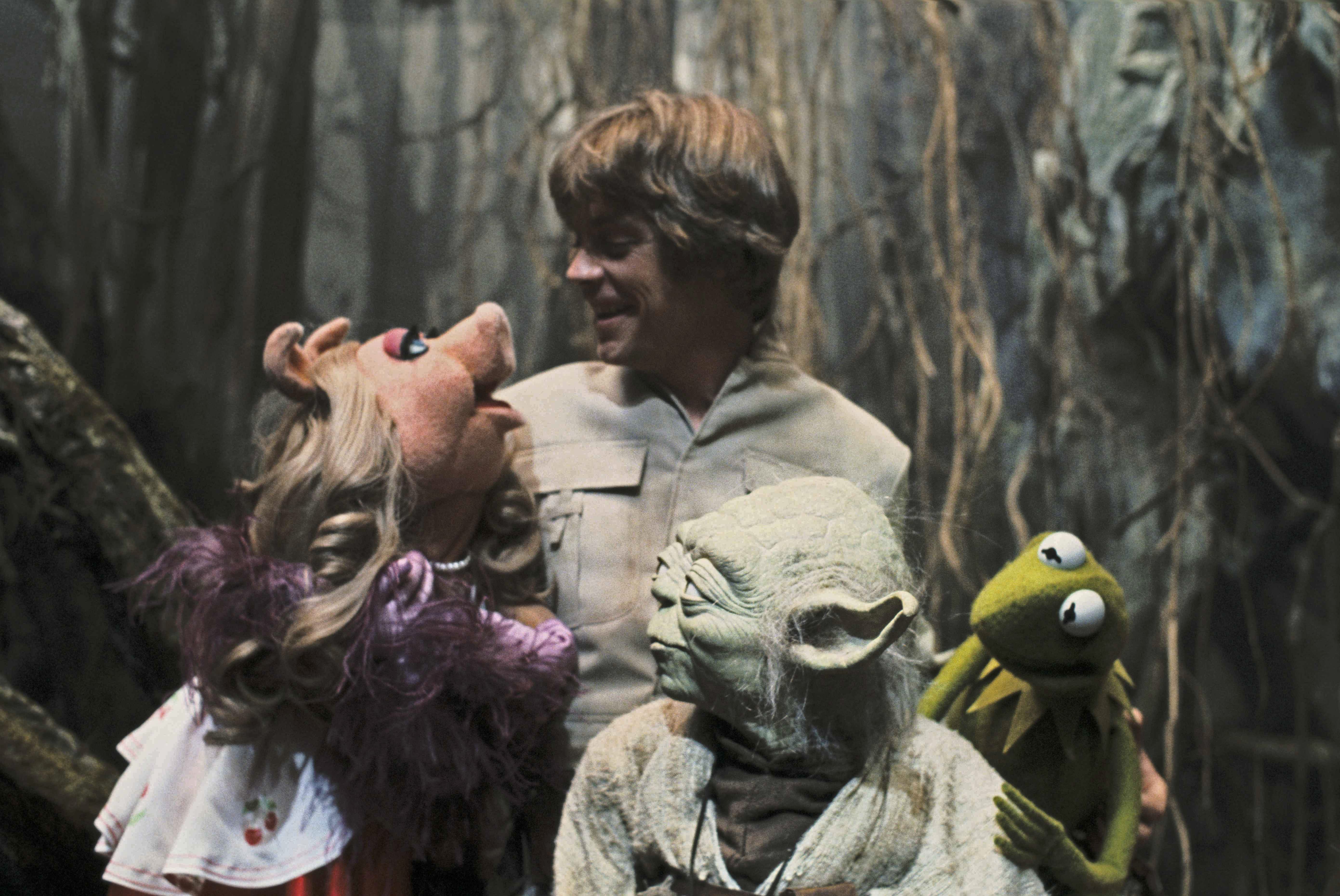
I just bought tickets for opening night of the new Star Wars movie, “The force Awakens,” now produced by Disney instead of Lucas Film. While the original films were not family unfriendly, Disney has a peculiar wholesome reputation to uphold and a peculiar taste for cross marketing. As Disney now owns the Muppets, too, and the muppets 30 years ago made some cross-promotional photos with Kermit and Piggy, I now propose the following plot to integrate the photos into the saga as it stands.

We know that the main characters from SW6 (Empire Strikes Back) are back. Harrison Ford appeared on an entertainment magazine wearing a peculiar black vest. I expect to see them on sale, as the Indiana Jones hat was on sale, and maybe still is (I nearly bought one). In a preview he’s shown handing a blaster to a young girl dressed vaguely like a Jedi. My guess is this is an orphan he’s found, and that she’s going to become a Jedi. Han’s personality never changes in the earlier movies, and neither did Leah’s, so my expectation is they’re still the same here. I see Leah leading the free rebels, making pompous comments about uncle Luke, or about the kids (I expect they have at least one child). Han remains a grumpy fly-boy, with perhaps some depreciating humor about his age. I expect Leah to plan the winning air battle, and expect Han to pick the kids up at the end of the movie, and to fly off in the old Millennium Falcon station as the credits roll. Han and Leah are not main characters; mostly there for reference and continuity.

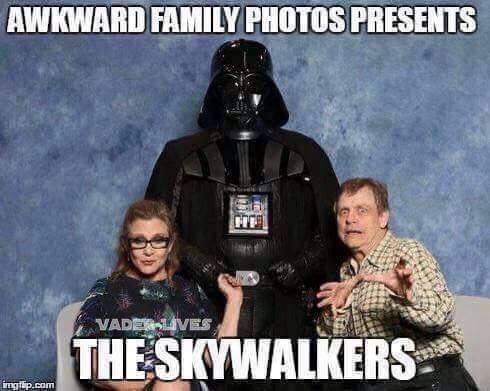
This is a meme on Facebook, don't know who did it, but clearly relevant to Star Wars 7.

I saw this on Facebook; don’t know who did it.

In the preview, the girl enters a wrecked star ship and hears a voice saying, “who are you?” The girl answers “nobody.” I’ll guess this is a new female companion, who is, like the girl a castaway. All the key people enter Star Wars as castaways of one sort or another (Han, Luke, Chewie, Obiwan, Yoda, Anakin, Qui Gon, Jar Jar Binks…) It’s a pattern found with the baby Moses, or the young Oedipus found by Polybus. Finding such castaways is rarely good luck for the finder’s clan. As the castaway is unseen, I’ll assume it’s a certain muppet, a voluptuous pig who dresses like Leah. We’ll call her Lola. My guess is that Luke will be taken by her. Is it love? Can Luke be true to her and to the force? The Ghost of Yoda will appear to claim she’s trouble, and will remind them that control of feelings is of utmost importance. (Yoda’s a creeper, as was Obi Wan: teaches emotion control and pacifism; helps Luke blow up a death star).

The previews also show a handsome black ex-storm trooper, perhaps he’ll be a love interest for the girl, and perhaps the next generation of Jedi: the force has to awaken in someone. Either way, he too is a castaway. There’s also a bad guy in black. I don’t expect another castaway, so I’ll guess this finally is the biological son of Han and Leah, and that he’s the first student of Luke.

I see a new love interest: Lola, the she pig. Can she be trusted? Can Luke keep true to her and to The Force?

I see a new love interest: Lola, the she pig. Can she be trusted? Can Luke be true to her and The Force?

The bad guy is shown at the head of an army of Imperial storm troopers. He’s been turned bad, perhaps by the skull of Vader? Luke, dressed in black, is still on the good side and will try to teach the girl and storm-trooper, dressed in white, but without much success. He’s lost his nerve. Someone is shown in black, with a cross- shaped light-saber; my guess is it’s Luke. Disney would not put a cross in the hands of a villain (just saying). The red cross shape flickers suggests anguish. My guess is there is a foreshadowing that Luke will eventually perform an act of self-sacrifice, like Christ or Obi Wan; can’t let the cat out of the bag.

Not knowing otherwise, I’ll assume that the ex-storm trooper is the McGuffin, or has it. It’s he that attracts the bad guys. He conveniently crash-lands on a desert planet where we also find Han, the mystery girl, and the mystery pig (the force is strong with him). Perhaps he’s been turned to the good side by the mystery pig. The Empire attacks and Han takes them all to the Rebel base where we meet Leah and Luke. Luke sees something in the trio and (I’ll guess) takes them to Degoba, the planet where Luke was trained. Why? Luke won’t say. I picked Degoba because that’s where the muppet shoot was. I expect one robot to go, and the other robot to stay behind with Han and Leah. Robots always accompany people in SW, like valets.

I expect Luke’s ship to be blown up on Degoba, stranding them. They get stranded in every movie, so why not. But who did it: Luke? Lola? One of the kids? Something’s not kosher about the pig. Is she a sith with a snout (say that five times fast). I imagine Luke teaching the kids some Jedi stuff, but growing frustrated. He tells them to control their feelings; that fear leads to hate, etc. His niece will say she’s already heard that from Yoda, and will add, What are you doing with the pig? Don’t you see the danger? Luke will try to explain: “You’ll understand when you’re older,” and will walk off with the pig into the woods.

Star Wars, green with envy.

You make me feel like I’m 500 again, but my place is with Kermie. It’s another awkward family reunion photo.

The kids will meet another green, wise one. A frog, named Kermit, who will train them using music and laughter. The kids will then try to explore the woods with Kermit in tow.

Meanwhile Luke, will fire up his cross-shaped light saber and raise up a hoard of dark assistants (or assassins?). Who are they? They are phantasms of Luke’s wayward student, and of other’s he’s injured. Luke will fight a phantasm and kill it; again it’s himself. The girl will show up and he’ll nearly kill her, but Lola will stop them, and tell Luke not to feel bad about the bad guy, his student.

The ghost of Yoda appears, and Lola says, “It’s about time, sonny-boy..”  Yoda will say, “Yes, mommy.” Luke says, “She’s your mother?!”. Lola will look up at Luke and say, “yes, and a very troublesome lad he’s been. “He’s told you all wrong about feelings. “Feelings are good.” The ex-storm trooper and the girl look at each other. Lola will look at Luke and say, “you make me feel like I’m 500 again, but my place is with Kermie.” Kermit  looks lovingly at Yoda.

There’s a space attack from the Empire. Rescuers appear, with Han at the lead in the falcon. The two youths turn out to be excellent flyers. Everyone flies off. Inside the ship, Lola turns to Kermis, “Feelings, Kermie, I’ve been in that prison ship for 800 years, get behind the seats, and I’ll show you feelings.”… Kermis makes a face. Han hits the hyper drive. Ship vanishes, Music swells, and the credits roll.

Buxbaum, Yes, that’s a winning combination script, written. November 23, 2015.

Comedy: what is comedy?

It’s a mistake, I think, to expect that comedy will be funny; the Devine comedy isn’t, nor are Shakespeare’s comedies. It seems, rather, that comedy is the result of mistakes, fakes, and drunks stumbling along to a (typically) unexpected outcome. That’s sometimes funny, as often not. Our expectation is that mistakes and fools will fail in whatever the try, but that’s hardly ever the outcome in literature. Or in life. As often as not, the idiot ends up as king with the intelligent man working for him. It’s as if God is a comic writer and we are his creation. Perhaps God keeps us around for our amusement value, and drops us when we get stale.

It’s not uncommon to have laughs in a comedy; a Shakespearian comedy has some, as does life. But my sense is that you find more jokes in a tragedy, e.g. Romeo and Juliet, or Julius Caesar. What makes these tragedies, as best I can tell, is the great number of honorable people behaving honorably. Unlike what Aristotle claims, tragedy doesn’t have to deal with particularly great people (Romeo and Juliet aren’t) but they must behave honorably. If Romeo were to say “Oh well, she’s dead, I’ll find another,” it would be a comedy. When the lovers choose honorable death over separation, that’s tragedy.

hell viewed as a layer cake. Here is where suicides end up.

Dante’s hell viewed as a layer cake. The “you” label is where suicides end up; it’s from an anti-suicide blog.

Fortunately for us, in real life most people behave dishonorably most of the time, and the result is usually a happy ending. In literature and plays too, dishonorable behavior usually leads to a happy ending. In literature, I think it’s important for the happy ending to come about semi-naturally with some foreshadowing. God may protect fools, but He keeps to certain patterns, and I think a good comic writer should too. In one of my favorite musicals, the Music Man, the main character, a lovable con man is selling his non-teaching of music in an Iowa town. In the end, he escapes prison because, while the kids can’t play at all, the parents think they sound great. It’s one of the great Ah hah moments, I think. Similarly at the end of Gilbert and Sullivan’s Mikado, it’s not really surprising that the king (Mikado) commutes the death sentence of his son’s friends on the thinnest of presence: he’s the king; those are his son’s friends, and one of them has married a horrible lady who’s been a thorn in the king’s side. Of course he commutes the sentence: he’s got no honor. And everyone lives happily.

Even in the Divine Comedy (Dante), the happy ending (salvation) comes about with a degree of foreshadowing. While you meet a lot of suffering fools in hell and purgatory, it’s not totally unexpected to find some fools and sinners in heaven too. Despite the statement at the entrance of hell, “give up all hope”, you expect and find there is Devine grace. It shows up in a sudden break-out from hell, where a horde of the damned are seen to fly past those in purgatory for being too pious. And you even find foolish sinning at the highest levels of heaven. The (prepared) happy ending is what makes it a good comedy, I imagine.

There is such a thing as a bad comedy, or a tragic-comedy. I suspect that “The merchant of Venice” is not a tragedy at all, but a poorly written, bad comedy. There are fools aplenty in merchant, but too many honorable folks as well. And the happy ending is too improbable: The disguised woman lawyer wins the case. The Jew loses his money and converts, everyone marries, and the missing ships reappear, as if by magic. A tragic-comedy, like Dr Horrible’s sing along blog; is something else. There are fools and mistakes, but not totally unexpected ending is unhappy. It happens in life too, but I prefer it when God writes it otherwise.

It seems to me that the battle of Bunker Hill was one of God’s comedies, or tragic-comedies depending on which side you look. Drunken Colonials build a bad fort on the wrong hill in the middle of the night. Four top British generals agree to attack the worthless fort with their best troops just to show them, and the result is the greatest British loss of life of the Revolutionary war — plus the British in charge of the worthless spit of land. It’s comic, despite the loss of life, and despite that these are not inferior people. There is a happy ending from the American perspective, but none from the British.

I can also imagine happy tragedies: tales where honorable people battle and produce a happy result. It happens rarely in life, and the only literature example I can think of is  1776 (the musical). You see the cream of the colonies, singing, dancing, and battling with each other with honorable commitment. And the result is a happy one, at least from the American perspective.

Robert E. Buxbaum, September 17-24, 2015. I borrowed some ideas here from Nietzsche: Human, All too Human, and Birth of Tragedy, and added some ideas of my own, e.g. re; God. Nietzsche is quite good on the arts, I find, but anti-good on moral issues (That’s my own, little Nietzsche joke, and my general sense). The original Nietzsche is rather hard to read, including insights like: “A joke is an epigram on the death of a feeling.”

Pelham G. Wodehouse would like to acknowledge

Here is the acknowledgement page of P. G. Wodehouse’s autobiography, “Over Seventy”, published 1957. Wouldn’t we all like to be able to write an acknowledgement like this (and have enough of an oeuvre to make it funny)?

Wouldn't we all like to write one like this.

You have to have a lot of hits — or an imaginary Frisby –to get away with an acknowledgement like this.

For those who don’t know, P.G. Wodehouse (1881-1975)  was the author of some 150 books and plays, plus a hundred or so short stories, radio-sketches and songs. He is best known as the creator of one of the great bromance relationships: carefree Bertram Wooster and his super-competent valet, Jeeves. Wodehouse collaborated on two dozen Broadway musicals including with Jerome Kern (Showboat), Cole Porter (Anything Goes), Guy Bolton, and George Gershwin, and once had 5 running simultaneously. But, to my knowledge, he has never sold an eel, jellied or otherwise.

Robert E. Buxbaum, September 1, 2015. “It was one of those cases where you approve the broad, general principle of an idea but can’t help being in a bit of a twitter at the prospect of putting it into practical effect. I explained this to Jeeves, and he said much the same thing had bothered Hamlet.”  (Jeeves in the Morning).