Category Archives: water

May 1, St. Tammany day

May 1 is St. Tammany day, a day to rejoice in the achievements of Tammany Hall, and of St Tammany, the guardian of crooked politicians everywhere. The Sons of St. Tammany started in 1773 as a charitable club of notable revolutionary-era individuals including Benjamin Franklin, John Hancock, and John Dickenson, but evolved into perhaps the most corrupt, and American, of political organizations. The picture of a US politician – the cartoon version at least — is the Tammany Democrat: a loud, drunken, womanizer, willing to do or promise whatever the people seem to want at the moment. Tammany and its bosses helped form this image. They helped new immigrants, but did so by creating needless government jobs, by filling them often with incompetent loyalists, and by overcharging on government contracts. Today, these Tammany ways rule in every major American city; the other clubs of the day are gone or influence-less.

John Hancock leads a meeting of the St. Tammany (Columbian) society. Note the "Appeal to Heaven flag and the Indian, real or imagined. Indians participated in several, early St. Tammany meetings.

John Hancock leads a meeting of the St. Tammany society. Note the “Appeal to Heaven” flag. While Indians participated in some, early meetings, the one here is, I suspect, a ghost: St. Tammany.

In revolutionary-era America, the Sons of St. Tammany was just one of many social-charitable clubs (Americans like to form clubs), in many ways it was similar to the Masons and the Cincinnati, but those clubs were international and elitist. The sons of Tammany was purely American, and anti-elitist. It was open to anyone born on this side of the Atlantic, and had Indian customs. The Cincinnati society, for comparison, started with members who were as notable (Alexander Hamilton, George Washington, Marie, Marquis de Lafayette, Henry Knox, etc.) but was originally open only to high officers of the regular army, including foreigners like Lafayette, but not ordinary soldiers, minutemen (militia), or the general public. The symbols of the Tammanies were American: the liberty-cap and the “Appeal to Heaven” flag, now a popular symbol of the Tea Party; the leader was called by an Indian name: Sachem. By contrast, the Cincinnati society symbol was the Imperial Eagle (Washington’s was gold with diamonds), and the leader was called “general”. The Tammany society began admitting immigrants in 1810 or so, while the Cincinnati society remains closed to this day, except to descendants of Revolutionary officers — an aristocratic affectation in the eyes of some.

It was Aaron Burr who first saw the opportunity to use the Tammany organization as a for-profit, political machine. In the years 1795-9, New York was suffering from yellow fever and a variety of other diseases that were taken to be caused by a lack of clean water. Burr proposed, with Tammany support, the creation of a corporation to build a new water system to bring fresh, clean water from the Bronx River to lower Manhattan via iron pipes. The Manhattan company was duly chartered, with directors who were primarily Tammany men, Republican-Democrats, and not Federalists. Federalists (Hamilton, primarily) controlled the only NY banks at the time and controlled the directorate of every chartered company in the city. The Manhattan company requested a $2,000,000 perpetual charter, twice as big as the charter of Hamilton’s Bank of New York, and a monopoly on water distribution. These were reasonable requests given the task, but unusual in the lack of Federalist or governmental oversight. But the Manhattan company was a water company, and water was needed. But Burr’s intent, all along, it seems was to build a bank, not a water company. After the charter was approved, but before signing, he amended it to allow any excess funds to be used for any legal purpose. 

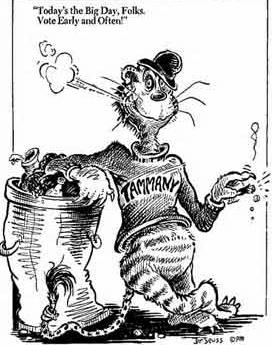
In this cartoon by Dr. Seuss, The Tammany Tiger says, "Today is the Big Day Folks. Vote Early and Often."

In this cartoon by Dr. Seuss, The Tammany Tiger says, “Today is the Big Day Folks. Vote Early and Often.”

Money was raised, but only $100,000 used for the water system. The remaining 95% of the charter funds, $1,900,000, went to found “The Bank of The Manhattan company” — later to be known as “The Chase Manhattan Bank” or “The Manhattan Bank of Cholera.” Instead of building the reservoir in upper Manhattan and filling it with clean water as originally proposed, Burr’s Tammany trustees voted to dig wells in lower Manhattan, and placed its reservoir in lower Manhattan too, near Chamber’s St,  next to a cemetery where Cholera victims were buried. New York suffered with Cholera, Typhoid, and leaky, wooden pipes until 1842 when Peter Cooper brought clean water to lower Manhattan from the Groton River via iron pipes. To this day, crooked water contracts are a staple of Tammany politics

The Bank of the Manhattan company opened at 40 Wall St on September 1, 1799, a mere four months after the water company’s incorporation. Hamilton was furious. The company continues today as The JP Morgan, Chase Manhattan Bank, one of the largest banking institutions in the world. Burr used the money and power of his company to reward supporters and to run for vice president with Thomas Jefferson’s tacit support. Except for his Tammany candidacy, John Adams would have won New York and a second term as president. Burr’s career pretty-well died after the Hamilton duel, but Tammany did well without him. By 1812, the Society built its first Tammany Hall, officially called the Wigwam, a $55,000, five-story building with a meeting hall for 2000. New York Democratic politics would center on Tammany Hall for the next century at least.

Following disappointment with John Quincy Adams, “the bitter branch of the bitter tree,” Tammy leaders went national. They recruited Andrew Jackson, a war hero and early recruit of Burr’s. They’d support Jackson if he’d hand over spoils, control of government jobs. He agreed and, as president, fired perfectly good, long-standing government employees He replaced them with Democratic loyalists. When Jackson stepped down in 1833, Tammany elected an equally corrupt New Yorker, Martin van Buren. Though there were periodic Whig and Republican reforms, Tammany learned they could wait those out. They always re-emerged like mushrooms after a rain.

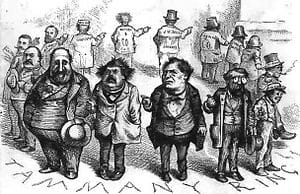
Boss Tweed and other Tammany leaders: who stole the money?

Boss Tweed and other Tammany leaders in a cartoon by Nast, Tammany Ring. “Who stole the money? He did.”  

A key vote-getter in the Tammany system is to provide Thanksgiving dinners and other charitable giveaways for the poor, as well as promises of jobs. By the late 1800s, William J. Brian added promises of soft money and wealth redistribution, cornerstones of the Democratic platform to this day. Tammany also tends to be for low tariffs as opposed to the high tariff ideas of Hamilton and many Whigs and 19th century Republicans. A case can be made for either view.

Tammany helped New York immigrants, particularly the Irish to get citizenship and avoid legal troubles in return for votes and occasional muscle. In other cities, Democratic clubs were less open to Catholics, reflecting the views of the common voter in each state. In the North they were pro-union, in the South anti, electing Klu Kluxers like George Wallace, Sam Ervin, and Robert Byrd. This lead to a famous split in the Democratic party about the 1968 convention. Famous Tammany leaders include William M. “Boss” Tweed, “Big” Tim Sullivan, and “Gentleman” Jimmy Walker. Sullivan famously authored the first anti-gun law, the Sullivan act; it was designed to protect his thugs against private citizens shooting them. It didn’t always work.

Edwin Edwards, Democratic Governor of Louisiana. 1972-1996. Who would not trust this man?

Hon. (?) Edwin Edwards, Governor of Louisiana. 1972-1996. Tammany lives

If you want to see Tammany politics in action, visit almost any large US city, or read its newspaper. In Chicago, the dead vote, and 4 of the last 6 governors have gone to jail. Mayor Daily famously told Kennedy that 90 percent of the registered voters of Cook County would vote for him. They did (sort of); because of this, JFK won Illinois and the presidency. In New York, voters discovered only in the 1960s that Tammany’s leader, Carmine DeSapio had been working for 30 years with known gangland murderer, Charles “Lucky” Luciano. In Detroit, where I live and corruption in the water department is legendary. Race-based job handouts, unemployment is high along with high minimum (living) wages. We’re now in the process of a $70,000,000 project to replace 100 feet of sewer pipe, and we’re building a $140 million, 3.3 mile trolley. Tammany loves all public works.

Then there is Louisiana, home to St Tammany parish. Louisiana Democrats like Huey Long and Edwin Edwards (shown at left) are unusual in that they’re proud to say that their corrupt methods are corrupt. Edwards has had two long runs as governor despite several convictions for doing illegal things he admits to doing. When Edwards was asked why he did favors for his friends. He responded: “Who should I do them for? My enemies?” Or, to quote one of Edwin Edwards campaign ads. Vote Edwin EdwardsPeople seem to love it, or did until the levy broke. There is a particularly American grandeur to all this. As Will Rodgers said, “America has the best politicians money can buy.” Today is the day to be proud of that uniquely American tradition. You too can grow up to buy a president.

Robert Buxbaum, April 28, 2017. I ran for water commissioner, and have written about sewage treatment, flood avoidance, and fluoride, as well as the plusses and minuses of trade unionization, and the difference between Republicans and Conservatives.

pee in the shower and other water savers

Do you want to save the planet and save money at the same time? Here are some simple tips:

The first money and planet saver, is to pee in the shower. For those who don’t have a lawn, or who don’t water, your single biggest water cost is likely the toilet. Each person in your household will use it several times per day, at roughly 1.6 gallons per flush. In Oak Park, Michigan the cost of water is 1.5¢/gallon, so each flush costs you, roughly 2.5¢. If you pee in the shower every morning, you’ll save yourself about one flush per day, or 2.5¢. Over the course of a year you’ll have used about 500 gallons less, and will have saved yourself somewhere between $5 and $10. Feel good about yourself every morning; the effort involved is truly minimal.

Related to peeing in the shower, I should mention that many toilets leak. A significant part of your water bill can often be cut by replacing the “flapper valve on the inside of your toilet tank, and/or by cleaning the needle fill valve. To see if you need this sort of help, put a few drops of food dye in the toilet when you leave in the morning. If the color is largely gone by the time you get back, the toilet is leaking the equivalent of a few volumes per day, that is at least as much water as is flushed. If the color goes faster, or you hear the tank refill when no one used it, you’re leaking more. Check the flapper and replace it if it’s worn — it’ll cost about $3 — and check the needle-fill valve. They don’t work forever. Cleanliness is near godliness.

Mulch is good, this is too much concentrated by the tree trunk. Use only 2 inches and spread it out to save water and weeding.

Mulch is good, this is too much concentrated by the tree trunk. Use only 2-3 inches and spread it out from the trunk to save water and weeding without attracting bugs.

If your valve is leaking and you decide to replace it, you may want to replace with a variable flush valve. Typically, there are two options: a big vale for big flush (1.6 gal) and a small valve for small flush (1 gal or less). These are widely used in Europe. You can make up for this cost rather quickly at 1.5¢/gallon.

The next big issue is lawn-care. If you water your lawn and flowers daily, you’ve likely noticed that you pay about $300/month for water in the summer: a lot more than in the winter, or than your lazes-faire neighbor in the summer. Every $150 of summer-excess, water bill you pay represents about 10,000 gallons applied to your lawn. That’s a cubic foot, or 1¢ to 2¢ of water applied per ft2 per month for typical watering. While many sites advise that you can save by adding a rain barrel, I disagree. Rain barrels are costly, ugly, and are a lot of work ago plumb in. And each barrel only holds 55 gallons of water, 82¢ worth when full. You do a lot better, IMHO by putting down an inch or two of mulch around your flowers and vegetables. This mulch requires no work and will keep you from needing to water these areas for the 3-4 days after every rainfall. A layer of 1″ to 2″ will help your soil hold 0.5 to 1 gallon of water per square foot. At typical prices of mulch and water, this will pay for itself in 1-2 years and will help you avoid weeding. Mulch is a far better return than the rain-barrels that are often touted, and there’s far less effort involved. Buy the mulch, not the barrel, but don’t put down too more than 2″ on flowers and vegetable. Trees can take 3 -4″; don’t use more. Avoid a mulch mountain right next to a tree, it causes the roots to grow weird, and provides a home for bugs and undesirable anaerobic molds.

A little more work than the above is to add a complete rain garden or bioswale. Build it at the bottom of any large incline on your property, where the water runs off (It’s likely a soggy swamp already). Dig the area deeper and put, at the bottom of the hole, a several-inch layer of mulch and gravel. Top it off with the soil you just removed, ideally raising the top high enough that, if the rain garden should fill, the water will run off to the street. Plant in the soil at the top long-rooted grasses, or flowers, vegetables, or water-tolerant trees. You may want to direct the water from your home’s sump pump here too (It can help to put a porous pipe at the bottom to distribute this water). If you do this right, you’ll get vegetables or trees and you won’t have to water the garden, ever. Also, you’ll add value to your property by removing the swampy eyesore. You’ll protect your home too, since a major part of home flooding comes from the water surge of sump water to the sanitary sewer.

Robert E. Buxbaum, April 14, 2017. I ran for water commissioner, Oakland County, MI, Nov. 2016. Among my other thoughts: increased retention to avoid flooding, daylighting rivers, and separating the sanitary from the storm sewers. As things stand, the best way to save money on water– get the same deal the state gave to Nestle/ Absopure: they pay only $200/year to pump 200 gal/minute. That is, they pay only 1/3000 of what you and I pay. It helps to have friends in government.

Rethinking fluoride in drinking water

Every now and again, it pays to rethink what everyone knows is so. As it happens I was asked to rethink fluoride in the drinking water. So here goes.

Fluoride is a poison, toxic for a small child in doses of 500 mg, and toxic to an adult in doses of a few thousand mg. It is a commonly used rat poison that kills by robbing the brain of its ability to absorb oxygen. In the form of hydrofluoric acid, it is responsible for the deaths of more famous chemists than any other single compound: Humphrey Davy died trying to isolate fluorine; Paul Louyet and Jerome Nickles, too. Thomas Knox nearly died, and Henri Moissan’s life was shortened. Louis-Joseph Gay Lussac, George Knox, and Louis- Jacques Thenard suffered burns and similar, George Knox was bedridden for three years. Among the symptoms of fluoride poisoning is severe joint pain and that your brain turns blue.

In low doses, though, fluoride is thought to be safe and beneficial. If true, this would be an example of hormesis. It’s found that many things that are toxic at high doses are beneficial at low. Most drugs fall into this category; chemotherapy works this way. Sunshine and radioactivity show hormesis too. Fluoride seems to be like this. In small doses, Fluoride is associated with strong teeth, and few cavities, and no obvious health risks. It is found at ppm levels many well water systems, and has shown no sign of toxicity, either for humans or animals at these ppm levels. Following guidelines set by the AMA, most US cities have been putting fluoride in drinking water since the 1960s, typically at concentrations between 0.7 and 1.2 ppm. We have seen no deaths or clear evidence of any injury from this, but there has been controversy. Much of the controversy stems from a Chinese study that links fluoride to diminished brain function, and passivity (Anti-fluoriders falsely attribute this finding to a Harvard researcher, but the Harvard study merely cites the Chinese). The American dental association strongly maintains that worries based on this study are groundless, and that the advantage in lower cavities more than off-sets any other risks. Notwithstanding, I thought I’d take another look. The typical US adult consumes 1-3 mg/day the result of drinking 1-3 liters of fluoridated water (1 ppm = 1 mg/liter). This < 1/1000 the toxic dose,

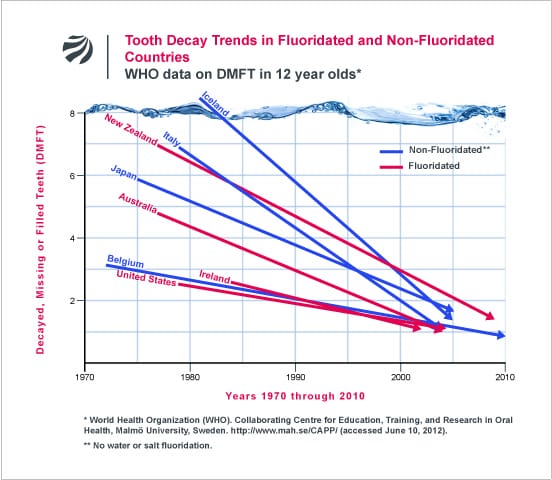
While there is no evidence that people who drink high-fluoride well water are any less-healthy than those who drink city water, or distilled / filtered water, that does not mean that our city levels are ideal. Two months ago, while running for water commissioner, I was asked about fluoride, and said I would look into it. Things have changed since the 1960s: our nutrition has changed, we have vitamin D milk, and our toothpastes now contain fluoride. My sense is we can reduce the water concentration. As shown below, many industrial countries that don’t add fluoride have similar tooth decay rates to the US.

World Health Organization data on tooth decay and fluoridation.

World Health Organization data on tooth decay and fluoridation.

This chart should not be read to suggest that fluoride doesn’t help; all the countries shown use fluoride toothpaste, and some give out fluoride pills, too. And some countries that don’t add fluoride have higher levels of cavities. Norway and Japan, for example. They don’t add fluoride and have 50% more cavities than we do. Germany doesn’t add fluoride, and has fewer cavities, but they hand out fluoride pills, To me, the chart suggests that our levels should be lower than the AMA guidance, though not zero. In 2015, the Department of Health recommend lowering the fluoride level to 0.7 ppm, the lower end of the previous range, but based on the experience of Europe, I’d pick 1/2 the original dose: 0.6 to 0.35 ppm. I’d then revisit the data in another 15 years.

Having picked my target fluoride concentration, I checked to see what the levels we use in my county, Oakland county, MI. I was happy to discover that the levels were already below the AMA guide. The water the county drinks, provided by Detroit Water and Sewage, NOCWA and SOCWA contains 0.43-0.55 ppm fluoride, in the center of in the range I would have picked. Fluoride concentrations are higher in towns that use well water, about  0.65-0.85 ppm. I do not know if this is because the well water comes from the ground with these fluoride concentrations or if the towns add more, aiming at the Department of Health target. In either case, I don’t find these levels alarming. If you live in one of these towns, or outside of Oakland county, check your fluoride levels. If they seem high, write to your water commissioner or add a filter to your tap. You can also switch from fluoride toothpaste to non-fluoride, or baking soda. In any case, remember to brush. That does make a difference, and it’s completely non-toxic.

Robert Buxbaum, January 9, 2017. Another toxic additive is chlorine. I discuss chlorine addition a bit in this essay. As a side issue, a main mechanism of sewer pipe decay is related to tooth decay. The roofs of sewer pipes grow acid-producing, cavity causing bacteria that live off of the foul sewer gas. In time these bacteria destroy concrete sewer pipes. The remedies for this erosion is to clean sewer pipes regularly, after having them checked by a professional, about once per year. As with death, one should repair cavities early. Here too, it seems high fluoride cement resists cavities better.

How do you drain a swamp, literally

The Trump campaign has been claiming it wants to “drain the swamp,” that is to dispossess Washington’s inbred army of academic consultants, lobbyists, and reporter-spin doctors, but the motto got me to think, how would you drain a swamp literally? First some technical definitions. Technically speaking, a swamp is a type of wetland distinct from a marsh in that it has no significant flow. The water just, sort-of sits there. A swamp is also unlike a fen or a bog in that swamp water contains enough oxygen to support life: frogs, mosquitos, alligators,., while a fen or bog does not. Common speech ignores these distinctions, and so will I.report__jaguars_running_back_denard_robi_0_5329357_ver1-0_640_360

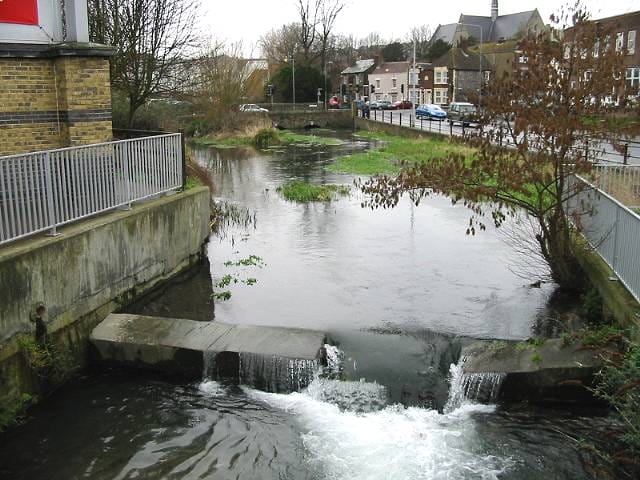
If you want to drain a large swamp, such as The Great Dismal Swamp that covered the south-east US, or the smaller, but still large, Hubbard Swamp that covered south-eastern Oakland county, MI, the classic way is to dig a system of open channel ditches that serve as artificial rivers. These ditches are called drains, and I suppose the phrase, “drain the swamp comes” from them. As late as the 1956 drain code, the width of these ditch-drains was specified in units of rods. A rod is 16.5 feet, or 1/4 of a chain, that is 1/4 the length of the 66′ surveyor’s chains used in the 1700’s to 1800’s. Go here for the why these odd engineering units exist and persist. Typically, 1/4 rod wide ditches are still used for roadside drainage, but to drain a swamp, the still-used, 1956 code calls for a minimum of a 1 rod width at the top and a minimum of 1/4 rod, 4 feet, at the bottom. The sides are to slope no more than 1:1. This geometry is needed. experience shows, to slow the flow, avoid soil erosion and help keep the sides from caving in. It is not unusual to add one or more weirs to control and slow the flow. These weirs also help you measure the flow.

The main drain for Royal Oak and Warren townships, about 50 square miles, is the Red Run drain. For its underground length, it is 66 foot wide, a full chain, and 25 feet deep (1.5 rods). When it emerges from under ground at Dequindre rd, it expands to a 2 chain wide, open ditch. The Red Run ditch has no weirs resulting in regular erosion and a regular need for dredging; I suspect the walls are too steep too. Our county needs more and more drainage as more and more housing and asphalt is put in. Asphalt reduces rain absorption and makes for flash floods following any rain of more than 1″. The red run should be improved, and more drains are needed, or Oakland county will become a flood-prone, asphalt swamp.

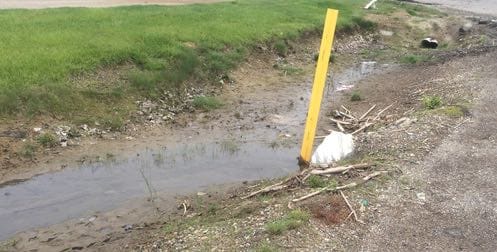
Classic ditch drain, Bloomfiled MI. Notice the culverts used to convey water from the ditch under the road.

Small ditch drain, Bloomfield, MI. The ditches connect to others and to the rivers via the culvert pipes in the left and center of the picture. A cheap solution to flooding.

Ditch drains are among the cheapest ways to drain a swamp. Standard sizes cost only about $10/lineal foot, but they are pretty ugly in my opinion, they fill up with garbage, and they tend to be unsafe. Jaguars running back Denard Robinson was lucky to have survived running into one in his car (above) earlier this year. Ditches can become mosquito breeding grounds, too and many communities have opted for a more expensive option: buried, concrete or metal culverts. These are safer for the motorist, but reduce ground absorption and flow. In many places, we’ve buried whole rivers. We’ve no obvious swamps but instead we get regular basement and road flooding, as the culverts still have combined storm and sanitary (toilet) sewage, and as more and more storm water is sent through the same old culverts.

Given my choice I would separate the sewers, add weirs to some of our ditch drains, weirs, daylight some of the hidden rivers, and put in French drains and bioswales, where appropriate. These are safer and better looking than ditches but they tend to cost about $100 per lineal foot, about 10x more than ditch drains. This is still 70x cheaper than the $7000/ft, combined sewage tunnel cisterns that our current Oakland water commissioner has been putting in. His tunnel cisterns cost about $13/gallon of water retention, and continue to cause traffic blockage.

Bald cypress swamp

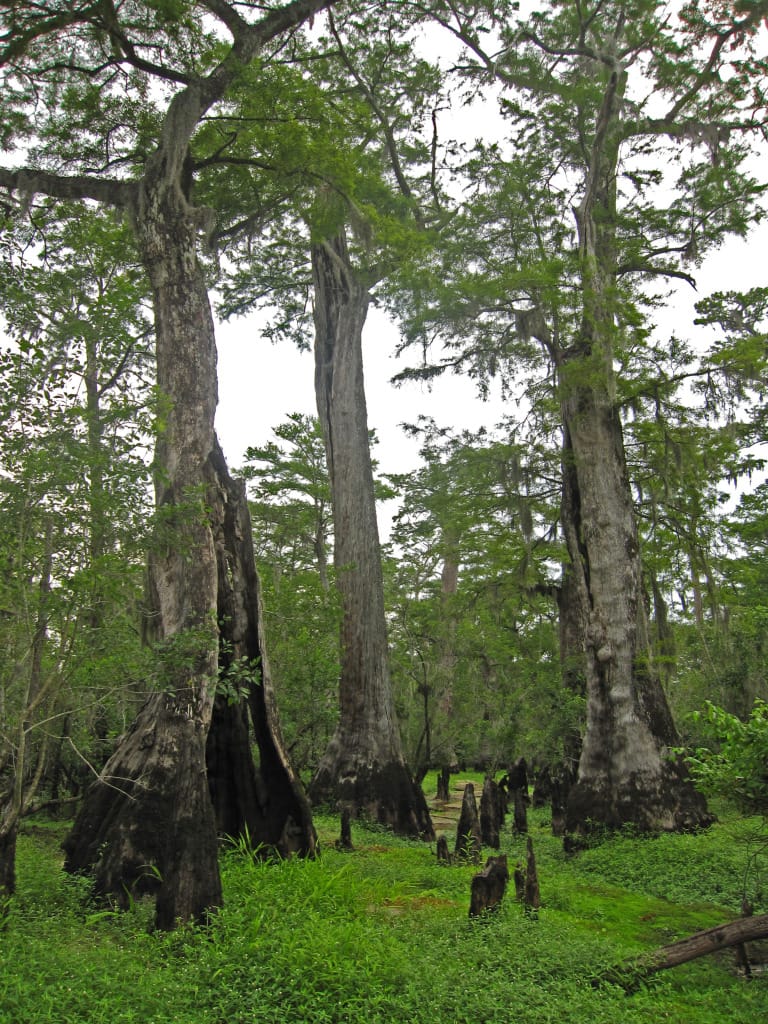
Bald cypress in a bog-swamp with tree knees in foreground.

Another solution is trees, perhaps the cheapest solution to drain a small swamp or retention pond, A full-grown tree will transpire hundreds of gallons per day into the air, and they require no conduit connecting the groundwater to a river. Trees look nice and can complement French drains and bioswales where there is drainage to river. You want a species that is water tolerant, low maintenance, and has exceptional transpiration. Options include the river birch, the red maple, and my favorite, the bald cypress (picture). Bald cypress trees can live over 1000 years and can grow over 150 feet tall — generally straight up. When grown in low-oxygen, bog water, they develop knees — bits of root-wood that extend above the water. These aid oxygen absorption and improve tree-stability. Cypress trees were used extensively to drain the swamps of Israel, and hollowed-out cypress logs were the first pipes used to carry Detroit drinking water. Some of these pipes remain; they are remarkably rot-resistant.

Robert E Buxbaum, December 2, 2016. I ran for water commissioner of Oakland county, MI 2016, and lost. I’m an engineer. While teaching at Michigan State, I got an appreciation for what you could do with trees, grasses, and drains.

The straight flush and strong shower

I’m not the wildest libertarian, but I’d like to see states rights extended to Michigan’s toilets and showers. Some twenty years ago, the federal government mandated that the maximum toilet flush volume could be only 1.6 gallons, the same as Canada. They also mandated a maximum shower-flow law, memorialized in this Seinfeld episode. Like the characters in those shows, I think this is government over-reach of states rights covered by the 10th amendment. As I understand it, the only powers of the federal government over states are in areas specifically in the constitution, in areas of civil rights (the 13th Amendment), or in areas of restraint of trade (the 14th Amendment). None of that applies here, IMHO. It seems to me that the states should be able to determine their own flush and shower volumes.

If this happen to you often, you might want to use more water for each flush, or  at least a different brand of toilet paper.

If your toilet clogs often, you might want to use more flush water, or at least a different brand of toilet paper.

There is a good reason for allowing larger flushes, too in a state with lots of water. People whose toilets have long, older pipe runs find that there is insufficient flow to carry their stuff to the city mains. Their older pipes were designed to work with 3.5 gallon flushes. When you flush with only 1.6 gallons, the waste only goes part way down and eventually you get a clog. It’s an issue known to every plumber – one that goes away with more flush volume.

Given my choice, I’d like to change the flush law through the legislature, perhaps following a test case in the Supreme court. Similar legislation is in progress with marijuana decriminalization, but perhaps it’s too much to ask folks to risk imprisonment for a better shower or flush. Unless one of my readers feels like violating the federal law to become the test case, I can suggest some things you can do immediately. When it comes to your shower, you’ll find you can modify the flow by buying a model with a flow restrictor and “ahem” accidentally losing the restrictor. When it comes to your toilet, I don’t recommend buying an older, larger tank. Those old tanks look old. A simpler method is to find a new flush cistern with a larger drain hole and flapper. The drain hole and flapper in most toilet tanks is only 2″ in diameter, but some have a full 3″ hole and valve. Bigger hole, more flush power. Perfectly legal. And then there’s the poor-man solution: keep a bucket or washing cup nearby. If the flush looks problematic, pour the extra water in to help the stuff go down. It works.

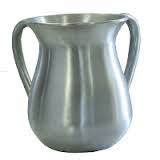
A washing cup.

A washing cup. An extra liter for those difficult flushes.

Aside from these suggestions, if you have clog trouble, you should make sure to use only toilet paper, and not facial tissues or flushable wipes. If you do use these alternatives, only use one sheet at a flush, and the rest TP, and make sure your brand of wipe is really flushable. Given my choice, I would like see folks in Michigan have freedom of the flush. Let them install a larger tank if they like: 2 gallons, or 2.5; and I’d like to see them able to use Newman’s Serbian shower heads too, if it suits them. What do you folks think?

Dr. Robert E. Buxbaum, November 3, 2016. I’m running for Oakland county MI water resources commissioner. I’m for protecting our water supply, for better sewage treatment, and small wetlands for flood control. Among my less-normative views, I’ve also suggested changing the state bird to the turkey, and ending daylight savings time.

Most flushable wipes aren’t flushable.

I’m a chemical engineer running for Oakland county water resources commissioner, and as the main job of the office is sewage, and as I’ve already written on the chemistry, I thought I might write about an aspect of the engineering. Specifically about toilet paper. Toilet paper is a remarkable product: it’s paper, compact and low in cost; strong enough to clean you, smooth on your bum, and beyond that, it will disintegrate in turbulent water so it doesn’t clog pipes. The trick to TP’s dry strength and wet-weakness, is that the paper pulp, wood cellulose, is pounded very thin, yet cast fluffy. For extra softness, the paper is typically coated with aloe or similar. Sorry to say, the same recipe does not work for wet-wipes, paper towels or kleenex (facial tissues); all of these products must have wet-strength, and this can cause problems with sewer clogs.

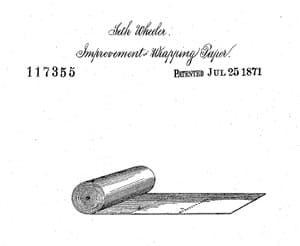
Patent 117355 for perforated toilet paper claimed it as an improved wrapping paper.

Patent 117,355 for perforated toilet paper on a roll. It’s claimed as an improved wrapping paper.

Before there was toilet paper, the world was a much sadder, and smellier place. Much of the world used sticks, stones, leaves, or corn cobs, and none of these did a particularly thorough job. Besides, none of these is particularly smooth, or particularly disposable, nor did it fall apart — not that most folks had indoor plumbing. Some rich Romans had plumbing, and these cleaned themselves with a small sponge on the end of a stick. They dipped the sponge end in water for each use. It was disgusting, but didn’t clog the pipes. I’ve seen this in use on a trip to Turkey 25 years ago — not in actual use, but the stick and sponge was there in a smelly bucket next to the hole in the ground that served as the commode.

The first reasonably modern toilet was invented in 1775 by Alexander Cummings, and by 1852 the first public flush toilets were available. The design looked pretty much like it looks today and the cost was 1¢. You got a towel and a shoe-shine too for that penny, but there was no toilet paper as such. Presumably one used a Roman sponge or some ordinary, standard paper. A popular wipe, back in the day was the Sears-Roebuck catalog. It came free to most homes and included a convenient hole in the corner allowing one to hang it in and outhouse or near the commode. It was rough on the bum, and didn’t fall apart. My guess is that it clogged the pipes too, for those who used it with flush toilets. The first toilet-specific paper wasn’t invented till 1859. Joseph Gayetty, an American, patented a product from pulverized hemp, a relatively soft fiber, softened further with aloe. This paper was softer than standard, and had less tendency to clog pipes.

Toilet paper has to be soft

Toilet paper is either touted to be soft or strong; Modern Charmin touts wet strength, while Cottonelle touts completeness of wipe: ‘go commando.”

The next great innovation was to make toilet paper as a perforated product on a roll. These novelties appear as US Patent #117,355 awarded to Seth Wheeler of Albany, NY 25 July 1871 (Wheeler also invented the classic roll toilet paper dispenser). Much of the sales pitch was that a cleaner bum would prevent the spread of cholera, typhoid, and other plagues and that is a legitimate claim. As the  market expanded, advertising followed. Some early brands touted their softness, others their strength. Facial tissues, e.g. Kleenex, were sold specifically as a soft TP-like product that does not fall apart when wet. Sorry to say, this tends to go along with clogged toilets; do not flush more than one kleenex down at a flush. Kleenex is made with the same short fibers and aloe as toilet paper, but it contains binders (glue) to give it wet-strength. My guess is that Charmin is made the same way and that it isn’t great on your plumbing.

Paper towels and most baby wipes are worse to flush than Kleenex. They are made with lots of binder and they really don’t fall apart in water. Paper towels should never be flushed, and neither should most baby wipes, even brands that claim to be ‘flushable.” When flushed, these items tend to soak up fat and become fat bergs – the bane of sewer workers everywhere. There is a class action law suit against flushable wipe companies, and New York City is pursuing legislation to prevent them from claiming to be flushable. Still, as with everything, there are better and worse moist-wipe options. “Cottonelle” brand by Kleenex, and Scott flushable wipes are the best currently. In a day or less they will dissolve in water. These products are made with binders like kleenex, but the binder glue is a type that dissolves in any significant amount of water. As a result, these brands fall apart eventually. For now, these are the only flushable brands I’d recommend flushing, and even then I suggest you only flush one at a time. In tests by Consumer Reports, other brands, e.g. Charmin and Equate flushable wipes do not dissolve. These manufacturers either have not quite figured out how to make dissolvable binders, or they can’t get around Kleenex’s patents.

Robert Buxbaum. October 10, 2016. If you live in Oakland County, MI, vote for me for water commissioner. Here’s my web-site with other useful essays. I should mention Thomas Crapper, too. He invented the push-button flush and made some innovations in the water cistern, and he manufactured high-end commodes for Parliament and the royal family, but he’s irrelevant to the story here.

just water over the dam

Some months ago, I posted an engineering challenge: figure out the water rate over an non-standard V-weir dam during a high flow period (a storm) based on measurements made on the weir during a low flow period. My solution follows. Weir dams of this sort are erected mostly to prevent flooding. They provide secondary benefits, though by improving the water and providing a way to measure the flow.

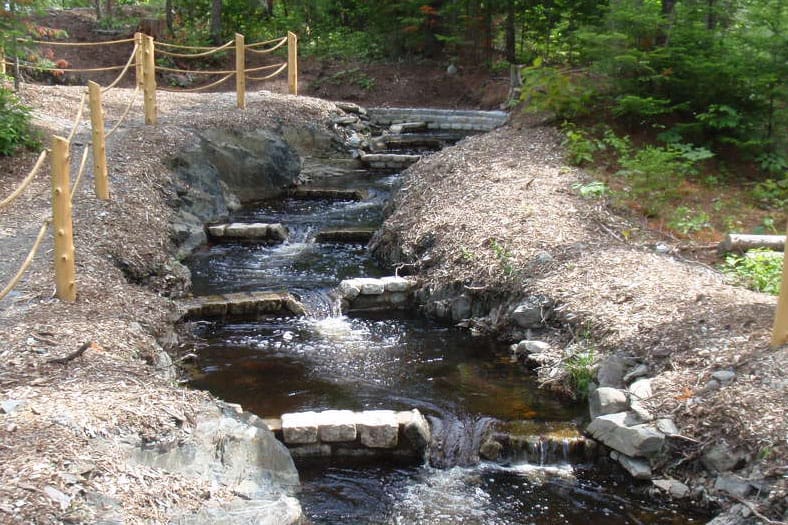
A series of weir dams on Blackman Stream, Maine. These are thick, rectangular weirs.

A series of compound, rectangular weir dams in Maine.

The problem was stated as follows: You’ve got a classic V weir on a dam, but it is not a knife-edge weir, nor is it rectangular or compound as in the picture at right. Instead it is nearly 90°, not very tall, and both the dam and weir have rounded leads. Because the weir is of non-standard shape, thick and rounded, you can not use the flow equation found in standard tables or on the internet. Instead, you decide to use a bucket and stopwatch to determine the flow during a relatively dry period. You measure 0.8 gal/sec when the water height is 3″ in the weir. During the rain-storm some days later, you measure that there are 12″ of water in the weir. Give a good estimate of the storm-flow based on the information you have.

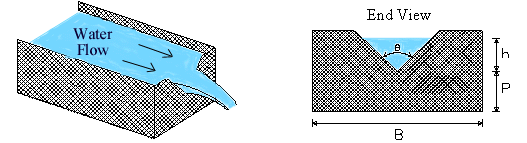
A V-notch weir, side view and end-on.

A V-notch weir, side view and end-on.

I also gave a hint, that the flow in a V weir is self-similar. That is, though you may not know what the pattern will be, you can expect it will be stretched the same for all heights.

The upshot of this hint is that, there is one, fairly constant flow coefficient, you just have to find it and the power dependence. First, notice that area of flow will increase with height squared. Now notice that the velocity will increase with the square root of hight, H because of an energy balance. Potential energy per unit volume is mgH, and kinetic energy per unit volume is 1/2 mv2 where m is the mass per unit volume and g is the gravitational constant. Flow in the weir is achieved by converting potential height energy into kinetic, velocity energy. From the power dependence, you can expect that the average v will be proportional to √H at all values of H.

Combining the two effects together, you can expect a power dependence of 2.5 (square root is a power of 0.5). Putting this another way, the storm height in the weir is four times the dry height, so the area of flow is 16 times what it was when you measured with the bucket. Also, since the average height is four times greater than before, you can expect that the average velocity will be twice what it was. Thus, we estimate that there was 32 times the flow during the storm than there was during the dry period; 32 x 0.8 = 25.6 gallons/sec., or 92,000 gal/hr, or 3.28 cfs.

The general equation I derive for flow over this, V-shaped weir is

Flow (gallons/sec) = Cv gal/hr x(feet)5/2.

where Cv = 3.28 cfs. This result is not much different to a standard one  in the tables — that for knife-edge, 90° weirs with large shoulders on either side and at least twice the weir height below the weir (P, in the diagram above). For this knife-edge weir, the Bureau of Reclamation Manual suggests Cv = 2.49 and a power value of 2.48. It is unlikely that you ever get this sort of knife-edge weir in a practical application. Be sure to measure Cv at low flow for any weir you build or find.

Robert Buxbaum, vote for me for water commissioner. Here are some thoughts on other problems with our drains.

The chemistry of sewage treatment

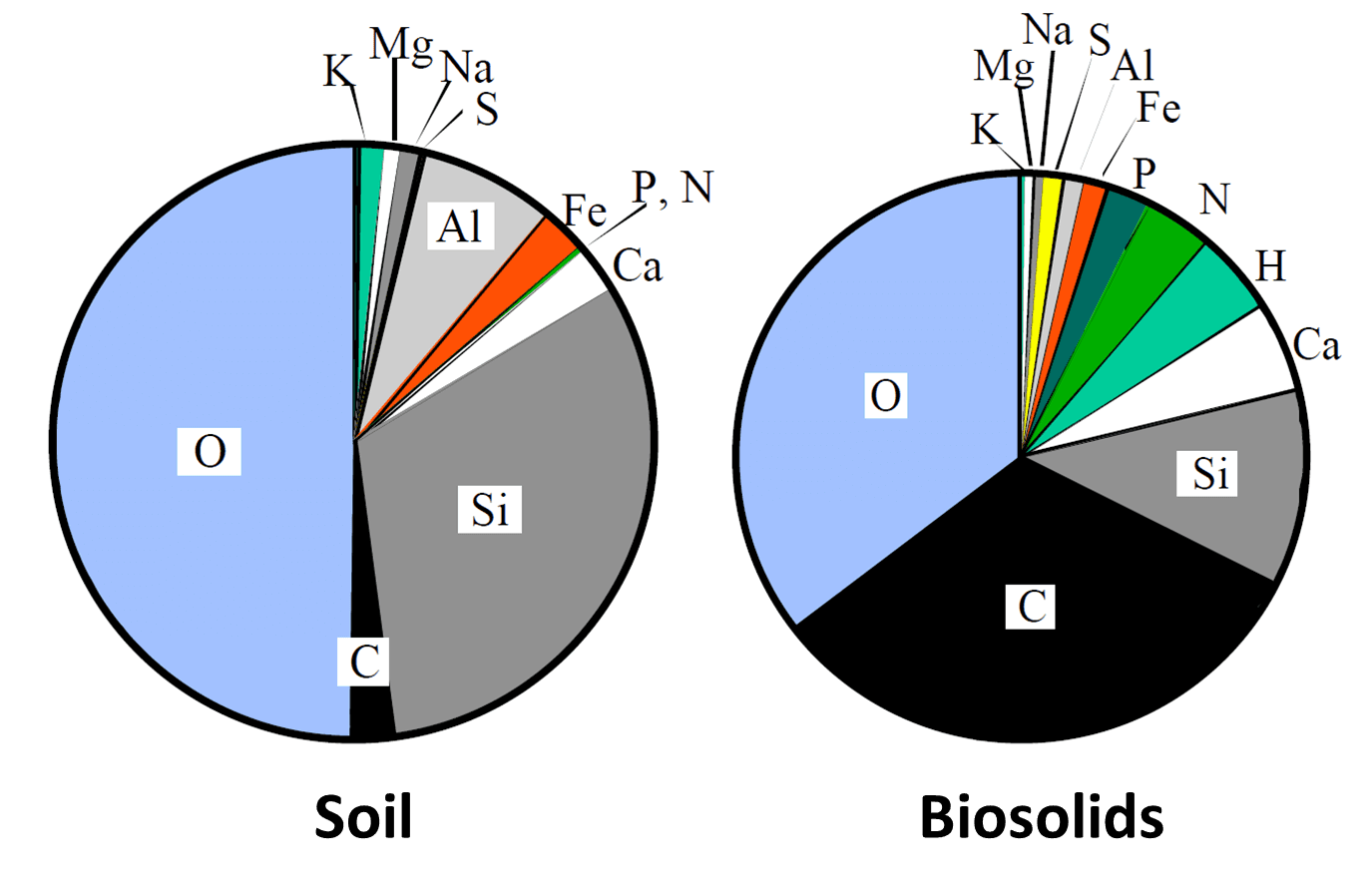
The first thing to know about sewage is that it’s mostly water and only about 250 ppm solids. That is, if you boiled down a pot of sewage, only about 1/40 of 1% of it would remain as solids at the bottom of the pot. There would be some dried poop, some bits of lint and soap, the remains of potato peelings… Mostly, the sewage is water, and mostly it would have boiled away. The second thing to know, is that the solids, the bio-solids, are a lot like soil but better: more valuable, brown gold if used right. While our county mostly burns and landfills the solids remnant of our treated sewage, the wiser choice would be to convert it to fertilizer. Here is a comparison between the composition of soil and bio-solids.

The composition of soil and the composition of bio-solid waste. biosolids are like soil, just better.

The composition of soil and the composition of bio-solid waste. biosolids are like soil, just better.

Most of Oakland’s sewage goes to Detroit where they mostly dry and burn it, and land fill the rest. These processes are expensive and engineering- problematic. It takes a lot of energy to dry these solids to the point where they burn (they’re like really wet wood), and even then they don’t burn nicely. As shown above, the biosolids contain lots of sulfur and that makes combustion smelly. They also contain nitrate, and that makes combustion dangerous. It’s sort of like burning natural gun powder.

The preferred solution is partial combustion (oxidation) at room temperature by bacteria followed by conversion to fertilizer. In Detroit we do this first stage of treatment, the slow partial combustion by bacteria. Consider glucose, a typical carbohydrate,

-HCOH- + O–> CO+ H2O.    ∆G°= -114.6 kcal/mol.

The value of ∆G°, is relevant as a determinate of whether the reaction will proceed. A negative value of ∆G°, as above, indicates that the reaction can progress substantially to completion at standard conditions of 25°C and 1 atm pressure. In a sewage plant, many different carbohydrates are treated by many different bacteria (amoebae, paramnesia, and lactobacilli), and the temperature is slightly cooler than room, about 10-15°C, but this value of ∆G° suggests that near total biological oxidation is possible.

The Detroit plant, like most others, do this biological oxidation treatment using either large stirred tanks, of million gallon volume or so, or in flow reactors with a large fraction of cellular-material returning as recycle. Recycle is needed also in the stirred tank process because of the low solid content. The reaction is approximately first order in oxygen, carbohydrate, and bacteria. Thus a 50% cell recycle more or less doubles the speed of the reaction. Air is typically bubbled through the reactor to provide the oxygen, but in Detroit, pure oxygen is used. About half the organic carbon is oxidized and the remainder is sent to a settling pond. The decant (top) water is sent for “polishing” and dumped in the river, while the goop (the bottom) is currently dried for burning or carted off for landfill. The Holly, MI sewage plant uses a heterogeneous reactors for the oxidation: a trickle bed followed by a rotating disk contractor. These have higher bio-content and thus lower area demands and separation costs, but there is a somewhat higher capital cost.

A major component of bio-solids is nitrogen. Much of this in enters the form of urea, NH2-CO-NH2. In an oxidizing environment, bacteria turns the urea and other nitrogen compounds into nitrate. Consider the reaction the presence of washing soda, Na2CO3. The urea is turned into nitrate, a product suitable for gun powder manufacture. The value of ∆G° is negative, and the reaction is highly favorable.

NH2-CO-NH2 + Na2CO3 + 4 O2 –> 2 Na(NO3) + 2 CO2 + 2 H2O.     ∆G° = -177.5 kcal/mol

The mixture of nitrates and dry bio-solids is highly flammable, and there was recently a fire in the Detroit biosolids dryer. If we wished to make fertilizer, we’d probably want to replace the drier with a further stage of bio-treatment. In Wisconsin, and on a smaller scale in Oakland MI, biosolids are treated by higher temperature (thermophilic) bacteria in the absence of air, that is anaerobically. Anaerobic digestion produces hydrogen and methane, and produces highly useful forms of organic carbon.

2 (-HCOH-) –> COCH4        ∆G° = -33.7 Kcal/mol

3 (-HCOH-) + H2O –> -CH2COOH + CO2 +  2 1/2 H2        ∆G° = -21.9 kcal/mol

In a well-designed plant, the methane is recovered to provide heat to the plant, and sometimes to generate power. In Wisconsin, enough methane is produced to cook the fertilizer to sterilization. The product is called “Milorganite” as much of it comes from Milwaukee and much of the nitrate is bound to organics.

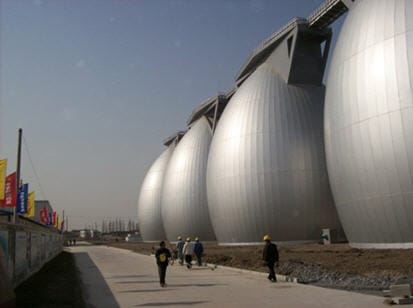
Egg-shaped, anaerobic biosolid digestors.

Egg-shaped, anaerobic biosolid digestors, Singapore.

The hydrogen could be recovered too, but typically reacts further within the anaerobic digester. Typically it will reduce the iron oxide in the biosolids from the brown, ferric form, Fe2O3, to black FeO.  In a reducing atmosphere,

Fe2O3 + H2 –> 2 FeO + H2O.

Fe2O3 is the reason leaves turn brown in the fall and is the reason that most poop is brown. FeO is the reason that composted soil is typically black. You’ll notice that swamps are filled with black goo, that’s because of a lack of oxygen at the bottom. Sulphate and phosphorous can be bound to ferrous iron and this is good for fertilizer. Generally you want the reduction reactions to go no further.

Weir dam on the river dour. Used to manage floods, increase residence time, and oxygenate the flow.

Weir dam on the river Dour in Scotland. Dams of this type increase residence time, and oxygenate the flow. They’re good for fish, pollution, and flooding.

When allowed to continue, the hydrogen produced by anaerobic digestion begins to reduce sulfate to H2S.

NaSO4 + 4.5 H2 –>  NaOH + 3H2O + H2S.

I’m running for Oakland county, MI water commissioner, and one of my aims is to stop wasting our biosolids. Oakland produces nearly 1000,000 pounds of dry biosolids per day. This is either a blessing or a curse depending on how we use it.

Another issue, Oakland county dumps unpasteurized, smelly black goo into Lake St. Clair every other week, whenever it rains more than one inch. I’d like to stop this by separating the storm and “sanitary” sewage. There is a capital cost, but it can save money because we’d no longer have to pay to treat our rainwater at the Detroit sewage plant. To clean the storm runoff, I’d use mini wetlands and weir dams to increase residence time and provide oxygen. Done right, it would look beautiful and would avoid the flash floods. It should also bring natural fish back to the Clinton River.

Robert Buxbaum, May 24 – Sept. 15, 2016 Thermodynamics plays a big role in my posts. You can show that, when the global ∆G is negative, there is an increase in the entropy of the universe.

Weir dams to slow the flow and save our lakes

As part of explaining why I want to add weir dams to the Red Run drain, and some other of our Oakland county drains, I posed the following math/ engineering problem: if a weir dam is used to double the depth of water in a drain, show that this increases the residence time by a factor of 2.8 and reduces the flow speed by 1/2.8. Here is my solution.

A series of weir dams on Blackman Stream, Maine. Mine would be about as tall, but somewhat further apart.

A series of weir dams on Blackman Stream, Maine. Mine would be about as tall, but wider and further apart. The dams provide oxygenation and hold back sludge.

Let’s assume the shape of the bottom of the drain is a parabola, e.g. y = x, and that the dams are spaced far enough apart that their volume is small compared to the volume of water. We now use integral calculus to calculate how the volume of water per mile, V is affected by water height:  V =2XY- ∫ y dx = 2XY- 2/3 X3 =  4/3 Y√Y. Here, capital Y is the height of water in the drain, and capital X is the horizontal distance of the water edge from the drain centerline. For a parabolic-bottomed drain, if you double the height Y, you increase the volume of water per mile by 2√2. That’s 2.83, or about 2.8 once you assume some volume to the dams.

To find how this affects residence time and velocity, note that the dam does not affect the volumetric flow rate, Q (gallons per hour). If we measure V in gallons per mile of drain, we find that the residence time per mile of drain (hours) is V/Q and that the speed (miles per hour) is Q/V. Increasing V by 2.8 increases the residence time by 2.8 and decreases the speed to 1/2.8 of its former value.

Why is this important? Decreasing the flow speed by even a little decreases the soil erosion by a lot. The hydrodynamic lift pressure on rocks or soil is proportional to flow speed-squared. Also, the more residence time and the more oxygen in the water, the more bio-remediation takes place in the drain. The dams slow the flow and promote oxygenation by the splashing over the weirs. Cells, bugs and fish do the rest; e.g. -HCOH- + O2 –> CO2 + H2O. Without oxygen, the fish die of suffocation, and this is a problem we’re already seeing in Lake St. Clair. Adding a dam saves the fish and turns the run into a living waterway instead of a smelly sewer. Of course, more is needed to take care of really major flood-rains. If all we provide is a weir, the water will rise far over the top, and the run will erode no better (or worse) than it did before. To reduce the speed during those major flood events, I would like to add a low bicycle path and some flood-zone picnic areas: just what you’d see on Michigan State’s campus, by the river.

Dr. Robert E. Buxbaum, May 12, 2016. I’d also like to daylight some rivers, and separate our storm and toilet sewage, but those are longer-term projects. Elect me water commissioner.

A run runs through it

The word ‘run’ appears to be a Michigan dialect for small river. Perhaps Michigan’s most famous run is the Willow run, where the airport is. Currently, almost all of our runs are unrecognizable, they are either trapped in pipes underground, or so dredged out and poisoned that they are more properly called sewers. If I’m elected Oakland county water resources commissioner (drain commissioner) I’d like to free some of these runs, and detoxify them.

These branches of the red run flow beneath the surface of Royal Oak with the main section beneath Vinsetta Blvd.

These branches of the red run flow beneath the surface of Royal Oak with the main section beneath Vinsetta Blvd.

Consider this historical map of Royal Oak. It shows two  river branches, currently under ground. Back in the day, these were known as the north and south branch of the Red run. The south branch is fed by the Washington creek and the small run, now under ground, with the main branch of the run crossing Woodward ave at Catalpa st. These runs only appear above ground in Warren, MI, miles away, as a polluted sewer. But in Royal Oak they should still be clean. If they were partially freed. That is if the channel were exposed to air again to provide small wetlands along the original path — along Vinsetta Blvd, for example. Vinsetta Blvd. already has concrete bridges to show where the run originally ran. The small wetlands would provide habitat for birds and butterflies, and would provide storm relief and some bioremediation as well. After a heavy rain, most of the water would be absorbed into the ground, while the existing pipes carry away the rest.

Robert E. Buxbaum, March 21, 2016