Category Archives: water

Follow the feces; how to stop the poisoning

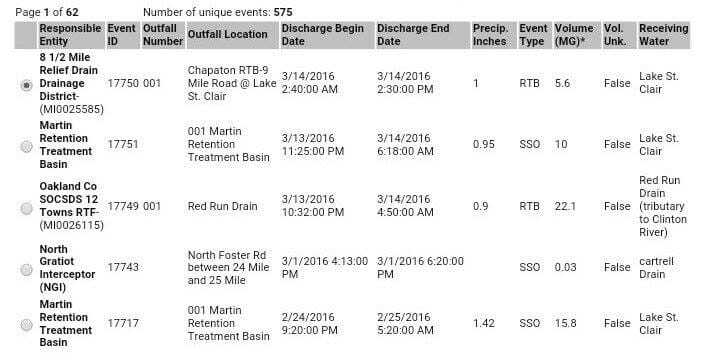
In Oakland county, we regularly poison our basements and our lake St Clair beaches with feces — and potentially our water supply too. We have a combined storm and sanitary sewer system that mixes feces-laden sanitary sewage with rainwater, and our pipes are too old and small to handle the amount of storm water from our larger rains. A group called “Save Lake St. Clair” is up in arms but the current commissioner claims the fault is not his. It’s global warming, he says, and the rains are bigger now. Maybe, or maybe the fault is wealth: more and more of the county is covered by asphalt, so less rain water can soak in the ground. Whatever the cause, the Commissioner should deal with it (I’m running for water commissioner, BTW). As the chart of toxic outfalls shows, we’ve had regular toxic sewage discharges into the Red Run basically every other week, with no exceptional rainfalls: only 0.9″ to 1.42″.

Toxic outfalls into lake St Clair, Feb 20 to Mar 20, 2016. There were also two outfalls into the Rouge in this period. These are too many to claim they are once in hundred-year events.

Toxic outfalls into lake St Clair, Feb 20 to Mar 20, 2016. There were also two outfalls into the Rouge in this period. These are too many to claim they are once in hundred-year events.

Because we have a combined system, the liquid level rises in our sewers whenever it rains. When the level is above the level of a basement floor drain, mixed sewage comes up into the basement. A mix of storm water comes up mixed with poop and anything else you and your neighbors flush down. Mixed sewage can come up even if the sewers were separate, but far less often. Currently most of the dry outfall from our old, combined sewers is sent to Detroit’s Waste Water Treatment plant near Zug Island. When there is a heavy rain, the pipe to Zug is overwhelmed. We avoid flooding your basement every other week by diverting as much as we can of the mixed storm water and septic sewage to lake St. Clair. This is poop, barely treated, and the fishermen and environmentalists hate it.

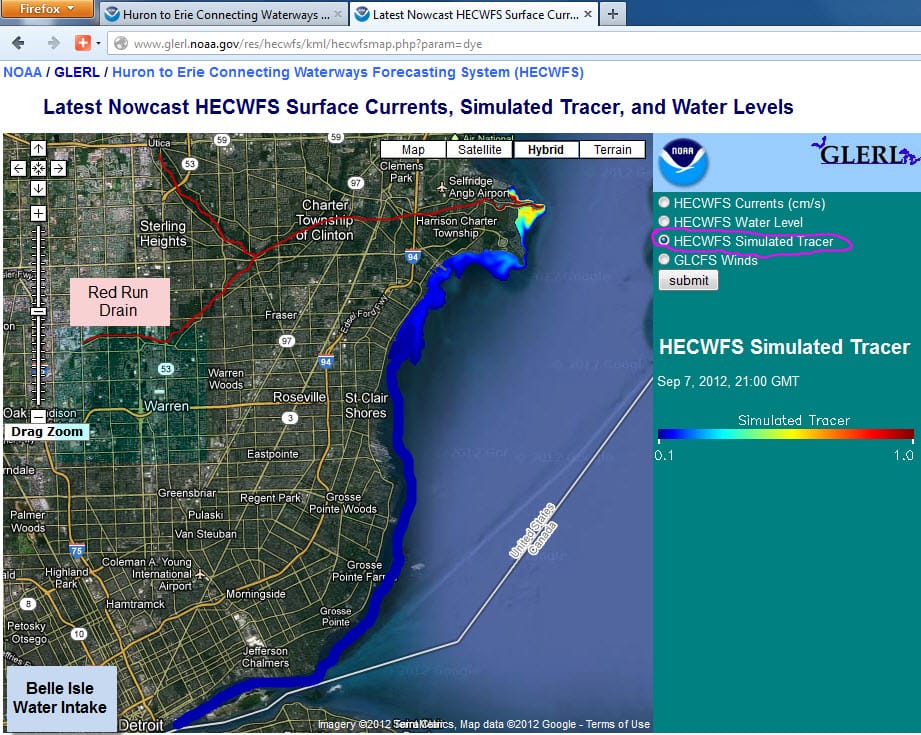
The beaches along Lake St Clair are closed every other week: whenever the pipes to Detroit start getting overwhelmed, whenever there is about 1″ or rain. Worse yet, the sewage is enters the lake just upstream of the water intake on Belle Isle, see map below. Overflow sewage follows the red lines entering the Clinton River through the GW Kuhn — Red Run Drain or through the North Branch off the River. From there it flows out into Lake St. Clair near Selfridge ANG, generally hugging the Michigan shore of the lake, following the light blue line to poison the metro beaches. it enters the water intake for the majority of Oakland County at the Belle Island water intakes, lower left.

Follow the feces to see why our beeches are polluted. It's just plain incompetence.

The storm water plus septic sewage mix is not dumped raw into lake St. Clair, but it’s nearly raw. The only treatment is to be spritzed with bleach in the Red Run Drain. The result is mats of black gunk with floating turds, toilet paper and tampons. This water is filtered before we drink it, and it’s sprayed with more chlorine, but that’s not OK. We can do much better than this. We don’t have to regularly dump poop into the river just upstream of our water intake. I favor a two-prong solution.

The first, quick solution is to have better pumps to send the sewage to Detroit. This is surprisingly expensive since we still have to treat the rain water. Also it doesn’t take care of the biggest rains; there is a limit to what our pipes will handle, but it stops some basement flooding, and it avoids some poisoning of our beaches and drinking water.

This is our combined sewer system showing a tunnel cistern (yuk) and the outflow into the Red Run. We can do better

A combined sewer system showing a tunnel cistern. Outflow goes into the Red Run. We can do better.

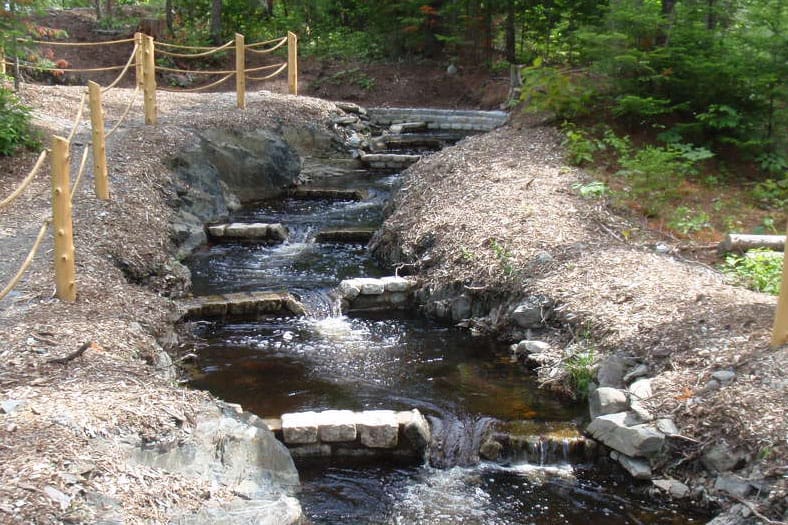
A second, longer term solution is to disentangle the septic from the storm sewers. My approach would be to do this in small steps, beginning by diverting some storm runoff into small wetlands or French drain retention. Separating the sewers this way is cheaper and more environmentally sound than trying to treat the mixed flow in Detroit, and the wetlands and drains would provide pleasant park spaces, but the project will take decades to complete. If done right, this would save quite a lot over sending so much liquid to Detroit, and it’s the real solution to worries about your floor drains back-flowing toxic sludge into your basement.

The incumbent, I fear, has little clue about drainage or bio-treatment. His solution is to build a $40MM tunnel cistern along Middlebelt road. This cistern only holds 3 MM gallons, less than 1/100 of the volume needed for even a moderate rain. Besides, at $13/gallon of storage, it is very costly solution compared to my preference — a French drain (costs about 25¢/gallon of storage). The incumbents cistern has closed off traffic for months between 12 and 13 mile, and is expected to continue for a year, until January, 2017. It doesn’t provide any bio-cleaning, unlike a French drain, and the cistern leaks. Currently groundwater is leaking in. This has caused the lowering of the water table and the closure of private wells. If the leak isn’t fixed , the cistern will leak septic sewage into the groundwater, potentially infecting people for miles around with typhus, cholera, and all sorts of 3rd world plagues.

There is also an explosion hazard to the incumbent’s approach. A tunnel cistern like this blew up near my undergraduate college sending manhole covers flying. This version has much bigger manhole covers: 15′ cement, not 2′ steel. If someone pours gasoline down the drain during a rainstorm and if a match went in later, the result could be deadly. The people building these projects are the same ones who fund the incumbent’s campaign, and I suspect they influenced him for this mis-chosen approach. They are the folks I fear he goes to for engineering advice. If you’d like to see a change for the better. Elect me, Elect an engineer.

Dr. Robert E. Buxbaum, March 26, 2016. Go here to volunteer or contribute.

How to help Flint and avoid lead here.

As most folks know, Flint has a lead-poisoning problem that seems to have begun in April, 2014 when the city switched its water supply from Detroit-supplied, Lake Huron water to their own source, water from the Flint River. Here are some thoughts on how to help the affected population, and how to avoid a repeat in Oakland county, where I’m running for water commissioner. First observation, it is not enough to make sure that the source water does not contain lead. The people who decided on the switch had found that the Flint river water had no significant content of lead or other obvious toxins. A key problem, it seems: the river water did not contain anticorrosion phosphates, and none, it seems, were added by the Flint water folks. It also seems that insufficient levels of chlorine (hypochlorite) were added. After the switch, citizens started seeing disgusting, brown water come from their taps, and citizens with lead pipes or solder were poisoned with ppb-levels of lead. There was also an outbreak of legionaries disease that killed 12 people. It was the legionaries that alerted the CDC to the possibility of lead, since it seems the water folks were fudging the numbers there, and hiding that part of the problem.

Flint water, Sept 2015, before switching back to Lake Huron.

Flint water after 5 hours of flushing, Sept 2015, before switching back to Lake Huron.

The city began solving its problem by switching back to Detroit-supplied, Lake Huron water in October, 2015. Beginning in December, 2015, they started adding triple doses of phosphate to the wate. As a result, Flint tap-water is now back within EPA standards, but it’s still fairly unsafe, see here for more details.

There has been a fair amount of finger-pointing. At Detroit for raising the price of water so Flint had to switch, at water officials ignoring the early signs of lead and fudging their reports, at other employees for not adding phosphate or enough chlorine, and at “the system” for not providing Flint’s government with better oversight. My take is that a lot of the problem came from the ignorance of the water commission, and it’s commissioner. We elect our water commissioners to be competent overseers of complex infrastructure, but in may counties folks seem to pick them the same way they pick aldermen: for a nice smile, a great handshake, and an ability to remember names. That, anyway, seems to be the way that Oakland got its current water commissioner. When you pick your commissioner that way, it’s no surprise that he (or she) isn’t particularly up on corrosion chemistry, something that few people understand, and fewer care about until it bites them.

Flint river water contains corrosive chloride that probably helped dissolve the lead from pipes and solder. Contributing to the corrosion problem, I’m going to guess that Flint River water also contains, relatively little carbonate, but significant amounts of chelating chemicals, like EDTA, in 10s of ppb concentration. EDTA isn’t poisonous at these concentrations, but it’s common in industry and is the most commonly used antidote for lead poisoning. EDTA extracts lead and other metals from people and would tend to contribute to the process of extracting lead and iron oxide from the pipes surface into the drinking water. With EDTA in the water, a lot of phosphate or hypochlorite would be needed to avoid the lead poisoning problem and the deadly multiplication of disease.

Detroit ex-mayor Kwame Kilpatrick has claimed that both Flint water and Detroit water were known to be poisoned even a decade before the switch. I find these claims believable given the high levels of lead in kids blood even before the switch. Also, I note that there are areas of Detroit where the blood-lead levels are higher than Flint. Flint tested at the taps in a way that fudged the data during the first days of the poisoning, and I suspect many of our MI cities do this today — just to make the numbers look better. My first suggestion therefore is to test correctly, both at the pipes and at the taps; lead pipes are most-often found in the last few feet before the tap. In particular, we should test at all schools and other places where the state has direct authorization to fix the problem. A MI senate bill has been proposed to this effect, but I’m not sure where it stands in the MI house. It seems there are movements to add lots of ‘riders’ and that’s usually a bad sign.

Another thought is that citizens should be encouraged to test their private taps and helped to fix them. The state can’t come in and test or rip out your private pipes, even if they suspect lead, but the private owner has that authorization. The state could condemn a private property where they believe the water is bad, but I doubt they could evict the residents. It’s a democratic republic, as I understand; you have the right to be deadly stupid. But I’ll take my own suggestion to encourage you: If you think your water has lead, take a sample and call (517) 335-8184. Do it.

Another suggestion, perhaps the easiest and most important, is drink bottled water for now, and if you feel you’ve been poisoned, take an antidote.  As I understand things, the state is already providing bottles of imported water. The most common antidote is, as I’d mentioned, EDTA. Assuming that Flint River water had enough EDTA to significantly worsen the problem, the cheapest antidote might be Flint River water, assuming you drew it in lead-free pipes and chlorinated sufficiently to rid it of bugs. If there is EDTA it will help the poisoned. Another antidote is Succinic acid, something sold by REB Research, my company. As with EDTA it is non-toxic, even in fairly large doses, but its use would have to be doctor- approved.

Robert E. Buxbaum, January 19-31, 2016. I hope this helps. We’d have to check Flint River water for levels of EDTA, but I suspect we’d find biologically significant concentrations. If you think Oakland should have an engineer in charge of the water, elect Buxbaum for water commissioner.