Category Archives: Business

The Gift of Chaos

Many, if not most important engineering systems are chaotic to some extent, but as most college programs don’t deal with this behavior, or with this type of math, I thought I might write something on it. It was a big deal among my PhD colleagues some 30 years back as it revolutionized the way we looked at classic problems; it’s fundamental, but it’s now hardly mentioned.

Two of the first freshman engineering homework problems I had turn out to have been chaotic, though I didn’t know it at the time. One of these concerned the cooling of a cup of coffee. As presented, the coffee was in a cup at a uniform temperature of 70°C; the room was at 20°C, and some fanciful data was presented to suggest that the coffee cooled at a rate that was proportional the difference between the (changing) coffee temperature and the fixed room temperature. Based on these assumptions, we predicted exponential cooling with time, something that was (more or less) observed, but not quite in real life. The chaotic part in a real cup of coffee, is that the cup develops currents that move faster and slower. These currents accelerate heat loss, but since they are driven by the temperature differences within the cup they tend to speed up and slow down erratically. They accelerate when the cup is not well stirred, causing new stir, and slow down when it is stirred, and the temperature at any point is seen to rise and fall in an almost rhythmic fashion; that is, chaotically.

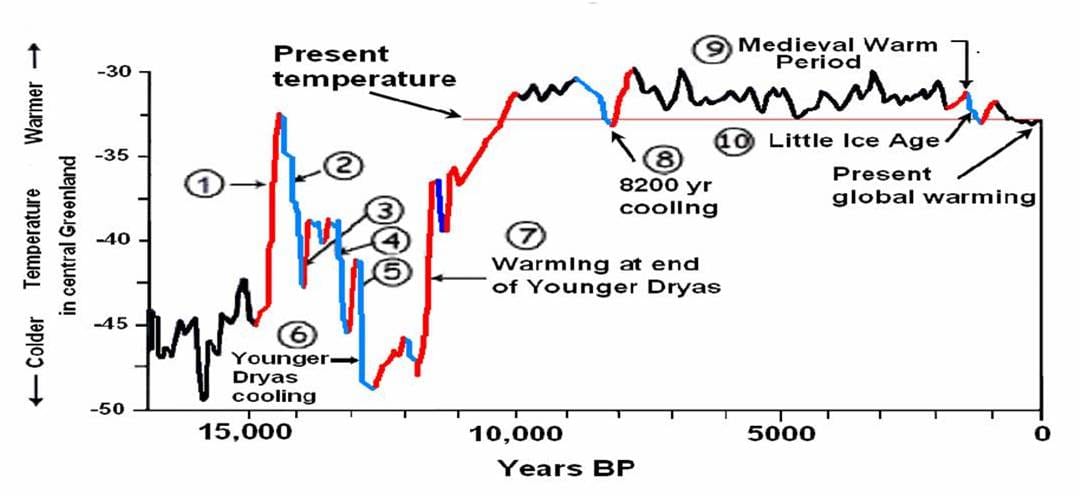
While it is impossible to predict what will happen over a short time scale, there are some general patterns. Perhaps the most remarkable of these is self-similarity: if observed over a short time scale (10 seconds or less), the behavior over 10 seconds will look like the behavior over 1 second, and this will look like the behavior over 0.1 second. The only difference being that, the smaller the time-scale, the smaller the up-down variation. You can see the same thing with stock movements, wind speed, cell-phone noise, etc. and the same self-similarity can occur in space so that the shape of clouds tends to be similar at all reasonably small length scales. The maximum average deviation is smaller over smaller time scales, of course, and larger over large time-scales, but not in any obvious way. There is no simple proportionality, but rather a fractional power dependence that results in these chaotic phenomena having fractal dependence on measure scale. Some of this is seen in the global temperature graph below.

Global temperatures measured from the antarctic ice showing stable, cyclic chaos and self-similarity.

Global temperatures measured from the antarctic ice showing stable, cyclic chaos and self-similarity.

Chaos can be stable or unstable, by the way; the cooling of a cup of coffee was stable because the temperature could not exceed 70°C or go below 20°C. Stable chaotic phenomena tend to have fixed period cycles in space or time. The world temperature seems to follow this pattern though there is no obvious reason it should. That is, there is no obvious maximum and minimum temperature for the earth, nor any obvious reason there should be cycles or that they should be 120,000 years long. I’ll probably write more about chaos in later posts, but I should mention that unstable chaos can be quite destructive, and quite hard to prevent. Some form of chaotic local heating seems to have caused battery fires aboard the Dreamliner; similarly, most riots, famines, and financial panics seem to be chaotic. Generally speaking, tight control does not prevent this sort of chaos, by the way; it just changes the period and makes the eruptions that much more violent. As two examples, consider what would happen if we tried to cap a volcano, or provided  clamp-downs on riots in Syria, Egypt or Ancient Rome.

From math, we know some alternate ways to prevent unstable chaos from getting out of hand; one is to lay off, another is to control chaotically (hard to believe, but true).

Why the Boeing Dreamliner’s batteries burst into flames

Boeing’s Dreamliner is currently grounded due to two of their Li-Ion batteries having burst into flames, one in flight, and another on the ground. Two accidents of the same type in a small fleet is no little matter as an airplane fire can be deadly on the ground or at 50,000 feet.

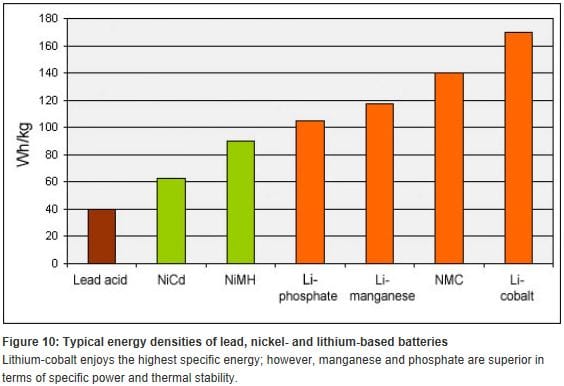
The fires are particularly bad on the Dreamliner because these lithium batteries control virtually everything that goes on aboard the plane. Even without a fire, when they go out so does virtually every control and sensor. So why did they burn and what has Boeing done to take care of it? The simple reason for the fires is that management chose to use Li-Cobalt oxide batteries, the same Li-battery design that every laptop computer maker had already rejected ten years earlier when laptops using them started busting into flames. This is the battery design that caused Dell and HP to recall every computer with it. Boeing decided that they should use a massive version to control everything on their flagship airplane because it has the highest energy density see graphic below. They figured that operational management would insure safety even without the need to install any cooling or sufficient shielding.

All lithium batteries have a negative electrode (anode) that is mostly lithium. The usual chemistry is lithium metal in a graphite matrix. Lithium metal is light and readily gives off electrons; the graphite makes is somewhat less reactive. The positive electrode (cathode) is typically an oxide of some sort, and here there are options. Most current cell-phone and laptop batteries use some version of manganese nickel oxide as the anode. Lithium atoms in the anode give off electrons, become lithium ions and then travel across to the oxide making a mixed ion oxide that absorbs the electron. The process provides about 4 volts of energy differential per electron transferred. With cobalt oxide, the cathode reaction is more or less CoO2 + Li+ e– —> LiCoO2. Sorry to say this chemistry is very unstable; the oxide itself is unstable, more unstable than MnNi or iron oxide, especially when it is fully charged, and especially when it is warm (40 degrees or warmer) 2CoO2 –> Co2O+1/2O2. Boeing’s safety idea was to control the charge rate in a way that overheating was not supposed to occur.

Despite the controls, it didn’t work for the two Boeing batteries that burst into flames. Perhaps it would have helped to add cooling to reduce the temperature — that’s what’s done in lap-tops and plug-in automobiles — but even with cooling the batteries might have self-destructed due to local heating effects. These batteries were massive, and there is plenty of room for one spot to get hotter than the rest; this seems to have happened in both fires, either as a cause or result. Once the cobalt oxide gets hot and oxygen is released a lithium-oxygen fire can spread to the whole battery, even if the majority is held at a low temperature. If local heating were the cause, no amount of external cooling would have helped.

battery-materials-energy-densities-battery-university

Something that would have helped was a polymer interlayer separator to keep the unstable cobalt oxide from fueling the fire; there was none. Another option is to use a more-stable cathode like iron phosphate or lithium manganese nickel. As shown in the graphic above, these stable oxides do not have the high power density of Li-cobalt oxide. When the unstable cobalt oxide decomposed there was oxygen, lithium, and heat in one space and none of the fire extinguishers on the planes could put out the fires.

The solution that Boeing has proposed and that Washington is reviewing is to leave the batteries unchanged, but to shield them in a massive titanium shield with the vapors formed on burning vented outside the airplane. The claim is that this shield will protect the passengers from the fire, if not from the loss of electricity. This does not appear to be the best solution. Airbus had planned to use the same batteries on their newest planes, but has now gone retro and plans to use Ni-Cad batteries. I don’t think that’s the best solution either. Better options, I think, are nickel metal hydride or the very stable Lithium Iron Phosphate batteries that Segway uses. Better yet would be to use fuel cells, an option that appears to be better than even the best batteries. Fuel cells are what the navy uses on submarines and what NASA uses in space. They are both more energy dense and safer than batteries. As a disclaimer, REB Research makes hydrogen generators and purifiers that are used with fuel-cell power.

More on the chemistry of Boeing’s batteries and their problems can be found on Wikipedia. You can also read an interview with the head of Tesla motors regarding his suggestions and offer of help.

Some people have noticed that I’m wearing a rather dapper suit during the recent visit of the press to my lab. It’s important to dress sharp and fashionable, I think. What that is varies from situation to situation, but fashion is an obligation, not a privilege or a right: you’ve got to be willing to suffer for it, for the greater good of all.

Do you think Lady Gaga finds her stuff comfortable?

Do you think Lady Gaga finds her stuff comfortable? She does it for the greater good.

R.E. Buxbaum. You are your own sculpture; Be art.

Robert Buxbaum is now on the board of a new charity

I’m now on the board of directors for two non-profits (lucky me), plus for my own hydrogen company, REB Research. My first charity seat is for The Jewish Heritage Foundation; it’s really one rabbi who takes donations to make tapes about topics he finds interesting. He then gives away or sells the tapes. We meet once a year to go over the finances and decide what his salary ought to be — basically we rubber stamp.

The second board seat, one I’ve been elected/appointed to just this week, is with a group call “The First Covenant Foundation” they’re semi-religious, trying to get people to behave decently. The first covenant is the one with Noah — God won’t destroy the earth but we have to behave sort-of OK. It’s certainly worthwhile to get people to keep to this minimal standard: no murder, no bestiality, don’t eat the limbs off of living creatures… Then again, if God has trouble keeping folks to this standard, I’m not sure how effective the 1st covenant will be. So far they’ve done nothing illegal or immoral that I’ve seen, so that’s good. Unlike with my first my board position, my contract with first covenant includes a sanity clause. They’re more inclusive that way; as expected, the Jewish heritage group didn’t believe in any sanity clause.

As for REB Research, our aims are simpler: to make and sell good hydrogen-related products, to make money, to pay our workers and creditors, and to develop our workers through training associated with the making and selling of good hydrogen products. Simple enough. My board meets 3 or 4 times a year over pizza; the salary of board members is the pizza. So far we haven’t done anything illegal either, that I know of — and we’re even making money.

Helium leak detector repaired and refurbished in Frankenmuth

To those who know Frankenmuth, MI, it is generally as “Little Bavaria,” the German-themed vacation town of quaint houses and shops; of cheese, wurst, beer, Christmas ornaments, and Oom Pa Pa bands. I know it in a slightly different way as the only town to get your helium leak detector repaired. There are at least three shops in Frankenmuth that repair helium leak detectors (or make new specialty versions), and this is the source of the reference leaks that most qualified shops use. So I was here yesterday and today, both for the World-class snow sculpture contest, and to get my helium leak detector looked at. It was acting funny; it turns out there was a leak in the leak detector plus a bad potentiometer on a switchover circuit. The leak is already fixed, and I should have it back in my shop next week (Wednesday).

Snow-sculpting in Frankenmuth 2013; I was there to have my helium leak detector fixed.

Snow-sculpting in Frankenmuth 2013; I was there to have my helium leak detector fixed.

veeco He-leak detector at REB Research.

Theodore Roosevelt jumps fence, rides moose

Perhaps my favorite president is Theodore Roosevelt, a liberal Republican with a strong America first agenda, and an ability to work on the world stage. He was a friend to immigrants and to the poor, but not opposed to prosperity either. Though some thought he might be crazy, none thought he was a wuss, and none messed with him or with the USA when he was in office. Yes, that’s the president riding a moose, jumping a fence, and camping on a cliff with John Muir. In his spare time, he wrote books (very good books) rode in an airplane, and visited Panama.

theodore-roosevelt-mooseTheodore Roosevelt Jumps Fence on Horsetheodore-roosevelt-yosemite

He had many pets and children in the Whitehouse, by the way, spoke several languages the conversing with guests, and kept a boxing instructor on staff so he could stay in shape. For a fun read, try his biography of Thomas Hart Benton, or his Naval war of 1812. His personal defense pistol of choice was a .32 caliber, semi-automatic, gold inlaid.

January 16, 2013 R.E. Buxbaum. If you liked this, you might want my insights into a famous incident where Teddy Roosevelt got shot on the way to giving a speech. Instead of treatment, he gave the 2 hour speech and survived after asking that the bullet be allowed to remain in place. Why did he do this? How did he survive it?

Healthcare thoughts

I offer healthcare to keep workers working for me — it’s an employee retention benefit that helps cover the cost of training. As it is now, if they quit, covered workers will have to pay for their own heathcare or find another company that’s willing to pay for it.

Perhaps that’s mean to think this way, but it’s really my only means to keep people from jumping shop at the first higher-paying opportunity. Anyway, that’s what I do/did. When congress gave free healthcare to everyone as of this year, they not only raised my taxes, and my company taxes, they also removed a key tool I have for keeping people on the job. In return, I suppose my healthcare fees are supposed to go down, but I have no faith they will, in part because I worked for the government and have no faith in their ability to be efficient or fast moving; in part because my ability to pay for healthcare comes from my ability to keep trained workers.

Though I’m not too happy about the change, I imagine (hope) that my employees are happy. Their  taxes will go up a bit, but they will be more free to jump ship at will. I imagine that the unemployed are especially thrilled, though I don’t know why that was not implemented through an increase in Medicare and Medicaid. In a sense I’m surprised it took congress this long to give everyone “free” healthcare without forcing them to work for it.

Michigan tax wrongs righted

This month, at last, the Michigan legislature began to take seriously the job of correcting some tax wrongs that needed correcting for years. The most important change: they decreased the tax on business property (only by 10% but it’s a start) and shifted the burden to a tax on business profit.

The personal property tax was paid on any equipment, inventory, or supplies that a business kept in-house. No matter if their were sales or none, a tax was due so long as a business had equipment or unsold inventory. Even in years where there were no profits or sales, money was due to the state — a tax on your dreams of somehow making a go of things. Aside from its complexity of valuing your unused supplies and inventory, the tax guaranteed that struggling businesses would fail — immediately. The governor (Granholm – glad she’s gone) claimed that taxing unused equipment and inventory protected the state coffers from the ups and downs of the business cycle, but the state was is far better shape than a struggling business when it came to the cost of borrowing. Besides, I’m not sure she was doing Michigan any favors by destroying businesses that were barely hanging on.

Governor Granholm (thank G-d she’s gone) gave out the money she collected to the right sort of people, her friends, and to targeted businesses that she liked: e.g. movie makers who made money-losing, dystopian films and left as soon as the checks cashed. The current governor, Snyder claims his aim is to eliminate the business property tax in 10 years, 10% at a time. I hope, we’ll see.

Another tax that’s now gone, at last, is the 0.8% on transactions between businesses. It wasn’t an unfair tax like the property tax, but was annoying to keep track of. What a mess. Keep up the good work, lads. Now if only they can do something about Detroit’s uncommonly high minimum wage.

Robert Buxbaum, November 20, 2012

Detroit economics and the minimum wage

A major cause of Detroit’s financial problems, it seems to me, is that Detroit has an uncommonly high minimum wage, $13.75/hr for all employees in any company that contracts with the city and does not provide free health care; or $10.50/hr for companies that provide healthcare. This minimum, called a living wage, is about double the state minimum wage of $7.40.

Although the city is financially bankrupt, the city can not hire janitors and pay less than this, nor hire accountants from a company that pays its janitors less than this. Besides the burden on Detroit’s budget, this puts a burden on its unemployment system. Many in Detroit don’t possess the education or skills to justify jobs at this wage. This high minimum wage effectively cuts them from the bottom rung of jobs at these companies — jobs at the bottom of the ladder of success. Many businesses find innovative ways around the law, using corruption and bribes to skirt enforcement, if the recent trials of the mayor are any indication, but a system of corruption is not good for the city.

As these wages are far above standard, most employed workers for the city get their jobs by corruption and connections, and most everyone knows they got their jobs this way rather than skill. As a result, workers have no incentive to improve at their job. In a corrupt system like this, there is no likelihood that  a raise would come with improved performance.

The justification for the living wage is the cost to support a family of 4 or 5, but Detroit is a much cheaper place to live than most, and not all workers are supporting families of 4 or 5. It therefore makes little sense to force all potential workers to refuse entry-level employment at $8.00/hour, a wage that would allow a single, motivated individual a decent living and a chance to climb as his/her needs and skills grew. Instead of promoting hard work and merit, this ordinance fosters corruption and cronyism; it makes it expensive for the city to hire contractors, makes it hard for workers to get their first jobs, and removes the benefits that normally come with improved skills. It’s a disaster, I suspect, and a reason the city is bankrupt.

Dr. Robert E. Buxbaum is a self-employed curmudgeon who tries to speak the truth as he sees it.