Category Archives: Business

Say no to the dress

A popular reality TV show follows the struggles of young brides-to-be shopping for a wedding dress at a famous store, Kleinfeld’s. They’ve come to believe that this charming adornment will make their dream-wedding really perfect. There is some sort of idea that the perfect wedding is necessary (or desirable) to get you started on a perfect life. This is stated in various ways throughout the show with phrases like: “you deserve to be the princess,” or “you deserve your special day.”

Each woman brings a retinue to help her pick the gown, and to help advise her about what dress has the most pop, or looks best on her, or makes her look the most special. Often it’s someone in this retinue that will pay for the dress too, a father, uncle, or a close family member. The store caters to the retinue at lest at the beginning to get a commitment to the price, generally $5,000 to $10,000, but sometimes to “no limit on the price.” It then provides a dazzling variety of dresses and an old hand or two to guide the young lady to the right one. At first, the retinue chimes in, but eventually the retinue is detached, and the bride is made to embrace that it’s her special day, alone. Then, when the perfect dress is finally chosen (often at the high-end of the budget), the bride is asked: “are you ready to say yes to the dress?” She does, with tears, and everyone claps, especially the retinue. Often, there is a final shot of the beautiful bride at the beautiful wedding. It’s touching, but perhaps unnecessary. So here’s an alternate  thought: just say “no”. No to the expensive dress; no to the expensive cake (sorry, cake boss) and no to the fancy, big diamond. instead, throw a big fun wedding on the cheap, perhaps at a park in a rented gown; friends will get you through life, the big dress and big cake will not.

An expensive wedding didn’t keep John Kennedy faithful, nor did it help cement Elizabeth Taylors 7 husbands (two to Richard Burton). Just the opposite: a recent study on marriage stability showed that the higher priced the wedding, the more likely it is to end in divorce.
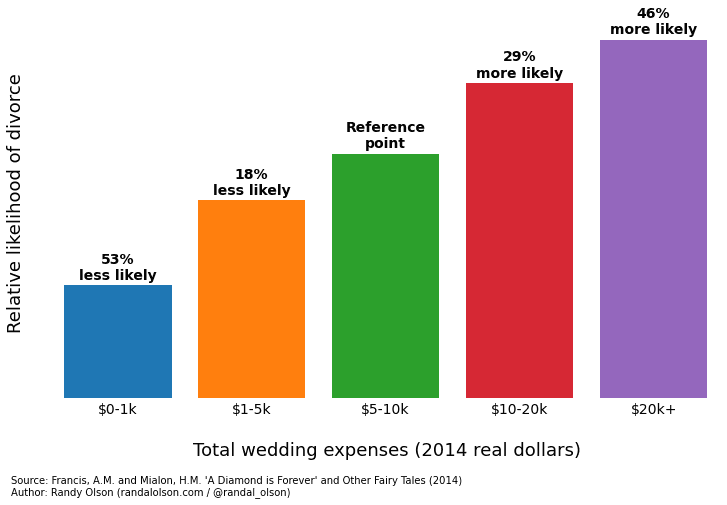
Marriage stability goes down as the wedding costs go up.

Marriage stability goes down as the wedding costs go up. If you dress costs $5,000, your wedding is unlikely to come in at less than $10k. From Francis and Mialon, “A diamond is forever and other Fairy Tales,” 2014. The average cost of a US wedding: $30,000.

The point of the wedding is to have a long, happy marriage, not a one day party, and expensive weddings appear to be counter-productive to stability. Things are worse for those who enter poor, backing up the observation that money stresses are among the main causes of marriage failure. This is not to say that you should not have a wedding party, but that spending should be watched especially if the couple isn’t that extraordinarily rich. The average, employed US 20-something earns about $26,000/year before taxes. That’s not bad money until you realize that the average US wedding costs over $30,000 not including dress, ring and honeymoon. There is a far lower chance of divorce for the couple with the $5-$10k wedding, and even lower if the couple can keep expenses in the 0-$5k range.
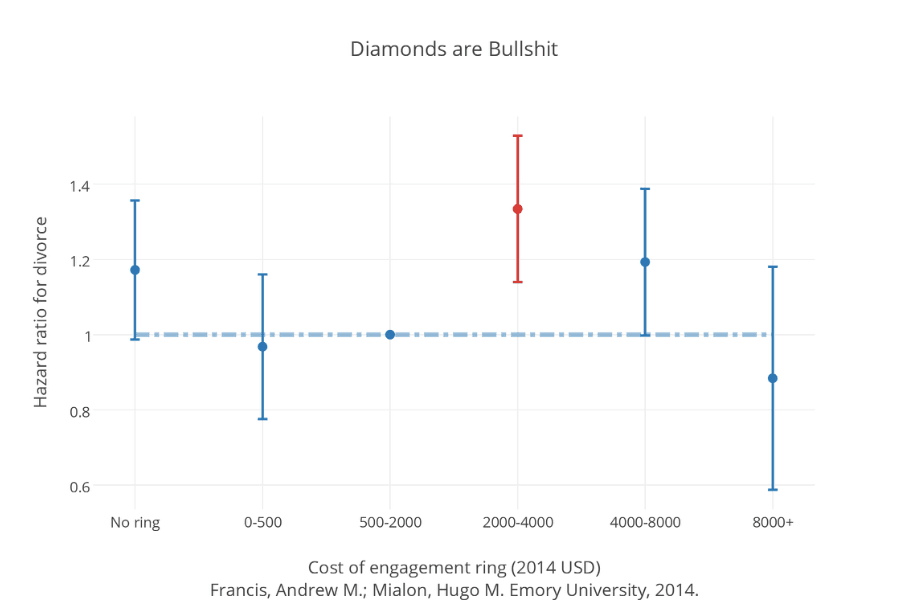
Give her a diamond ring, but the ideal cost is between $100 and $2000 (unless you're super rich)

Give her a ring, but the ideal cost is between $200 and $2000 unless you’re super rich.

Statistics suggest that spending on the diamond doesn’t help either, unless it’s a very expensive stone — and that, perhaps, is because the very expensive stone is only bought by the very rich groom. Still, even for the 1% who can afford it, the dress or stone should be considered a sunk cost, not an investment. You’ll never be able to resell that dress at all, and though you can resell a diamond it is virtually impossible to get even half your money back. This isn’t to say that you should not give a ring — without a ring the bride will feel cheated, but most grooms will be better served giving one in the $100-$2000 range.
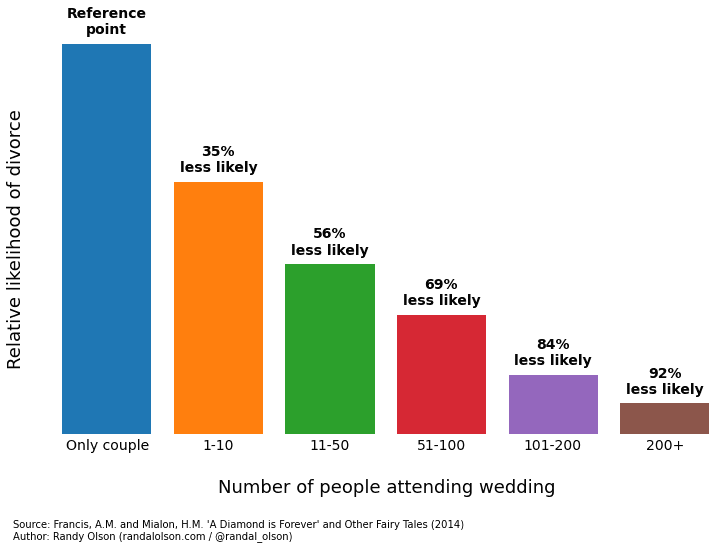
It seems that having lots of people at the wedding is perhaps the single best thing you can do for marriage stability. On the other hand, this graph might show that the sort of person who has 200 good friends is the sort of person to remain happily married.

Having lots of people at the wedding is perhaps the single best thing you can do for marriage stability. On the other hand, this graph might show that the sort of person who has 200 good friends is the sort of person to remain happily married. ibid.

While your wedding should be cheap, or at least affordable, it should not be small. It turns out that having lots of friends and family in attendance correlates strongly with having a long, stable marriage. I’m not sure if this is entirely cause and effect: perhaps those with lots of friends and family are giving and stable than those without. Still, it strikes me that friendships are good for every couple, and very worth maintaining. These are people who will be there for advice, or just be there when things get rocky. Give them a good party, and don’t drive them away by sending a message that a large gift is expected. If you get married on the cheap, it’s likely your guests will feel more comfortable showing up in business clothes with simple affordable gifts. Most bridesmaids are happier if they don’t have to buy a big expensive dress.
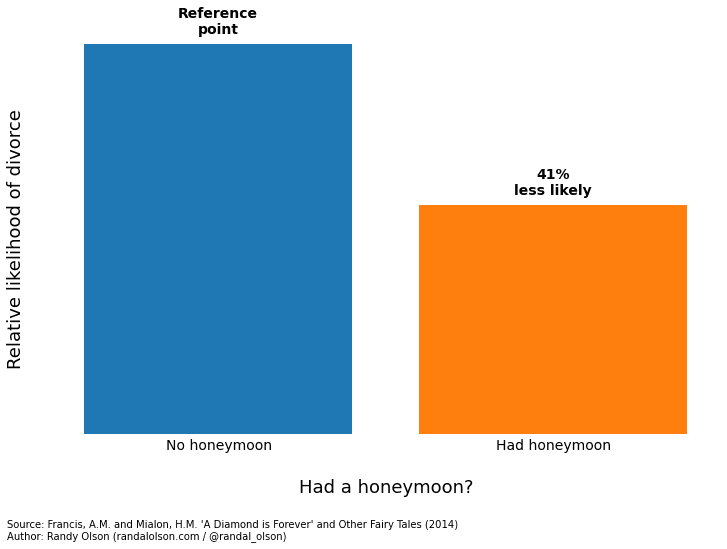
Honeymoons help malaise stability too.

Honeymoons help marriage stability too. ibid.

Robert E. Buxbaum, July 12, 2015. My 3 children are all entering marriageable age — and PhD age (I wrote a post comparing a wedding to a PhD.) The above are my thoughts before being hornswoggled into buying $5,000 worth of taffeta. They are also suggestive of the sort of work to get a PhD. Another good spending investment, I think, is to go on a honeymoon. I didn’t, and though we didn’t get divorced, in retrospect it seems like a good idea. I plan to finally go on a honeymoon for our 25th anniversary. Let’s toast (with Geritol) to finding the right mate. Good luck.


The mystery of American productivity

Americans are among the richest and best paid people in the world. On a yearly basis, Americans produce and earn about 20% more than Britons and about 30% more than Japanese. On an hourly basis, counter to what you might expect, American workers produce about 30% more than Britons or Canadians, and about 50% more than the vaunted Japanese.

Per hour worker productivity, from the Economist.  We do OK for backward hicks.

Per hour worker productivity, from the Economist. We do OK for backward hicks.

French and German workers produce about as much as we do, per hour, but tend to work fewer hours. Still, the differences are not quite what you might expect. French workers take many more hours off than we do and are still so much more productive than the British that it appears they could take an extra month off and still beat them in yearly output. Japanese workers meanwhile produce only as much as the French, per year, but take far more hours to do it. One thought is that it’s all the vacation time that makes French so productive and it’s perhaps the lack of vacations that causes the Japanese to be relatively unproductive.

Not that vacation time alone explains our high productivity, nor that of the Germans or Italians relative to the Canadians and Britons. One part of an answer, I suspect, is that we put fewer roadblocks to workers becoming business owners, and to running things their own way. Another thought is that US and Germany have a low minimum wage, comparatively, and Italy has no minimum wage at all; Germany had no minimum wage in 2013, the time of the productivity comparison. In countries like this, there is a larger profit to be had by clever individuals who work hard, think, and start their own businesses. With minimal requirement on how much to pay, the business owner can bring to bear a mix of low-wage, minimally productive workers with labor-saving innovation, allowing them to become rich while decreasing unemployment. It also allows them to serve otherwise under-served parts of the market and profit from it. And profit is a powerful motivator. As Friedrich Nietzsche said, “a why beats a how.” 

The nine European countries with no minimum wage are among the richest on the continent, and among those with the lowest unemployment: Iceland, Lichtenstein, Norway, Sweden, Finland, Denmark, Austria, Italy, and Switzerland. By contrast, England, Canada, and Japan have relative high minimum wages and relatively high unemployment. There are also some poor countries with no minimum wage (Egypt, Zimbabwe, Rwanda…) but these countries suffer from other issues, like rampant crime. I’ve argued that the high “Living Wage” in Detroit is a major cause of Detroit’s high unemployment and bankruptcy. If low minimum wage is a major source of American worker productivity and wealth, it would be a real mistake to raise it.

Worker productivity is the best single predictor of long-term national success. As such, the long-term prediction for Britain, Canada, and Japan is not good. Unless something changes in these countries, we may expect to see them off to a long, dark tea-time of declining significance. Perhaps, it is a fear of this that was behind the resounding defeat of the Labour party in British elections last week. The Labour government oversaw England’s last big drop in productivity.

R.E. Buxbaum, May 28, 2015. It’s also possible (unlikely) that US universities are really good, or at least not as bad as thought. We don’t seem to quite beat the enthusiasm out of our students, though we do drug them quite a lot. Here’s a Forbes article on minimum wage.

Detroit emerges from bankruptcy. Not quite.

missing homes Detroit

While Detroit’s central core comes back, surrounding, homes burn at 220+/month, leave Detroit streets looking like the teeth of an aging hillbilly.

Detroit went bankrupt last year, the largest US city to do so since New York in 1970. As with New York’s bankruptcy, Detroit’s was used to cancel old debts and rewrite ill-thought contracts. Detroit also got to jail some crooked politicians including mayor Kilpatrick, described as “a walking crime wave.” But the city and county have no easy path out of bankruptcy as both city and county are likely insolvent. That is, they spend more than they take in despite massive out-state funding, and high taxes, 10% above the state level. To make matters worse, they are losing population at the rate of 1% or so per year. It’s hard to fund a city built for 2 million on the tax revenue of 1/3 as many, especially when they are mostly unemployed. Unless a lot changes soon, another bankruptcy is almost inevitable — likely this time at the county level.

We got in this predicament, largely as a result of a 50 year war between the black political establishment of the city, solidly Democrat, crooked, somewhat anarchist, and the white, stayed, mostly Republican out-state. The white population fled following Detroits riots of the 60s, and the richer black population soon followed. The remainder, poor, old and black, stayed, trapped in slowly decaying neighborhoods, relying on flashy, crooked politicians as the city went broke. White flight allowed the black community to develop its own, Motown culture, but except for the music industry, Detroit has not benefitted from this culture.

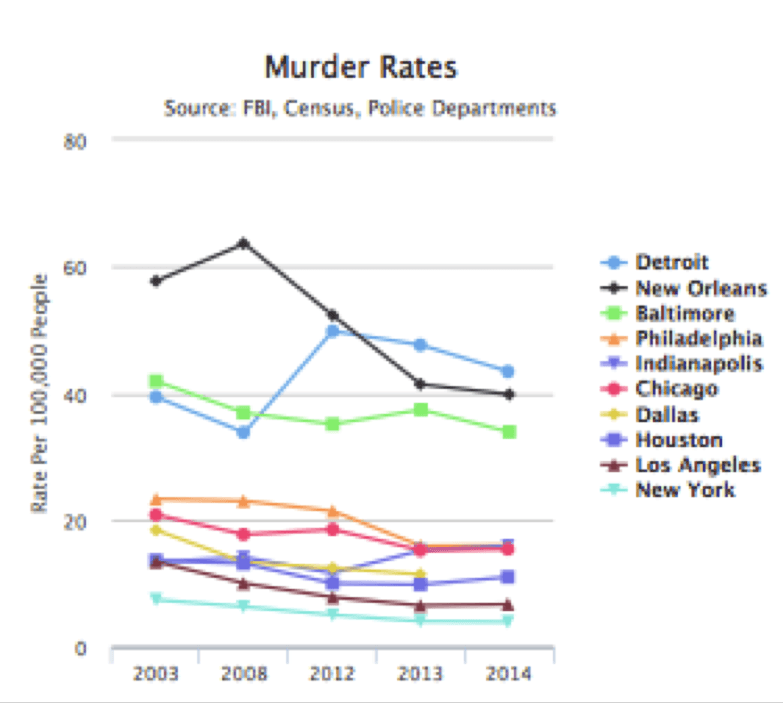
Detroit's murder rate, 45/100,000, is the highest in the US. It's coming down but not that fast.

Detroit’s murder rate is the highest in the US. It’s come down 10% in the last 2 years, but has far to go.

Detroiters have poor health, poor savings rates, high murder rates. The fire rate is about .22% per month, 2.6% per year. The city lacks reliable fire fighting and street plowing. Police, at one point, erected signs at the border that said, “Enter at your own risk.” There is a lack of small businesses and the services they would provide too: laundromats, grocery stores, and taxis (though no lack of bars and marijuana maintenance clinics). Employment in the auto-industry is down. And it’s not being replaced by home-grown small business – perhaps hampered by the low savings rate. A surprisingly large fraction of Detroit homes are in foreclosure, see map, and with it there’s a high abandonment rate. The high fire rate is at least half arson to collect on insurance. As pheasant and dear return, non-core Detroit is beginning to look like farm country.

Detroit foreclosures near me. Blue is occupied homes, red is unoccupied, yellow unknown, and green is destroyed homes or vacant, foreclosed land.

Detroit foreclosures near me. Homes in dark blue are occupied foreclosed, red is unoccupied, and green plots are destroyed homes or vacant, foreclosed land.

It’s not clear what political leaders should do now. The city council would like to return to their pre-bankruptcy ways where they could borrow as much as they felt they needed and spend on whatever they saw fit — often on fast friends, fast cars, gambling, and vacation homes outside of the city. But the out-state population has been reluctant to give them the credit card. Is this racist or prudent — probably both, but this war can not continue. The city and county pension funds were ransacked for ill-advised investments and consulting fees to cronies and their power-lawyers. Either the money is replaced from out-state or there will be some unhappy retirees in the not-too-distant future. My guess is that the state will have to pick up the tab for this mismanagement, but only if they don’t have to hand over management control afterwards.

Rand Paul, a potential GOP presidential candidate, has proposed rebuilding business and property values by a method that the city will almost certainly reject. His solution: cut services to low-population density areas and cut taxes on business and earned income. While this would likely bring in new people and new businesses, the people would likely be white, and the businesses white-owned/ white-serving. Black-Detroiters have too little savings, organization and income to directly benefit from this plan, and black politicians are likely to feel threatened. They are likely to claim, not without merit, that this is welfare for rich whites: a way for them to become yet-richer while doing nothing for the poor blacks of the burning neighborhoods. They are likely to demand control as the elected officials of the town: regulating business and raising the minimum wage to create “equality.” I suspect this is a bad idea.

Detroit hunger games

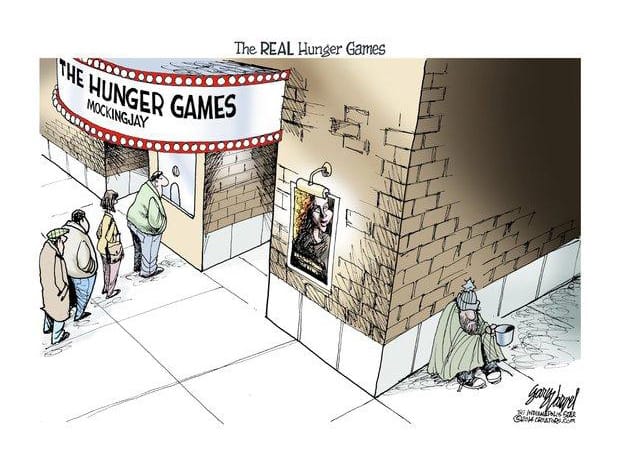
Detroit suffers from two populations and a divide.

To some extent we’re already seeing the return of white-owned, white-serving businesses. Classic buildings in the core of the city have been purchased by white developers – notably Dan Gilbert of Quicken Loans leading to gentrification and an influx of single, white hipsters. The newcomers are viewed as half-saviors, half-carpetbaggers. They dwell in a whiter city core with hipster bars and expensive restaurants. Does a poor city with massive debt, crime, and unemployment benefit from a core filled with high-priced, gourmet coffee and fern bars?

The author, Robert Buxbaum, enjoys a day at an artificial beach in central Detroit.

The author, Robert Buxbaum, enjoys a beer at an artificial beach-cafe in central Detroit with some, few black folks, none poor. Is this good for Detroit?

The new hipsters put a squeeze on city services too — one that’s hard to deal with fairly. Detroit can not afford to plow all the streets after a snow. Should the new high-tax white folks get plowed streets, or should they suffer equally with everyone else? Detroit education is abysmal, but the high tax-bracket folks want better. Should they get it, or suffer equally? They want extra street lights and police protection. Should they get it, or suffer equally? Is this the way up?  A solution I’d proposed some while ago was to divide the core city from the now-rural outskirts so that each could be managed more sanely. It’s not a grand a solution like Rand’s plan, but less likely to be rejected. One way or another, we seem destined to have a Detroit with a rich core and abandoned neighborhoods. I suspect it might as well be managed that way.

Robert E. Buxbaum, February 10, 2015. I don’t have solutions, but write about the city’s problems, and the partial solutions I’ve heard of as a way to clarify my thinking — and perhaps yours too.

Is college worth no cost?

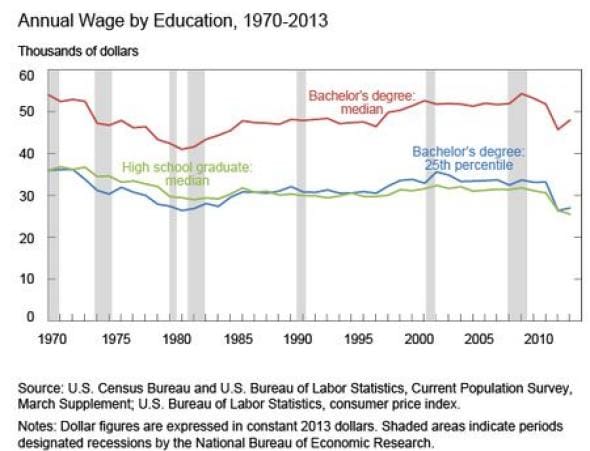
While a college degree gives most graduates a salary benefit over high school graduates this has to be balanced against the four years of not working. What’s more, a Bureau of Labor statistics study found that the salary benefits disappear if you graduate in the bottom 25% of your class, and if you don’t graduate at all you can end up losing salary money, especially if you go into low-paying fields like child development or physical sciences.

Salary benefits of a college degree are largely absent if you graduate in the bottom 25% of your class.

The average college graduate earns significantly more than a high school grad, but not if you attend a pricy school, or graduate in the bottom 1/4 of your class, or have the wrong major.

Most people realize there is a great earnings difference depending on your field of study with graduates in engineering and medicine doing better, financially. Even top graduates in child development or athletic sciences are barely able to justify the tuition and opportunity costs –it’s worse at an expensive college, but what isn’t always realized is that not everyone entering these fields graduates. For them, there is a steep loss when the tuition and four (or more) years of lost income are considered.

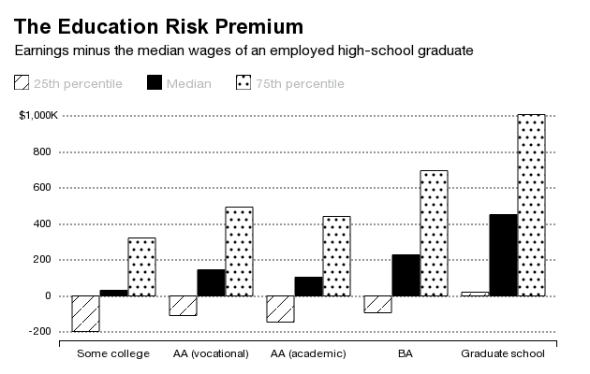
risk premium in wages

If you don’t graduate or get only an AA or 2 year degree the increase in wages is minimal, and you lose time working and whatever your costs of education. The loss is particularly high if you study social science fields at an expensive college, and don’t graduate, or if you graduate in the bottom of your class.

A report from the New York Federal Reserve finds that the highest pay major is petroleum engineering, mid-career salary $176,300/yr, and the bottom is child development, mid-career salary $36,400/yr (click the report link to check on your major). I’m not sure most students or advisors are aware of the steep salary difference, or that college gives a salary down-grade if one picks the wrong major, or does not complete the degree. In terms of earnings, you’d be better off avoiding even a free college in these areas unless you’re fairly sure you’ll complete the degree, or you really want to work in these fields.

Top earning majors Fed Reserve and Majors that pay you back.

Top earning majors: Majors that pay.

Of course college can provide more than money: knowledge, for instance, and learning: the ability to reason better. But these benefits are likely lost if you don’t work at it, or don’t go in a field you love. They can also come to those who study hard in self-taught reading. In either case, it is the work habits that will make you grow as a person, and leave you more employable. Tough colleges add a lot by exposure to new people and new ways of thinking about great books, and by forced experience in writing essays — but these benefits too are work-dependent and college dependent. If you work hard understanding a great book it will show. If you didn’t work at it, or only exposed yourself to easier fare, that too will show.

Colleges bend education to get students and keep them enrolled, to the detriment of the students. They understand that students don’t like criticism, and that good criticism is hard to give. As a result, many less-demanding colleges give little or no critical feedback, especially for disadvantaged students. This disadvantages them even more. You get is a positive experience, a nice campus, and a dramatic graduation, but this is not learning. Positivity isn’t bad, but is it worth the cost and 4-5 years of your life.

As an alternative to a liberal arts education, I present “Father” Guido Sarduchi, of Saturday Night LIve, and his “5 minute college experience.” To a surprising extent, it provides everything you’ll remember from 4 years of college in 5 minutes, including math, history, political science, and language (Spanish). For many Americans, Father Sarduchi’s 5 minutes may be a better investment than even a free 4 years in college.

Robert. E. Buxbaum. January 21-22, 2015. Education is what you get when you don’t get what you want.

Of Scrooge and rising wheat production

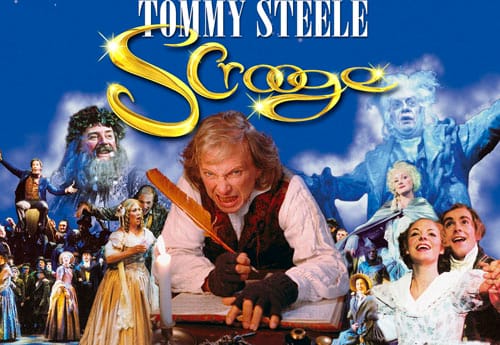
The Christmas Carol tells a tale that, for all the magic and fantasy, presents as true an economic picture of a man and his times as any in real-life history. Scrooge is a miserable character at the beginning of the tale, he lives alone in a dark house, without a wife or children, disliked by those around him. Scrooge has an office with a single employee (Bob Cratchit) in a tank-like office heated by a single lump of coal. He doesn’t associate much with friends or family, and one senses that he has few customers. He is poor by any life measure, and is likely poor relative to other bankers. At the end, through giving, he finds he enjoys life, is liked more, and (one has the sense) he may even get more business, and more money.

Scrooge (as best I can read him) believes in Malthus’s economic error of zero-sum wealth: That there is a limited amount of food, clothing, jobs, etc. and therefore Scrooge uses only the minimum, employs only the minimum, and spends only the minimum. Having more people would only mean more mouths to feed. As Scrooge says, “I can’t afford to make idle people merry. I help to support the establishments I have mentioned [the workhouses]. They cost enough, and … If they [the poor] would rather die,” said Scrooge, “they had better do it, and decrease the surplus population.”

Scrooge, the poor rich man.

Scrooge, the poor rich man with a tiny carbon footprint.

The teaching of the spirits is the opposite, and neither that of the Democrats or Republicans. Neither that a big government is needed to redistribute the wealth, nor that the free market will do everything. But, as I read it, the spirits bring a spiritual message of personal charity and happiness. That one enriches ones-self when one give of and by ones-self — just from the desire to be good and do good. The spirit of Christmas Present assures Scrooge that no famine will result from the excess population, but tells him of his 1800 brothers and shows him the unending cornucopia of food in the marketplace: spanish onions, oranges, fat chestnuts, grapes, and squab. Christmas future then shows him his funeral, and Tim’s: the dismal end of all men, rich and not:  “Will you decide what men shall live, what men shall die? It may be, that in the sight of Heaven, you are more worthless and less fit to live.” And Scrooge reforms, learns: gives a smile and a laugh, and employs a young runner to get Cratchit a fat goose. He visits his nephew Fred, a cheerful businessman for dinner, and laughs while watching Tom Topper court Fred’s plump sister-in-law.

The spirits do not redistribute Scrooge’s wealth for him, and certainly don’t present a formula for how much to give whom. Instead they present a picture of the value of joy and societal fellowship (as I read it). The spirits help Scrooge out of his mental rut so he’s sees worthy endeavors everywhere. Both hoarding and redistribution are Malthusian-Scroogian messages, as I read them. Both are based on the idea that there is only so much that the world can provide.

World wheet production

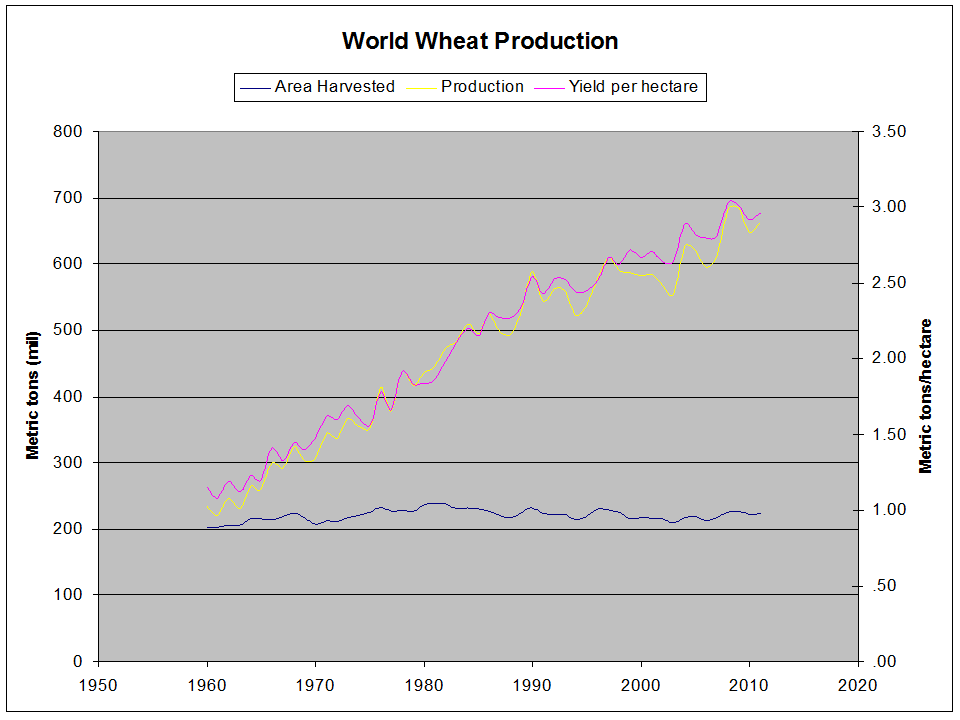
World wheat production tripled from 1960 to 2012 (faostat.fao.org), but acreage remained constant. More and more wheat from the same number of acres.

The history of food production suggests the spirits are right. The population is now three times what it was in Dickens’s day and mass starvation is not here. Instead we live among an “apoplectic opulence” of food. In a sense these are the product of new fertilizers, new tractors, and GMOs (Genetically modified organisms), but I would say it’s more the influence of better people. Plus, perhaps some extra CO2 in the air. Britons now complain about being too fat — and blame free markets for making them so. Over the last 50 years, wheat production has tripled, while the world population doubled, and the production of delicacies, like meat has expanded even faster. Unexpectedly, one sees that the opulence does not come from bringing new fields on-line — a process that would have to stop — but instead from increased production by the same tilled acres.

The opulence is not uniformly distributed, I should note. Countries that believe in Malthus and resort to hoarding or redistribution have been rewarded to see their grim prophesies fulfilled, as was Scrooge. Under Stalin, The Soviet Union redistributed grain from the unworthy farmer to the worth factory worker. The result was famine and Stalin felt vindicated by it. Even after Stalin, production never really grew under Soviet oversight, but remained at 75 Mtons/year from 1960 until the soviet collapse in 1990. Tellingly, nearly half of Soviet production was from the 3% of land under private cultivation. An unintended benefit: it appears the lack of Soviet grain was a major motivation for détente.  England had famine problems too when they enacted Malthusian “corn acts” and when they prevented worker migration Irish ownership during the potato famine. They saw starvation again under Attlee’s managed redistribution. In the US, it’s possible that behaviors like FDR scattering the bonus army may have helped prolong the depression. My sense is that the modern-day Scrooges are those against immigration “the foreigners will take our jobs,” and those who oppose paying folks on time, or nuclear and coal for fear that we will warm the planet. Their vision of America-yet-to-be matches Scrooge’s: a one-man work-force in a tank office heated by a single piece of coal.

Now I must admit that I have no simple formula for the correct charity standard. How does a nation provide enough, but not so much that it removes motivation– and the joy of success. Perhaps all I can say is that there is a best path between hoarding and false generosity. Those pushing the extremes are not helping, but creating a Dickensian world of sadness and gloom. Rejoice with me then, and with the reformed Scrooge. God bless us all, each and every one.

Robert Buxbaum, January 7, 2015. Some ideas here from Jerry Bowyer in last year’s Forbes.

von NotHaus, the terrorist who uttered money.

Bernard von NotHaus was sentenced two days ago, December 3, 2014 in Federal court, North Carolina on charges of terrorism for the crime of making token coinage. This crime is called uttering money in English common law, but it is not generally considered terrorism, or generally prosecuted at all in modern times. The sentencing was covered by only one newspaper, The New York Sun. The New York Times and others, I guess, found it wasn’t news fit to print. But I find it newsworthy enough to blog about.

The current price of silver (as I write) is $16.60 per ounce. Had Bernard von NotHaus limited himself to selling ordinary, one ounce, silver medallions for $20 each, he could have made money on each, and perhaps been awarded a medal for his artistry. Instead, von NotHaus stands convicted as a terrorist against the US economy. The problem: his $20 medallions include the symbol “$20” and the word “dollar” on the coins. The government’s claim is that people might come to use his silver medallions to buy $20 worth of products, and this, it was argued, could bring down the government. Also incendiary was the phrase “Trust in God.” The federal prosecutor argued this was too close to our government’s, “In God we Trust.”

A liberty dollar. The crime is terrorism by uttering money -- saying that this coin should be used as $20 currency.

A liberty $20 piece The crime is terrorism, undermining the US by suggesting people use this coin as currency.

Von NotHaus was arrested on June 6, 2009, and had his coins and metal confiscated. He was convicted of terrorism March, 2011. Among the evidence are gold coins with the image of Ron Paul and certificates with von NotHaus’s image marked as 1 Dollar negotiable currency. Making these items isn’t quite counterfeiting, as the coins and certificates don’t look like US currency, but the US government decided it’s worse: economic terrorism. Anne Tompkins, the federal prosecutor successfully argued that von NotHaus is suggesting that the currency of the US is somehow deficient, and perhaps that the president and his crowd are doing something wrong in their efforts to drive inflation by printing excess currency. Ms. Tompkins successfully argued that such “attempts to undermine the legitimate currency of this country are simply a unique form of domestic terrorism” and that they “represent a clear and present danger to the economic stability of this country.” I’d say that’s over-reacting.

The Liberty Dollar. It's not counterfeiting, but the crime of terrorism by uttering money. Printing certificates with the intent of having them used as currency.

The Liberty Dollar. It’s not counterfeiting, but terrorism. 20 of these can be exchanged for a silver coin. US currency is non-negotiable; you have no right to change

The mechanism whereby these items are supposed to undermine the economic stability is the reverse of Gresham’s law. Gresham’s law is that the worse currency will stay in circulation and the better will be driven out. Applied here, Gresham would predict that people will hoard these liberty dollars and will spend only the paper. That’s what happens with ordinary art, or gold bars. But our government’s terrorism argument assumes Gresham’s theories are wrong, and that people will hoard Obama’s paper while spending von NotHaus’s coins. On that chance, Mr. von NotHaus stands convicted of terrorism. Mr. von NotHaus’s defense is that he never claimed his medallions should be used as currency. The judge rejected this defense. For all I know, Ms Tompkins could now pursue Von NotHaus for sedition: suggesting there is something wrong with the way we pursue minters.

The Ron Paul $1000, weapon of mass destruction.

The Ron Paul, $1000 weapon of national destruction.

At sentencing yesterday, Judge Voorhees ignored rules that should have condemned von NotHause to life in prison. Instead, he ruled for 6 month’s house arrest and 3 years probation saying he didn’t believe von NotHaus was motivated by evil intent, but rather by philosophical speech (something partially protected by the first amendment). I’m always glad for lenient sentencing, especially when the argument involves freedom of speech. I’m also glad for philosophy, but that does not mean I’m happy about the outcome. To me, von NotHaus deserves a medal; he is the Rosa Parks of hard currency. And I think that’s fit to print.

Part of the reason this conviction bugs me is that I got a free education courtesy of Peter Cooper, the citizen industrialist of the 19th century who founded the greenback party. He published (uttered) $3 bread notes to advertise his cause. Robert Buxbaum is a good US citizen, who uses only non-negotiable, fiat currency; none of this negotiable stuff for me. December 5, 2014.

Loyalty, part 2: power hurts the leader

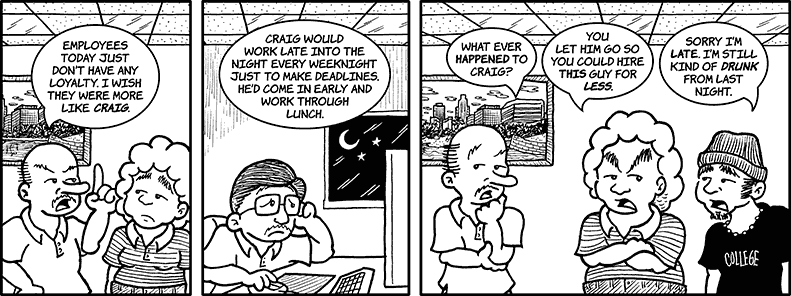
In a previous post, I made the case that one should avoid accepting loyalty requests as these are generally requests for your self-destruction. Someone who asks for loyalty is not saying he’ll provide you with good pay, a comfortable environment, empowerment, and good security. Rather that he wants your service despite little or not pay, discomfort, enslavement, and likely death or disgrace. There are some, few exceptions, but loyal service of this type rarely serves the servant.

Your chance of surviving as a minion is low; your chance as master is lower.

Your chance of surviving as a minion is low; your chance as master is lower.

I’d now like to claim that having loyal followers hurts the leader, too, costing him good service, and separating him from health, friends, and family. Most leaders are better off as half of a duopoly, without minions, and only loose control of their workers. The first reason for this is to note that minions don’t do good work relative to free men. They die for no good reason (e.g. you forgot to feed them), or they stop work and wonder what you’d like next, or they get drunk and gripe, or they beat each other up over fervor or small territorial issues. They very rarely innovate or work together, and for any complex project like taking over the world (or the tristate area) needs workers who do. Good work requires pride in achievement, and a loyal slave has none.

Having loyal followers precludes one from having a close relationship with the followers (you can’t appear weak), and also with friends (your minions must have one leader, not two). The leader gets used to being surrounded by sycophants, and begins to doubt those who behave otherwise. The boss will begin to distrust friends and allies, those he needs to stay in power, as these are the very people who could most easily assist others to take leadership from him. Over time, the king, boss, monopolist and dictator share less and less. As a result they end up secret and bitter, with many fears and none he can call close. And what pleasure is there in power, if one can’t share the rewards with friends and family, or share the burden with others.

Only support someone who could rule reasonably honestly and well. Chaos is worse than a dictator. Kanin from the New Yorker.

Only support someone who could rule reasonably honestly and well. Chaos is worse than a dictator. Kanin from the New Yorker.

A great number of kings have killed themselves in one way or another, very often because of overly large ambitions (see cartoon). King Saul, in the Bible is perhaps the first, Hitler is perhaps the most famous, and Colonel Qadhafi of Libya is perhaps the most recent. More often, maximum leaders are murdered, typically by friends and family. Famous examples include Julius Caesar, Augustus Caesar, and Nero; Charles I, Louis XVI, Richard III, and Tzar Alexander. Both the king of rock (Elvis) and the king of pop (Michael Jackson) killed themselves with drugs. Yet others died in needless wars or were exiled. Napoleon was defeated, exiled, returned, re-exiled and then murdered by an associate.  It’s not that safe to be the infallible king. Perhaps the wisest move is that of Pope Benedict, who last year left Rome for a life of monk-like solitude. Machiavelli points out, in “The Prince”, that only two Roman Emperors died of natural causes, one because he became emperor at a very old age, and the other was Marcus Aurelius, an advanced ruler who empowered his subjects.

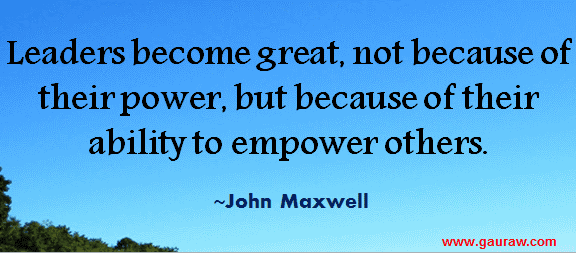
The great leaders create so much space for others to lead that they are almost invisible: they lead by offering encouragement.

Political bosses and monopolist businessmen, though lower in power, don’t fare much better in life. Boss Tweed died in jail, as did Capone, Boss Pendergast. Even if they avoid jail, the fact that no one likes you takes a toll. No one liked Vanderbilt or Rockefeller, Carnegie, Morgan, or Fisk. While they lived, they could expect nothing more than senate investigations and ugly lampoons in the free press, plus an unfavorable memory after death. William Hearst and Howard Hughes died as virtual hermits, best remembered as the inspiration for “Citizen Kane” and “The Navigator.” Peter Cooper and Steve Jobs are different,  industrialists liked in life and in death; and Bill Gates may join them too. Their secret was to empower others.

He's being eaten alive by his power, money, and respect. In the end, he had none.

He’s being eaten alive by his power, money, and respect, as are all those he might love.

Woe to the wife, child or friend of the dictator. The wife and children of a king or king-pin rarely enjoy much of the power. The king-pin doesn’t trust them (often with good reason), and neither do the people. Stalin killed his wife and children as did Nero, Frederick the Great, Herod, Hitler, and quite a few others. It was said that is was preferable to be an animal in the courtyard of these greats than a son at their table. And even if the king or king-pin doesn’t kill his wife child or son, the people often do e.g. Marie Antoinette was killed shortly after Louis XVI and the Tzarina of Russia alongside Alexander III. Similarly, the wife of Hitler, the Mistress of Mussolini, and the wife of Nicolae Ceausescu all died at their husband’s side, sharing the punishment for their husband’s ambition.

The kings of Sparta fared relatively well, as did their wives, despite the militarism of Sparta. Their trick was that Sparta was a du-archy, a country with two kings. Sparta was strong and stable, and their kings (mostly) died at home. In business too, it seems the selfish leader should step back and become almost invisible. It helps him, and helps the people too. If the leader can’t share power this way, he or she should at least give people a simple choice between two things he controls and accepts (chocolate and vanilla; Democrat and Republican). Workers with a choice, even a small one, learn to act somewhat independently, and customers (or citizens) don’t complain as much either if they have some control over their fate. All will come to like the leader more, and the leader will like himself more. People stopped resenting Microsoft when there was a viable alternative, Apple, and Microsoft engineers benefitted by having a competitor to their products. I suspect that Bill Gates realized this would happen when he helped fund Apple’s return to the market. Unfortunately, most monopolists, bosses, and king-pins are too stupid, or too afraid to do this. In the end, it’s the trapped employee or follower who shoots the leader from behind.

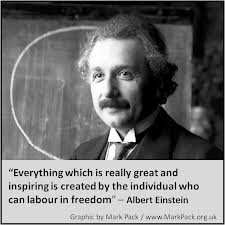
Einstein on freedom producing good. I'd say freedom is also a good in itself

The ideal situation is a delicate balance between control and freedom. A great leader will empower those around him and support the opposition. That was the unrealized sense of Mao Tse Tung’s hundred flowers movement (let 100 flowers bloom; left 100 schools of thought contend). It’s political tensegrity. Most leaders can not let go to do this (Mao could not). Still, there IS a sanity clause, Virginia. And a leader should know that there is no benefit to the king who gains the whole world and loses his friends, family and sleep.

Robert Buxbaum. Remember, remember the 5th of November; those oppressed, and those imagining themselves oppressed rise and plot.

When is loyalty a good thing? pt. 1

Loyalty to a person or institution is generally presented as a good thing — a sign of good character. Disloyalty, by contrast, is considered one of the basest of character traits — the sign of a dastard, a poltroon. But I’d like to make the case that the loyalty that leaders demand (the most common loyalty situation) isn’t real loyalty, but stupidity or worse, toadyship disguised as loyalty. I’d further like to suggest that this attachment hurts the leaders as much as the followers in most situations — well, nearly as much. That is, a sane leader is better off where there is a viable alternative to his product, leadership, or service — a loyal opposition party, as it were.

If you give loyalty for free don't expect it in return.

If you give loyalty above your self interest, don’t expect it in return. If you don’t value yourself, no one else will.

But first, what is Loyalty? If I believe a teacher because he makes sense, or serve a boss because he pays me well, this is not loyalty, but common self-interest. Similarly, if I eat at a restaurant or buy a product regularly, it isn’t loyalty if the quality is particularly good and the prices particularly reasonable. Loyalty is when you eat at a place despite the quality being bad, or the prices high; or follow a leader who pays poorly and provides only danger and hardship. Or who’s crooked and damaging to your sense of self.

If you give a company or group loyalty for free, they are likely to take it and you for granted; if you don't value yourself, no one else will.

If you give a company or person loyal service, they are likely to take it and you for granted; Matt Johnson, 2010.

In general, there are only two reasons why any person would follow a leader like this. One is an attachment to the leader’s vision of the horrible future if you do not. Tales of grisly torture from a distant enemy are good to keep the underlings in their place. An even better reason is attachment to a brilliant future if you do suffer in the present. Tales of the glorious messianic future where you and those you love benefit from the current struggle and sacrifice. It doesn’t have to be a godly messiah; communism presents a messianic vision without a god, but it’s glorious, and the sun always shines. Generally speaking leaders who ask for loyalty ask from both perspectives: a horrible enemy at the gates, and a glorious future if you follow.

There may be a rational basis to fear a grisly enemy, or to suffer and follow in hopes of a glorious future, but if you find you are being asked to follow a single individual or a group that’s controlled by one individual, it’s worthwhile worrying that the leader may not be loyalty to you. Ask yourself: does the leader share real power and information? Does the leader make you feel worthless for the heck of it? If you have a leader like that, it might be worth considering: if the messianic vision ever does materialize (unlikely) the leader may forget to reward your part. History has quite a few examples of this.

Loyalty to country includes the imperative to try to improve the leadership.

Loyalty to country requires one try to improve the leadership. Leadership rarely agrees.

Where real loyalty shows up as a sign of a fine personality, is in marriage where both parties share power, money, and information. Or in loyalty to a country where you (or your child) has a real, rational chance of being leader. If you really trust the significant other (a good marriage) or where there is reason to think one’s home and family will benefit from one’s personal sacrifice, one might rationally give up ones comfort and life following to protect one’s significant others. Even so, the real loyalty is not to the leader, but rather to an organization that one believes will protect one’s children and community. A leads who asks you to kill innocents (Al Qaeda, Stalin, HItler, Jonestown), or who amuses himself by your suffering, e.g. (Stalin) probably has lost the connection between your loyalty and the goal. (Cue the song– we don’t get fooled again).

An honest military leader will have a soldier council or protective group above him to keep him (and others) from over-reaching. There will also be a time limit on the loyalty commitment and an explicit understanding that service does not include suicide, genocide, immolation, or personal embarrassment for the amusement of others. There is an also understanding that the follower’s life and well-being will not be sacrificed in vain, and that no one will be expected to accept suicide rather than capture. On the other hand, a soldier who runs away from all danger and thus endangers his fellows or mission should expect punishment or courts-marshal.

Church groups don't often look favorably on oversight

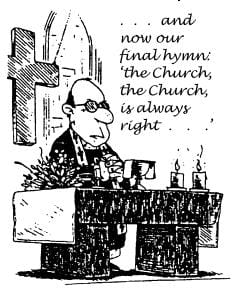
Church groups don’t often look favorably on oversight

Many groups don’t tolerate oversight of this type, and these groups should be viewed with suspicion. Church groups for example, are often led by those would like you to believe that suspicion of them is suspicion of God, it isn’t — it’s suspicion of a person. An honest leader gives the option of going to the police or the union representative, or the newspaper if necessary. Without redress, the worker/soldier/churchman may come to suffer needlessly or come to commit atrocities because of the power of the organization or the personal charisma of the leader. Any organization with a messianic vision of the future is dangerous; all the more so if there is no half-way point, no real sharing of power in the way to get there, and no real oversight for the grand-high pooh-bah (or whatever the grand leader’s title). Let the follower beware.

A Parable: The Donkey and the Brigands, by I don’t know who (I can’t find a source, but know this isn’t my own creation).

There once was a farmer who had a donkey — a talking donkey, as is the way with these parables. At one point, as they were traveling through the woods, they heard the approach of brigands (thieves). “Move quickly,” the farmer said to the donkey, otherwise we’ll be captured.” “Will the brigands treat me any worse than you do?” asked the donkey. “No,” said the farmer, about the same.” “Will they feed me any less than you do, or beat me any more?” “No,” said the farmer, about the same, I’d guess.” Will they load me any heavier, or make me go on longer journeys?” No, said the farmer, about the same, I’d guess.” “When I’m too old to work, will they keep me in my old age, or will they kill me, as you likely will for animal feed and for my bones and skin?” “Probably they’ll do as I would,” said the farmer. “In that case,” said the donkey, “I’ll go at my pace and what will be with the capture will be.” The moral: loyal service has to be a two-way street.

In part 2 of this essay, I’ll explain why even the leader doesn’t benefit from your complete loyalty.

Robert Buxbaum, October 20, 2014. I run my own business, and sometimes think about it, and life.

How do technology companies sell stuff?

As the owner of a technology company, REB Research, hydrogen generators and hydrogen purifiers, I spend a fair amount of time trying to sell my stuff, and wondering how other companies connect to potential customers and sell to them. Sales is perhaps the most important area of business success, the one that makes or breaks most businesses — but it was sadly ignored in my extensive college education. Business books are hardly better: they ignore the salesmen (and women); you’re left to imagine sales and profit came of themselves by the insight of the great leader. The great, successful internet companies are applauded for giving away services, and the failed interned companies are barely mentioned. And hardly any book mentions smaller manufacturing businesses, like mine.

So here are some sales thoughts: things I tried, things that worked, and didn’t. I started my company, REB Research, about 20 years ago as a professor at Michigan State University. I figured I knew more about hydrogen purifiers than most of my colleagues, and imagined this knowledge would bring me money (big mistake: I needed customers and profitable sales). My strategy was to publish papers on hydrogen and get some patents as a way to build credibility (worked reasonably well: I write well, do research well, and I’m reasonably inventive). Patents might have been a better strategy if I had not then allowed my patents to be re-written by lawyers. I built the company. while still a professor (a good idea, I think).

When I realized I needed sales, I decided to use trade fairs, conferences, and ads as the big companies did. Most of my budget went for ads in The Thomas Register of American Manufacturing, a fantastically large compendium of who did or sold what (it worked OK, but was since rendered obsolete by the internet). I bought $1500 worth of ads, and got 2 small lines plus a 1/8 page. That’s where I got my sales until the internet cam along. In retrospect, I suspect I should have bought more ads.

William Hamilton cartoon from the new-yorker. I sure wish I could make deals.

William Hamilton cartoon from the new-yorker.

My other big expense was trade fairs. Many big companies sold at trade fairs, events that are widely attended in my field. Sorry to say, I never found customers at these fairs, even when the fairs were dedicated to hydrogen, everyone who’d come by was was selling, and no one was buying, as best I could tell.Somehow, my bigger competitors (also at the fairs) seemed to get interest but I’m not sure if they got sales there. They seem to find sales somewhere, though. Is it me? Am I at the wrong fairs, or are fairs just a scam where no one wins but the organizers? I don’t know. Last month, I spent $2000 for a booth in Ann Arbor, MI, including $350 for inclusion into the promoter’s book and $400 for hand-out literature. As with previous events, few people came by and none showed anything like interest, I got no e-mail addresses and no sales. Some hungry students wandered the stalls for food and freebees, but there was not one person with money in his/her pocket and a relevant project to spend it on. I doubt anyone read the literature they took.

To date, virtually all of my sales have come from the internet. I got on the internet early, and that has helped my placement in Google. I’ve never bought a google ad, but this may change. Instead I was lucky. About 20 years ago, 1994?, I attended a conference at Tufts on membrane reactors, and stayed at a bed-and-breakfast. After the conference let out, the owner of the BnB suggested I visit something that was new at Harvard; a cyber cafe, the second one in the US. They had Macintosh computers and internet explorer a year before the company went public. I was hooked, went home, learned html, and wrote a web-site. I bought my domain name shortly thereafter.

The problem, I don’t know the next big thing. Twitter? Facebook? LinkedIn? I’m on 2 of these 3, and have gotten so sales from social media. I started a blog (you’re reading it), but I still wonder, why are the bigger companies selling more? The main difference I see is they attend a lot more product fairs than I do, have slicker web-sties (not very good ones, I think), and they do print advertising. Perhaps they match their fairs to their products better, or have a broader range of products. People need to see my products somewhere, but where? My latest idea: this week I bought HydrogenPurifier.com. Send me advice, or wish me luck.

Robert E. Buxbaum, flailing entrepreneur, September 10, 2014. Here’s a feedback form, the first time I’m adding one. 

Political tensegrity: the west is best

We are regularly lectured about the lack of kindness and humility of the western countries. Eastern and communist leaders in Russia, Iran, Saudi Arabia point to Western pollution, consumerism, unemployment as prof you need a strong leader and central control to do good by regulation, thought policing, and wealth redistribution.

Let me point out that the good these leaders provide is extracted from the populace, and the advantage of central control is rarely as clear to the populous as to the leadership. When leaders redistribute wealth or place limits on the internet, movies or books, the leaders are generally exempted, and the populous are not made more moral or generous either. One does not say a prisoner or slave-worker is more generous of moral than one on the outside despite the prisoner working for free. The leaders feel certain they are protecting their people from thought and greed, but it isn’t clear outside of the leadership that these dangers are as great as the danger of despotism or rule by whim.

Authors and thoughts are blocked in the East by the whim of a supreme leader who also determines who is an infidel or enemy, or friend, and which businesses should flourish, and who should be rich (his buddies). By contrast, two fundamentals of western society — things that lead to purported immorality, are citizen rights and the rule of law: that citizens can possess things and do things for their own reasons, or no reason at all, and that citizens may stand as equals before a bar of law, to be judged by spelled-out laws or freed, with equal believability and claim.

In Russia or Iran, the Commissar and Imam have special rights: they can take possessions from others at whim, shut down businesses at whim; imprison at whim  — all based on their own interpretation of God’s will, the Koran, or “the good of the state.” Only they can sense the true good, or the true God well enough to make these decisions and laws. And when they violate those laws they are protected from the consequences; the masses can be prosecuted to the full extent of the law, and then some, not even requiring a trial in many places (Gaza, for example) if the leader feels speed is needed. The rule of law with equal treatment is a fundamental of western civilization (republicanism). It is commanded by Moses in the Bible at least seven times: Numbers 15:15, Numbers 15:16, Numbers 15:29, Exodus 12:49, Numbers 9:14, and Leviticus 24:22, “One law and one ordinance you should have, for the home-born, and the foreigner who dwells among you.”

The equal treatment under the law: for rich and poor, king and commoner, citizen and foreigner is a revolutionary idea of the west; that justice is blind. Another idea is personal possessions and freedoms. There is no concept of equality under business law unless there is a business that you can own, and personal possessions and rights. These are not in place in eastern theocracies: they tend to treat the preachers (imams) better than non preachers because they are presumed smarter and better; similarly men are treated better than women, who have few rights, and the state religion is treated better than infidels. In communist countries and dictatorships the dictator can get away with anything. Admittedly, in capitalistic states the rich and powerful find loopholes while the poor find prison, but not always (our Detroit’s ex-mayor is in prison) and it’s not the law. A feature of Eastern theocracies and dictatorships is that they lack a free press, and thus no forum for public exposure of legal mischief.

Einstein on freedom producing good. I'd say freedom is also a good in itself

Einstein on freedom producing good. I’d say freedom is also a good in itself.

The strongest arguments for socialist dictatorship and theocracy is that this is needed to protect the weak. Clement Attlee (labor socialist British Prime Minister, 1945 -56) explained his government’s take over of almost all British business: “There was a time when employers were free to work little children for sixteen hours a day… when employers were free to employ sweated women workers on finishing trousers at a penny halfpenny a pair. There was a time when people were free to neglect sanitation so that thousands died of preventable diseases. For years every attempt to remedy these crying evils was blocked by the same plea of freedom for the individual. It was in fact freedom for the rich and slavery for the poor. Make no mistake, it has only been through the power of the State, given to it by Parliament, that the general public has been protected against the greed of ruthless profit-makers and property owners.”  (Quotes from Spartacus.edu). it’s a brilliant speech, and it taps into the government’s role in the common defense, but it’s not at all clear that a chinless bureaucrat will be a better boss than the capitalist who built the firm. Nor is it clear that you help people by preventing them from work at a salary you decide is too low

England suffered a malaise from public ownership and the distribution of profit by those close the liberal party. Under Attlee there was lack of food and coal while the rest of Europe, and particularly Germany prospered, and passed England in productivity. Germany had no minimum wage, and  still doesn’t have one. In eastern countries, ingenuity is deadened by the knowledge that whatever a genius or worker achieves is taken by the state and redistributed. A cute joke exchange: Churchill and Attlee are supposed to have found themselves in adjoining stalls of the men’s room of Parliament. Churchill is supposed to have moved as far as possible from Attlee. “Feeling standoffish, Winston” Attlee is supposed to have said. “No. Frightened. “Whenever you see something large you try to nationalize it.” Perhaps more telling is this Margret Thatcher’s comment, and exchange. Making everyone’s outcome equal does more to penalize those with real pride in their ideas and work than it does to help the truly needy.

While there is a need for government in regards to safety, roads, and standards, and to maintain that equality of law. It seems to me the state should aid the poor only to the extent that it does not turn them into dependents. There is thus a natural tension between private good and public service similar to the tensegrity that holds cells together. Capitalists can only make money by providing desired goods and services at worthwhile rate, and paying enough to keep workers; they should be allowed to keep some of that, while some must be taken from them to get great things done. I’ve related the tensegrity of society to the balance between order and disorder in a chemical system.

Robert E. Buxbaum August 27, 2014. This essay owes special thanks to a Princeton chum, Val Martinez. Though my training is in engineering, I’ve written hobby pieces on art, governance, history, and society. Check out the links at right.