Category Archives: Business

How do technology companies sell stuff?

As the owner of a technology company, REB Research, hydrogen generators and hydrogen purifiers, I spend a fair amount of time trying to sell my stuff, and wondering how other companies connect to potential customers and sell to them. Sales is perhaps the most important area of business success, the one that makes or breaks most businesses — but it was sadly ignored in my extensive college education. Business books are hardly better: they ignore the salesmen (and women); you’re left to imagine sales and profit came of themselves by the insight of the great leader. The great, successful internet companies are applauded for giving away services, and the failed interned companies are barely mentioned. And hardly any book mentions smaller manufacturing businesses, like mine.

So here are some sales thoughts: things I tried, things that worked, and didn’t. I started my company, REB Research, about 20 years ago as a professor at Michigan State University. I figured I knew more about hydrogen purifiers than most of my colleagues, and imagined this knowledge would bring me money (big mistake: I needed customers and profitable sales). My strategy was to publish papers on hydrogen and get some patents as a way to build credibility (worked reasonably well: I write well, do research well, and I’m reasonably inventive). Patents might have been a better strategy if I had not then allowed my patents to be re-written by lawyers. I built the company. while still a professor (a good idea, I think).

When I realized I needed sales, I decided to use trade fairs, conferences, and ads as the big companies did. Most of my budget went for ads in The Thomas Register of American Manufacturing, a fantastically large compendium of who did or sold what (it worked OK, but was since rendered obsolete by the internet). I bought $1500 worth of ads, and got 2 small lines plus a 1/8 page. That’s where I got my sales until the internet cam along. In retrospect, I suspect I should have bought more ads.

William Hamilton cartoon from the new-yorker. I sure wish I could make deals.

William Hamilton cartoon from the new-yorker.

My other big expense was trade fairs. Many big companies sold at trade fairs, events that are widely attended in my field. Sorry to say, I never found customers at these fairs, even when the fairs were dedicated to hydrogen, everyone who’d come by was was selling, and no one was buying, as best I could tell.Somehow, my bigger competitors (also at the fairs) seemed to get interest but I’m not sure if they got sales there. They seem to find sales somewhere, though. Is it me? Am I at the wrong fairs, or are fairs just a scam where no one wins but the organizers? I don’t know. Last month, I spent $2000 for a booth in Ann Arbor, MI, including $350 for inclusion into the promoter’s book and $400 for hand-out literature. As with previous events, few people came by and none showed anything like interest, I got no e-mail addresses and no sales. Some hungry students wandered the stalls for food and freebees, but there was not one person with money in his/her pocket and a relevant project to spend it on. I doubt anyone read the literature they took.

To date, virtually all of my sales have come from the internet. I got on the internet early, and that has helped my placement in Google. I’ve never bought a google ad, but this may change. Instead I was lucky. About 20 years ago, 1994?, I attended a conference at Tufts on membrane reactors, and stayed at a bed-and-breakfast. After the conference let out, the owner of the BnB suggested I visit something that was new at Harvard; a cyber cafe, the second one in the US. They had Macintosh computers and internet explorer a year before the company went public. I was hooked, went home, learned html, and wrote a web-site. I bought my domain name shortly thereafter.

The problem, I don’t know the next big thing. Twitter? Facebook? LinkedIn? I’m on 2 of these 3, and have gotten so sales from social media. I started a blog (you’re reading it), but I still wonder, why are the bigger companies selling more? The main difference I see is they attend a lot more product fairs than I do, have slicker web-sties (not very good ones, I think), and they do print advertising. Perhaps they match their fairs to their products better, or have a broader range of products. People need to see my products somewhere, but where? My latest idea: this week I bought HydrogenPurifier.com. Send me advice, or wish me luck.

Robert E. Buxbaum, flailing entrepreneur, September 10, 2014. Here’s a feedback form, the first time I’m adding one. 

Political tensegrity: the west is best

We are regularly lectured about the lack of kindness and humility of the western countries. Eastern and communist leaders in Russia, Iran, Saudi Arabia point to Western pollution, consumerism, unemployment as prof you need a strong leader and central control to do good by regulation, thought policing, and wealth redistribution.

Let me point out that the good these leaders provide is extracted from the populace, and the advantage of central control is rarely as clear to the populous as to the leadership. When leaders redistribute wealth or place limits on the internet, movies or books, the leaders are generally exempted, and the populous are not made more moral or generous either. One does not say a prisoner or slave-worker is more generous of moral than one on the outside despite the prisoner working for free. The leaders feel certain they are protecting their people from thought and greed, but it isn’t clear outside of the leadership that these dangers are as great as the danger of despotism or rule by whim.

Authors and thoughts are blocked in the East by the whim of a supreme leader who also determines who is an infidel or enemy, or friend, and which businesses should flourish, and who should be rich (his buddies). By contrast, two fundamentals of western society — things that lead to purported immorality, are citizen rights and the rule of law: that citizens can possess things and do things for their own reasons, or no reason at all, and that citizens may stand as equals before a bar of law, to be judged by spelled-out laws or freed, with equal believability and claim.

In Russia or Iran, the Commissar and Imam have special rights: they can take possessions from others at whim, shut down businesses at whim; imprison at whim  — all based on their own interpretation of God’s will, the Koran, or “the good of the state.” Only they can sense the true good, or the true God well enough to make these decisions and laws. And when they violate those laws they are protected from the consequences; the masses can be prosecuted to the full extent of the law, and then some, not even requiring a trial in many places (Gaza, for example) if the leader feels speed is needed. The rule of law with equal treatment is a fundamental of western civilization (republicanism). It is commanded by Moses in the Bible at least seven times: Numbers 15:15, Numbers 15:16, Numbers 15:29, Exodus 12:49, Numbers 9:14, and Leviticus 24:22, “One law and one ordinance you should have, for the home-born, and the foreigner who dwells among you.”

The equal treatment under the law: for rich and poor, king and commoner, citizen and foreigner is a revolutionary idea of the west; that justice is blind. Another idea is personal possessions and freedoms. There is no concept of equality under business law unless there is a business that you can own, and personal possessions and rights. These are not in place in eastern theocracies: they tend to treat the preachers (imams) better than non preachers because they are presumed smarter and better; similarly men are treated better than women, who have few rights, and the state religion is treated better than infidels. In communist countries and dictatorships the dictator can get away with anything. Admittedly, in capitalistic states the rich and powerful find loopholes while the poor find prison, but not always (our Detroit’s ex-mayor is in prison) and it’s not the law. A feature of Eastern theocracies and dictatorships is that they lack a free press, and thus no forum for public exposure of legal mischief.

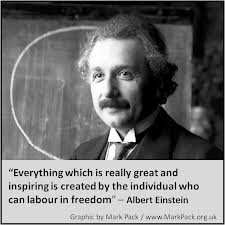
Einstein on freedom producing good. I'd say freedom is also a good in itself

Einstein on freedom producing good. I’d say freedom is also a good in itself.

The strongest arguments for socialist dictatorship and theocracy is that this is needed to protect the weak. Clement Attlee (labor socialist British Prime Minister, 1945 -56) explained his government’s take over of almost all British business: “There was a time when employers were free to work little children for sixteen hours a day… when employers were free to employ sweated women workers on finishing trousers at a penny halfpenny a pair. There was a time when people were free to neglect sanitation so that thousands died of preventable diseases. For years every attempt to remedy these crying evils was blocked by the same plea of freedom for the individual. It was in fact freedom for the rich and slavery for the poor. Make no mistake, it has only been through the power of the State, given to it by Parliament, that the general public has been protected against the greed of ruthless profit-makers and property owners.”  (Quotes from Spartacus.edu). it’s a brilliant speech, and it taps into the government’s role in the common defense, but it’s not at all clear that a chinless bureaucrat will be a better boss than the capitalist who built the firm. Nor is it clear that you help people by preventing them from work at a salary you decide is too low

England suffered a malaise from public ownership and the distribution of profit by those close the liberal party. Under Attlee there was lack of food and coal while the rest of Europe, and particularly Germany prospered, and passed England in productivity. Germany had no minimum wage, and  still doesn’t have one. In eastern countries, ingenuity is deadened by the knowledge that whatever a genius or worker achieves is taken by the state and redistributed. A cute joke exchange: Churchill and Attlee are supposed to have found themselves in adjoining stalls of the men’s room of Parliament. Churchill is supposed to have moved as far as possible from Attlee. “Feeling standoffish, Winston” Attlee is supposed to have said. “No. Frightened. “Whenever you see something large you try to nationalize it.” Perhaps more telling is this Margret Thatcher’s comment, and exchange. Making everyone’s outcome equal does more to penalize those with real pride in their ideas and work than it does to help the truly needy.

While there is a need for government in regards to safety, roads, and standards, and to maintain that equality of law. It seems to me the state should aid the poor only to the extent that it does not turn them into dependents. There is thus a natural tension between private good and public service similar to the tensegrity that holds cells together. Capitalists can only make money by providing desired goods and services at worthwhile rate, and paying enough to keep workers; they should be allowed to keep some of that, while some must be taken from them to get great things done. I’ve related the tensegrity of society to the balance between order and disorder in a chemical system.

Robert E. Buxbaum August 27, 2014. This essay owes special thanks to a Princeton chum, Val Martinez. Though my training is in engineering, I’ve written hobby pieces on art, governance, history, and society. Check out the links at right.

High minimum wages hurt the poor; try a negative tax

It is generally thought (correctly I suspect) that welfare is a poor way to help the poor as it robs them of the dignity of work. Something like welfare is needed to keep the poor from starving, and the ideal alternative to welfare seems to be a minimal job — that is one that is easy enough for a minimally skilled worker to do it, and high-paying enough so that this worker is able to support a family of 4. Such jobs are hard to produce, and hard to sell to those currently getting welfare — that is those getting paid the same amount for no work at all. I’d like to propose something better, a negative tax along with the removal of our minimum wage.

I suspect that our current system of minimum wage hurts the desperate poor and middle class at least as much as it helps the working poor. One problem with it is that it flattens the wage structure, hurting the ego and incentive of those who work harder or with higher skills. The minimum wage encourages lax work, and reduces the incentive of workers to improve. A higher talented or more experienced worker should make more than an unskilled beginner, but with the current minimum wages they hardly do. Our high minimum wage also hurts the desperate poor by cutting the lower rungs off of the employment ladder. Poor, unskilled, young folks are not hired because it will take a while before they’re productive enough to justify the minimum wage. And anyway, why should the minimum wage number assume that every worker lives independently (or should) and that every job deserves to support a family of four. Most unskilled workers are neither independent nor are they supporting a family of four. Most unskilled workers are not independent, nor are they the sole support of a family.

I suspect that people push for high minimum wages as a way to help without giving themselves. The cost is borne by the company, and companies are seen as evil, faceless oppressors. They prefer not to notice that the a high minimum wage creates high unemployment in central cities and other low skill areas, like Detroit before bankruptcy, and Puerto Rico today. In Detroit before bankruptcy, the living wage was set so high that companies could not compete and went bankrupt or fled. The ones that stayed hired so selectively that the unskilled were basically unemployable. Even the city couldn’t pay its wages and bills.

A high minimum wage increases the need for welfare, as some workers will be unemployable — because of disability, because of lack of skill, or from an ingrained desire to not work. The punishments a community can mete out are limited, and sooner or later some communities stop working and stop learning as they see no advantage.

The difficulties of taking care of the genuinely needy and disabled while the lazy and unskilled has gotten even some communist to reconsider wealth as a motivator. The Chinese have come to realize that workers work better at all levels if there is a financial reward to experience and skill at all levels. But that still leaves the question of who should pay to help those in need and how.  Currently the welfare system only helps the disabled and the “looking” unemployed, but I suspect they should do more replacing some of the burden that our minimum wage laws places on the employers of unskilled labor. But I suspect the payment formula should be such that the worker ends up richer for every additional hour of work. That is, each dollar earned by a welfare recipient should result in less than one dollar reduction in welfare payment. Welfare would thus be set up as a negative tax that would continue to all levels of salary and need so that there is no sudden jump when the worker suddenly starts having to pay taxes. The current and proposed tax / welfare structure is shown below:

Currently someone's welfare check decreases by $1 for each dollar earned. I propose a system of negative tax (less than 100%) so each dollar earned puts a good fraction in his/her pocket.

Currently (black) someone’s welfare check decreases by $1 for each dollar earned, then he enters a stage of no tax — one keeps all he earns, and then a graduated tax. I propose a system of negative tax (red) so each dollar earned adds real income.

The system I propose (red line) would treat identically someone who is  incapacitated as someone who decided not to work, or to work at a job that paid $0/hr (e.g. working for a church). In the current system treats them differently, but there seems to be so much law and case-work and phony doctor reports involved in getting around it all that it hardly seems worth it. I’d use money as the sole motivator (all theoretical, and it may not work, but hang with me for now).

In the proposed system, a person who does not work would get some minimal income based on family need (there is still some need for case workers). If they are employed the employer would not have to pay minimum wage (or there would be a low minimum wage — $3/hr) but the employer would have to report the income and deduct, for every dollar earned some fraction in tax — 40¢ say. The net result would be that the amount of government subsidy received by the worker (disabled or not) would decrease by, for 40¢ for every dollar earned. At some salary the worker would discover that he/she was paying net tax and no longer receiving anything from the state. With this system, there is always an incentive to work more hours or develop more skills. If the minimum wage were removed too, there would be no penalty to hiring a completely unskilled worker.

At this point you may ask where the extra money will come from. In the long run, I hope the benefit comes from the reduced welfare rolls, but in the short-term, let me suggest tariffs. Tariffs can raise income and promote on-shore production. Up until 1900 or so, they were the main source of revenue for the USA. As an experiment, to see if this system works, it could be applied to enterprise zones, e.g. in Detroit.

R. E. Buxbaum, June 27, 2014. I worked out the math for this while daydreaming in an economics lecture. It strikes me as bizarre, by the way, that one can contract labor for barter, pay a pizza for two hours labor, but you can’t contract labor for less than the minimum cash-rate $7.45/hr. You can go to jail by paying less than this in cash, but not in food. In Canada they have something even more bizarre: equal wages for equal skills — a cook and a manager must earn the same, independent of how well the cook cooks or how needed the work is. No wonder violent crime is higher in Canada.

My solution to the world’s problems: better people

Most of the problems of the world are caused by people. Look at war, it’s caused by people; look at pollution, people; look at overeating, or welfare, or gun violence. You name it, the problem is people. My simple solution, then: better people. Immigration is a simple solution for a county that can do it selectively (take in the best, leave the rest); it’s worked for the US and it doesn’t have to beggar the third world. Education is another way to help, but we’re not quite sure what sort of education makes people better. “An uneducated man may steel from a boxcar, an educated one may steal the whole railroad.” Theodore Roosevelt is supposed to have quipped.

Those who claim they are uncommonly moral and good at teaching have barely any proof that they are. American schools produce financially successful people, but not particularly moral ones; Europe’s approach is different, but there’s no indication they’ve done better at moral education. We look to the 18th century, or the Greeks, but they were no more moral than us, as best I can tell. The Taliban, the communists, or similar fundamentalists claim moral superiority over the west, but from my perspective, they look even worse. 

I notice that people learn morality from one another — that is each person acts like his neighbor. I also note that people tend to act better when they are involved, and feel part of whatever country, city or group they are in. Targeted immigration might bring in better people–honest, hard working, non-violent — and these people might help improve and motivate the locals. And even if we don’t improve by interaction, perhaps lazy Americans will ride on the backs of the hard-working immigrants. But it strikes me that the disconnect between world problems of high unemployment, world hunger, and lots of open, US jobs is a moral problem that could be solved by targeted love. Allowing some increased mobility from country to country and job to job (plus better preaching?). If you can move you are more-likely to find a job or place where you feel fulfilled, and you are likely to do better and more there. Even the countries and jobs that are left might benefit by being rid of their malcontents. And we don’t have to take everyone.

From "Hispanic-hope."

From “Hispanic-hope.”, an interesting combination of Bible-study and immigration morality.

Living in America is desirable for most people from most countries. Far more people want to live here than we can accept. As a result, we are in a position to target the bright, honest, hard-working Peoples from virtually any country. These folks are helpful to industry and to the US tax base as these immigrants tend to work out — or get deported. In the short-term they might displace Americans or depress salaries, but even that is not certain. There is no fixed slate of US jobs nor a fixed amount of work need. Yesterday’s job taker is tomorrow’s job creator. Our country is built on immigrants, and has not suffered from it. We should not take those who hate the US, or those who hate freedom, or have no skills, criminals and the sick. Nor should we give citizenship immediately. But that still leaves plenty who we’d want, and who want to be here. Th. Roosevelt said, “you can not take in too many of the right people, and even one of the wrong type is too many.” I suspect this is true.

I suspect we’d have 90+% odds picking good people from a crowd. The Immigration system does a good job now, and the great colleges have done better for years. The past is usually a great indicator. If someone is well, and has worked for years, or has been here in school; if they’ve managed to stay productive and out of trouble, he/she is a good candidate. A first step would be a work permit, and in a few years they can apply for permanent residence or citizenship. Many of the most successful people in America are either immigrants or descendents of immigrants. The founders of Google and Facebook; the builders and the shakers. These people have the ‘get-up and go.’ You can tell because they’ve gotten up and gone.

Dr. Robert Buxbaum, June 16, 2014. I’m a child of an immigrant, went to public school, got a PhD at Princeton, have built my own company, and have (so far) avoided arrest, imprisonment or serious scandal. With the help of my Canadian-immigrant wife, I’ve produced three Buxbaum clones, my biggest contribution to improving the US and the world.

The future of steamships: steam

Most large ships and virtually all locomotives currently run on diesel power. But the diesel  engine does not drive the wheels or propeller directly; the transmission would be too big and complex. Instead, the diesel engine is used to generate electric power, and the electric power drives the ship or train via an electric motor, generally with a battery bank to provide a buffer. Current diesel generators operate at 75-300 rpm and about 40-50% efficiency (not bad), but diesel fuel is expensive. It strikes me, therefore that the next step is to switch to a cheaper fuel like coal or compressed natural gas, and convert these fuels to electricity by a partial or full steam cycle as used in land-based electric power plants

Ship-board diesel engine, 100 MW for a large container ship

Diesel engine, 100 MW for a large container ship

Steam powers all nuclear ships, and conventionally boiled steam provided the power for thousands of Liberty ships and hundreds of aircraft carriers during World War 2. Advanced steam turbine cycles are somewhat more efficient, pushing 60% efficiency for high pressure, condensed-turbine cycles that consume vaporized fuel in a gas turbine and recover the waste heat with a steam boiler exhausting to vacuum. The higher efficiency of these gas/steam turbine engines means that, even for ships that burn ship-diesel fuel (so-called bunker oil) or natural gas, there can be a cost advantage to having a degree of steam power. There are a dozen or so steam-powered ships operating on the great lakes currently. These are mostly 700-800 feet long, and operate with 1950s era steam turbines, burning bunker oil or asphalt. US Steel runs the “Arthur M Anderson”, Carson J Callaway” , “John G Munson” and “Philip R Clarke”, all built-in 1951/2. The “Upper Lakes Group” runs the “Canadian Leader”, “Canadian Provider”, “Quebecois”, and “Montrealais.” And then there is the coal-fired “Badger”. Built in 1952, the Badger is powered by two, “Skinner UniFlow” double-acting, piston engines operating at 450 psi. The Badger is cost-effective, with the low-cost of the fuel making up for the low efficiency of the 50’s technology. With larger ships, more modern boilers and turbines, and with higher pressure boilers and turbines, the economics of steam power would be far better, even for ships with modern pollution abatement.

Nuclear steam boilers can be very compact

Nuclear steam boilers can be very compact

Steam powered ships can burn fuels that diesel engines can’t: coal, asphalts, or even dry wood because fuel combustion can be external to the high pressure region. Steam engines can cost more than diesel engines do, but lower fuel cost can make up for that, and the cost differences get smaller as the outputs get larger. Currently, coal costs 1/10 as much as bunker oil on a per-energy basis, and natural gas costs about 1/5 as much as bunker oil. One can burn coal cleanly and safely if the coal is dried before being loaded on the ship. Before burning, the coal would be powdered and gassified to town-gas (CO + H2O) before being burnt. The drying process removes much of the toxic impact of the coal by removing much of the mercury and toxic oxides. Gasification before combustion further reduces these problems, and reduces the tendency to form adhesions on boiler pipes — a bane of old-fashioned steam power. Natural gas requires no pretreatment, but costs twice as much as coal and requires a gas-turbine, boiler system for efficient energy use.

Todays ships and locomotives are far bigger than in the 1950s. The current standard is an engine output about 50 MW, or 170 MM Btu/hr of motive energy. Assuming a 50% efficient engine, the fuel use for a 50 MW ship or locomotive is 340 MM Btu/hr; locomotives only use this much when going up hill with a heavy load. Illinois coal costs, currently, about $60/ton, or $2.31/MM Btu. A 50 MW engine would consume about 13 tons of dry coal per hour costing $785/hr. By comparison, bunker oil costs about $3 /gallon, or $21/MM Btu. This is nearly ten times more than coal, or $ 7,140/hr for the same 50 MW output. Over 30 years of operation, the difference in fuel cost adds up to 1.5 billion dollars — about the cost of a modern container ship.

Robert E. Buxbaum, May 16, 2014. I possess a long-term interest in economics, thermodynamics, history, and the technology of the 1800s. See my steam-pump, and this page dedicated to Peter Cooper: Engineer, citizen of New York. Wood power isn’t all that bad, by the way, but as with coal, you must dry the wood, or (ideally) convert it to charcoal. You can improve the power and efficiency of diesel and automobile engines and reduce the pollution by adding hydrogen. Normal cars do not use steam because there is more start-stop, and because it takes too long to fire up the engine before one can drive. For cars, and drone airplanes, I suggest hydrogen/ fuel cells.

Dada, or it’s hard to look cool sucking on a carrot.

When it’s done right, Dada art is cool. It’s not confusing or preachy; it’s not out there, or sloppy; just cool. And today I found the most wonderful Dada piece: “Attention”, by Gabriel -Belladonna, shown below from “deviant art” (sorry about the water-mark).

At first glance it’s an advertisement against smoking, drinking, and eating sweets. The smoker has blackened lungs, the drinker has an enlarged liver, and the eater of sweets a diseased stomach. But something here isn’t right; the sinners are happy and young. These things are clearly bad for you but they’re enjoyable too and “cool” — Smoking is a lot cooler than sucking on a carrot.

Dada at it's best: Attention by Mio Belladonna. The sinners are happy.

Dada at it’s best: “Attention” by Dadaist Gabriel (Mio) Belladonna, 2012; image from deviant art. If I were to choose the title it would be “But it’s hard to look cool sucking on a carrot.”

At its best, Dada turns advertising and art on its head; it uses the imagery of advertising to show the shallowness of that, clearly slanted medium, or uses art-museum settings to show the narrow definition of what we’ve come to call “art”. In the above you see the balance of life- reality and the mind control of advertising.

Marcel Duchamp's fountain and "Manikken Pis" Similar idea, Manikken is better executed, IMHO.

Marcel Duchamp’s fountain and “Manikken Pis.”

Any mention of dada should also, I suppose, mention Duchamp’s fountain (at right, signed fancifully by R. Mutt). In 2004, fountain was voted “the most influential artwork of the 20th century” by a panel of artists and art historians. The basic idea was to show the slight difference between art and not-art (to be something, there has to be a non-something, as in this joke). Beyond this, the idea would be that same as for the Manikken Pis sculpture in Brussels. Duchamp’s was done with a lot less work — just by signing a “found object.” He submitted the work for exhibition in 1917, but it was rejected as not being art — proving, I guess, the point. Fountain is related to man: his life, needs, and vain ambitions; it’s sort-of beautiful, so why ain’t it art? (It has something to do with skill, I’d say.)

Duchamp designed two major surrealist exhibitions — a similar approach, but surrealism typically employs more skill and humor than Dada, with less shock. Below is another famous work of dada, Oppenheim’s fur-lined tea-cup (Breakfast in fur — see it at the Modern Museum in NYC) compared to a wonderful (and in my mind similar) surreal work, “Ruby lips” by Dali. Oppenheim made the tea-cup and spoon disgusting by making it out of a richer material, fur. That’s really cool, and sort-of shocking, even today.

Duchap's tea cup (left), and Dali's ruby lips (right). Similar ideas treated as Dada or Surreal.

Meret Oppenheim’s fur tea-cup (Breakfast in fur) and Dali’s ruby lips; the same idea (I think); dada vs surreal.

Dali’s “ruby libs” brooch took more skill than gluing fur to a cup and spoon; that adds to the humor, I’d say, but took from the shock. It’s made from real rubies and pearls: hard materials for something that should be soft; it’s sort of disgusting this way, and the message is more or less the same as Oppenheim’s, I’d say, but the message gets a little lost in the literal joke (pearly teeth, ruby lips…). I could imagine someone wearing Dali’s brooch, but no one would use the fur-lined cup. 

There is a lot of bad dada, too unfortunately, and it tends to be awful: incomprehensible, trite, or advertising. An unfortunate tendency is to collect some found pieces of garbage, and set it out in an attempt to scandalize the art world, or put down “the man” for his closed mindset. But that’s fountain, and it’s been done. A key way to tell if it’s good dada — is it cool; is it something that makes you say “Wow.” Christo’s surrounded islands certainly have the wow-cool factor, IMHO. 

Christo's wrapped Islands. Islands near Miami Beach wrapped in pink (fuscha) plastic.

Christo’s surrounded Islands: Islands near Miami Beach wrapped in pink (fuchsia) plastic.

A nice thing about Christo is that he takes it down 2 weeks or so after he makes the sculptures. Thus, the wow factor of his work never has a chance to go stale. Sorry to say, most dada stays around. Duchamp’s “fountain” sits in a museum and has grown stale, at least to me and Duchamp. What was scandalous and shocking in 1917 is passé and boring in 2014. The decline in shock is somewhat less for “breakfast in fur,” I think because the work is better crafted, a benefit I see in “Attention” too; skill matters.

Paris Street art. I don't know the artist, but it's cool.

Paris Street art; it’s just cool.

At the height of his success, Duchamp left art for 30 years and played chess. He became a chess grand master (life is as strange as art) and played for France in international tournaments. He later came back to art and did one, last, final piece, a very fine one, seen only through a peephole. Here’s some further thoughts on good vs bad modern art, and on surrealism, and on the aesthetic of strength in engineering: what materials to use; how strong should it be, and on architecture humor

Robert E. Buxbaum. April 4-7, 2014. Here is a link to my attempt at good Dada: Kilroy with eyes that follow you, and at right some Paris street art that I consider good dada too. As far as what the word “dada” means, I translate it as “cool,” “wow,” “gnarly,” or “go go.” It’s dada, man, y’ dig?

In praise of tariffs

In a previous post I noted that we could reduce global air pollution if we used import taxes (tariffs) to move manufacture to the US from China and other highly polluting countries. It strikes me that import tariffs can have other benefits too, they can keep US jobs in the US, provide needed taxes, and they’re a tool of foreign policy. We buy far more from China and Russia than they buy from us, and we get a fair amount of grief — especially from Russia. An appropriate-sized tariff should reduce US unemployment, help balance the US, and help clean the air while pushing Russia in an alternative to war-talk.

There is certainly such a thing as too high a tariff, but it seems to me we’re nowhere near that. Too high a tariff is only when it severely limits the value of our purchasing dollar. We can’t eat dollars, and want to be able to buy foreign products with them. Currently foreign stuff is so cheap thought, that what we import is most stuff we used to make at home — often stuff we still make to a small extent, like shoes, ties, and steel. An import tax can be bad when it causes other countries to stop buying from us, but that’s already happened. Except for a very few industries, Americans buy far more abroad than we sell. As a result, we have roughly 50% of Americans out of well-paying work, and on some form government assistance. Our government spends far more to care for us, and to police and feed the world than it could possibly take in, in taxes. It’s a financial imbalance that could be largely corrected if we bought more from US manufacturers who employ US workers who’d pay taxes and not draw unemployment. Work also benefits folks by developing, in them, skills and self-confidence.

Cartoon by Daryl Cagle. Now why is Russia a most favorable trade partner?

Cartoon by Daryl Cagle. Trade as foreign policy. Why is Russia a most favorable trade partner?

In a world without taxes or unemployment, and free of self-confidence issues, free trade might be ideal, but taxes and unemployment are a big part of US life. US taxes pay for US roads and provide for education and police. Taxes pay for the US army, and for the (free?) US healthcare. With all these tax burdens, it seems reasonable to me that foreign companies should pay at least 5-10% — the amount an American company would if the products were made here. Tariff rates could be adjusted for political reasons (cartoon), or environmental — to reduce air pollution. Regarding Russia, I find it bizarre that our president just repealed the Jackson Vanik tariff, thus giving Russia most favored trade status. We should (I’d think) reinstate the tax and ramp it up or down if Russia invades again or if they help us with Syria or Iran.

A history of US tariff rates. There is room to put higher tariffs on some products or some countries.

A history of US tariff rates. Higher rates on some products and some countries did not harm the US for most of our history.

For most of US history, the US had much higher tariffs than now, see chart. In 1900 it averaged 27.4% and rose to 50% on dutiable items. Our economy did OK in 1900. By 1960, tariffs had decreased to 7.3% on average (12% on duty-able) and the economy was still doing well. Now our average tariff is 1.3%, and essentially zero for most-favored nations, like Russia. Compare this to the 10% that New York applies to in-state sales, or the 6% Michigan applies, or the 5.5% that Russia applies to goods imported from the US. Why shouldn’t we collect at least as high a tax on products bought from the non-free, polluting world as we collect from US manufacturers.

Some say tariffs caused the Great Depression. Countries with lower tariffs saw the same depression. Besides the Smoot-Hawley was 60%, and I’s suggesting 5-10% like in 1960. Many countries today do fine today with higher tariffs than that.

Robert E. Buxbaum, March 25, 2014. Previous historical posts discussed the poor reviews of Lincoln’s Gettysburg address, and analyzed world war two in terms of mustaches. I’ve also compared military intervention to intervening in a divorce dispute. My previous economic post suggested that Detroit’s very high, living wage hurt the city by fostering unemployment.

Ivanpah’s solar electric worse than trees

Recently the DoE committed 1.6 billion dollars to the completion of the last two of three solar-natural gas-electric plants on a 10 mi2 site at Lake Ivanpah in California. The site is rated to produce 370 MW of power, in a facility that uses far more land than nuclear power, at a cost significantly higher than nuclear. The 3900 MW Drax plant (UK) cost 1.1 Billion dollars, and produces 10 times more power on a much smaller site. Ivanpah needs a lot of land because its generators require 173,500 billboard-size, sun-tracking mirrors to heat boilers atop three 750 foot towers (2 1/2 times the statue of liberty). The boilers feed steam to low pressure, low efficiency (28% efficiency) Siemens turbines. At night, natural gas provides heat to make the steam, but only at the same, low efficiency. Siemens makes higher efficiency turbine plants (59% efficiency) but these can not be used here because the solar oven temperature is only 900°F (500°C), while normal Siemens plants operate at 3650°F (2000°C).

The Ivanpau thermal solar-natural gas project will look like The Crescent Dunes Thermal-solar project shown here, but will be bigger.

The first construction of the Ivanpah thermal solar-natural-gas project; Each circle mirrors extend out to cover about 2 square miles of the 10mi2 site.

So far, the first of the three towers is operational, but it has been producing at only 30% of rated low-efficiency output. These are described as “growing pains.” There are also problems with cooked birds, blinded pilots, and the occasional fire from the misaligned death ray — more pains, I guess. There is also the problem of lightning. When hit by lightning the mirrors shatter into millions of shards of glass over a 30 foot radius, according to Argus, the mirror cleaning company. This presents a less-than attractive environmental impact.

As an exercise, I thought I’d compare this site’s electric output to the amount one could generate using a wood-burning boiler fed by trees growing on a similar sized (10 sq. miles) site. Trees are cheap, but only about 10% efficient at converting solar power to chemical energy, thus you might imagine that trees could not match the power of the Ivanpah plant, but dry wood burns hot, at 1100 -1500°C, so the efficiency of a wood-powered steam turbine will be higher, about 45%. 

About 820 MW of sunlight falls on every 1 mi2 plot, or 8200 MW for the Ivanpah site. If trees convert 10% of this to chemical energy, and we convert 45% of that to electricity, we find the site will generate 369 MW of electric power, or exactly the output that Ivanpah is rated for. The cost of trees is far cheaper than mirrors, and electricity from wood burning is typically cost 4¢/kWh, and the environmental impact of tree farming is likely to be less than that of the solar mirrors mentioned above. 

There is another advantage to the high temperature of the wood fire. The use of high temperature turbines means that any power made at night with natural gas will be produced at higher efficiency. The Ivanpah turbines output at low temperature and low efficiency when burning natural gas (at night) and thus output half the half the power of a normal Siemens plant for every BTU of gas. Because of this, it seems that the Ivanpah plant may use as much natural gas to make its 370 MW during a 12 hour night as would a higher efficiency system operating 24 hours, day and night. The additional generation by solar thus, might be zero. 

If you think the problems here are with the particular design, I should also note that the Ivanpah solar project is just one of several our Obama-government is funding, and none are doing particularly well. As another example, the $1.45 B solar project on farmland near Gila Bend Arizona is rated to produce 35 MW, about 1/10 of the Ivanpah project at 2/3 the cost. It was built in 2010 and so far has not produced any power.

Robert E. Buxbaum, March 12, 2014. I’ve tried using wood to make green gasoline. No luck so far. And I’ve come to doubt the likelihood that we can stop global warming.

Where does industrial CO2 come from? China mostly.

The US is in the process of imposing strict regulations on carbon dioxide as a way to stop global warming and climate change. We have also closed nearly new power plants, replacing them with cleaner options like a 2.2 billion dollar solar-electric generator in lake Ivanpah, and this January our president imposed a ban on lightbulbs of 60 W and higher. But it might help to know that China produced twice as much of the main climate change gas, carbon dioxide (CO2) as the US in 2012, and the ratio seems to be growing. One reason China produces so much CO2 is that China generates electricity from dirty coal using inefficient turbines.

Where the CO2 is coming from: a fair amount from the US and Europe, but mostly from China and India too.

From EDGAR 4.2; As of 2012 twice as much carbon dioxide, CO2 is coming from China as from the US and Europe.

It strikes me that a good approach to reducing the world’s carbon-dioxide emissions is to stop manufacturing so much in China. Our US electric plants use more efficient generating technology and burn lower carbon fuels than China does. We then add scrubbers and pollution reduction equipment that are hardly used in China. US manufacture thus produces not only less carbon dioxide than China, it also avoids other forms of air pollution, like NOx and SOx. Add to this the advantage of having fewer ships carrying products to and from China, and it’s clear that we could significantly reduce the world’s air problems by moving manufacture back to the USA.

I should also note that manufacture in the US helps the economy by keeping jobs and taxes here. A simple way to reduce purchases from China and collect some tax revenue would be to impose an import tariff on Chinese goods based, perhaps on the difference in carbon emissions or other pollution involved in Chinese manufacture and transport. While I have noted a lack of global warming, sixteen years now, that doesn’t mean I like pollution. It’s worthwhile to clean the air, and if we collect tariffs from the Chinese and help the US economy too, all the better.

Robert E. Buxbaum, February 24, 2014. Nuclear power produces no air pollution and uses a lot less land area compared to solar and wind projects.

Hydrogen cars and buses are better than Tesla

Hydrogen fueled cars and buses are as clean to drive as battery vehicles and have better range and faster fueling times. Cost-wise, a hydrogen fuel tank is far cheaper and lighter than an equivalent battery and lasts far longer. Hydrogen is likely safer because the tanks do not carry their oxidant in them. And the price of hydrogen is relatively low, about that of gasoline on a per-mile basis: far lower than batteries when the cost of battery wear-out is included. Both Presidents Clinton and Bush preferred hydrogen over batteries, but the current administration favors batteries. Perhaps history will show them correct, but I think otherwise. Currently, there is not a hydrogen bus, car, or boat making runs at Disney’s Experimental Community of Tomorrow (EPCOT), nor is there an electric bus car or boat. I suspect it’s a mistake, at least convening the lack of a hydrogen vehicle. 

The best hydrogen vehicles on the road have more range than the best electric vehicle, and fuel faster. The hydrogen powered, Honda Clarity debuted in 2008. It has a 270 mile range and takes 3-5 minutes to fuel with hydrogen at 350 atm, 5150 psi. By contrast, the Tesla S-sedan that debuted in 2012 claims only a 208 mile range for its standard, 60kWh configuration (the EPA claims: 190 miles) and requires three hours to charge using their fastest charger, 20 kW.

What limits the range of battery vehicles is that the stacks are very heavy and expensive. Despite using modern lithium-ion technology, Tesla’s 60 kWh battery weighs 1050 lbs including internal cooling, and adds another 250 lbs to the car for extra structural support. The Clarity fuel system weighs a lot less. The hydrogen cylinders weigh 150 lb and require a fuel cell stack (30 lb) and a smaller lithium-ion battery for start-up (90 lb). The net effect is that the Clarity weighs 3582 lbs vs 4647 lbs for the Tesla S. This extra weight of the Tesla seems to hurt its mileage by about 10%. The Tesla gets about 3.3 mi/kWh or 0.19 mile/lb of battery versus 60 miles/kg of hydrogen for the Clarity suggesting  3.6 mi/kWh at typical efficiencies. 

High pressure hydrogen tanks are smaller than batteries and cheaper per unit range. The higher the pressure the smaller the tank. The current Clarity fuels with 350 atm, 5,150 psi hydrogen, and the next generation (shown below) will use higher pressure to save space. But even with 335 atm hydrogen (5000 psi) a Clarity could fuel a 270 mile range with four, 8″ diameter tanks (ID), 4′ long. I don’t know how Honda makes its hydrogen tanks, but suitable tanks might be made from 0.065″ Maranging (aged) stainless steel (UTS = 350,000 psi, density 8 g/cc), surrounded by 0.1″ of aramid fiber (UTS = 250,000 psi, density = 1.6 g/cc). With this construction, each tank would weigh 14.0 kg (30.5 lbs) empty, and hold 11,400 standard liters, 1.14 kg (2.5 lb) of hydrogen at pressure. These tanks could cost $1500 total; the 270 mile range is 40% more Than the Tesla S at about 1/10 the cost of current Tesla S batteries The current price of a replacement Tesla battery pack is $12,000, subsidized by DoE; without the subsidy, the likely price would be $40,000.

Next generation Honda fuel cell vehicle prototype at the 2014 Detroit Auto Show.

Next generation Honda fuel cell vehicle prototype at the 2014 Detroit Auto Show.

Currently hydrogen is more expensive than electricity per energy value, but my company has technology to make it cheaply and more cleanly than electricity. My company, REB Research makes hydrogen generators that produce ultra pure hydrogen by steam reforming wow alcohol in a membrane reactor. A standard generator, suitable to a small fueling station outputs 9.5 kg of hydrogen per day, consuming 69 gal of methanol-water. At 80¢/gal for methanol-water, and 12¢/kWh for electricity, the output hydrogen costs $2.50/kg. A car owner who drove 120,000 miles would spend $5,000 on hydrogen fuel. For that distance, a Tesla owner would spend only $4400 on electricity, but would have to spend another $12,000 to replace the battery. Tesla batteries have a 120,000 mile life, and the range decreases with age. 

For a bus or truck at EPCOT, the advantages of hydrogen grow fast. A typical bus is expected to travel much further than 120,000 miles, and is expected to operate for 18 hour shifts in stop-go operation getting perhaps 1/4 the miles/kWh of a sedan. The charge time and range advantages of hydrogen build up fast. it’s common to build a hydrogen bus with five 20 foot x 8″ tanks. Fueled at 5000 psi., such buses will have a range of 420 miles between fill-ups, and a total tank weight and cost of about 600 lbs and $4000 respectively. By comparison, the range for an electric bus is unlikely to exceed 300 miles, and even this will require a 6000 lb., 360 kWh lithium-ion battery that takes 4.5 hours to charge assuming an 80 kW charger (200 Amps at 400 V for example). That’s excessive compared to 10-20 minutes for fueling with hydrogen.

While my hydrogen generators are not cheap: for the one above, about $500,000 including the cost of a compressor, the cost of an 80 kW DC is similar if you include the cost to run a 200 Amp, 400 V power line. Tesla has shown there are a lot of people who value clean, futuristic transport if that comes with comfort and style. A hydrogen car can meet that handily, and can provide the extra comforts of longer range and faster refueling.

Robert E. Buxbaum, February 12, 2014 (Lincoln’s birthday). Here’s an essay on Lincoln’s Gettysburg address, on the safety of batteries, and on battery cost vs hydrogen. My company, REB Research makes hydrogen generators and purifiers; we also consult.