Category Archives: Business

1500 people shot in Detroit, 4/5 survive; some thoughts.

There are two remarkable things about shootings in Detroit. One is how many there are. About 1500 Detroiters last year, about 0.2% of the city’s population. The other remarkable tidbit is that only about 1/5 of them died. More specifically, there were 1173 non fatal shootings. There were also 327 criminal homicides, but many shooting deaths in Detroit are non-criminal, as in self-defense, or police interventions, and there are also many criminal homicides that are done with knives or poison. Put this together and it seems that only about 1/5 or those shot, perhaps 327 out of 1500 total. The headline from June 21, 2020 reads: 1 fatal, 11 non-fatal shootings in Detroit overnight. You almost feel like getting these guys marksmanship lessons, but there seems to be more at play.

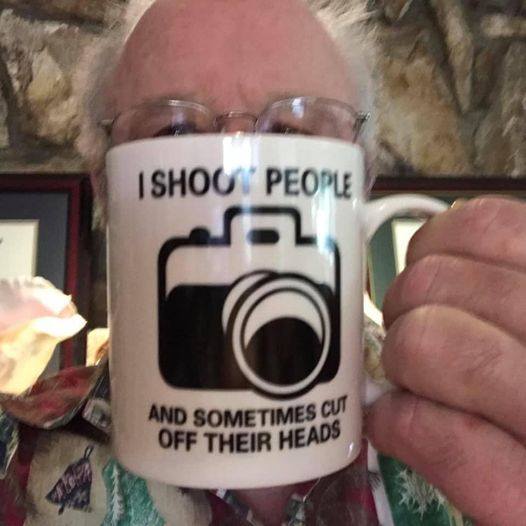
Even in photography, a fair percentage of shooters miss simple head shots.

The number of shootings are way up this year, and drugs – alcohol is to blame, here and in other cities. People have lost their jobs to COVID and globalization, more in Detroit than in most cities, but the government has offered checks that are used for alcohol and drugs. Most Detroit shootings begin as arguments that turn violent. There is also some gang shooting, enhanced by a bout of prison releases, because of COVID.

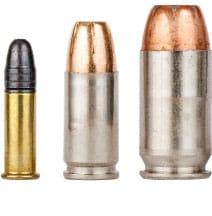
Drugs and alcohol help explain the low death rate. It’s hard to shoot straight when you’re drunk or stoned, and hard even if you’re not, as Alexander Hamilton found. In Detroit, many of these hit were hit in non-vital areas (I tell folks to avoid those areas :). But another part of the low death rate is lower caliber bullets. Military caliber bullets were in short supply this year, and as best as I was able to tell, a fair number of shootings were with 22 and 25 instead of the military cartridges, 9mm and bigger that were popular years ago. A 9mm cartridge is shown as the center picture below, between a 22lr and a 45. Big bullets make for big holes and high death rates.

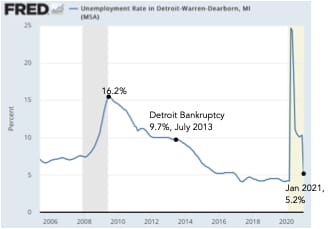
Per capita, the Detroit shooting rate is about 15 times that of New York City. New York saw roughly the same number of shootings as Detroit, 1,531 in a city 15 times bigger, and 462 criminal homicides The cause does not appear economic. but social. When Detroit’s unemployment rate fell, the murder rate did not. Thanks to COVID, Detroit’s unemployment rate is lower than New York’s. My only thought is that the culture is the difference, that the culture in New York is such that arguments do not turn violent as regularly.

Size comparison; 22, 9mm, 45. Big bullets leave big holes.

Stricter gun laws will not help, I think. Michigan’s gun laws make it hard to own pistols with barrels less than 16″ long. The net result is that most crime in the city is done with illegal guns. In general, countries with strict gun laws have more violent crime, not less. I would like to encourage private citizens to choose smaller bullets for self defense though, 22 or 32, and not military grade, 9mm. As a private citizen, you have to bring in the criminal, or storm a building. Your only goal is to get the criminal to stop without harming yourself. A 22 will get the criminal to stop. It will killl too, just less often. A 22 caliber bullet killed Bobby Kennedy, and Reagan was nearly killed with one. A small caliber bullet is less likely to kill you in an accident, or to kill people standing behind the target. This year, some 11 police forces came to a consensus report on use of the minimum of force necessary; read it here. For a private citizen, that’s a 22. Besides, speaking from my own limited experience, I find it easier to aim a small bullet.

Robert Buxbaum, January 10, 2021

China keeps building coal-fired plants so we can close ours.

Part of the mandate to the 2020 election was to join with Europe and the rest of the western world in agreeing to stop the use of coal. It’s a low cost way to generate energy. Of course we still like to buy things, and we’ve largely turned to China, a country that still burns coal, and thus makes things cheap. The net result of this shift to Chinese goods is that China keeps building coal-fired plants while we shut ours. As it happens, China is worse than the US in terms of CO2 per output, but at least when China pollutes, we don’t see the smoke directly, and we don’t see their new coal plants at all. So we feel better buying things from China than from the US. Besides, slave labor is cheap.

From th eEconomist, December 2020.

Buying Chinese goods is good for the importers, and for the non-manufacturing consumer, at least in the short term. It has the effect of exporting jobs though, and eventually we have to support the displaced workers. It also means we don’t keep up our manufacturing technology. Long term, that affects innovation, and that starts to displace other industries. Antibiotic production has already left the US and along with it semiconductors. Still, we feel good about it since the Chinese don’t let us see the slave labor camps. We do get to see the haze of the pollution.

The Chinese expect this pattern to continue. China is building new coal-fired plants at a furious rate. Presently China has most of the world’s coal-fired power plants. Mostly these are only 4 to 12 years old, far younger than our forty year old plants China plans to build more, and keeps encouraging us to shut down ours. Even 10 years ago, China lead the world in CO2 output. And their fraction of the CO2 keeps climbing.

China is popular with the press. In part, I expect, that’s because they pay the international experts. lAlso, writers and editors are consumers industrial products, but not manufacturers. Consumers benefit from slave labor, or maybe not, but displaced American workers certainly suffer. Also, of course, the news requires pictures and personal stories to keep viewer interest. If you can’t get pictures of young protesters, like Grey Thunberg, you can get an interesting story. Our Chinese pollution is out of sight, and not in the press.

Robert Buxbaum, January 6, 2021. BTW, if we wanted preserve jobs and stop CO2 pollution, we’d go nuclear.

MI hunting: You can arm bears; you just can’t buy bullets.

Large chunks of Michigan shut down for the prime days of hunting season, from the middle of October to early November. About 8% of the state gets a hunting license each year, some 800,000 people, all trying to “Bag a buck.” Michigan is an open carry state for rifles and holstered pistols, something seen recently in the state capitol, I’d say this was an illegal example since there is also a brandishing law, but it gives a sense of things here. About 29% of the state owns at least one gun, and usually more. There are about as many guns as people. Getting bullets, on the other hand, is near impossible, both for handguns and for most rifles, shotguns excluded.

A lot of the attraction of hunting is that you get to eat what you kill. Mot people do this or donate it to a food back. Hunting is also cheaper than golf. Rural farmers also hunt to protect their crops from crows, squirrels, rabbits, rats, snakes, and raccoons. This is legitimate hunting, in my opinion, even though you typically don’t eat crow. Some people do hunt bear, but that’s a different story (I like to be dressed). It’s possible that the bullet shortage is just a hiccup in the supply chain, “supply and demand” but it’s been going on for 12 years now so I suspect it’s here to stay.

Michigan, was once a Republican, pro-gun stronghold. It has swung Democrat and anti-gun for the last few years. Bulletes have been scare for about that long, at least since the Obama election or the Sandy Hook shooting. Behind this is a general trend of urbanization and class-action law suits. At this point, few sporting stores carry guns or bullets, and those that do, tend to hide them in a back room. Amazon carries neither bullets nor guns, and the same holds at e-bay, Craig’s list, and Walmart on line. Dunhams still sells guns but the only bullets, when I visited today were, 17 caliber, 227 and duck-hunting, shotgun shells. Gone were normal handgun calibers: 22, 25, 32, 38, 45, 357, and 9mm. The press seems OK with duck or moose hunting; not so OK with anything else.

The salesman at Dunham’s said that he had moved to bow hunting, something that’s becoming common, but it’s incredibly difficult even with modern bows. I can rarely hit a non-moving target at 50 feet on the first arrow, and I can only imagine the frustration of trying to hit a moving target after sitting in a cold blind for days waiting for one to appear whose distance and placement is unknown, and that might disappear at any moment, or attack me then disappear.

Part of the problem is that arrows travel at only about 250 ft/s, or about 1/6 the speed of a bullet. Thus, an arrow fired from 50 yards takes about 0.6 seconds to hit. In that time it drops about 6 feet and must be aimed 6 feet above the deer if you hope to hit it. A riffle bullet falls only about 2 inches, about 1/36 as much. Whaat’s more, though an arrow is about three times heavier than a hunting bullet, its slow speed means it hits with only about 1/10 the kinetic energy, about the same as hunting with a 22 from a handgun.

There are those who say the bullet shortage will go away on its own because of supply and demand. That’s true until the government steps in in the name of public safety. Though recreational marijuana and moonshine are both legal, government regulation means that prices are high and supply is limited, with a grey market of people buying high and selling higher. I’m seeing the same with ammunition; there is tight supply, a grey market, and a fair number of people trying to reload spent ammunition using match-tips for primers. Talk about white lightning.

R. E. Buxbaum, December 24, 2020.

Tale of a fast, accurate home COVID test

My son works at a company called Homodeus. It’s part of 4Catalyzer, an umbrella of seven medical biotechnology companies with a staff of 300 scientists and engineers. One of the Homodeus products, still waiting FDA guidance is a COVID-19, RNA self-tester called Homodeus Detect. It tests for COVID RNA directly, not for antibodies, with tests are much faster than hospital tests, taking 45 minutes, but more complex than the unreliable test strips. So far, the Detect tests have shown no false positives or false negatives. That would suggest 100% reliable, except but there are a fair number of invalid tests. The invalid tests are lares due to the complexity, and also to the fact that you are testing snot, essentially. There is no blood-taking involved, unlike with the test strips, but  just a nasal swab, and the cost is moderate, about $35 per test. However you have to do some lab work. After you swab your nose, you put the swab in a heated liquid bath where chemicals break up the snot and dissolve the shells on any viruses or pollen present. After 30 minutes, you pass the liquid onto a detector strip that contains a conjugate protein that binds to SARS-CoV-2 RNA. Your answer appears 15 minutes later as one of three lines: one for positive, one for negative, or one indicating an invalid test. Invalid tests show up more often than they like, about half the time, especially when the test is done by amateurs. 

Getting an invalid test result is a downside of the current product, but I don’t think it should prevent sales. You get better at doing the test, and speed and lack of false positives and negatives is a bigger plus. It seems worthwhile to fast-track offer this test for doctors offices and hospital admissions, at least. I’d also like to see it used for airplane boarding and interstate travel, so that a person traveling might avoid the two week quarantine that many states impose. I’d certainly pay $200 or more to avoid a two-week quarantine, and if I have to do a second or third test, I’d do that too. 

At least some people realize it’s a big advantage to know if you are currently infections.

Because this test measures virus RNA, and not antibodies, it indicates infection virtually as soon as you’re infected. That’s a benefit for those wishing to fly, or to meet with people, an advantage that is not lost on Elon Musk at least (see tweet). The test also shows negative as soon as the virus is gone, and that’s big. In recent months the FDA has fast-track approved an antibody indicating test from Abbott Labs, but that test has many false readings and only indicates infection several days afterward, and it does not indicate when you are no longer infectious. 

The FDA has not offered to fast track this test, or any other like it for approval. They have not even indicated what sort of reporting and privacy requirements they want, so things sit in limbo, both for Homodeus, and for competing companies. Here is a story in USA today: https://www.usatoday.com/story/news/2020/07/29/fda-opens-door-rapid-home-covid-19-tests/5536528002. One big issue that the FDA is contact tracing. The FDA would like to be able to trace all the contacts of anyone who tests positive, while maintaining privacy as demanded by the 4th Amendment.

One way around the 4th amendment concerns would be to require anyone who uses the test to sign a waiver allowing the government to trace their contacts. Alternately there could be a block-chain enabled app that would come with the test. An app coms already providing a timer for when to move to the next step, and it includes a machine-vision system to help analyze dim lines on the indicator. Perhaps the FDA would accept block chain as a way to allow full reporting while maintaining privacy The FDA has yet to provide guidance on what they want, though. Without guidance or fast-track approval, things sit in limbo. Here is a scathing legal analysis from the Yale Law Journal.

You can get a free test, but have to do it at Homodeus headquarters in Guilford, Connecticut. It’s free, and results appears in about 45 minutes.. Homodeus has been manufacturing the test in quantity; if you are interested, use the following link to sign up: https://www.homodeusinc.com/research. Healthcare providers are particularly welcome.

The Homodeus detect test kit. Picture from this article in the New Haven Register.

Why did the FDA fast-track approve Abott’s antigen/ antibody test. Maybe because the tests rethought to not lead to lower mask use. Alternately, Abott has more political pull. You can read the FDA’s explanation here. In my biassed opinion the Homodeus product is good enough to fast track especially for hospitals and healthcare providers. It could save lives while allowing the economy to reopen.

Robert Buxbaum, November 15, 2020 (with massive help from Aaron M. Buxbaum)

Pneumonia vaccine in the age of COVID

A few days ago, I asked for and received the PCV-13 pneumonia vaccine, and a few days earlier, the flu shot. These vaccines are free if you are over 65, but you have to ask for them. PCV-13 is the milder of the pneumonia vaccines, providing moderate resistance to 12 common pneumonia strains, plus a strain of diphtheria. There is a stronger shot, with more side-effects. The main reason I got these vaccines was to cut my risk from COVID-19.

Some 230,00 people have died from COVID-19. Almost all none of them were under 20, and hardly any died from the virus itself. As with the common flu, they died from side infections and pneumonia. Though the vaccine I took is not 100% effective against event these 13 pneumonias, it is fairly effective, especially in the absence of co-morbidities, and has few side effects beyond stiffness in my arm. I felt it was a worthwhile protection, and further reading suggests it was more worthwhile than I’d thought at first.

It is far from clear there will be a working vaccine for SARS-CoV-2, the virus that causes COV-19. We’ve been trying for 40 years to make a vaccine against AIDS, without success. We have also failed to create a working vaccine for SARS, MERS, or the common cold. Why should SARS-CoV-2 be different? We do have a flu vaccine, and I took it, but it isn’t very effective, viruses mutate. Despite claims that we would have a vaccine for COVID-19 by early next year, I came to imagine it would not be a particularly good vaccine, and it might have side effects. On the other hand, there is a fair amount of evidence that the pneumonia vaccine works and does a lot more good than one might expected against COVID-19.

A colleague of mine from Michigan State, Robert Root Bernstein, analyzed the effectiveness of several vaccines in the fight against COVID-19 by comparing the impact of COVID-19 on two dozen countries as a function of all the major inoculations. He found a strong correlation only with pneumonia vaccine: “Nations such as Spain, Italy, Belgium, Brazil, Peru and Chile that have the highest COVID-19 rates per million have the poorest pneumococcal vaccination rates among both infants and adults. Nations with the lowest rates of COVID-19 – Japan, Korea, Denmark, Australia and New Zealand – have the highest rates of pneumococcal vaccination among both infants and adults.” Root-Bernstein also looked at the effectiveness of adult inoculation and child inoculation. Both were effective, at about the same rate. This suggests that the the plots below are not statistical flukes. Here is a link to the scientific article, and here is a link to the more popular version.

An analysis of countries in terms of COVID rates and deaths versus pneumonia vaccination rates in children and adults. The US has a high child vaccination rate, but a low adult vaccination rate. Japan, Korea, etc. are much better. Italy, Belgium, Spain, Brazil, and Peru are worse. Similar correlations were found with child and adult inoculation, suggesting that these correlations are not flukes of statistics.

I decided to check up on Root-Bernstein’s finding by checking the state-by state differences in pneumonia vaccination rates — information available here — and found that the two US states that were hardest hit by COVID, NY and NJ, have among the lowest rates of inoculation. Of course there are other reasons at play. These states are uncommonly densely populated, and the governments of both made the unfortunate choice of sending infected patients to live in old age homes. At least half of the deaths were in these homes.

Pneumonia vaccination may also explain why the virus barely affected those under 20. Pneumonia vaccines was available only in 2000 or so. Many states then began to vaccinate about then and required it to attend school. The time of immunization could explain why those younger than 20 in the US do so well compared to older individuals, and compared to some other countries where inoculation was later. I note that China has near universal inoculation for pneumonia, and was very mildly hit.

I also took the flu shot, and had taken the MMR (measles) vaccine last year. The side effects, though bad, are less bad than the benefits, I thought, but there was another reason, and that’s mimicry. It is not uncommon that exposure to one virus or vaccine will excite the immune system to similar viruses, so-called B cells and T-cell immunity. A recent study from the Mayo Clinic, read it here, shows that other inoculations help you fight COVID-19. By simple logic, I had expected that the flu vaccine would help me this way. The following study (from Root-Bernstein again) shows little COVID benefit from flu vaccine, but evidence that MMR helps (R-squared of 0.118). Let men suggest it’s worth a shot, as it were. Similar to this, I saw just today, published September 24, 2020 in the journal, Vaccines, that the disease most molecularly similar to SARS-CoV-2 is pneumonia. If so, mimicry provides yet another reason for pneumonia vaccination, and yet another explanation for the high correlations shown above.

As a final comparison, I note that Sweden has a very high pneumonia inoculation rate, but seems to have a low mask use rate. Despite this, Sweden has done somewhat better than the US against COVID-19. Chile has a low inoculation rates, and though they strongly enforced masks and social distance, it was harder hit than we were. The correlation isn’t 100%, and masks clearly do some good, but it seems inoculation may be more effective than masks.

Robert Buxbaum, November 7, 2020.

Hand washing and masks help, just not that much.

There are two main routes for catching flu. One is via your hands and your eyes and nose. Your hands pick up germs from the surfaces you touch, and when you touch your eyes or nose passages, the germs infect you. This was thought to be the main route for infection, and I still think it is. I’d been pushing iodine hand sanitizer for some time, the stuff used in hospitals, saying that that the alcohol hand sanitizer doesn’t work well, that it evaporates.

The other route, the one touted by the press these days is via direct cough droplets, breathing them in or getting them in your eyes. Masks and face shields are the preferred protection from this route, and the claim is that masks will stop 63% of the spread. The 63% number has an interesting history, it comes from this test with infected hamsters. Hamsters are 63% less likely to infect other hamsters when they wear a mask. Of course, the comparison has some weaknesses: hamsters don’t put their fingers in their noses, nor do they rub their eyes with their hands, and hamsters can be forced to keep the mask barrier all the time — read the study to see how.

A more realistic study, or more relevant to people, in my opinion showed a far lower effect for masks, about 20%. During the HiNi flu pandemic of 2009 a group of 1437 college students at a single university were divided into three randomized groups, see the original report here. Students at a few chosen residence halls were instructed to wash their hands regularly, use sanitizer, and wear masks. Students at other halls were either told to wear masks only, or told to go on as they pleased. This was the largest group, the control. They included students of the the largest residence hall on campus. The main results appear as the graph below, Figure 1 of the report. It shows a difference of 6% or 20%, depending on how you look at things, with the mask plus hand-health group, MPHH, doing the best.

After 6 weeks of monitoring, approximately 36% of the control group had gotten the flu or some collection of flu symptoms. The remaining 64% of the residents remained symptom free. This is he darkest line above.

Of the FM Only group, the medium line above, those instructed to wear face masks only. 30% of this group showed flu symptoms, with 70% remaining symptom free. Clearly masks do help with humans, but far less than what you’d expect from the news reports.

Sweden kept the primary schools open and allows people to wear masks and social distance at they see fit. The death toll to August 1 is identical to Michigan, or slightly bette Sweden’s top virologist recommends that the US follow suit. Open up and trust people.

The group that did best was FMHH, the group who both wore facemarks and used hand health, regular hand washing plus hand sanitizer. This group reported an average of 3.5 hours per day of mask use above the control group average. This is about as good or better than I see in Michigan. Adding the hand health provided an additional 1% improvement, or a 3% improvement, depending on how you look at these things. The press claims hand health is wasted effort, but I’m not so sure. I argue that the effect was significant, and that the hand sanitizer was bad. I argue that iodine hand wash would have done better at far less social cost.

I also note that doing nothing was not that much worse than mask use. This matches with the observation of COVID-19 in Sweden. With no enforced social distancing, Sweden did about the same as Michigan — slightly better, despite Michigan closing the schools and restaurants, and imposing some of the toughest requirements for social distancing and mask use.

Other things that affect how likely you are to get flu symptoms. I find these rustles more interesting than the main face-mask result.

There were other observations from the university study that i found isignificant. There are racial differences and social differences. The authors didn’t highlight these, but they are at least as large as the effect of mask use. Asians got the flu only 70% as often as others, while black students got it 8% more often. This matches what has been seen in the US with COVID-19. Also interesting, those with a recent flu shot got flu more often; those with physical activity 13% more often. Smokers got the flu less than non-smokers and women got it 22% more often than men. The last two are the reverse with COVID-19. I could speculate on the reasons, but clearly there is a lot going on.

Why did Asians do better than others? Perhaps Asians have had prior exposure to some similar virus, and are thus slightly immune, or perhaps they used the masks more, being more socially acceptable. Why were smokers protected? It’s likely that smoke kills germs; was that the cause. These are speculations, and as for the rest I don’t know.

I am not that bothered that the students probably didn’t wear their masks 100% of the time. Better would be better, but even with mask use 100% of the time, there are other known routes that are almost impossible to remove: clothing, food, touching your face. I still think there is a big advantage to iodine hand wash, and I suspect we would be better off opening up a bit too.

Robert Buxbaum August 7, 2020.

Hamilton and his slave-trading father in law.

Philip Schuyler as a Major General in the Revolution. His statue was removed.

What most folks know about Alexander Hamilton’s father in law, Philip Schuyler, is that he was “loaded”, that he had three daughters, and that he quickly took to young Alexander. But an important fact varnished over is that Schuyler made his money in the slave trade, a trade that Hamilton was likely in when he met the young Schuyler daughters. Schuyler was also a slave owner, owning 13 slaves, by his record, and perhaps another 17 indentured servants working at two mansions. So far, only the Philip Schyler statue has been taken down. It seems possible that many monuments to Hamilton may follow.

Statue of Alexander Hamilton, proudly stands in front of Columbia University. The ten dollar founding father.

The play “Hamilton” proclaims Hamilton’s genius and exceptional work ethic, mentioning that, at the young age of 14 (more likely 16) he was left in charge of a trading company. This was for 5 months in 1771, while the owner was over seas doing business. Hamilton knew the business well; he’d been hired as a clerk at 11 at Beekman and Cruger, a similar import-export trading firm. What items did these firms trade — cotton, sugar, rum, and most profitable slaves. This likely was the business that kept the owner overseas for 5 months while Alexander ran the shop. There are at least two notifications of slave ships entering the harbor with human good for sale. Among Hamilton’s likely jobs would have been fattening and oiling the goods for sale. Hamilton himself seems to have owned a slave-boy named Ajax who he inherited (briefly) from his mother, Rachel. His mother is listed on the tax records as white. She owned five saves at one time, suggesting she was not entirely impoverished. Hamilton’s father, though a failed businessman, was a Scottish Laird (a Lord). As for the court-mandated transfer of Ajax from Alexander, it was to his half-brother James because James was “Legitimate.”

I base Hamilton’s age on the Nevis-St Kitts record of his birth, January 11, 1755.”[1] The play takes as a fact Hamilton’s claim to have been born two years later, January 11, 1757. I trust the written records here, and imagine Hamilton wanted to present himself as a young genius, rather than as a bright, but older fellow. In 1772, at at age 17, Hamilton wrote a “fire and brimstone” description of a deadly hurricane, describing it as “divine rebuke to human vanity and pomposity.”[2] Between this, and his skill at trading, the community leaders collected money to send him to New York, but unlike the play’s description, it was not only for further education. The deal was that he continue trading for the firm,[3] and this is likely how he met his future father in law. “[4] 

Hercules Mulligan, a revolutionary tailor: He was a spy. According to the CIA, much of the work was through his black slave, Cato.

In New York, Hamilton met Schuyler and his daughters. It seems likely that he met the father first, likely as possible customer for the slave trade from the Caribbean, or perhaps as a customer for rum and sugar. A 1772 letter in Hamilton’s handwriting [4] asks for the purchase of “two or three poor boys” for plantation work, “bound in the most reasonable manner you can.” As in the play, Hamilton was friends with John Laurens, an abolitionist, and among his first lodgings was with Hercules Mulligan, a tailor’s apprentice. Hercules is presented as black in the play, but he was quite white (see picture) with a black slave, Cato. Cato ran most of the messages. According to the play, “I’m joining the rebellion cuz I know it’s my chance
To socially advance, Instead of sewin’ some pants, I’m taking my shot. No, Hercules was socially advanced ,married into the British Admiralty, even. He was a true believer in freedom and a slave-holder. His older brother, Hugh Mulligan, was one of the traders that Hamilton was supposed to work with.[5] As for Laurens and his anti-slavery organization, most of those in the organization owned slaves, and though they opposed slavery, they could never decide on when or how to end it. There is no evidence that Cato was ever set free.

The appointment to Washingtons staff was not likely a coincidence. The elder Schuyler was one of the four top generals appointed in 1775 to serve directly under Washington. Phillip oversaw, at a distance, the disastrous attack on Quebec and the victory at Saratoga– both, Burr served admirably. Phillip’s main role was as a quartermaster/supplier, and this is not a small role. Phillip Schuyler had been a quarter-master in the French and Indian war. It’s likely that it was Schuyler who got Hamilton his appointment to Washington’s staff.

Once on Washington’s staff, Hamilton served admirably. Originally serving as a secretary, Hamilton wrote many of Washington’s dispatches. Then, according to tradition, as a cannon commander, he took particular pleasure in the attack on Princeton University. He then served well as secretary of the Treasury, and as head of the Bank of The United States, the only major US bank until Burr opened the Bank of the Manhattan company. Despite his aversion to slavery, Hamilton also continued to deal in slaves. A 1796 cash book entry records Hamilton’s payment of $250 to his father-in-law for “2 Negro servants purchased by him for me.” This is only 3 years before 1799, when New York began to end slavery in the state with the Act for the Gradual Abolition of Slavery. Children of slaves born after July 4, 1799, were to be legally free, but required indentured servitude: to age 28 for males and 25 for females. Those born before July 4, 1799 became free in 1817. There is no evidence that Hamilton was a leader in any of this, but Burr, another slave-owning abolitionist, was a leader in the NY legislature at the time.

I’m with Burr.He was flawed, a slave-owning abolitionist, but vehimently against the Alien and Sedition Acts, a Hamiltonian horror.

It seems that Robert Morris introduced Hamilton to the importance of tariffs, and to the idea of using debt service as a backing to currency. It’s brilliant idea, but Hamilton understood it and took to it. Hamilton also understood the need for a coast guard to enforce the tariffs. As for Hamilton’s character, or Burr’s. Both, in my understanding, were imperfect people who did great deeds. I’ve already written that Hamilton was likely setting up Burr for murder, perhaps because of Burr’s vehement opposition to the Alien and Sedition Acts — That’s why Hamilton wore his glasses and fiddled with the gun so much. Burr was also gaining power through his Manhattan corporation and Tammany organization. both of which got his support among the immigrants.

My intent here is not to knock the image of Hamilton, Schuyler, Laurens and Mulligan, nor to raise that of Burr, but to correct some current fictions in the play “Hamilton”, and to fight a disease of our age, the cancel culture. The cancel culture elevates their heroes (Hamilton, Mulligan) to god-status. They will lie to cover the flaws of their heroes, and will lie also to claim a drop of black blood in them; neither Hamilton nor Mulligan were black and both owned slaves, as did Burr. The other side of the cancel culture is to cancel — to eliminate the validity — of the reactionaries, the non-revolutionary. In the play, these include Samuel Seebury and Aaron Burr. Great building is almost always the work of contradictory people. They need some talent, and a willingness to act, and because building requires a group, they have to work in a group, tolerating flaws of the others in the group. It is just these flawed, contradictory builders that are being cancelled, and I don’t think that’s right or healthy.

Robert Buxbaum, August 4, 2020.

Sweden v Michigan: different approaches, same outcome.

Sweden has scientists; Michigan has scientists. Sweden’s scientists said to trust people to social distance and let the COVID-19 disease run its course. It was a highly controversial take, but Sweden didn’t close the schools, didn’t enforce masks, and let people social distance as they would. Michigan’s scientists said to wear masks and close everything, and the governor enforced just that. She closed the schools, the restaurants, the golf courses, and even the parks for a while. In Michigan you can not attend a baseball game, and you can be fined for not wearing a mask in public. The net result: Michigan and Sweden had almost the same death totals and rates, as the graphs below show. As of July 28, 2020: Sweden had 5,702 dead of COVID-19, Michigan had 6,402. That’s 13 more dead for a population that’s 20% smaller.

Sweden’s deaths pre day. There are 5,702 COVID dead since the start, out of a population of 10.63 million. There are 79,494 confirmed COVID cases, but likely a lot more infected.

Sweden and Michigan are equally industrial, with populations in a few dense cities and a rural back-country. Both banned large-scale use of hydroxy-chloroquine. Given the large difference in social distance laws, you’d expect a vastly different death rate, with Michigan’s, presumably lower, but there is hardly any difference at all, and it’s worthwhile to consider what we might learn from this.

Michigan’s deaths pre day. There are 6,426 COVID dead since the start, out of a population of 9.99 million. There are 88,025 confirmed COVID cases, but likely a lot more infected.

What I learn from this is not that social distance is unimportant, and not that hand washing and masks don’t work, but rather it seems to me that people are more likely to social distance if they themselves are in control of the rules. This is something I also notice comparing freezer economies to communist or controlled ones: people work harder when they have more of a say in what they do. Some call this self -exploitation, but it seems to be a universal lesson.

Both Sweden and the US began the epidemic with some moderate testing of a drug called hydroxychloroquine (HCQ)and both mostly stopped in April when the drug became a political football. President Trump recommended it based on studies in France and China, but the response was many publications showing the didn’t work and was even deadly. Virtually ever western country cut back use of the drug. Brazil’s scientists objected — see here where they claim that those studies were crooked. It seems that countries that continued to use the drug had fewer COVID deaths, see graph, but it’s hard to say. The Brazilians claim that the anti HCQ studies were politically motivated, but doctors in both Sweden and the US largely stopped prescribing the drug. This seems to have been a mistake.

US hospitals stopped using HCQ in early April almost as soon as Trump recommended it. Sweden did the same.

In July, Henry Ford hospitals published this large-scale study showing a strong benefit: for HCQ: out of 2,541 patients in six hospitals, the death rate for those treated with HCQ was 13%. For those not treated with HCQ, the death rate was more than double: 26.4%. It’s not clear that this is cause and effect. It’s suggestive, but there is room for unconscious bias in who got the drug. Similarly, last week, a Yale researcher this week used epidemiological evidence to say HCQ works. This might be proof, or not. Since epidemiology is not double-blind, there is more than common room for confounding variables. By and large the newspaper experts are unconvinced by epidemiology and say there is no real evidence of HCQ benefit. In Michigan and Sweden the politicians strongly recommend continuing their approaches, by and large avoiding HCQ. In Brazil, India and much of the mideast, HCQ is popular. The countries that use HCQ claim it works. The countries that don’t claim it does not. The countries with strict lock-down say that science shows this is what’s working. The countries without, claim they are right to go without. All claim SCIENCE to support their behaviors, and likely that’s faulty logic.

Hydroxychloroquine and COVID-19 fatality rates in different countries as of early June 2020. This isn’t enough to prove HCQ effectiveness, but it’s promising, and suggests that increased use is warranted, at least among those without heart problems.

Given my choice, I’d like to see more use of HCQ. I’m not sure it works, but I’m ,sure there’s enough evidence to put it into the top tier of testing. I’d also prefer the Sweden method, of nor enforced lockdown, or a very moderate lockdown, but I live I’m Michigan where the governor claims she knows science, and I’m willing to live within the governor’s lockdown.There is good, scientific evidence that, if you don’t you get fined or go to jail.

Robert Buxbaum, July 29, 2020. As I side issue, I think iodine hand wash is a good thing. I may be wrong, but here’s my case.

Package postage from China: 70¢ for 2 oz.

The minimum US postage rate to send a 1 oz to 8 oz package across the street is $8.30. This is the price for any size package going in “zone 1”. That is, to a nearby, instate address. It costs more to send a package to nearby states or across the country, zones 2,3,4,5,6,7, 8 You don’t get shipping updates or delivery confirmation unless you pay more. By comparison the US post office charges no more than $1.50 to Chinese companies to deliver packages of up to 4.4 lbs (2 kg) and they get shipping and delivery confirmation thrown in free. The high US rates are, in part, because the post office is losing money to subsidize postage from China.

On the internet folks are amazed at how cheap things are shipped from China (I copied this post from this Forbes article)

US producers can not compete on the sale of small items, in part, because we subsidize the shipping costs. Go to Amazon or e-Bay and you can buy from China packaged items shipped by air for a total price of $1 or so. That includes the price of the item, the shipping cost, and some profit for Amazon or eBay. A US supplier could not sell this cheap even if it were a box of air. The low shipping costs result from a poorly negotiated postage deal of 2011 between us (Obama’s negotiator) and the Chinese. Until 2021, we are committed to deliver a package of 50g or less, (2 oz) for 5 Chinese Yuan, or 70¢ at the current exchange rate of 14¢/NCY. Additional ounces are billed at 35¢ up to 4.4 lbs; use the following table of prices and apply the dollar to CNY conversion. We threw in tracking services and an e-mail confirmation for free, in part because China was poor, and we were rich. Also, the deal was pushed by e-Bay and Amazon, two big supporters of Obama’s presidency.

US suppliers cannot compete.

Adding insult to injury, Obama raised the de minimis amount for billing tariffs from the normal $100 to $800 making almost all purchases from China duty free. Obama made some complaints about unfair trade, and about the counterfeits and knockoffs but no major enforcement. In 2012 and 2014, the Obama administration signed similar postage deals with Korea, Hong Kong, and the EU. The Germans applauded as it allows them to ship goods to the US for far less than the cost of us shipping to Germany. The US post office loses money on this and makes up for it by charging us more for domestic mail.

The Washington Post praised Obama on these deals claiming that they benefitted US customer and promoted democracy. Of course, the Washington Post is owned by Amazon’s main stock holder, Jeff Bezos– someone who benefits very much by the deal. He is among the relatively few people and organizations that own the media outlets. The Post loses money on newspaper sales but benefits the owners by the propaganda value of the stories, a situation also found with Al Jazeera and the emir of Qatar.

Trump has informed China that these special rates will end when the treaty runs out in January 1, 2021. A per-package ship fee will be $3.00 for a one ounce package, with 11¢ per additional once. This is less than the domestic rate, but far higher than the current 35¢ for 1 oz. I’d probably have raised their postage even more, but this is an election year, and Biden may well reverse any deal Trump signs.

Robert Buxbaum, July 14, 2020. Though I’m appalled by this postage deal, I just bought a 50 lb kayak from China, $99.99 including shipping. The prices are too low to pass up.

Methuselah palm finds a mate after 2100 years

The Judean date palm was extinct until 15 years ago, remembered only through pictures, eg. on ancient coins, see below, and mentions in ancient books including the psalms of David. There were also some ancient seeds, 2100 years old, that had been found buried in a jar near the entry ramp of the fortress Masada. Sarah Sallon of Israel’s Natural Medicine Research Center became convinced that these dates had medicinal as well as historical value, and badgered the archeologists for seed samples and permission to try her luck reviving this extinct plant. The archeologists thought she was nuts but eventually she got permission to try her luck with some seeds that Prof Ehud Netzer, had stored in his desk.

Dr. Elaine Solowey, Dr. Elaine Solowey, Director of the Center for Sustainable Agriculture, and, the Methuselah tree. Note the distinctive leaves. The tree is not ten feet tall and ready to mate.

Against all odds, Dr. Sallon, in 2005, succeeded in germinating one of these ancient seeds, a feat thought to be botanically impossible. Named, Methuselah it was the oldest seed ever grown, attracting wide international attention. But it was a one-off, a male without a female plant.

Methuselah was, at that point, a historic artifact – an interesting tourist attraction at the center fro sustainable agriculture. There was no way to grow the famous Judaic dates, though without a female parent. But Dr. Sallon was undeterred, she found another archaeologist who had recovered a trove of date seeds from various sites in Qumran — the site where the Dead Sea scrolls had been discovered, plus from the Wadi Makukh and the Wadi Kelt. Some of these seeds were as old as the one that produced Methuselah.

Vespasian coin with Judaean palm and the legend “Iudaea Capta.” (Judea is captured). A Judean date palm is shown along with a mourning Jew and a triumphant Roman.

A group headed by Dr. Sallon, selected a total of 34 seeds for further study, choosing specimens that appeared to be visually to be intact, whole seeds, in good condition, and without holes. Chosen to study included more seeds from Masada (8 seeds), Qumran (18 seeds), Wadi Makukh (7 seeds), and Wadi Kelt (1 seed). The seeds were identified by code numbers, photographed, and measured for weight and length (with the exception of Masada seeds, which unfortunately were not measured). One date seed, from the Qumran excavations (HU 37 A11), was selected as a control and left unplanted.

The remaining 33 seeds were subjected to a preparatory process to increase the likelihood of germination): the seeds were soaked in water for 24 hours and in gibberellic acid (5.19 mM) (OrthoGrow, USA) for 6 hours to encourage embryonic growth. This was followed by Hormoril T8 solution (5 g/liter) (Asia-Riesel, Israel) for 6 hours to encourage rooting and KF-20 organic fertilizer (10 ml/liter) (VGI, Israel) for 12 hours. All solutions were maintained at 35°C.

Following the above procedure, one seed was found to be damaged and not planted. The others were separately potted in sterile potting soil, 1 cm below the surface, and placed in a locked quarantine site at the Arava Institute of Environmental Sciences in southern Israel.

The six young trees. the two females are at the bottom right.

Six of these germinated. Periodically they were treated with KF-20 (10 ml/liter) and iron chelate (10 g/liter). Irrigation used desalinated water, as the previous study indicated that using the region’s highly mineralized water produced “tip burn” (darkening and drying of leaves). The seeds that did not germinate were removed for further testing and the shells of the seeds that did sprout were tested to determine their sex,  Of the six, two were determined to be female and four male. The female plants have been named Judith and Hannah, two Biblical names associated with children. It will be many years before they can mate, but it’s a hopeful start. The four other plants are Adam, Jonah, Urial, and Boaz. Radio-carbon dating suggests that one of these female seeds is 2100 years old, like Methuselah, while the other is only 1900 years old. See article in AAAS.

If either of the female plants survives to maturity, and if they prove to be compatible, we may yet get to eat of the famous biblical fruit. When the Bible calls Israel is called the land of milk and honey, the honey is the date honey of this tree.  Will these dry bones yet rise and live? Perhaps so. Dr. Solloway seas the revival of this plant as a symbol of hope. I do too.

Robert E. Buxbaum, June 7, 2020, There is a bit of Frankenstein in any revival of the dead, but I’m ore comfortable bringing back ancient plants than bringing back the Wooly Mammoth, the passenger pigeon, or the T Rex.