Tag Archives: wages

Black folks have no savings (poor whites too)

The wealth of the mean American household has dropped since 2007, a result of  de-industrialization, and unmet expectations. On average, America is richer, but we’ve increased the economic divide. The richest have left behind the working and bourgeoise classes. Though we are beginning to come back, with home ownership rising, a particularly nasty legacy remains, especially among black families. Some 47% of black families have no liquid savings  — a far greater fraction than in 2007. This. has to change if black folks are ever to get ahead as a group.

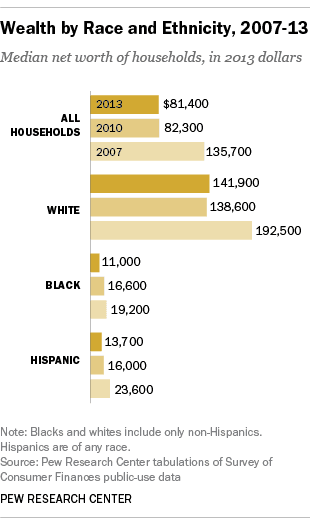
College graduation rates have increased among black students, and black salaries, but I’m not sure the degrees are in productive fields (true for white students too). As of 2015, 22.5% of black students and 15.5% of Hispanic students had completed four years of college. That’s less than the 36.2% of white students, an inequality, but not a horrible one. As of 2013, the average salary of a black college grad was over $1000/week, somewhat less than the average for white grads, but enviable compared to the world as whole. The big problem I see is that black workers save very little compared to other ethnic groups, or compared to previous savings rates as shown by the graphic below. By 2013, the net worth of the median black family (savings, plus paid-off part of home and car) was $11,000 (Pew Research Data, below), down from $19,200 six years earlier. This is much lower than the net worth of white families (also down since 2007). In terms of liquid savings the mean is near zero, and this is the mean. Half of all black families are doing worse.

Net worth disparity 2007 - 2011. Black folks are doing poorly and it's getting worse.

Net worth disparity 2007 – 2011. Black folks are doing poorly and it’s getting worse.

The combination of low savings and low net worth puts black folks at a distinct disadvantage to their condition six years earlier. Without savings, it is near-impossible to weather the loss of a job, or even to fix a car or pay a ticket; a major disease is basically a one-way ticket to the welfare office. Six years ago, when people saved more and prices were lower, problems like this were annoyances. Now, it’s a family disaster.

A person without savings will not have a savings account or a checking account. As such, he or she will not have a credit card or check cashing privileges. The only way to cash a check will be via a for-fee service, and these tend to come at a steep cost (2-5%). The growth of check-cashing services in black neighborhoods is a symptom of this. People with savings accounts cash checks essentially for free, and can usually borrow money by way of a credit card. Black people and poor whites tend to use debit cards instead. They look and work like credit cards, but they incur fees upon use, and do not provide instant loans. When black folks and poor whites need quick cash, their options are the loan-shark or the pawn shop: high-cost options.

While black individuals have lower incomes than whiteindividuals, most of the blame seems to be family stability. Employed, college-educated blacks earn, on average, 95% as much as employed, college-educated whites — not great, and I trust that will improve. The bigger problem is not being able to show up for work because of family instability., Single-parent families are significantly more common among black folks. Roughly 40% of black families are single-mother, or mother+grandparent households compared to “only” 26% in the population generally. In both populations, the number of single parent households have increased dramatically in the last few years, a result I suspect of the government’s desire to help. The government gives more aid to a split-up couple than to one that stays together, but the aid brings with it long-term damage to net worth. A family with one parent will naturally have a lower-income and savings rate than a family with two. The lack of stability that comes from a single parent family, I suspect, has contributed to crime, births out-of-wedlock, and the tendency of black folks to drop out of college.

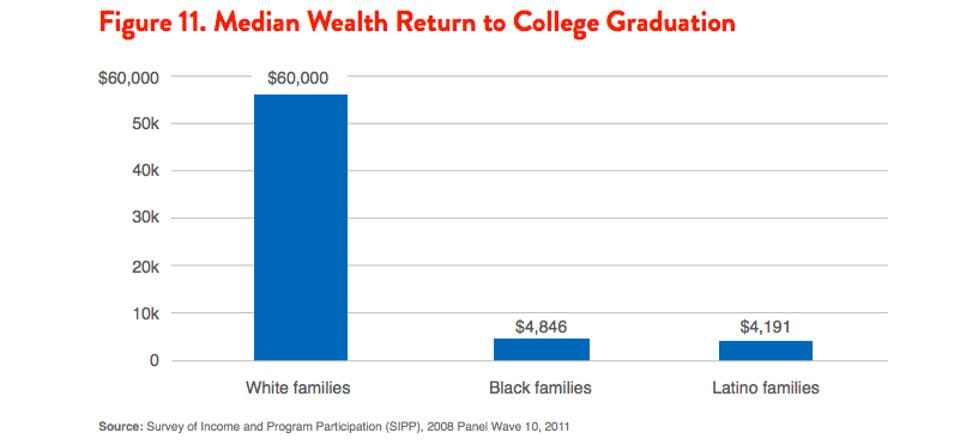
Black families don't benefit as much from college --in part a result of the choice of courses.

Black families don’t benefit much from college –in part a result of course choices, in part the result of borrowing. (Forbes, 2015).

Some white do-gooders want to eliminate check cashing businesses and pawn shops in a misguided desire to help the low-income neighborhoods, but the success of these companies tell me that they are needed. Though check services and pawn brokers take a nasty bite, urban life would be much worse without them, I suspect.

Another so-called solution of the do-gooders, is to tax savings and transfer the wealth to the poor. This form of wealth redistribution has been a cornerstone of the Democratic party for the last century. The idea of the tax is that it will transfer “idle wealth” from rich savers to poor folks who will spend it immediately. The problem is that great swathes of the nation don’t save at all currently; net worth is down all across the US — among white and black families both. Taxing savings will almost-certainly reduce the savings rate even further. Besides, savings are the stuff of self-determination and dreams — far more than spending, it is savings that allows a person to start a new business. One does not provide for the dreams of one group by taking them from another — particularly when the merit of the receiving group is that they are immediate spenders. The danger of this is seen by looking at Detroit.

As it is, inner city children do not see a path out via education. Detroit school attendance hovers around 50%, and business startups are lacking. With higher savings rates and higher family stability, folks could start businesses, and/or take advantage of job opportunities that come along, and that would help the community more than redistribution.  It sometimes seems that the only successful businesses in Detroit are check cashing, pawn brokers, churches, hair-salons, fast food, and medical marijuana — businesses that provide little community return. Detroit has lost its manufacturing center, and now has more medical marijuana providers than groceries — a sad state of affairs.

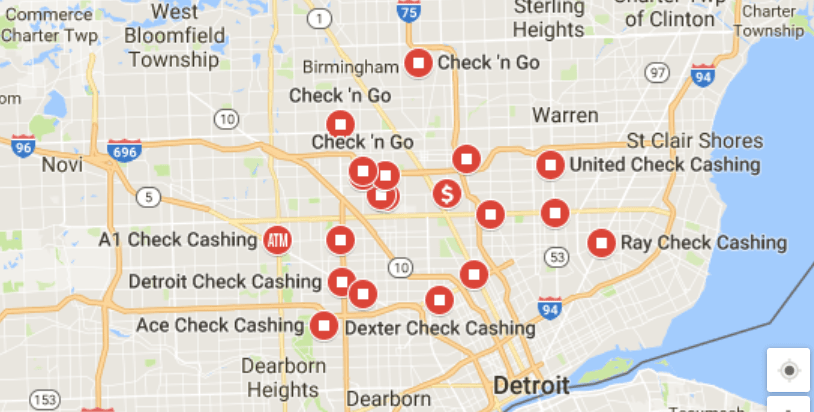
The Check cashing services of south-eastern MI are concentrated in poor black and white neighborhoods.

The Check cashing services of south-eastern MI are concentrated in poor black and white neighborhoods.

In 2016, both presidential candidates touted major building projects to help the inner city poor. In principle this could help, but the  inner city youth lack the training or licenses to build roads and bridges. They have barely the math skills to manage a McDonald’s. For another thing, many of the project aren’t needed. They’re form of income redistribution and graft. Surely we can do better. Trump makes the case for tariffs (reducing free trade) as a way to rebuild the industrial base of cities like Detroit. It’s an approach with merit, I think. He’s also and has suggested closing the border to low-wage workers. This is expected to raise the price of California lettuce and NY hotel stays, but it’s likely to increase employment and wages among lower-skilled, black and white Americans. Small steps, I think, to solving a serious problem.

One more thing: open a bank account if you don’t have one. Mine is at a credit union. I opened it with $5, and opened a checking account at the same time. Have your wages deposited automatically, if you can. And avoid the check cashing services. Let your savings grow.

Robert E. Buxbaum, April 21, 2017.  I ran for water commissioner 2016 (Republican) and lost. If you find my comments insensitive, that could be why I lost.

The argument for free trade is half sound

In 1900, the average tariff on imported goods was 27.4% and there was no income tax. Import tariffs provided all the money to run the US government and there was no minimum wage law. The high tariffs kept wage rates from falling to match those in the 3rd world. Currently, the average tariff is near-zero: 1.3%. There is a sizable income tax and a government income deficit; minimum wage laws are used to prop up salaries. Most economists claim we are doing things right now, and that the protective tariffs of the past were a mistake. Donald Trump claimed otherwise in his 2016 campaign. Academic economists are appalled, and generally claim he’s a fool, or worse. The argument they use to support low tariffs was made originally by Adam Smith (1776): “It is the maxim of every prudent master of a family, never to attempt to make at home what it will cost him more to make than to buy…. If a foreign country can supply us with a commodity cheaper than we ourselves can make it, better buy it of them with some part of the produce of our own industry.” As a family benefits from low cost products, a country must too. How stupid would you have to be to think otherwise?

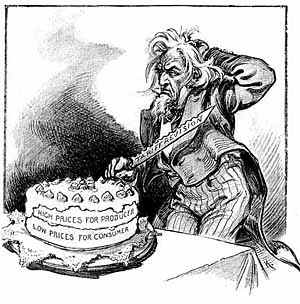
A cartoon from Puck 1911. Do you cut tariffs, and if so how much. High tariffs provide high wages and expensive prices for the consumer. Low tariffs lead to cheap products and low wages. Uncle Sam is confused.

A cartoon from Puck, 1911. Should tariffs be cut, and if so, how much. High tariffs provide high prices and high wages. Low tariffs lead to low prices for the consumer, but low wages. Uncle Sam is confused.

Of course, a country is not a family, and there are certain benefits in keeping manufacturing and employment here, in not exporting jobs and expertise. It is clear that some people benefit from a flood of cheap, imported products, while some folks suffer. Consumers and importers benefit, while employees generally do not. They are displaced from work, or find they must compete with employees in very low wage countries, and often with child labor or slave labor. The cartoon at right shows the conundrum. Uncle Sam holds a knife labeled “Tariff Revision” trying to decide where to cut. Any cut that helps consumers hurts producers just as much. Despite the cartoon, it seems to me there is likely an optimal, non-zero tariff rate that allows productive trade, but also provides revenue and protects American jobs.

A job-protecting tariff was part of the Republican platform from Lincoln’s time, well into the 20th century, and part of the Whig platform before that. Democrats, especially in the south, preferred low tariffs, certainly no more than needed to provide money for government operation. That led to a diminution of US tariffs, beginning in the mid- 1800s, first for US trade with developed countries, and eventually with third world as well. By the 1930s, we got almost no government income from tariffs, and almost all from an ever-larger income tax. After WWII low tariff reductions became a way to promote world stability too: our way of helping the poor abroad get on their feet again. In the 2016 campaign, candidate Donald Trump challenged this motivation and the whole low-tariff approach as anti- American (amor anti America-first). He threatened to put a 35% tariff on cars imported from Mexico as a way to keep jobs here, and likely to pay for the wall he claimed he would build as president. Blue-collar workers loved this threat, whether they believed it or not, and they voted Republican to an extent not seen in decades. Educated, white collar folks were uniformly appalled at Trump’s America-first insensitivity, and perhaps (likely) by the thought that they might have to pay more for imported goods. As president, Trump re-adjusted his threat to 20%, an interesting choice, and (I suspect) a good one.

The effect of a 20% tariff can be seen better, I think, by considering a barter-economy between two countries, one developed, one not: Mexico and the US, say with an without a 20% tax. Assume these two countries trade only in suits and food. In the poor country, the average worker can make either 4 suits per month or 200 lbs of food. In the developed country, workers produce either 10 suits or 1000 lbs of food. Because it’s a barter economy with a difference in production, we expect that, in the poor country, a suit costs 50 lbs of food; in the rich country, 100 lbs of food. There is room here to profit by trade.

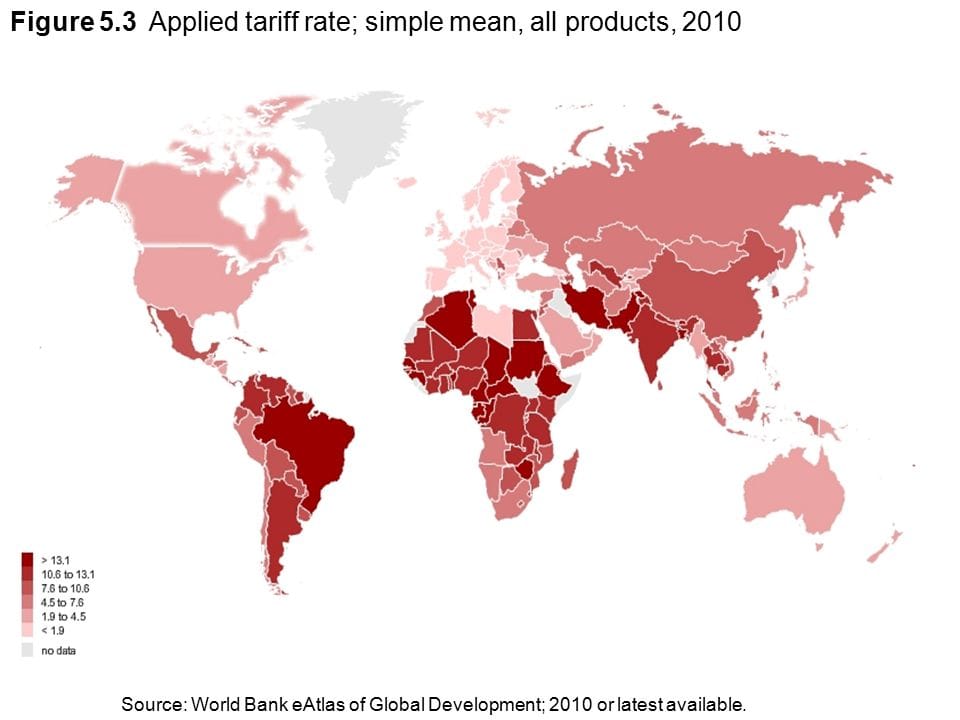
The current state of tariffs world-wide. Quite a few countries have tariffs much higher than ours. Among those, Mexico.

Tariffs world-wide. We put no tax on most imported products while much of the world taxes our products heavily.

With no tariff, totally free trade, an importer will find he can make a profit bringing 100 lbs of US food to Mexico to trade for 2 suits. He can return two suits to the US having gotten his two suits at the price of one, less the cost of transport, lawyers, and middlemen (relatively low). Some US suit-makers will suffer, but the importer benefits immediately, and eventually US consumers and Mexican suit workers will benefit too. Eventually, US suit prices will go down, and Mexican wages up, We will have cheaper suits and will shift production to what we make best —  food.

In time, we can expect that an American suit maker will move his entire production to Mexico bringing better equipment and better management. Under his hand, lets assume his Mexican workers make 6 suits per month. The boss can now pay them better, perhaps 100 lbs of food and two suits per month. He still makes a nice profit, more than before: he ships two suits to the US to buy the 200 lbs of food, and retains now two suits as profit. Hillary Clinton believed this process was irreversible. “Those jobs are gone and they’re not coming back,” her campaign told CNN. She claimed she’d train the jobless “for the jobs of the future” and redistribute the wealth of the rich, a standard plank of the democratic platform since 1896. But, for several reasons, industrial voters didn’t trust her to succeed, or even to try. Redistribution of wealth rarely works because, even if a politician has the will, and most don’t, manufacturers can usually keep their profits off-shore, and they do.

A very high tariff would stop all trade, but lets see what would happen with Trump’s 20% tariff. With a 20% tariff, when the first two suits come to the US, we’d extract 0.4 suits in tax revenue. The importer still makes a profit, but it’s now 0.6 suits, the equivalent of 60 lbs of food. He can sell suits for less than the American, but not as much less. If the manufacturer moves to Mexico he makes more money, but not quite as much. Tax is still collected on every suit brought to America — now 20% of the 3 suits per Mexican worker that the Boss must export. The American worker’s wages are depressed but he/she isn’t forced to compete with the Mexican dollar-for-dollar (suit for suit). In barter terms, he isn’t required to make 6 suits for every 100 lbs of food.lincoln-national-bank-internal-improvements-tariffs

We find that, in the above fictional economy, a 50% tariff in the maximum to allow any profitable suit trade: the first two suits might enter the US; but they’d be taxed at one suit, just enough to pay for the 100 lbs of food that he’d have to barter for the 2 suits. At that rate, there would be no profit for the importer, and he/she would stop importing. A 50% tariff is thus counter-productive to the consumer and the US gov’t: we would get no imported goods, and we’d collect no import revenue – a bad situation in general, though good for the manufacturer. Lincoln’s “protective tariffs” of 1861 contributed to Southern succession and the start of the civil war. It seems to me that some modest tariff of 10% to 20% is fair and productive — tariff rates that Trump seems to have intuited, and that many other countries have adopted, see map-chart above. As for the academic economists, I note that they also predicted a stock market crash should Trump be elected; it’s gone nearly straight up since November 8, 2016. I find that most economists are not rich despite claiming to be experts on money.

Robert E. Buxbaum, March 27, 2017. I learned such economics as I have from my one course in economics, plus comic books like the classic “Once upon a dime” produced by the New York Federal Reserve. Among the lessons learned: that money is a distraction, just a more convenient way to carry around a suit, 100 lbs of food, or a month of work. If you want to understand economics, I think it helps to work things out in terms of barter, as above.